

PART 1: The Woman in the Purple Tracksuit
My hands were trembling.
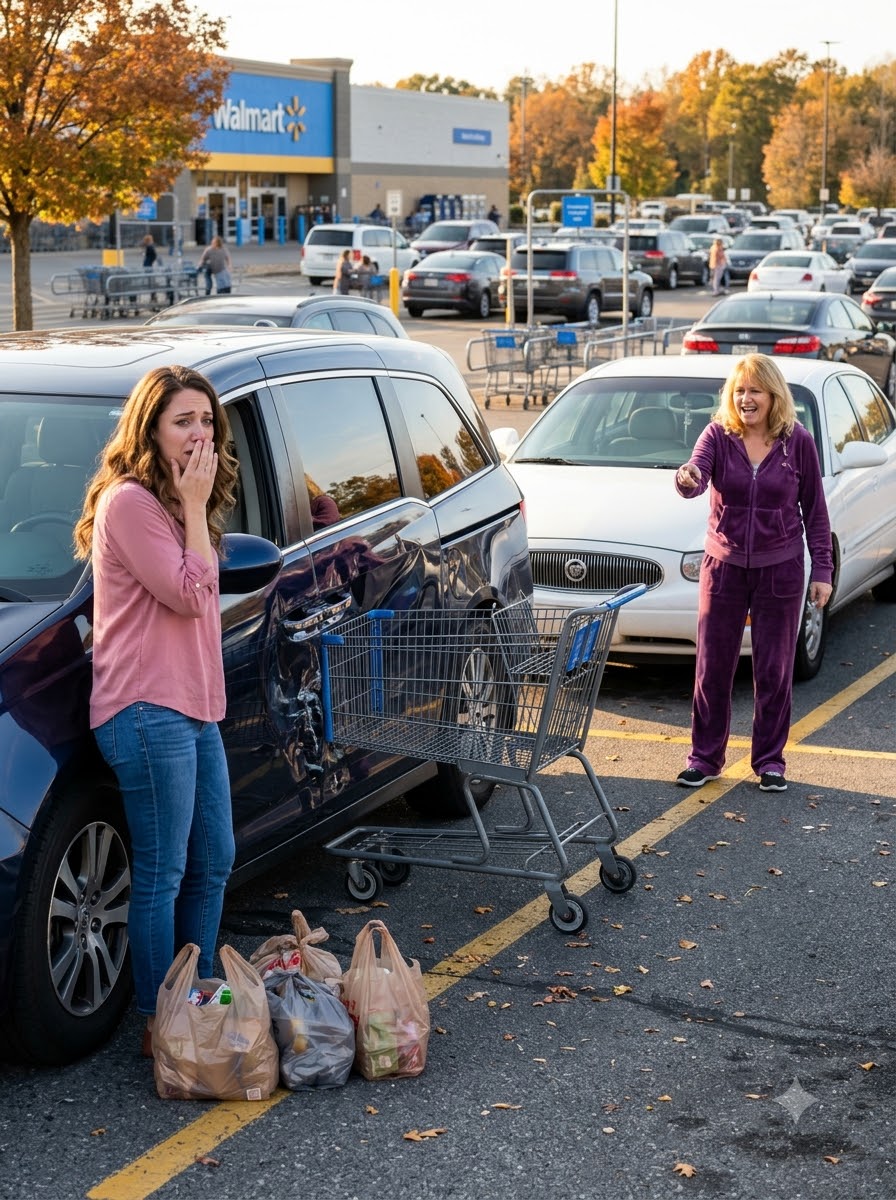
I stood in the Walmart parking lot on a Saturday afternoon in October, four bags of groceries hanging from my wrists, staring at the damage to my van.
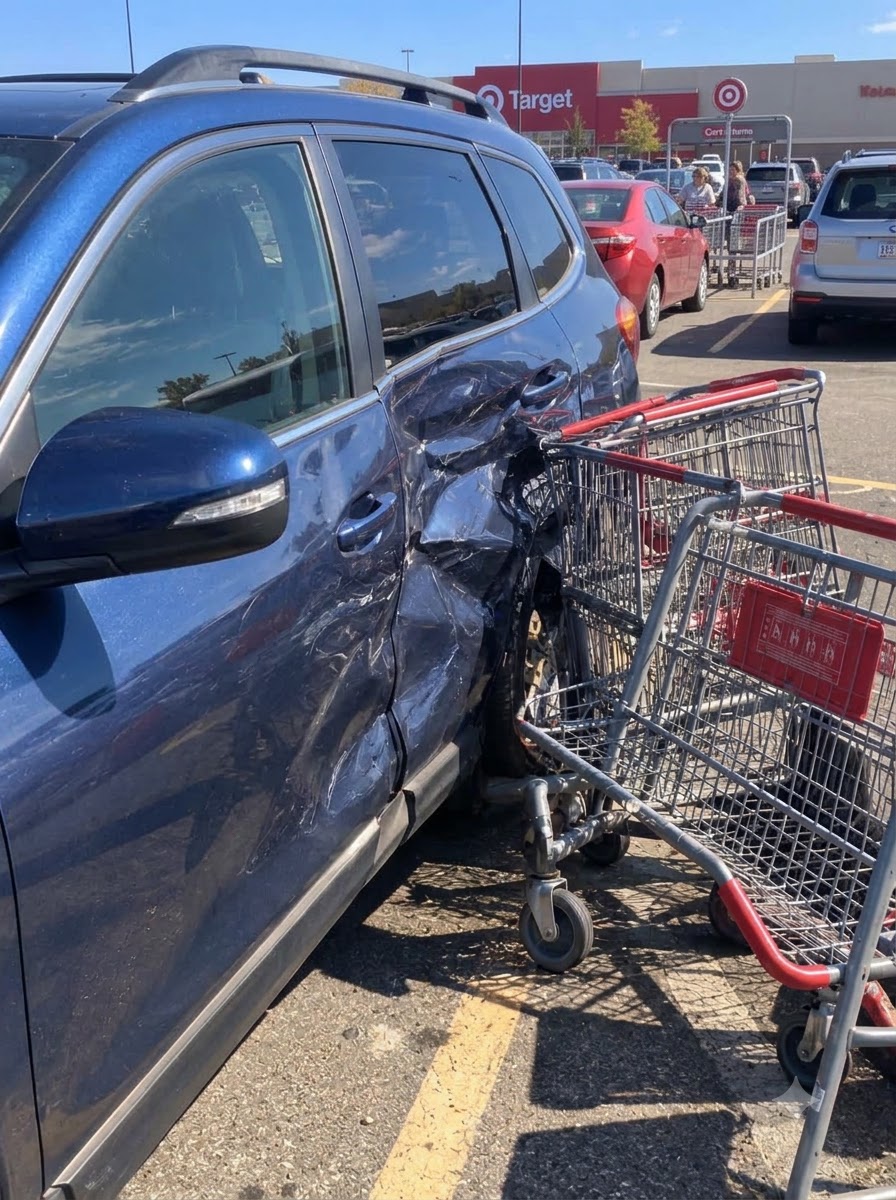
A shopping cart was wedged against the driver’s door.
It hadn’t simply rolled into the vehicle. It had been driven into the side with enough force to buckle the metal beneath the window. The door was dented inward, and three long, parallel scratches stretched toward the sliding door, cutting through the blue paint until the primer showed.
The side mirror was cracked.
I lowered my groceries onto the asphalt.
Eggs. Milk. Ground beef. Josie’s Goldfish crackers. Ben’s dinosaur-shaped chicken nuggets. A birthday card for my mother-in-law.
Then I approached the van.
I touched the dent, feeling the cold, twisted metal beneath my fingers.
It was a 2014 blue Honda Odyssey with 161,000 miles, a broken cup holder, and the lingering smell of apple juice in the back row. My daughter had scratched her name into the third-row seat when she was five.
The van wasn’t particularly valuable.
Maybe six thousand dollars.
But it had belonged to my father.
He bought it new in 2014, the year Josie was born. His first grandchild.
He drove it straight from the dealership in Springfield to the hospital, arriving with a car seat already installed.
“For the baby,” he said. “She’s going to need a good ride.”
For eight years, he drove that van everywhere.
To Josie’s birthday parties. To Ben’s T-ball games. To Silver Dollar City every summer.
And eventually, to the hospital when his heart began failing in the fall of 2022.
He died in January 2023.
He left me the van.
I’d taken care of it the way he would have. Regular oil changes, tire rotations, washing it every other Sunday.
Not a single dent.
Not one serious scratch.
Until that afternoon.
I lifted my head.
And there she was.
About sixty feet away, beside a white Buick LaCrosse with its trunk open, stood a woman in her fifties with bleached blonde hair, oversized sunglasses, gold hoop earrings, and a purple velour tracksuit.
I recognized her immediately.
The woman from the shopping cart corral.
She was staring directly at me.
Smiling.
When our eyes met, she laughed.
A sharp, satisfied laugh that carried across the parking lot.
Then she raised her hand and waved.
Something inside me snapped.
I left the groceries on the ground and started walking toward her.
But to explain why that moment mattered, I need to go back forty-five minutes.
My name is Amanda Pruett. I’m thirty-four years old, and I teach art at Pershing Middle School in Springfield, Missouri.
Six periods a day, I teach seventh and eighth graders about clay, watercolor, charcoal, and why drawing one circle doesn’t automatically make something a masterpiece.
My husband, Jake, works as a mechanic at a Ford dealership on Glenstone.
We’ve been married eleven years.
Our daughter, Josie, is nine and wants to become a marine biologist despite living hundreds of miles from the ocean.
Our son, Ben, is six and currently wants to become a dinosaur.
That Saturday, Jake had taken the kids to a birthday party at a trampoline park.
I had two hours to buy groceries.
I’d made a shopping list, as I always did.
My father taught me that habit.
“A man without a list buys three things he doesn’t need and forgets the one he went for.”
I parked in Row F, close to the cart return.
I always parked there because it made unloading groceries easier.
Then I walked toward the Walmart entrance on Battlefield Road.
Outside the automatic doors were two long rows of shopping carts.
At least twenty.
I reached for the one at the end.
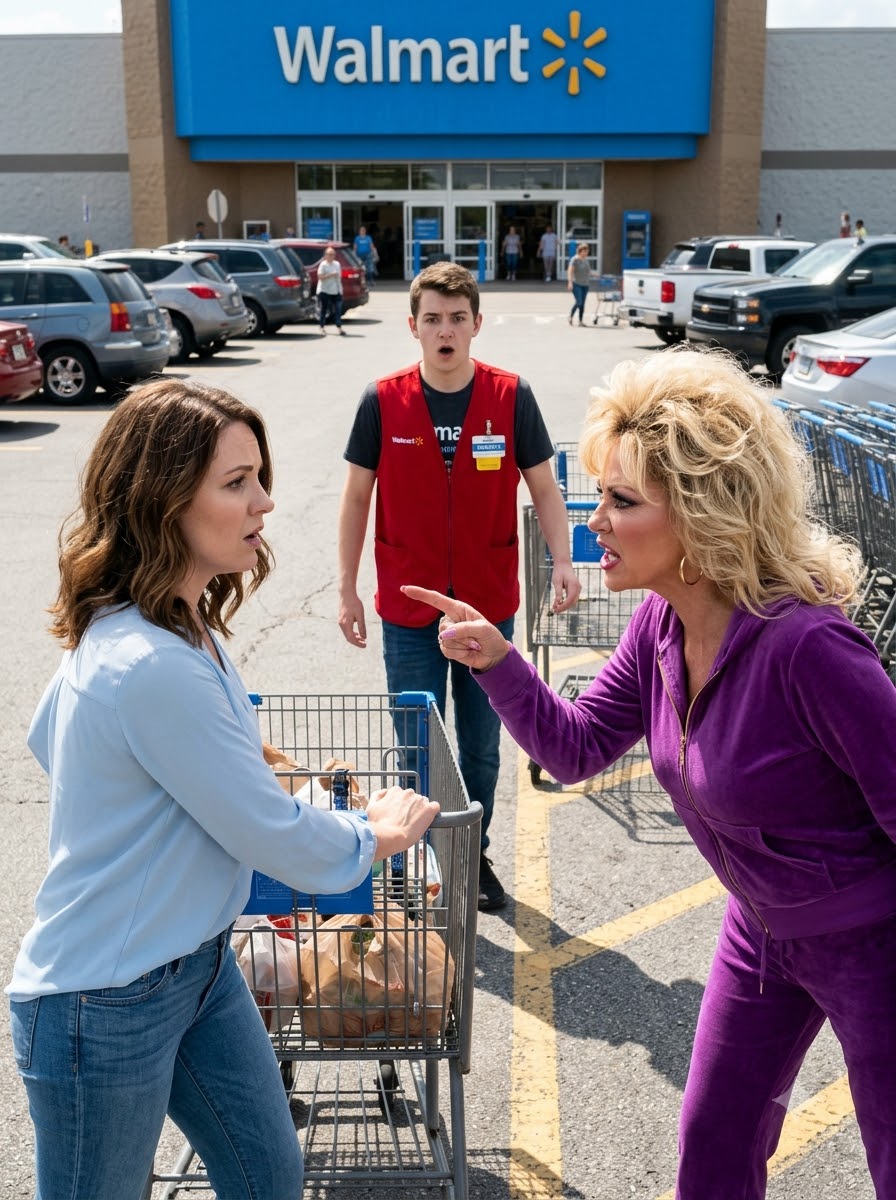
“Excuse me!”
A woman’s voice cut through the afternoon noise.
“That was MY cart!”
I turned around.
A blonde woman in a purple tracksuit stood several feet behind me, glaring at the cart beneath my hand.
I glanced at the other nineteen carts.
“I’m sorry,” I said. “Were you reaching for this one?”
She rolled her eyes.
“I was walking toward it,” she snapped. “I was walking right toward it. And you just grabbed it. Right in front of me.”
“I didn’t see you,” I replied. “I’m sorry. There are plenty of—”
“You selfish little brat!”
I froze.
Brat?
I was thirty-four, married, raising two children, paying a mortgage, and already finding gray hairs.
“Some people,” she announced loudly, “have absolutely no manners.”
Customers near the entrance turned to watch.
An older man stopped pushing his cart. A young mother pulled her toddler closer.
I tried to remain calm.
“Ma’am, you can take the next one.”
I gestured toward the row of identical carts.
Her face flushed.
“Oh, so now you’re telling me what to do?”
She stepped closer.
“You think you can just take whatever you want? Because you’re young? Because you’re pretty? Because you think the world owes you something?”
“Ma’am, I don’t think—”
“People like you have no idea. No idea what it’s like. You just take and take and take.”
She jabbed a finger toward my face.
A Walmart employee appeared through the doors.
He was a skinny young man, perhaps nineteen, wearing a red vest and a name tag reading ELI.
He’d been bringing in a long row of carts.
“Is everything okay here?” he asked.
The woman immediately pointed at me.
“This girl stole my cart.”
Eli looked at me.
Then at the woman.
Then at the dozens of available carts.
“Ma’am,” he said carefully. “There’s a lot of carts.”
“That’s not the point!”
I considered arguing.
I could have explained that I hadn’t stolen anything, that the carts belonged to Walmart, and that this entire confrontation was absurd.
But I spent my working days managing thirteen-year-olds who threw clay when they were frustrated.
I wasn’t going to spend my rare free afternoon arguing with a stranger over a shopping cart.
I released the handle.
“Here,” I said, pushing the cart toward her. “Take it. It’s yours.”
She stared at me.
I pulled out another cart.
“Have a good day.”
And I went inside.
I assumed she’d get over it.
Maybe she’d had a terrible morning. Maybe she was dealing with something painful.
I’d taught long enough to recognize people who were carrying anger they didn’t know where to put.
I didn’t take the incident personally.
I bought my groceries.
Forty minutes later, I checked out with eggs, milk, ground beef, snacks for the kids, a birthday card, Jake’s favorite coffee, and a bottle of wine.
By then, I’d almost forgotten the confrontation.
Until I returned to Row F.
Until I saw the shopping cart embedded in my father’s van.
And until I spotted that woman laughing beside her Buick.
The anger I felt was unlike anything I’d experienced in years.
I wanted to scream.
I wanted to take that cart and ram it into her car until she understood what she’d done.
I wanted her to feel the pain of seeing something precious destroyed.
I started walking toward her.
She noticed.
Her laughter stopped.
She slammed her trunk and hurried toward the driver’s door, fumbling with her keys.
I was thirty feet away.
Then twenty.
And suddenly, I stopped.
Because I remembered my father.
He’d served twenty-six years as a Greene County sheriff’s deputy before retiring in 2010.
When I was sixteen, a girl at Kickapoo High had keyed my first car, a 1998 Corolla, because I’d been nominated for homecoming court.
I’d come home furious.
I wanted revenge.
My father sat me at the kitchen table.
“Mandy,” he said. “Listen to me. You want to hurt her. I get it. But if you go over there and key her car, what happens?”
“She’ll know how it feels.”
“And then she’ll key yours again. And you’ll slash her tires. And she’ll throw a brick through your window. And it never ends. Because you both decided you’re the one who gets to be the judge.”
He tapped the table.
“You want a lesson about consequences? Let the consequences do the teaching. Not you.”
Standing in Row G, I remembered every word.
I took out my phone.
I photographed the woman, her Buick, and the Missouri license plate.
HVL-8432.
She froze when she noticed.
“What are you doing?”
I took another photograph.
Then I pointed toward the security cameras mounted on the parking lot light poles.
“Walmart has cameras on every pole in this lot,” I told her. “High-definition. Recording twenty-four hours a day. They show every car. Every cart. Every person.”
My voice sounded remarkably steady, although my hands were shaking.
“I’m going to walk inside. And I’m going to ask Asset Protection to pull the footage from Row F. From the last forty minutes. And then I’m going to call the police.”
She gave a nervous laugh.
“Prove it. Go ahead. Prove it was me. Carts roll into cars all the time. It’s windy.”
“It’s not windy.”
The afternoon was perfectly still.
“Carts don’t roll uphill,” I continued. “My van’s parked on a slope. The cart’s on the high side. It didn’t roll there. Somebody pushed it.”
She looked toward the van.
Then at the cameras.
Her expression changed.
“Ma’am?”
A voice came from behind me.
I turned.
Eli, the young employee from the entrance, stood nearby holding his phone.
“I saw it,” he said.
The woman went pale.
“I was getting carts. Over by the garden center. I saw her push a cart into your van.”
He swallowed.
“Three times. She backed it up and rammed it. Three times. And then she kicked it. To wedge it in.”
“That’s a lie!” the woman snapped. “He’s lying. He’s a kid. He doesn’t know what he saw.”
Eli looked straight at her.
“I recorded the last time.”
He lifted his phone.
The fourteen-second video showed a woman in a purple tracksuit beside my blue Odyssey.
She pulled a shopping cart backward.
Then slammed it into the driver’s door.
The metal crunched.
She kicked the cart twice, wedging it against the damaged panel.
Then she looked around and walked away.
The video ended.
For a moment, nobody spoke.
The woman jumped into her Buick.
She slammed the door, started the engine, and reversed so quickly she nearly struck another vehicle.
Then she sped toward Battlefield Road.
I watched her disappear.
Eli approached.
“Are you okay?”
I looked at him.
A nineteen-year-old with an earbud in one ear and a pimple on his chin had just done something I would never forget.
“Why did you record it?” I asked.
He shrugged.
“My mom always says if you see something messed up, you get proof. She says nobody believes kids like me unless there’s proof.”
He glanced at the van.
“I’m sorry about your car. It’s a nice van.”
“It was my dad’s.”
Eli fell silent.
Then he retrieved my groceries from the asphalt.
“Your eggs are okay,” he said. “I checked.”
I called the Springfield Police Department’s non-emergency number.
Officer Dana Whitfield arrived approximately twenty minutes later.
She photographed the damage, watched Eli’s video twice, and took our statements.
Then she accompanied us inside to speak with Asset Protection.
The manager, Roger, was a sixty-year-old former Marine with a gray mustache.
He brought us into a small office containing eight surveillance monitors.
He located the footage from Row F.
At 2:14 p.m., my van arrived.
At 2:19, the white Buick entered Row G.
The woman got out.
But she didn’t enter Walmart.
She waited beside her vehicle.
At 2:31, she collected a shopping cart from the garden center.
She pushed it across the parking lot, directly toward my van.
She looked around.
Then she rammed the cart into the driver’s door.
Once.
Twice.
Three times.
The van rocked on its suspension.
Finally, she kicked the cart until it became wedged in the dent.
Then she returned to her Buick, opened the trunk, and waited.
Forty minutes.
She stood there checking her phone and looking toward the store entrance.
Waiting to see me discover the damage.
Roger paused the video.
“Twenty-two years in loss prevention,” he said quietly. “Four years before that in the Corps. I’ve seen a lot of things.”
He shook his head.
“I’ve never seen somebody wait forty minutes to watch the damage land.”
Officer Whitfield ran the license plate.
The Buick belonged to Sherry Lynn Dunlap, fifty-seven, from Republic, Missouri.
“Criminal mischief,” she explained. “Property damage over seven hundred fifty. That makes it a Class E felony in Missouri. Do you want to press charges?”
I stared at the frozen image.
The woman who had deliberately destroyed my father’s van was standing beside her car, waiting for my reaction.
I remembered Dad’s words.
Let the consequences do the teaching. Not you.
“Yes,” I said.
Jake arrived with the children.
Josie saw the damaged van and immediately began crying.
“Grandpa’s van. Mom. What happened to Grandpa’s van?”
Jake inspected the damage.
The driver’s door was bent. The window regulator was broken. The mirror needed replacement. The scratches required repainting.
“Thirty-two hundred,” he estimated. “Maybe more. If the frame’s bent, we’re looking at replacing the whole door.”
Ben stared at the damaged shopping cart.
“Did the cart do it?”
“A lady did it,” I said. “With the cart.”
He frowned.
“Why?”
“Because she was angry.”
“At the van?”
“At me.”
“Why was she angry at you?”
I looked at my little boy.
“I don’t know, buddy. I really don’t know.”
Eleven days later, Detective Raymond Cole called.
Sherry Dunlap had been arrested and charged.
But her attorney had contacted the Greene County Prosecutor’s Office about a restorative justice program.
For certain first-time offenders involved in nonviolent property crimes, the program allowed supervised meetings with victims, restitution agreements, and the possibility of a reduced charge after successful completion.
Participation was voluntary.
“Why would I want to meet her?” I asked.
Detective Cole paused.
“Her attorney says there are circumstances that might help you understand what happened.”
“What circumstances?”
“That’s for her to tell you. If you agree to meet.”
My first instinct was to refuse.
I wanted her to pay for the van.
I wanted her to stand before a judge and admit what she’d done.
I didn’t want explanations.
But then I remembered Ben’s question.
Why was she angry at you?
And the answer I couldn’t give him.
“Okay,” I said. “I’ll meet her.”
Two weeks later, I walked into a conference room at the Greene County Justice Center.
Sherry Dunlap was already sitting at the table.
The purple tracksuit was gone.
Her blonde hair was pulled into a plain ponytail, gray showing at the roots.
She wore a beige cardigan and black slacks.
She looked smaller.
Older.
Frightened.
Grace Okafor, the restorative justice facilitator, reminded me that I could leave whenever I wanted.
“Nothing she says today excuses what she did,” Grace explained. “That’s not what this is for.”
“Then what’s it for?”
“It’s for understanding. So you can decide what happens next. With your eyes open.”
I sat opposite Sherry.
She stared at her shaking hands.
Finally, she whispered, “I’m sorry about your van.”
I remained silent.
“I’m sorry I called you a brat. I’m sorry I screamed at you.”
Her voice broke.
“I’m sorry I waited. To watch.”
“Why?” I demanded.
I told her about the twenty identical carts.
About how I’d given her the one she wanted.
About the three deliberate impacts.
About the forty minutes she’d spent waiting to watch my reaction.
Then I told her whose van she’d destroyed.
“My father bought it the day my daughter was born. He died three years ago. It’s the only thing I have left that he drove.”
Sherry covered her mouth.
Grace leaned toward her.
“Sherry, can you tell Amanda what you told me? About that day?”
Sherry took a trembling breath.
“My husband’s name was Gordon.”
She looked down.
“We were married thirty-one years.”
Then she said something that made my entire body go cold.
“Gordon died in August. August twenty-third. A Saturday. At Walmart.”
I stared at her.
“In the parking lot,” she whispered. “Row F. By the cart return.”
And suddenly, I understood that the place where she’d destroyed my father’s van was the very place where something inside her had already been broken.
PART 2: The Grief Behind the Damage
Sherry sat across from me with her hands trembling on the conference table.
For several moments, she couldn’t speak.
Then she began telling me about Gordon.
He’d been a long-haul truck driver for thirty years, traveling from Springfield to Dallas, Memphis, Denver, and back.
He spent much of his working life away from home.
But when he returned, they had one tradition.
Every Saturday, they went grocery shopping at the Walmart on Battlefield Road.
For twenty years.
“It sounds stupid,” Sherry said. “It wasn’t stupid. It was ours.”
Gordon always collected the shopping cart.
He’d approach the corral, bow slightly, and say, “Allow me, my lady.”
Then he’d select a cart.
He tested the wheels, pushing it forward and backward.
If one squeaked or wobbled, he returned it and chose another.
“He said I deserved a cart that didn’t wobble,” Sherry whispered.
Her voice cracked.
Then she described August twenty-third.
They’d finished shopping.
Gordon loaded their groceries into the Buick and said what he always said.
“I’ll take the cart back, Sher.”
He pushed it toward the return at the end of Row F.
Sherry watched from the car.
He reached the corral.
Then he stopped.
One hand moved toward his chest.
He turned toward her.
And collapsed.
“Heart attack,” she whispered. “Massive. He was dead before the ambulance got there. Right there. On the asphalt. Next to the cart return. With his hand still on the cart.”
I couldn’t speak.
For the first time, Row F meant something entirely different.
Sherry wiped her face.
She hadn’t returned to that Walmart after Gordon died.
Instead, she’d driven to the Price Cutter in Republic, going twenty minutes out of her way to avoid the place where she’d lost him.
Until the Saturday she met me.
“I’d been sitting in my car,” she explained. “For an hour. In Row G. Trying to make myself get out.”
She wanted to buy groceries at their old store.
She wanted to do one ordinary thing she’d always done with her husband.
But she couldn’t bring herself to approach the carts.
Finally, she stepped out of the Buick.
She walked toward the entrance.
And she noticed one cart sticking slightly farther out than the others.
“Like somebody had just pulled it out and left it.”
Her eyes filled with tears.
“And I thought, I swear to God, I thought. That’s the one. That’s Gordon’s. He pulled it out for me.”
I covered my mouth.
“I know it’s crazy,” she continued. “I know it was just a cart. I know. But I’d been sitting in my car for an hour. And I was so tired. And I missed him so much.”
She whispered the words he’d said every Saturday.
“Allow me, my lady.”
Then she looked at me.
“And then you grabbed it.”
I stared at her.
“I know you didn’t know. I know you didn’t see me. I know you didn’t mean anything. You were just getting a cart. Like a normal person on a normal Saturday.”
She shook her head.
“But in that second, you were taking him. From me. Again. And I just snapped.”
She described shouting at me.
Calling me selfish.
Calling me a brat.
Accusing me of having no manners.
“And you were so calm,” she said. “You said ma’am, you can take the next one. And you pushed it to me. And you said take it.”
She looked down.
“And I couldn’t take it. Because it wasn’t his anymore. You’d touched it. It was just a cart.”
I felt my throat tighten.
She’d returned to her Buick, shaking with anger.
But she wasn’t truly angry with me.
She was furious at Gordon for dying.
At God.
At the parking lot.
At the entire world for continuing to function as though nothing had happened.
Then she saw my van.
Parked in Row F.
Exactly where she’d parked on the day Gordon died.
“Right where he died,” I said quietly.
She nodded.
“Right in that spot.”
She’d collected a cart from the garden center and pushed it toward my van.
Then she’d slammed it into the driver’s door.
Again.
And again.
And again.
“I wanted somebody else to feel it,” she whispered.
Her hands covered her face.
“Just once. I wanted somebody else to come out of that store and find something broken in that parking lot. Something they loved.”
She began sobbing.
“I wanted somebody else to stand in Row F and feel like the world had ended.”
Then she admitted why she’d waited.
Forty minutes.
She wanted to watch me discover the damage.
She wanted to see another person’s expression collapse.
“I think I needed to see somebody’s face fall apart. The way mine did. In August.”
Her voice dropped.
“And when you came out, and saw it. And your face—”
She stopped.
“I laughed. God forgive me. I laughed. Because for one second, I wasn’t the only one.”
Silence filled the conference room.
Grace sat motionless.
Sherry’s public defender stared at the wall.
And I thought about my own father.
January 2023.
Cox South Hospital.
Room 412.
I’d been sitting beside his bed, holding his hand.
His heart had been failing for months.
The doctors said he had only days left.
I’d been awake for thirty hours.
Eventually, I went downstairs to buy coffee.
Fifteen minutes.
When I returned, he was gone.
My father had died while I was standing in a cafeteria line.
I hadn’t been there to hold his hand.
I hadn’t heard his final breath.
That evening, I drove home in his blue Odyssey.
I parked in the driveway.
I sat behind the steering wheel where his hands had rested.
And I screamed until my throat hurt.
The next morning, I went to Hy-Vee on Sunshine Street to buy milk.
A stranger accidentally bumped his shopping cart into mine.
He apologized.
But I turned on him and demanded to know why he couldn’t watch where he was going.
He stared at me, startled, then walked away.
I stood there shaking.
I’d never spoken to a stranger like that before.
Until Sherry told me about Gordon, I’d almost forgotten the incident.
But now I remembered exactly how grief had transformed me.
How it had filled me with anger that had nowhere to go.
How it had made me want someone else to hurt.
I looked across the table.
“Sherry.”
She raised her head.
“My father died while I was getting coffee.”
She stopped moving.
I told her about the hospital.
About the fifteen minutes.
About the coffee I never drank.
About the stranger whose cart accidentally touched mine.
“The next morning, I screamed at a stranger in a grocery store. Because he bumped my cart.”
Sherry covered her mouth.
“I’m not telling you that to make you feel better,” I continued. “I’m not telling you it’s okay. It’s not okay.”
I took a breath.
“You smashed my father’s van. On purpose. You stood there and laughed. My daughter cried when she saw it. My son asked why somebody would do that and I didn’t have an answer.”
“I know,” Sherry whispered.
“You’re going to pay for it. Every dollar. Thirty-two hundred. The door. The mirror. The paint. The window.”
“I know.”
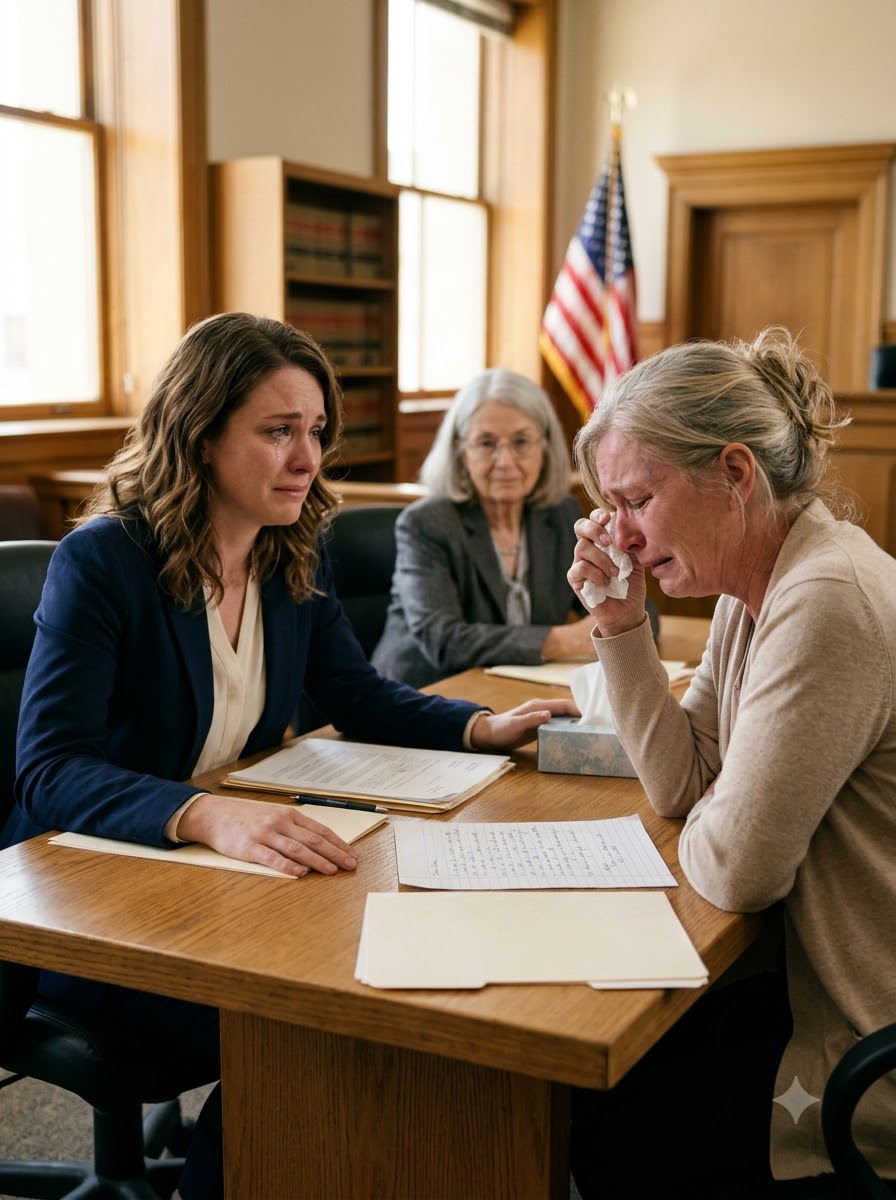
“And you’re going to tell the judge what you did. Out loud. In a courtroom. Every second of it.”
“I know. I will.”
I looked at her.
“But I understand.”
Sherry began crying again.
Not with anger this time.
Not with the same desperate shame.
It was as though she’d been holding her breath for months and had finally been allowed to exhale.
Grace offered her tissues.
This time, she accepted them.
We talked for two hours.
About Gordon.
About my father.
About Row F.
About the Price Cutter in Republic and the Hy-Vee on Sunshine Street.
About driving out of your way to avoid a place that reminds you of someone you’ve lost.
About sitting in a car for an hour, unable to make yourself get out.
Near the end, I asked Sherry whether she had family.
“We never had kids,” she explained. “We tried. It didn’t happen. Gordon’s brother lives in Oregon. My sister passed in 2019.”
“Friends?”
She looked at her hands.
“Gordon was my friend. Thirty-one years. He was gone so much. When he was home, I didn’t need anybody else.”
She admitted she hadn’t really spoken to anyone about her grief for three months.
I was the first person she’d told about Gordon’s shopping cart ritual.
About the words, “Allow me, my lady.”
Grace mentioned a grief support group at Mercy Hospital.
Tuesday evenings.
For people who’d lost spouses.
“I’m not saying it’s part of the agreement,” she told Sherry. “I’m just saying it’s there.”
Sherry glanced toward me.
I remained quiet.
That decision belonged to her.
At the end of the meeting, Grace prepared our agreement.
The restitution was $3,240, paid in twelve monthly installments of $270 beginning November 1.
Sherry would complete eighty hours of community service within six months.
She would write an apology letter addressed to me and my children.
After successful completion, her felony charge could be reduced to a Class A misdemeanor.
We both read the agreement.
We both signed.
Sherry put down the pen.
Then she asked about Eli.
“The kid. In the red vest. At the cart corral. Who recorded me.”
“Eli,” I said.
“Is he in trouble? For filming me? I don’t want him to get in trouble.”
“No. He’s not in trouble. Walmart gave him an award. For employee of the month.”
Sherry almost smiled.
“Good. He did the right thing. I want to tell him that.”
Three weeks later, a plain white envelope arrived in my mailbox.
The handwriting was careful.
It was addressed to Amanda, Josie, and Ben Pruett.
Inside was Sherry’s apology.
I read it alone first.
Then I gathered my children at the kitchen table.
Dear Amanda, Josie, and Ben,
My name is Sherry. I’m the lady who broke your van.
I want to tell you I’m sorry. I’m sorrier than I’ve ever been about anything.
She apologized to Josie for damaging her grandfather’s van and making her cry.
She told Ben that his question about why she’d done it was a good one.
Then she explained.
I was very sad. My husband died. And I didn’t know what to do with how sad I was. So I did something bad. I tried to make somebody else feel as sad as me.
That doesn’t work, Ben. It never works. It just makes two sad people instead of one.
She hoped he’d never make the same mistake.
She hoped that when he felt sad, he’d find someone to talk to.
Then she thanked me for listening.
She wrote that she’d joined the Tuesday support group at Mercy Hospital.
A widower named Walt attended.
His wife had died in a Hy-Vee grocery store, in the bread aisle.
They’d sat together during a meeting.
They hadn’t said much.
But it helped.
Sherry had also begun completing her community service at Ozarks Food Harvest, sorting donations for eight hours every Saturday.
She promised to repay every dollar.
At the bottom, she added a postscript.
Please tell Eli thank you for me. Tell him his mom is right. Proof matters. Nobody would have believed what I did without it. And I needed somebody to know what I did. Even if I didn’t know it at the time.
When I finished reading, Ben remained quiet.
“She was sad,” he said eventually.
“She was very sad.”
“Like you were when Grandpa died?”
“Yes. Like I was when Grandpa died.”
He thought for a moment.
“Did you break anything? When Grandpa died?”
I hesitated.
“No. But I yelled at a man in a grocery store. Because he bumped my cart.”
Ben’s eyes widened.
“You yelled at somebody?”
“I did. It was a long time ago. I was very sad. And I didn’t know what to do with it.”
He looked at Sherry’s letter.
“It just makes two sad people instead of one,” he read slowly.
“That’s right.”
Josie took the letter.
She read it again.
Then she disappeared into her bedroom.
When she returned, she carried construction paper and markers.
“What are you making?” I asked.
“A card. For Sherry.”
She worked for nearly an hour.
The finished drawing showed a blue minivan labeled GRANDPA’S VAN.
A black dent marked the driver’s door.
Beside it stood two stick figures, one tall with yellow hair and one short with brown hair.
They were holding hands.
Above them, Josie had written:
I’M SORRY YOUR HUSBAND DIED.
MY GRANDPA DIED TOO.
IT’S OKAY TO BE SAD. JUST DON’T BREAK STUFF.
— JOSIE
I mailed the card.
The payments began arriving.
Every month, on the first.
Two hundred and seventy dollars.
Each check came in Sherry’s careful handwriting.
She wrote something in the memo line every time.
November: For the door.
December: For the mirror.
January: For the window.
February: Happy Valentine’s to your family.
March: Walt and I went to lunch after group. Cracker Barrel. He told me about his wife.
Meanwhile, Jake repaired the van.
He worked after hours at the Ford dealership and on Saturdays.
He located a replacement door at a salvage yard in Joplin.
Same year.
Same color.
He installed it, replaced the window regulator and mirror, and repainted the scratches.
Six weeks later, the Odyssey looked as though nothing had happened.
Except Jake had saved one piece of the original door.
A strip of blue metal, three inches long, marked by one silver scratch.
He riveted it inside the replacement door, where it was visible only when the door stood open.
“Why’d you keep that?” I asked.
Jake shrugged.
“I don’t know. Felt wrong to throw it all away. Your dad would’ve kept it.”
He was right.
Dad kept everything.
By October, a full year had passed since the incident.
Sherry’s final payment arrived.
Two hundred and seventy dollars.
The memo read:
October — Paid in full.
There was another letter inside.
Sherry wrote that she’d completed all eighty hours of community service in April.
But she’d continued volunteering at Ozarks Food Harvest.
Every Saturday.
They’d even made her a shift lead.
The judge had reduced her charge in May, just as the agreement allowed.
She’d stood in court and told him everything.
The cart.
Row F.
Gordon.
The forty minutes she’d waited.
The judge had reportedly called it the most honest statement he’d heard in twenty years.
She still attended grief support meetings with Walt.
They went to Cracker Barrel afterward.
He always ordered chicken and dumplings.
Gordon had always ordered meatloaf.
Then Sherry wrote something that made me stop reading.
She’d returned to the Walmart on Battlefield Road four times since our meeting.
Walt had accompanied her.
But she still couldn’t bring herself to pull a cart out of the corral.
She could walk into the store.
She could buy groceries.
But Walt always had to collect the cart.
She wanted to try again.
Alone.
I’m going to try again on Saturday. October 18th. At two o’clock.
I don’t know why I’m telling you this.
Maybe because you were the one who was there.
— Sherry
I read the letter three times.
Jake had been reading over my shoulder.
“You going?” he asked.
I looked toward the driveway.
My father’s blue van sat outside, repaired and shining in the October sunlight.
I thought about the woman who’d once waited forty minutes to watch me suffer.
Now she was preparing to return to the place where her husband had died.
And I knew exactly where I needed to be at two o’clock on Saturday.
PART 3: Allow Me, My Lady
Saturday, October eighteenth.
Two o’clock.
I drove my father’s blue Odyssey to Walmart on Battlefield Road.
The new driver’s door matched the rest of the van perfectly.
Inside it, hidden near the frame, was the three-inch strip Jake had saved.
I parked in Row F.
My usual spot.
Near the cart return.
Then I walked toward the entrance.
Sherry stood beside the shopping cart corral.
Alone.
Walt wasn’t with her.
She wore jeans and a gray sweater.
Her hair was short now, cut close and naturally gray.
The bleached blonde style and purple tracksuit were gone.
She stood facing the carts with both hands buried in her pockets.
She didn’t notice me.
I stopped several feet away.
She slowly removed one hand from her pocket.
She reached toward the nearest cart.
Her fingers hovered an inch from the handle.
Then she stopped.
Her hand trembled.
She withdrew it and slipped it back into her pocket.
“Sherry,” I said.
She turned.
When she recognized me, her face crumpled.
“You came.”
“You told me two o’clock.”
She swallowed.
“Walt couldn’t make it. His daughter’s in town. I told him I’d be fine.”
She looked toward the corral.
“I’m not fine.”
I walked over and stood beside her.
We faced the two rows of shopping carts.
Twenty of them.
Almost identical.
“He used to test the wheels,” Sherry whispered. “Every time. He’d push it back and forth. If it squeaked, he’d put it back.”
“My dad did that too.”
She turned toward me.
“Really?”
“Every time. He said a squeaky cart was a sign of bad character.”
Sherry laughed.
It was the first time I’d heard her laugh since that afternoon in Row G.
But this laugh was different.
There was no cruelty in it.
No satisfaction at another person’s pain.
Just a small, genuine laugh.
I reached for the cart at the end of the row.
I pulled it free.
Then I pushed it forward and backward twice.
Listening.
The wheels rolled smoothly.
No squeak.
I turned it toward Sherry.
Held out the handle.
And said, “Allow me, my lady.”
Sherry went completely still.
She looked at the cart.
Then at me.
Her eyes filled with tears.
One hand covered her mouth.
For a long time, she couldn’t speak.
Finally, she reached forward.
Both hands closed around the handle.
Right where mine had rested.
Right where Gordon’s hands had always been.
“Thank you,” she whispered.
We entered Walmart together.
Sherry pushed the cart.
I walked beside her.
We moved through the aisles slowly.
She carried a shopping list.
She explained that Gordon had always made their lists.
For thirty-one years, she’d never needed to write one herself.
Now she was learning.
She was getting better at remembering what she needed.
In the cereal aisle, she stopped.
Her eyes settled on a box of Grape-Nuts.
“He ate these every morning,” she said. “Every single morning. For thirty-one years.”
She picked up the box.
“I hate Grape-Nuts. They taste like gravel.”
She placed it in the cart anyway.
Then she shook her head.
“I don’t know why I’m buying them.”
“Yes, you do,” I said.
She looked at me.
Then left the cereal where it was.
We continued shopping.
There was no grand speech.
No dramatic transformation.
Just two women walking through a grocery store.
One of us had lost a father.
The other had lost a husband.
And somehow, we’d ended up helping each other carry something neither of us had known how to put down.
At checkout, Sherry paid for her groceries.
We walked outside together.
Across the parking lot.
Toward Row G, where her white Buick waited.
She loaded her bags into the trunk.
Then she stood holding the empty shopping cart.
Her eyes moved toward the return at the end of Row F.
The place where Gordon had collapsed.
The place she’d avoided for more than a year.
“I’ll take it back,” I offered. “If you want.”
Sherry studied the cart return.
For a long moment, she said nothing.
Then she shook her head.
“No. I’ll do it.”
She began pushing.
Across Row G.
Into Row F.
Past my father’s van.
Her footsteps slowed as she approached the corral.
Then she stopped.
She stood on the same patch of asphalt where Gordon had fallen.
For a long time, she didn’t move.
I remained where I was.
I didn’t call out.
I didn’t hurry her.
Finally, she pushed the cart forward.
Gently.
The front wheels entered the corral.
The cart nested against the others.
Sherry kept one hand on the handle.
Then she let go.
She turned and walked back toward me.
Her face was wet with tears.
But she stood straight.
“I did it,” she said.
“You did it.”
“First time. Since August. I took the cart back.”
She glanced over her shoulder.
“He always took the cart back. I’ll take it back, Sher. Every time. For twenty years.”
She wiped her eyes.
“I finished it for him.”
We stood together in the October sunlight.
Beside my father’s van.
Sherry studied the blue Odyssey.
“Jake fixed it,” I explained. “My husband. He’s a mechanic.”
She approached the driver’s door.
Ran her hand along the smooth paint.
Where the dent had once been.
“You can’t even tell.”
“Open the door,” I said.
She looked at me.
Then carefully opened it.
Inside, near the frame, she noticed the riveted strip of old blue metal.
Three inches long.
One silver scratch.
She stared.
“Jake saved it,” I explained. “From the old door. He said it felt wrong to throw it all away.”
Sherry reached toward the scratch.
Touched it lightly with one finger.
“That’s mine,” she whispered. “I did that.”
“You did.”
She looked at me.
“Why would you keep it?”
I thought about my father sitting at the kitchen table when I was sixteen.
About his warning against revenge.
About Ben asking whether I’d ever broken anything when Grandpa died.
About Josie’s card.
It’s okay to be sad. Just don’t break stuff.
“Because it happened,” I said. “And it mattered. And you paid for it. Every dollar. And you stood up in court and told the truth.”
I looked at the scratched metal.
“I don’t want to forget that. Any of it. The part where you broke it. Or the part where you fixed it.”
Sherry closed the door.
Gently.
Her hand remained against the paint.
“Amanda, can I ask you something?”
“Okay.”
“That day. When you came out. And saw the van. And saw me laughing. You started walking toward me.”
“I did.”
“You were so angry. I could see it. Your face. You were coming to hurt me. I was sure of it.”
“I was.”
She looked into my eyes.
“Why did you stop?”
I turned toward the cart return.
“My dad was a sheriff’s deputy. For twenty-six years. He saw a lot of people who wanted to hurt somebody back.”
Sherry listened.
“When I was sixteen, a girl keyed my car. I wanted to key hers back. He told me if I did, it would never end. Because we’d both decided we got to be the judge.”
I looked at her.
“He said, Let the consequences do the teaching. Not you.”
Sherry stood quietly.
“The consequences taught me a lot,” she said.
“I know.”
“The arrest. The video. The courtroom. The thirty-two hundred dollars. The eighty hours.”
She paused.
“But that’s not what taught me the most.”
“What did?”
She looked toward the cart return.
“A woman whose father died while she was getting coffee. Who sat across a table from the person who smashed his van. And said I understand.”
I didn’t know what to say.
So I said nothing.
We stood together in Row F.
Beside the van that had carried my father through the final years of his life.
Beside the parking lot where Sherry had lost Gordon.
And for once, neither of us needed to explain anything.
Sherry began returning to Walmart every Saturday.
Two o’clock.
Sometimes Walt accompanied her.
Sometimes she came alone.
Occasionally, I saw her there.
Not because we arranged it.
Simply because it was Saturday, and Row F was still where I parked.
Whenever I spotted her near the corral, I pulled out a cart.
I pushed it forward and backward twice.
Checked the wheels.
Then handed it to her.
“Allow me, my lady.”
Every time, she laughed.
One afternoon, Josie asked why I was kind to the woman who’d broken Grandpa’s van.
We were driving home from school.
Josie sat in the second row of the Odyssey, her name still scratched into the plastic behind her.
“Because she paid for it,” I said.
“But she broke it on purpose. She was mean. She laughed.”
“She was. And she had to face what she did. In front of a judge. In front of me. She had to pay every dollar. She had to work eighty hours for free.”
Josie thought about that.
“So she learned a lesson?”
“She learned a lesson.”
Then my daughter asked something I hadn’t expected.
“Did you?”
I glanced at her in the rearview mirror.
Nine years old.
Sitting in the van her grandfather had bought when she was born.
“Yeah,” I said. “I did.”
“What was it?”
I considered my answer.
“That everybody who breaks something is carrying something broken.”
Josie remained quiet.
“That doesn’t make it okay,” I continued. “It never makes it okay. They still have to fix it. Every dollar. Every time.”
I watched the road.
“But you can’t help somebody fix it if you won’t look at what’s broken.”
My daughter was silent for a moment.
Then she said, “Grandpa would’ve liked that.”
“Yeah?”
“He always said everybody has a story. Even the bad guys. Especially the bad guys.”
I glanced at her.
“He said that?”
“When he took me fishing. At Table Rock. I asked why he became a sheriff. He said because somebody had to listen to the bad guys’ stories. So they could figure out how to stop being bad guys.”
I pulled into our driveway.
Turned off the engine.
And sat there for a moment.
My hands rested on the steering wheel.
The same steering wheel my father had held for eight years.
Then I opened the driver’s door.
The replacement door Jake had installed.
Inside, where only I could see it, remained that strip of original metal.
Three inches of blue.
One long silver scratch.
Sometimes people ask me about the woman at Walmart.
The one who screamed at me over a shopping cart.
Who deliberately rammed another cart into my father’s van.
Who stood beside her Buick laughing while I discovered the damage.
They expect a story about punishment.
About the police.
The surveillance footage.
The arrest.
The courtroom.
And I tell them those things.
Because they happened.
Because Sherry was responsible for what she did.
Because grief did not excuse the damage she’d caused.
She paid $3,240.
She completed eighty hours of community service.
She admitted her actions before a judge.
And she apologized to my children.
Those consequences mattered.
But then I tell people about Gordon.
A truck driver who spent thirty-one years loving his wife.
A man who took her grocery shopping every Saturday.
Who tested the wheels on every cart.
Who said, “Allow me, my lady.”
I tell them about the last Saturday in August.
About Row F.
About a man who collapsed beside the cart return and never came home.
About a grieving woman who sat in her Buick for an hour, trying to make herself walk into the store.
About a cart that stuck out slightly from the others.
A cart she imagined her husband had left waiting for her.
I tell them about forty minutes spent beside an open trunk, waiting to watch somebody else’s heart break.
And about a sheriff’s deputy who taught his teenage daughter that revenge only creates more damage.
Let the consequences do the teaching. Not you.
The consequences taught Sherry Dunlap what she’d done wrong.
They made her accountable.
They made her pay for what she’d destroyed.
But those consequences couldn’t teach her how to reach for a shopping cart again.
They couldn’t help her walk across Row F.
They couldn’t show her how to return to the exact place where her life had changed.
For that, she needed someone to stand beside her.
Someone who understood what it meant to lose a person you loved.
Someone who knew that grief could turn an ordinary grocery store into the most frightening place in the world.
Someone who could acknowledge the harm without pretending it hadn’t happened.
And who could still hold out a shopping cart.
The hardest lessons in life can teach us what we did wrong.
But they don’t always teach us how to stop hurting.
Sometimes, healing requires another person.
Someone willing to listen.
Someone who has stood in a parking lot with a broken heart.
Someone who understands that you can hold people responsible for their actions without refusing to see their pain.
And sometimes, moving forward begins with something as ordinary as pushing a shopping cart back into its corral.
Standing there for a moment.
Remembering the person you lost.
And finally letting go.
THE END.
