


“Mom… can I have a little more, or is that it?” Her voice was so quiet it nearly vanished beneath the low hum of the refrigerator.
She was seven years old, seated at a long polished walnut table in a pristine home in Highland Park, Illinois—the kind that smelled of citrus polish, expensive candles, and fresh-cooked meals. Yet on her plate sat only a slice of dry bread… and a glass of water.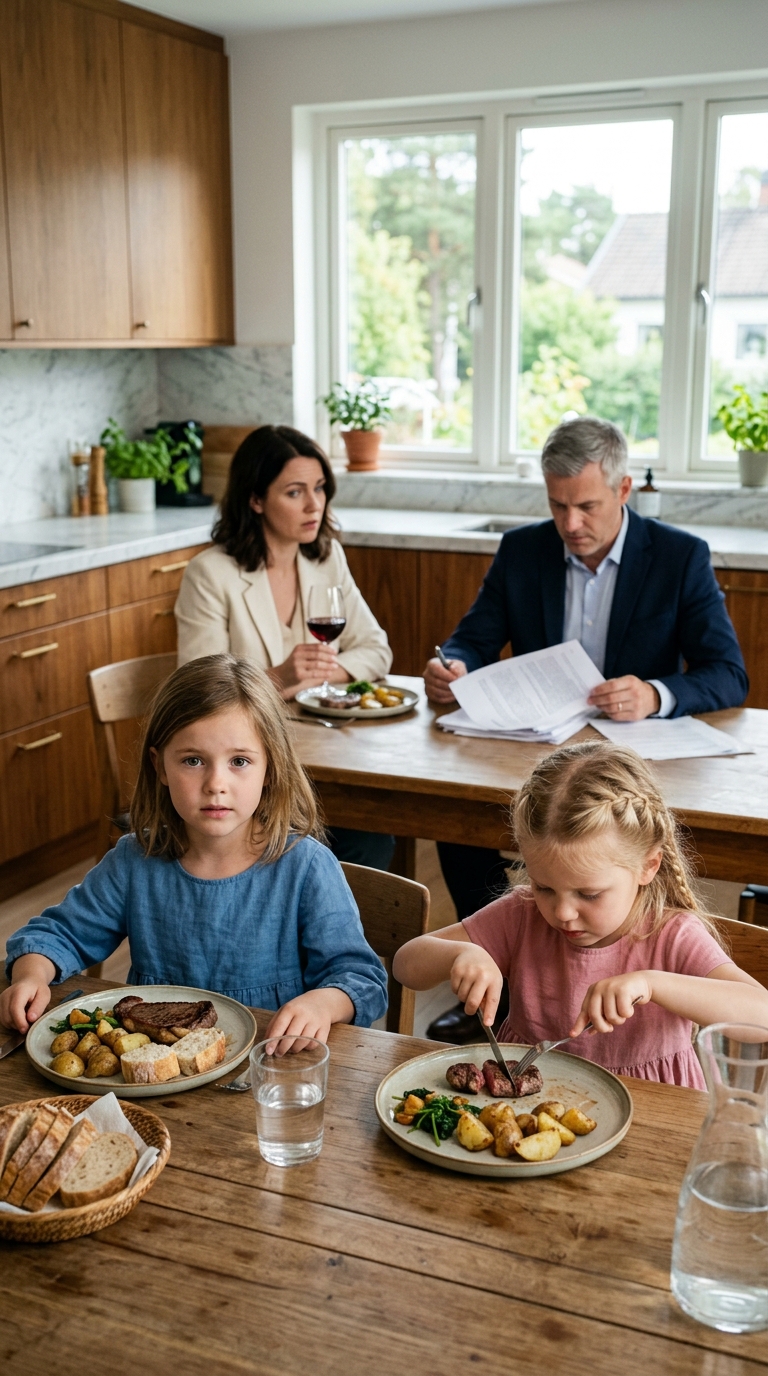
Across from her, her stepsister Chloe—eight years old, rosy-cheeked with neatly braided hair—carefully cut into a tender filet mignon beside buttery mashed potatoes. She ate slowly. Calmly. Never once needing to ask permission.
There were no raised voices.
No slammed doors.
No obvious cruelty.
But unfairness sat at that table like an unseen fourth guest.
Because when a child learns to ask if she’s allowed to eat, the issue isn’t food.
It’s control.
At the head of the table sat Victoria Langford—Chloe’s mother. Elegant. Composed. Perfect smile. To her right sat Daniel Whitaker, a respected estate attorney and longtime associate of Victoria’s. He had come to “review a few inheritance documents.”
Nothing unusual. Nothing dramatic.
Yet from the moment dinner began, something inside him tightened.
The little girl with the bread—Lily Bennett—didn’t lean back in her chair. She leaned slightly forward, as if her body had forgotten how to relax. Her eyes looked too large for her face. Her fingers tore the bread into small pieces—not playfully, but carefully, as though she had learned to make it last.
Chloe asked for more mashed potatoes.
“Of course, sweetheart,” Victoria replied warmly, adding another generous scoop.
Lily swallowed.
The smell of steak drifted toward her like a quiet temptation. She didn’t ask for any. She simply raised a small piece of bread to her lips and took a sip of water.
Then, almost unconsciously, she whispered:
“It smells really good.”
There was no accusation in her voice.
Only hunger.
Victoria didn’t look at her. She kept smiling at Chloe.
“Chloe needs proper nutrition to grow strong.”
Only then did she turn toward Lily, as if noticing something slightly out of place.
“Rich food upsets your stomach. Simple is better for you.”
Chloe continued eating. To her, this was normal.
Lily lowered her gaze. Her stomach growled—soft, but audible.
She pressed her hand against it, as if she could quiet it.
Victoria’s eyes flicked toward her—not with concern, but with disapproval.
A chill crept down Daniel’s spine.
He said nothing.
But he saw everything.
The Locked Cabinet
The next afternoon, Daniel returned under the pretense of forgetting something.
“I left a folder here last night.”
Victoria greeted him with the same flawless smile. Chloe ran down the stairs, chatting about school and piano lessons. Lily was nowhere in sight.
“She’s resting,” Victoria said before he could ask. “She’s very sensitive. Gets tired easily.”
Sensitive.
The word sounded harmless.
It no longer felt that way.
While Victoria prepared lemonade, Daniel let his eyes wander.
That’s when he noticed it.
A pantry cabinet in the corner—secured with a small metal lock.
Not decorative.
Functional.
Victoria followed his gaze.
“Oh, that’s where I keep special snacks. For Chloe.”
As if on cue, Chloe walked in.
“Mom, I’m hungry.”
Victoria took a key from her chain and unlocked the cabinet with a sharp click.
Inside were protein bars, organic smoothies, granola clusters, almonds, whole-grain crackers, and squares of dark chocolate.
Lily appeared quietly in the doorway.
She didn’t step forward.
She just watched.
Victoria closed and locked the cabinet again. Then she gestured toward an open shelf lined with plain crackers and white sandwich bread.
“That’s better for you, Lily.”
Lily reached for a cracker.
She ate slowly.
She drank water.
Her body clearly wanted more.
But she said nothing.
Daniel felt anger rise—but he kept it contained.
Anger makes noise.
Action creates change.
Three Phone Calls
That afternoon, Daniel made three calls:
• Sofia Alvarez, Child Protective Services social worker
• Dr. Marissa Chen, pediatrician
• A trusted legal colleague experienced in sensitive family cases
He didn’t want a scene.
He wanted protection.
Two Days Later
Sofia rang the Langford doorbell.
Victoria answered, calm as ever.
“There must be some misunderstanding.”
“Perhaps,” Sofia replied. “Let’s make sure.”
She spoke to the girls separately.
Chloe answered easily.
“I have eggs or waffles for breakfast. And juice before ballet.”
“Does Lily eat the same thing?” Sofia asked.
Chloe frowned.
“No. Mom says Lily’s stomach is delicate.”
When Sofia sat with Lily, her voice softened.
“You’re not in trouble. I just want to know how you’re doing.”
Lily glanced toward the kitchen.
“Sometimes I have bread and water.”
“At night?” Sofia asked.
“Bread… or crackers.”
“Are you still hungry?”
Lily hesitated.
Then she said something Daniel would never forget:
“Yes… but I wait.”
As if hunger were something you quietly endured.
Sofia asked to see the kitchen. She noticed the lock immediately.
“Do you have medical documentation supporting a restricted diet?”
Victoria faltered.
“There was… a discussion… years ago.”
There was no documentation.
That same day, Sofia ordered a medical evaluation.
Victoria objected.
“Lily doesn’t handle change well.”
“If everything is fine,” Sofia replied calmly, “today’s exam will confirm it.”
Lily came downstairs slowly.
Sofia knelt beside her.
“We’re going to have a doctor check you. That’s care, not punishment.”
Lily asked, almost afraid:
“And… will I get to eat?”
Silence filled the house.
“Yes,” Sofia said. “When you’re hungry, you eat.”
Lily’s shoulders eased—just a little.
The Truth Beneath the Surface
At the clinic, Dr. Chen completed a full examination.
Mild malnutrition. Fatigue. Signs of long-term restriction.
Not dramatic.
But real.
Meanwhile, Daniel reviewed the financial documents Victoria had asked him to organize.
He found something else:
A life insurance payout and monthly survivor benefits in Lily’s name after her father, Andrew Bennett, passed away.
Money meant for her care.
Money clearly not being used for her.
This wasn’t just control.
It was exploitation.
A Different Ending
The court ordered temporary removal.
Then someone unexpected stepped forward.
Margaret Bennett—Lily’s aunt—who had tried for years to stay in contact, always turned away politely.
She entered the hearing holding a small pastry box.
“I just want my niece to eat,” she said, her voice shaking. “And never be afraid to ask for water.”
Lily studied her carefully.
“In your house… can I eat?”
Margaret broke down.
“Yes. And you can have seconds.”
Learning a New Normal
During her first week in her aunt’s home, Lily asked permission for everything.
For cereal.
For milk.
For more rice.
Each time, the answer was the same:
“Yes, Lily. Your body doesn’t need permission.”
Within two months, color returned to her cheeks.
Within four, she could run without dizziness.
Within six, she stopped breaking bread into tiny pieces.
One evening at dinner, she said something so simple that Margaret froze mid-motion:
“I’m full.”
Not “sorry.”
Not “is that okay?”
Just:
“I’m full.”
Chloe began supervised visits and therapy. Slowly, she learned something new:
Love isn’t limited.
One afternoon, she watched Lily finish a yogurt and asked quietly:
“Did you like it?”
Lily nodded.
Chloe swallowed.
“I didn’t know.”
Lily met her eyes.
“I didn’t know I was allowed to say I was hungry.”
They hugged—awkward at first, then real.
Victoria faced legal consequences and mandatory counseling.
And Daniel, who had come only to review paperwork, left with a truth he would never forget:
The most dangerous injustice doesn’t always shout.
Sometimes it whispers:
“Can I have a little more… or is that it?”
And when someone listens in time, that whisper can become something simple.
“I’m hungry.”
And the answer:
“Eat. You’re safe here.”
