

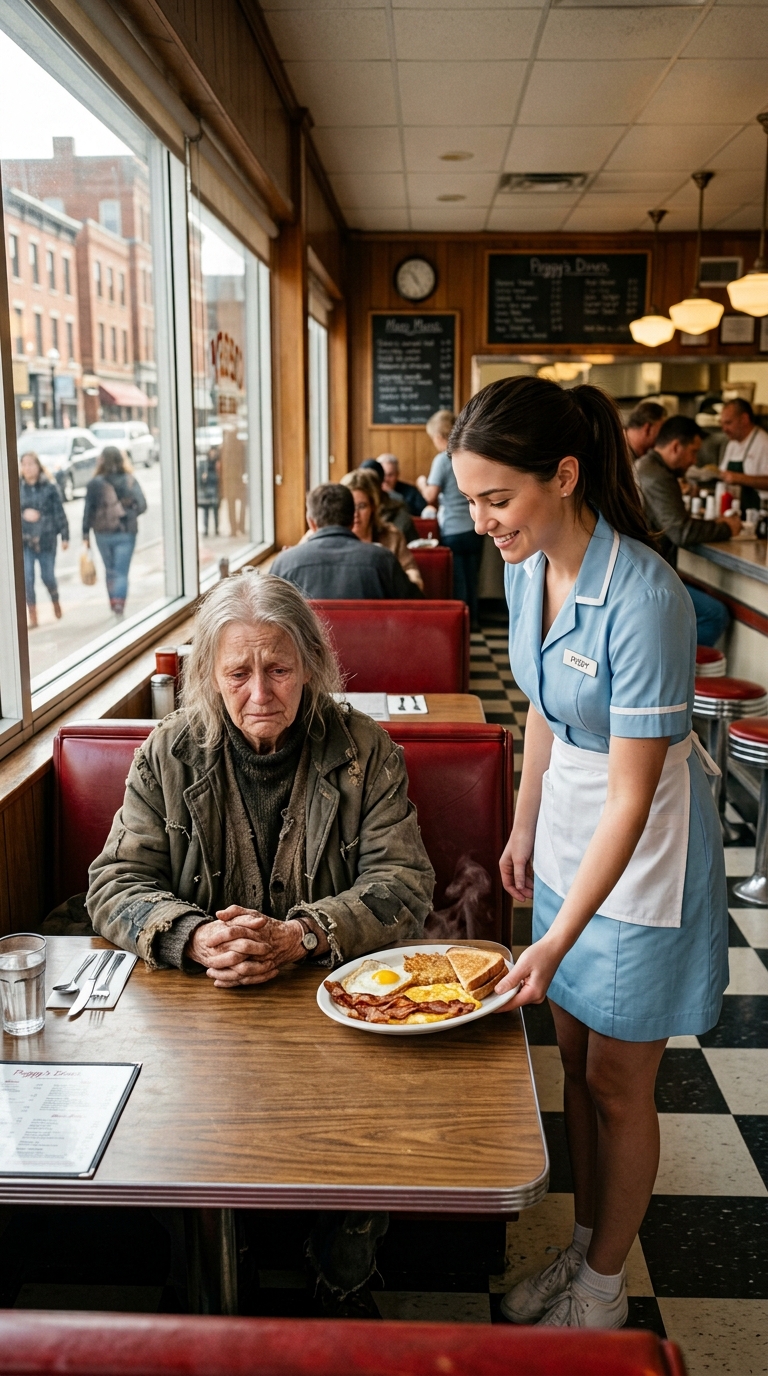
At a small diner, a waitress notices an elderly woman standing silently at the door, soaked to the bone and shivering. Without hesitation, she invites her in and serves her a hot meal, paid for with her own tips. But her act of kindness sparks her manager’s fury. She’s fired on the spot, walking out with nothing but her dignity. It seemed like she had lost everything, but she never imagined that one simple act would soon return and change her life forever.
Naomi Ellis was used to being unnoticed. At 33, she had perfected the art of being present without being seen, of gliding through rooms like a shadow, of offering refills and quiet smiles without ever expecting one back. In Wilkinsburg, Ohio, a town of red bricked churches and rusted pickup trucks, invisibility had become both a shield and a sentence.
Harper’s Diner sat on the edge of Main Street like it always had, with its flickering neon sign and windows smudged with time. Inside, the coffee flowed, the biscuits crumbled just right, and Naomi moved through it all like a well-oiled gear in a machine that never stopped to ask how she was doing. She wore her tan apron through the double shift, and her shoes, though cleaned nightly, always had the scent of fried grease embedded deep into the soles. She opened the place before the sun rose and closed it after the last booth had emptied.
No one ever asked her why she worked that much. No one cared that she lived in a tiny rented room above a garage on Maple Avenue, where the faucet squealed every time she brushed her teeth, and the heater coughed louder than the radio. No one knew about Peanut, her one-eyed cat, who waited faithfully for her return each night, curling against her side like he knew she needed the warmth more than he did.
What they didn’t see, what they never asked about, was the box Naomi kept under her bed. A small worn wooden box with a folded flag, a tarnished dog tag, and a photo of her grandfather in uniform. Walter Ellis, World War II veteran, preacher of quiet dignity, and the only father figure she’d ever known. He raised her on grit and grace after her parents disappeared into lives they couldn’t hold on to. Walter taught her what it meant to stand tall, even when the world wanted you to shrink.
“Honor isn’t loud,” he used to say, smoking a hand-rolled cigarette on their front porch. “It’s something you carry, like breath, like faith. You don’t brag about it. You just live it.”
She gave Peanut the good stuff when she could. Walked three miles in the rain because the bus route stopped two blocks too short. And never asked anyone for a thing.
It was a Tuesday night, cold, wet, quiet, the kind of night when people ordered their coffee to go just to avoid eye contact. Rain hammered the windows. Thunder rolled low in the distance. And the few patrons inside Harper’s Diner sat hunched over their mugs like they were protecting secrets.
Naomi was wiping down the counter, half listening to the oldie station, humming from the back when she saw her. She wasn’t in the diner. Not yet. She was standing just outside under the narrow awning, her figure barely visible through the glass fogged from the inside. The woman looked like a ghost of something once strong. Her coat, a faded military green, was soaked through and clung to her frail body. One pant leg was torn, exposing gauze wrapped tightly around a swollen calf. Her gray hair was patchy. Her cheeks hollowed by hunger. She stood motionless like she was trying to disappear into the wall. Her face turned slightly down, eyes scanning the sidewalk, not to be seen, but to make sure she wasn’t seen too long.
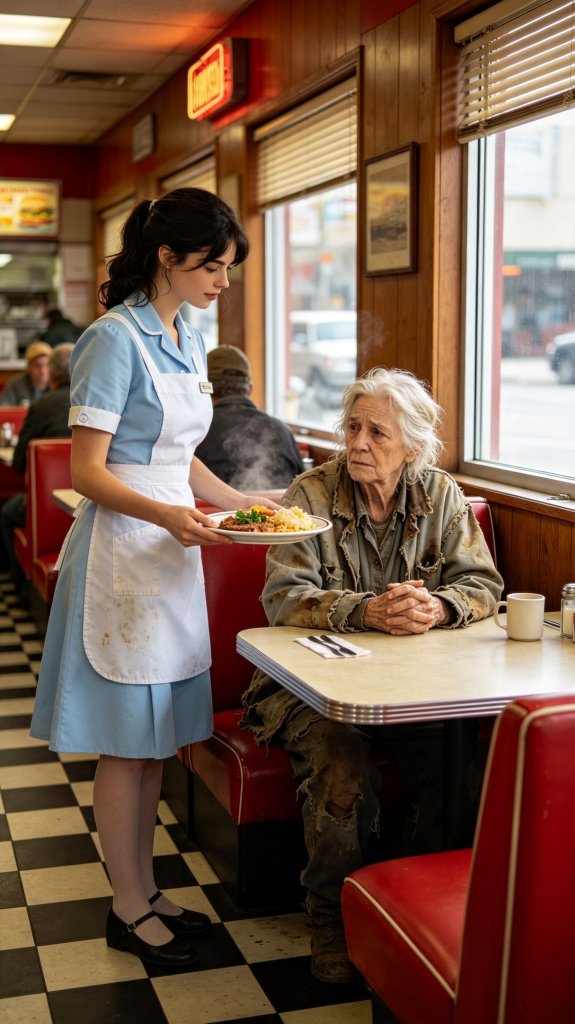
A couple of regulars looked toward the window, then quickly turned back to their coffee. One of them shook his head and muttered something about strays under his breath. Naomi watched quietly. The way she cradled a small paper bag like it was her last possession made her chest tighten. She wasn’t coming in, that was clear. She wasn’t trying to cause trouble. She was just standing there, wet, cold, invisible.
Naomi didn’t hesitate. She stepped out from behind the counter, ignoring the curious glance from the bus boy and the disapproving lift of the cook’s eyebrow. She walked to the front door, pulled it open gently, and stepped just outside into the rain.
“Ma’am,” she said, soft but clear, “Would you like to come in? It’s warm.”
The woman turned her head slowly. Her eyes were pale blue, ringed with red, and full of exhaustion that ran deeper than sleep. She didn’t answer right away, just stared, almost afraid it was a trick. Naomi took a small step back, giving her room.
“You don’t have to buy anything,” she added. “Just come out of the rain.”
She looked past her into the diner, then down at her soaked shoes. Finally, with a quiet nod, she limped forward, one foot dragging slightly. The bell above the door jingled as they stepped back inside, and the warmth hit them like a wave.
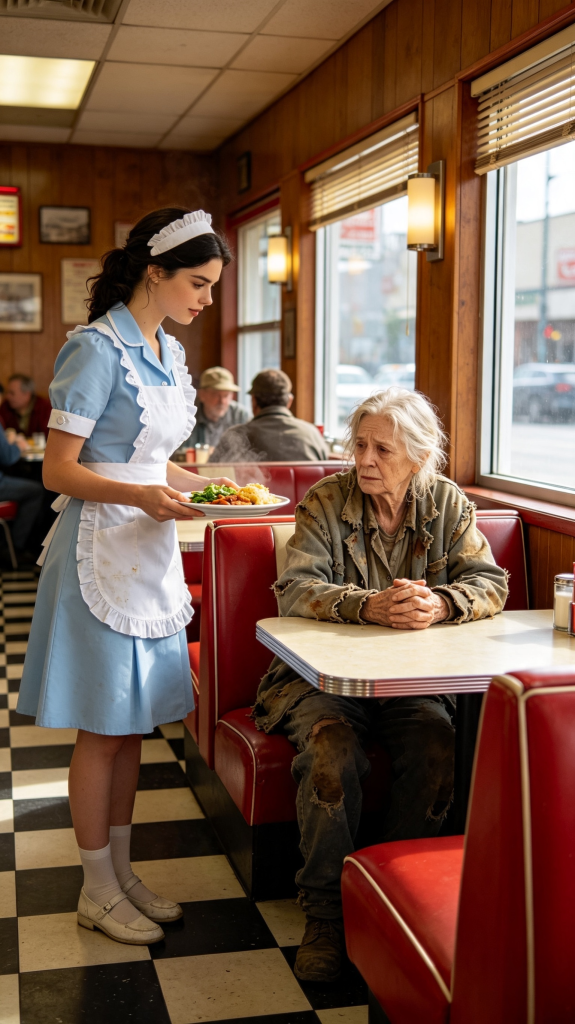
She led her to the far corner booth, the one no one liked because it was too close to the kitchen, and she stood beside it, unsure. Naomi gave her a small smile and nodded toward the seat.
“I’ll be right back,” Naomi said.
In the kitchen, the air behind her felt thicker. A few patrons had stopped talking. One woman stirred her tea extra slowly. The cook muttered something under his breath, but Naomi didn’t hear it. She had other things on her mind, and though no one knew it yet, the moment she opened that kitchen door was the moment everything began to change.
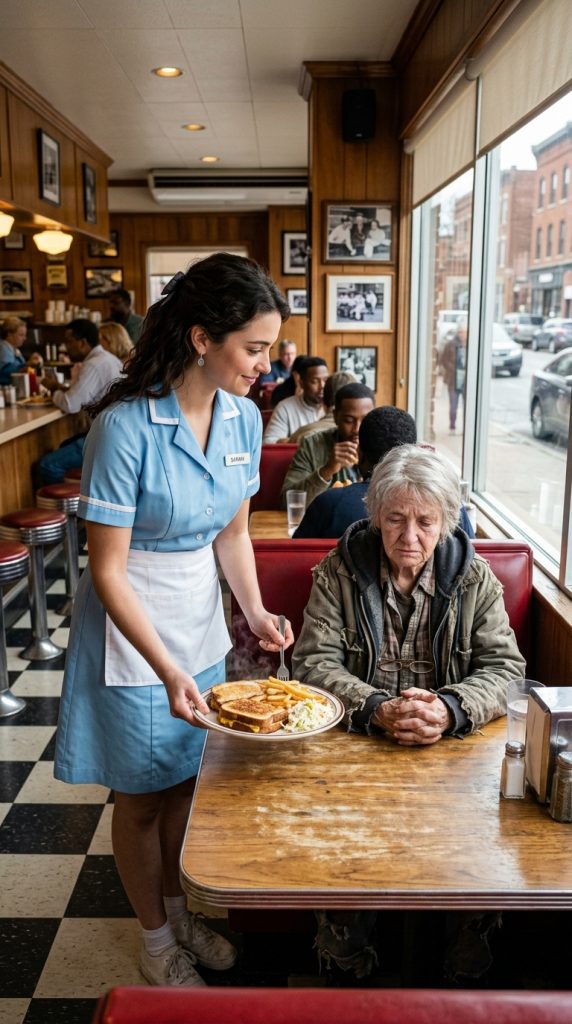
The kitchen was quiet except for the hum of the overhead lights and the low hiss of the fryer. Naomi moved quickly, but not carelessly. She scanned the heat lamp trays and spotted a returned plate of fried chicken and buttered bread, still warm, untouched, left behind by a customer who’d stormed out earlier over a cold coffee complaint. The food would have gone in the trash. She reached for it, carefully slid the pieces onto a clean plate, added a scoop of mashed potatoes, and drizzled a little gravy on top like it mattered. Then, without asking permission or waiting for approval, she poured a fresh cup of black coffee and placed it all on a tray with a folded cloth napkin.
The gesture wasn’t loud, but in her heart, it felt like rebellion.
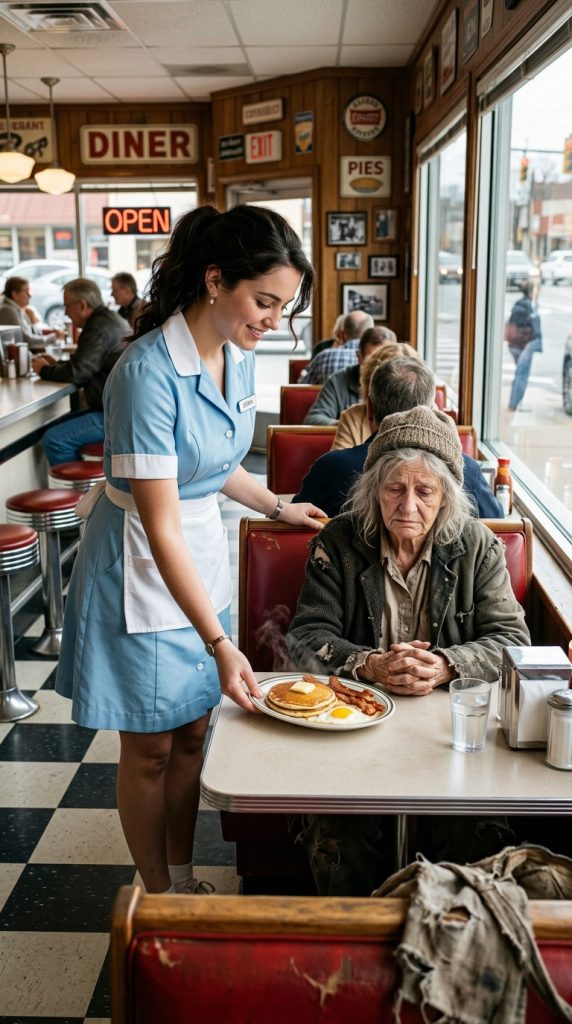
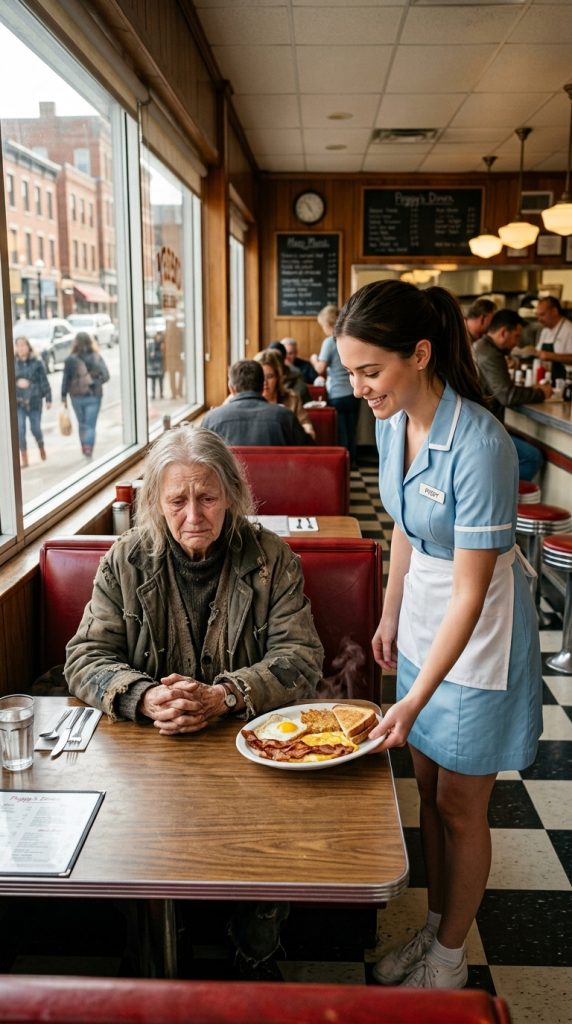
Naomi carried the tray through the swinging door, her footsteps steady, her breath tucked neatly behind a calm expression. The woman, still standing beside the booth, watched her approach with eyes that didn’t quite believe what they were seeing. She set the tray down gently in front of her.
“This was going to be thrown out,” Naomi said.
The woman looked at the plate, then up at her, then back down again.
“I can’t pay,” she murmured. Her voice was low, raw, thick with something that wasn’t just shame. It was fatigue. “Not the kind that sleep fixes, but the kind you carry for years.”
Naomi shook her head, giving her the faintest smile.
“It’s already paid for,” she said. “Eat while it’s hot.”
The woman eased herself into the booth with effort, wincing slightly as her leg shifted beneath the table. She picked up the fork like it weighed more than she did and paused before taking a bite. Naomi didn’t leave. She sat quietly across from her for a moment, just watching, not out of pity, but because she saw something in her that pulled at a place she’d buried for too long. She saw her grandfather. Same posture, same careful pride. Same quiet pain behind the eyes.
After a few bites, she glanced up, the steam from the food curling between them like smoke from an old fire.
“You remind me of my daughter,” she said. “She used to say nobody should have to feel forgotten, especially if they’ve been through too much.”
Her eyes glistened for a moment, and Naomi looked away, pretending not to notice. She wasn’t good with tears, hers or anyone else’s.
From across the diner, the cook gave her a sharp glance, but she didn’t flinch. Her hands stayed folded in her lap. The woman took another bite, then another, slower this time. It was but to stretch out the moment of dignity she’d given her. They sat in silence until her plate was nearly clean. She sipped the coffee like it was the first warm thing she’d held in weeks, then reached into the inside of her coat and pulled something from a hidden pocket.
It was an old dog tag. The chain dull, the metal scratched with time. She pressed it into Naomi’s hand gently.
“Name’s Margaret Hail,” she said. “If I don’t make it through this winter, I want someone to know I was here.”
Naomi’s fingers closed around the tag. She looked down at it and nodded once solemnly. There was nothing else to say.
Margaret stood slowly, sliding out from the booth with the same quiet as when she arrived. She gave her one last glance, a look full of meaning, of gratitude, of something unspoken that passed between them like a folded flag. Then she walked to the door, coat dripping, leg dragging, and stepped back into the storm.
Naomi stood still for a long moment, the tag still warm in her hand. She didn’t move until she heard the bell above the door jingle shut. The quiet inside the diner returned, but something inside her had shifted, subtle, but certain. She slid the dog tag into the pocket of her apron and turned slowly toward the kitchen.
But before she reached the back door, a voice rang out from across the room. Not kind, not curious, just angry.
“What the hell do you think you’re doing?”
Naomi turned slowly toward the voice, already knowing who it belonged to. Rick Manning, the owner of Harper’s Diner, stood in the kitchen doorway, his bulky frame filling the space like a wall. His face was red, his jaw tight, and his eyes locked on the empty plate that still sat on the table in front of Margaret Hail’s now vacant seat. The plate was spotless, the coffee cup still steaming faintly, as if trying to defend her.
The few customers in the diner froze in place. A spoon paused mid-stir. A menu rustled, then fell silent.
Rick stormed across the diner floor, each step hitting the tiles like a drum beat of judgment. He pointed a thick finger toward Naomi, his voice sharp enough to cut glass.
“You fed her?” He barked. “You gave food to that woman? I told you before, we don’t serve street trash here.”
Naomi’s hands trembled slightly, but she didn’t back away. She reached into the pocket of her apron and gently touched the dog tag still resting there, letting it ground her.
Her voice was quiet but clear.
“She’s a veteran, sir,” she said. “She asked for hot water and a crust of bread. I gave her food that was going to be thrown away.”
Rick’s eyes blazed.
“It’s not about the food,” he shouted. “It’s about principle. You made me look soft in front of paying customers. This is a business, Naomi, not a soup kitchen.”
The sudden absence of humanity inside. No one spoke. No one made eye contact. Naomi stood tall despite the weight in her chest.
“I paid for the coffee,” she said evenly. “You can take it out of my tips.”
Rick slammed his hand against the counter with a crack that echoed like thunder.
“No,” he snapped. “You don’t get to decide what’s acceptable in my restaurant. You just embarrassed this place in front of everyone.”
He looked around the diner, expecting nods of agreement, but all he got was silence. Customers avoided his gaze, staring into their cups, pretending not to be part of it. Naomi waited, not because she thought anyone would speak up for her, but because a part of her still hoped. No one moved.
Rick’s voice lowered, but the venom in it remained.
“You’re done here,” he said. “Pack your things. You’re fired.”
His finger pointed to the door like a final verdict.
Now Naomi slowly reached behind her waist and untied her apron. Her fingers were stiff but steady. She folded it once, then again, and placed it carefully on the counter. She didn’t cry, not because it didn’t hurt, but because she couldn’t afford to. Not here, not now.
She turned toward the exit, grabbing her coat from the hook near the staff hallway. The bell above the door jingled as she stepped out into the cold night. Rain soaked through her canvas shoes in seconds. Her hair, once tightly pinned, now clung to her forehead. Her bag felt heavier with what had just been lost.
She walked past the diner’s windows, where faces peeked through the glass, but quickly looked away. Outside under the narrow awning where Margaret Hail had stood just an hour earlier, Naomi paused. Her heart pounded, not from fear, but from the crushing weight of disappointment. Behind her, the voices inside the diner resumed, casual and low, as if nothing had happened.
She didn’t cry. Instead, she exhaled and closed her eyes for a brief moment. That’s when she heard the soft rustle of fabric and the shuffle of tired feet. From the alley beside the diner, Margaret reappeared. She was still soaked, still limping, but her eyes carried something fierce, something proud.
“I saw what happened,” she said hoarsely. “I shouldn’t have let you take the fall for me.”
Naomi shook her head gently.
“You didn’t do anything wrong,” she said.
She stepped closer, reaching into her coat once again. This time she didn’t hand her the tag. She placed her rough hand over hers and closed it tight around the metal.
“You saved a soul tonight,” she whispered. “You reminded me I wasn’t invisible.”
She nodded, the corners of her mouth twitching with something between sorrow and strength. Margaret gave her one last look, then turned and disappeared into the darkness once more.
That night, Naomi sat on the edge of her narrow bed, her coat spread out in hopes they’d dry by morning. Peanut curled beside her, purring gently, offering what little comfort he could. The room was silent, except for the sound of rain against the window. She pulled the dog tag from her pocket, read the name etched into the scratched surface, and whispered, “Margaret Hail.”
She didn’t know what tomorrow would bring. Rent was still due. Her name was now tied to controversy in a town that didn’t like troublemakers. But deep in her chest, past the fear and the exhaustion, there was something else. She had done the right thing, even if no one clapped.
And miles away, unknown to her, a video was already beginning to spread.
By morning, the storm had passed, but Naomi’s world hadn’t stopped shaking. She woke early, out of habit more than hope, and sat beside the window of her small room, watching the pale light creep across the sidewalk. Her phone buzzed. She checked it with tired eyes. 20 notifications, 30. Then more messages, missed calls, mentions, a video.
Someone had filmed the moment she was fired from across the diner. Shaky and grainy, but clear enough. It showed Rick’s finger jabbing at the air, his voice raised, his words sharp and ugly. And it showed Naomi standing there calm and composed, refusing to apologize for doing what was right.
By noon, the video had gone viral. The comments came fast and cruel. “Rules are rules,” some said. “She should have asked before giving away food.” Others accused her of stealing, of trying to play the hero for attention. Former co-workers unfriended her. One even messaged her directly.
“You always had to be the moral one. Look where it got you.”
Naomi spent the afternoon applying for jobs. She visited three diners that day, places she’d eaten at, places she’d once considered competition. At the first, the manager glanced at her resume, then did a double take.
“You’re the girl from the video, right?” he asked. “We just can’t have the attention. Nothing personal.”
At the second, she wasn’t even allowed to finish her application. They slid the form back across the counter without a word. By the third, she stopped trying. She walked home with her head tucked safely inside.
That evening, she passed a bus shelter near the edge of downtown. Underneath a sagging plastic tarp, Margaret Hail was curled against the concrete, arms wrapped tightly around the same paper bag she’d clutched the night before. She was asleep, or trying to be, shielding herself from the wind as best she could.
Naomi didn’t wake her. She knelt quietly beside her, placed a sandwich wrapped in newspaper near her side, half of what she’d eaten earlier, and whispered, “Thank you for remembering me.” Then she turned and walked away.
What she didn’t see just as she disappeared into the mist was the sleek black luxury SUV that had pulled up to the corner. Inside, a sharply dressed man lowered his phone from his ear, stared out the window at the spot where Naomi had been, and gave a quiet nod.
The next morning began like any other in Wilkinsburg, quiet, gray still. But at exactly 6:45 a.m., a low rumble began on Main Street. It wasn’t thunder. It was presence. Black luxury SUVs, one after another, turned the corner and came to a stop in front of Harper’s Diner. Their doors opened in sequence and out stepped rows of security personnel and assistants. Each one silent, composed, standing in perfect formation as they lined the street.
The locals stared from behind blinds and blinked twice, unsure if they were dreaming. In a town where nothing ever happened, this was something.
Inside the diner, Rick Manning was pouring fresh coffee when the bell above the door jingled. He looked up and nearly dropped the pot. A tall, well-dressed man in an immaculate suit stepped through, his presence commanding the room. He scanned the space with calm authority.
“I’d like to speak to the owner,” he said.
Rick stepped forward, pale and unsure.
“I’m the owner.”
More people had gathered outside. Phones were up. Cameras were rolling. The team stood firm.
“My name is Alexander Hail,” he said. “I’m the son of Margaret Hail, the woman you humiliated here two nights ago.”
A hush fell over the diner. Rick’s mouth opened, but no sound came.
Alexander continued. “My mother served in the military with incredible courage. She carried me through hardships when I was young. She sacrificed everything so I could build what I have today.”
He reached into his coat and pulled out a laminated citation.
“This is her silver star.”
Rick tried to speak, but the weight in the room was too thick. Alexander took a step closer.
“After years apart, I searched for her for months. Now we find her here, fed and shown kindness. Not by your business, not by this town, but by a waitress. A woman you fired.”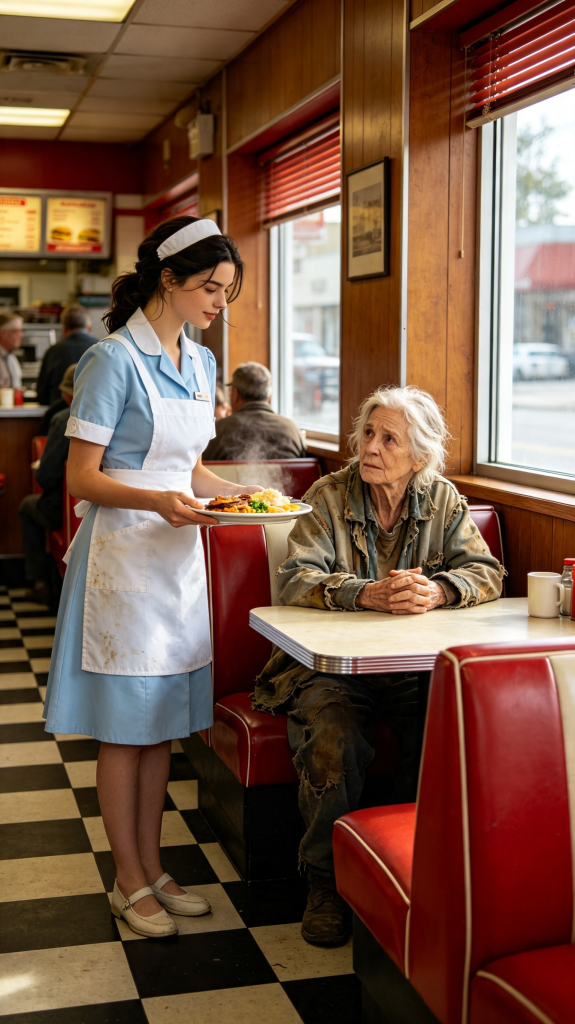
He turned to the doorway and nodded. An assistant brought forward the one Margaret had pawned years ago to help others. Alexander faced the crowd, his voice steady now.
“My mother once told me that wealth doesn’t feed the hungry. But the woman who stood up for her reminded me that compassion still exists.”
Another assistant stepped forward.
“Bring her,” he said.
Across town, Naomi was just finishing her tea when a knock came at the door. A young reporter, out of breath, stood outside.
“They’re asking for you,” she said, nearly breathless. “The team, the whole block is full. Alexander Hail, you have to come now.”
Naomi thought it was a mistake, a joke. But the sound of approaching footsteps told her otherwise. And as she stepped outside and saw the suited team waiting in silence, part of her knew. The world wasn’t ignoring her anymore.
The crowd outside Harper’s Diner parted as Naomi approached, her footsteps slow, unsure, but steady. The team stood in perfect formation, rows upon rows lining the street, their presence solemn. And then, as if choreographed by something deeper, every hand rose in respect.
Naomi froze at the edge of the sidewalk, overwhelmed, breath caught in her chest. No one spoke. They didn’t need to. Their silence held more power than any cheer.
Alexander Hail stepped forward, the silver star in hand, his voice quiet but firm.
“My mother wanted you to have this.”
“It’s not mine.”
Alexander gently placed the case into her palms.
“It is now.”
The crowd that had gathered outside the diner broke into quiet murmurs. Some lowered their phones. Some just watched in awe. Naomi stood there unsure of what to do next. The metal weighing heavier than it looked. Not just because of the metal, but because of what it meant. Recognition, sacrifice, and something far rarer. Truth.
The fallout came swiftly. By the end of the week, Harper’s Diner had shuttered its doors. Suppliers canceled their contracts. Staff resigned. Community groups from across the state picketed the front steps. Rick Manning disappeared from town without a word. The neon open 24 hours sign that once buzzed faintly above the window went dark for the first time in years.
But Naomi didn’t celebrate. She didn’t post about it. She didn’t give interviews or accept invitations to talk shows. She simply returned to what she knew, serving others quietly without applause.
The difference now was that she wasn’t doing it alone. Within days, a nonprofit organization reached out to her with an offer. Manage a new community kitchen in Wilkinsburg. One that would serve the people like Margaret Hail. The forgotten, the invisible, the ones who never asked but always needed.
Naomi accepted. The space was a former warehouse now transformed. Laughter echoed through its hallways. The smell of chili and cornbread drifted out through its doors. Volunteers lined up daily. Retired nurses, single mothers, teenagers with homework still in their backpacks.
And in the corner of Naomi’s modest office sat a wooden box with three items. A folded flag, a tarnished dog tag, and a silver star. Smoke gray light filtered through the windows most mornings, and Peanut, now a fixture of the kitchen, liked to perch on the window sill, watching it all like a quiet guardian.
Naomi wore no name tag. She gave no speeches. She simply showed up day after day, apron tied, sleeves rolled, heart open.
A week after the gathering that changed everything, Naomi was wiping down the serving table when the kitchen door creaked open. A boy no older than seven or eight stepped in. He had sandy blonde hair, shoes too big for his feet, and a serious look on his face. In one hand, he held a single dollar bill folded into thirds. In the other, a cookie wrapped in wax paper and tied with string.
He walked straight up to Naomi, eyes locked on hers.
“I saw you in the video,” he said. “My grandpa was a veteran, too. He used to help people, so I want to help someone, too.”
He placed the dollar and the cookie on the counter with care.
Naomi knelt in front of him, hands on her knees, trying to keep her composure.
“Can I use this to help someone?”
Her throat was tight. The room seemed quieter than usual. Instead of words, she placed her hand over her heart and gave him a slow, solemn nod.
The boy smiled, nodded back, and turned to leave. He didn’t know it, but his small act had echoed a truth Naomi already understood. That kindness doesn’t need a camera. It just needs a heart willing to see what others overlook.
Margaret Hail now lived under a roof provided just a few miles away. Word spread that Alexander Hail visited often. Sometimes people came just to listen to Margaret’s stories. She didn’t just talk about her service. She talked about quiet struggles fought here at home, about nights spent alone, about people who looked away, and about one woman who didn’t.
Naomi visited her when she could. They didn’t say much. They didn’t have to. She still carried her dog tag in her coat pocket, still kept her silver star in the small box by her bed. And some nights, when the world felt too heavy, she’d run her fingers over its edges and whisper the words her grandfather once said.
“Honor isn’t loud, it’s quiet.”
Time passed. The headlines faded. The video scrolled lower and lower on feeds full of louder outrages. But for those who had really seen it, it never went away. Not because Naomi raised her voice, but because she raised her hand when no one else would. Because she gave when no one asked, because she showed that in a world that moves faster than most hearts can keep up, Naomi reminded us all what it looks like to slow down and simply care.
