

PART 1
Inés Villaseñor had never pointed a musket at a man.
That dawn, she did so without her hands trembling.
Behind her, two children clung to her skirt. The older one held his breath like a cornered soldier. The little girl made a weak, repetitive murmur—a wordless song that seemed to come from a place no one could reach.
In the hallway of the house stood a tall man, soaked by the rain, wearing a black coat.
“Step back, sir,” Inés ordered. “Take another step and I will shoot.”
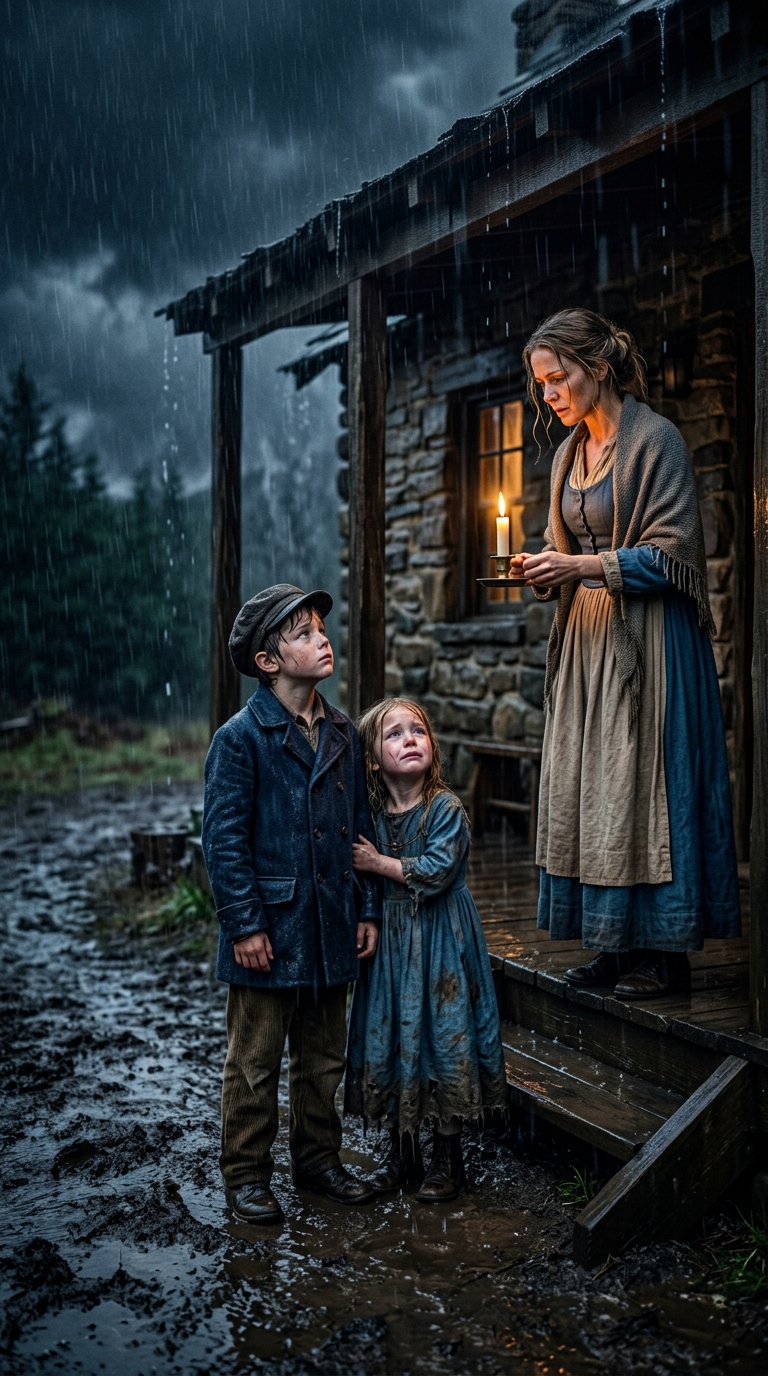
It had all begun a few hours earlier, when a storm descended on the mountains of the Bajío.
It was the summer of 1824. Mexico was only just learning to live again after the War of Independence. The roads were still full of soldiers without an army, landowners who believed themselves above the law, and families who had lost more than they dared mention.
Inés lived alone in a small adobe house located three leagues from San Jerónimo de los Sauces. She had worked as a teacher for nine years, until the school closed for lack of funds. Since then she sewed clothes for the town’s widows and grew corn on a small plot she had inherited from her father.
That night she was mending a shirt by the hearth when she heard three knocks on the door.
They were not a man’s knocks.
They were too weak.
Inés took her father’s old musket and asked:
“Who’s there?”
At first only the wind answered.
Then she heard a child’s voice.
“Please, ma’am… don’t turn us in.”
Inés opened the door just a few inches.
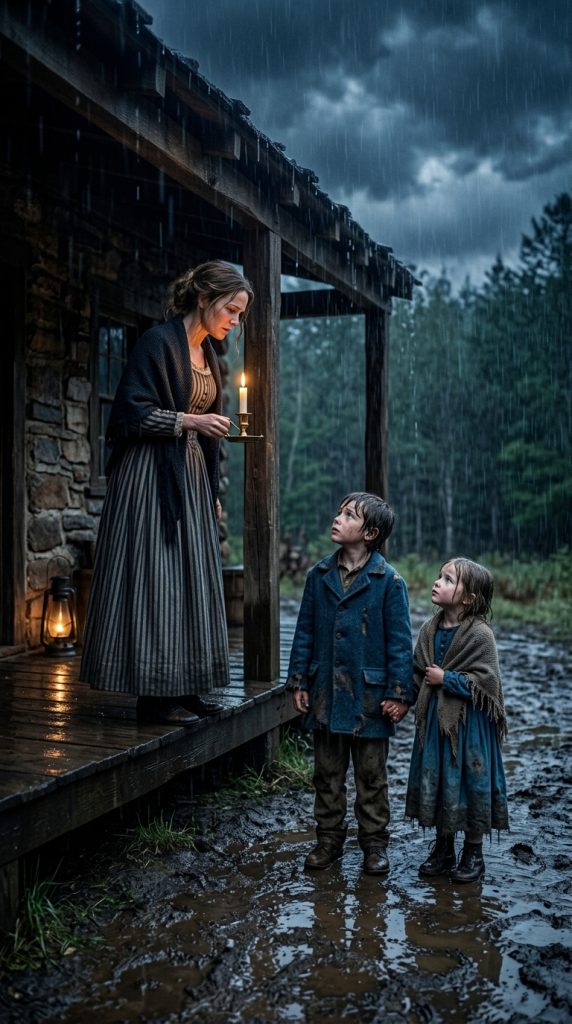
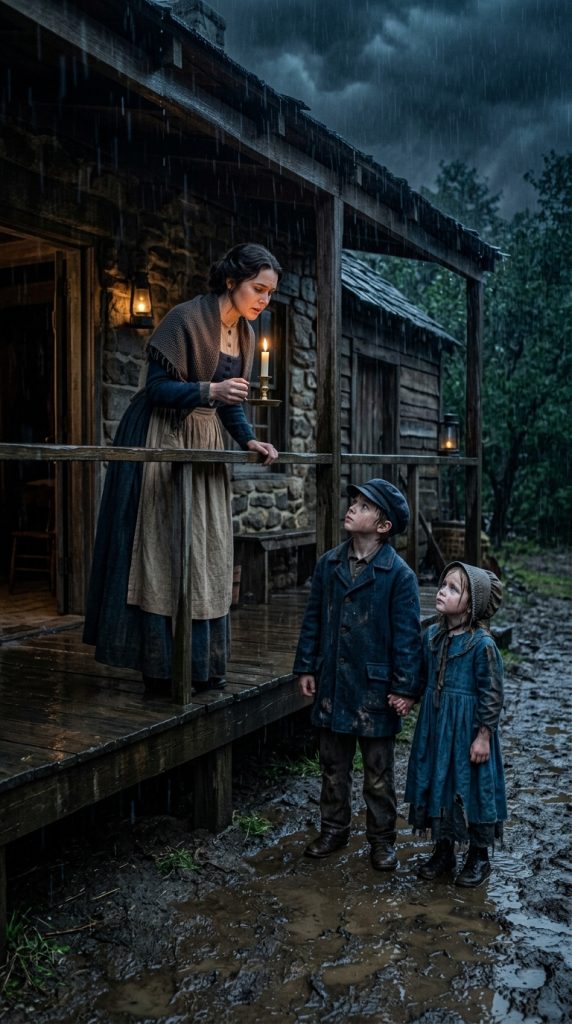
In the rain she saw a boy of about seven years old and a little girl who could not have been more than four. They were covered in mud. However, their clothes did not belong to peasant children. The collar of the boy’s shirt had fine lace, and the little girl’s boots were embroidered with silver thread.
The boy clutched a leather case to his chest.
“Come in before you die of cold.”
He didn’t move.
“Is there any man living here?”
“No.”
“Are you sure?”
“I have a pot, two blankets, and a goat that hates strangers. That’s all.”
The boy looked at his sister. Finally he crossed the threshold.
“My name is Mateo Rivas,” he confessed. “She is Luz.”
Inés gave them dry clothes, hot milk with piloncillo, and some bread. Mateo ate slowly, watching every window. Luz didn’t touch anything until Inés sat far away from her.
The girl kept humming the same melody.
“Who taught you that song?” Inés asked.
“Our father,” Mateo answered. “He sang it when he was afraid.”
“Where is he?”
“He died.”
“And your mother?”
Mateo lowered his gaze.
“She did too.”
Inés asked no more questions. She had buried her own parents during an epidemic and knew how loss could empty a child’s voice.
She prepared a bed by the hearth. When Luz fell asleep, Mateo took a small silver compass from his coat.
“It was my father’s. Luz kept it hidden so they wouldn’t take it.”
Inés turned it over.
On the back was an inscription:
“Captain Tomás Rivas. I entrust my children to God.”
Inés recognized the name.
Captain Rivas had fought in the war and died of fever shortly after the victory. According to rumors, before dying he had entrusted his two children to his comrade-in-arms, Don Gabriel de la Vega, owner of a large hacienda north of the valley.
“Mateo,” she whispered, “did you escape from the De la Vega hacienda?”
The boy turned pale.
Luz woke up and began singing louder.
Mateo took his sister’s hand.
“They locked us in the granary for three nights.”
“Who?”
The boy pressed his lips together.
“If I say his name, he’ll send us back.”
Inés placed a hand on the table.
“Listen to me. My father built this house after returning from the war. He said a house doesn’t deserve to be called a home if it can’t keep a wolf outside its door. Whoever locks a little girl in a granary is a wolf, even if he wears silk and sits in the first pew of the church.”
Mateo looked at her with eyes full of tears.
“You won’t turn us in?”
“Tonight, no one will cross that door to take you away.”
A little after three in the morning, the sound of horses approaching was heard.
Inés took the musket.
Before going out, she leaned over the children.
“No one will touch you.”
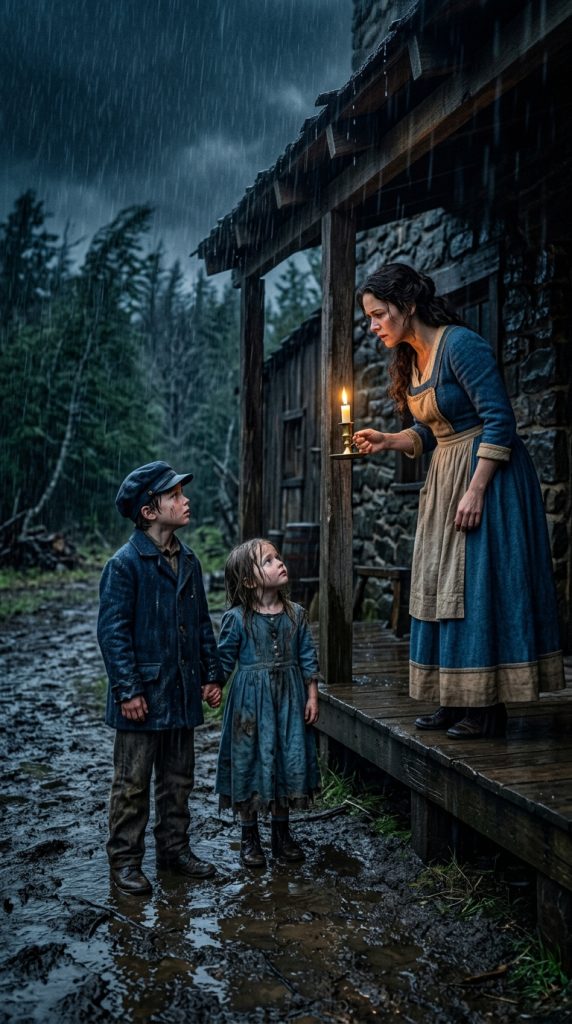
She opened the door and found a man of about thirty-five beside an exhausted horse. His black coat was soaked and his face was marked by exhaustion.
“I am Gabriel de la Vega,” he said. “I’m looking for two children.”
Inés raised the weapon.
“Then you can go back the way you came.”
“I only need to know one thing.”
“Speak.”
The landowner’s voice broke.
“Are they alive?”
The question disarmed something inside Inés.
“They are alive.”
Gabriel closed his eyes and covered his face. When he lowered his hand, there were tears mixed with the rain.
“Thank God.”
“Tell me why they ran away from your house.”
Gabriel remained still.
“Because I failed them.”
He confessed that he had been traveling for weeks to negotiate the purchase of land. In his absence, his aunt, Doña Prudencia de la Vega, had been left in charge of the hacienda. A stable boy had just revealed to him that the children had been punished, humiliated, and locked up.
“My aunt said they were the children of a poor soldier and would never be worthy of our surname,” he explained. “When I returned, I saw a bruise on Mateo’s face. He lied to protect his sister. I should have understood everything.”
“Why didn’t you throw your aunt out immediately?”
Gabriel lowered his head.
“Because I am a coward. She has ruled my house since my mother died. I could give orders to forty men during the war, but I didn’t have the courage to confront the woman who raised me.”
Inés studied him for several seconds.
“You may come in, but leave your coat and boots outside. You will not touch the children. You will not ask them to forgive you.”
Gabriel obeyed.
He sat far from the hearth and gazed at Mateo and Luz, huddled under a blanket. The boy was not asleep. He had heard every word.
“Don Gabriel,” he said without standing up, “you should have stopped her the first time.”
The man closed his eyes.
“You’re right.”
“My dad would have done it.”
“Your father was a better man than I am.”
“You are not my dad.”
“No. But I promised him I would protect them and I failed.”
Mateo remained silent.
“You’re crying, sir.”
“Yes.”
“Dad cried before he died. He asked me not to tell anyone.”
Gabriel let out a shaky breath.
“I was with him. I cried that night too.”
Mateo thought for a long moment.
“It’s all right, sir.”
It was not forgiveness, but it was a door left ajar.
Then the sound of a carriage advancing along the road was heard.
Gabriel stood up.
“It’s my aunt.”
Behind the carriage came the district notary’s coach.
Doña Prudencia was not coming only for the children.
She was coming with the law.
PART 2
The woman who descended from the carriage wore black silk and white gloves. Despite the mud, she walked as if the earth were obligated to stay clean beneath her shoes.
Beside her was Licenciado Jacinto Robles, the court notary, with a folder of documents.
“Step aside, Miss Villaseñor,” Prudencia ordered. “I’ve come for the minors.”
“No one enters my house without permission.”
Prudencia looked inside and saw Gabriel sitting by the table.
A thin smile appeared on her face.
“Exactly as I imagined.”
The notary unfolded a document. Prudencia had filed a request to remove Gabriel’s guardianship for negligence. She claimed he had allowed two minors to run away during a storm.
But there was more.
The document accused Gabriel of immoral conduct for having spent the early morning hours under the roof of an unmarried woman.
Inés felt the blow strike her chest.
In a small town, such an accusation could destroy her. She would lose the school when it reopened. Families would not send their daughters to a woman marked by scandal. No one would sit beside her at Mass.
Prudencia spoke sweetly:
“Hand over the children and this document will disappear. Your reputation will remain intact.”
“Have you come to rescue them or to buy my silence?”
“I have come to prevent two orphans from ruining my family’s name.”
Gabriel stood up.
“You locked Luz in the granary.”
“I disciplined a willful girl.”
“You hit Mateo.”
“The boy lied.”
“You insulted their father’s memory.”
Prudencia looked at him with contempt.
“Their father was a soldier with no fortune. You have wasted land, money, and marriage opportunities over a promise made to a dying man.”
Gabriel stepped to the door.
“By noon, your belongings will be out of my hacienda.”
Prudencia smiled.
“I no longer live there. I have moved my residence to the parish priest’s house. I am now the closest relative legally requesting custody. When the judge learns that these children escaped under your responsibility and he found you here with a spinster, he will strip you of all rights over them.”
Inés then understood the true trap.
Prudencia had mistreated the children to provoke their escape. She would then use the flight as proof of Gabriel’s negligence. In addition, she would destroy Inés’s reputation to prevent her from testifying or protecting them.
“You knew they would come to this house,” Inés said.
For the first time, Prudencia’s smile faltered.
“A lost child always seeks a compassionate woman. And a poor woman always ends up accepting money.”
“You are wrong.”
“Think carefully. You are 37 years old, with no fortune and no husband. Your name is the only thing you possess.”
Inés held her gaze.
“That’s true. My name is my entire fortune. And you have come to tell me that the price of opening my door to two wet children is losing it all.”
“Exactly.”
“Then the price seems acceptable to me.”
Prudencia frowned.
“I will not lose those children to keep a seat in church. I will not hand them over to save my job. You can tell the entire valley that Gabriel de la Vega was in my house. Tell them also that he left his coat in the hallway, that he sat far from my bed, and that he cried when he discovered his children were alive.”
“Those children are not of your blood.”
Mateo’s voice came from the hearth.
“But he came looking for us.”
Everyone turned.
The boy was standing, protecting Luz.
“Mateo,” Prudencia said, “come with me.”
He did not obey.
“She locked us up because I found the letters.”
The woman’s face changed.
“What letters?”
Mateo opened the leather case he had defended all night. He took out several papers wrapped in waxed cloth.
Gabriel immediately recognized the handwriting.
“They are from Tomás.”
Before dying, Captain Rivas had written several letters. In them he stated that part of the De la Vega family lands had been purchased with money belonging to his late wife, the mother of Mateo and Luz. The children were not a burden on the hacienda.
They were legitimate owners of one third.
A final letter revealed that Prudencia knew about the inheritance and had tried to destroy the evidence.
“I found them behind my father’s portrait,” Mateo explained. “She saw me. That’s why she locked us up.”
Doña Prudencia tried to snatch the documents, but Gabriel stepped between them.
“You will never touch him again.”
The notary examined the seals and signatures.
“These papers must be presented before the judge.”
“They are false,” Prudencia claimed.
Then Luz came out from behind her brother.
The girl looked at the woman in black and began to sing her father’s melody.
Prudencia lost control.
“Shut up! I locked you up so I wouldn’t have to hear that song again!”
The silence that followed was absolute.
The notary slowly put away Prudencia’s document.
“We have all heard your confession.”
Prudencia realized too late what she had said.
She backed toward the carriage, but Gabriel spoke with a firmness Inés had not heard before.
“At nine o’clock we will be before the judge. And this time, Aunt, you will not speak for everyone.”
PART 3
The hearing was held that same morning.
The town hall was full. The story of the scandal had traveled faster than the horses. Some neighbors came expecting to see Inés humiliated. Others wanted to witness the fall of Gabriel de la Vega.
Doña Prudencia sat dressed in black, confident that money and the family name would still be enough.
They were not.
The stable boy testified that he had seen the children locked up. A cook confessed that Prudencia had ordered them to be denied food. The notary presented Captain Rivas’s letters and repeated the confession everyone had heard in the hallway.
Finally, Mateo stood up.
His legs trembled, but his voice did not.
“Don Gabriel didn’t hit us. He went on a trip and left us with her. That was wrong. But when he learned the truth, he rode all night to find us.”
“Do you wish to return with him?” the judge asked.
Mateo looked at Gabriel.
“Only if Mrs. Inés can visit us.”
A murmur ran through the room.
The judge turned his gaze to Luz.
“And you, little one?”
Luz clutched her father’s compass. Then she stretched out her arms toward Inés.
The teacher lifted her.
“I want to stay with Mama Inés,” the girl whispered.
It was the first time she had called anyone mother.
Inés closed her eyes to hold back the tears.
The judge stripped Prudencia of all rights over the minors. He also ordered an investigation into the concealment of the inheritance and forbade her from approaching the children. Gabriel retained guardianship, but he had to legally recognize the lands that belonged to them.
At the end of the hearing, the neighbors who had come looking for scandal stepped aside to let Inés pass.
The parish priest removed his hat before her.
“Forgive me. I believed the rumors.”
“You don’t need to ask my forgiveness. Just remember the facts when someone repeats the lie again.”
On the town hall steps, Gabriel waited with his hat in his hands.
“The children want you to come with us,” he said.
“The children are still afraid of your house.”
“Then the house will have to change.”
Gabriel kept his word.
He expelled the servants who had obeyed Prudencia’s punishments. He turned the granary where Luz had been locked into a school for the workers’ children. He gave Mateo and his sister the documents for their lands and appointed Inés administrator of the inheritance until they came of age.
He also offered her the chance to run the new school.
Inés accepted, but refused to move to the hacienda.
“I will not allow people to say I entered your house looking for a rich husband.”
“And what must I do so people don’t say that?”
“Don’t visit me at night. Don’t arrive during a storm. Don’t show up without your hat and crying in my kitchen.”
For the first time, Gabriel laughed.
In the following months, he went to see her every Saturday, always in broad daylight. Sometimes he brought books for the school. Other times he accompanied Mateo and Luz. He never entered without knocking.
Mateo smiled again.
Luz stopped singing only when she was afraid. Now she sang while playing in the garden.
Ten months later, Gabriel arrived alone at Inés’s house. He tied his horse beside the mesquite and remained on the first step with his hat in his hand.
“I have put my house in order,” he said. “I have tried to fulfill the promise I made to a dying man. I have not come to ask for your gratitude or to repay you for what you did.”
Inés waited.
“I have come to ask you to be my wife. I want to be a father to Mateo and Luz, not just their guardian. But I also want to build a life with you. You can answer today, in a month, or never. The decision is yours.”
Inés took five seconds.
“Yes, Gabriel.”
It was the first time she had spoken his name.
They were married in July 1825.
Mateo carried his father’s letters during the ceremony. Luz walked beside Inés with the silver compass in her hands. In the front pews sat workers, farmers, widows, and children from the new school.
Years later, Mateo became a surveyor and mapped roads throughout the Bajío. Luz learned to read in three languages and managed the lands inherited from her mother. Gabriel and Inés had a daughter, but they never made distinctions between the three children.
When Luz was an old woman, her grandchildren asked how she had become part of that family.
She showed them her father’s compass and told them the truth.
She did not say that a poor woman had found them.
She said that, during a storm, she and her brother had found a house whose fire was still burning.
And that in that house lived a woman who was willing to lose her name, her job, and her place in the world rather than hand two children over to the wolves.
“That night,” Luz would say, “we did not find shelter.
We found our mother.”
