

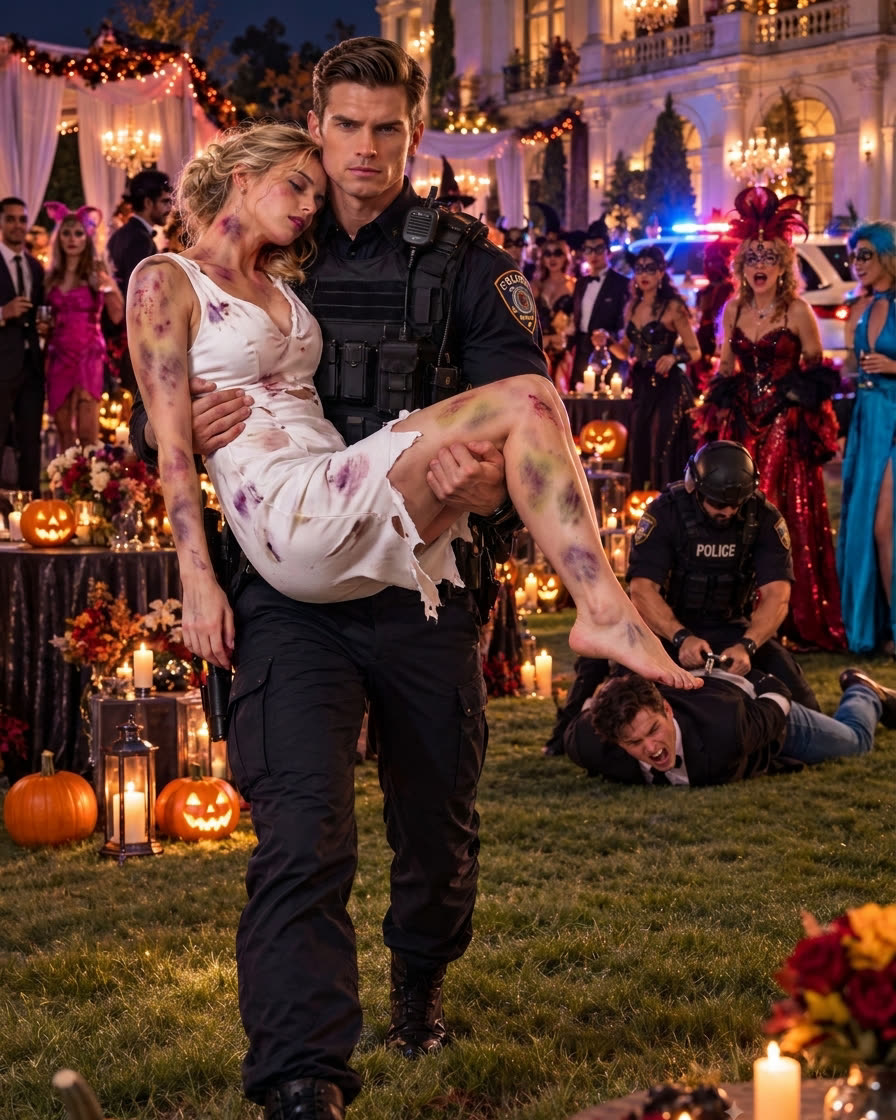
Part 1: The Hands on the Drywall
In my studio, every leaf carries its own anatomy of survival. As a botanical illustrator, I have logged hundreds of hours beneath the chilly white glare of a magnifying lamp, tracing the fragile, fibrous skeletons of winter foliage. I know exactly how much sideways pressure a dried stem can bear before its vascular bundles give way. I know that under the thin, translucent skin of an orchid petal runs a complex network of veins, laboring without rest to carry water upward against gravity.
Never did I imagine that one evening my own throat would become the specimen put through a catastrophic stress test.
When my skull struck the drywall, it didn’t crack. It made a dull, hollow thud that jarred my teeth in their sockets. David Sterling didn’t hit me with an open palm, and he didn’t reach for an object. He used what he always used once his carefully groomed aristocratic poise came apart: the raw, heavy machinery of his own hands.
His fingers locked around my neck like a pair of vises cast from cold iron. My windpipe buckled inward with a sickening, wet friction. Instinct, ancient and frantic, seized control at once. My hands shot up to tear at his thumbs, but my fingers slid uselessly against the tailored Italian cuffs of his tuxedo. He pressed the full two hundred pounds of his body forward, driving his thumbs inward and upward, hoisting me until the soles of my satin evening pumps dangled four inches above the gleaming herringbone hardwood of our foyer.
“You think you have a choice, Clara?” he whispered.
His face hovered inches from mine. Under the warm, golden light of our crystal chandelier, he looked flawless. His sandy hair was parted with geometric precision; his jaw was shaved smooth; his breath carried a faint trace of peppermint and vintage Scotch. To anyone who had seen him that morning on the cover of the regional business journal—hailed as the crown prince of luxury commercial real estate—he was the very picture of polished American wealth.
To me, he was a suffocation hazard.
“Answer me,” he growled, though his grip made speech a biological impossibility. “You think you can embarrass me? You think you can call my mother two hours before the annual gala and claim you have a migraine?”
My lungs burned as though they had been flooded with boiling oil. Dark, ragged blotches—clusters of crimson and greasy black static—spread across my vision, multiplying as fast as mold spores under glass. The capillaries in my eyes were rupturing; I could feel tiny pinpricks of heat beneath my eyelids. My feet kicked wildly against the wainscoting, scuffing the spotless eggshell paint. The world faded into a shrill, metallic ringing that buried the ticking of the grandfather clock down the hall.
He is going to do it, the calm, rational part of my mind noted from somewhere far away. He is going to squeeze the carotid arteries until the brain stem stops telling the diaphragm to move. It takes under four minutes.

In one last burst of panic, I hooked my left hand into the bend of his elbow and twisted my body, trying to turn my weight against his leverage. It was the motion of a drowning woman clawing toward a surface that wasn’t there.
David’s eyes darkened with annoyance. Never loosening the clamp of his right hand on my throat, he swung his left fist down across my wrist with precise, downward torque.
CRACK.
My radial bone gave way with a crisp sound, like a green branch snapped across a knee. Pain, white-hot and sickening, exploded from the joint and shot straight into my shoulder. My whole body went slack. The instinct to fight drained from my limbs, replaced by a crushing wave of shock that left my mouth hanging open in a silent, airless scream.
Pleased by my surrender, David abruptly opened his fingers.
Gravity took me back. I hit the hardwood like a sack of wet soil, my hips and my broken arm absorbing the impact. The jolt forced air back into my battered trachea, but the swollen cartilage resisted every millimeter of it. I choked, retching violently onto the polished floor, my right hand shaking as it hovered helplessly above my left wrist. The joint was already ballooning, the shape of my lower forearm warped by an unnatural, nauseating stair-step deformity beneath the skin.
David didn’t flinch. He didn’t offer a hand, and he didn’t look away. He simply reached into his breast pocket, pulled out a linen handkerchief, and meticulously dabbed a fleck of my saliva from the lapel of his dinner jacket.
“Get up,” he said, checking the platinum watch on his wrist. “The limousine will be at the gate in twenty minutes. If you make us late, Clara, what happened just now will seem like an act of mercy.”
“I… I can’t,” I wheezed, my vocal cords scraping together like two sheets of rough sandpaper. The voice that left my throat was a stranger’s—a dry, rasping rattle that barely reached across the hallway. “My arm, David… it’s broken. I need… the emergency room.”
He crouched beside me, folding his knees with an athlete’s easy grace. He reached out, caught my jaw, and wrenched my face upward toward the mirror above the entrance console.
The woman in the reflection was a horror. A thick, blotchy ring of deep plum and furious scarlet was already spreading around my throat, mapping the exact geometry of his fingers. Deep crescent-shaped dents marked the places where his thumbs had dug into my jugular. My face was flushed a dusky, mottled red, and the whites of my eyes were freckled with burst petechiae.
“You aren’t going to the hospital,” David said softly, his voice sinking into the rhythmic, hypnotic cadence he used when closing multi-million-dollar land acquisitions. “You are going to the ballroom at Sterling Manor . You are going to smile at the Governor. You are going to laugh at my mother’s jokes. And you are going to play your part.”
“They will… see,” I rasped, tears at last spilling over the swollen rims of my eyelids and carving hot paths down my cold cheeks. “Look at me. Look at my neck.”
David smiled. It was a cold, hollow stretch of the lips that never reached his eyes.
From his pocket, he drew a small rectangular jeweler’s box covered in black velvet. He flicked the brass clasp open with his thumb. Inside, nestled against white satin, lay a wide choker of midnight-black velvet ribbon. From its center hung an ornate, teardrop-shaped pendant of oxidized silver, intricately carved into the shape of a weeping willow leaf.
“My mother chose this year’s theme months ago: Victorian Gothic Masquerade,” David said, lifting the heavy fabric from the box. “It is Halloween, Clara. The entire city elite will be dressed as phantoms, ghouls, and aristocratic revenants.”
He knelt over me, straddling my hips to pin my legs against the floor, and bent forward. With terrifying tenderness, he wound the thick band of velvet around my raw, swollen throat. The fabric was coarse and weighty; it felt like sandpaper dragging across open burns. He drew the silver buckle tight at the nape of my neck, cinching it until the velvet’s edges bit straight into the swollen ridges of the hematoma.
I gasped, the edges of my vision going gray from the sheer, smothering pressure.
“There,” David whispered, his lips brushing my ear as his thumb caressed the weeping willow pendant. “A masterpiece. If anyone asks about the purple showing above the ribbon, you will tilt your head, give them that modest little smile of yours, and tell them it’s theatrical makeup. You’re a zombie bride. You’re a murdered Victorian ghost. You’re whatever you need to be to ensure nobody asks a single follow-up question.”
He rose to his feet, looming over me, and nudged my good foot with the toe of his patent leather oxford.
“Go upstairs, put on the black silk gown, and fix your face. If you cry, if you whisper a single word of truth to anyone tonight, Clara… I won’t just break your wrist when we get home. I will take you down to the wine cellar, and I will finish the job. Do you understand me?”
I lay on the cold hardwood, staring up at the ceiling, feeling the pulse in my neck pounding wildly against the velvet choker. I couldn’t nod; my neck was too rigid, the pain too blinding.
“I asked you a question,” David said, his voice sinking an octave into pure malice.
“Yes,” I croaked. “I understand.”
David nodded, satisfied, straightened his tie in the mirror, and strode toward the front door to look for the driver.
Slowly, bracing my back against the wall and pushing with my right arm, I hauled myself upright. My broken left arm dangled uselessly against my ribs, sending waves of nausea through my stomach with every heartbeat. I lifted trembling right fingers to touch the silver teardrop pendant lying against my ruined throat.
Hidden beneath the intricate silver filigree of the willow leaf, invisible to any human eye, a microscopic sensor registered the sudden surge of body heat and the unmistakable acoustic signature of my broken gasps.
A single sub-miniature red diode inside the casing blinked once, silently launching an encrypted high-frequency transmission protocol: CARRIER DETECTED. ENCRYPTION PROTOCOL: ALPHA ONE ACTIVE.
The Grand Ballroom of Sterling Manor was a display of generational wealth turned into a weapon of sensory theater.
Perched on the highest ridge above the city, the estate was a commanding stone fortress raised during the Gilded Age, its granite turrets and sprawling slate roofs towering over acres of manicured, withering autumn gardens. Tonight, the mansion had become a lavish crypt. Hundreds of black beeswax candles flickered in wrought-iron candelabras, throwing long, trembling shadows across walls hung with heavy charcoal velvet. Enormous urns overflowed with dried black roses and weeping eucalyptus, saturating the air with a cloying blend of damp earth, dried petals, and costly woodsmoke.
Fifty of the state’s most powerful people glided across the parquet floor, their faces hidden behind Venetian masks of hammered gold, glossy porcelain, and black filigree. Up on the mezzanine, a string quartet played a minor-key waltz by Camille Saint-Saëns, the cello’s deep notes pulsing through the floorboards like an uneven heartbeat.
I sat at Table One—the table set aside for dynasty.
Each breath was a trial. My fractured left arm lay in my lap beneath the heavy, cascading folds of the vintage black silk gown David had chosen for me. To a casual glance, my posture was classically aristocratic: spine straight, chin lifted, hands demurely folded. In truth, my back was rigid with agony. Whenever I risked a full exhale, my broken radius shifted under the swollen flesh, firing sharp, electric pain through my forearm.
Under the heavy linen tablecloth, David’s left hand cradled my broken wrist in a loose, casual hold. From across the room, it looked like marital devotion—a husband tenderly holding his wife’s hand on a festive night.
In reality, his thumb sat directly on top of the fractured bone.
Whenever my breathing grew too shallow, or whenever my eyes drifted toward the double exit doors at the far end of the hall, his thumb pressed down. Only a fraction of a millimeter. Only enough to grind the broken ends of the radial bone against each other.
“Smile, Clara,” David murmured through clenched teeth, his face a mask of genial charm as he nodded toward a passing appellate court judge dressed as a Venetian plague doctor. “Judge Morrison is looking at us. Tilt your head. Show him the cheekbones.”
I forced the corners of my mouth upward. The motion stretched the skin of my neck taut against the velvet choker, making the raw, swollen tissue beneath it throb with nauseating force.
“Good girl,” David whispered, his fingers tightening in warning around the injury. “Keep that expression frozen on your face, or I swear to God I’ll press hard enough to push the bone through the skin.”
“David… please,” I managed to whisper, the sound almost lost under the rising crescendo of the strings. “The pain… I’m going to pass out.”
“You pass out, and I’ll tell everyone you had too much champagne,” he said smoothly, lifting his crystal flute with his free hand and taking a dainty sip of Dom Pérignon. “You know how fragile you are, darling. Always the delicate artist.”
A rustle of heavy silk announced the arrival of the matriarch.
Eleanor Sterling advanced on Table One like a queen reviewing her court. At sixty-five, Eleanor had the keen, predatory beauty of an osprey. Tonight she had spared no expense, costumed as Marie Antoinette in the last days of her reign. Her gown was an architectural wonder of slate-gray brocade, cinched impossibly tight at the waist, while a soaring powdered wig sprinkled with pearl flakes climbed two feet above her stern, aristocratic brow.
At her throat, a waterfall of genuine diamonds sparkled in the candlelight, catching the amber glow of the chandeliers.
“David, darling,” Eleanor swept in, her voice carrying that distinct, brassy projection common among women who had never once been told to be quiet. She laid a heavily ringed hand on David’s shoulder, and her sharp, pale blue eyes dropped straight to me.
Her gaze didn’t stray to my gown, nor did it linger on my hair, which had been pinned up to bare my neck. Her eyes fastened directly on the velvet choker—and more precisely, on the dark, unmistakable crescents of deep purple and blotchy indigo swelling above and below the black fabric.
She bent down. Her perfume struck me like a physical blow: a stifling, funereal cloud of white gardenias and vintage sandalwood. Her gaze was clinical, calculating, and not the least bit surprised.
She saw the burst petechiae in my eyes. She saw the unnatural, lopsided swelling along my jaw where David’s thumb had dug into my parotid gland. She saw the vicious, fresh hematoma that no velvet ribbon in the world could completely hide.
She didn’t drop her champagne flute. She didn’t gasp. She didn’t draw her son aside to ask what had happened in the foyer of our home.
Instead, Eleanor tipped her head back and let loose a sharp, shrill laugh that sliced through the quartet’s music like a cleaver through marrow.
“Oh, David! Absolutely marvelous!” Eleanor announced, tapping her son’s cheek with a folded, black lace fan. The surrounding tables—crowded with city council members, bank presidents, and high-court magistrates—went quiet, turning to watch the family matriarch.
“Look at her, everyone!” Eleanor addressed the surrounding tables, her voice dripping with venomous theatricality. “David has outdone himself this year! Clara, my dear, you make the most astonishingly convincing battered corpse I have ever seen in all my life!”
A wave of polite, faintly puzzled laughter rolled through the nearby guests.
“I mean, really!” Eleanor continued, leaning closer, her eyes glittering with a cruel, complicit triumph. “Look at the shading on those finger marks! The bruising is so vivid it almost looks completely authentic! You’d think my son actually tried to strangle the life out of you before dinner!”
Laughter burst out around Table One.
A well-known developer seated to my right chuckled into his scotch. “Incredible prosthetic work, David! What is that, theatrical silicone? The coloration is extraordinarily realistic!”
“You should win the costume prize tonight, Clara!” chirped Mrs. Kensington, wife of the district’s most powerful private equity manager, her face concealed behind an emerald-studded cat mask. “Most convincing victim! You look positively drained of life!”
I sat utterly frozen, my teeth chattering, bile rising hot and sour at the back of my throat. I looked at their faces—these men and women who ran our city, who bankrolled our universities, who sat on hospital boards—and saw only a terrifying, impenetrable wall of willful blindness. They didn’t want the truth. The Sterling name was worth two hundred million dollars in commercial developments along the riverfront; admitting that the bruised woman before them was a genuine crime victim would mean disturbing the ecosystem of their own fortunes.
David smiled warmly and lifted his glass to his mother. “I told her the look suited her, Mother. Clara has always had an affinity for the dramatic.”
Under the linen, his thumb ground down into my fractured radius with deliberate, crushing cruelty. A jagged scream lodged in my throat and escaped only as a strangled, pitiful gasp, instantly swallowed by applause from the next table.
Eleanor bent until her face was inches from my ear, her towering wig grazing my cheek.
“You keep that pathetic chin up, you little commoner,” she hissed, her voice a razor-thin whisper meant only for me, hidden beneath the laughter. “You think you’re the first woman David has had to discipline? You think you can ruin my son’s life with your delicate, neurotic tantrums? You will sit here until midnight. You will smile until your face aches. And if you embarrass this family, I will personally ensure you leave this town in a pine box.”
She straightened, her face snapping back into a mask of maternal grace. “Enjoy your dinner, darlings! Don’t let the ghost catch cold!”
David watched her glide away, his eyes shining with sadistic victory. He leaned in close to my ear, his peppermint breath flowing over the raw, inflamed skin of my neck.
“You see that, Clara?” he whispered, his voice vibrating with absolute, unchecked arrogance. “Nobody is coming to save you. My mother knows. They all know, in their own little cowardly way. And none of them care. When this masquerade is over, we’re going home. I think an accidental drowning in the indoor pool will tidy this up quite nicely. A tragic slip after too much wine.”
Part 2: The Frequency on Channel One
I didn’t answer. I didn’t cry.
I lowered my gaze to the rim of my empty wine glass. In the crystal’s reflection, the silver weeping willow pendant lay against my crushed throat, catching the glow of the candelabras.
I tipped my head down, letting my lips hang less than an inch above the silver leaf. My voice was a thin, fading frequency, quieter than the whisper of the silk tablecloth.
“Marcus…” I whispered into the metal. “Did you hear him?”
Six miles west of Sterling Manor, deep in the soundproofed, underground nerve center of Metropolitan Police Headquarters, there was no music. There were no champagne flutes, no Venetian masks, and no laughter.
There was only the cold, steady hum of liquid-cooled server racks and the horrifying, uncompressed audio feed pouring through the master tactical monitors.
Chief Marcus Vance stood utterly still in front of the central dispatch console.
At six feet three inches, with the broad, powerful shoulders of a man who had spent ten years leading Tier-1 military tactical operations before taking charge of the city’s police force, Marcus was ordinarily the very image of disciplined calm. He had survived urban combat, and he was famous as a commander of stoic, ice-water efficiency in high-stakes emergencies.
Tonight, his knuckles were pressed against the edge of the steel tactical desk, his body leaning forward with such volcanic tension that the heavy industrial joints of the furniture groaned under his weight.
His face was an unyielding slab of dark granite. The skin over his temples was stretched bone-tight, and a thick purple vein throbbed violently at the hairline above his right ear. His eyes—the same storm-gray as mine—were fixed on the digital audio waveform jumping in jagged green spikes across the forty-foot projection screen on the command wall.
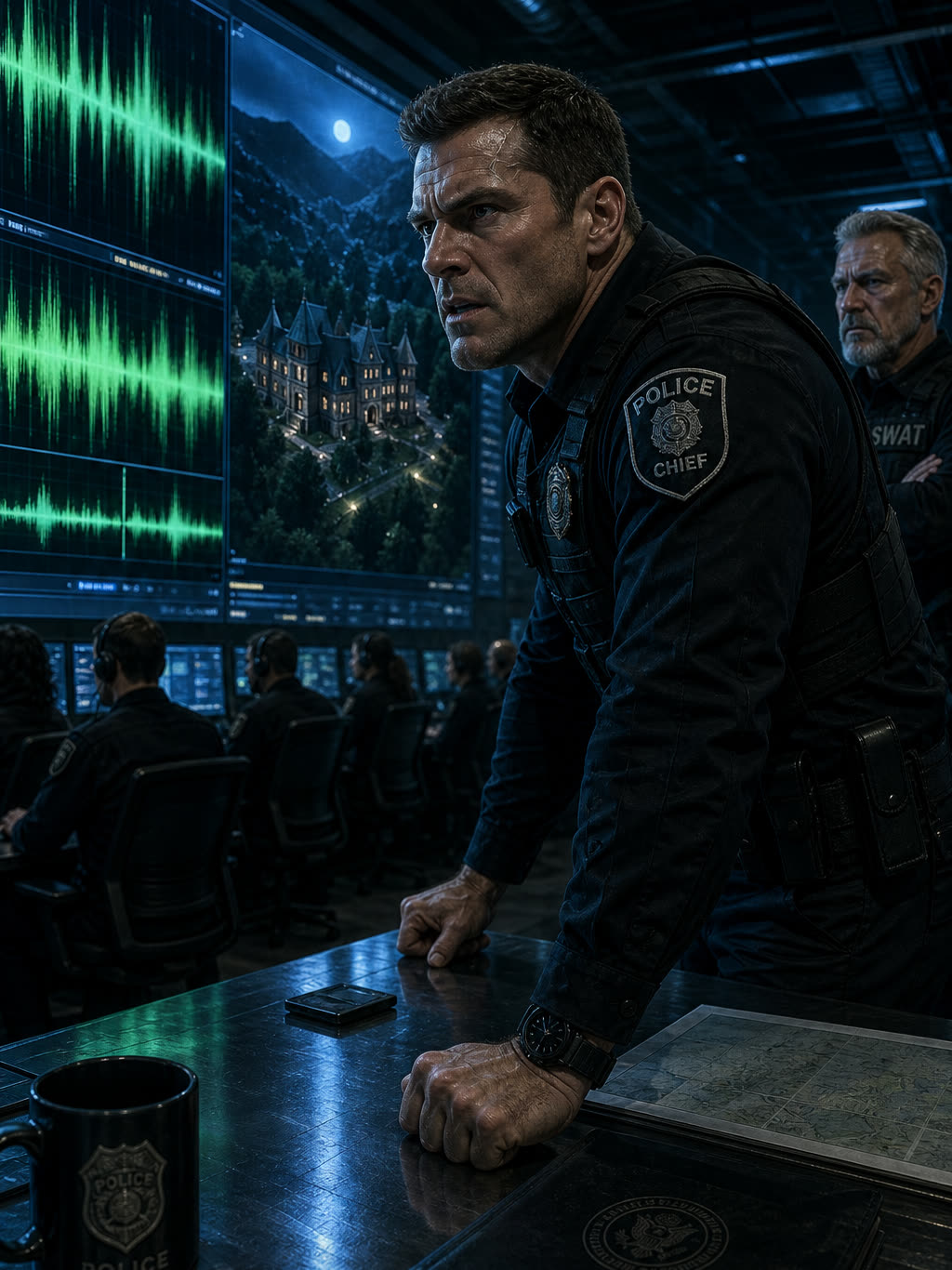
Behind him, twelve tactical dispatchers, two SWAT squad commanders, and the lead operations supervisor sat in complete, frozen silence. No one reached for a coffee cup. No one touched a keyboard.
The audio had been streaming since 6:02 PM.
Through the high-fidelity monitor speakers, the room had heard every moment of the nightmare. They had heard my head slam against the drywall. They had heard the sickening, unmistakable wet crunch of my larynx being crushed by hand. They had heard the wet, horrifying snap of my radial bone splintering beneath David Sterling’s fist. They had heard me choking and vomiting on the floorboards, followed by David’s calm, cultured voice promising my execution in the cellar.
Then, only moments earlier, the command center had heard Eleanor Sterling’s shrill, jeering laughter.
“David has outdone himself this year! Clara, my dear, you make the most astonishingly convincing battered corpse I have ever seen in all my life!”
Followed by David’s chilling, private promise: “When this masquerade is over, we’re going home. I think an accidental drowning in the indoor pool will tidy this up quite nicely.”
And last of all, the faint, ragged whisper that had broken the silence of the monitoring room:
“Marcus… did you hear him?”
SWAT Commander Robert Miller, a weathered twenty-year veteran stationed at the perimeter console, slowly removed his headset. His hands, usually as steady as stone, were shaking with pure, white-hot professional rage. “Jesus, Chief… that’s your sister.”
Marcus didn’t blink. He didn’t shout. When he spoke, his voice didn’t grow louder; it sank instead into an arctic, subterranean flatline that raised the hair on the arms of every officer in the room.
“Two years,” Marcus said softly, his voice vibrating with the terrifying resonance of an engine running at critical pressure. “For two years, David Sterling used his money, his lawyers, and his political influence to sever Clara from me. He took her phone. He controlled her bank accounts. He convinced her friends she was unstable, and he told the city council that I was using my badge to harass his family whenever I tried to conduct a welfare check.”
Marcus reached down and lifted a heavy tactical radio from its charging cradle.
“He thought she was alone,” Marcus continued, his gray eyes locking onto Commander Miller. “He didn’t know that three months ago, when Clara managed to slip away to my office for twenty minutes, I gave her our mother’s antique silver pendant. He didn’t know that my tactical communications team had gutted the silver leaf, installed a military-grade cryptographic transponder, and wired it with an accelerometer programmed to trigger an open emergency transmission the second it experienced concussive force exceeding four Gs.”
Marcus pressed the main broadcast button on the console, routing his voice straight into the encrypted metropolitan tactical frequency—a channel reserved solely for catastrophic civil emergencies and active terror attacks.
“All units, this is Chief Vance,” he spoke. It felt as if the air pressure in the command center had plunged ten millibars in a single second. “Authorize Priority Zero . We have an active hostage situation involving premeditated attempted murder, aggravated felony assault, and ongoing witness intimidation at 1400 Sterling Ridge Road .”
Every precinct channel in the city went instantly silent. Across five sectors, hundreds of patrol officers and tactical units halted what they were doing to hear the chief’s broadcast.
“Target location is Sterling Manor,” Marcus continued, his cadence steady, clinical, and lethal. “SWAT Teams Alpha and Bravo will deploy immediately with full breaching apparatus. All available sector units within a five-mile radius will initiate a blackout approach. No sirens. No emergency beacons until perimeter breach. Code Three response upon arrival.”
Marcus turned from the desk, his hands moving with practiced, rhythmic speed as he drew his service sidearm, checked the chamber, and racked the slide with a sharp, mechanical CLACK . He holstered the weapon in his tactical drop-leg rig, seized his heavy Kevlar tactical vest bearing the four-star insignia of the Chief of Police, and buckled it across his chest.
“Chief,” Commander Miller stood up, reaching for his own combat helmet. “The Sterling family has the Mayor on speed dial. Half the state supreme court is inside that ballroom right now.”
Marcus stopped at the heavy armored exit door of the command center. He glanced back over his shoulder, his eyes blazing with an ancient, unbending fury that promised biblical ruin.
“Let them call the Mayor,” Marcus Vance said, his voice cold enough to freeze blood. “By the time the Mayor wakes up, I will have David Sterling in steel irons, or I will carry him out of that house in a body bag. Deploy the rams. Nobody leaves that estate tonight.”
High in the wooded, twisting hills of Sterling Ridge, the darkness of the autumn night was abruptly carved open by shadows.
Six tactical transport vehicles, escorted by twelve interceptor cruisers, climbed the switchbacks like a pod of predatory orcas cutting through black water. Their headlights were fully dark; their running lights had been cut. They navigated entirely by military infrared night-vision systems, their massive tires grinding silently over the wet asphalt.
At the head of the column, the lead BearCat armored vehicle surged past sixty miles per hour as it swung around the final curve.
Ahead loomed the massive, twelve-foot wrought-iron gates of the Sterling Estate, their ornamental gilded spikes glinting in the faint October moonlight, emblazoned with the bronze Sterling family crest.
Inside the BearCat’s cabin, the lead breacher gripped the hydraulic controls of the reinforced steel battering ram mounted on the front.
“Three hundred yards,” the driver announced over the internal comms. “Ram locked. Speed sixty-five.”
Marcus Vance sat in the passenger seat of the lead vehicle, his assault carbine braced firmly across his chest, his eyes locked on the iron gates ahead.
“Take the gates,” Marcus ordered.
In the Grand Ballroom, the masquerade was building toward its climax.
A fresh tower of crystal flutes had been stacked on the central banquet table, seven feet high and brimming with sparkling golden champagne. The string quartet had shifted into an energetic, frenzied rendition of a Vivaldi concerto, their bows racing across the strings with frantic elegance. Guests were dancing, their heavy silk cloaks swirling, their laughter loud, rowdy, and loosened by hours of vintage liquor.
David still sat beside me, his thumb pressing heavily on my broken wrist.
“Look at them, Clara,” he whispered into my hair, his voice oozing smug satisfaction. “They worship us. In an hour, we’ll slip out the side terrace. Nobody will even notice we’re gone. And by morning, the police will be fishing you out of the deep end, and I will be the grieving widower with fifty witnesses to prove how happy we were tonight.”
I didn’t flinch. The pain in my wrist had faded from a sharp, shrieking burn into a deep, pulsing numbness that crept up my arm like frost. But my mind was no longer clouded. The terror that had frozen me on the foyer floor was gone, burned away by the icy understanding of what was about to happen.
I felt it before I heard it.
It began as a deep, seismic tremor through the soles of my shoes—a violent, rhythmic shudder that set the champagne flutes on the high tables rattling against each other.
“What is that?” David muttered, his brow creasing beneath his porcelain mask. He raised his head, and for the first time all evening his grip on my broken arm loosened. “Is there maintenance work on the lower drive?”
The towering twelve-foot stained-glass French doors that led out to the rear terrace did not simply swing open.
They were obliterated.
BOOM.
Part 3: The Stripping of the Mask
It wasn’t the blast of gunpowder; it was the concussive, catastrophic collision of a six-ton armored vehicle smashing through the outer portico at full speed. A split second later, two high-intensity tactical flashbang canisters sailed through the broken frames, arcing through the air and landing dead center on the dance floor.
FLASH-BANG.
A blinding, 180-decibel whiteout detonation tore through the ballroom.
The noise was physical, a concussive sledgehammer of compressed air that burst every fragile champagne glass within thirty feet. The towering champagne pyramid collapsed in an avalanche of crystal shrapnel and spraying liquor. Fifty high-society socialites—judges, politicians, heiresses, and executives—screamed in raw, animal terror as their eardrums ruptured and blinding white light wiped out their vision.
Costumed bodies dropped to the floor in droves, skidding on spilled alcohol and shattered glass, scrambling over one another in a frantic, desperate stampede toward the service exits.
The classical waltz died mid-measure as the quartet clambered over their toppled cellos.
Through the shattered terrace doors, cutting through the thick haze of pulverized glass and burning magnesium smoke, came the deafening mechanical howl of tactical sirens and the blinding, high-intensity halogen floodlights of thirty police cruisers ringing the perimeter. The ballroom was lit with the harsh, clinical glare of a football stadium.
“METROPOLITAN POLICE! SWAT! NOBODY MOVE! DOWN ON THE FLOOR! DOWN ON THE GROUND!”
The roar of twelve tactical operators filled the room. Clad in matte-black tactical armor, their faces hidden behind ballistic helmets and gas masks, the breachers streamed through the broken frames with military precision. Their assault carbines were held at low-ready, their green and crimson laser sights slicing through the smoke and painting the walls, the chandeliers, and the terrified faces of the aristocrats with glowing crosshairs.
“What is this?!” David shrieked, his voice leaping two octaves into a hysterical, cowardly squeak. The arrogance that had defined him for three years vanished in an instant. “Do you know who I am?! I am David Sterling! Get these weapons out of my face!”
In a panic, watching the crimson laser dots skitter across his tuxedo, David lunged at me with both hands, his fingers clawing savagely at my shoulder as he tried to yank me upright and use my body as a human shield between himself and the advancing tactical line.
“Get up, Clara! Stand up!” he screamed.
For three years, I had given in. For three years, I had shrunk into the corners of rooms, softened the tone of my voice, and hidden my bruises under silk scarves to escape his rage.
Not tonight.
When his hand clamped down on my good shoulder, I didn’t pull away. I twisted my hips, planted my feet firmly on the parquet, and drove my right elbow with every last ounce of kinetic energy in my body straight into his solar plexus.
THUD.
The air burst from David’s lungs in a wet, ragged gasp. He reeled backward, his heels snagging on the heavy linen tablecloth. With a spectacular, undignified crash, David toppled onto his back amid spilled platters of roasted venison, shattered porcelain, and spreading pools of red wine.
I stood over him. My black silk gown was splashed with champagne, my fractured left arm hung limp at my side, but I held my head higher than I ever had in my life.
Through the thinning smoke at the terrace doors walked my brother.
Chief Marcus Vance did not run. He moved with the heavy, deliberate stride of an executioner approaching the scaffold. He wore full tactical combat gear, his four-star commander’s vest stark against the black uniform beneath, his service sidearm drawn and aimed with unwavering, mechanical precision squarely at David Sterling’s forehead.
His face was an unreadable, terrifying mask of total authority. He didn’t glance at the shrieking socialites crawling under the catering tables. He didn’t glance at the toppled candelabras setting fire to the hems of the velvet curtains.
He walked straight to Table One.
David was scuttling backward like a beetle flipped on its shell, his expensive tuxedo soaked in red wine, his hands sliding on broken glass, his face as pale as chalk. “Marcus! Marcus, wait! This is a misunderstanding! This is a private party! You can’t do this!”
I stepped between my brother and my husband.
In the sudden, heavy silence that settled over the wrecked ballroom—interrupted only by the idling growl of the armored vehicles outside—I lifted my trembling right hand to my throat.
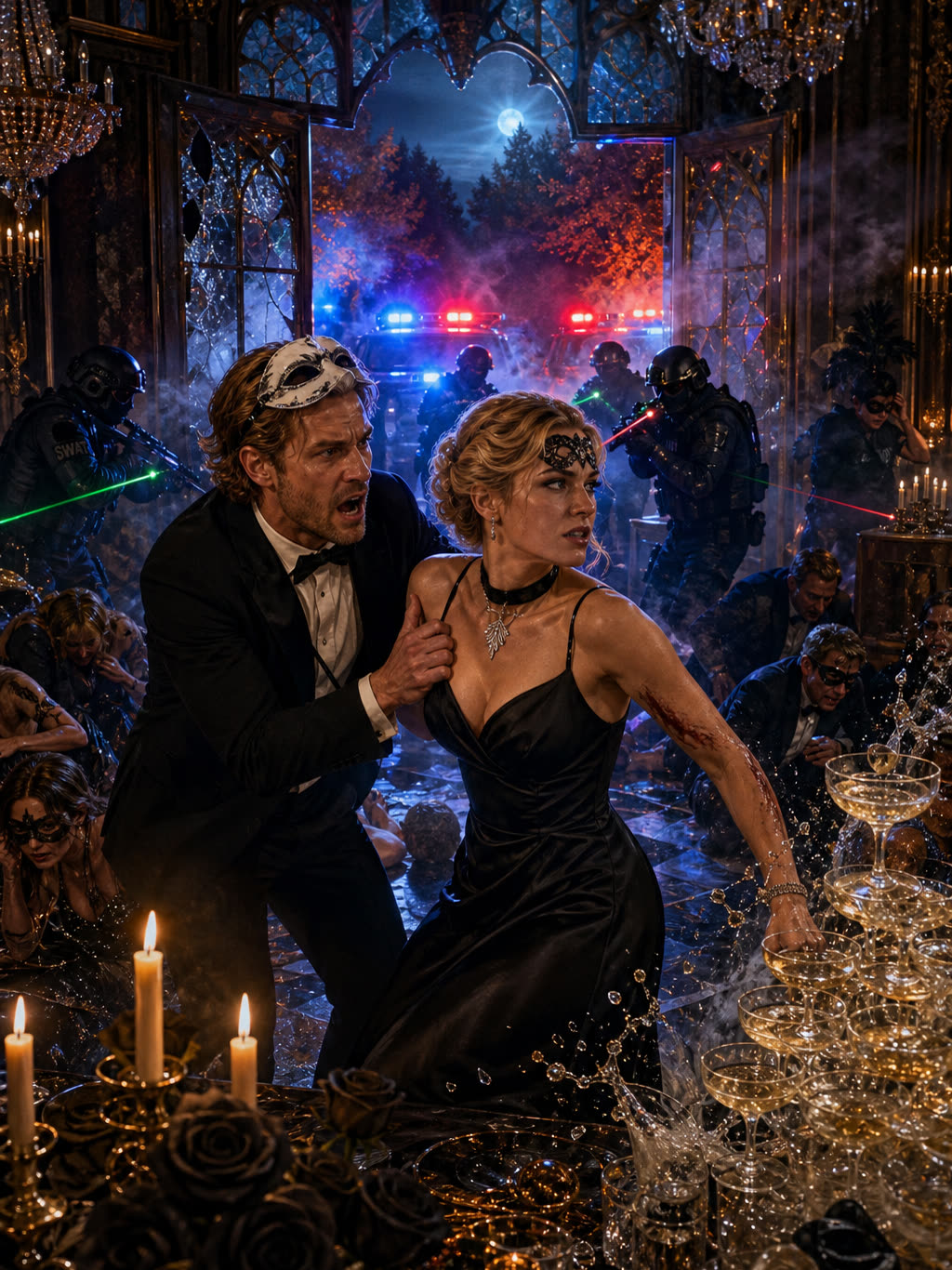
My fingers found the silver clasp at the nape of my neck. With a clean, deliberate click, I released it.
I peeled the heavy black velvet band away from my skin.
A collective, horrified gasp swept through the socialites huddled on the floor.
With the velvet gone, the full horror of David’s work lay bare under the blinding glare of the police floodlights. My neck was a landscape of catastrophic injury: a deep, unbroken ring of black-and-purple hematomas, the distinct, brutal imprints of human thumbs pressed deep into my trachea, and raw, bleeding scrapes where the velvet had chafed the crushed skin.
I looked down into David’s weeping, pitiful face.
I opened my hand and let the black velvet choker, with its silver weeping willow pendant, fall straight onto his chest.
“It’s not makeup, David,” my voice rasped, clear and resonant through the smoke-filled room. “And those federal handcuffs aren’t a costume.”
Marcus moved forward, his heavy tactical combat boot sweeping with blinding speed. He kicked David’s legs out from beneath him, flipped him onto his stomach with one hand, and drove his knee squarely into the middle of David Sterling’s spine, pinning him flat to the floorboards.
CLACK-CLACK.
The heavy, high-carbon steel handcuffs ratcheted shut around David’s wrists with a loud, sharp, final sound. It was like the slam of an iron vault door.
“Ahhh! My shoulder! You’re dislocating my shoulder!” David shrieked, his cheek mashed into the puddle of spilled wine and broken glass. “Marcus, please! We’re family! You’re making a mistake!”
Marcus didn’t ease off. He pressed his knee harder into David’s thoracic spine, reaching down with his gloved left hand to seize a fistful of David’s styled sandy hair and wrench his head back, lifting his face directly into the glare of the tactical lights.
“David Sterling,” Marcus spoke. His voice was an arctic flatline that seemed to rattle the plaster moldings of the ballroom ceiling. “You are under arrest for attempted first-degree murder by manual strangulation, aggravated domestic battery resulting in grievous bodily harm, and felony witness intimidation.”
“You have no proof!” David wept, blood trickling from his nose where it had struck the floor. “It’s her word against mine! You planted this! You orchestrated this whole raid!”
“We have two hours and fourteen minutes of continuous, uncompressed, cryptographic audio recorded on a dedicated federal frequency,” a new voice rang out from the terrace doors.
Stepping through the shattered glass came District Attorney Sarah Hayes . She wore no costume, only her sharp charcoal courtroom suit, her leather portfolio tucked under her arm, flanked by two armed state investigators.
“Every threat you made in your foyer,” District Attorney Hayes said, looking down at David with undisguised revulsion, “every word of your intent to stage a drowning in your indoor pool, and every single second of your physical assault was recorded, time-stamped, and archived directly onto the Department of Justice secure servers. An emergency grand jury was convened twenty minutes ago. An indictment for attempted murder has already been signed by the presiding judge.”
From across the ruined room, a shrill, hysterical scream ripped through the air.
“Get your filthy hands off me! How dare you! Do you know who I am?!”
Eleanor Sterling was writhing violently against the catering table. Her towering Marie Antoinette wig had been knocked completely askew, drooping over her left ear like a dying bird and shedding white powder all over her brocade gown. Her diamond necklace had snapped in the struggle, scattering hundreds of thousands of dollars in loose stones across the wet parquet.
Two female tactical officers held her arms locked behind her back, bending her down until her aristocratic forehead hung inches above an overturned silver soup tureen.
“Marcus Vance!” Eleanor spat, her face twisted with grotesque, aristocratic fury. “I built this city! My family built the department you work for! I will have your badge stripped by morning! I will have every single officer in this room fired and blacklisted from law enforcement!”
District Attorney Hayes strolled calmly over to the struggling matriarch and drew a red-sealed legal document from her portfolio.
“Eleanor Sterling,” Hayes announced, her voice cutting through Eleanor’s screeches. “At 8:42 PM this evening, you were recorded acknowledging the severe manual strangulation marks on your daughter-in-law’s neck. You were recorded loudly identifying them as resembling a ‘battered corpse,’ and you were subsequently recorded threatening Clara Vance with murder in a pine box if she disrupted your son’s social standing.”
Eleanor’s face went completely slack, the color draining from her cheeks until she looked older than her years, her powdered makeup cracking around her gaping mouth.
“You are being charged under the state penal code as an active accessory to attempted capital murder, felony obstruction of justice, and felony witness tampering,” Hayes stated, nodding to the officers. “Take her into custody. Due to the recorded death threats, the Commonwealth is moving for pretrial detention without the possibility of bail.”
“No!” Eleanor screamed as the steel cuffs snapped around her frail, ringed wrists. “David! David, do something!”
David didn’t respond. He couldn’t. Two hulking SWAT operators were dragging him to his feet, his custom tuxedo torn to ribbons, his face smeared with tears, mucus, and red wine, his expensive leather shoes scraping uselessly across the floorboards as they marched him toward the terrace.
Two tactical paramedics hurried to my side with a trauma kit and a folding stretcher.
“Ma’am, please don’t move,” the lead paramedic said gently, his fingers immediately reaching for my carotid pulse. “We need to stabilize that cervical spine immediately. The swelling on that airway is critical.”
“My wrist,” I managed to whisper, the adrenaline finally draining away and leaving my body racked with violent, uncontrollable shivers. “It’s broken.”
“We see it, ma’am. We’re going to splint it right now.”
As they carefully fastened a rigid cervical collar around my bruised neck and fitted an oxygen mask over my face, the heavy, reassuring weight of a fleece jacket came to rest across my trembling shoulders.
I looked up through the clear plastic of the oxygen mask.
Marcus stood above me. The terrifying, archangel wrath that had burned in his eyes during the raid had vanished entirely, replaced by a deep, devastating sorrow. He dropped to his knees beside the stretcher, his tactical helmet off, his forehead resting softly against my uninjured shoulder.
His large, calloused hands—a warrior’s hands—gently took my good right hand and held it against his cheek.
I felt the hot, silent trail of his tears across my knuckles.
“I’m sorry, Clara,” Marcus choked out, his voice breaking for the first time in his life. “I’m so sorry I let him keep you from me for so long. I should have kicked his door down a year ago.”
I raised my right fingers and touched my brother’s hair.
“You came,” I whispered beneath the mask, the clean, cool oxygen filling my burning lungs. “You brought the whole world with you, Marcus.”
“I promised Dad I’d always protect you,” he whispered, lifting his head, his gray eyes shining with fierce, eternal devotion. “The monster is in a cage, Clara. He will never, ever touch you again.”
The paramedics lifted the stretcher and carried me out through the shattered stained-glass doors into the crisp autumn night.
As they slid me into the back of the lead tactical ambulance, thirty police cruisers sat with their light bars washing the granite turrets of Sterling Manor in rhythmic waves of blue and crimson.
I watched through the ambulance’s rear windows as we pulled away down the winding estate drive.
At the main entrance, the heavy, gilded wrought-iron gates lay twisted and crushed in the ditch. The bronze crest of the Sterling dynasty had been sheared clean off the stone pillars by the police battering ram, and it lay face-down in the mud, trampled beneath the heavy tread of thirty tactical tires.
One year later.
The October breeze rolling across the rolling hills of western Virginia did not smell of damp velvet, dying flowers, or funeral gardenias. It smelled of woodsmoke, sweet honeycrisp apples, and clean, unpolluted mountain air.
I stood on the wide, cedar-plank porch of my new farmhouse, holding a heavy ceramic mug of steaming chamomile tea with both hands.
My hands were steady.
I looked down at my left wrist. A faint, razor-thin surgical scar ran along the margin of the radial bone—the only remaining physical trace of the titanium plate and six pins that had knit my arm back together with unyielding strength. There was no tremor in the fingers. In my sunlit studio just inside the French doors, a six-foot watercolor canvas of a wild mountain laurel stood on the easel, every intricate vein and delicate petal rendered with absolute, breathtaking precision.
My neck was completely bare.
I wore an open-collared cream linen shirt, completely unbuttoned at the throat. There were no velvet ribbons. No silk scarves. No high collars. Just smooth, sun-warmed skin, completely open to the light of the morning sun. The deep, terrifying shadows that had once carved David’s fingers into my throat were gone, erased by time, surgery, and peace.
The legal storm that followed that Halloween night had been swift, devastating, and absolute.
There was no trial. The uncompressed audio captured by the tactical transponder—coupled with the high-resolution forensic macro-photography taken by the police technicians before my surgery—left David Sterling’s high-priced legal defense team with zero options. Faced with overwhelming, indisputable evidence of premeditated attempted murder, David accepted a plea agreement to avoid life imprisonment.
He was sentenced to twenty-five years at the Red Onion State Penitentiary—a maximum-security facility three hundred miles west, carved into the side of a barren mountain. There are no Italian tuxedos there. There are no vintage champagnes or society galas. His daily routine consists of twenty-three hours inside an eight-by-ten concrete cell, his high-society name erased from every corporate board and social registry in the country.
Eleanor Sterling’s fate was equally absolute. Convicted of felony conspiracy and witness tampering, she was sentenced to eight years at the state women’s correctional center. The Sterling commercial real estate empire, stripped of its leadership and paralyzed by massive civil lawsuits filed on my behalf, collapsed into bankruptcy. The grand manor on the ridge was seized by the court, liquidated at auction, and the proceeds were transferred entirely into a trust bearing my name.
The crunch of tires on the gravel driveway broke the morning quiet.
A dark green pickup truck pulled up beside the porch. The driver’s door swung open, and Marcus stepped out.
He wasn’t wearing tactical armor. He didn’t have a weapon strapped to his thigh. He wore faded denim jeans, a warm flannel shirt, and a wide, easy smile that reached all the way to his gray eyes. In his arms, he carried a heavy wooden bushel basket overflowing with fresh, crisp mountain apples from the orchard down the valley.
“Morning, Clara,” Marcus called out, jogging up the porch steps with the effortless athleticism that had carried him through a lifetime of service. He set the basket down on the cedar planks and pulled me into a fierce, warm bear hug.
I buried my face into his shoulder, breathing in the familiar, comforting scent of cedar, coffee, and clean wind.
“You’re late,” I teased him gently, pulling back with a smile. “The tea is already half cold.”
“Traffic on Route 29,” Marcus laughed, leaning his back against the porch railing, looking out over the golden, sun-drenched valley. “Some city folks trying to look at the autumn leaves.”
He turned his head, his eyes sweeping over my open collar, resting for a moment on the smooth, unblemished skin of my throat. His smile softened into something deeply protective, something sacred and eternal.
“How does the air taste today, Clara?” he asked softly.
I leaned against my brother’s side, closed my eyes, and drew in a deep, long, effortless breath. I felt the crisp, cold oxygen fill every chamber of my lungs—clean, unbroken, and free.
“It tastes like freedom, Marcus,” I whispered into the autumn light.
They thought they could choke the life out of a woman because she was quiet. They thought wealth and social decorum could build a wall high enough to conceal the destruction of a human soul.
They forgot that when you try to steal someone’s breath… they might just bring an entire storm home to take it back.
As the morning sun climbed higher over the ridge, my phone buzzed on the wooden porch table.
I picked it up. It was a formal notification from the Department of Justice: the inaugural grant for The Unbroken Voice—the foundation I had established using the liquidated Sterling assets to engineer and distribute covert tactical alert technology to domestic abuse survivors nationwide—had just been officially ratified.
Over five thousand hidden units were scheduled to be distributed to shelters across three states by the end of the month.
I looked up at Marcus, my heart beating with fierce, unshakable purpose.
“Let’s go save some lives, Chief.”
Disclaimer: This story is a work of fiction inspired by real-life themes. Names, characters, places and events are fictionalized, and any resemblance to real persons is purely coincidental. Images are for illustration purposes only.
