Dona Carmen was born in a small, dusty village in Michoacán, Mexico — a place where the sun punished the land and hard work was the only inheritance anyone could hope for. Orphaned at a very young age, she learned that life offered no shortcuts. At eighteen, she married a humble construction worker, but tragedy struck when her son, Ricardo, was only three years old. A fatal accident at a job site took her husband, leaving her widowed, with not a single peso and a child to feed. Desperate, Carmen made the decision to move to the vast Mexico City in search of a future. They lived in a tin-roof shack in a marginalized neighborhood of Iztapalapa. By day, Carmen cleaned houses for wealthy families in Polanco; by night, she prepared tamales and atole to sell in the cold early mornings. She walked kilometers in the rain, her feet covered in blisters, sleeping barely four hours a night — but every time she looked at Ricardo’s face, she found the strength to keep going.
Ricardo grew up watching his mother sacrifice her entire life. He saw her wear the same torn pair of shoes for four years so he could have school sneakers. He saw her refuse to eat, pretending she wasn’t hungry, just so he could have a second serving. Every sacrifice carved itself into his soul. He studied with fierce determination, often by candlelight. At seventeen, he earned a scholarship to a prestigious university. Ricardo graduated, started as an intern in a logistics company, and within fifteen years became one of the most powerful and respected businessmen in the entire country. He bought a spectacular mansion in Lomas de Chapultepec, luxury cars, and wanted to give his mother the world. But Carmen was a simple woman; she refused to live in the mansion because she felt she didn’t belong there. She only accepted a small, comfortable house twenty minutes away, where she could tend her own garden.
Then Rafaela entered Ricardo’s life. Rafaela was a high-society woman, always dressed in exclusive brands, obsessed with status and appearances on social media. She didn’t fall in love with Ricardo — she fell in love with what he represented: power, luxury, and an unlimited bank account. They married a year later in a monumental event that cost millions of pesos. Dona Carmen attended wearing a modest dress she had altered herself. In the middle of the celebration, Rafaela looked her up and down and whispered with contempt, “You could have tried a little harder not to look so miserable at my wedding.” Carmen didn’t respond. She simply smiled and walked away. She knew that woman would be trouble — but for the sake of her son, she remained silent.
For illustration purposes only
Over the next five years, Rafaela built an invisible wall between Ricardo and his mother. She invented excuses, scheduled lunches with her superficial friends on the exact days Carmen would visit, just to leave her sitting alone in the living room, and always justified her cruelty with fake concern. Carmen, unwilling to cause problems in her son’s marriage, slowly began to distance herself. The climax of this silent war came when Rafaela organized a massive party at the mansion to showcase her power to Mexico’s elite. There were 150 guests on the list — politicians, businessmen, and celebrities — but Dona Carmen’s name was not on it. When Ricardo noticed, Rafaela pretended she would invite her personally in a “more special way.” The next day, she called Carmen and told her it would be a “small and simple gathering.”
On the night of the party, Carmen arrived at the mansion wearing her best dark blue dress and flat shoes. The moment she stepped inside, she realized the trap. The luxury was overwhelming — women dripping in diamonds, waiters carrying silver trays, imported floral arrangements. She quietly sat in a corner near a window, trying to remain invisible while waiting for Ricardo, who was stuck in traffic across the city. Rafaela, on the other side of the hall, sipped champagne with her Polanco friends, mocking her mother-in-law. “Look at her… she looks like a beggar who snuck into the party,” Rafaela said venomously.
Her friends laughed, encouraging her to do something about it.
Alcohol and years of resentment finally pushed Rafaela over the edge. She hated Carmen because she knew Ricardo would always love his mother more than her. With firm steps and eyes filled with hatred, Rafaela walked toward the corner where Carmen sat. The music kept playing, but conversations slowly faded. Everyone could feel something terrible was about to happen. Rafaela stopped in front of the older woman, blocking the light, and began insulting her loudly, humiliating her in front of everyone for her origins and her clothes.
Carmen, heartbroken, held back her tears.
But Rafaela wasn’t satisfied with words.
Her eyes landed on a glass pitcher filled with ice water and slices of lemon sitting on the nearby table.
Her fingers tightened around the glass.
What was about to happen next… no one in that room was prepared for.
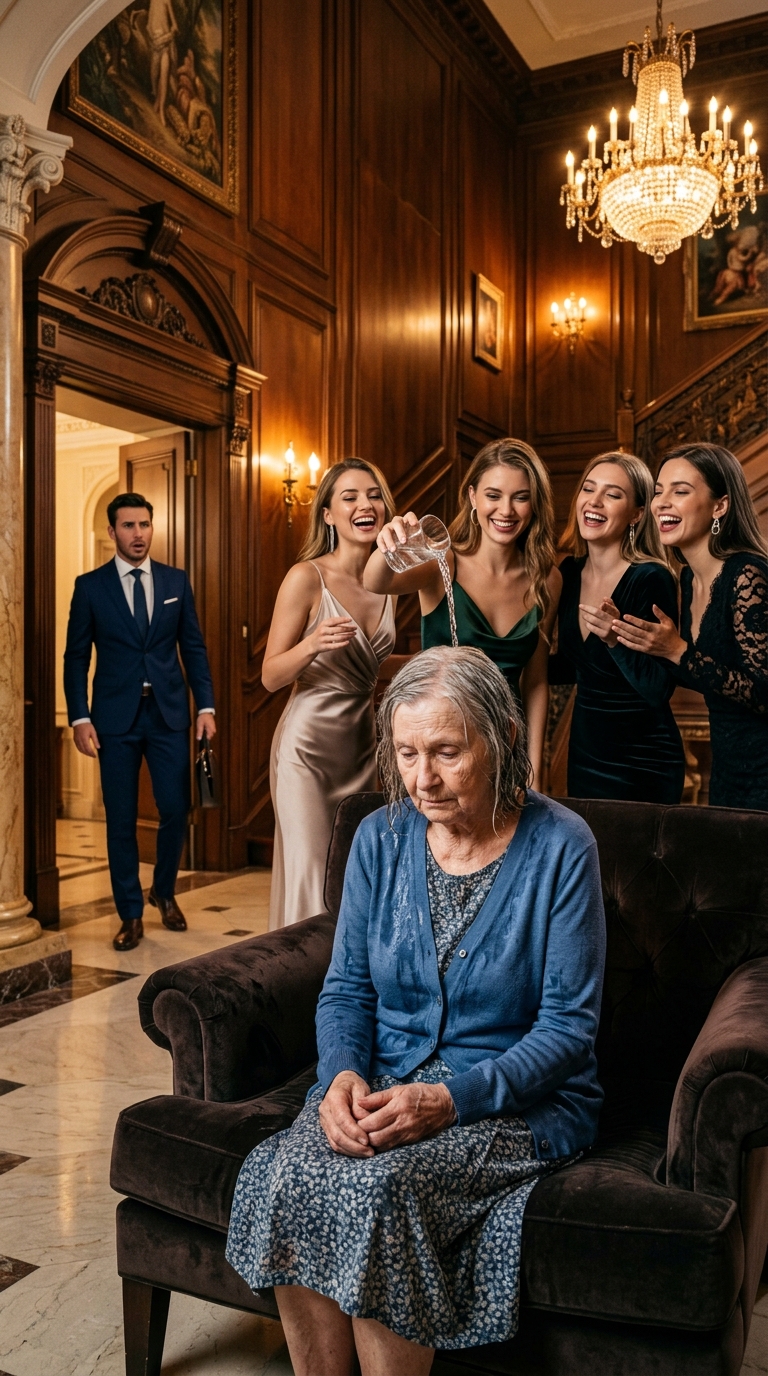
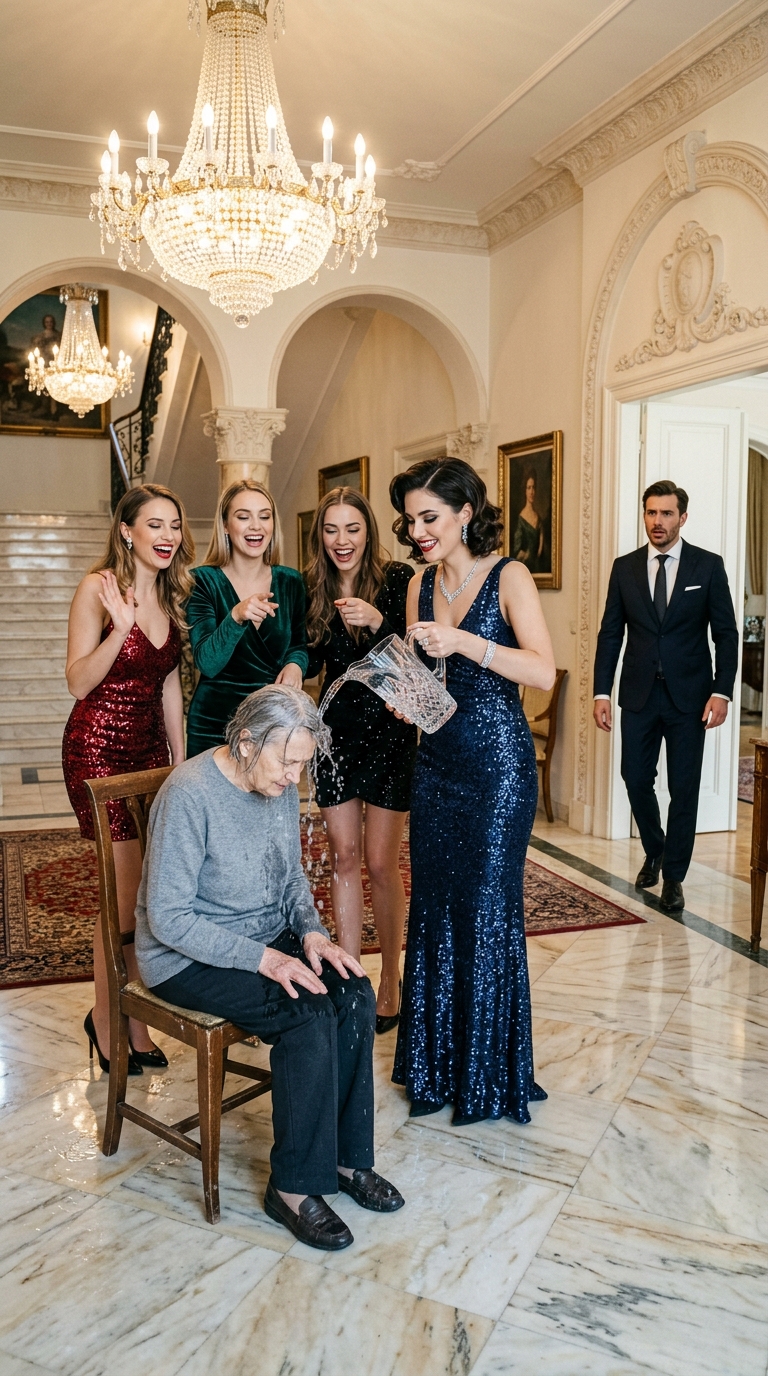
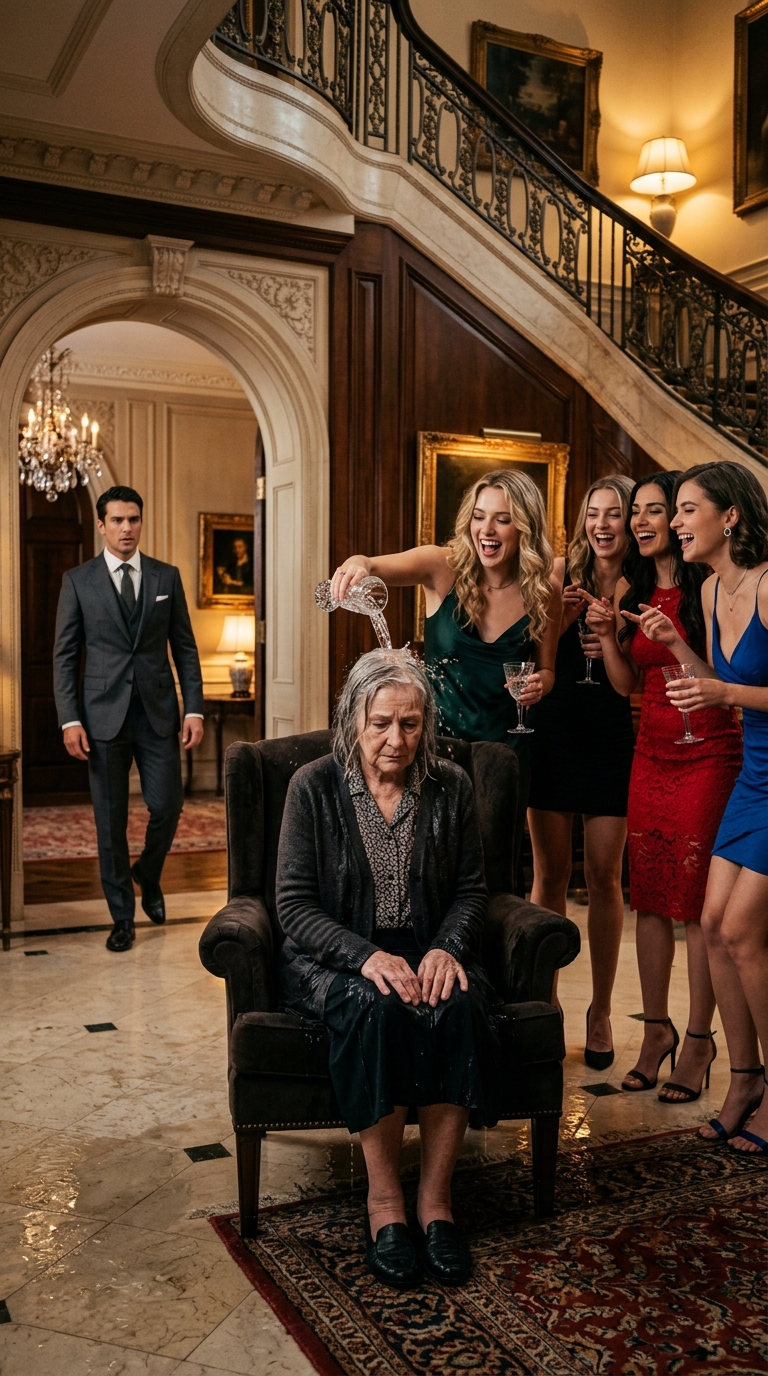
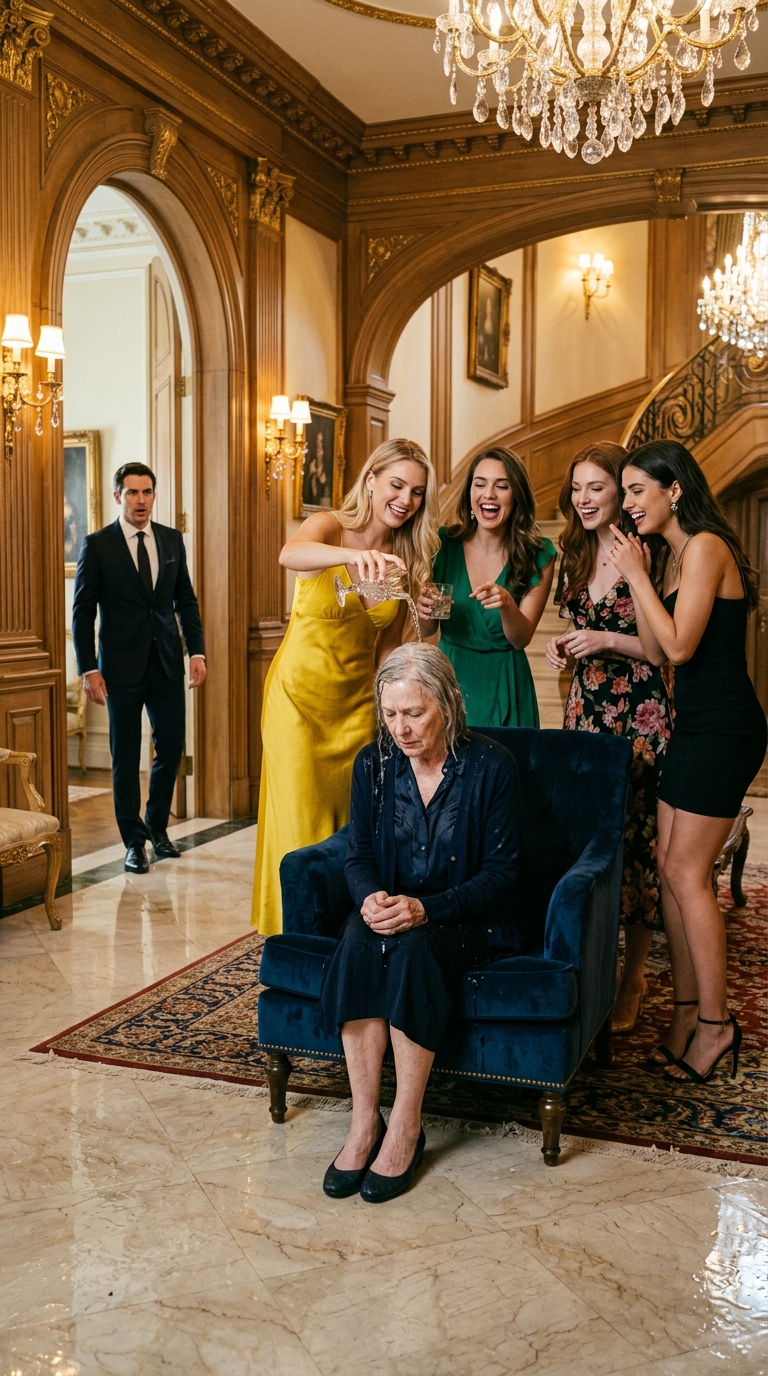
With one swift movement, fueled by years of jealousy and cruelty, Rafaela lifted the heavy glass pitcher and poured its icy contents directly over Dona Carmen’s head. The cold water streamed down the elderly woman’s wrinkled face, soaking her dark blue dress and dripping onto the expensive marble floor. The lemon slices fell into her lap like a final insult. The entire hall fell into a deathly silence. No one breathed. Some high-society women covered their mouths in shock, others let out nervous, restrained laughter, but not a single person moved to help.
Dona Carmen did not scream, did not cry, did not even try to wipe her face. She simply closed her eyes. In that moment of deep public humiliation, her mind was no longer in that luxurious mansion. It drifted back to the cold nights in Iztapalapa, when she went to sleep hungry so her son could eat. She remembered the humiliations she endured cleaning other people’s homes just to buy Ricardo’s schoolbooks. She remembered everything she had sacrificed, all the love she had given, so her son could rise to the top. And now she was here — soaked and humiliated in her own son’s house, surrounded by wealthy people who looked at her with pity or contempt. Rafaela broke the silence with a mocking laugh. “This is so you learn not to dirty anything in this house again — a house that will never be yours,” she declared arrogantly.
But what Rafaela didn’t know was that, at that exact moment, the main door had opened. Ricardo was standing at the entrance. In one hand, he held a large bouquet of flowers; in the other, a velvet box containing a piece of jewelry he had bought for his mother. His eyes took in the entire scene: his wife holding the empty pitcher… and his mother, drenched, humiliated in front of 150 guests.
The bouquet slipped from his hand, scattering red petals across the marble like drops of blood. The sharp sound of the flowers hitting the ground made everyone turn. Rafaela dropped the pitcher, which shattered into pieces, breaking the tension in the room. Terror flooded her face when she saw her husband. “Ricardo, my love…” she stammered, the alcohol draining from her system, leaving only paralyzing fear. “It’s not what it looks like, she provoked me, I just—”
For illustration purposes only
Ricardo raised his hand, silencing her without saying a word. His footsteps echoed over the broken glass as he walked straight toward his mother. He removed his expensive designer coat and gently placed it over Dona Carmen’s trembling shoulders, shielding her from the cold and from the eyes of the crowd. “Mom… look at me,” he whispered, his voice breaking.
When Carmen opened her eyes and saw her son’s face filled with love and pain, she finally broke down. The tears she had held back poured out. Ricardo held her tightly in front of the entire elite audience, not caring about ruining his clothes. “It’s over, Mom. I’m here,” he told her.
Then slowly, Ricardo pulled away and turned toward his wife. Rafaela stepped back, trembling. In Ricardo’s eyes there was no explosive rage — but something far more devastating: absolute, cold, final disappointment.
“Explain what, Rafaela?” he said, his tone so calm it was terrifying. “That you poured ice water on my mother in front of 150 people… in my own house? For five years, I pretended not to see your disgust, pretended not to hear your venomous comments. I wanted to believe that deep down, you were a good person. But I was wrong. You are exactly the empty monster I always feared you were.”
Rafaela collapsed to her knees, sobbing uncontrollably. “Please, it was a mistake, I love you!” she begged.
Ricardo let out a dry, bitter laugh. “You love me? You love this mansion. You love unlimited credit cards. You love status. But real love? You’ve never known it.”
Ricardo turned to the guests, who remained frozen in shock. “I apologize to everyone for this spectacle. This wasn’t the party I planned… but since you’re all here, I might as well make an announcement.”
He walked to where his gift had fallen, picked up the velvet box, and returned to his mother. Kneeling in front of her, he opened it, revealing a beautiful gold necklace with a pendant. “Mom, this necklace is just a symbol of my gratitude,” he said, tears in his eyes.
Then he reached into the inner pocket of his coat — still wrapped around Carmen — and pulled out a thick envelope.
“The real gift is this. These are the deeds and legal documents. Seven days ago, I transferred 100% of my assets into your name. This mansion, the cars, the bank accounts, the companies… everything legally belongs to you now.”
A wave of disbelief swept across the entire hall. Ricardo’s business associates exchanged stunned glances. Rafaela, still on the floor, felt as if the ground had collapsed beneath her. “What?!” she screamed, her voice breaking. “You can’t do that! I’m your wife — I have legal rights!”
Ricardo looked at her, his gaze cold as ice. “You had rights. Our marriage ended the moment you lifted that pitcher. And since the transfer was made a week ago — before any divorce proceedings — you are entitled to absolutely nothing. You leave this house with exactly what you brought into my life: nothing.”
For illustration purposes only
Rafaela erupted into hysterical screams, threatening lawsuits and swearing she would destroy him in the media. Ricardo simply gestured to the private security guards. “Escort this woman out. She is only allowed to take what she’s wearing.”
Two large men grabbed Rafaela by the arms and dragged her across the hall. Her screams echoed through the corridors as she passed the paintings she had chosen, the furniture she had proudly displayed on social media. The same friends who had laughed with her moments earlier now lowered their eyes, pretending not to know her. She was thrown out into the cold night of Mexico City — expelled from the paradise she herself had destroyed with her arrogance.
Inside the mansion, the atmosphere shifted completely. Ricardo ordered dry towels for his mother, and several guests, witnessing the devotion of such a powerful man toward a humble woman, approached to apologize to Dona Carmen. Those who had ignored her all night now lined up to shake her hand, recognizing the true queen of that empire. Ricardo did not leave her side for a single second.
Hours later, when the grand house finally fell silent, mother and son sat together in the living room. Carmen, now warm and dry, gently touched her son’s face. “You didn’t have to do all this for me, my son,” she whispered.
Ricardo took her hands — rough from years of hard work — and kissed them. “Mom… I wouldn’t be anything without you. This house, this success, my entire life — it’s all yours. Today, I only put things back where they belong.”
The next morning, Ricardo and Carmen shared breakfast in the vast kitchen, laughing and remembering old times — no luxury, just simple coffee and sweet bread, just like they used to have in that small room in Iztapalapa.
Meanwhile, in some cheap hotel across the city, Rafaela cried over her downfall, learning the most painful lesson of her life: arrogance can build a temporary throne, but it only takes one act of cruelty to turn it into ashes.
In the end, it doesn’t matter how much money you have in the bank or what clothes you wear — the only thing that truly defines your greatness is how you treat those who gave everything for you.