

I drove forty minutes to that Sunday lunch, both hands gripping the steering wheel, my back aching while my daughter shifted inside me as if she already sensed I was heading somewhere I didn’t belong. At seven months pregnant, even getting in and out of the car had become a struggle, but I kept telling myself it mattered. Family mattered. Marriage mattered. Showing up mattered. I had spent three years proving that to my husband, Grant, and to his mother, Dorothea, who treated warmth like something you had to earn—only to keep moving it further out of reach.
The moment I stepped onto her porch, I felt it—something was off.
The door opened just a crack before she filled the space, pearls in place, that same brittle smile that never reached her eyes. “Use the side door, Celeste,” she said, glancing past me like I was a delivery person. “We’re already set in here.”
I stood there for a moment, one hand resting on my belly. “The side door?”
“It’ll be easier,” she replied sharply. “Don’t make this awkward.”
So I walked around the house, my heels sinking into damp grass, humiliation rising hotter with every step. Inside, the scent of roast chicken and rosemary filled the kitchen. Laughter drifted in from the dining room. I followed it—and stopped cold.
Eleven people sat around the main table beneath the chandelier, wine glasses lifted, silverware clinking, smiling like a staged holiday moment. And in my usual seat, beside my husband, sat a woman in a fitted cream dress, glossy hair falling perfectly, one hand resting casually on the edge of my plate.

Sloan.
I had met her once at a charity event. Grant had introduced her as “someone from work.” She smiled with too much confidence when she saw me now, but it was Grant’s expression that broke something in me. He wasn’t surprised. He looked irritated that I had noticed.
Dorothea pointed toward a small folding table pushed beside the kitchen island, already set with a single plate and a cheap water glass. “We had to make adjustments,” she said. “You can sit there.”
“At the overflow table?” I asked quietly.
“Oh, don’t be dramatic,” she replied. “You should be grateful you were included.”
Grant finally spoke, not to defend me, but to mutter, “Celeste, just let it go. Not today.”
Not today. Not while his mistress sat in my place, wearing my smile back at me.
My throat burned, but I sat down anyway, because this family had trained me to survive by staying small. From where I was, I could hear every joke, every toast, every careless laugh. I could also see Sloan lean toward Grant and whisper something that made him smile the way he hadn’t smiled at me in months.
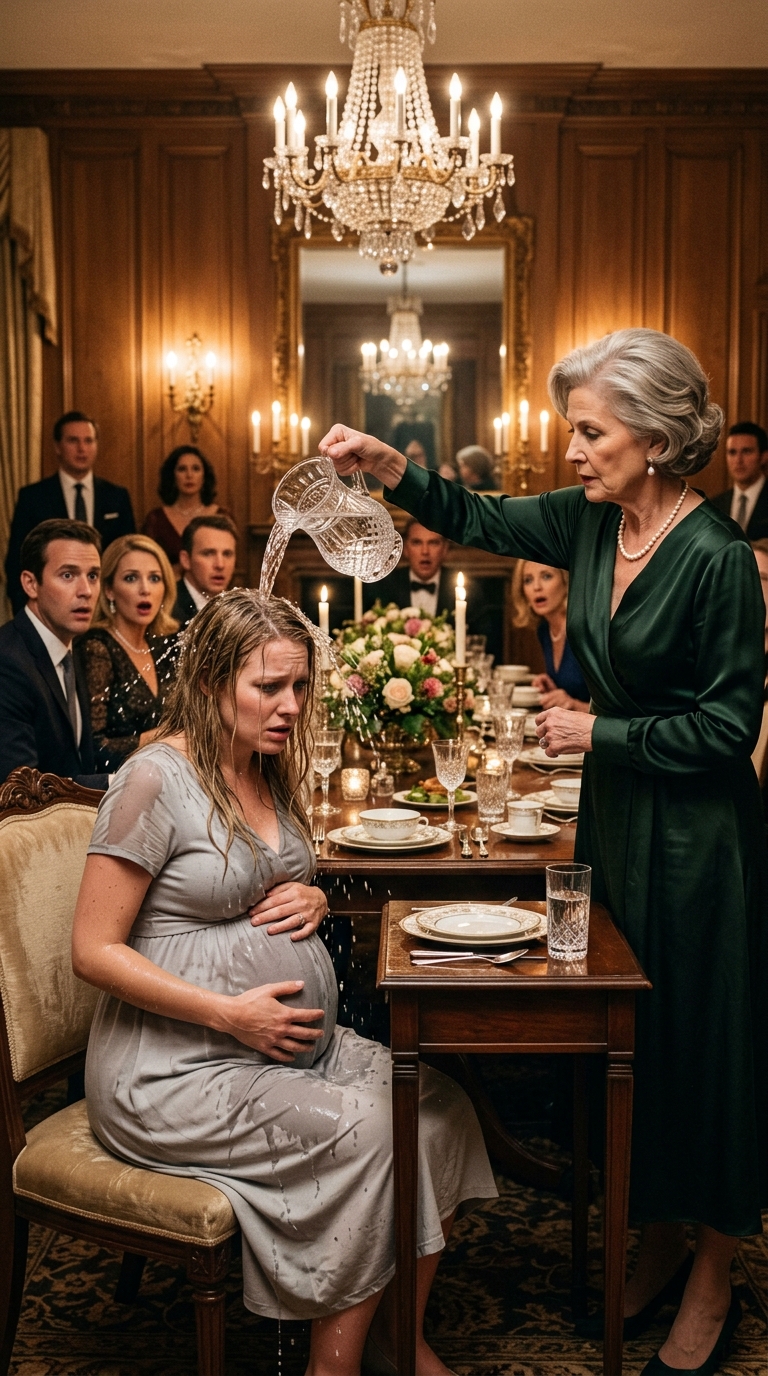
Then Dorothea swept into the kitchen carrying a crystal pitcher filled with ice water. She paused beside my small table and looked down at me like I was something sticky on her floor.
“You know,” she said loudly enough for everyone to hear, “some women can’t stand not being the center of attention.”
I looked up at her, my entire body suddenly still. “I haven’t said a word.”
She tilted her head. “Exactly.”
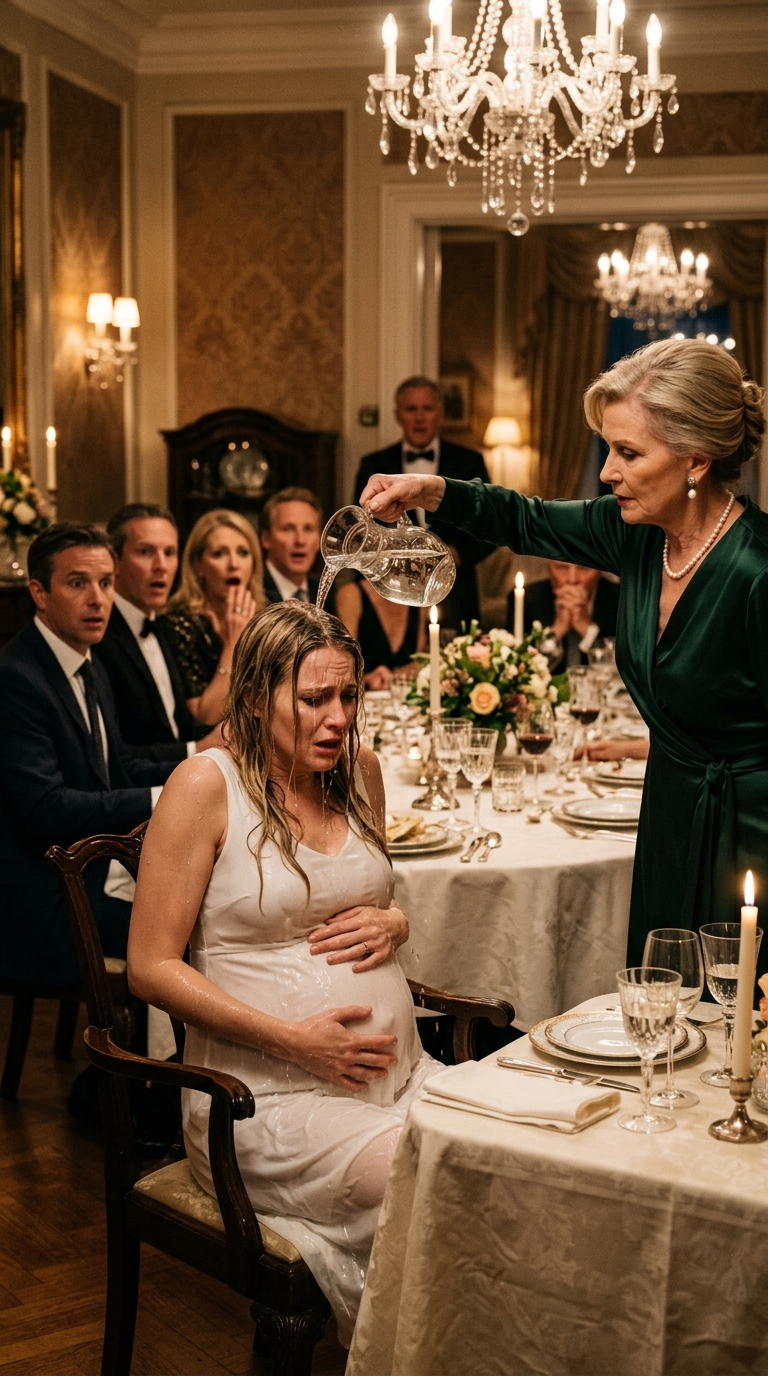
And then, before I could react, she lifted the pitcher and dumped the entire thing over my head.
Ice water poured down my face, my dress, my swollen stomach, pooling beneath my chair as the room fell silent. I gasped, one hand flying protectively over my baby.
“Leave,” Dorothea said.
I turned to Grant, soaked and shaking. He stood there holding a glass, looking at me like I was the one ruining lunch.
That was when I reached for my phone, tapped one name, and whispered through chattering teeth, “Reed… come get me.”
My brother answered on the second ring.
“Celeste?”
I could barely get the words out. My hair dripped onto the kitchen tile, my dress clung cold against my stomach, and eleven people were still staring at me like I was a scene they wanted to end. “I’m at Dorothea’s,” I said. “Please come.”
His voice shifted instantly, dropping into that calm, dangerous tone I had only heard a few times in my life. “Are you hurt?”
“No.”
“Is the baby okay?”
“I think so.”
“I’m on my way. Stay where other people can see you. Don’t leave alone.”
Nineteen minutes later, Reed Calloway walked through my mother-in-law’s front door without knocking, wearing a navy coat and rain-darkened shoes, carrying a kind of silence that made the entire room rearrange itself around him. My brother had built three companies, sold two, and had the reputation of a man who never raised his voice because he never needed to. Dorothea clearly knew exactly who he was. Her expression shifted from triumph to calculation in less than a second.
“Mr. Calloway,” she said, forcing a smile. “This is a family misunderstanding.”
Reed looked at the puddle beneath my chair, then at my soaked dress, then at my face. “Celeste,” he said softly, “stand up.”
I did.
He slipped off his coat and draped it around my shoulders, careful not to press against my belly. Then he turned to Grant. “Did you let this happen?”
Grant straightened. “This is between my wife and my mother.”
Reed’s jaw tightened. “Your wife? Interesting word choice, considering you seated your mistress at the head table.”
Sloan flinched. Grant’s face drained of color. Around the room, every guest seemed to stop breathing all at once.
Dorothea recovered first. “That is an outrageous accusation.”
“No,” Reed said. “What’s outrageous is humiliating my pregnant sister in front of witnesses and assuming no one would answer for it.”
I thought he would take me home and let everything unfold behind closed doors. Instead, he escorted me to his car, called his physician on speaker, and sent me straight for a checkup. The baby was fine. I was fine, physically. But by the time I was wrapped in a blanket in Reed’s guest room later that evening, the emotional shock had begun settling into something colder. Clearer.
Facts.
Reed believed in facts.
By midnight, he had already contacted an attorney named Carter Webb. By morning, he had hired an investigator. And within two days, the lies surrounding my marriage began to crack open.
Grant had not been going through “a rough patch.” He had been having an affair with Sloan for seven months—exactly as long as I had been pregnant. Sloan herself had no idea I was still living with him in what she believed was a functioning marriage. He had told her we were “separated in every way except paperwork.” When Reed’s investigator showed her proof, she called me directly, her voice trembling with anger and humiliation.
“I didn’t know,” she said. “I swear to you, I didn’t know.”
I believed her.
Then came the deeper betrayal.

Dorothea had known the entire time. Worse, she had quietly helped Grant move money, shift assets, and prepare a divorce strategy designed to leave me financially cornered before I even realized I was being pushed out.
And the man who finally confirmed it was Douglas—my father-in-law.
He arrived at Reed’s office looking twenty years older than the last time I’d seen him. “I should’ve stopped this months ago,” he said, placing a folder on Carter Webb’s desk with shaking hands. Bank statements. Emails. Property records. “I was weak. I thought staying quiet would keep the peace.”
I looked at him for a long moment. “There was never any peace.”
He lowered his head.
That night, Carter reviewed the documents, set his glasses down, and looked at me with steady certainty. “Celeste,” he said, “they didn’t just betray you. They documented it while doing so. And that’s exactly how we dismantle this.”
For the first time since that lunch, I felt something stronger than humiliation.
I felt ready.
The legal battle lasted months, but the illusion of Grant’s control collapsed far faster than he expected.
Carter Webb moved with surgical precision. He filed motions before Grant’s side had even settled on a consistent story. Reed funded everything that needed to be done—not because I asked, but because he refused to let me negotiate from fear. Sloan, furious at being deceived, turned over messages, travel records, and gifts that made Grant’s timeline impossible to defend. Douglas provided the financial records Dorothea had hoped would never surface. Under scrutiny, the transfers looked exactly like what they were: an attempt to conceal assets and weaken a pregnant woman before a divorce.
Then the video appeared.
One of Grant’s cousins had recorded part of that Sunday lunch, intending to capture a family toast. Instead, the footage showed Dorothea standing over me, lifting the crystal pitcher, and dumping ice water over her seven-month-pregnant daughter-in-law while saying, “Leave.” By the end of the week, it had spread far beyond the family circle. Church friends, charity boards, country club acquaintances—people who once praised Dorothea’s manners now witnessed her cruelty firsthand. Public exposure didn’t create her consequences, but it stripped away the polished image she had hidden behind for years.
When the settlement was finalized, I sat in Carter’s office with both hands wrapped around a cup of tea, listening as he reviewed the terms one final time. The house would remain mine. Full financial support was secured. Custody arrangements prioritized my daughter’s stability. Grant would have visitation, and Douglas—despite everything—would be allowed to know his granddaughter because regret, when followed by truth, still mattered to me.
A month later, I gave birth to a little girl with dark hair and strong lungs who entered the world as if she refused to ever shrink for anyone. I named her Clara Caroline Harmon. As I held her against my chest in the quiet hours after midnight, I thought about that folding table in Dorothea’s kitchen—the table where they expected me to sit alone, grateful for scraps, small enough to ignore.
I realized then that the deepest wound had not been the affair or even the humiliation. It had been how long I had agreed to be diminished before anyone even needed to force me.
Grant came to see Clara two weeks later. He stood beside her bassinet, quieter than I had ever seen him. “I never thought it would end like this,” he said.
“It didn’t,” I replied. “It ended exactly where your choices were heading.”
He nodded, because there was nothing left to say.
I didn’t keep my marriage, but I kept myself. And in the end, that mattered more.
The woman who drove forty minutes hoping to be accepted would not recognize the woman I became. I don’t sit at side tables anymore. I don’t beg for decency. I don’t mistake silence for peace. I built a new life for my daughter and me—one with doors that open, rooms where I’m wanted, and a table no one can take from me.
If this story stayed with you—if you’ve ever been underestimated, pushed aside, or told to make yourself smaller to keep others comfortable—then you already understand the lesson it cost me everything to learn: the moment you stop accepting humiliation is the moment your real life begins.
And if you believe no one should ever have to earn a seat where they belong, share this story—because someone out there may still be sitting at the wrong table, waiting for permission to stand up.
