

On the morning DeAndre Price began at his new school, he sat in the passenger seat of his father’s car, trying hard not to show how nervous he felt. He had chosen his clothes carefully: the clean blue hoodie his aunt had given him for his birthday, jeans without a rip at the knee, and the sneakers he and his father had scrubbed the previous night. His backpack sat between his feet, filled with notebooks, pencils, the lunch his father had prepared before sunrise, and a folded schedule that already seemed far too complicated.
His father, Marcus Price, glanced across from behind the wheel and smiled. Marcus was a broad-shouldered man in his late thirties, with calm eyes, closely cropped hair, and the sort of presence that made people straighten their posture before he ever needed to raise his voice. He wore a simple dark jacket over a neatly pressed shirt, nothing flashy and nothing that revealed who he really was. That morning, he wanted to be just one thing: a father driving his son to school.
“So,” Marcus said, stopping at a red light, “you ready for your first day?”
DeAndre stared through the window at the storefronts sliding past and shrugged. “Not really.”
Marcus smiled. “Not really is honest.”
“What if nobody likes me?” DeAndre asked.
“That is not going to happen.”
“You don’t know that.”
“I know you,” Marcus said. “You’re funny. You’re smart. You’re kind when you don’t want people to know you’re being kind. Somebody is going to notice.”
DeAndre ran his fingers along the zipper of his backpack. “What if there’s a bully in my class?”
Marcus kept his attention on the road. “Then you stand your ground.”
“Dad, have you seen me?” DeAndre glanced down at his thin arms. “I’m not exactly terrifying.”
Marcus chuckled quietly. “Standing your ground doesn’t mean you win every fight. It means you let people know there are consequences for mistreating you.”
“That sounds like something people say right before they get beat up.”
“Sometimes you might get beat up,” Marcus said honestly. “But if somebody learns they can take from you without resistance, they will keep taking. If they learn it costs them something every time, they think twice.”
DeAndre turned toward him. “So if a bully takes my lunch money, I fight him?”
“You use your brain first. You tell an adult. You stay near people who can help you. You don’t start trouble. But if someone puts hands on you, you protect yourself.”
“I don’t know how.”
“That’s because I haven’t taught you the dirty tricks yet.”
DeAndre finally grinned. “Dirty tricks?”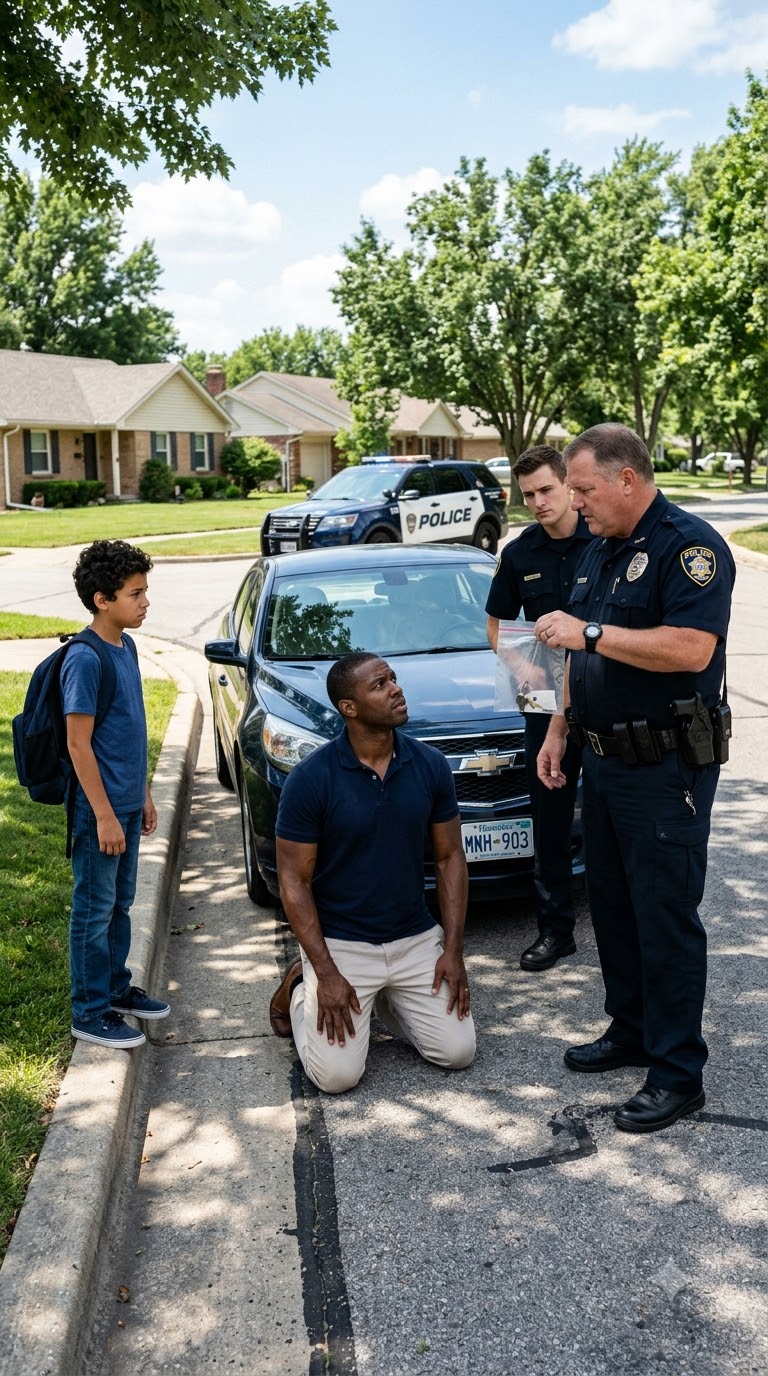
Marcus nodded solemnly. “There are rules in sports. There are rules in school. But if someone corners you and tries to hurt you, you don’t worry about looking polite. You get away. You make noise. You protect your body. You survive.”
“I like this version of parenting.”
“You like it because you think it means you get permission to act wild.”
“I didn’t say that.”
“You were thinking it.”
DeAndre laughed, and for a moment, the anxiety inside him eased. They were only ten minutes from the school now. He pictured himself entering the classroom, locating his locker, and perhaps finding one friend before lunchtime. Marcus reached across and lightly tapped the back of his hand.
“You’re going to be fine,” Marcus said. “And remember, you don’t need to prove you belong. You already do.”
The words had barely settled between them when flashing red and blue lights appeared behind the car.
DeAndre twisted around in his seat. “Dad?”
Marcus checked the rearview mirror. A police cruiser had pulled up closely behind them, emergency lights flashing, its siren chirping once to make certain there was no confusion. Marcus reduced his speed, activated his signal, and carefully steered onto the shoulder.
“I didn’t do anything wrong,” DeAndre whispered.
“I know.”
“Why are they stopping us?”
“I don’t know yet.” Marcus put the car in park, switched off the engine, and calmly rested both hands on the steering wheel. “Stay quiet. Let me do the talking.”
DeAndre nodded, though his stomach tightened. His father sounded completely composed, yet DeAndre noticed how deliberate every movement had become. His hands remained clearly visible. He drew one slow breath before the officer had even reached the window.
Two officers emerged from the cruiser.
The older one approached first. He was a heavyset white man in his fifties, thick-necked, with flushed cheeks and a rigid jaw that appeared permanently clenched. His nameplate read BARBRADY.
The younger officer walked a couple of steps behind him. He seemed barely older than some of the substitute teachers at DeAndre’s school, with uneasy eyes and a uniform that looked freshly pressed. His nameplate read LENNY.
Officer Barbrady approached the driver’s side as though he had already determined the situation was dangerous. One hand hovered close to his belt. His gaze traveled across Marcus, then DeAndre, and finally around the interior of the vehicle.
“License and registration,” Barbrady said.
Marcus maintained an even tone. “Good morning, officer. May I ask why I was stopped?”
“License and registration.”
“I’m happy to provide them,” Marcus said, “but I’d like to know the reason for the stop.”
Officer Lenny started to speak. “Sir, the reason we’re stopping you is—”
“Lenny,” Barbrady snapped. “Enough.”
The rookie immediately fell silent.
Barbrady bent closer to the window. “We don’t owe you explanations. You see this badge? You know how to read?”
Marcus’s jaw tightened almost imperceptibly, but his hands remained on the steering wheel. “I know what the badge says. I also know how a lawful traffic stop is supposed to work. I’m asking what violation you observed.”
Barbrady gave him a humorless smile. “You want to see why I pulled you over?”
“If you don’t mind, I would appreciate it.”
“Oh, I’ll show you.”
The officer backed away.
Lenny watched him with confusion.
“Sir?” Lenny said quietly.
Barbrady ignored the question. He walked toward the rear of Marcus’s vehicle and stopped beside the left taillight. Marcus turned slightly, attempting to see what was happening through the side mirror.
“What are you doing?” Marcus asked.
Barbrady raised his baton and smashed the taillight.
Red plastic shattered, scattering fragments across the asphalt.
DeAndre gasped. “Dad.”
Marcus pushed his door open slightly before stopping himself. “Officer, did you just break my taillight?”
Barbrady spun around, the baton still gripped in his hand. “Get back in the car now.”
“You damaged my vehicle.”
“I’m not going to ask again. Get back in the car before I have to use force.”
Marcus remained seated, but his voice became firmer. “There is no reason to escalate this. I’m unarmed. My child is in the car.”
Barbrady reached toward his shoulder radio. “Dispatch, we have a dangerous subject refusing commands. Possible weapon involved.”
“A weapon?” Marcus said. “I don’t have a weapon.”
Lenny stepped forward. “Sir, maybe we should slow down. He hasn’t—”
Barbrady pointed toward him. “Rookie, stay out of this.”
“With all due respect,” Lenny said, struggling to keep his tone controlled, “I don’t know why we pulled him over. I didn’t observe a violation before you—”
“Before I what?” Barbrady asked.
Lenny glanced down at the shattered taillight pieces scattered across the road. He swallowed. “Before the taillight broke.”
Barbrady moved close to him. “You have been on this job for five minutes. I have years of experience. What I see in that car is a dangerous criminal.”
Marcus stared at him through the open window. “Based on what?”
Barbrady turned toward him. “Based on the fact that I know your type.”
Lenny’s expression shifted. “Sir.”
But Barbrady continued. “When someone looks like that, they’re usually selling something, hiding something, or running from something.”
DeAndre sank farther into his seat.
Marcus slowly shifted his gaze from Barbrady toward Lenny. “You hear that?”
Lenny looked ashamed.
Barbrady snapped, “You better listen to your partner, boy, and stop running your mouth before I make sure you never use it again.”
DeAndre’s hands began trembling.
Marcus turned toward his son, his expression immediately softening. “Son, look at me.”
DeAndre looked at him.
“Everything is going to be okay.”
“Dad, I’m scared.”
“I know. Stay still. Stay quiet. Remember what I told you.”
“About bullies?”
“Yes,” Marcus said. “Sometimes bullies wear uniforms. You still tell the truth.”
Barbrady suddenly pulled open the driver’s door. “Out. Now.”
Marcus climbed out slowly, every movement measured and cautious. He understood how easily a frightened man could be blamed simply for showing fear. He knew stillness could be interpreted as guilt and anxiety labeled resistance. He kept both hands where they could clearly be seen.
“Turn around,” Barbrady ordered. “Get on your knees.”
“Under arrest for what?” Marcus asked.
“I said get down.”
“Officer, I am complying, but I am asking the basis for—”
Barbrady shoved him forcefully between the shoulders.
Marcus dropped onto one knee, catching himself with one hand against the pavement.
“Dad!” DeAndre shouted.
“Stay in the car,” Marcus said quickly.
Barbrady seized Marcus’s wrists and fastened the handcuffs far too tightly. Then, positioning his body away from Lenny’s dash camera, he slipped a hand into his own pocket.
Lenny noticed the movement.
At first, he couldn’t understand what he was seeing.
Then Barbrady crouched beside the vehicle and raised a small plastic bag as though he had just discovered it beneath the seat.
“Well, well,” Barbrady said loudly. “What do we have here?”
Marcus looked over his shoulder. “What are you talking about?”
Barbrady raised the bag higher. “Narcotics.”
“What?” Marcus said. “That’s not mine.”
“Oh, no?”
“You planted that.”
Barbrady produced an exaggerated laugh. “These aren’t yours? Then why do they have your fingerprints all over them?”
“My fingerprints aren’t on those.”
“Not yet,” Barbrady muttered.
Lenny went still.
The older officer grabbed Marcus’s cuffed hand and attempted to force his fingertips against the plastic bag.
Marcus pulled away. “Hey. What are you doing? That’s not right. You’re framing me.”
From inside the car, DeAndre screamed. “Stop! Leave my dad alone!”
Barbrady’s expression twisted. “Did you just threaten an officer of the law?”
“I said you’re framing me,” Marcus said, his voice rising for the first time. “Because you are.”
“That’s it.” Barbrady grabbed Marcus by the back of his neck and forced him downward. “I’ve had it with you people.”
Marcus slammed chest-first onto the asphalt.
Lenny rushed forward. “Sir, don’t—”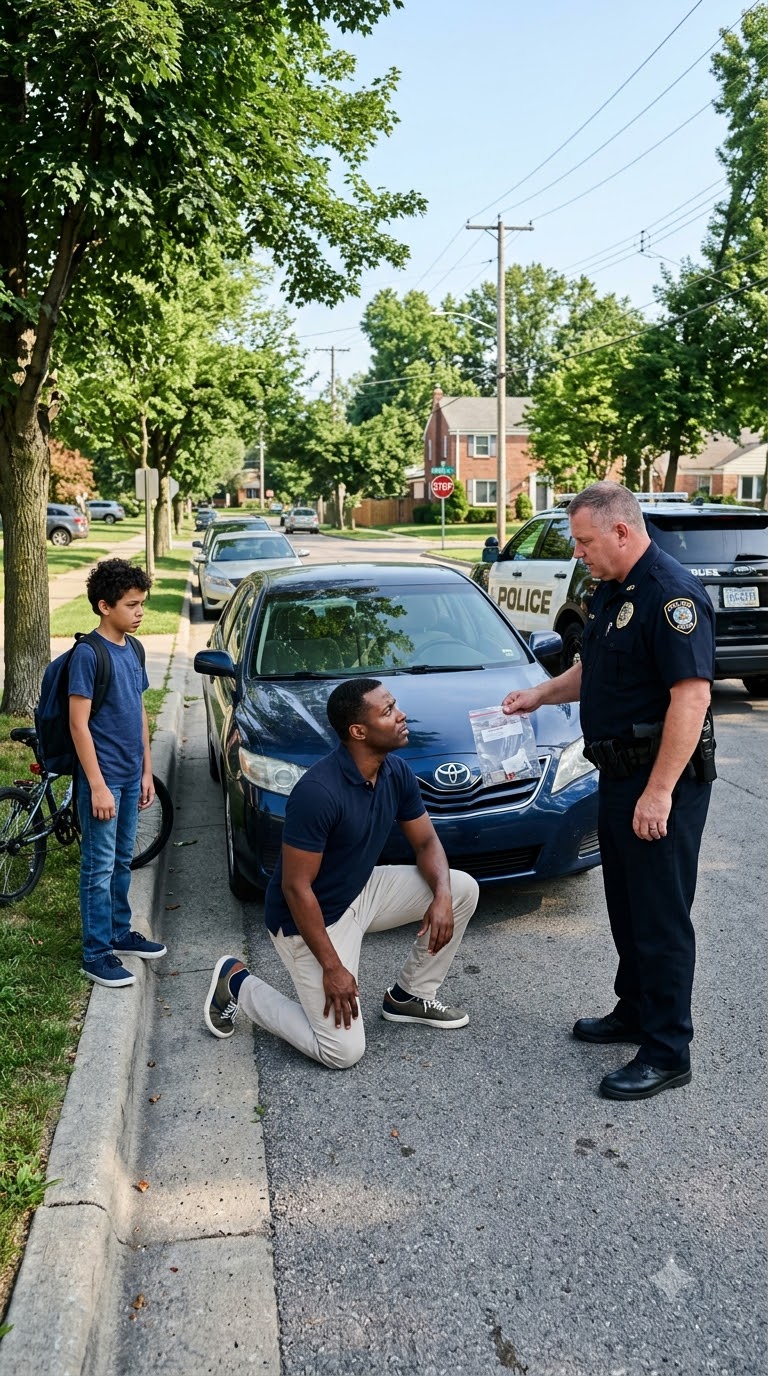
Barbrady drove his knee into Marcus’s upper back and leaned his weight into him. Marcus gasped as his cheek scraped against the road.
“I can’t breathe,” Marcus said.
DeAndre struggled with the door handle before stumbling from the vehicle. “Please! You’re hurting him!”
“Get back,” Barbrady shouted. “Your dad is getting what he deserves, and you will too.”
Tears filled DeAndre’s eyes. He suddenly looked smaller than he had that morning, smaller than sixteen, smaller than any child should ever look beside a road.
“Let go of my dad. You’re going to kill him.”
Barbrady increased the pressure. “Just a few more seconds and it’ll all be—”
“Enough!”
The word came from Lenny.
For one suspended second, nobody moved.
Barbrady slowly turned his head. “What did you say?”
Lenny had gone pale, but his hands remained steady. “Let him go.”
“You better stand down, rookie.”
“I can’t let you do this.”
“Can’t?” Barbrady laughed quietly. “What are you going to do?”
Lenny moved closer. “I’m going to tell them what happened. I’m going to tell them you pulled him over for no reason. I’m going to tell them you broke his taillight. I’m going to tell them you planted the drugs. I’m going to tell them you tried to put his fingerprints on the bag. And I’m going to tell them you used force after he was already restrained.”
Barbrady glared at him. “You little weasel.”
Lenny’s voice trembled, but he held his position. “He’s a human being. His son is watching.”
Barbrady looked down at Marcus before turning his eyes back toward Lenny.
The silence lingered long enough for the distant noise of passing traffic to become noticeable again.
Finally, Barbrady removed his knee and stood.
Marcus coughed violently as he struggled to draw air back into his lungs.
DeAndre rushed toward him but stopped when he noticed the handcuffs. “Dad? Dad, are you okay?”
Marcus rolled onto his side, breathing heavily. “Not really.”
“I thought you were going to die.”
Marcus looked directly at his son. “I thought so too.”
Lenny knelt beside him. “Sir, I’m sorry. I should have stopped it sooner.”
Marcus studied the rookie for a moment. “You stopped it when it mattered.”
Barbrady snorted. “Don’t get sentimental. He’s still under arrest.”
“No,” Lenny said. “He isn’t.”
“You don’t decide that.”
“Then take the cuffs off me,” Marcus said, his voice still rough. “And I’ll show you who does.”
Barbrady laughed. “You hear that, Lenny? Now he thinks he’s in charge.”
Marcus looked toward the rookie. “Son, you know I’ve done nothing wrong.”
Lenny paused for only a second.
Then he unlocked the cuffs.
Barbrady erupted. “You just made the biggest mistake of your life.”
Marcus slowly rose to his feet, rubbing his wrists. The collar of his shirt was torn, and dust covered the fabric from where he had hit the road. His cheek was scraped.
He reached into the inside pocket of his jacket and removed a leather credential case.
He opened it.
Lenny’s eyes widened.
Barbrady reached toward the case. “Let me see that.”
Marcus pulled it away. “You had your chance to look at evidence.”
He held the badge where both officers could read it clearly.
Captain Marcus Price.
New commanding officer of the division.
The color disappeared from Barbrady’s face. “No.”
DeAndre stared at his father.
He had always known his dad worked in law enforcement. He knew Marcus had recently been transferred. He knew about the late-night phone calls, closed-door conversations, and stacks of paperwork spread across the kitchen table.
But until that moment, he had never fully understood what his father meant when he said his new position began after dropping him at school.
Marcus looked directly at Barbrady. “I am the new police captain of this division.”
Barbrady opened his mouth, then closed it again. “Sir, this is a misunderstanding.”
Marcus stepped toward him. “You stopped me without cause.”
“I thought—”
“You broke my taillight and manufactured a violation.”
“Sir, I was—”
“You planted narcotics.”
“No, sir, that’s not—”
“You attempted to force my fingerprints onto evidence you introduced.”
Barbrady swallowed.
Marcus lowered his voice. “And then you put your knee on my back while I told you I couldn’t breathe, in front of my son.”
Barbrady glanced toward DeAndre.
For the first time, he appeared to recognize the teenager as someone’s child instead of another target.
“I have a family,” Barbrady said. “Kids. Please.”
Marcus’s expression remained unchanged. “What about mine? When my son thought he was watching me die, did you think about my family?”
Barbrady turned his eyes away.
“That’s what I thought.”
A second police cruiser arrived, followed by a third.
The backup officers quickly climbed out, visibly confused by what they found: one officer pale and silent, one nervous rookie standing beside a shaken teenager, and the man who had just been handcuffed now holding a captain’s badge.
Marcus turned toward Lenny. “Officer Lenny.”
“Yes, sir.”
“Secure Officer Barbrady’s weapon and place him under arrest.”
Lenny blinked, as though he had heard the command before his mind had fully processed it. “Yes, sir.”
Barbrady staggered backward. “You can’t do this.”
Marcus said, “You did this.”
Lenny approached his senior officer. “Turn around.”
“Lenny,” Barbrady warned.
“Turn around,” Lenny repeated, his voice stronger now.
The older officer glanced toward the others, searching for support that never came.
Slowly and humiliatingly, he turned around.
Lenny removed his firearm, secured it, and handcuffed the man who had spent years teaching younger officers that loyalty mattered more than integrity.
“You’re going to regret this,” Barbrady hissed.
Lenny tightened the cuffs. “No, sir. I think I finally won’t.”
Marcus remained silent as Barbrady was placed inside the back of a cruiser.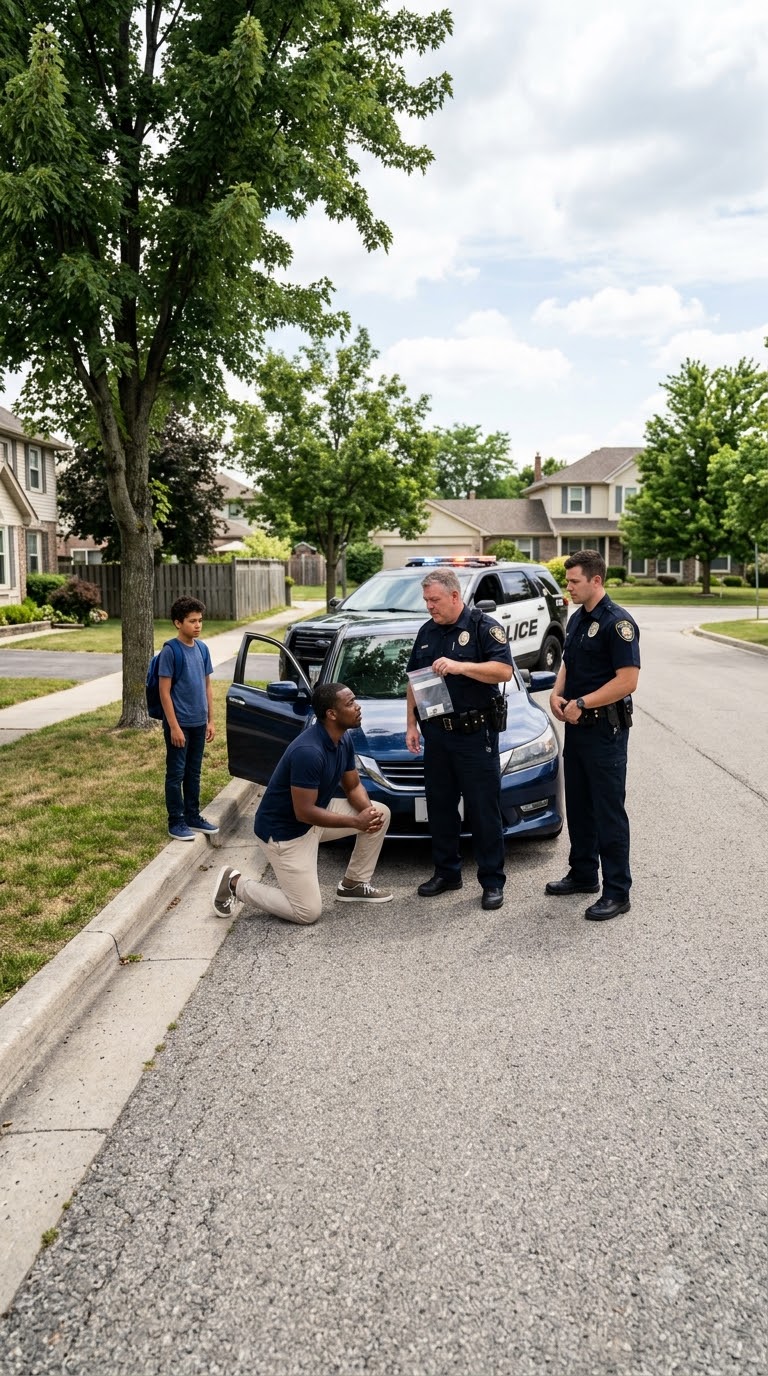
Only then did he turn toward his son.
DeAndre stood beside the car with his arms wrapped tightly around himself.
Marcus walked to him and rested both hands on his shoulders. “I’m sorry you had to see that.”
DeAndre’s voice cracked. “Why didn’t you tell him who you were earlier?”
Marcus looked down the roadway. “Because I wanted to see how far he would go when he thought he was dealing with someone powerless.”
“He almost killed you.”
“Yes,” Marcus said quietly. “And that means he may have almost killed someone before. Or he would have someday.”
DeAndre wiped his face with his sleeve. “I was scared.”
“So was I.”
“You?”
Marcus nodded. “Being brave doesn’t mean you aren’t scared. It means you do what is right while you’re scared.”
DeAndre glanced toward Lenny, who was standing beside the other officers giving his statement. His face remained pale, but his words were clear.
“Like him?”
“Exactly like him.”
Back at the precinct, news of what had happened traveled faster than anyone anticipated.
The body-camera recordings from both officers were immediately secured. The dash camera clearly captured Barbrady striking the taillight. Audio recorded the fabricated dispatch report, the insults, the planted evidence, Marcus saying he couldn’t breathe, and Lenny finally choosing to intervene.
Internal affairs arrived before noon.
The district attorney’s office had been contacted by early afternoon.
By sunset, Officer Barbrady was facing more than suspension. Criminal charges were being brought against him for evidence tampering, official misconduct, assault under color of authority, filing a false report, and civil rights violations.
Captain Marcus Price delivered his first formal speech to the division the following morning.
He stood before the roll-call room with a bandage covering his scraped cheek and dark bruising spreading along his jaw. DeAndre sat in the rear beside his grandmother, who had refused to let Marcus out of her sight after watching the footage.
Officers packed the room shoulder to shoulder.
Some appeared ashamed.
Others looked defensive.
Still others seemed relieved that someone was finally speaking openly about what had been whispered for years.
Marcus never raised his voice.
“Yesterday,” he began, “I was stopped on the way to take my son to school. I was treated as a suspect before I was treated as a person. My property was damaged. Evidence was planted. Force was used against me while I was restrained. My son was threatened.”
Silence filled the room.
“I am not telling you this because I was the victim. I am telling you this because the only reason I am standing here is that one rookie officer remembered that his oath was not to his partner’s ego, not to a bad tradition, and not to a blue wall. His oath was to the law and to the people.”
His eyes moved toward Lenny, who stood stiffly near the rear wall, visibly uncomfortable with the attention.
“Officer Lenny put his job at risk to stop something wrong. That is not betrayal. That is policing.”
Several officers lowered their eyes.
Marcus continued. “If you believe loyalty means helping another officer violate the rights of a citizen, you do not belong in this department. If you believe a badge gives you permission to humiliate people, you do not belong in this department. If you believe the color of someone’s skin tells you what crime they committed before you have evidence, you do not belong in this department.”
He allowed the words to settle across the room.
“And if you are scared to do the right thing because you think you’ll stand alone, look at Officer Lenny. He stood alone for about ten seconds. Then the truth stood with him.”
The investigation into Barbrady soon widened.
After Marcus ordered a review of his previous arrests, troubling patterns began appearing.
Traffic stops made without an obvious reason.
Searches based on vague claims of suspicion.
Reports repeating the same phrases again and again: furtive movement, aggressive tone, officer safety concerns.
Complaints had repeatedly been dismissed because no video existed or because Barbrady’s account had been accepted over the driver’s.
Some people had lost their jobs after missing work because they were arrested.
Others had accepted plea agreements simply because challenging the charges was too expensive.
Parents remembered children crying from back seats.
Young men remembered learning to fear the sight of flashing police lights behind them.
Marcus personally met with the review team each evening.
He never pretended he could reverse every injustice.
He never claimed every old case could easily be reopened.
But he refused to allow procedure to bury the truth again.
Officer Lenny was summoned to testify at several hearings.
Every time, his account remained unchanged.
He admitted being frightened.
He admitted waiting longer than he should have.
He admitted that Barbrady had warned him his career would suffer if he spoke against him.
Then he delivered the sentence that later appeared in the local newspaper.
“I realized that if keeping my career required watching an innocent man die, then it wasn’t a career worth keeping.”
The trial lasted almost a year.
Barbrady’s defense attempted to characterize the entire incident as a misunderstanding.
They argued that he had reacted instinctively.
They claimed he genuinely believed Marcus posed a danger.
They suggested the taillight might already have been damaged.
They claimed the narcotics had been discovered during a lawful search.
They argued that placing a knee against Marcus’s back had been a control technique rather than an assault.
Then the prosecution played the video.
Everyone in the courtroom watched Barbrady smash the taillight.
They listened as he fabricated the threat.
They saw him remove the bag from his own pocket.
They heard Marcus say he couldn’t breathe.
They heard DeAndre pleading for his father’s life.
And they watched Lenny finally step forward and say, “Let him go.”
After that, there was little left for the defense to argue.
Barbrady was convicted on multiple charges and sentenced to prison.
To Marcus, the exact length of the sentence mattered less than what the conviction represented.
A uniform could not transform criminal conduct into procedure.
A badge could not transform cruelty into legitimate authority.
And experience did not excuse corruption; sometimes it simply gave corruption longer to remain hidden.
Lenny advanced through the department faster than most people expected, although Marcus made certain the promotion was never presented as a reward for a single dramatic decision.
Lenny underwent additional training, worked beneath supervisors respected for fairness, and spent months learning how to rebuild relationships with communities that had every reason to distrust the department.
When the promotion finally arrived, Marcus shook his hand in front of the entire division.
“You did the right thing when it was hard,” Marcus said. “Now do it when nobody is watching.”
Lenny nodded. “Yes, sir.”
DeAndre eventually made it to school on that first day, although he arrived two hours late, his eyes still red, carrying a story he refused to share with anyone.
During the first few weeks, he hated the attention.
He hated knowing people had watched the video.
He hated hearing classmates whisper about his father, the bad cop, and the moment he had cried beside the road.
But Marcus kept his promise about teaching his son how to stand up for himself.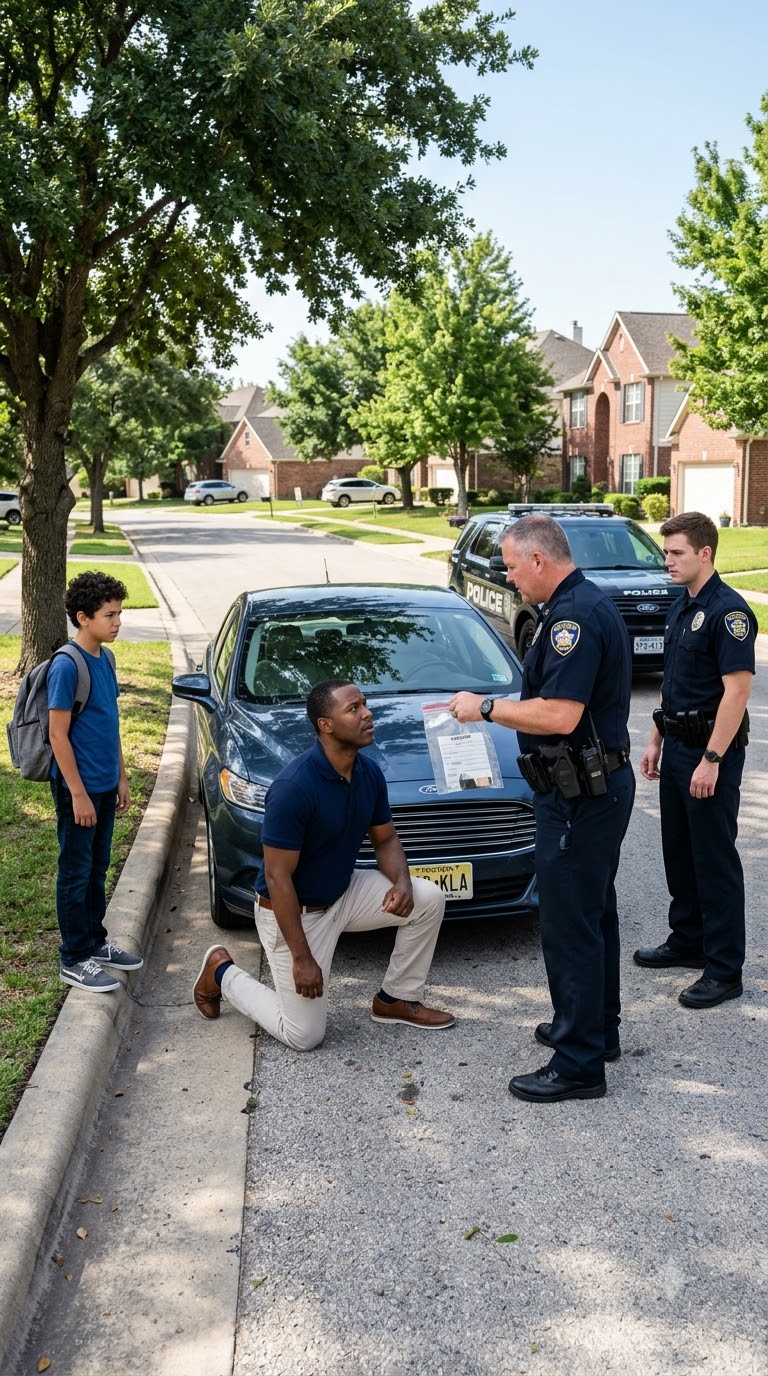
He didn’t turn DeAndre into someone searching for fights.
Instead, Marcus taught him how to control his breathing when fear arrived.
How to keep his hands open.
How to speak clearly.
How to walk away when walking away was safe.
How to protect himself only when protection became necessary.
He taught DeAndre that strength and aggression were not the same thing, and courage did not mean pretending fear didn’t exist.
The first time a boy at school shoved DeAndre against a locker and called him weak, DeAndre didn’t start swinging.
He planted his feet.
He raised his voice.
He told the boy to step back.
A teacher heard him.
Other students turned toward them.
Embarrassed by the attention, the bully backed away.
That afternoon, DeAndre told his father, “I didn’t win a fight.”
Marcus smiled. “Yes, you did.”
Years afterward, people around the city still remembered the traffic stop that exposed Officer Barbrady.
Some described it as a story with a dramatic twist, focusing on the moment the handcuffed driver revealed that he was the division’s new captain.
Others remembered the rookie who chose to stand against his superior.
Some remembered the trial.
Others remembered the reforms that followed: mandatory reviews of use-of-force complaints, automatic preservation of body-camera recordings, independent audits of traffic stops, and a new requirement ordering officers to intervene when another officer crossed the line.
But DeAndre remembered something different most clearly.
He remembered sitting in the passenger seat that morning, frightened that nobody at his new school would like him.
He remembered his father explaining that bullies depended on silence.
He remembered watching a bully wearing a badge nearly crush the breath from his father’s body.
And he remembered Officer Lenny stepping forward, his voice trembling, and saying no.
That was the lesson DeAndre carried with him.
Bullies didn’t always resemble children stealing lunch money.
Sometimes they wore uniforms.
Sometimes they turned rules into weapons.
Sometimes they called cruelty experience and cowardice loyalty.
But every one of them relied on the same thing: everyone around them remaining silent.
Captain Marcus Price devoted the remainder of his career to ensuring silence would no longer be department policy.
Officer Lenny developed a reputation for listening before making judgments.
DeAndre grew into a young man who understood that being afraid did not mean failing.
And whenever Marcus drove along the stretch of road where everything had happened, he still glanced toward his son and remembered the promise he’d made moments before the flashing lights appeared behind them.
Nothing bad is going to happen to me.
He had been wrong about that.
Something bad had happened.
But something true had happened as well.
A corrupt officer had been exposed.
A good officer had discovered his courage.
A boy had learned that standing up for yourself didn’t always require throwing a punch.
Sometimes it meant speaking the truth while your voice trembled.
Sometimes it meant refusing to turn away.
And sometimes, when a bully demanded obedience, it meant planting your feet, drawing a breath, and saying, “Let him go.”
