

PART 1
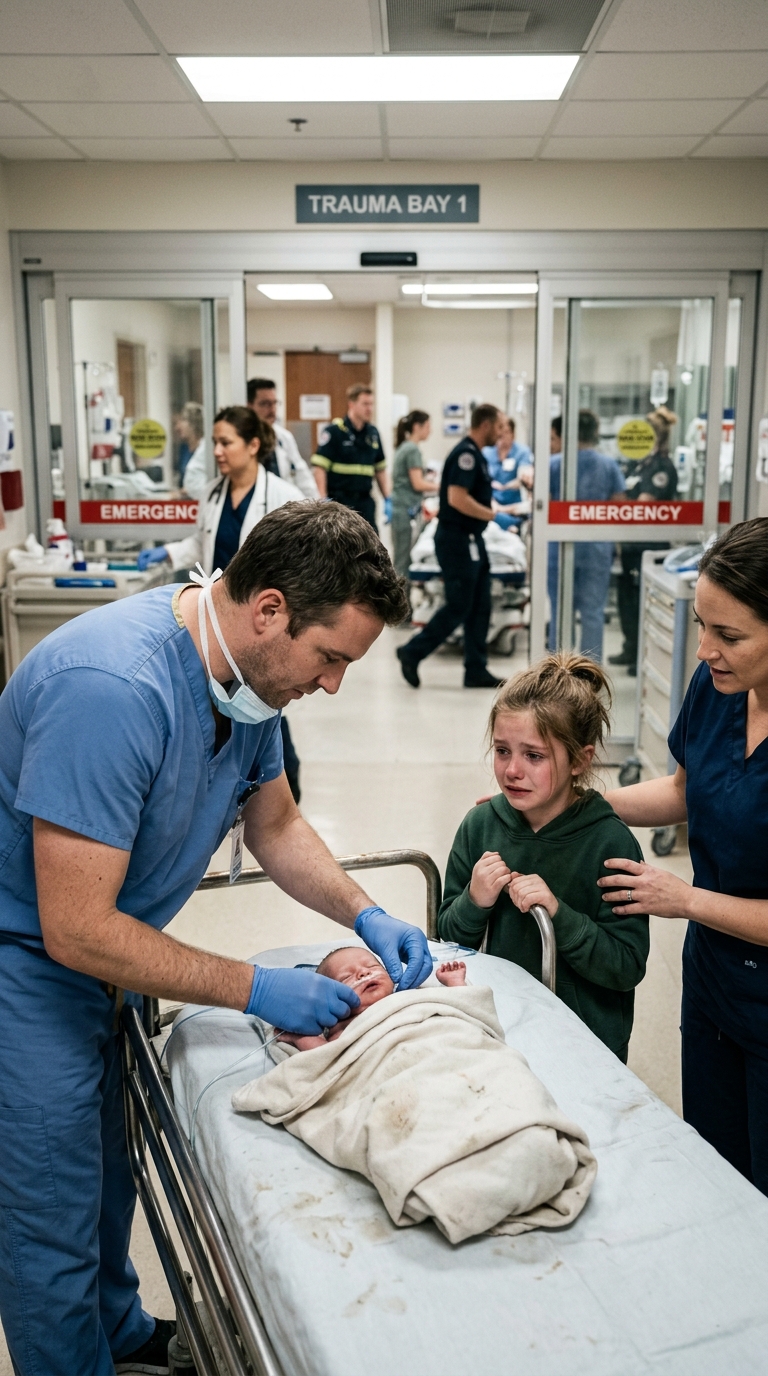
I had worked seventeen years as a pediatric emergency physician in Chicago, long enough to think I knew every kind of human crisis—until the night everything I believed about “worst-case scenarios” quietly came apart beside a vending machine.
It was mid-December, the sort of cold that turned the air to glass inside your lungs. Inside the ER, chaos moved with its usual rhythm—flu cases piling up, monitors beeping out of sync, tired parents bargaining with crying children over thermometers and juice boxes. I had just finished stabilizing a boy with pneumonia and was already thinking about the next chart when I noticed them.
Two figures. Too still.
They stood near the vending machines, a little separate from the crowd, as if they belonged to another world from everyone else in that room. The older one—a girl, maybe eight or nine—was thin in a way that seemed unnatural. Not just small. Hollow. Her dark hair fell in uneven clumps, and she wore a man’s oversized coat that almost reached the floor.
But it wasn’t her that made me stop walking.
It was what she was holding.
Cradled tightly in her arms was a toddler wrapped in a dirty blanket, her body unnaturally limp. One small arm hung out, pale and unmoving, the fingers slightly curled as if they had forgotten their purpose.
I didn’t think. I moved.
As I approached, the older girl flinched—not with confusion, but with instinct. She tightened her grip on the child, her body angling protectively, her eyes scanning me like I was something dangerous.
“Hey,” I said softly, slowing my pace, lowering myself just enough to seem less threatening. “I’m Dr. Rowan. You’re okay. I just want to help.”
Her lips trembled. “She won’t wake up,” she whispered. “I tried. I tried everything.”
I stepped closer, and that’s when the reality hit.
The toddler wasn’t just unconscious.
She was shutting down.
Her skin had that gray, waxy tone that every emergency doctor recognizes immediately—the color of a body running out of time. Her breathing was shallow, barely there. Her ribs showed through the blanket like thin lines drawn under paper.
“How long has she been like this?” I asked, already reaching out.
The girl shook her head, panic flashing in her eyes. “She was crying before… but then she stopped.”
And then, as if on cue, the toddler’s head fell back.
Her body went slack.
Completely.
“No—” the older girl gasped, her voice breaking into something raw and primal. “No, no, no—please—”
I caught the child just as she slipped from her arms.
“Code Blue! Pediatric! Now!” I shouted, turning and running.
Everything else blurred. The hallway, the doors, the noise—it all collapsed into a single point: the weightless body in my hands.
Behind me, I heard the girl’s footsteps. Fast. Desperate.
“Don’t take her!” she screamed. “Don’t leave me!”
“I’m not leaving her!” I yelled back, pushing through the trauma doors. “I’m saving her!”
We hit the room like a storm.
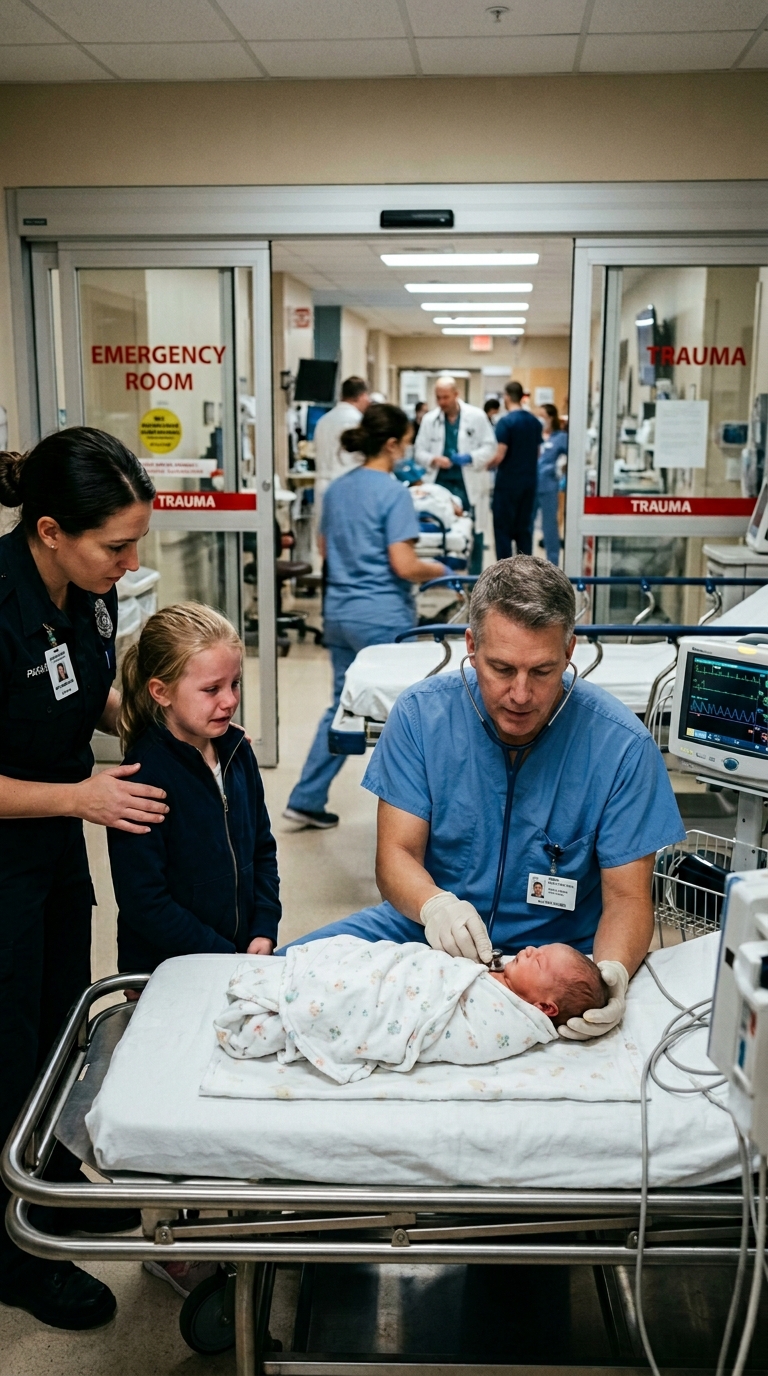
“Pulse?” I demanded.
“Nothing,” a nurse answered immediately.
I was already working. Two fingers pressed against the child’s chest, starting compressions—careful, precise, terrified of breaking bones that already felt too fragile.
“Airway. IO access. Warm fluids. Move!”
The team responded instantly, but there was a heaviness in the air—the kind that comes when everyone knows this isn’t a routine save.
“She’s severely malnourished,” one of the nurses said under her breath.
I didn’t respond. I couldn’t.
Because she was right.
This wasn’t just illness.
This was something else.
Something prolonged.
Something deliberate.
“Still flatline,” the monitor called out in its cold, steady tone.
I pushed harder. “Again. We’re not losing her.”
Out of the corner of my eye, I saw the older girl.
She had made it to the doorway, clutching the frame so tightly her knuckles had gone white. Her entire body shook, but she didn’t cry—not loudly, not anymore. Just small, broken sounds caught somewhere in her throat.
She was watching everything.
Every second.
“Epinephrine ready,” the nurse said.
“Push it.”
The seconds dragged. Then minutes.
Nothing.
“Come on,” I muttered under my breath. “Come on, kid… not like this.”
Then—
A flicker.
A single, uneven spike on the monitor.
“Wait—” the nurse leaned forward. “I think—”
Another spike.
Then another.
“We have rhythm!”
The room shifted instantly.
“Pulse is weak, but it’s there!”
“Ventilator, now!”
Relief hit like a wave—but it was fragile, unstable, like everything could collapse again at any second.
As we worked to stabilize her, I stepped back just enough to breathe.
And that’s when I saw it.
The blanket had shifted.
Around the toddler’s waist was something thick. Leather.
Too thick.
Too tight.
I stepped closer, pulling the fabric aside carefully.
It wasn’t a belt.
It was a collar.
A heavy, worn leather collar—like the kind used for large dogs—fastened tightly around her small body. Attached to it was a jagged piece of broken metal, like something had been forcibly cut.
For a moment, no one spoke.
No one moved.
The room went silent in a way I had never experienced before.
“What… is that?” someone whispered.
But I already knew.
And I felt something inside me break.
“Call the police,” I said quietly. “Now.”
I turned away before the anger could show on my face.
Because the girl in the doorway was still watching.
And she didn’t need to see that.
She had already seen enough.
I walked out into the hallway slowly, forcing my breathing to steady.
She was sitting now, curled into herself, her eyes locked on me the moment I stepped out.
“Is she dead?” she asked.
Her voice wasn’t loud.
It didn’t need to be.
“No,” I said gently, kneeling in front of her. “She’s alive. We’re helping her.”
The girl stared at me, searching for something—truth, maybe. Or permission to believe.
“What’s your name?” I asked.
She hesitated.
Then, barely audible: “Lena.”
“Hi, Lena,” I said. “I’m Rowan.”
She nodded faintly, her hands tightening around the sleeves of that oversized coat.
“And your sister?”
“Emmy.”
I swallowed.
“Lena… you did something very brave bringing her here.”
She didn’t react to the compliment.
Instead, she looked past me, toward the doors, like she expected someone to walk in at any moment.
“You can’t let him find us,” she whispered.
My chest tightened. “Who?”
She shook her head, panic rising again. “He gets angry when we leave.”
I felt the ground shift under me.
“Lena,” I said carefully, “where did you come from?”
She didn’t answer right away.
Her eyes filled, but the tears didn’t fall.
“He said Emmy was useless,” she said finally, her voice hollow. “She kept crying. So he took her away.”
My pulse spiked.
“Took her where?”
Lena looked down at her hands.
“The back room,” she whispered. “Where he keeps the broken things.”
A cold, creeping dread spread through me.
“And how did you get her back?”
This time, Lena’s voice trembled.
“I waited until he went outside,” she said. “Then I opened the door.”
Her eyes met mine.
“I wasn’t supposed to.”
Silence hung between us.
Heavy. Suffocating.
And then she said something that made everything worse.
“There are more,” she added quietly. “Downstairs.”
I felt it then.
Not just fear.
Not just anger.
Something deeper.
Something darker.
This wasn’t over.
This wasn’t even the beginning.
And somewhere out there—very close, if my instincts were right—
The person who did this was still looking for them.
And he wasn’t done.
PART 2
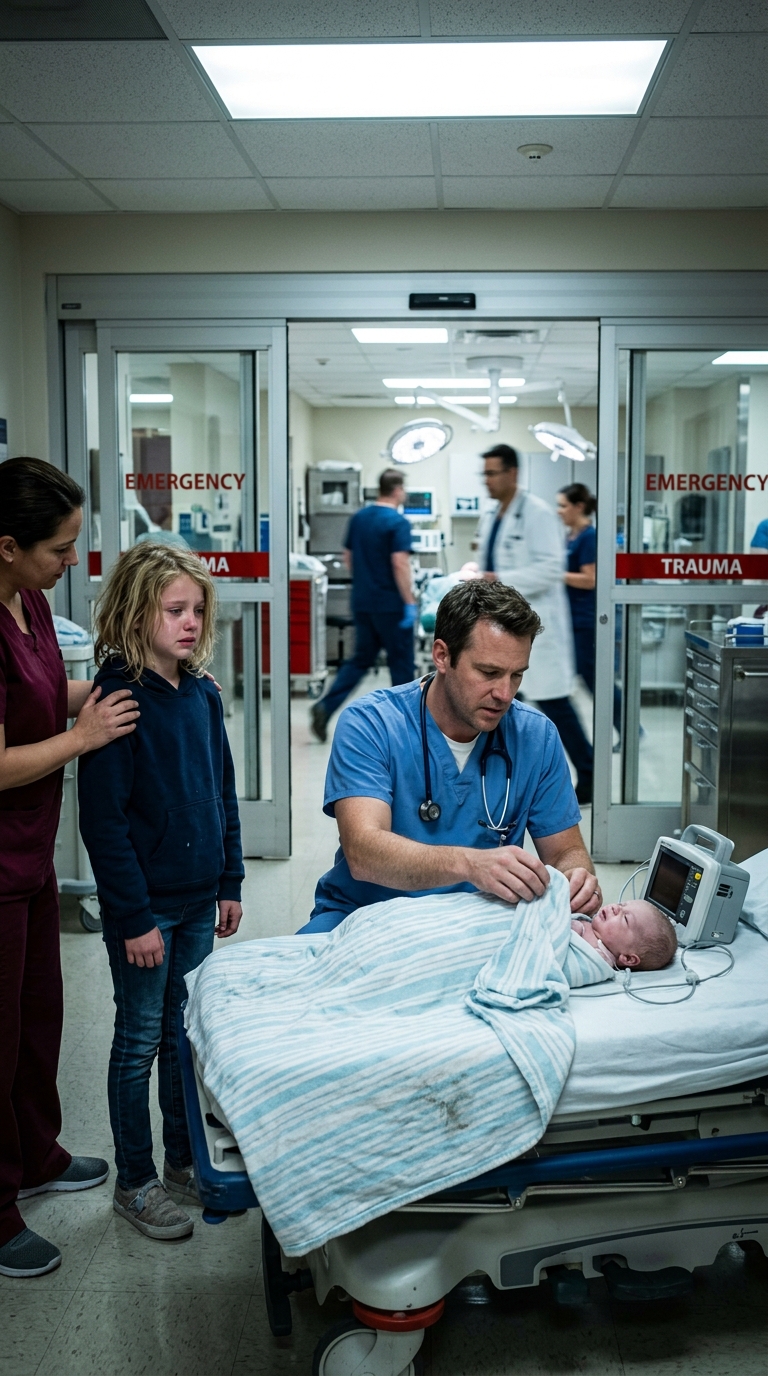
Detective Grant Holloway arrived within minutes, but the atmosphere shifted the second he stepped into the hallway—not because of authority, but because of recognition; men like him had spent years chasing patterns like this, and the moment I told him what Lena had said, I saw it in his eyes: this wasn’t an isolated case, it was a thread, and if we pulled it wrong, it could snap before leading us to anything; he crouched in front of Lena, his voice calm but deliberate, asking her simple questions—colors, sounds, smells—never “what happened,” never “who did this,” just pieces she could hold without breaking; Lena described a place near “loud roads” and “a fence that sings when the wind hits it,” and something about a red light that blinked all night, and while it sounded like fragments of a child’s imagination, Holloway didn’t dismiss a single word, instead signaling quietly to his partner to start mapping industrial zones near the outer highways; meanwhile, I couldn’t stop glancing back through the glass at Emmy, whose fragile chest now rose and fell with the machine, each breath bought by seconds we had stolen from death; the collar around her waist had been carefully removed, but the imprint of it—angry, bruised, permanent—remained, like something the body itself refused to forget; and standing there between the detective building a case and the child fighting for her life, I realized we were already running out of time in more ways than one, because whoever “he” was, men like that didn’t lose control without trying to take it back.
Lena’s condition worsened faster than I expected once the adrenaline drained from her system; when we moved her into an exam room, she initially resisted, insisting she had to stay where she could “see Emmy breathe,” but her body was already beginning to betray her—her hands shaking uncontrollably, her temperature dropping, her pulse erratic in a way that told me she had been surviving on almost nothing for far too long; when I gently removed her coat, the weight of it surprised me, and when it slipped from her shoulders, the sound it made hitting the floor was wrong—too heavy, too dense; inside the pockets were small stones, dozens of them, smooth and carefully chosen, mixed with handfuls of dry, crushed pet food; I didn’t ask right away, but Lena noticed my expression and answered before I could speak, saying simply, “He checks,” as if that explained everything, and in a way, it did; children adapt to survive in ways that adults can’t comprehend, and Lena had learned how to cheat hunger, how to trick a system designed to punish her; but nothing prepared me for what came next, because when I examined her abdomen, she froze completely, her body going rigid, her eyes wide—not with pain, but with expectation; slowly, reluctantly, she lifted her shirt, and there it was again—the same thick leather collar, still locked in place with a rusted metal clasp, the skin around it inflamed, infected, grown into it over time; I had to steady my hands before I touched it, because the professional part of me was already calculating removal procedures, antibiotics, surgical consults, but the human part of me was screaming.
Holloway reentered the room just as I finished documenting Lena’s injuries, his expression darker than before; he had a location—an abandoned storage facility near the edge of an industrial strip not far from the highway Lena described, a place that had been flagged months ago for code violations but never properly investigated; “We’re moving in,” he said quietly, not to Lena, but to me, as if I were somehow part of this now, as if by touching the edges of this case I had already crossed into it; Lena overheard anyway, her reaction immediate and visceral, her heart rate spiking on the monitor as she grabbed my wrist with surprising strength; “No,” she whispered, shaking her head violently, “he hears things… he knows when people come,” and Holloway paused, something like hesitation crossing his face, but only for a second; “We’ll be careful,” he told her, softer now, but firm, because men like him knew that waiting meant losing more than time; after he left, the room felt too quiet, like something had been set into motion that none of us could stop; I sat beside Lena as a nurse started fluids, watching her eyelids grow heavier, her body finally giving in to exhaustion; “Will they bring them back?” she asked, barely conscious now, and I knew she didn’t just mean the other girls—she meant something larger, something impossible to promise; “We’re going to try,” I said, and it felt inadequate, but it was the only truth I could offer.
The call came less than forty minutes later, and I knew before I picked up the phone that something had gone wrong; it wasn’t the words—it was the silence before them; Holloway’s voice was tight, controlled in a way that only happens when control is barely holding; they had found the place, just like Lena described, but it wasn’t empty, not exactly; there were signs of recent movement—food containers, restraints, makeshift bedding—but the people were gone; “We were too late,” he said, and I could hear the frustration bleeding through every syllable; they had found evidence of at least three other children, maybe more, but whoever was responsible had cleared out in a hurry, leaving behind only fragments—chains cut hastily, doors left ajar, a single shoe that didn’t match anything else; and then he said something that made my stomach drop: “We found the vehicle,” he added, “an EMS transport van, unregistered, modified,” and suddenly everything snapped into place—the uniform, the access, the way he had walked into my trauma room like he belonged there; this wasn’t improvisation, this was method; he didn’t just hide in shadows, he moved through systems, used them, twisted them until no one questioned his presence; and now he knew where the girls were, because he had already tried to finish what he started.
I was halfway back to Emmy’s room when the alarms started again, sharp and relentless, cutting through the hallway like a blade; for one split second, I thought it was her—that her fragile body had finally given out—but when I pushed through the doors, I saw something worse; the ventilator was still running, her vitals still present, but the IV line—her lifeline—had been tampered with; the bag hung slightly off, the connection loosened just enough to disrupt the flow, just enough to destabilize everything we had fought to rebuild; “Who was in here?” I demanded, my voice louder than I intended, and the nurse hesitated, confusion flashing across her face; “No one,” she said, “just a paramedic who said he was sent to check the line,” and the words hit like a physical blow; I turned slowly, scanning the room, the hallway beyond, every open doorway suddenly feeling like a threat; Lena’s scream echoed from down the corridor before I even reached her, raw and terrified, a sound that didn’t belong in any hospital; “He’s here!” she cried, struggling against the nurse holding her in place, her eyes locked on something behind me; and in that moment, as I turned back toward the trauma bay, I understood something with absolute clarity—this wasn’t over, it had never been over, and the man we were chasing wasn’t running anymore; he was coming back, again and again, until he finished what he believed belonged to him.
PART 3
Everything that followed happened too fast and too slow at the same time, the kind of distortion that only comes when your body realizes danger before your mind can process it; Lena’s scream still echoed in my ears as I turned toward the hallway, my eyes scanning for movement, for anything out of place, and then I saw him—not rushing, not hiding, just walking with deliberate calm toward the exit corridor like he had already decided the outcome; he was still in that paramedic jacket, still blending in with the world that trusted uniforms without question, but there was something colder now, something stripped of pretense; I didn’t think about protocol, didn’t call for security again, I just moved, cutting him off before he reached the back stairwell; “Stop,” I said, my voice sharper than I’d ever heard it, and for the first time, he looked directly at me—not through me, not past me, but at me, measuring; “You’re making this harder than it needs to be,” he said quietly, as if we were discussing something minor, something administrative; “They don’t survive anyway,” he added, almost casually, and something inside me snapped—not into rage, but into a kind of clarity; “They already did,” I replied, stepping closer, refusing to give him space to maneuver, because I understood now that men like him thrived on hesitation, on fear, on the seconds people wasted trying to understand them instead of stopping them; behind me, I could hear footsteps—security, nurses, someone shouting—but I didn’t look away, because neither did he, and in that locked moment, I knew he was calculating whether he could get past me or through me.
He chose through; the movement was sudden, violent, his hand swinging not with a weapon this time but with brute force, catching me off balance as he tried to break past, but I held on, grabbing the front of his jacket, driving him sideways into the wall with more force than I thought I had left; we struggled in a tight, brutal tangle of limbs and momentum, the sterile hallway suddenly reduced to impact and breath and the sharp echo of bodies hitting tile; “You don’t understand,” he hissed, his voice breaking for the first time, revealing something unhinged beneath the control, “they were already gone when I found them,” and I pushed him harder, pinning his arm, refusing to let go even as my muscles screamed; “Then you should have left them alone,” I shot back, and that was when security finally reached us, two guards tackling him from the side, forcing him down to the floor; he fought, not wildly, but with a disturbing precision, like someone who had practiced this, who knew exactly how much force to use, where to twist, how to slip grips—but it wasn’t enough anymore; within seconds, his hands were restrained, his body pinned, and the calm returned to his face as if a switch had been flipped; Detective Holloway arrived moments later, breathless but focused, taking in the scene in a single glance before kneeling beside the man; “Leon Vance,” he said, not a question but a confirmation, and the man smiled faintly, not denying it; “You took too long,” Vance replied, almost disappointed, and Holloway’s jaw tightened as he signaled for officers to take him away, this time not as a shadow slipping through systems, but as a man in cuffs, visible, contained.
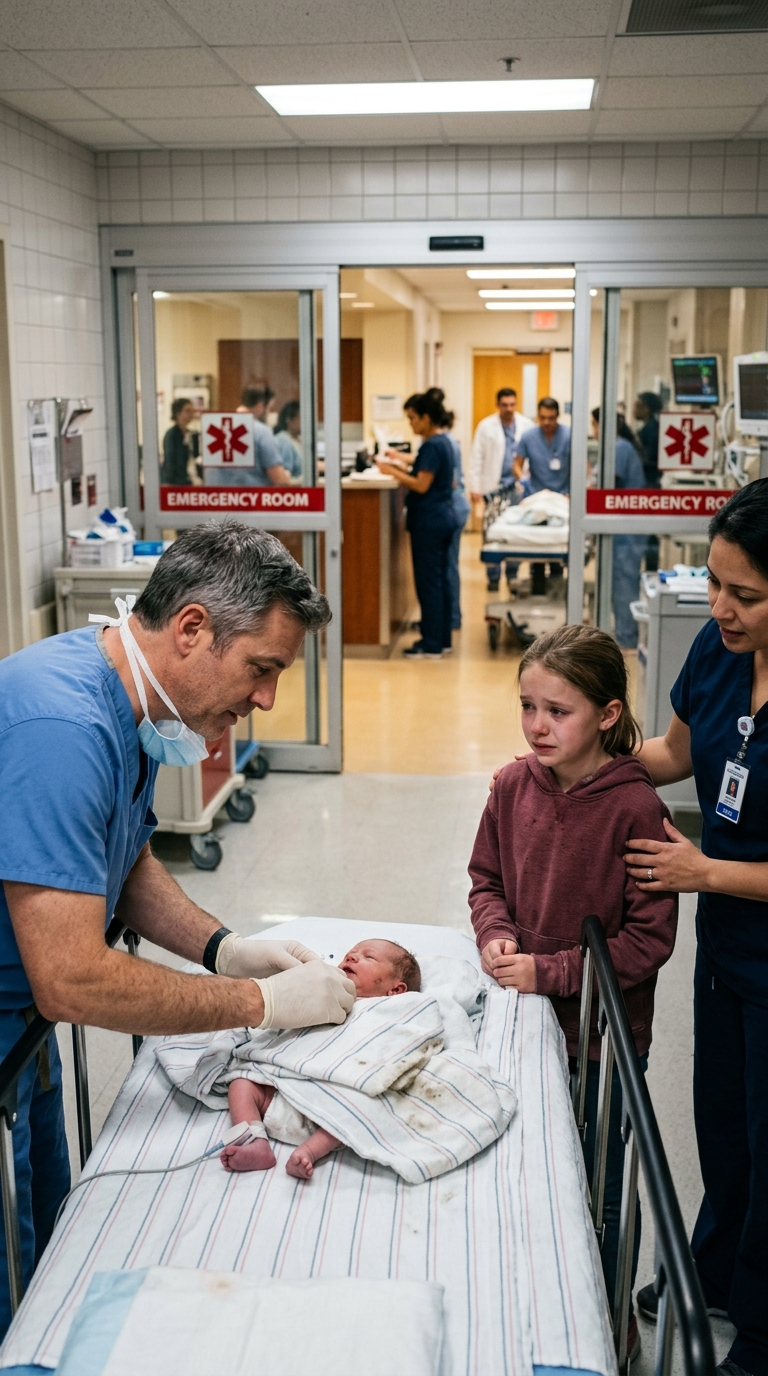
The hours after his arrest unfolded in fragments of information, each one heavier than the last; the abandoned facility had been a temporary holding site, part of a larger network Vance had exploited using his knowledge of transport routes and emergency access points, moving unnoticed because people rarely questioned those who appeared to be helping; the other girls Lena had mentioned were found that same night, not far from the original location, hidden in the back of the modified EMS van Vance had used to circle back to the hospital, intending to eliminate the one piece of evidence he couldn’t control—Emmy; they were alive, barely, each one carrying the same marks, the same collars, the same quiet, fractured awareness that survival had come at a cost no child should ever pay; Lena didn’t see them immediately, and I made sure of that, because her body was still stabilizing, her mind still caught between vigilance and collapse, but when I told her they had been found, something in her posture shifted—not relief, not exactly, but a release of a tension that had been holding her upright for far too long; Emmy, meanwhile, remained in critical care, her recovery slow and fragile, each improvement measured in degrees and milliliters and cautious hope, but she was still here, still breathing, and in that space, that was everything.
Weeks turned into months, and the hospital gradually returned to its familiar rhythms, but nothing felt the same to me anymore; I checked on Lena and Emmy every day, even when they were transferred out of the ICU, even when other cases demanded my attention, because some patients don’t leave you when they leave your care; Lena began to change first, small things at the start—accepting food without hiding it, sleeping without waking at every sound, speaking in full sentences instead of fragments; the collar was surgically removed, the process delicate and painful, but necessary, and when it was finally gone, she touched the scar left behind with a kind of disbelief, as if she needed to confirm it wasn’t coming back; Emmy’s progress was slower, her body having endured more than it should have survived, but she responded to Lena’s presence in a way that no medication could replicate, her eyes tracking her sister’s movements, her breathing steadier when Lena sat beside her; the other girls were placed under protective care, each one beginning their own long, uncertain path toward recovery, their futures still unwritten but no longer dictated by someone else’s control.
The trial came nearly a year later, and I attended only one day, enough to see the outcome but not enough to relive every detail; Vance was convicted on multiple counts—kidnapping, abuse, attempted murder—and sentenced to spend the rest of his life behind bars, a decision that felt less like justice and more like containment, a way to ensure he would never again have access to the systems he had once manipulated; he showed no remorse, no visible reaction, just that same hollow calm as the sentence was read, as if consequences were simply another external event that didn’t reach him; Holloway told me afterward that cases like this never truly closed, not in the way people expect, because the damage extended beyond what any verdict could address, but he also said something else, something I held onto: “We stopped him,” he said, not as reassurance, but as fact, and sometimes fact is the only solid ground you get.
One year after the night Lena carried Emmy through the cold, I heard a knock on my door on a quiet Saturday morning; when I opened it, I almost didn’t recognize them—not because they were different people, but because they finally looked like children; Lena stood a little taller, her hair neatly braided, her eyes still watchful but no longer hollow, and beside her, Emmy held her hand, steady on her feet, her cheeks full with color instead of shadows; behind them stood their adoptive parents, a couple trained in trauma care, patient in a way that couldn’t be taught quickly, only earned; Emmy stepped forward first, wrapping her arms around me with a confidence that would have been impossible a year ago, while Lena handed me a small envelope; inside was a drawing—two girls under a bright sun, standing in front of a house, no shadows anywhere in sight; “We’re okay now,” Lena said, her voice clear, certain, and for the first time, I believed her completely; Vance would never leave prison, Holloway continued his work, the other girls were rebuilding their lives piece by fragile piece, and Lena and Emmy—no longer defined by what had been done to them—were finally living in a world where survival wasn’t the only goal; as they walked back toward the car, laughing softly, I realized the story had ended in the only way that truly mattered—not with the capture of a man, but with the restoration of something he had tried to take and failed to destroy.
