

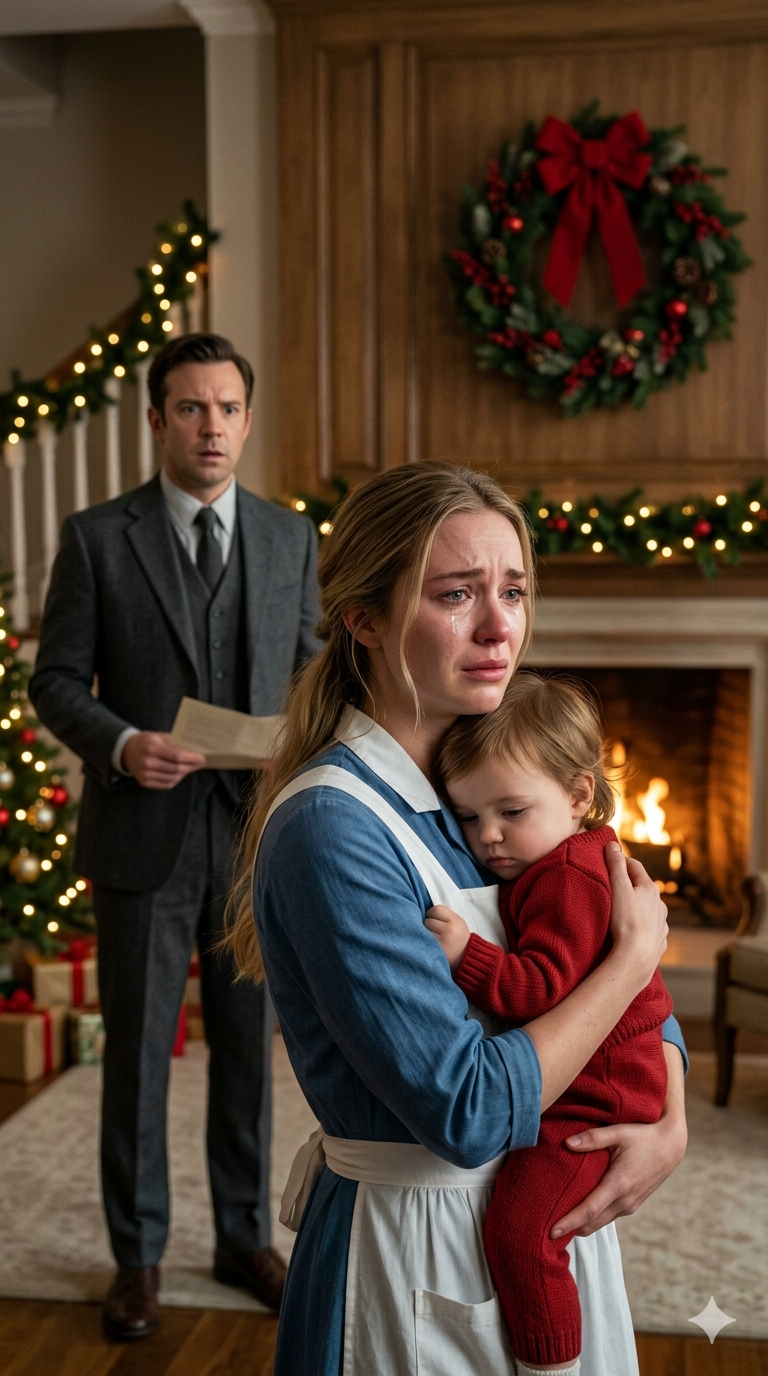
Elisa Navarro never imagined that Christmas Eve would be the last day she would ever spend inside the Cortés estate.
That morning, the crisp winter air of Barcelona drifted through the tall windows as Elisa stood in the kitchen, carefully shaping gingerbread cookies. Her hands moved from memory. She had made these same cookies every Christmas for the past four years—because they were the only ones Lucía would eat.
Outside, the city glowed with holiday lights. Inside the estate, staff rushed through the halls, preparing for an extravagant Christmas celebration.
But to Elisa, the house felt hollow.
Empty.
Heavy.
Because she knew something no one else did.
At exactly 11:59 p.m., her time there would end.
The letter had arrived three days earlier.
Thick paper. Formal wording. A precise signature at the bottom.
Alejandro Cortés.
Her employer.
Lucía’s father.
The letter informed her—politely, efficiently—that her services as Lucía’s nanny would no longer be needed. Her contract would end on December 24 at 11:59 p.m.
No explanation.
No conversation.
Just an ending.
Elisa had read it in the hallway, her back pressed against the wall as if the words had knocked the air from her lungs.
Four years.
Four years of sleepless nights.
Four years of sitting beside a bed while a little girl trembled from nightmares she couldn’t explain.
Four years of loving a child who never spoke.
And it ended with a signature.
Lucía had been mute since the night her mother died in a car accident. Doctors called it trauma-induced mutism. Therapists tried everything. Specialists came and went. Nothing worked.
Until Elisa arrived.
Not with pressure.
Not with fear.
But with patience.
With warmth.
With love.
Slowly, Lucía changed.
She smiled more.
She slept.
She stopped hiding.
And now Elisa was being erased—quietly, neatly—as if she had never mattered.
That afternoon, the front door opened.
Isabella Ríos stepped inside. She was striking in a way that demanded attention—perfect hair, flawless posture, heels clicking sharply across the marble floor. She moved as though the house already belonged to her.
She barely looked at Lucía.
Her eyes settled on Elisa.
“I need you to move your things out of the main service bedroom,” Isabella said coolly.
“Alejandro and I feel the house needs… a refresh.”
A refresh.
As if four years of devotion could be redesigned.
Lucía froze.
Her small hands gripped Elisa’s leg, her eyes filling with fear.
Something broke inside Elisa’s chest—but she nodded.
Because she already understood.
This was goodbye.
Later that day, Elisa received an unexpected visit.
Doña Pilar.
Alejandro’s grandmother.
The elderly woman watched Lucía quietly from across the room, sorrow clouding her eyes.
“Alejandro is running,” she said softly.
“From his grief. From his guilt.”
Elisa swallowed.
“He’s tearing apart everything you built with that child,” Doña Pilar continued.
“You have what he lost long ago—the courage to feel. And that frightens him.”
Elisa looked at Lucía, who was tracing slow circles on the floor with her finger.
“I can’t stay,” she whispered.
Doña Pilar squeezed her hand.
“I know.”
That night, Elisa packed.
Each folded sweater felt like a betrayal.
When Lucía saw the suitcase, panic flooded her face.
Her breathing quickened.
Her hands trembled.
Then, for the first time in four years, Lucía spoke.
“You… lied.”
One word.
Clear.
Fragile.
Devastating.
Elisa dropped to her knees, tears spilling freely.
She had promised she wouldn’t leave.
And now she was.
As the estate prepared for a glittering Christmas party, Elisa carried Lucía to the park one last time.
The cold bit at their skin.
Lucía knelt in the dirt, writing Elisa’s name over and over with her finger.
Her lips trembled.
Then—barely louder than the wind—she whispered:
“Mom.”
The word broke the silence.
Elisa froze.
Every sacrifice suddenly made sense.
Every sleepless night.
Every silent tear.
She had always been Lucía’s mother.
When they returned to the estate, Isabella was waiting.
But before she could speak, Alejandro stopped.
He looked at his daughter.
Really looked at her.
Not as a problem.
Not as an obligation.
But as a little girl who had finally found her voice.
And that voice had chosen Elisa.
Alejandro’s hands began to tremble.
Slowly, he stepped forward.
And then, in front of everyone, he knelt.
“I was wrong,” he said, his voice breaking.
“You didn’t just care for her. You saved her.”
He looked at Lucía, tears in his eyes.
“My daughter doesn’t need a nanny,” he whispered.
“She needs a mother.”
Turning to Elisa, he said the words she never expected:
“Please stay. Not as an employee—but as the mother you already are.”
That night, snow fell softly over Barcelona.
Inside the estate, Elisa, Alejandro, and Lucía sat together.
As a family.
For the first time, Lucía smiled—a real smile.
Three months later, spring arrived.
Lucía laughed.
She spoke.
She told stories.
Elisa watched her grow, knowing one decision had changed everything.
Love had found its way—not through contracts, but through courage.
And the girl who once had no voice now had endless stories to tell.
Because someone chose to stay.
