

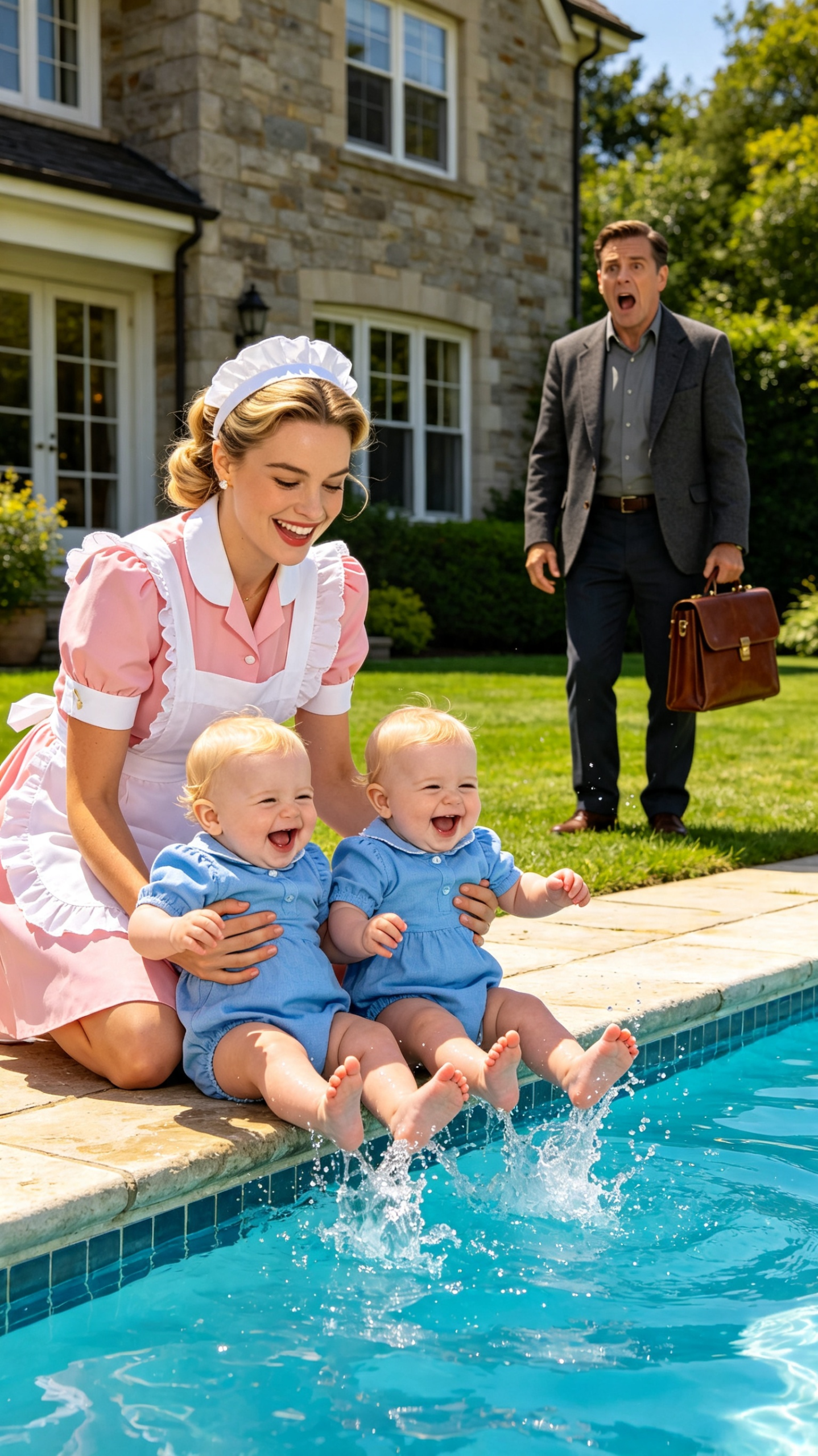
In the vast, glass-walled Hale mansion perched above the Pacific, silence had long been the governing law. The house itself seemed designed for it—white stone floors that absorbed footsteps, climate-controlled rooms that never allowed a draft or a sudden temperature shift, and a security system so refined it could distinguish between the soft click of a door latch and the heavier tread of an unauthorized visitor. At the center of this carefully engineered quiet lived two small boys, Leo and Ethan Hale, identical in face and nearly identical in the stillness they carried.
They were six years old. Their father, Jonathan Hale, had spent those six years constructing a fortress of protection around them. Specialists arrived on precise schedules. Occupational therapists mapped every possible sensory trigger. Behavioral consultants rewrote the household rules until even the staff spoke in measured tones. The pool—an infinity edge of turquoise water that spilled toward the horizon—had been declared off-limits after a single near-miss years earlier. The boys were not to approach the water without three adults present, life jackets, and written clearance. Noise was monitored. Joy, when it appeared at all, was observed rather than invited.
Maria Reyes had been hired six months earlier as a temporary caregiver. She was not a specialist. She had no advanced degrees in developmental psychology, no published papers, no glowing letters from previous high-profile families. What she possessed was a quiet attentiveness and a refusal to treat the twins as problems to be solved. On the morning everything began to shift, she had simply asked permission to sit with them beside the pool while the regular therapy session ran late.
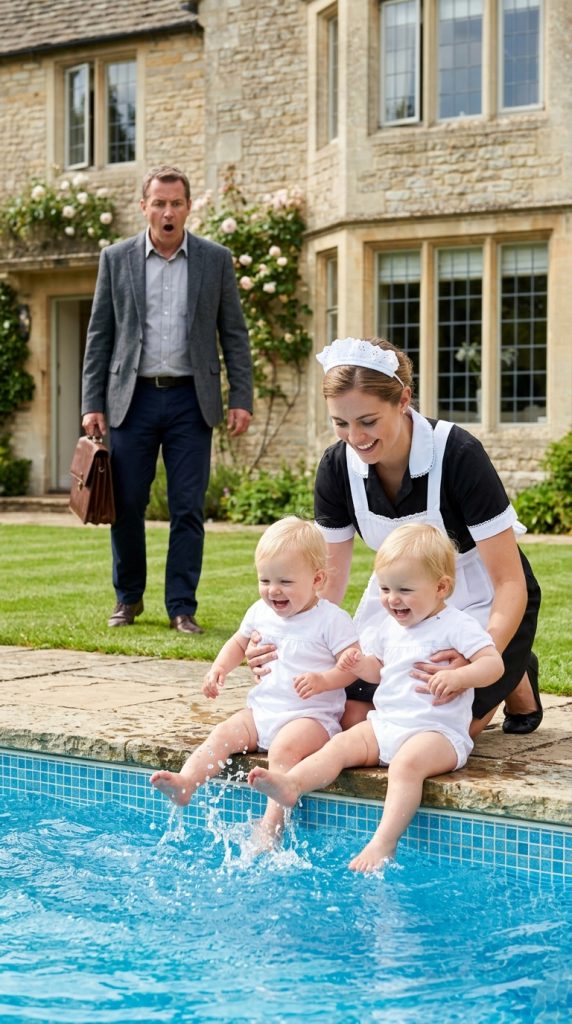
The sun was high and clean. The water lay almost motionless, reflecting the pale sky and the distant green of the hills. Maria sat on the warm stone edge, her bare feet dangling just above the surface. Leo sat to her right, Ethan to her left. Both boys wore the same white shirts and soft shorts, their dark hair neatly combed, their hands folded in their laps the way they had been taught.
Maria did not speak at first. She only moved her hand slowly through the water, watching the light fracture and reassemble around her fingers. The motion was gentle, repetitive, almost meditative. After a long minute she scooped a little water into her palm and let it trickle back down in a thin, silver stream.
Leo’s eyes followed the falling drops.
Something shifted in his face—not alarm, not the familiar blankness, but a faint, almost invisible curiosity. His lips parted. Then, without warning, a sound escaped him.
It was not a scream. It was not fear.
It was laughter.
At first the sound was small, startled by its own existence, as though Leo’s body had forgotten the pathway and was testing it carefully. The laugh came again, a little stronger, a little brighter. Maria froze mid-motion. She did not turn toward him. She did not speak. She did not dare claim the moment as hers.
Ethan noticed first. His head snapped toward his brother so quickly it looked painful. His eyes widened. Disbelief flooded his face. He stared at Leo the way one might stare at a bird that had suddenly begun to sing after years of silence.
Leo laughed again—louder this time, unrestrained. The sound bounced against the glass walls of the house, clumsy and bright and unmistakably real. It filled the space that had known only rules and quiet.
Ethan’s hands curled and uncurled at his sides. His shoulders rose and fell. For a moment it seemed he might remain locked in observation. Then Maria dipped her hand into the water once more and whispered, not as an instruction but as an invitation, “Your turn.”
Ethan leaned forward. When his fingertips brushed the surface, his breath caught sharply. His entire body tensed. For a split second he looked ready to pull away. Then something inside him broke open.
Ethan laughed.
Not softly. Not carefully. The sound burst out of him—wild, messy, uncontrollable. It shook his small frame and clearly startled even him. He clapped his wet hands together, sending droplets flying in every direction. Water sprayed across Leo’s shirt, across Maria’s arms, across the stone.
The twins looked at each other.
And then they both laughed.
Together.
Not the polite, trained sounds therapists had spent years trying to coax from them, but genuine, tangled joy. Their shoulders shook. Their eyes shone. Their voices rose and fell and tangled into one chaotic, beautiful noise. For the first time in their lives, the Hale twins were not quiet.
Inside the house the security system recorded everything in crisp, high-definition silence. Miles away, in a glass conference room downtown, Jonathan Hale sat at the head of a long table half-listening to quarterly projections when his phone vibrated hard against the polished wood.
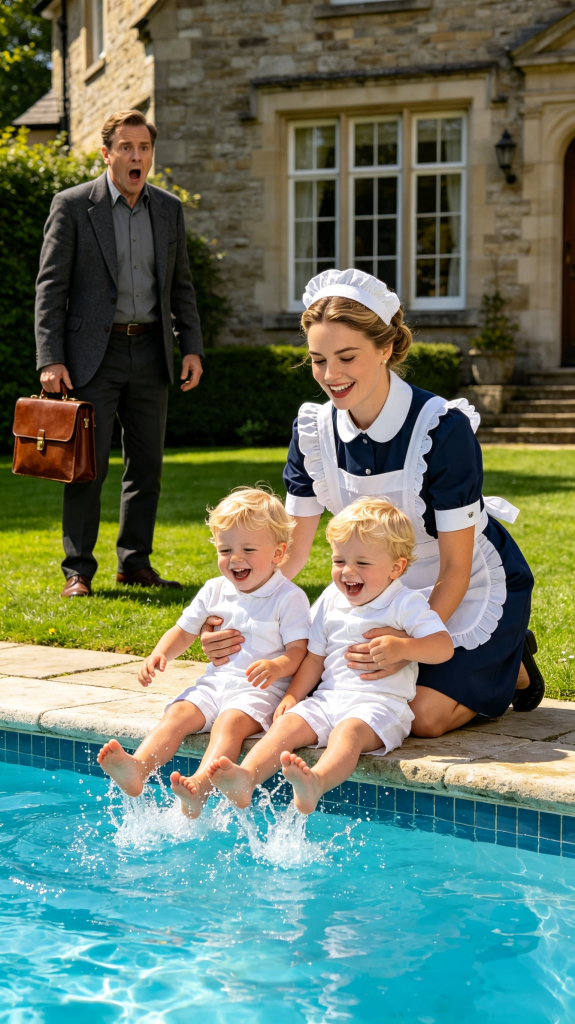
Alert: Unauthorized activity near the pool.
His heart slammed against his ribs. He muttered an apology he barely heard himself make, stood without fully registering the movement, and walked into the corridor with shaking hands. The live feed opened on his screen.
He stopped breathing.
His sons were laughing.
Loudly.
Water splashed as Maria moved her hand in slow circles. The boys mirrored her, their faces transformed—lit from the inside as though they had only just discovered the world could contain more than rules and quiet rooms. Jonathan’s knees gave way. He sank back into the nearest chair, one hand clamped over his mouth. For years he had poured money into the best minds, the strictest schedules, the most carefully designed therapies. Millions of dollars spent trying to protect them, to manage them, to keep them safe from a world that felt too sharp and too loud.
And all it had taken was water. And permission.
When Jonathan arrived home that afternoon the laughter was gone. The boys sat once more by the pool’s edge, hands folded, faces calm and unreadable, as though the earlier hour had been a shared hallucination. Maria stood a few feet away, posture straight, hands clasped in front of her. She looked ready to be dismissed. Ready to be blamed.
Jonathan walked past her without a word.
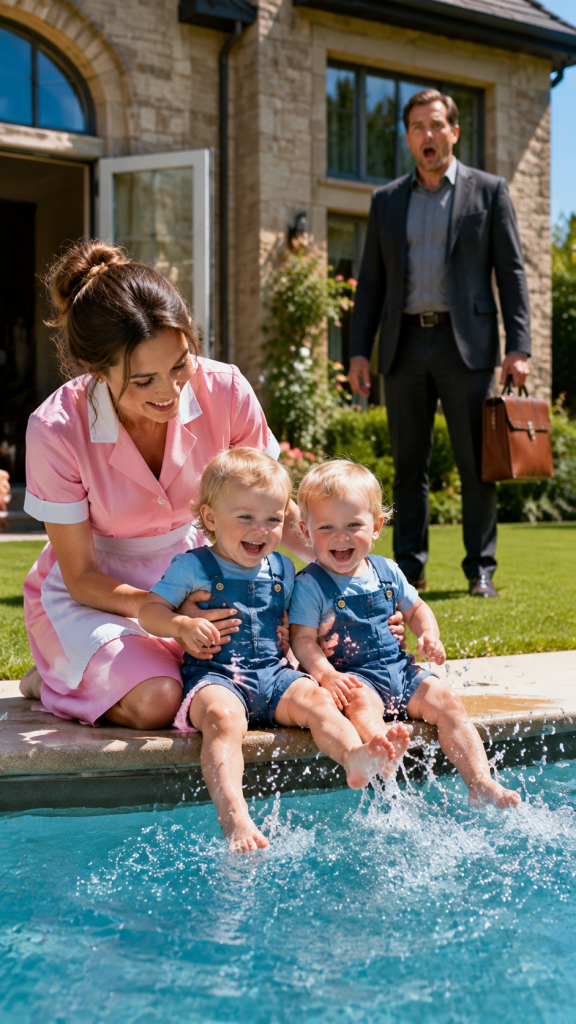
He knelt in front of the twins. He looked at them carefully—really looked—for the first time in a long while. Something subtle had changed. A softness around the eyes. A faint, lingering spark that had not been there that morning.
“Did you like it?” he asked. His voice was unsteady.
Ethan nodded once.
Leo reached out and wrapped his small fingers around the fabric of Jonathan’s sleeve—an unprompted touch, gentle and deliberate.
Jonathan closed his eyes.
That night the household rules began to rewrite themselves.
The pool was no longer forbidden. Noise was no longer punished. The rigid therapy schedule remained, but spaces opened around it for play, for mess, for the unpredictable music of children’s voices. Maria kept her position. More than that—she was thanked, quietly and without ceremony, by a man who had spent years believing that safety required the absence of joy.
In the weeks that followed, the twins laughed often. Not because they had been cured of whatever quiet had held them. Not because their lives had suddenly become easy. They laughed because someone had finally seen them as children rather than problems to be managed or risks to be controlled.
Jonathan Hale learned something no specialist had ever managed to teach him.
Safety without joy is only another kind of cage.
And the sound that now filled the Hale mansion was no longer silence.
It was life.
