

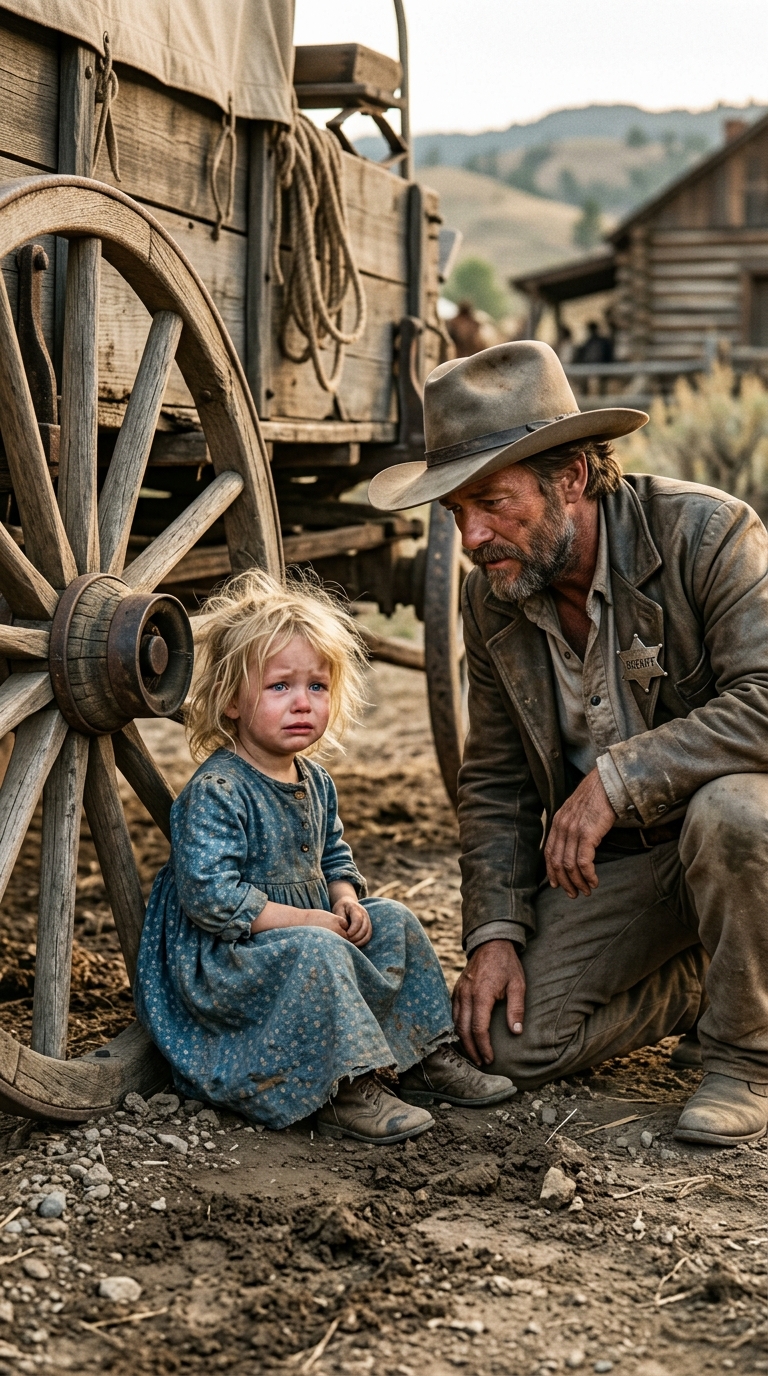
The Sonora sun had not yet fully risen when death arrived at Los Robles Ranch.
It came on horseback, in the icy gray of dawn, with four shadows moving through the dust as if they knew the road to hell by heart. Not even the coyotes howled. Not even the wind dared to blow. Lucía Robles, only nine years old, would remember every sound for the rest of her life.
She was hiding beneath the wagon when the first shot rang out.
Her father had put her there half a minute earlier, his hands trembling but his voice steady. He had gently pushed her down onto the cold ground, adjusting her skirt so it wouldn’t stick out, and whispered in her ear:
“Don’t come out, no matter what happens. Promise me, baby girl.”
Lucía promised.
Now she lay between earth and wood, her cheek pressed against the damp dust of the night, her heart pounding against her ribs as if it wanted to escape. Through the cracks of the wagon, she could only see fragments of the world: riding boots, long shadows, the edge of a green dress, and a golden bracelet that caught the first light of dawn.
Then she heard a woman’s voice.
It was refined, elegant—almost musical. But empty of humanity.
“You had your chance to stay quiet, Tomás,” she said. “You chose poorly.”
Tomás. Her father.
Lucía clutched the small wooden cross hanging from her neck, a gift from her mother the previous Christmas. She gripped it so tightly that one corner dug into her palm. Then she heard her father speak, with a desperation she had never heard before.

“Not the girl. Please. She doesn’t know anything.”
The woman let out a soft, low, terrible laugh.
“There are no innocents left in these lands.”
Lucía wanted to scream. She wanted to run. She wanted to cover her ears. She wanted to stop existing. But she had promised. Her father had told her to stay. So she stayed.
The shot that killed Tomás was so loud it made her bones vibrate.
Then came chaos: more gunshots, men shouting, her mother’s voice calling her name—only once—before it was suddenly cut off. Lucía saw a hand fall in front of the wagon wheel.
Her mother’s hand.
The wedding ring caught a flicker of sunlight… and then went still forever.
The girl shoved her fist into her mouth to keep from crying out loud. She tasted blood, dirt, and terror.
She heard footsteps approaching the wagon.
“Should we check underneath?” a man asked.
There was a pause. Then the same woman in the green dress replied, closer this time, and Lucía caught the scent.
Roses.
Sweet, cloying, unbearable roses in the middle of the smell of blood.
“No. We’ve already wasted too much time. Riders are coming from the east.”
A second later, the horses took off. The ground trembled.
And then… silence.
The cruelest silence in the world.
Lucía stayed under the wagon. She didn’t know how much time passed. Minutes, hours, a lifetime. The sun rose, the blood dried, the flies came. She remained there, because her father had told her not to come out.
To keep from going mad, she began arranging small stones in the dirt—rows, circles, meaningless shapes. She also hummed softly a song her mother used to sing to her during storms. It was that, or listen to the echo of the gunshot over and over again.
When the sun was high, she heard a single horse approaching slowly.
She didn’t run. She didn’t scream.
The rider dismounted, walked among the bodies, and stayed silent for a long time. Lucía heard the rustle of a blanket, then another. The stranger was covering her dead.
That kindness broke something inside her.
Footsteps approached the wagon—but did not invade it.
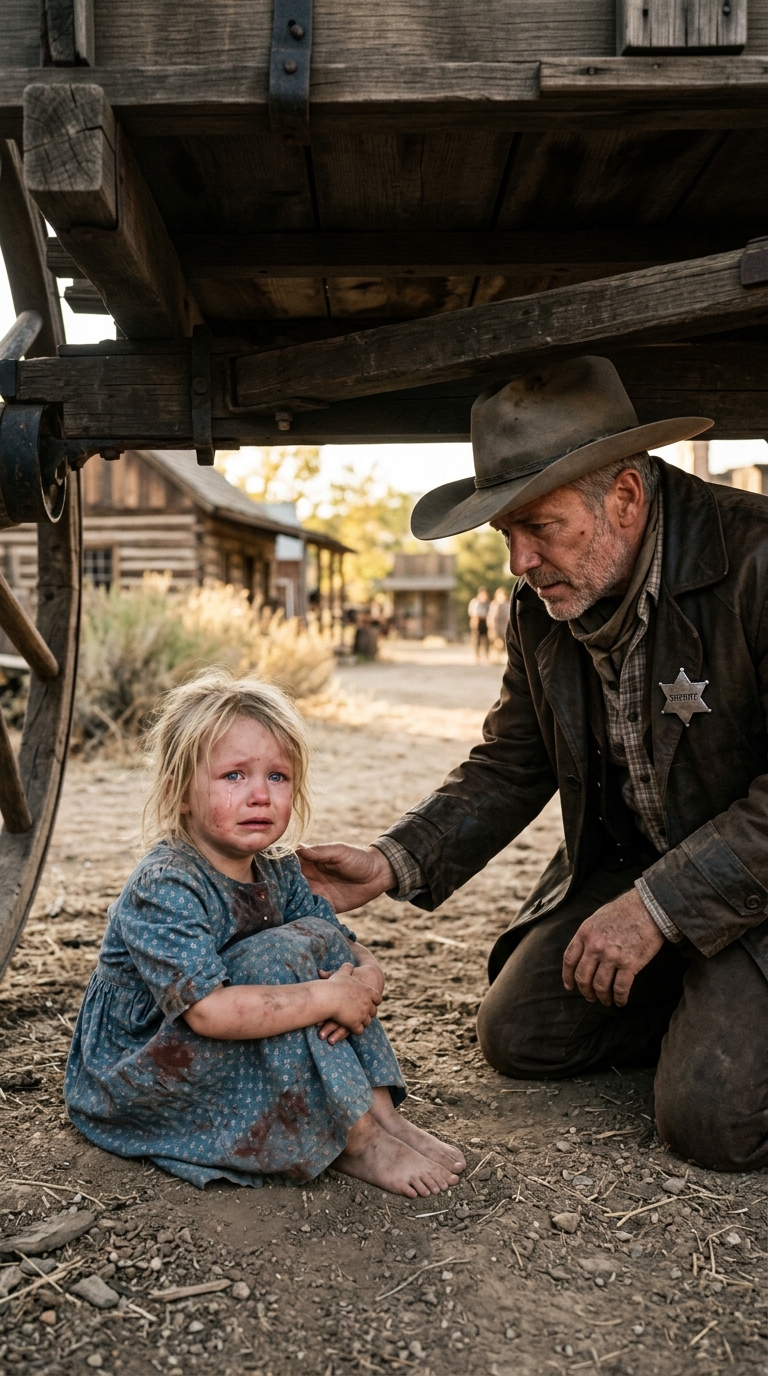
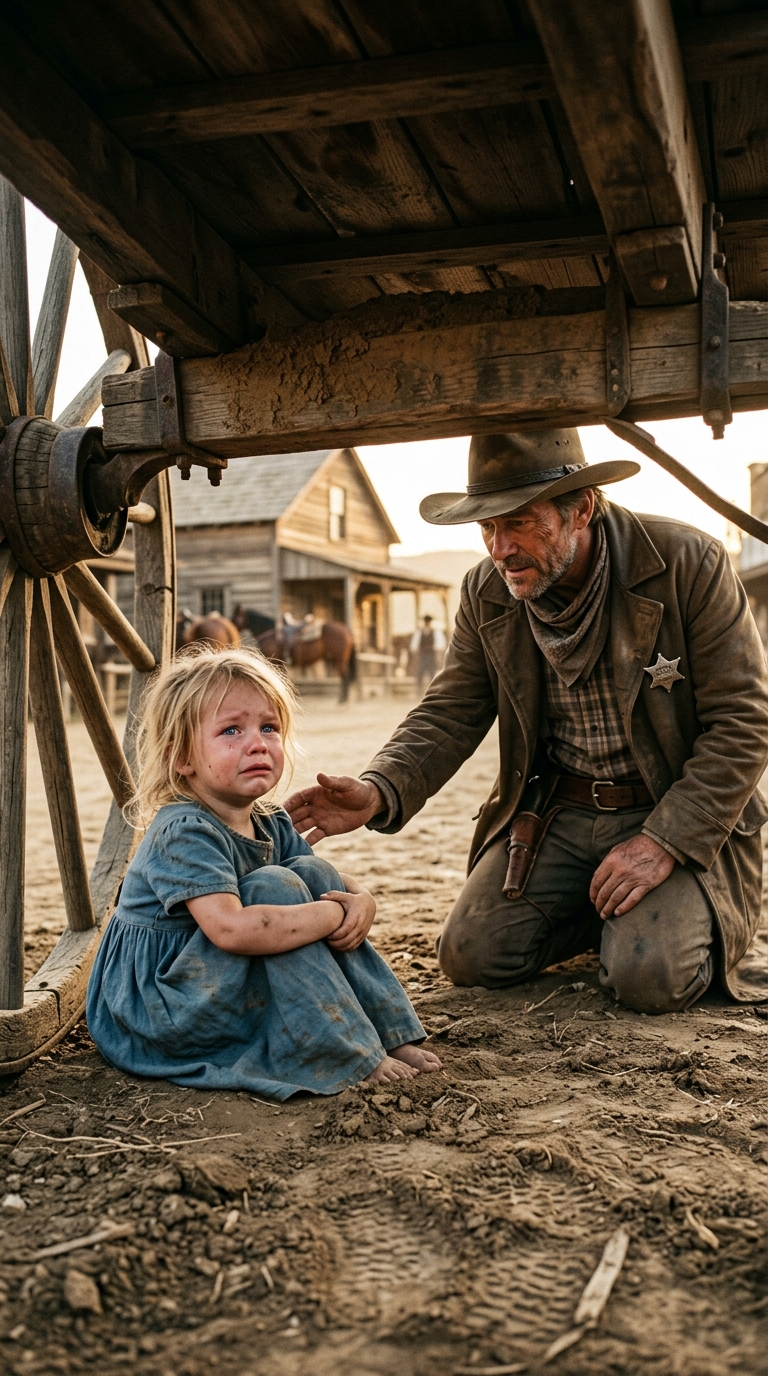
“Hello, little one,” a man’s voice said, rough with dust and life. “My name is Gabriel. I won’t hurt you.”
Lucía kept arranging stones.
“Can you come out? There’s no one else left.”
“There’s no one else left.” The words hurt so much she almost stopped breathing.
At last, she looked up. The man kneeling outside appeared to be in his early forties. His skin was weathered by the desert sun, he had several days’ worth of beard, and dark eyes that did not lie. He looked tired. Sad. But not cruel.
“They’ll come back,” Lucía whispered, in a voice that didn’t feel like her own. “They said they didn’t want any witnesses.”
Gabriel clenched his jaw.
“Who said that?”
“The lady who smells like roses.”
Gabriel Ortega had been riding alone through Sonora for six days. A former federal officer, he had retired years earlier after losing his wife and young daughter to fever. He had learned to live with little: a black horse, a worn saddle, a canteen, and far too many memories. Finding dead families in the desert had never been part of his plans—but he had seen enough evil to recognize it at first glance.
When he finally convinced Lucía to come out, he wrapped her in his own coat. The girl was dehydrated, covered in dust and other people’s blood, and trembling despite the heat.
“What’s your name?”
“Lucía Robles.”
“Beautiful name. A strong name,” he said. “I’m going to get you out of here.”
She didn’t respond. She no longer believed in promises.
Gabriel examined the place with a trained eye. This was no ordinary raid. They had been searching for something. The trunks were forced open, the saddlebags torn apart, papers half-burned. On Tomás Robles’s chest, he found a Bible carefully placed, open to a marked page:
“I looked for someone among them who would stand in the gap for this land…”
Lucía glanced at the passage and murmured:
“That was my father’s favorite. He said you had to stand against evil—even if you stood alone.”
Gabriel looked at her with quiet pain. Nine years old… and already speaking like a weary adult.
Little by little, through silences, the girl told him what little she knew. Her father worked at the land office in Hermosillo. He had uncovered fraud—fake deeds, stolen land, poor ranchers being stripped of everything. Her mother, Mariana, said powerful men were taking land from the poor with the help of bought judges. Tomás had been gathering evidence. He was going to hand it all over to a journalist in the capital.
“Mom used to say that if you stay silent, you help the bad ones,” Lucía said.
Gabriel understood.
This hadn’t been revenge.
It had been an execution.
“Do you have any other family?” he asked.
Lucía thought for a moment.
“My uncle Esteban. My mom’s brother. I think he’s a captain in the army. But they fought many years ago. Mom said he wanted to forget… and she didn’t.”
Gabriel looked toward the horizon. The name was a possibility. The nearest federal post was in Ures. If Esteban Robles was still there, maybe he could protect the girl. And if not, it would still be safer than any town where money could buy silence.
They didn’t bury the dead that day. Gabriel marked the place and swore silently he would return. Then he lifted Lucía onto the saddle, and they rode north.
For two days they traveled through dry riverbeds, red stone hills, and mesquite scrub. Lucía barely spoke, but she observed everything. One afternoon, while they rested under the shade of a saguaro, she spotted two riders in the distance, still on a ridge.
“They’re following us,” she said.
Gabriel didn’t even pretend to be surprised.
“Yes.”
“Are they the same people?”
“Or people working for them.”
“Are they going to kill us?”
Gabriel took a moment before answering.
“Not if I can stop it.”
“Don’t promise things you don’t know.”
He looked at her. The girl wasn’t being defiant—just brutally honest. She had learned too early the cost of a broken promise.
“Then I’ll promise you only this,” he said. “I will fight for you until the end.”
Lucía nodded. That, she could believe.
They reached the Ures garrison at dawn on the third day. The soldiers at the entrance eyed them with suspicion—until Gabriel mentioned the name Captain Esteban Robles.
The man who came out to meet them was tall, lean, his uniform impeccable, his face hardened by discipline. But the moment he saw Lucía, he went pale.
“My God…” he whispered.
The girl studied him without any visible emotion.
“Are you my uncle?”
Esteban swallowed.
“Yes. I’m your mother’s brother.”
Lucía lowered her gaze.
“Mom never told me she had a brother.”
The words struck him like a bullet.
Inside the office, Esteban told the whole story. Their father, Don Julián Robles, had been stripped of everything years earlier by a corruption network led by a man named Ramiro Salvatierra, the regional director of lands. The old man died ruined, eaten alive by rage. Mariana had sworn she would make him pay one day. Esteban, on the other hand, chose the army—and caution. He had begged her to let it go, not to sacrifice her life for an impossible war. She called him a coward.
They never spoke again.
“And now she’s dead,” Esteban said, his voice breaking. “And I wasn’t there for her.”
Gabriel placed the Bible found at the ranch on the table and told him about the mysterious rider who had covered the bodies and marked the verse.
Esteban frowned.
“Then Tomás managed to secure something. There’s someone who could have helped him: Father Anselmo, at the Santa Rosalía mission. My sister trusted him.”
The plan was simple—and dangerous: Gabriel and Esteban would go to the mission. Lucía would stay at the garrison with Elena, Esteban’s wife, a calm woman who immediately welcomed her with firm tenderness.
But that same afternoon, the unthinkable happened.
A woman in a green dress appeared at the gates of the garrison.
She entered carrying the scent of roses.
She was beautiful, flawless, with the smile of a respectable lady—and the coldest eyes Gabriel had ever seen.
“My name is Verónica Salvatierra,” she said. “I’ve come to retrieve some stolen documents—and to take the girl. The poor child is traumatized. She needs proper care.”
Lucía saw her from a window and recognized her instantly. The air left her lungs.
“It’s her,” she whispered.
Gabriel stood in front of the office door like a wall.
“The girl isn’t going anywhere.”
Verónica smiled faintly.
“How touching. Playing father now?”
Gabriel didn’t answer.
She threatened them—with judges, with politicians, with her husband, with the governor. She made it clear that Ramiro Salvatierra owned half of Sonora. Then, before leaving, she dropped a sentence that froze everyone’s blood:
“Accidents happen—even inside military posts.”
That decided everything.
That same night, the four of them left: Gabriel, Lucía, Esteban, and Elena. At the Santa Rosalía mission, they found Father Anselmo praying in front of the altar. When Gabriel told him what had happened, the priest led them to a side wall, removed a loose stone, and pulled out a leather bag.
“Tomás asked me to deliver this only if something terrible happened,” he said.
Inside were ledgers, copies of forged deeds, letters, payments to judges, signatures, names, and dates.
Enough to destroy Ramiro Salvatierra—and half the corruption network.
But also enough to condemn them all if it fell into the wrong hands.
They didn’t leave in peace. The next day at noon, they were ambushed in a narrow pass between hills. Bullets whistled over their heads. Esteban returned fire from behind the rocks. Elena shielded Lucía and placed a small revolver in her hand.
“It’s not for killing,” she said. “It’s so you understand you will never be defenseless again.”
Verónica appeared at the front, wounded in one shoulder from a previous shot—but still proud.
“Give me the papers, and I’ll let the girl live.”
Gabriel spat into the sand.
“You’re lying.”
“Of course I’m lying,” she replied with a fierce smile. “But I enjoy seeing whether you still expect honor from monsters.”
The situation seemed lost—until Lucía, hiding behind a rock, remembered something her father had taught her about canyon echoes. She took a breath and shouted with all her strength toward the opposite wall:
“Now, Captain!”
The echo exploded through the valley as if soldiers were arriving from behind. Verónica’s men hesitated. Esteban seized the moment and shot one man’s horse. Gabriel charged downhill, disarmed another, and knocked him to the ground. Elena aimed at Verónica with an iron-steady hand.
“It’s over.”
Verónica turned her weapon toward Lucía.
And Lucía, her hands trembling but her gaze steady, raised the small revolver Elena had given her.
She didn’t fire.
She just aimed.
But that image—a nine-year-old girl, covered in dust, holding fear like a burning stone and refusing to lower her eyes—was enough to break something inside the killer.
At that moment, a federal detachment arrived from Hermosillo, sent by a trusted friend of Esteban’s, warned the night before. The net closed.
Verónica was arrested, screaming threats. Ramiro Salvatierra fell two days later, trying to flee toward Guaymas with money and half-burned documents.
The trial was long, loud, and full of powerful men trying to save themselves.
But the evidence was overwhelming.
And when Lucía took the stand, wearing a simple white dress and the wooden cross around her neck, no one could move her an inch.
“Do you recognize the woman who gave the order?” the prosecutor asked.
Lucía pointed at Verónica.
“Yes. She smells like roses.”
A silence fell so deep that someone could be heard crying in the back.
She told what she saw. What she heard. What her father said. What her mother defended.
She didn’t embellish. She didn’t exaggerate.
She spoke with a truth so pure it seemed to cut the air.
Ramiro Salvatierra was convicted of fraud, murder, and conspiracy. Verónica received the maximum sentence. And at last, the names of Tomás and Mariana Robles were cleared.
Months later, Gabriel returned with Lucía to the ruined ranch. They buried her parents beneath a large mesquite tree, where the sunrise could be seen. The priest prayed. Esteban asked his dead sister for forgiveness out loud. Lucía placed a handful of stones on the grave, arranged in the shape of a cross.
That afternoon, on their way back, Gabriel stopped in front of a small adobe house on the outskirts of Ures. It had a corral, chickens, a crooked garden, and an old horse grazing by the fence.
“It’s not much,” he said. “But if you want… we could start here.”
Lucía looked at the house, then at him.
“As what?”
Gabriel swallowed hard.
“As a family—if you’ll have me.”
The girl stayed silent for a few seconds that felt like eternity to him. Then she took his hand.
“Okay. But on one condition.”
“What is it?”
“Never lie to me. Not even to protect me.”
Gabriel smiled, his eyes filled with tears.
“Deal.”
A year later, in that same house, Lucía ran after a chestnut filly while Elena watered the garden and Esteban fixed a fence on the Sundays he came to visit. Gabriel watched from the porch, a cup of coffee in his hand, still struggling to believe that something good could survive so much pain.
Lucía still had difficult nights. Sometimes she woke up crying. Sometimes she hated the smell of roses.
But she also laughed again.
She rode again.
She read aloud.
She drew horses and sunrises.
One evening, as the sky turned orange over the mountains, she sat beside Gabriel on the front step.
“Do you think Mom and Dad can see us?”
Gabriel wrapped an arm around her shoulders.
“Yes. And I think they’re at peace.”
Lucía rested her head against his arm.
“Then it was worth it.”
Gabriel looked out at the horizon—the new ranch, the girl the desert had failed to break—and understood that justice does not bring back the dead.
But it can save the living.
And sometimes, if you have the courage to keep going, it can even turn tragedy into a home.
The Sonoran wind drifted softly through the mesquite trees.
It no longer smelled of blood.
It smelled of earth, of life, of a future.
And for the first time since that cursed dawn, Lucía Robles smiled without fear.
