

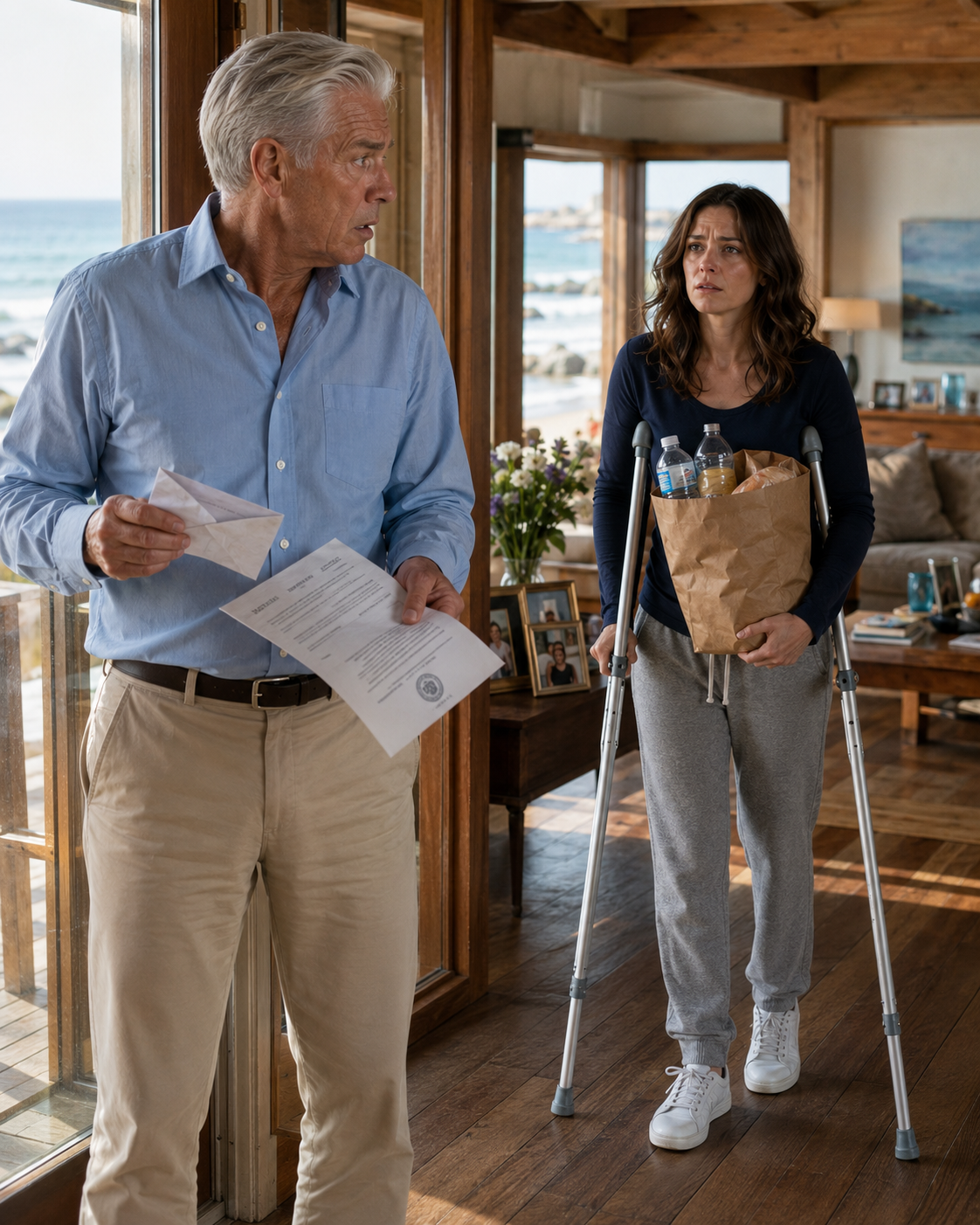
When my wife passed away, I inherited the forgotten beach cabin, while my son received the villa in Italy. He looked over the documents and said, “you can go live in that abandoned place by the water.”
Bradley laughed when the attorney placed the cabin keys in front of him, and in that moment I understood that my son no longer saw me as his father.
Not because he looked angry. Anger would have been easier to accept. Anger still carries emotion, and emotion means there is something left underneath. Bradley looked amused. He relaxed in the leather chair beside me inside Mr. Thompson’s office, one leg crossed over the other, his expensive watch reflecting the afternoon sunlight, casually turning through the final pages of his mother’s will as if he were browsing a restaurant menu. When he reached the section describing the properties, a smile appeared on his face unlike anything I had ever seen from him as a child.
“A beach cabin,” he said, almost laughing. “Dad gets some old shack on the coast, and I get the villa in Italy.”
Mr. Thompson, who had handled our family’s legal matters for fifteen years, cleared his throat.
“Your mother left very specific instructions.”
“Clearly.” Bradley looked toward me, satisfaction visible in his eyes. “Well, that’s just perfect. Even now, Mom knew who deserved what.”
The room became silent.
I had barely spoken since the reading started, my hands resting quietly in my lap. My black suit suddenly felt uncomfortable around my shoulders because grief has a way of making even familiar things feel strange. Helen had been gone for eight days. The house still smelled like her face cream and the lavender sachets she placed in every drawer. Her robe still hung behind our bedroom door. I still had not learned how to sleep on my side of the bed without expecting to hear her breathing.
And my son was smiling over property.
Mr. Thompson looked back at the documents.
“The coastal property is completely paid off, Eugene. No mortgage. No remaining debt. The deed transfers directly to you.”
Bradley gave a short laugh.
“Perfect. Dad can spend retirement with the seagulls.”
I remained quiet.
For thirty-two years, I had solved problems created by pressure and force. I worked as a construction engineer, the person contractors called when expensive structures stopped behaving as expected. I examined damaged bridges, unstable foundations, weakened steel, and storm destruction. I trusted calculations. Weight distribution. Engineering plans. If you understood how pressure moved, you could understand why something survived or why it collapsed.
But there was no formula for the pain of your only child looking at you like something disposable.
Mr. Thompson pushed a small envelope toward me. Inside were two old keys, one brass and one darkened by age.
“The address is 127 Driftwood Lane, Clearwater Beach,” he said. “It has been empty for quite some time, from what I know.”
“From what you know?” I asked.
He paused.
“Helen was very private about that property.”
That was an understatement.
I had been married to Helen Miller for thirty years, yet until that day I had never known she owned a coastal cabin.
Bradley placed his copy of the documents inside a leather portfolio and stood up. His perfectly tailored suit matched his entire life, because someone had always handled the cost before he ever had to think about it.
“This has been interesting,” he said, already walking toward the door. “But I need to arrange my flight. The villa needs to be evaluated.”
“Bradley,” Mr. Thompson called quietly.
My son stopped with his hand on the doorframe.
“You should probably start packing, Dad.”
I looked at him.
He smiled.
“I’m listing the house next week.”
For a moment, I wondered if grief had affected my hearing.
“This is my home too.”
“Not according to the will.” His voice stayed casual, almost pleasant. “Mom left the house and everything else important to me. You have your beach cabin.”
“Your mother would not want you to push me out.”
“My mother made her choices clear.” He glanced at the envelope in my hand. “You have forty-eight hours.”
The door closed behind him.
Mr. Thompson stayed silent for a moment. He removed his glasses, rubbed his forehead, and suddenly appeared much older.
“Eugene,” he said, “there may be more behind Helen’s decisions than you realize.”
“What are you saying?”
“I’m saying she asked me to follow the will exactly as written. She never explained her reasons.”
“That sounds like Helen.”
He leaned closer.
“Visit the cabin before deciding what you think she meant.”
I looked down at the keys.
They rested in my hand like two small pieces of a life I never knew existed.
That evening, I sat inside the home I had shared with Helen for thirty years while movers removed the furniture my wife had carefully chosen and my son had already claimed. The grandfather clock, the china cabinet, the walnut sideboard from Helen’s aunt, the cream-colored sofa we bought after Bradley left for college because Helen wanted something “grown-up.” Everything had been marked, wrapped, or placed into boxes. Bradley arranged it all before the funeral flowers had even disappeared.
I grabbed our wedding photograph from the mantel before a mover could pack it away.
Helen wore a satin dress she bought secondhand and altered herself. I stood beside her in a rented tuxedo, smiling like the luckiest fool in Ohio. We were twenty-five and twenty-eight, sunburned from our honeymoon at Lake Michigan, struggling enough to count every restaurant expense, yet happier than we understood.
When did that woman become someone who secretly owned a cabin, left our son a villa, and gave me nothing except keys to a weathered building near the sea?
Or had I become the stranger first?
I had no answer.
At sunrise, I loaded my pickup with the belongings that were truly mine. My tools. My clothes. Three boxes of books Helen never enjoyed. My drafting table because Bradley said it was “too ugly to stage around.” A metal lockbox filled with work records. The wedding photograph.
By noon, I sat in the driveway with the engine running, staring at the front window where Helen used to stand with her coffee while I cut the grass.
Bradley stood on the porch, looking through his phone.
He never lifted his eyes.
The drive to Clearwater Beach took just over two hours. The farther south I went, the softer everything became. Shopping centers turned into bridges, blue water, small seafood restaurants, fishing stores, stucco houses, palm trees leaning over parking areas, and tourists driving rental cars as if they had forgotten the ocean was nearby.
I kept the windows open, allowing the salty air into the truck.
Driftwood Lane was not the kind of place people discovered by accident. It was narrow, sandy, and partly hidden beneath tall beach grass. Some homes had been transformed into bright vacation properties with glass balconies and outdoor showers. Others looked like they had been waiting years for someone to decide their future.
Number 127 belonged to the second group.
I parked where a driveway had likely been before nature reclaimed it. Sand covered most of the path. Weeds grew between broken shells. The cabin stood behind a crooked fence, its faded blue paint peeling away, porch steps weakened, and roofline twisted by years of storms. Two front windows were boarded shut. A rusty mailbox hung open like a tired old mouth.
Bradley’s voice returned in my thoughts.
A shack.
For a moment, I remained inside the truck, feeling ashamed. Helen had left me this. A forgotten cabin on a sandy road while our son received the house, the furniture, and a villa overseas that somehow became the family’s greatest prize despite the fact that I had never even liked it.
But Helen had never been careless. She had always been capable of becoming distant. She knew how to hide things. She could hurt someone more deeply through silence than others ever could with angry words. But she was never careless.
I pulled the keys from my pocket and stepped outside.
The brass key slid into the lock.
It turned without resistance.
Far too easily.
For a place that was supposed to have been forgotten, the door opened as though it had been expecting me.
I walked inside and immediately stopped.
The smell was not old wood. Not mold. Not the damp, ruined scent of a place left untouched for years.
Lavender.
Gentle, yet impossible to miss.
The living room was simple, with aging wooden floors and a faded couch positioned beneath the window. But the floors were clean. A blue blanket was carefully folded over one side of the couch. Fresh yellow and white flowers stood in a mason jar on the coffee table, their stems recently cut. A pile of letters sat beside a pair of reading glasses. Sunlight entered through a small opening in the curtains and spread across a woven rug that showed no sign of dust.
Someone was living here.
I slowly placed my toolbox down.
In the kitchen, I found two plates sitting in the drying rack. Two cups. Silverware arranged neatly on a towel. A refrigerator quietly ran in the corner. When I opened the door, I saw milk, soup stored in a container, eggs, half a lemon, and several prescription bottles lined up carefully on the top shelf.
Every label carried the same name.
Carol Martinez.
The address listed was 127 Driftwood Lane.
I closed the refrigerator and stood frozen, one hand still resting on the handle, trying to connect all the pieces.
Helen had left me a cabin.
The cabin had someone living inside.
A woman named Carol Martinez received mail here.
Among those letters were messages addressed to Helen herself, including an envelope from an oncology clinic dated two months before her death.
My wife had been coming here.
Not one time.
Not once in a while.
Regularly.
I picked up the oncology envelope and stared at the return address.
Clearwater Medical Center.
Oncology Services.
Appointment Confirmation.
Helen had told me those visits were nothing serious.
She had looked tired, yes, but she blamed everything except sickness. She blamed getting older, grief, sleepless nights, even the weather.
Anything but illness.
Fifteen years earlier, when cancer first entered our lives, we faced it together.
The appointments.
The sickness.
The scarves carefully folded on the dresser.
The nights she cried quietly in the bathroom so Bradley would never hear.
I believed we had overcome it together.
Side by side.
But now I was holding evidence that she had faced its return without me.
A photo album sat on the coffee table.
It was open to the first page, as if someone had only recently been looking through it.
I slowly sat down on the couch and lifted it into my hands.
The first picture took my breath away.
Helen was sitting on the beach outside the cabin, wearing a straw hat and the blue cardigan I remembered buying for her in Maine. Her arm rested around a young woman with dark hair and kind eyes.
They were laughing together, leaning toward each other while the ocean shimmered behind them.
Helen did not simply look happy.
She looked free.
I turned the page.
Helen and the woman preparing food together in the small kitchen.
Helen reading on the porch while the woman rested underneath a blanket.
The woman sitting in a wheelchair near the window while Helen knelt down to adjust something near her foot.
Helen holding birthday cupcakes with candles shaped like the number thirty-two.
The woman standing alone with forearm crutches, giving a shy smile toward the camera.
The same face appeared again and again.
Kind.
Exhausted.
Loved.
Who was she?
The answer came before I was ready to hear it.
Footsteps moved across the porch.
A key entered the lock from outside.
I stood too quickly, causing the album to slide from my lap onto the couch.
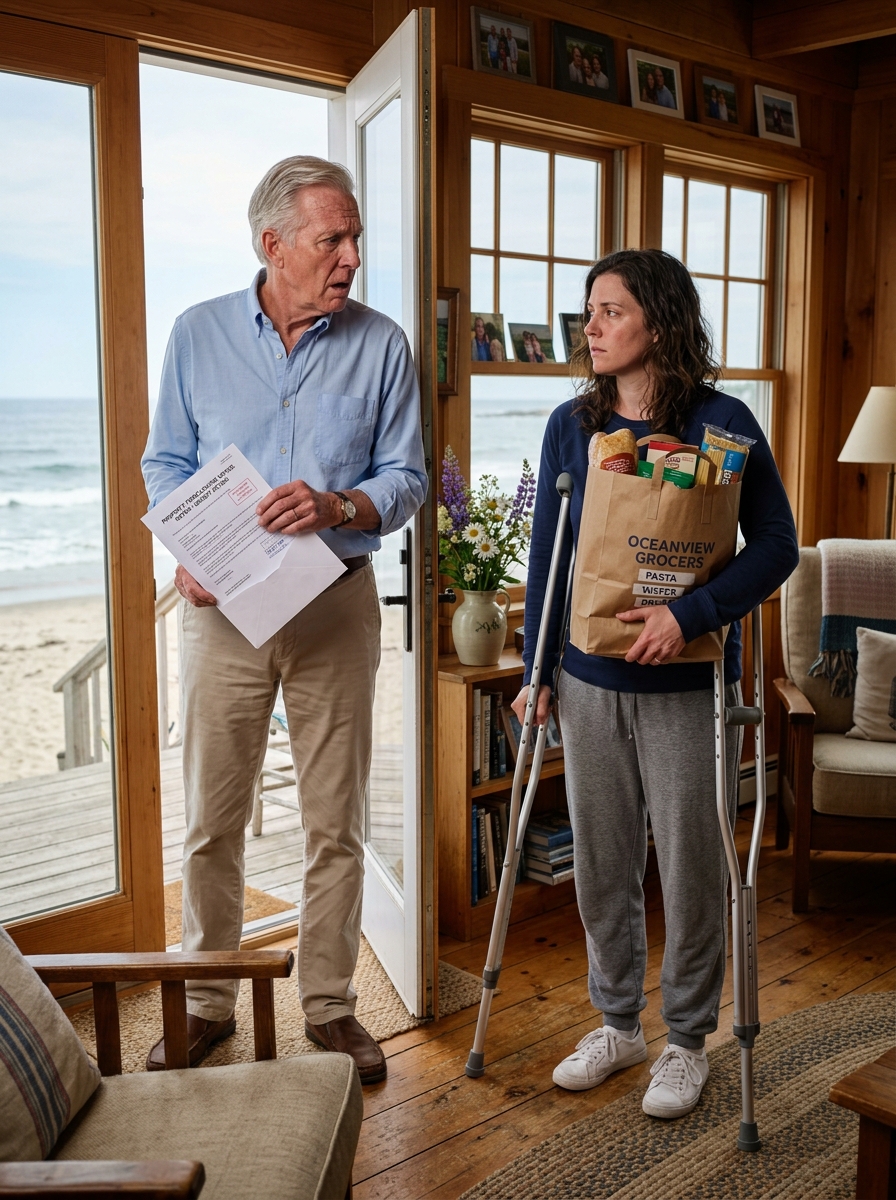
The door opened, and the woman from the photographs walked inside carrying a small grocery bag against her side.
“Helen?” she called softly. “They had the crackers you like. The doctor said your appetite might—”
She stopped immediately when she saw me.
For several seconds, neither of us spoke.
We simply stared at each other from opposite sides of the room.
She was smaller than she appeared in the pictures, or perhaps the illness made her seem more fragile in person. Her dark hair was pulled back at the base of her neck. She wore a pale green sweater and loose pants, with forearm crutches carefully tucked beneath both arms.
A canvas bag hung from her shoulder, and a medical bracelet surrounded her wrist.
Shock appeared on her face first.
Then fear.
Then confusion.
And finally something even more unexpected.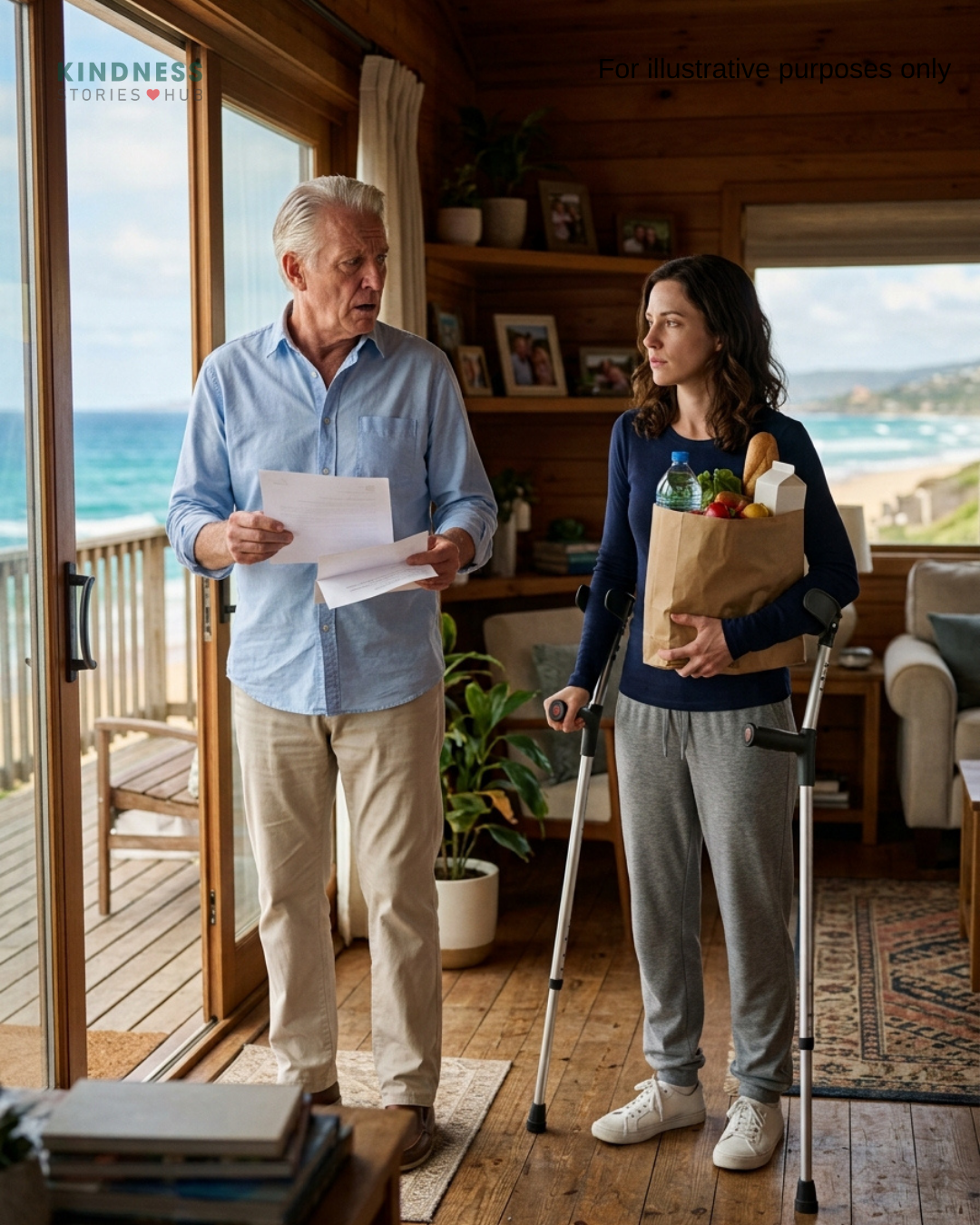
Recognition.
“You’re Eugene,” she said.
Not as a question.
My throat felt dry.
“And you are Carol Martinez.”
She slowly nodded.
“How do you know me?”
Her eyes moved toward the photo album before returning to me.
“Helen said you might come here eventually.”
Hearing my wife’s name spoken by this stranger almost broke something inside me.
“She said that?”
“She hoped you would.”
I looked around the cabin.
“Did she know you were living here?”
Carol carefully placed the grocery bag on the kitchen counter.
“This is my home.”
“No,” I replied, sharper than I intended. “Helen left this property to me.”
“I know.”
“Then why is your medication in the refrigerator? Why is your mail here? Why are there pictures of you and my wife everywhere?”
Carol slowly lowered herself into the chair across from the couch. The movement clearly required effort, though she tried not to reveal it.
“She bought it for me four years ago,” she said. “But she kept the deed in her name.”
“That is impossible.”
“It isn’t.”
“We didn’t have money for secret houses.”
“She used her mother’s inheritance.”
I stared at her.
Helen’s mother had left her money years earlier, and Helen always told me she donated most of it to medical charities after defeating cancer the first time.
I admired her for that.
I had proudly told our friends during dinners that my wife understood gratitude better than anyone I knew.
Carol’s expression softened, and somehow that kindness made me resent her even more.
“She wanted to tell you. She was afraid.”
“Afraid of what?” Carol reached over to the small table beside her and lifted a thick manila envelope. The edges were worn, and a red string clasp kept it sealed. Helen’s handwriting covered the front.
For Eugene.
Carol held the envelope gently with both hands before offering it to me.
“She was afraid of how much truth there was.”
I didn’t take it right away.
In less than two days, I had already lost my house, my belongings, and the confidence I had in everything I thought I understood. Whatever was hidden inside that envelope felt like it could take away the little certainty I had left.
Eventually, I reached out and accepted it.
Inside was a birth certificate.
The paper was old, but it had been carefully protected inside a clear plastic cover.
Name: Carol Helen Miller.
Mother: Helen Marie Miller.
Father: Not Listed.
I read those words again and again until their meaning finally reached me.
Then I raised my eyes.
Carol’s eyes were wet, but her voice remained steady.
“She was seventeen,” she explained. “Her parents made it clear that I could not come home. She gave me up for adoption. She said it was the choice that created every silence she carried afterward.”
Outside the cabin, the ocean continued moving in slow, peaceful waves.
“Helen had a daughter,” I whispered.
“Yes.”
“And she never told me.”
“No.”
I leaned back into the chair.
The cabin felt like it was shifting around me, even though nothing had actually changed. The flowers remained on the table. The photo album stayed open. The curtains still moved with the ocean breeze.
Only my understanding of thirty years of marriage had been completely rewritten.
“She found me four years ago,” Carol continued. “She hired someone to locate me. I was already sick by then. I have a progressive neuromuscular condition. Some days are easier than others. Insurance covered some of my treatment, but not the life that came with it. Helen wanted to help me.”
I thought about Helen’s so-called “charity donation.” The financial records she always managed herself. The weekends she described as women’s retreats, medical follow-ups, or quiet trips to clear her mind. The distance I had blamed on grief, age, our marriage, and time.
“You were her retreat,” I said.
Carol’s expression tightened with emotion. “No. I was her regret.”
That one sentence broke something inside me in a way Bradley’s cruelty never had.
My eyes filled with tears.
I looked again at the photographs. Helen smiling. Helen making soup. Helen sitting beside Carol beneath a blanket on the porch. Helen appearing like someone trying to repair an entire lifetime through simple, ordinary moments.
“She talked about you,” Carol said.
I shook my head. “She lied to me.”
“Yes.” Carol did not try to make the truth easier. “She did.”
Strangely, I valued that honesty more than sympathy.
“She also loved you,” she continued. “She said you were the only man who ever made her feel safe enough to become a better person, and then she spent years feeling ashamed of the parts of herself she had kept hidden from you.”
Behind the lamp on the side table was a small wooden box.
I knew it immediately.
I had made that box during my high school shop class. Walnut wood, uneven joints, and a lid that never closed perfectly. I gave it to Helen during the first summer we were together, with a note inside that said, for everything we’ll keep.
I had not seen it in decades.
I thought it had vanished during one of our moves or ended up discarded during one of Helen’s intense cleaning sessions.
Carol noticed my eyes on it.
“She kept it here,” she said. “She told me you built it when both of you still believed forever was easy.”
I opened the box.
Inside were letters.
Many of them.
Every envelope had my name on it.
Helen’s familiar handwriting covered each one, angled and neat, exactly like the shopping lists, condolence cards, and birthday messages she had written throughout our life together.
The letter on top was dated two weeks before she passed away.
My hands trembled as I unfolded it.
My dearest Eugene,
If you are reading this, then you have met Carol, and you know the truth I was too ashamed to tell you while I was still alive.
I am sorry.
Those words became blurry before my eyes.
I wiped them away with the back of my hand and continued reading.
I am sorry for making you live beside my secrets. I am sorry for letting you believe my distance was because of something you did. It was never your failure. It was mine. I was a frightened girl before I became your wife, and I carried that frightened girl into our marriage without ever allowing you to truly know her.
Carol is my daughter. She is not your betrayal. She is my first wound and my final opportunity to heal something I damaged.
Please be kind to her if you can.
I stopped reading and looked toward Carol.
She was crying silently.
The letter continued.
There is more, Eugene. I wish there wasn’t, but there is. Before I died, I discovered things about Bradley that you need to know before he comes to you asking for help.
The atmosphere inside the room suddenly changed.
Carol noticed that I had stopped moving.
“What about Bradley?” I asked.
She brought her hands together tightly. “Keep reading.”
So I continued. Bradley was facing a serious financial crisis. He had taken out large loans against the villa using documents that seemed to contain my approval. I never approved any of them. I found out when a lender reached out to me directly. I also discovered he had taken money from accounts connected to my retirement and savings, using unauthorized signatures and repeated small transfers he hoped would escape my attention.
I knew this would hurt you. I am sorry I did not tell you sooner. I was exhausted, Eugene. Exhausted physically, exhausted emotionally, and ashamed of how easily our son had learned to treat love like something he could use whenever he wanted.
I lowered the letter.
“How much?” I asked.
Carol reached underneath the side table and brought out another folder.
“Helen collected the records,” she said.
I opened it.
Bank statements. Copies of checks. Withdrawal records. Transfer confirmations. My name appeared over and over beneath signatures that looked believable at first, but once I recognized the pattern, each one made my stomach tighten.
Seventy thousand dollars from my retirement account.
Twenty-seven thousand from my savings.
Multiple smaller withdrawals from an emergency fund I had almost forgotten about.
Ninety-seven thousand dollars.
Money I had earned through early mornings at construction sites, standing outside in storms with inspectors, answering work calls during family dinners, and fixing everyone else’s structural problems while my own family was quietly falling apart around me.
“Bradley did this?”
Carol nodded. “Helen’s investigator believed the amount was probably even higher after reviewing older transactions.”
I remembered Bradley laughing in Mr. Thompson’s office.
Hope you like the smell of low tide.
He had expected me to have nothing left.
Not just expected it.
Planned it.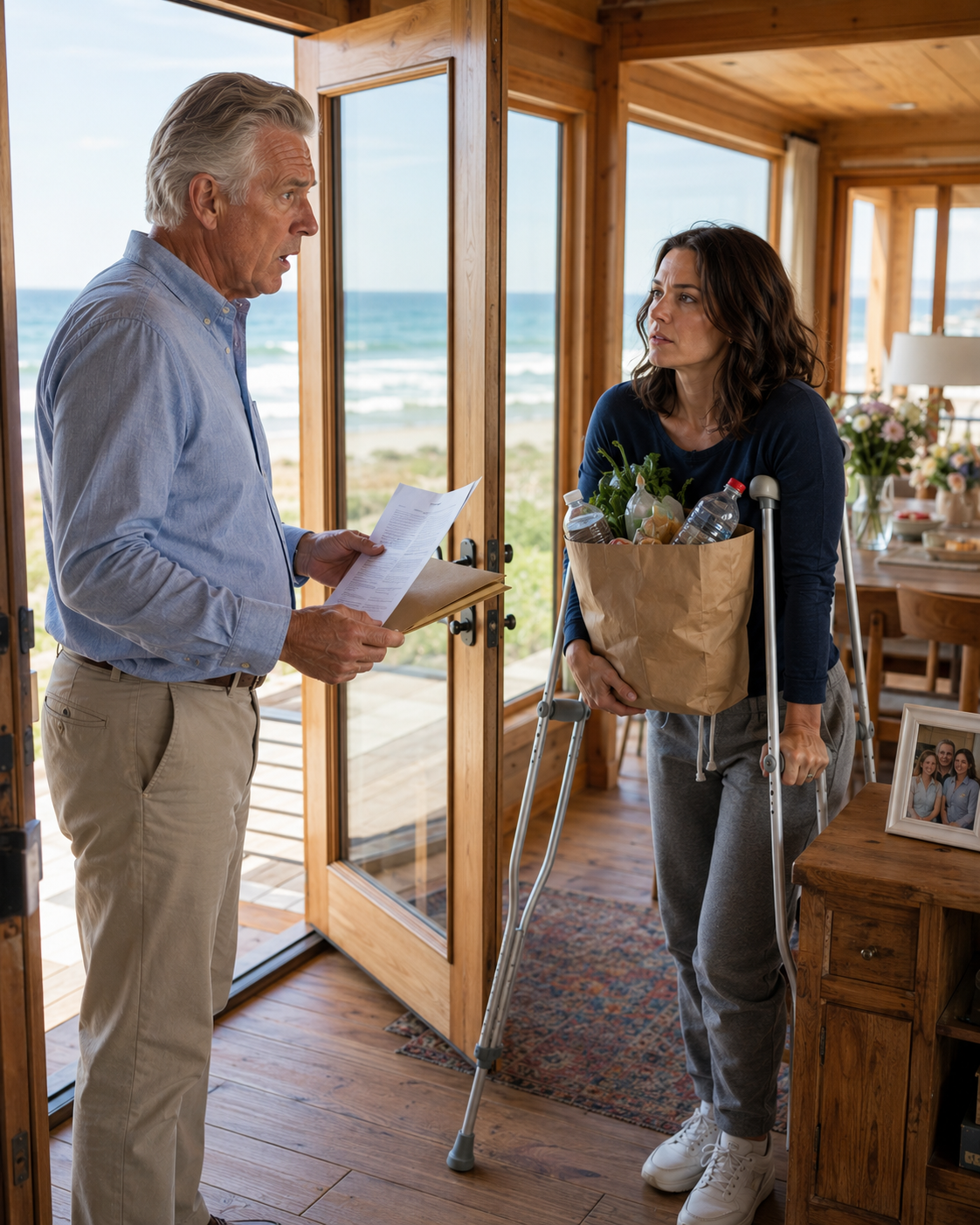
I picked up another letter from the wooden box.
Eugene,
The cabin is not the worthless property Bradley thinks it is. I allowed him to believe that. I even encouraged it in small ways. I am not proud of doing that, but I was trying to protect what remained.
The properties along Driftwood Lane were being acquired for a redevelopment and research project. The cabin and its land were valued at approximately 1.4 million dollars. If everything stayed on schedule, the sale would be completed the following month.
From that money, Carol would receive 900,000 dollars through a protected medical trust. I would receive the remaining 500,000 dollars directly.
Bradley would receive nothing from the property.
Not because I stopped loving him, but because I finally understood that more money would never save him. It would only give his worst choices more room to grow.
I looked at the number again.
1.4 million.
The old cabin. The sagging porch. The faded blue paint worn away by years of ocean wind.
Bradley had called it a shack.
Helen had given him the villa because it was already weakened by debt, loans, and irresponsible decisions. She gave me the cabin because beneath the damaged boards and aging appearance, it was the only thing that remained truly stable.
My phone suddenly began ringing.
The sound made both Carol and me look up.
Bradley.
His name appeared on the screen.
Carol glanced at the phone, then back at me.
“Helen said he would call,” she whispered.
I answered.
“Hello, Bradley.”
“Dad, thank God.” His voice sounded strained, completely different from the confident attitude he had displayed inside Mr. Thompson’s office. “I need to talk to you.”
“I’m listening.”
“There’s been some kind of paperwork problem with the villa. A lender says I owe them money. It’s a mistake.”
“What kind of money?”
A silence followed.
“Eight hundred fifty thousand.”
I closed my eyes.
Carol turned her attention toward the window.
Bradley kept talking quickly.
“They’re claiming I signed documents. That Mom approved everything. But I didn’t understand how it was set up. Dad, I’m in trouble.”
“Are you?”
“These people are serious. They’re threatening to take the villa, and if that happens, I don’t know what they’ll do next. I need help.”
Help.
From him, that word meant something different.
Not family.
Not regret.
Not accountability.
Help.
I remembered the movers carrying away my belongings. Bradley’s satisfied smile during the will reading. His forty-eight-hour warning. The fake signatures on my withdrawals. Helen sitting alone in this cabin, using the strength she had left to prepare a plan. “Come to the cabin tonight,” I told him.
“The cabin?”
“Yes.”
“Why?”
“Because your mother left me more than keys.”
He went silent.
I let that silence remain between us, allowing it to weigh on him.
“Come alone,” I said. “Bring every loan document you have. And Bradley?”
“Yeah?”
“Do not come here planning to lie.”
He arrived not long after sunset in a black BMW that looked completely wrong against the quiet sandy road.
Standing by the kitchen window, I watched him sit inside the car for several minutes before finally getting out. The Gulf sky had changed into shades of gold and pink. The last sunlight reflected against the cabin windows. Carol had retreated to her room, not because she was afraid of Bradley, but because Helen wanted me to face him first.
When he finally knocked, I made him wait.
Not long enough to hurt him.
Only long enough for him to understand that this conversation would happen on my terms, not his.
I opened the door.
My son looked completely different from the confident man who had sat in Mr. Thompson’s office. It was as if several layers of arrogance had been removed. His hair was messy. His expensive shirt was wrinkled. Dark shadows rested beneath his eyes. He stepped inside and immediately looked around the room with quiet disappointment, even though he tried to hide it.
“This place is smaller than I expected.”
I almost smiled at the reaction. Even while frightened, Bradley still needed to judge everything and decide its value.
“Sit down.”
His eyes moved toward the photo album on the coffee table. Helen with her arm around Carol. The birthday cupcakes. The beach.
“Who’s that woman with Mom?”
“Someone she loved.”
His forehead tightened. “What does that mean?”
“It means sit down.”
He sat across from me, keeping the manila folder pressed against his chest as though it could protect him.
“Dad, before anything else, I need you to know I didn’t understand the villa documents. I thought Mom had already authorized—”
I pushed the first bank statement across the table.
“Let’s begin with my retirement account.”
Bradley looked down at the page.
His face changed immediately.
First, recognition.
Then, calculation.
Then, fear.
“I can explain.”
“Good. Start with the unauthorized signatures.”
“I borrowed some money.”
“You borrowed ninety-seven thousand dollars without asking me?”
“I was going to pay it back.”
“With what?”
His mouth opened, but no words came out.
I leaned back in my chair. The wooden frame creaked beneath my weight.
“Your mother hired a very thorough investigator.”
His eyes quickly lifted to mine.
“She knew?”
“She knew more than you hoped.”
His fingers tightened around the folder. “I have a problem.”
“I know.”
“I mean a real problem. Compulsive betting. Debt. It got away from me. I was going to fix it.”
“By using my savings.”
“I panicked.”
“By using your mother’s name.”
His eyes began to fill with tears. Years ago, that might have been enough to break my resolve. A part of me still felt the connection. He was my son. I had stayed beside him through childhood illnesses. I had taught him how to ride his bicycle in our old driveway. I paid for his braces and struggled through endless algebra lessons with him. A father never completely forgets the little boy hidden inside the grown man.
But Helen’s letters remained beside me.
And the man he had become had caused real damage.
“Tell me about the villa loan,” I said.
He rubbed both hands over his face. “It was supposed to be temporary.”
“Eight hundred fifty thousand dollars is not temporary.”
“The people I owed were pressuring me. I needed collateral. The villa was supposed to increase in value, but then the market changed. There are environmental reviews, repair problems, some zoning dispute. It’s worth less than I thought.”
“How much less?”
He stared down at the floor.
“About four hundred thousand.”
“So you are short nearly half a million dollars before interest.”
His expression fell apart. “Dad, please.”
There it was.
Please.
There was no forty-eight-hour deadline anymore.
No jokes about seagulls.
No laughter about a forgotten cabin.
Only my son sitting inside the place he had mocked, slowly realizing it might be the final place where anyone could shield him from the consequences of his own decisions.
I unfolded Helen’s final letter.
“She wrote something for this moment,” I said.
Bradley became completely still.
I began reading.
My dearest Eugene,
By the time Bradley comes to you, he will be frightened. The villa will not save him. His creditors will be demanding payment. He will cry. He will promise to change. He may even mean it while he says it.
Do not mistake fear for transformation.
Bradley pulled back slightly.
I continued reading.
He has taken from us for longer than you know. Not only money, though that is part of it. He has taken patience, attention, forgiveness, and used each one as proof that consequences can be delayed forever.
I do not want our son destroyed by his own choices. But I refuse to let him destroy you, Carol, or what little peace I can still leave behind.
Bradley whispered, “Stop.”
I lowered the page. “You asked me for help. This is what help looks like now.”
His breathing became fast and uneven.
“There is one more person you need to meet.”
I looked toward the hallway. “Carol?”
The bedroom door slowly opened.
Carol stepped out with the support of her forearm crutches, moving carefully but keeping her head high. She had changed into a navy sweater, and her hair was pulled back neatly. There was nervousness in her expression, but she carried herself with quiet strength. Bradley watched as she entered the living room.
“Who is she?”
I placed the birth certificate in his hands.
“Your sister.”
His eyes dropped to the document. “No.”
“Yes.”
“Mom never—”
“Your mother had Carol when she was seventeen. She placed her for adoption. She found her again four years ago.”
A mixture of confusion and something close to jealousy crossed Bradley’s face.
“So that’s where the money went.”
Carol lowered her eyes.
My voice became colder. “Careful.”
Bradley looked back at me, surprised.
“That woman,” I said, “was here with your mother while you were focused on inheritance. She sat beside her through treatments you knew about and chose to ignore when they became inconvenient. She gave Helen a place where she could finally be honest before she died.”
“I didn’t know about her.”
“No. But you knew about the illness.”
The expression disappeared from Bradley’s face.
I had not planned to tell him that yet, but the truth had already found its way into the room.
“You knew the cancer had returned.”
He turned away toward the window.
“How?”
“Helen heard you in the hospital parking lot.”
His eyes closed.
“She heard you say you wished things would hurry along so the estate could be settled.”
Carol lifted a hand to her mouth.
Bradley shook his head. “I was upset. I didn’t mean—”
“You said it.”
The room became silent, with only the sound of waves outside the porch and the quiet hum of the refrigerator filling the space.
For the first time since he was a child, Bradley looked truly young. Not innocent. Not excused. Young in the way someone looks after finally reaching the edge of who they have become and realizing nobody else can step in and save them.
I removed another document from Helen’s box.
“Your mother left provisions.”
His head lifted immediately. Hope appeared across his face before he could hide it.
“She arranged for your immediate debts to be paid directly through a trust managed by Mr. Thompson.”
Bradley exhaled, as if he had been holding his breath for hours.
“But the money does not go to you,” I continued.
The relief disappeared.
“The payments go directly to verified creditors. Carol receives a protected medical fund. I receive the remaining proceeds from the cabin sale. You receive an opportunity to rebuild your life, but only if you accept treatment for your compulsive betting and financial misconduct.”
He stared at me. “Treatment?”
“A residential program in Colorado. Ninety days minimum. Continued counseling afterward. If you complete it and remain accountable, the trust will provide a modest monthly allowance for basic needs. If you refuse, the trust will not cover your debts.”
His face turned red. “So I get nothing.”
“You get your life.”
“That’s easy for you to say.”
“No,” I answered. “It is the hardest thing I have ever had to say to my son.”
He stood suddenly, then sank back into the chair as if his body could not decide whether pride or fear was stronger. His eyes moved from Carol to the photographs, the letters, and the cabin walls that carried more of his mother’s truth than the villa ever did.
“She really planned all this?”
“Yes.”
“Even after what I said?”
Carol answered before I could.
“She cried after she heard you. But she still made sure you had a way out.”
Bradley leaned forward, resting his elbows on his knees and covering his face with his hands.
For several minutes, nobody spoke.
When he finally looked up, his eyes were red.
“I’m sorry,” he said.
The words were quiet.
Not enough.
But maybe genuine.
I wanted to walk over and comfort him. Every instinct inside me pulled me toward the little boy who once ran into my arms after nightmares. But Helen’s letter remained heavy in my hand, almost like a reminder.
Love without boundaries had helped bring us here.
So I stayed where I was.
“Being sorry is a beginning,” I said. “Not a payment.”
Bradley nodded as tears silently moved down his face.
Carol turned toward the dark beach beyond the window. I wondered what she had imagined this family would become when Helen first found her. Whether she had hoped to be accepted. Whether she had feared this exact moment. Whether she already understood that grief and money could transform people connected by blood into strangers.
That night, Bradley slept on the couch inside the cabin he once mocked.
Carol made tea in the kitchen while I sat on the porch beside Helen’s wooden box. The moon rested low above the water, and the tide continued moving in and out. I opened another letter I had not read yet.
Eugene,
If I did one thing right at the end, I hope it is this: I gave you the truth in a place quiet enough to receive it.
I know the cabin looks poor from the road. I wanted it that way. Bradley sees shine before substance. You always saw structure.
This little house has held my shame, my love, my fear, and my peace. It held Carol when I could not give her my name. It held me when I could no longer carry all my lies alone. Now I hope it holds you long enough to understand that I did love you, even when I failed you.
I held the letter against my chest and finally cried for my wife.
Not the controlled tears I allowed myself at the funeral.
Not the quiet grief of a man packing boxes while strangers carried his life away from his home.
I cried for the frightened girl Helen once was, the mother she never had the chance to become, the wife who hid too many truths, and the dying woman who tried to mend her family through legal documents because she no longer had enough time to do it face to face.
And I cried for myself.
For everything I had never known.Three months later, the cabin no longer resembled the place I first discovered.
Not because it had been repaired. It was no longer there. The redevelopment company completed the purchase, but before the sale was finalized, Carol and I walked through each room, gathered every photograph, saved every letter, and took one last jar of flowers from the coffee table. I kept the old brass key after the property changed hands. Some keys stop unlocking doors but still hold memories.
Carol bought an accessible home twenty minutes inland, with wider doorways, a screened-in porch, and a bright kitchen that brought a smile to her face the moment she stepped inside. I purchased a smaller home two streets away. Not because I felt responsible. Because I wanted to. After thirty years of realizing the family I thought I knew was only part of the story, I found unexpected happiness in discovering I had a daughter who enjoyed porch coffee, classic movies, and quiet debates about whether soup counted as a full meal.
Bradley entered the program in Colorado.
During the first week, he called twice and attempted to negotiate. By the third week, his voice had changed. Less polished. More tired. By the sixth week, he apologized without trying to defend himself. By the ninth week, he asked if Carol would ever be willing to speak with him again.
“She gets to decide that,” I told him.
“I know,” he replied.
That was different.
I learned that change rarely happens in one dramatic moment. Sometimes it is simply a selfish person asking a question without demanding the answer they hope to hear.
The villa was gone before Christmas.
Most of the life Bradley once knew disappeared with it.
But he was still alive, separated from the habits that had controlled him, and learning how to follow a routine that no longer adjusted itself around his excuses. The trust paid only what Helen had approved. Nothing extra. Nothing placed directly into his possession. Nothing easy enough for him to waste.
On New Year’s Day, Carol came to my house carrying a pie she insisted she had baked herself, although the crust looked suspiciously like something purchased from a bakery. We sat together at my kitchen table beneath a framed picture of Helen laughing on the beach in her straw hat, one arm wrapped around Carol.
I had placed our wedding photograph beside it.
For years, I believed those two images could never belong in the same room. One represented the wife I knew. The other represented the woman who had lived an entire hidden chapter away from me.
Eventually, I realized they were both Helen.
Not perfect.
Not cruel.
Human.
Carol noticed me looking at the photographs.
“Do you forgive her?” she asked.
I took a slow breath.
Outside, palm leaves moved gently in the January breeze. Someone down the street was removing leftover holiday decorations. My new home smelled of coffee, pie, and the soft cedar oil I had applied to Helen’s wooden box earlier that morning.
“I don’t know yet,” I answered honestly. “But I understand her more than I did.”
Carol nodded.
“That might be enough for today.”
It was.
That night, I opened the wooden box and placed the cabin key inside. Next to it, I placed Bradley’s first letter from Colorado. Not because everything had been forgiven. Not because life had suddenly become simple and every wound caused by secrets, pride, and money had disappeared.
Because rebuilding starts by keeping the right evidence.
Helen left me a cabin that looked worthless.
Inside it, I found a daughter, a warning, a future, and the truth.
Bradley laughed at the coastal shack because he could not recognize value unless it was polished, appraised, and handed directly to him.
Helen understood me better.
She knew I would open the door.
She knew I would study the foundation beneath the damage.
And somehow, she knew that if I survived the first shock of everything she had hidden, I might eventually discover the life she had desperately and imperfectly tried to leave behind for me.
It was not the family I had imagined. But sitting at my kitchen table with Carol’s pie cooling between us, Helen’s letters in the next room, and the ocean only twenty minutes away, I understood it was still a family with a chance.
For the first time since the reading of the will, I no longer felt discarded.
I felt chosen.
Late.
Imperfectly.
Painfully.
But chosen.
