

PART 1 — THE GRAVE THAT DIDN’T EXIST
I hurried to the cemetery searching for my father’s grave, only for the elderly caretaker to regard me with pity and whisper, “Your father isn’t here.” My blood turned cold. Then came a hidden letter and a key my father had entrusted to him. Following them would expose something capable of bringing my stepmother’s entire life crashing down.
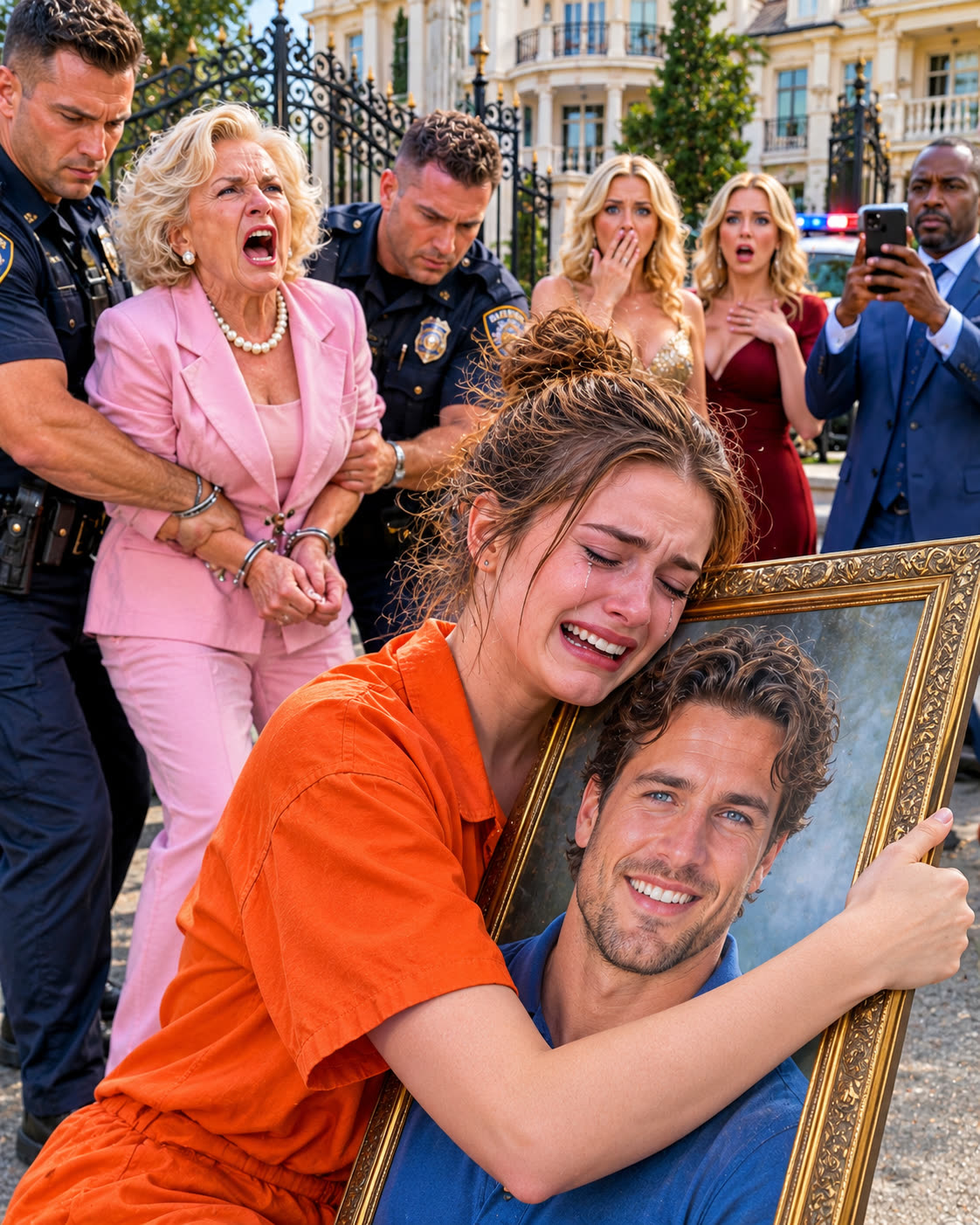
“YOUR FATHER DIED A YEAR AGO! NOW GET OUT OF MY HOUSE!” Those were the first words my stepmother greeted me with when I returned home after three years in prison. Throughout those 1,095 days behind bars, one hope had kept me going: holding my father, Franklin Hayes, in my arms again. In my imagination, he was always in his familiar leather armchair, quietly waiting for his son to come back.
Yet the house felt unfamiliar before I even reached the door. Someone had repainted the porch railing. Plants I didn’t recognize filled the garden. The blue front door Dad had always loved had disappeared. When I knocked, Sharon answered with a face that held no warmth. “Well, look who got out.” I swallowed before asking the question that mattered. “Where’s my father?”
For several seconds, she said nothing. Then, with a calmness that made the words even worse, she answered, “He died a year ago.” It felt as though the ground had fallen away beneath me. “WHAT? MY FATHER DIED? WHY DID NOBODY TELL ME?” Sharon merely shrugged. “You were in prison! What did you want, for us to mail you a sympathy card?”
I tried to look beyond her into the house. The photographs of Dad had vanished, and so had his armchair. Almost everything that might have shown he had once lived there was missing. “I want to see his room.” Her answer came immediately. “There’s nothing left to see!” Then the door slammed between us, leaving me outside the place I had spent three years longing to reach.
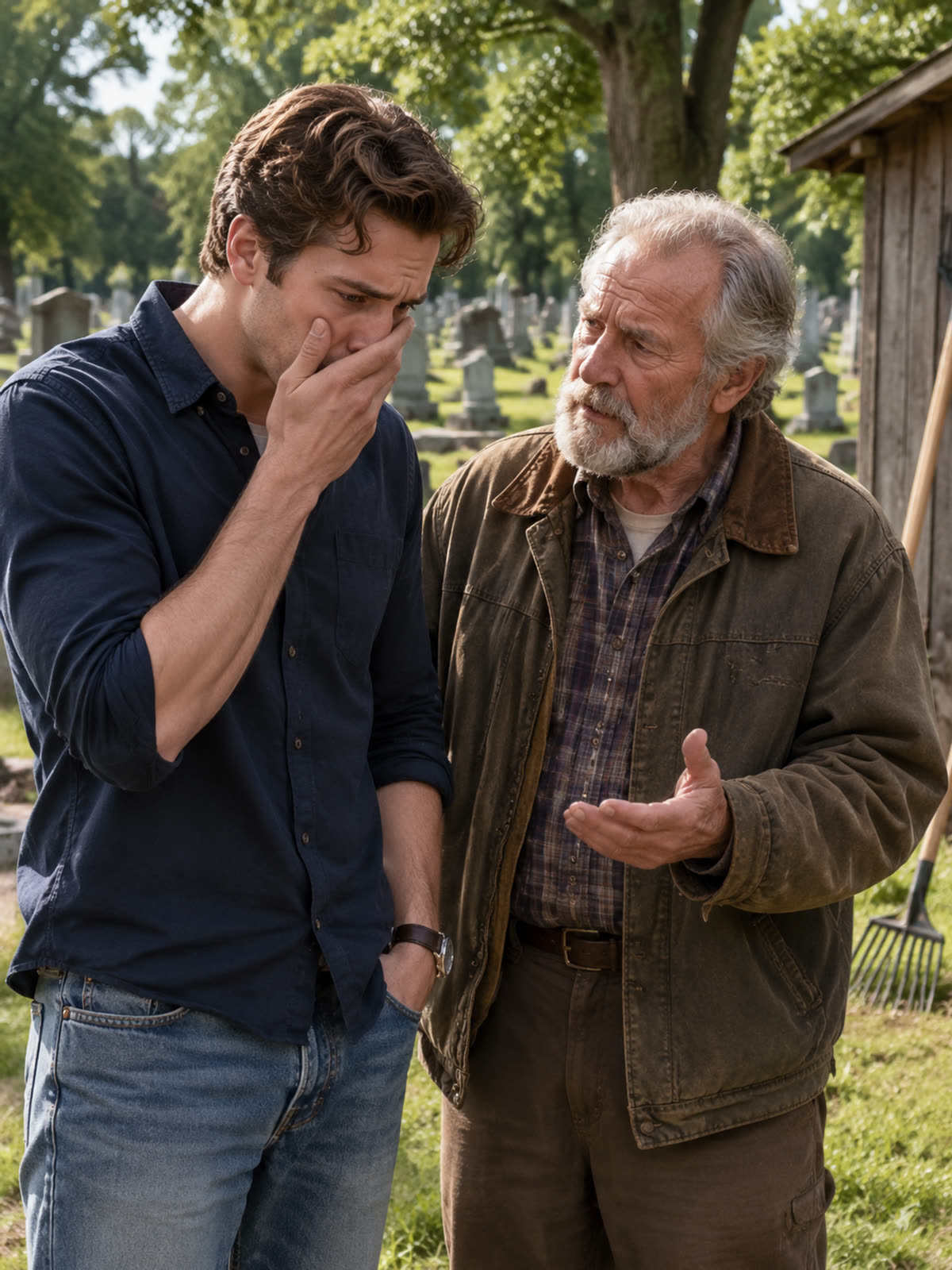
That afternoon, I went to the cemetery to find whatever remained of my father. An elderly man was working among the graves, tending the plots. I approached him and said, “Excuse me, sir. I’m looking for Franklin Hayes. He was my father.” His work stopped at once. Instead of pointing toward a grave, he looked carefully at my face.
When he finally spoke, his voice had dropped. “Don’t look…” I frowned, unable to understand what he meant. “What do you mean?” He came closer, and the pity in his expression only deepened my confusion. I had arrived expecting a name carved into stone, somewhere to stand and try to understand how an entire year had passed without anyone telling me.
Instead, the old man leaned toward me and whispered, “YOUR FATHER… ISN’T BURIED HERE!” I couldn’t move. Sharon had said he had been dead for a year. If that was true, where was his body? Why had she sent me away without an explanation? What could she be hiding that required stripping his photographs from the house and keeping his own son outside?
I stared at the caretaker as my confusion settled into a growing unease. He seemed to know something no one else had been willing to say. “Who are you, really?” I asked, struggling to keep my voice steady. He sighed with the exhaustion of someone who had carried a conversation inside himself for far too long, then rested his rake against the shed.
“My name is Amos,” he said. “I’ve kept these grounds for twenty-three years. I knew your father well. He was a good man, private, and a lot smarter than some people gave him credit for.” My throat tightened. After prison, after Sharon’s announcement and the slammed door, here stood a stranger speaking of Dad as though he still had something important to tell me.
Amos reached inside his jacket and brought out a small manila envelope. Its corners were worn, the paper marked by repeated handling. He offered it to me with a solemn expression. “Your father asked me to give you this if you ever came back asking about him.” For a moment, I couldn’t bring myself to take it. “How could he know I’d come?”
Amos met my eyes. “Because he never stopped waiting for you, son. And because he knew that when you did come back, there would be people willing to keep you from the truth.” My hands shook as I accepted the envelope. It felt heavier than I expected. When I pressed the paper, something small and metallic shifted beneath my fingers.
A key lay inside, along with a folded letter and a business card. The key had been taped to a separate slip of paper. I opened everything carefully and recognized Dad’s handwriting immediately: the firm, slightly sloping capitals he had used to label drawers and toolboxes in our garage. On the back of the business card, he had left three words. I read them twice before their meaning reached me.
“UNDER THE BENCH.” A chill moved through me. There was an old wooden bench beneath the big oak in our backyard. Dad had sat there every evening, including those final months before my arrest. “My father hid something there?” I asked. Amos nodded. “He made me promise not to let anyone remove it. Sharon tried to have it torn out twice, but I convinced her the wood was still good.”
I unfolded the letter. “Son, if you’re reading this, it means I couldn’t wait for you. Forgive me for not showing you how much you meant to me while I still had time.” Tears clouded the page, but I forced myself to continue. “Never believe I gave up on you. I looked into what happened while you were gone, and I found papers that someone wanted kept away from you. Don’t trust whatever version of my estate they tell you.”
I lifted my head. “Amos, I need to get back to that house.” He shook his head gently. “Not alone. Your father left instructions for an attorney, too.” That evening, he introduced me to Curtis Whitlow, one of Dad’s oldest friends. Sharon was away, and Curtis knew a route through the back lot. Together, we reached the bench I remembered so well.
A waterproof pouch had been taped beneath the seat. Inside it were a bank slip and the number of a safe-deposit box. Curtis recognized the number when we showed him the key. “It belongs to a private box at First County Bank,” he explained. “Your father arranged for only you to open it.” Dad had left more than a farewell. He had left a way through everything Sharon had refused to explain.
The following morning, we visited the bank. The box contained property records, financial statements, and a certified copy of Dad’s original will. Curtis examined the pages without speaking until something in his expression shifted. “There’s something very strange here.” I leaned toward him. “What is it?” He looked again at the document before answering.
“Your stepmother claimed your father left her the house. But this will says the property was to stay in your name.” The breath seemed to leave my body. “Then how did she end up with it?” Curtis drew out another sheet. “Someone filed a later document that completely changed the inheritance.” He studied the signatures side by side. “We need to verify that it’s authentic.”
What came next left me unable to speak. Before his supposed death, Dad had asked for an investigation into bank transfers made during my imprisonment. Every transfer led to an account connected to Sharon. The final statement recorded a withdrawal made one week after the date she said he had died. I kept looking at the dates, unable to make them fit.
“This doesn’t make sense,” I murmured. Curtis indicated the authorization line. “The transaction is listed as personally approved by your father.” Horror rose through me as I looked at him. “But he was already dead.” Amos had been waiting near the door. Now he stepped forward, as though the papers had finally made it impossible to keep something else to himself.
“There’s something else I never told you. The night before the burial, I saw your stepmother meeting a man behind the funeral home.” I turned toward him. “Who was he?” Amos lowered his voice. “The same attorney who signed the paperwork that sent you to prison.”
PART 2 — THE MAN IN THE BANK FOOTAGE
“Gerald Pruitt,” Curtis said quietly. “It has to be.” I stared at him. “The attorney from my case?” Curtis rubbed his forehead. “The one who sat beside you at your plea hearing.” Then he added, “Your father never trusted him. He told me Pruitt rushed you through that plea like a man clearing a desk before a holiday.”
I remembered the pressure clearly. Pruitt had warned that a trial could cost me fifteen years; signing the plea, he said, would get me out in three. I had been twenty-six, terrified, and unable to reach my father’s attorney friend, who was out of town. So I signed. The charge was check fraud: forged checks from Dad’s hardware business, carrying endorsements in my name. I had never written them. I had repeated that until the words meant nothing to anyone but me.
“Amos,” I said, “you told me my father isn’t buried at your cemetery. Was there ever a burial?” He slowly shook his head. “That’s what’s been eating at me for a year. There was a service at the funeral home, closed casket, a short graveside announcement that never happened. No interment was ever filed with us. No plot was purchased. I asked Sharon about it, and she said the family had decided on cremation.”
“Did you believe her?” I asked. Amos looked down at his hands. “I believed the paperwork, until I saw her handing an envelope to Pruitt in that alley.” His regret was plain. “I should have gone to the sheriff. I was afraid nobody would take a groundskeeper’s word over hers.” Curtis arranged Dad’s documents across the desk. “Then let’s find out what’s real. A cremation requires a death certificate, a permit, and a signature from the crematory. Those are public records. If any of them are missing, we have our answer.”
Curtis spent most of the following day making calls. I remained in his office with a cooling cup of coffee, hearing only his side of each conversation. By evening, the answers lay on his desk. The crematory in the neighboring county had no record of Franklin Hayes. The certificate Sharon had given the bank and county clerk carried the signature of Dr. Leland Marsh, a physician who, according to the state medical board, had surrendered his license two years earlier.
“The certificate is a forgery,” Curtis said flatly. “So either Franklin Hayes is dead and buried somewhere nobody’s looked, or…” He left the thought unfinished. “Or he’s alive,” I said. I had fought against that possibility. Prison had taught me to keep hope small enough that it couldn’t destroy me. Now it struck with such force that I had to put down the cup. “The bank withdrawal,” I said. “One week after he supposedly died. It was approved personally by him.”
“Yes.” Curtis nodded slowly. “Let’s go ask them how.” The manager at First County Bank was Dolores Pratt. At the mention of Dad’s name, her face lost its color. “I wondered when someone would come asking,” she said. She took us into a little office, closed the door, and sat with trembling hands. “Mr. Hayes came in about a week after the date on the death certificate,” she said. “I processed that withdrawal myself. His wife was with him. He was in a wheelchair, and he looked very thin. He didn’t speak. She did all the talking, and she guided his hand to sign.”
I could hardly draw breath. “He was alive?” Dolores answered, “I was sure of it. He looked right at me, and I’ll never forget his eyes. They were frightened, and they were pleading.” She brought her fingers to her mouth. “Later I learned from the news that he’d passed away. I told myself I must have mixed up the date. But I kept the video. I couldn’t make myself delete it.”
“You have the security footage?” Her voice broke. “I made a copy for my own records. I was afraid.” Then she said, “I’m so sorry. I should have said something.” Curtis placed a hand on the desk. “You’re saying something now. That matters.” She passed him a thumb drive. Back in his office, with the blinds shut, we watched what she had saved.
There was my father. He was thinner than in my memories, gray, his hair combed by somebody else. He sagged in a wheelchair, his left arm resting uselessly against his chest. Behind him stood Sharon in a cream-colored coat, smiling toward the teller. She bent over him, fitted a pen between his fingers, and guided his hand across the document. For half a second, Dad looked straight into the camera.
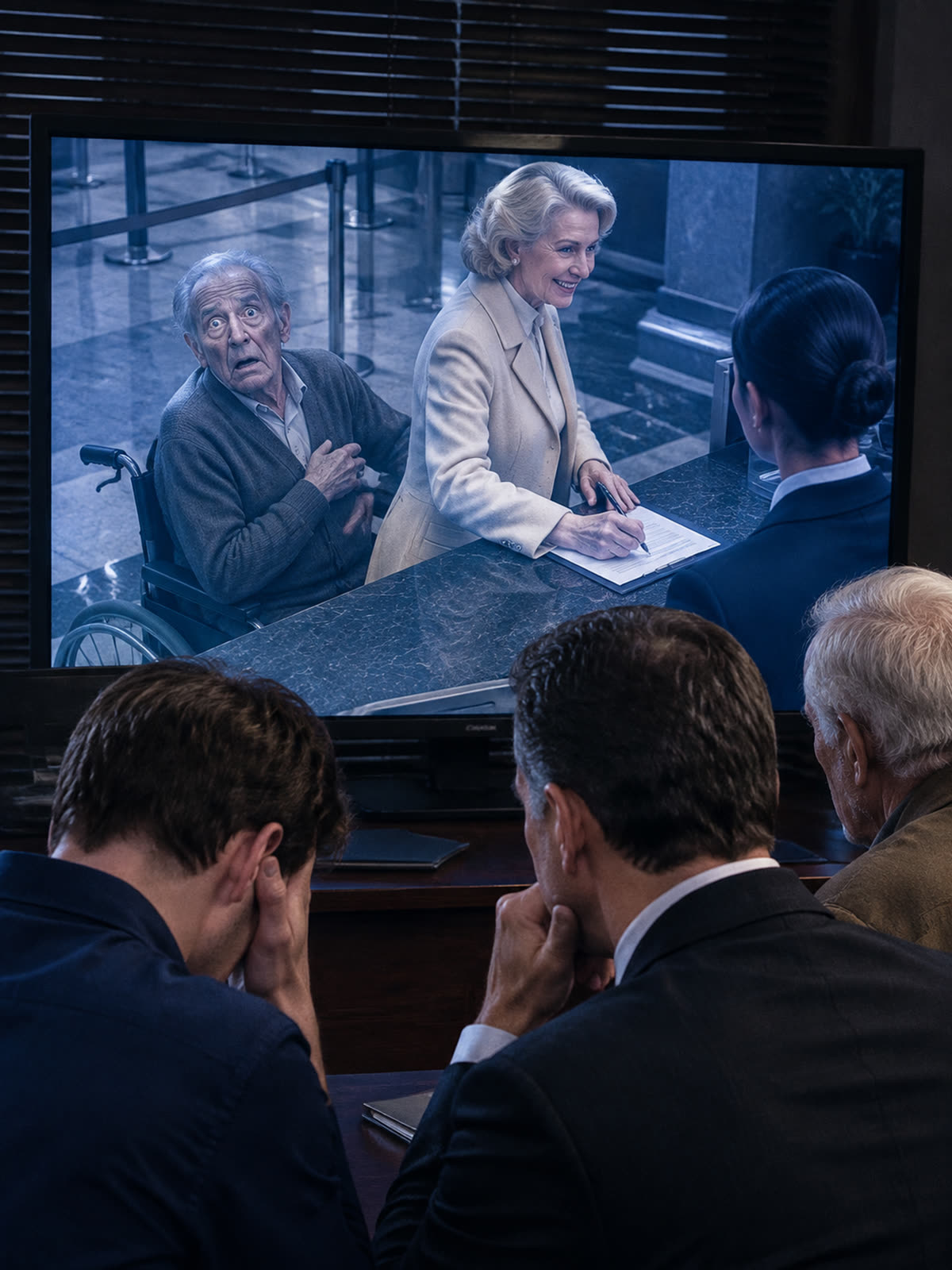
A sound escaped me that I didn’t recognize as my own. “He’s alive,” Amos whispered. “God help us, he was alive.” Curtis spoke carefully. “He was a year ago. We don’t know what happened since.” I stood so abruptly that my chair fell backward. “Then we find him.” There was no room in me for anything else. “Tonight.”
Curtis lifted a hand. “Reid.” I stopped, though everything in me resisted. “If we go barging into the wrong place, Sharon will hear about it within the hour, and he could be moved or worse. We do this properly. I’ll call the state police and the district attorney’s office, and I want the bank footage in their hands before anyone else sees it.” I wanted to argue, but three years in prison had taught me the cost of acting without evidence.
I lowered myself into the chair again and pressed my palms against my knees. “Okay,” I said. “Properly.” The detective assigned to us was Dana Okafor, a tall, weary-looking woman with eleven years of experience investigating elder fraud. She watched the footage twice in complete silence. Afterward, she requested Dad’s medical records. Curtis handed over the records Franklin had placed in the safe-deposit box.
“Stroke eighteen months ago,” she read. “Partial paralysis, speech impairment. He had capacity, but he needed help. Who had power of attorney?” Curtis answered, “Sharon. Signed six weeks after the stroke.” Okafor looked up. “Did he sign it himself?” Curtis directed her attention to the page. “Look at the signature.”
She examined it, then compared it with Dad’s handwriting on the original will. “These aren’t the same hand,” she said. “No.” Okafor set down the papers. “Then we have forgery on the POA, forgery on the death certificate, and a forged will changing the inheritance.” She paused before adding, “And a possible kidnapping. If your father’s alive, someone is holding him somewhere, and that someone had to be paid to keep quiet.”
She called her sergeant. Within an hour, a warrant request had reached a judge. Within three, investigators were examining Sharon’s telephone records, credit-card statements, and payments to a handful of vendors. Among those transactions, one recurring expense stood apart: $4,800 every month to Willow Creek Residential Care, an out-of-state facility in Pennsylvania.
The invoices did not name Franklin Hayes. Their resident was listed as Frank Holt. Okafor contacted the Pennsylvania State Police and coordinated the next steps. At dawn the following morning, she allowed me to accompany her. For the first time since seeing Dad’s face on the bank recording, we were heading toward somewhere he might actually be.
The drive took four hours, and I said almost nothing. Farmland passed beneath the pale November light outside the window. Over and over, I tried to decide what I would say if we found him. Every version sounded wrong, and I discarded each one. I had spent years imagining a homecoming, but none of those imagined moments had looked anything like this.
Willow Creek stood at the edge of a small town, a low brick building with a faded sign and wilting mums near the entrance. Its administrator was nervous and kept insisting he had followed the paperwork. When Okafor showed him her badge and a court order, the explanations stopped. A nurse took us down a quiet hallway toward its far end.
“Mr. Holt is in room fourteen,” she said. “He doesn’t say much. He’s been here almost a year. His wife visited the first month, then stopped.” I stood outside the door for what felt like a very long time. Somewhere on the other side might be the man I had mourned, the man whose hand Sharon had forced across a bank document.
Okafor touched my elbow. “Take your time.” I had rehearsed a hundred beginnings during the drive and could remember none of them. After three years behind bars, a death announcement, an empty cemetery, and a year of my father’s life hidden beneath another name, only one thing remained between us. I opened the door.
PART 3 — THE LIFE THEY TRIED TO ERASE
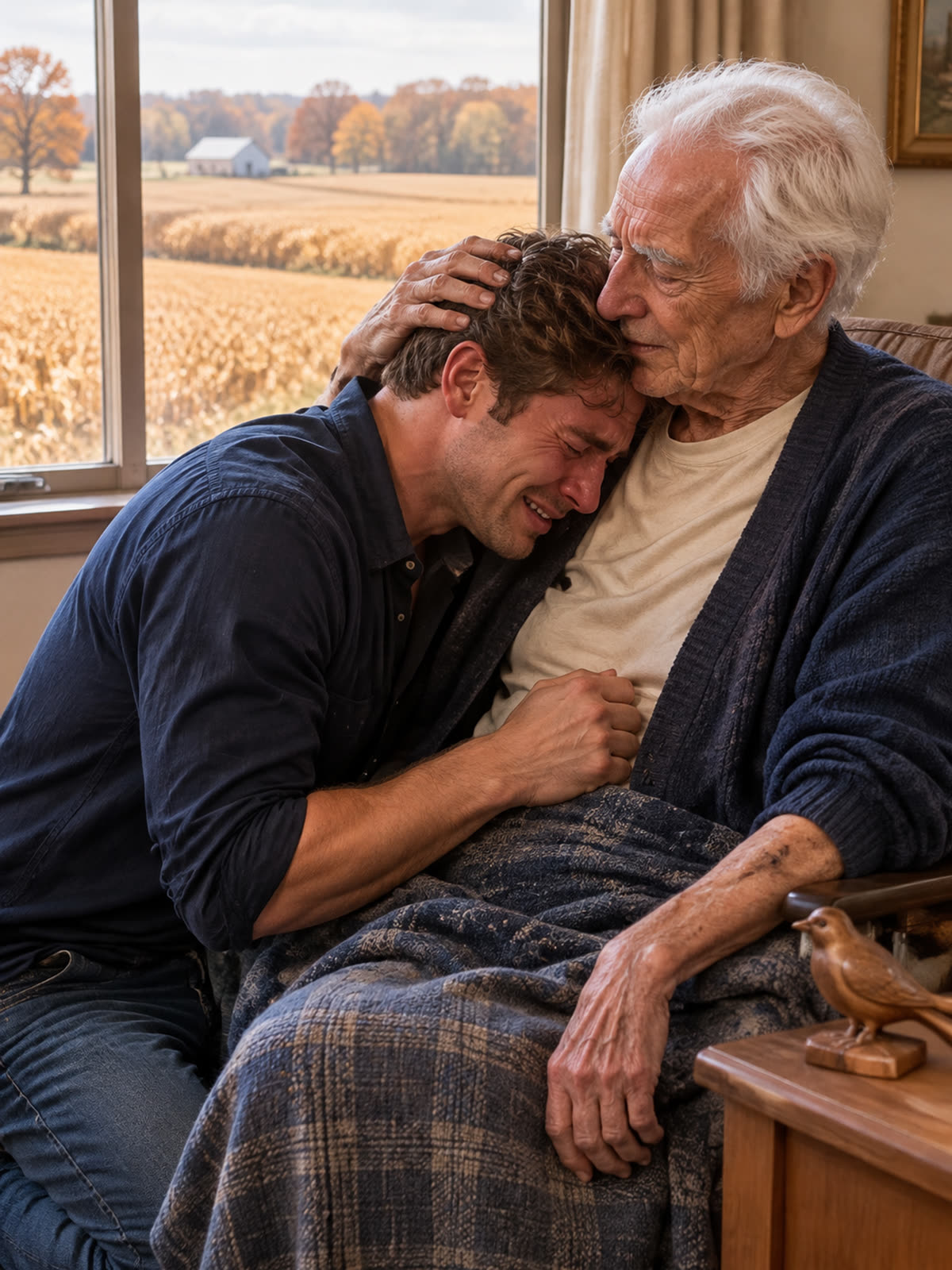
My father sat beside the window with a blanket covering his knees. His hair had turned entirely white. One hand lay limp in his lap; in the other, he held a small wooden bird, turning it over and over. The man before me was frailer than the father I had carried in my memory, but he was there. He was breathing. He looked up.
For one terrible second, his expression stayed empty, and I thought he might no longer recognize me. Then recognition moved across his face, slowly and with an enormity that seemed to fill the room. His mouth struggled to form a sound. When it finally came, it was thick and broken. “R-Reid.”
I crossed the room and dropped to my knees in front of him. His good hand was warm and rough, as familiar as anything I had ever known. I held it and lowered my forehead against his knuckles. “Dad,” I said. “I’m here. I’m out. I’m so sorry I took so long.”
He slipped his hand free and placed it against the back of my head, just as he had when I was a child. “Told… them,” he said, forcing out each word. “You… didn’t.” I knew what he was trying to tell me. “I know, Dad. I know you did.” He drew a breath, and tears traced the lines of his face.
“Wait… ed.” There was so much effort inside that one broken word. “I know.” Behind me, I heard Okafor withdraw quietly into the hallway. After all the days I had counted in prison, after coming home to be told he was dead, I knelt beside him while his hand rested against my head. He had waited. Neither of us had known how to reach the other.
Once we found him, the investigation moved quickly. With a speech therapist helping him and a state investigator giving him time, Dad recorded his statement over three days. The stroke had happened at home. Sharon had taken charge of his care and gradually convinced him he could no longer handle his own finances.
She and Pruitt had been working together for years. They had drained money from the hardware business, forged checks using my name, and turned my arrest into an explanation for the missing funds. When Dad began asking questions, Sharon told him I had confessed. The lie had served them twice: it put me behind bars and gave her an answer whenever my father questioned what had happened.
“I didn’t… believe,” he told Okafor. “I hired… investigator.” She asked, “What happened to the investigator?” Dad’s answer came slowly. “Quit. Got… a call.” He had continued looking into the forgeries and started preparing a new will. When he uncovered evidence, Sharon arranged to have him moved away.
She brought him to Pennsylvania under a false name, paid the facility in cash, and announced that he was dead. Pruitt obtained the fraudulent certificate through a disgraced doctor and a cooperative notary. Their plan was to keep Dad out of sight until the estate had been transferred completely and I was too broken to challenge what they had done.
But Amos had held on to the envelope for a full year. He had protected the bench beneath the oak when Sharon tried to remove it. Those small acts of loyalty had undone the hiding place they had made of my father’s life. Now Franklin Hayes could sit before an investigator and tell the truth, haltingly, while the son they had taken from him remained within reach.
Sharon was arrested at a nail salon on a Thursday afternoon. I wasn’t there to watch. I was still at the Pennsylvania facility, learning how to help Dad eat lunch with his weaker hand while he laughed at how clumsy I was. I heard afterward that she had screamed about a mistake and demanded an attorney.
Then, in a suddenly diminished voice, she asked a deputy whether the old man was really going to testify. “He’s going to testify,” the deputy told her. She had hidden him, renamed him, and presented paperwork declaring him dead. Now the man she had tried to erase would be able to speak for himself.
That same night, Gerald Pruitt attempted to leave the state. Authorities stopped him at an airport in Columbus carrying $60,000 in cash and a one-way ticket. At first, he pleaded not guilty. Then investigators searched his office and discovered a second set of books, along with a ledger recording payments to Dr. Marsh, the notary, and a retired county clerk.
His account of events unraveled in less than two weeks. The records joined the bank footage, the forged documents, and Dad’s statement. What Sharon had presented as a death and an inheritance was exposed as the conspiracy it had been. My own conviction, which I had been forced to live with for three years, was part of the same scheme.
Their trial began the following spring. Dad testified from his wheelchair, with a speech therapist seated beside him to help whenever language failed. What a healthy man might have explained in an hour took him four. The jury listened through all of it. No one turned away from the pauses or the effort it cost him to continue.
He described waking in a room he didn’t recognize. He told them about being informed that he was dead, and about hearing his wife speak his only son’s name with contempt. As he struggled through those memories, I saw a woman on the jury wipe her eyes. Sharon never once looked toward me.
She kept her gaze on the table, her face as smooth and unreadable as a mask. Even when the verdict was announced, her expression did not change. Guilty on every count: forgery, fraud, unlawful imprisonment of a vulnerable adult, conspiracy, and obstruction. Pruitt was also convicted on all charges and lost his law license before sentencing.
Three months later, my conviction was vacated. Curtis filed the motion, and Detective Okafor testified about the evidence proving the checks had been forged. From the bench, the judge looked directly at me. His voice carried through the silent courtroom. “Mr. Hayes, this court cannot give you back three years. But it can say, on the record, that you should never have lost them.”
I couldn’t answer. There was nothing I could make my voice do. Amos sat in the second row, dressed in a suit a size too large, his hat resting in his lap. When I turned around, he gave me a small, deliberate nod. He had believed my father mattered enough to keep a promise when there had been no guarantee anyone would come.
We brought Dad home in June. The house had been restored to the estate. Sharon’s possessions were packed and gone, and the rooms smelled of new paint and old wood. Dad remained in his wheelchair at the entrance for a long time. At last, he said a single word. “Blue.”
I understood immediately. The front door had been replaced with something flat, expensive, and white. “I’ll fix it, Dad.” That weekend, Amos helped me remove it from its hinges. In the garage, beneath a tarp, we found the original blue door. Sharon had pushed it aside but had not thrown it away.
Apparently, even she had stopped short of destroying it. The wood was faded and scratched, but it settled into the old frame as naturally as a hand into a glove. When we finished hanging it, Dad laughed—a wet, delighted laugh that sounded almost boyish. “There,” he said. “Home.”
That evening, I wheeled him into the backyard. Summer leaves filled the branches of the great oak, and the wooden bench remained beneath it where it had always been. Without telling us, Amos had refinished it that week. I set the wheelchair’s brake and sat on the bench beside my father.
For a while, we let the silence remain. Gold light filtered through the branches overhead. Then Dad spoke with his usual careful effort. “Reid,” my father said slowly. “Yes, Dad.” He looked at me and worked through the words. “Good… boy.”
I looked from the tree to the blue door and back to the man beside me. For three years, I had counted nights in a prison cell, convinced that everything I loved had been taken beyond my reach. I put my hand over his. “I’m home,” I said. For the first time in four years, the words were true.
What I had loved had not disappeared. It had been hidden by people who were certain nobody would ever come looking.
Disclaimer: This story is a work of fiction inspired by real-life themes. Names, characters, places and events are fictionalized, and any resemblance to real persons is purely coincidental. Images are for illustration purposes only.
