

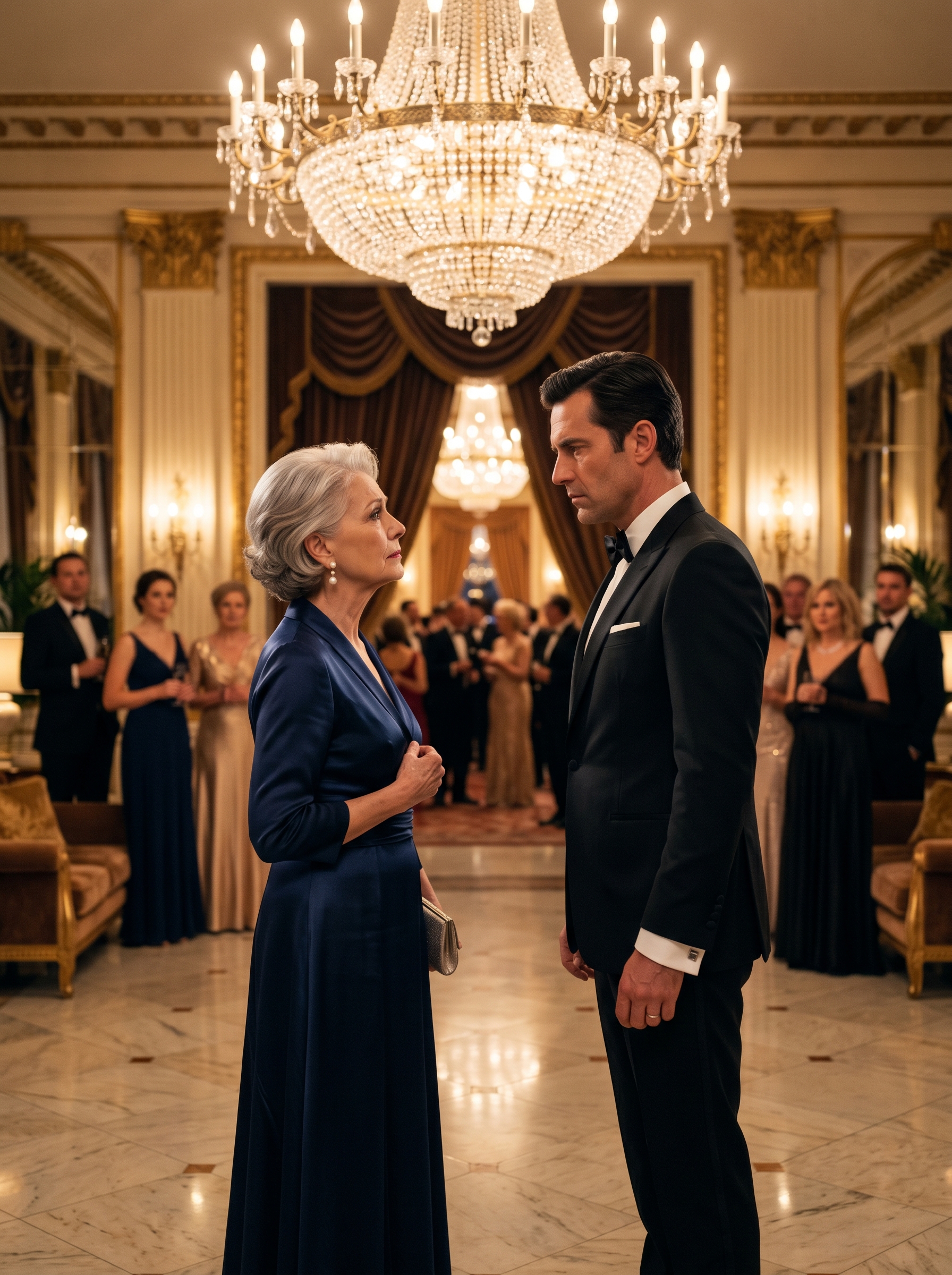
My son looked me up and down in the hotel lobby, adjusted his silver cufflinks, and said, “Mom, this is a professional event. You’re too old for this crowd.”

I was seventy-one years old.
And I had paid for the first desk his company ever owned.
My name is Margaret Ellis. Most people call me Maggie. I am a widow, a retired systems engineer, and for most of my life, I believed a mother should give without keeping score.
That night, standing beneath a crystal chandelier in my navy dress and pearl earrings, I learned something painful.
Some people don’t forget what you gave them.
They just hope you do.
My son, Daniel, worked for a fast-growing technology company called BrightLine Solutions in Seattle. He was a senior vice president now. His face was on brochures. His name appeared in business magazines. He had the clean haircut, the expensive watch, and the careful smile of a man who had learned how to look important.
The company gala was supposed to celebrate BrightLine’s twentieth anniversary.
Daniel had mentioned it three months earlier while sitting at my kitchen table, eating the pot roast he still asked for whenever he visited.
“It’s going to be huge, Mom,” he said. “Investors, founders, board members, press. Everyone will be there.”
I smiled. “That sounds wonderful.”
He hesitated. “I might be giving a speech.”
“You should,” I said. “You’ve worked hard.”
Then he looked at me in that way adult children sometimes do, as if weighing whether their parent still fits into the life they’ve built.
“You could come, I suppose,” he said. “But don’t feel you have to.”
I laughed softly. “Daniel, I changed your diapers and survived your teenage years. I think I can survive a company party.”
He smiled, but not with his eyes.
Still, two weeks later, an invitation arrived.
Margaret Ellis. Honored Guest.
I placed it on my mantel beside a photo of my late husband, Thomas.
“Well,” I told his picture, “our boy remembered me.”
Thomas had been gone twelve years. He never got to see Daniel rise in the company. But he had seen the beginning.
Back then, BrightLine was not a shining office tower. It was four tired young people in a rented room above a bakery. Daniel had just graduated from business school and begged me to meet “some brilliant folks with a big idea.”
Their idea was good.
Their system was not.
They had designed a healthcare scheduling platform, but it crashed every time more than thirty users logged in. Hospitals would never trust it. Investors were pulling back. The whole thing was days from dying.
I was fifty-one then, recently laid off after thirty years in software systems. I looked over their code, their architecture, and their security problems. I spent three nights at my dining room table with coffee, yellow legal pads, and Thomas bringing me toast at midnight.
I rewrote the core framework.
Not for money.
For Daniel.
The platform stabilized. Their first hospital signed. Then another. Then a regional network. BrightLine grew fast.
Daniel never talked about that part anymore.
In public, he said he had “helped lead the early strategy.”
That was true.
But not the whole truth.
I let it go for years because mothers are good at swallowing small hurts. We tell ourselves our children are busy. We tell ourselves success changes people. We tell ourselves pride is not the same as cruelty.
But sometimes it is.
The night of the gala, I took extra care getting ready. I chose a navy dress with long sleeves and a modest neckline. I pinned my silver hair back. I wore Thomas’s favorite pearls.
When I arrived at the Grand Meridian Hotel, the lobby sparkled with gold lights and black suits. Women in silk gowns laughed near tall flower arrangements. Men shook hands with practiced warmth.
For a moment, I felt proud.
My son belonged here.
Then I saw Daniel.
He stood near the entrance with his wife, Allison, who had never quite forgiven me for not being impressed by money. She wore a red dress and diamonds bright enough to signal aircraft.
Daniel’s smile tightened when he saw me.
“Mom,” he said. “You came.”
I held up the invitation. “It had my name on it.”
Allison leaned close to him, whispering something. Daniel’s jaw moved.
Then he stepped between me and the ballroom doors.
“Listen,” he said quietly. “Tonight is important. There are investors here. Media people. The CEO. I need everything to look right.”
I frowned. “And I don’t look right?”
He sighed, as if I were being difficult.
“That’s not what I mean.”
“All right. What do you mean?”
His voice dropped lower.
“I mean this is a modern tech event. It’s fast-paced. Loud. Full of industry talk. You won’t know anyone. You’ll be uncomfortable.”
“I spent thirty years in systems engineering, Daniel.”
His face flushed. “That was a long time ago.”
The words landed harder than I expected.
Allison smiled politely. “Margaret, maybe we can have dinner another night. Somewhere quieter.”
I looked past them into the ballroom. On a large screen above the stage were the words:
BRIGHTLINE SOLUTIONS: HONORING OUR FOUNDERS AND LEGACY BUILDERS
Legacy builders.
I almost laughed.
Daniel touched my elbow, not gently.
“Mom, please don’t make this awkward.”
I pulled my arm back.
“Did you invite me by mistake?”
He looked away.
That was answer enough.
Then he said it.
“You’re too old for this crowd.”
The lobby noise seemed to fade.
I heard Thomas’s voice in my memory: Maggie, don’t shrink yourself to fit someone else’s shame.
I straightened my shoulders.
“I see,” I said.
Daniel looked relieved, thinking I would leave.
But before I could speak again, a woman’s voice called from behind him.
“Margaret Ellis?”
Daniel turned.
A tall woman in a black evening suit walked toward us. She had silver-streaked hair, sharp eyes, and the kind of calm authority that made people move aside without knowing why.

Daniel stiffened.
“Ms. Reeves,” he said quickly. “Good evening.”
I knew the name.
Caroline Reeves. CEO of BrightLine Solutions.
She ignored Daniel and took both my hands.
“Mrs. Ellis,” she said warmly, “I have been waiting years to meet you.”
Daniel’s face changed.
Allison blinked.
I stared at Caroline. “Me?”
“Yes,” she said. “You.”
Daniel gave a nervous laugh. “Caroline, my mother was just leaving. She’s not really part of—”
Caroline turned her eyes on him.
“She is very much part of tonight.”
The silence around us widened. A few guests nearby stopped pretending not to listen.
Caroline linked her arm through mine.
“Come with me, Margaret. Your seat is at the front.”
Daniel stepped forward. “There must be some confusion.”
Caroline’s voice stayed calm.
“The only confusion, Daniel, is why your mother was standing in the lobby instead of being escorted inside.”
His mouth opened.
No words came out.
I let Caroline lead me into the ballroom.
And suddenly, the same room my son thought I did not belong in turned to look at me.
The ballroom was breathtaking. Round tables covered in white linen. Candles glowing. A string quartet near the stage. On the screens, old photos of BrightLine’s early days played in a slideshow.
I saw Daniel younger, thinner, smiling in a wrinkled shirt.
Then I saw something that made my breath catch.
A photo of my dining room table.
Yellow legal pads. Coffee mugs. My old laptop.
Thomas must have taken that picture without telling me.
I whispered, “Where did you get that?”
Caroline smiled. “From the company archives.”
“I didn’t know they had it.”
“They have more than that.”
She seated me at the front table beside the board chair and two original founders I recognized only vaguely. One of them, a man named Raj, leaned over with wet eyes.
“Mrs. Ellis,” he said, “I owe you an apology.”
“For what?”
“For letting your name disappear.”
Before I could answer, Daniel arrived at the table. His face was pale.
“Mom,” he whispered, “what is going on?”
I looked at him.
“For once, Daniel, I think you don’t know.”
Dinner passed in strange waves. People approached me with kind words. Some said they had heard rumors about “the woman who saved the platform.” Others said they had always wondered why the founding documents mentioned an M. Ellis, but no one ever explained it.
Daniel barely touched his food.
Allison stared into her wine glass.
Then the lights dimmed.
Caroline Reeves walked onto the stage.
Applause filled the room.
“Tonight,” she began, “we celebrate twenty years of BrightLine Solutions. We celebrate growth, innovation, and the people who built something that now serves hospitals across four countries.”
More applause.
“But we also need to tell the truth.”
The room grew still.
Caroline continued, “Companies love clean stories. We love founders in garages, bold speeches, brave investors. But real companies are often saved in quiet rooms, by people whose names never appear on the front page.”
My chest tightened.
Daniel stared at the table.
“Twenty years ago,” Caroline said, “BrightLine nearly failed. Our product was unstable. Our first major client was ready to walk away. Investors were leaving. Then someone stepped in.”
On the screen behind her appeared the photo of my dining room table.
A murmur moved through the room.
“She was not paid as a consultant. She did not demand shares. She did not ask for a title. She helped because her son asked her to. She redesigned the core system that allowed this company to survive.”
My hands trembled in my lap.
Caroline looked directly at me.
“Margaret Ellis, would you please join me on stage?”
For a second, I could not move.
Then Raj stood and began clapping.
Others followed.
Soon the whole ballroom rose.
I looked at Daniel.
His face was frozen with shame.
I walked to the stage slowly, carefully, with every eye in the room on me.
Caroline hugged me.
Then she handed me a glass award.

It read:
MARGARET ELLIS
FOUNDATIONAL LEGACY HONOREE
THE MIND THAT HELPED BUILD BRIGHTLINE
The applause washed over me, but my heart was not proud.
It was aching.
Caroline stepped back from the microphone.
“Would you like to say a few words?”
I looked out at the room.
At the people standing.
At my son sitting.
I leaned toward the microphone.
“I don’t have a long speech,” I said. “At my age, you learn the value of using only the words that matter.”
Soft laughter rippled through the room.
“I helped BrightLine many years ago because my son asked me to. I was glad to do it. A mother wants to see her child succeed.”
My voice shook, but I kept going.
“But success is a strange thing. It can make a person grateful. Or it can make a person forget.”
Daniel lowered his head.
“I am not angry that my name was forgotten by a company,” I said. “Companies are busy things. Records get buried. People move on.”
I paused.
“What hurts is being forgotten by someone you love.”
The room went silent.
I did not look away from Daniel.
“Older people are not old furniture. We are not faded photographs. We are not embarrassing reminders of where someone came from. We are the hands that held families together when there was no applause, no spotlight, and no award.”
Several people wiped their eyes.
I turned back to the room.
“So thank you for this honor. But more than that, thank you for remembering that wisdom does not expire. Experience does not become useless. And a person’s worth is not measured by how young they look standing in a ballroom.”
The applause came slowly at first, then thundered.
I stepped back, tears in my eyes.
Caroline squeezed my hand.
When I returned to the table, Daniel stood.
“Mom,” he whispered. “I’m sorry.”
Not a polished apology. Not a public relations apology.
A broken one.
I looked at him for a long moment.
“I believe you’re embarrassed,” I said softly. “I don’t yet know if you’re sorry.”
His eyes filled.
Allison looked away.
After the program, Daniel found me near the balcony doors. The city lights shimmered beyond the glass.
“Mom,” he said, “I was ashamed.”
I nodded. “Yes.”
“Not of you,” he said quickly. “Of where I came from. Of needing help. Of not being the self-made man people thought I was.”
I looked at my son, really looked at him. Beneath the suit and title, I saw the frightened young man who had once sat at my kitchen table, afraid his dream was over.
“You were never weak because you needed help,” I said. “You became weak when you pretended you didn’t.”
He began to cry then. Quietly, like a boy trying not to be heard.
“I erased you,” he said.
“Yes,” I answered. “You did.”
“Can I fix it?”
I looked toward the stage, where workers were gathering empty glasses and folding programs.
“Not tonight. Not with one apology.”
He nodded.
“But you can begin.”
The next morning, BrightLine updated its company history page.
My name was added.
Not as Daniel’s mother.
As the architect who rebuilt the original platform.
A week later, Daniel came to my house alone. No Allison. No expensive watch. No speech prepared.
He brought flowers and a folder.
Inside was a formal letter from the company, granting me honorary founder status and a scholarship fund in my name for older women returning to technology careers.
I read it twice.
Then I cried.
Daniel sat beside me at the kitchen table.
The same table where BrightLine had been saved.
“I don’t deserve forgiveness,” he said.
“No,” I replied. “Forgiveness is not about deserving. It’s about what the wounded person is willing to release.”
He reached for my hand.
This time, I let him take it.
We did not fix everything that day. Life is not a movie where one speech heals years of hurt. But we began with honesty, and sometimes honesty is the first clean brick in a broken wall.
As for me, I stopped hiding my old work in dusty boxes. I began speaking at community colleges and senior centers. I told older women and men that their minds still mattered. Their stories still mattered. Their names still mattered.
Because they do.
The world may worship youth, speed, and shiny new things.
But every bright future is built on someone’s quiet labor.
Someone’s sacrifice.
Someone’s love.
And sometimes, the person standing silently in the lobby is the very reason the ballroom exists.
So here is the lesson I learned at seventy-one:
Never let anyone make you feel outdated just because they have forgotten your value.
Age does not erase dignity.
Success does not excuse disrespect.
And love should never require you to stand outside a door you helped build.
What would you have done if your own child told you that you were too old to belong?
