

PART 1 — The Boy Who Came Back
My name is Jessamine, but everyone calls me Jess. I work as a cashier at a grocery store in a little mountain town just outside Asheville, North Carolina.
My son, Emmett, is eight years old. He’s smaller than most kids his age, with prominent ears and a face covered in freckles. He’s quiet around adults, but he’s the sweetest child I know. Whenever it rains, he stops to rescue worms from the sidewalk.
Last year, I married a man named Lowell. He works as a long-haul mover. He’s very strict. His father raised him with a belt, and he believes that’s the reason he turned out “just fine.”
He’s never physically hurt Emmett. But he shouts at him. And Emmett is frightened of him.
It all began on a Monday in October.
I’d purchased a case of bottled water for our home. By Wednesday, half the bottles had disappeared.
On Thursday, I bought another case. By Friday, six additional bottles were gone. So were a box of granola bars and an entire sleeve of crackers.
Lowell spotted it before I did.
“Somebody’s stealing from this house,” he said during dinner. His eyes went directly to Emmett.
Emmett kept his gaze fixed on his plate.
“Emmett? Are you taking the water?”
He gave a tiny nod.
“Why, buddy?”
He said nothing.
Lowell brought his fork down hard against the table.
“I’ll tell you why. Because he’s selling it to kids at school. Or giving it away to show off. I work sixty hours a week, and this kid is stealing from us.”
“I’m not selling it,” Emmett whispered.
“Then where is it going?”
He remained silent.
The following morning, Lowell caught him slipping four water bottles and a sleeve of crackers into his backpack.
He seized the bag, took it outside to the curb, and emptied its contents into the trash can. His books. His homework. His lunch box. Everything.
“You want to steal? Then you don’t get a backpack. And if I catch you one more time, you’re sleeping in the shed. Maybe that’ll teach you.”
Emmett sobbed the entire way to school.
That evening, everyone in town was talking about the same news. Sheriff Truman Rhodes had been missing for five days.
He’d gone hunting by himself the previous Sunday. His truck had been discovered at a trailhead. Search crews had been looking around the clock. Helicopters. Dogs. Volunteers.
Everybody in town knew him. He coached Little League and read stories to children at the library.
The search parties had covered miles of mountain terrain. They still hadn’t discovered anything.
I switched off the television and glanced at Emmett. He sat at the kitchen table, staring at the screen, his face completely pale.
“Emmett? What’s wrong?”
“Nothing,” he replied, much too quickly.
The next afternoon, I got off work early. I parked close to his school and waited for him.
When the bell rang, Emmett didn’t head toward the bus. Instead, he went behind the school, passed the baseball field, and disappeared into the woods through an opening in the fence.
He had a plastic grocery bag with him. I could see water bottles inside.
I went after him.
The path sloped downhill, growing steeper and muddier as it wound farther into the trees. Emmett moved quickly, as though he’d traveled this way countless times. I lost sight of him twice.
About twenty minutes later, I heard running water. There was a creek at the bottom of a ravine.
Then a voice reached my ears.
A man’s voice. Faint. Raspy.
“Emmett? Is that you, son?”
I stopped behind a tree.
“It’s me,” Emmett answered. “I brought more water. And crackers. Mom bought the good kind.”
I emerged from behind the tree and peered down into the ravine.
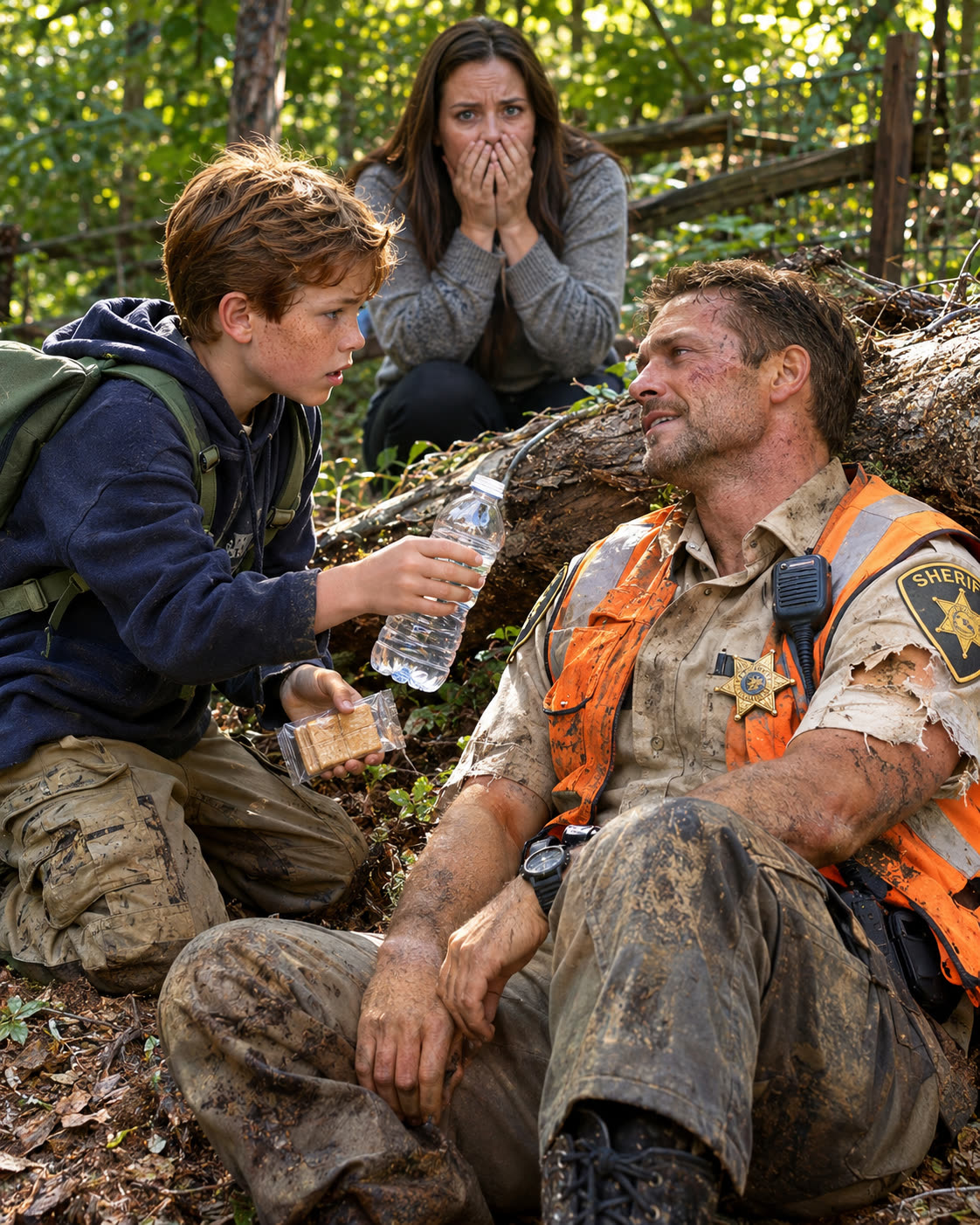
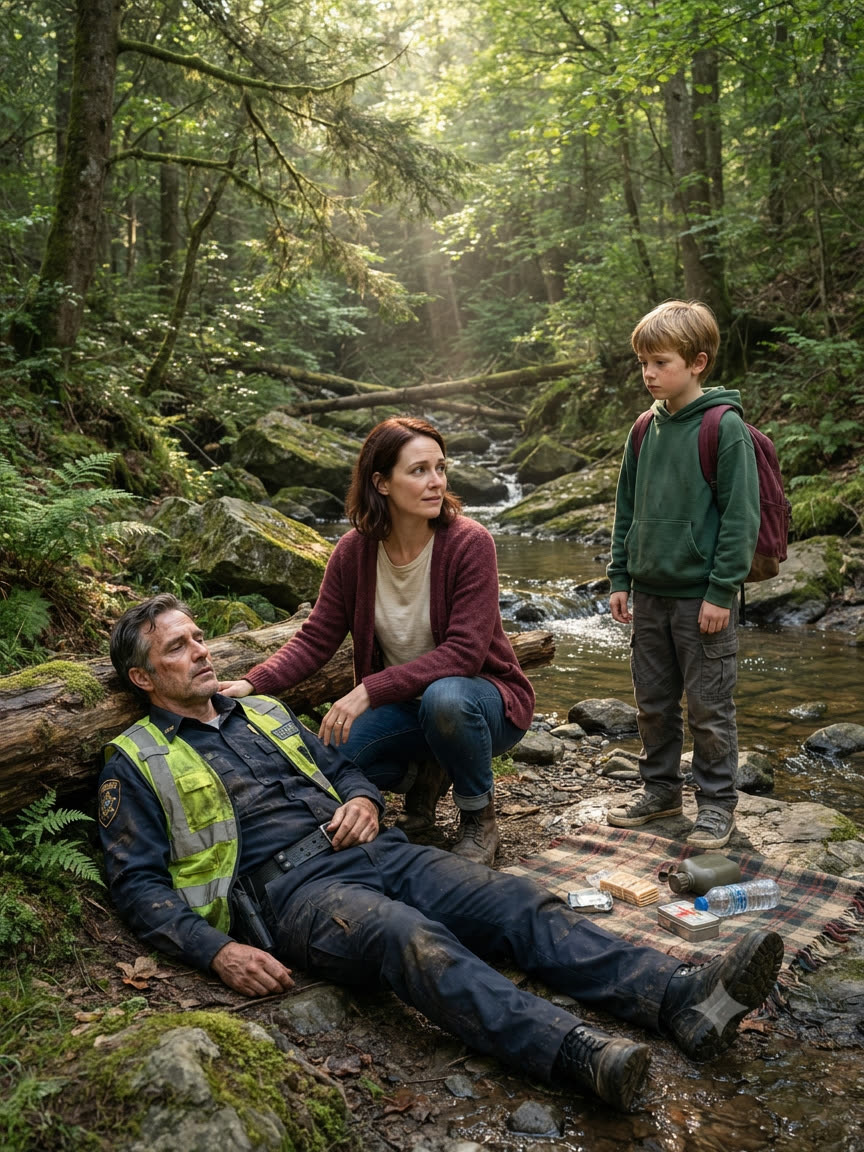
At the bottom, partly concealed beneath a fallen pine tree, a man lay on his back. One of his legs was twisted at a frightening angle. His face looked gray, covered with dirt and dried blood. He wore a ripped orange hunting vest.
Emmett was kneeling beside him, holding a bottle of water against his lips.
“Emmett!”
My son startled and spun around. The moment he recognized me, his expression crumpled.
“Mom, I’m sorry. I’m sorry. Please don’t tell Lowell.”
“Baby, who is this?”
The man slowly turned his head toward me. His eyes were barely open.
“Ma’am,” he rasped. “Your boy has kept me alive for four days.”
Then he raised a trembling hand and touched the torn badge attached to his vest.
It said Sheriff.
I slid into the ravine and took out my phone. A single bar of signal showed on the screen.
I dialed 911. “I found Sheriff Rhodes,” I said. “He’s alive. He’s in the ravine behind the elementary school.”
For a moment, the dispatcher said nothing. Then I heard her calling urgently to someone nearby.
As we waited, I knelt beside the sheriff and took his hand. His skin felt terribly cold.
“How did this happen?” I asked.
“Slipped on wet rocks up top,” he said slowly. “Fell about thirty feet. Broke my leg. Couldn’t climb out. My radio smashed. No signal down here.”
His gaze moved to Emmett. “Day two, I heard somebody walking by up there. I yelled until I lost my voice. This little guy came down to look. He was chasing a frog.”
Emmett gave a solemn nod. “It was a big one.”
“He brought me his own water bottle that day,” the sheriff said. “Then he came back every single afternoon after school. Water. Crackers. A granola bar. Even a blanket from your house.”
That explained where my old picnic blanket had disappeared to. “Why didn’t you tell anyone, Emmett?” I asked softly.
His lower lip began to tremble. “I tried to tell Lowell on the second night. I said I found a hurt man in the woods. He said to stop making up stories and go to bed. He said if I went in the woods again, I’d be punished.”
“So you went anyway.”
“He was thirsty, Mom,” Emmett said. “I couldn’t leave him.”
No words would come. My son had tried to ask for help—and now I knew what had happened when he did.
PART 2 — The Apology
The rescue team needed ninety minutes to carry Sheriff Rhodes out of the ravine on a stretcher. By the time they reached the top, half the town had gathered beside the woods, crying and cheering.
At the hospital, doctors said he was severely dehydrated. His leg was broken, and a serious infection had begun developing. Without water during those four days, they said, he almost certainly would have died.
An eight-year-old carrying a grocery bag had kept him alive.
Lowell arrived at the hospital that evening and found me standing in the corridor.
“Jess, what is this? The whole town is saying Emmett found the sheriff?”
“He tried to tell you,” I said. “On the second night. You told him he was lying. You threw his backpack in the trash for stealing water to keep a dying man alive.”
The color drained from Lowell’s face.
For the first time since we had met, he had no answer.
He entered Emmett’s hospital room. My son was sitting with the sheriff’s wife, enjoying some ice cream.
Lowell lowered himself beside the chair. “I’m sorry, Emmett,” he said. His voice cracked. “I should have listened. You did the right thing. I was wrong.”
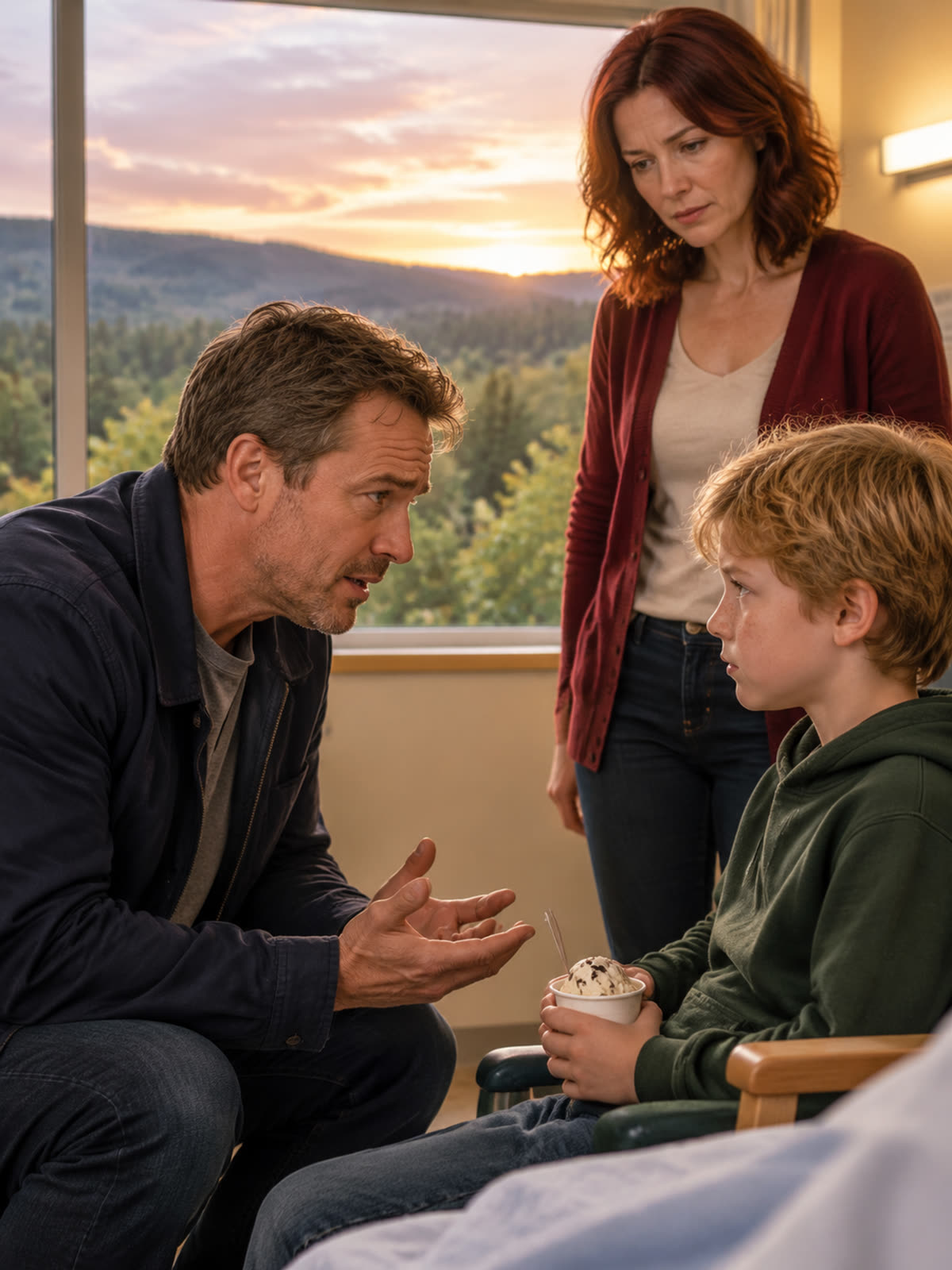
Emmett studied him for a long time.
PART 3 — The Small Gold Badge
Then my son offered him a spoonful of ice cream.
Since that day, Lowell has changed. Now, he listens.
He has even begun counseling to work through the way his own father brought him up.
The progress is slow. But it is genuine.
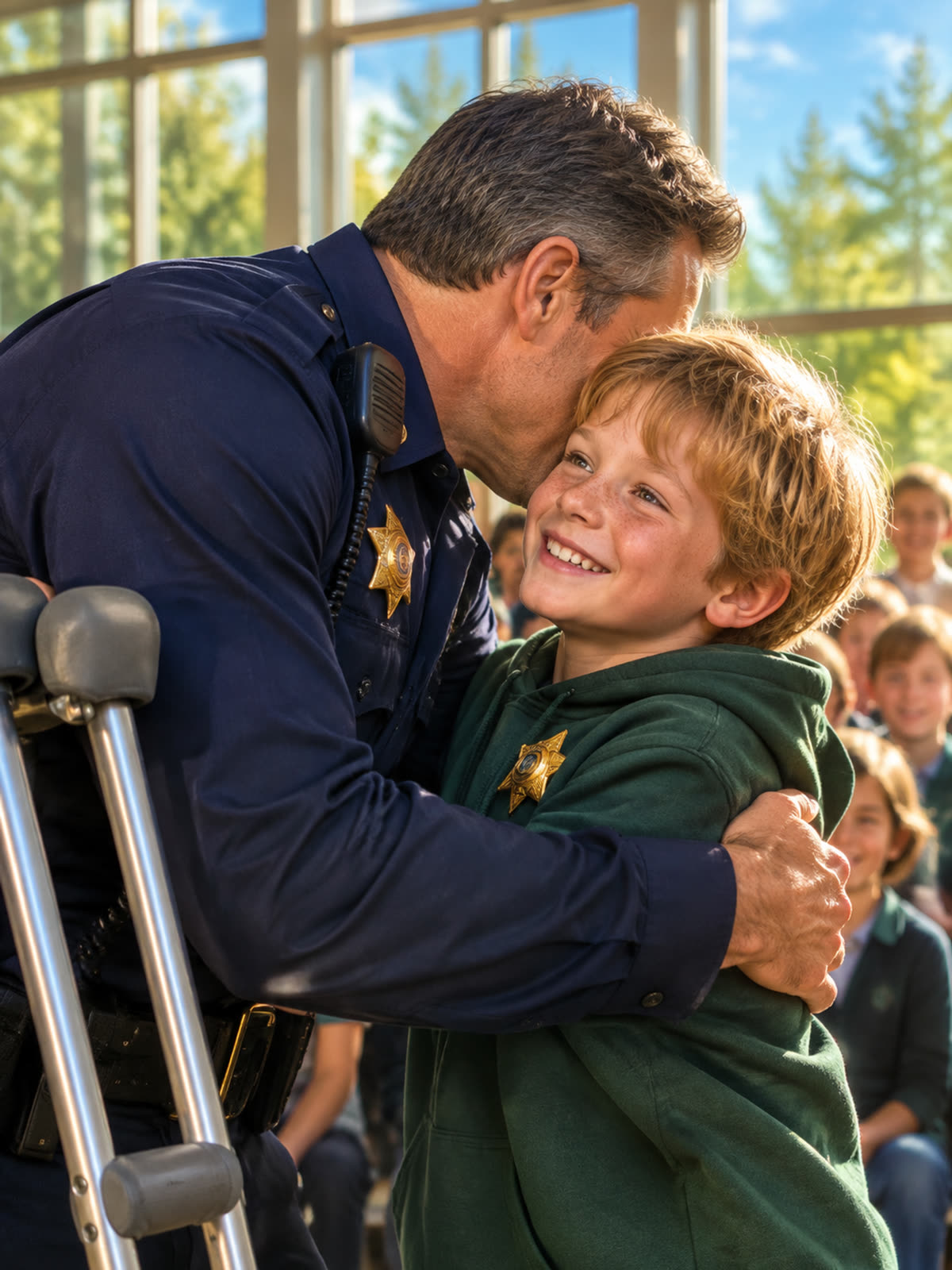
Two months afterward, Sheriff Rhodes came into Emmett’s school on crutches.
An assembly had been arranged, and the entire school attended.
He fastened a little gold badge to my son’s shirt.
“Honorary Deputy Emmett,” he said. “The bravest officer in this county.”
Emmett’s grin grew so wide I thought his face might split.
When the sheriff leaned down to embrace him, he whispered something into his ear.
Later, I asked my son what the sheriff had said.
“He said, ‘Next time you see a frog in those woods, you call me first.’”
Before punishing a child for keeping a secret, ask why. They may be carrying a burden much too heavy for such small shoulders.
If you had discovered your child in those woods, what would you have done? Share your answer in the replies.
Disclaimer: This story is a work of fiction inspired by real-life themes. Names, characters, places and events are fictionalized, and any resemblance to real persons is purely coincidental. Images are for illustration purposes only.
