

PART 1: The Gift She Threw Away
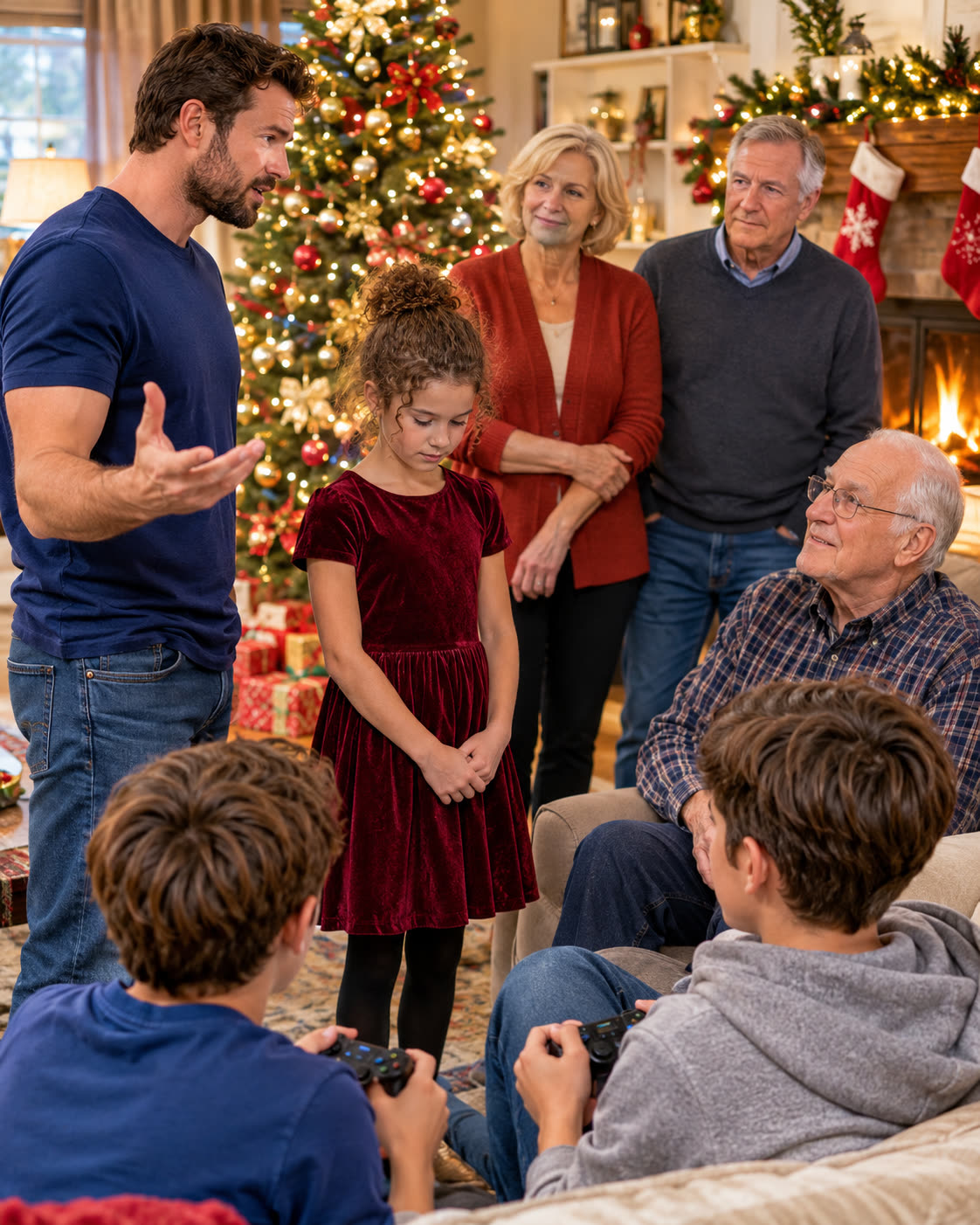
“No presents for you this year, sweetheart.” My mother delivered the words so casually that I briefly assumed she had to be kidding. She stood beside the fireplace, an eggnog mug in her hand, wearing her red Christmas sweater with its sequined reindeer. On her face was the same agreeable church smile I had seen every holiday of my life. Yolanda Wallace never raised her voice where other people could hear. This afternoon was no exception. Beside the Christmas tree stood my daughter, Kayla, wearing the red velvet dress my wife had chosen for her. A white ribbon held back her dark curls. She was seven, and she was watching her cousins unwrap a collection of gifts I would eventually work out had cost close to five thousand dollars. There were two new iPhones in their white packaging, a PlayStation and three games, noise-canceling headphones, designer sneakers worth more than my first car payment, and gift cards spread out like somebody’s winning poker hand.
My brother Brian’s sons, eleven-year-old Tyrese and nine-year-old Marcus, sat surrounded by shredded wrapping paper that nearly reached their knees. Brian occupied the couch behind them, laughing while he recorded the scene on his phone. My father watched the Lions game from his recliner with the television blaring. Kayla remained beside the tree, holding nothing. There wasn’t a package bearing her name, or a stocking waiting for her. She hadn’t even taken a candy cane from the coffee-table bowl. Nobody had offered, and she was too well-mannered to help herself. Her fingers gave my jeans a small tug. “Daddy?” I lowered myself beside her. “What is it, sweetheart?” Before answering, she looked toward her grandmother. Then she spoke in the hushed voice children use when they fear they already know the answer. “Did Grandma forget about us?” I hadn’t opened my mouth when my father’s voice came across the room. “Lance! Quit teaching that girl to be jealous!” Behind him, the football broadcast thundered on. Someone had fumbled.
I straightened slowly. “She’s seven, Dad,” I said. “She asked a question.” He kept his eyes on the television. “Then teach her to be grateful,” he said, “instead of watching what everybody else gets.” From the couch, Brian gave a laugh. “Come on, man. Don’t ruin Christmas over a couple of presents.” My eyes went to the electronics surrounding his boys. “That’s easy for you to say,” I said. Mom crossed her arms over the glittering reindeer. “We’re on a very tight budget this year, Lance,” she said. “You know that.” A tight budget. I came close to laughing. Apparently, ten dollars for a doll was beyond my parents’ means, while thousands for Brian’s children had somehow been manageable. I knew precisely what their budget looked like. For six years, I had been the one funding it. But the absence of a package for Kayla wasn’t the worst thing in that room. There was something else, something that made every excuse my mother offered sound even uglier.
When we arrived twenty minutes earlier, Kayla had gone directly to her grandmother with a little bundle wrapped in tissue paper. Inside was a clay star she had made at school. She had worked on it for two weeks, updating me every afternoon on how it was coming along. The star was sky blue. Using the tip of a toothpick, she had placed tiny gold dots around each of its five points. Through the center, in the careful lettering of a second grader, she had printed GRANDMA. My mother had given it scarcely a glance. “Oh,” she’d said. “That’s nice, honey.” She placed it on an end table, immediately turning away to ask Brian whether his sons wanted hot chocolate. Now, with my father’s accusation still hanging in the living room, I could see through the kitchen doorway. A black garbage bag stood near the back door, partly filled with paper plates and wrapping. Resting on top was a little blue star. One of its points was missing. Inside me, everything became cold and still.
My four-year-old son, Simon, sat on the rug near the tree, happily entertaining himself with a discarded length of curly ribbon. None of this meant anything to him yet. Kayla understood enough. “Get your coats, kids,” I said. My mother drew her brows together. “Lance, don’t you start making a scene.” “I’m not making a scene,” I said. “We’re going home.” At last, Dad turned away from his game. He bent forward in the recliner and aimed a finger at me. “Don’t you take that tone in my house,” he said. I took in the room: the large flat-screen television, the heat streaming out of the vents, the tree lights, the lamps, the roof above us. My wife’s earnings and mine were paying for all of it. “Your house,” I repeated quietly. Mom’s expression hardened. “Lance,” she said, and there was a warning in it. “That’s enough.” Rather than argue, I went into the kitchen and reached into the garbage. A point had snapped from Kayla’s star, and cranberry sauce streaked the gold dots. I gently wiped it against my shirt, then put it in my coat pocket. Mom followed as far as the doorway and watched. “You’re being ridiculous,” she said. I met her gaze. “No, Mom,” I said. “I’ve been ridiculous for six years. Today I’m done.”
We were halfway home before anybody spoke. From the back seat came Kayla’s tentative little voice. “Daddy, did I do something bad?” My grip tightened around the steering wheel. “No, baby,” I said. “You didn’t do anything bad.” She asked, “Then why didn’t Grandma get me anything?” After a short silence, she added, “Maybe she didn’t like my star.” I turned into the deserted lot of a closed Walgreens and stopped the car. Simon had fallen asleep in his seat, still holding his piece of ribbon. I twisted around toward my daughter, took the blue star from my pocket, and raised it between us under the parking-lot lights. “Kayla,” I said. “Listen to me. This is beautiful. It’s the most beautiful thing anybody gave anybody in that house today. Grandma made a bad choice. A really bad one. But you didn’t do anything wrong. Not one thing.” Tears traveled down her face. “Really?” she whispered. “Really,” I said. “And you know where this is going? Right in the middle of our Christmas tree. Top branch. Right under the angel.”
She rubbed her nose against the velvet of her sleeve. “Even with the broken part?” “Especially with the broken part,” I said. “That way we’ll always remember what it survived.” A small, tearful smile finally appeared. I faced forward and took us home, but my thoughts kept returning to a place I didn’t want to visit. The Christmas I was nine, Brian received a shiny red Huffy bicycle, streamers hanging from its handlebars. He was six. My presents were three pairs of white tube socks. Later, in the hallway, Mom explained that I was older and needed to understand. Money was short. Brian was little. I was the big boy. It became the arrangement that shaped my childhood. Brian needed something, and Lance understood. Brian damaged things, and Lance repaired them. Brian found trouble, and Lance covered for him. After he wrecked Dad’s truck at seventeen, I said I had been behind the wheel. When he left community college, I sat with him and helped complete job applications. Understanding had been my role for as long as I could remember. Now my parents were handing that same role to my daughter. I would not let them.
Six years before that Christmas, in March, Dad suffered a heart attack on the loading dock of the Dearborn warehouse where he had worked for twenty-eight years. He lived, but the damage to his heart meant he couldn’t return to lifting freight. There were no office positions waiting for sixty-one-year-old forklift drivers. Three months afterward, Mom called in tears. “Lance,” she said. “We’re behind on the mortgage. Four months. The bank sent a letter. We’re going to lose the house.” I work as a civil engineer for the Michigan Department of Transportation, designing highway interchanges. My salary is respectable, not enormous. My wife, Kendra, is an emergency-room nurse at Beaumont Hospital in Royal Oak. We had two young children, a modest brick bungalow in Ferndale with a basement that leaked, and a five-year plan to move somewhere larger. Of course I said I would help. She was my mother. I started paying twelve hundred and forty dollars a month toward the mortgage. Mom supplied the account details, and I arranged an automatic transfer from my checking account on the first of each month.
Another eight hundred and sixty dollars went each month toward groceries, electricity, gas, car insurance, and Dad’s heart medicine, which still cost three hundred dollars monthly despite Medicare. Mom suggested making her an authorized user on my credit card and allowing her access to my checking account so she could handle the bills directly. That would save her from bothering me whenever another electric bill arrived. I agreed. Twenty-one hundred dollars every month, for seventy-two months, came to a hundred fifty-one thousand, two hundred dollars. To keep us afloat, Kendra picked up nights, weekends, and holidays. She worked four Christmas Days in a row. Our larger house remained a plan. Vacations disappeared. We kept our Honda until its odometer passed two hundred and twenty thousand miles. Kayla wore clothes her cousins had outgrown, delivered by my mother in garbage bags with a small sigh about Brian’s generosity. Mom also insisted that Brian mustn’t know. “He’d feel terrible,” she said. “Knowing we needed help. Knowing you’re paying and he isn’t. It would hurt his pride. Please, Lance. Let it be our secret.” At church, she claimed Dad’s pension paid their expenses. Dad had no pension. His warehouse had shut down its plan in 2004. I knew her story was false, but I convinced myself I was preserving their dignity.
Kendra returned from the hospital at eight fifteen that Christmas evening, after twelve hours in the emergency room. She came through the rear door wearing navy scrubs, her hair escaping its clip, exhaustion shadowing her eyes. I was alone at the kitchen table. The children were asleep, and Kayla’s blue star lay in front of me. “What happened?” she asked. I explained the phones, the gifts, the empty place under the tree, my mother’s announcement, Dad calling our daughter jealous, and the star lying in garbage with cranberry sauce across it. Kendra sat opposite me. For a long while, she said nothing. She lifted the star and examined its broken point, turning it between her fingers. Finally, in a very low voice, she said, “So I worked Christmas Day so your mother could tell our daughter she couldn’t afford a present.” I couldn’t look beyond the tabletop. Tears gathered in her eyes. Kendra rarely cries. In eleven years of marriage, I could count perhaps four occasions. She has held the hands of dying patients, then come home and cooked dinner. “Lance,” she said. “When do our children finally come first?” I had no answer. I never had, which was exactly the problem. At last I said, “Tonight,” and then, “They come first tonight.”
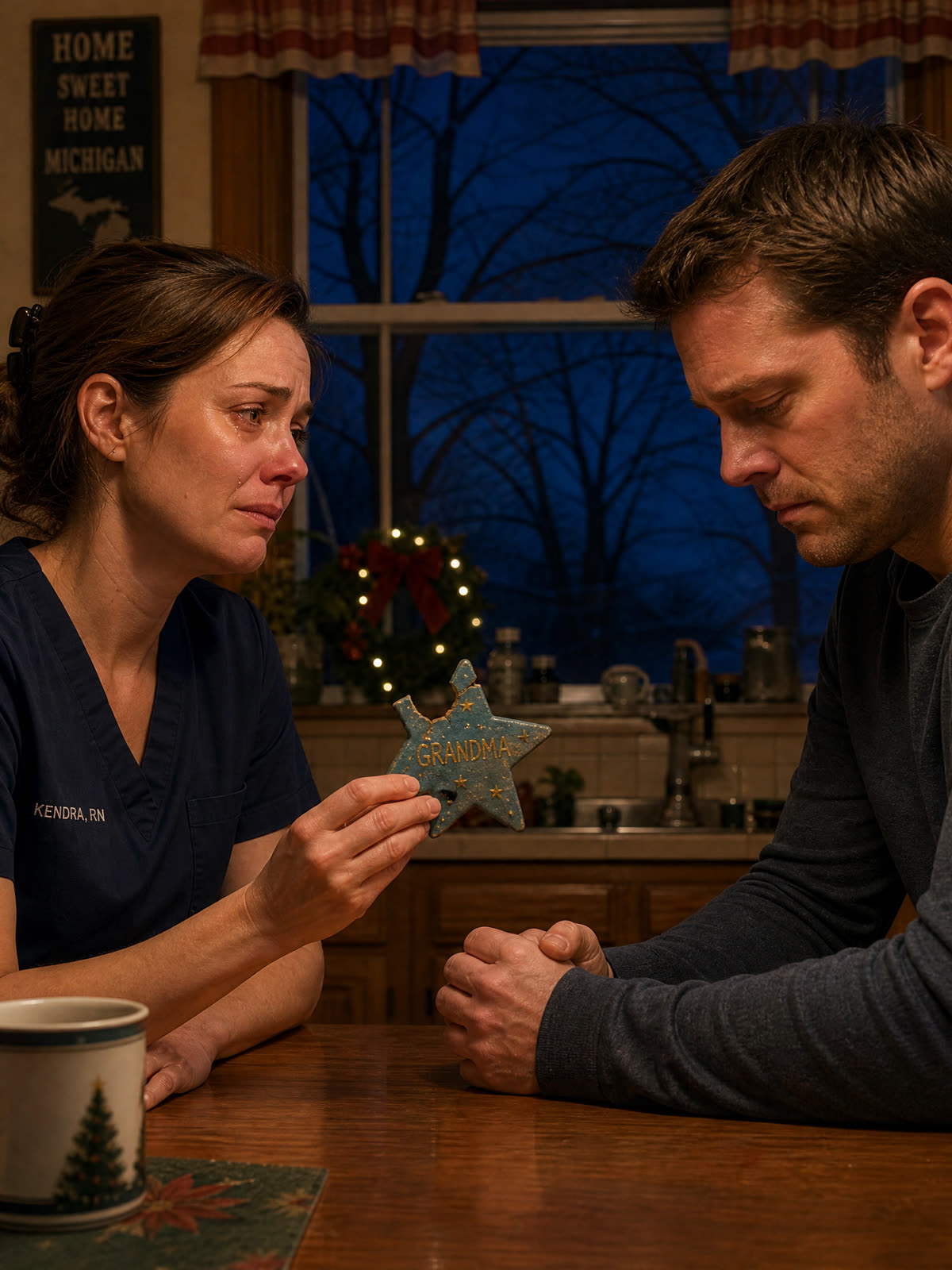
At nine forty, I called the bank. With my laptop open on the kitchen table and my debit card in my hand, I dialed the twenty-four-hour number for Great Lakes Federal Credit Union. Kendra remained across from me. Patricia, the woman who answered, spoke with a composed kindness. She sounded as though Christmas night had been a working night for her, too. I explained the changes I needed: stop the twelve-hundred-and-forty-dollar transfer scheduled for the first, cancel the DTE Energy and Consumers Gas payments connected to my parents’ home, remove Yolanda Wallace from my credit card, and revoke her checking-account access. Patricia worked through the requests, confirming them individually and reading them back. Then something shifted in her tone. “Mr. Wallace,” she said. “Before I finalize removing Mrs. Wallace’s access, I’m seeing something unusual in your account authorization history. I need to verify a few things with you. Is that all right?” “Sure,” I said. I heard more typing before her next question.
“Did you authorize Yolanda Wallace to open new credit accounts using your account as a reference?” “No,” I said. “I added her as an authorized user on one card. That’s it.” A pause followed. Patricia typed again. “Did you apply for a Capital One Platinum Visa in April of 2021?” she asked. “Or a Discover card in September of 2022?” “No,” I said slowly. “I have one credit card. With you.” The keyboard clicked some more. “Mr. Wallace,” Patricia said. “Can you confirm the Social Security number ending in 4471?” I frowned at the table. “That’s not mine,” I said. “Mine ends in 2209.” This time the silence lasted longer. When she spoke again, each word was careful. “Sir,” Patricia said finally. “Do you have a child with a Social Security number ending in 4471?” My mouth dried out. There was no need to find a document. I had entered that number on pediatrician forms, school registrations, and the application for a college savings bond. “That’s my daughter’s,” I said. “Kayla’s. She’s seven.”
“Mr. Wallace,” Patricia said. “I need you to listen carefully. I’m going to tell you what I’m seeing, and then I’m going to give you some numbers to call. Do you have something to write with?” Kendra pushed a pen and an envelope across the table. Over the following fifteen minutes, everything Patricia explained seemed to pull the floor farther beneath me. Three credit accounts used my checking account for payments, all connected through Yolanda Wallace’s authorized access. First was a Capital One card bearing my name, opened in April 2021. I had never requested it. My parents’ Westland home appeared as the address on the application. Its balance stood at eleven thousand, four hundred dollars. For almost four years, minimum payments had quietly left my checking account, described as CAP1 ONLINE PMT and lost among dozens of legitimate automatic transactions. The next account was a Discover card, also in my name, opened in September 2022. Same address, same monthly withdrawals, same absence of permission. That balance was fourteen thousand, two hundred dollars.
The last account was a store card from a large electronics retailer, opened that June. Its primary holder was listed as Kayla M. Wallace, with a birth year of 1994 and a Social Security number ending in 4471. Someone had paired my seven-year-old’s number with a false birthday that made her twenty-nine. The outstanding balance was nine thousand, eight hundred dollars. “Mr. Wallace,” Patricia said gently. “There were several large purchases on that third card in the past three weeks. December fourth, five days before. Two iPhones. A gaming console. Headphones. Some gift cards.” She paused. “Approximately forty-seven hundred dollars.” I couldn’t get a breath. Kendra watched my face, her own drained of color. “Sir?” Patricia said. “Are you still there?” “I’m here,” I said. My voice sounded unfamiliar to me. The phones. The PlayStation. The headphones. That spread of gift cards. My nephews’ Christmas had been bought with an account opened in my daughter’s name. The daughter who had stood empty-handed beside the tree and wondered whether her grandmother had forgotten her.
Patricia wasn’t finished. “There’s one more thing,” she said. “The recurring transfer you asked me to cancel. The twelve hundred and forty dollars, labeled as a mortgage payment.” “Yes?” I asked. “It’s not going to a mortgage lender,” she said. “It’s going to a personal savings account at another bank. Fifth Third. The account holder is Yolanda Wallace.”
PART 2: The Truth in the Driveway
By the time Kendra came around the table, I was on the kitchen floor, my back pressed against the dishwasher. I gripped the phone hard enough to hurt my knuckles. Patricia had remained on the call until she knew I had recorded everything. She gave me telephone numbers for the credit bureaus, the Federal Trade Commission’s identity-theft hotline, and the Capital One and Discover fraud departments. She instructed me to freeze Kayla’s credit the next morning and make a police report. Three times, she apologized. After the call ended, I slid down to the floor. “Lance,” Kendra whispered, kneeling beside me. “What happened?” I tried to answer, but nothing came out. She removed the envelope from my hand. On its back were the amounts I had written: Capital One — $11,400. Discover — $14,200. Kayla — $9,800. Mortgage = Mom’s savings. She read the notes twice, settled on the floor beside me, and rested her head against my shoulder. We stayed there without speaking. Finally, she asked, “Are you going to call your mother?” I shook my head. “No,” I said. “I’m going to let her call me.”
The first call arrived at twelve twenty in the morning. I knew what must have happened. Mom had attempted to use my credit card at a pharmacy open all night, a gas station, or an online shop, only to have it declined. Her authorization no longer existed. The screen lit up with Mom, and I watched it ring. Two minutes later, she tried again. Then again, and again. Her first messages sounded irritated: Lance, the card isn’t working. Call me back. Irritation became anger. I don’t know what you think you’re doing, but you need to fix this right now. After that, fear entered her voice. By three o’clock, she sounded desperate. “Please, Lance. Please call me. We need to fix this. We can fix this. Just don’t call anybody. Don’t call the bank. I’ll explain everything. I’ll pay it back. Please.” I didn’t answer. At three forty-seven, she left a voicemail I would play four separate times. She was crying, and I could hear her voice tremble.
“Lance, honey. I know you know. About the cards. I know they told you. I was going to pay them off, I swear. It was just for Brian. He’s been having such a hard time since the plant closed, and the boys, they didn’t have anything. I just wanted them to have a nice Christmas. And Kayla’s number, I only used it because yours was getting full, and I knew she wouldn’t need credit for years and years, and I’d have it all paid off by then. Nobody was supposed to get hurt. Please don’t tell your father. He doesn’t know. He doesn’t know anything. Please.” I saved that message, and every other one. Then I sat at the kitchen table assembling six years of bank records until daylight. Between four and six, our home printer produced seventy-two months of statements. I marked each transfer to Mom’s savings account in yellow. At five, I spoke with Capital One and Discover’s fraud departments and downloaded the statements for the accounts bearing my name. I also obtained Kayla’s credit report online. It listed one open store account, nine thousand eight hundred dollars owed, and two late payments. My daughter was seven years old and already had damaged credit.
Before sunrise, I took a cardboard box filled with documents to the Westland Police Department on Third Street. Officer Teresa Doyle handled my report. She was in her late forties, with cropped gray hair, reading glasses, and the calm patience of someone who had already encountered every variation of a family crisis. She examined every sheet in the box. With my phone’s volume turned all the way up, she listened twice to the message from three forty-seven. Afterward, she removed her glasses and sat quietly for a moment. “Mr. Wallace,” she said. “I’ve been doing this for twenty-two years. I’ve seen a lot of financial exploitation cases. Usually it’s the other direction. Kids taking from their parents.” She shook her head. “And I’ve seen child identity theft. More than you’d think. It’s almost always a family member.” She spent a long time typing, then handed me a piece of paper bearing a case number. I held it while she explained what would happen next.
“I’m going to send this to our financial crimes unit,” she said. “They’ll want to talk to your mother. And probably your brother, since the purchases went to his children.” Over the top of her glasses, she looked directly at me. “This could be charged as identity theft. Using a minor’s identity is a felony in Michigan. You understand that?” “I understand,” I said. “Do you want to press charges?” she asked. I saw Kayla again in that velvet dress, standing beside the tree with nothing in her hands. “I want the truth to come out,” I said. “Then I’ll decide.” When I got home, Kendra was sleeping on the couch, still dressed in her scrubs. The children were watching cartoons. I made Christmas pancakes, stirring green and red sprinkles into the batter. It was only the day after Christmas. My children deserved a morning that felt ordinary. Kayla ate three pancakes. Simon managed to get syrup in his hair. Then the messages from Brian began.
WHAT DID YOU DO TO MOM??? She’s been crying since midnight. She says you locked her out of the bank. DAD’S CHEST IS TIGHT BECAUSE OF YOU. If he has another heart attack it’s on you. I’M COMING OVER. At ten fourteen, my mother’s seventy-third call appeared on my screen. I watched it ring unanswered. A minute afterward, the doorbell sounded. From the front window, I could see Brian’s white Tahoe stretched across the end of the driveway, trapping my car. My parents’ gray Buick sat behind it. Farther back, at the curb, was a Westland police cruiser. Kendra joined me in the hall. The bell had awakened her. She rested a hand against my back, then turned toward the children. “Kids,” she said. “Upstairs. Go play in Kayla’s room. Now, please.” Kayla studied the window, then my face. Without speaking, she took Simon’s sticky hand and brought him upstairs. I opened the front door.
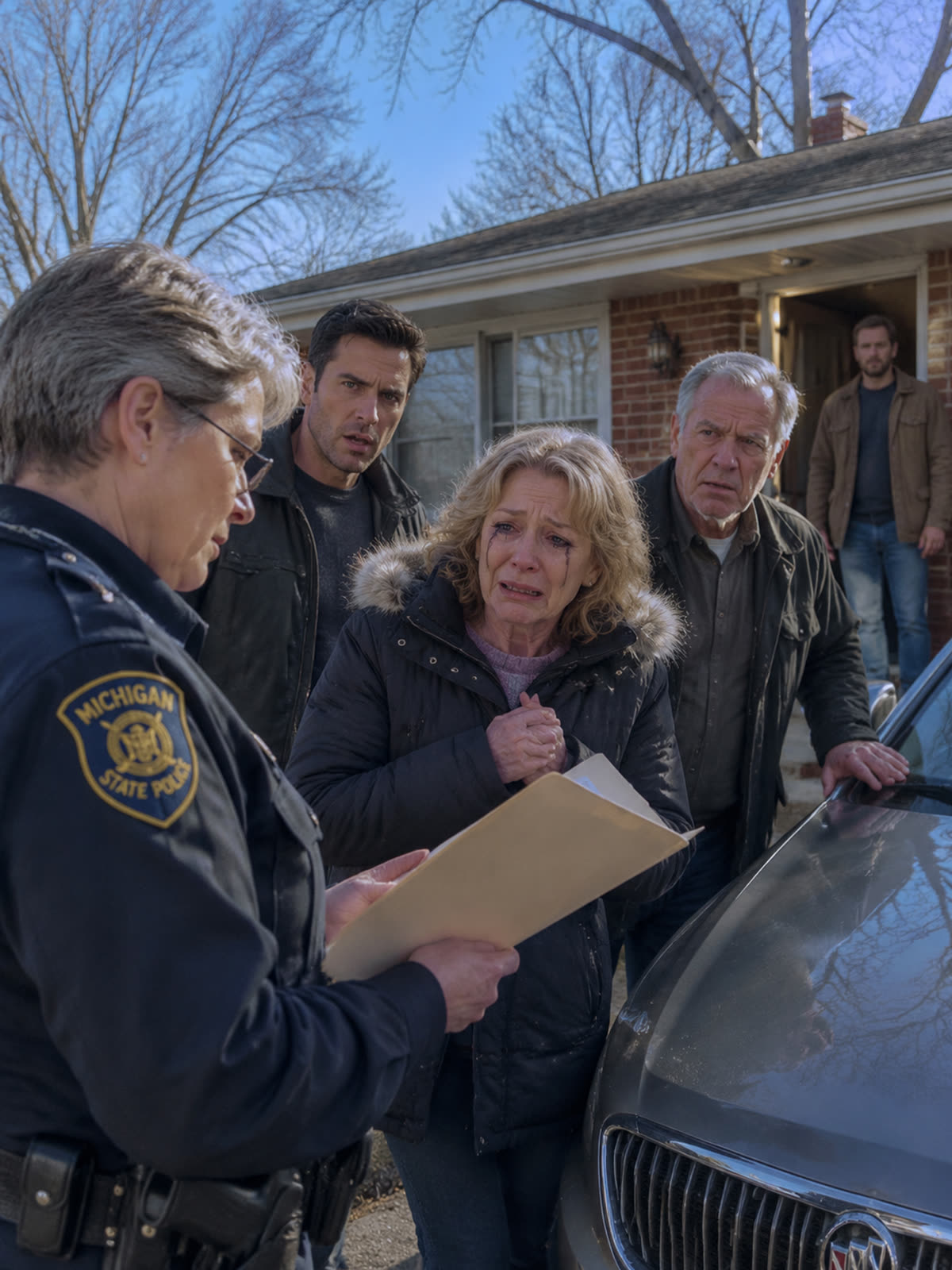
Brian was already advancing up the walk. His jacket hung open, and his face was flushed. At thirty-five, he was three years younger than me and wider through the shoulders, with our father’s square jaw and our mother’s dark eyes. He had always been the charming brother, the funny one people liked. “There he is!” he shouted, pointing. “He stole from our parents! Mom says he got into their bank accounts and drained them! She can’t buy Dad’s medicine!” Beside the Buick, Mom clutched her purse in both hands, bundled into her winter coat. Dad was easing himself out of the passenger seat, using the door for support. His face looked gray. Two officers approached along the driveway. One was a young man I didn’t know. The other had short gray hair and reading glasses hanging from a chain. Officer Doyle. Brian spotted them and immediately turned. “Officers!” he said. “That’s him. That’s my brother. He’s been stealing from our parents for years. Mom told me everything this morning. Arrest him!”
Officer Doyle raised one hand. “Sir,” she said. “That’s enough.” Brian stopped and stared. She gave me a slight nod where I stood in the doorway, then continued toward the Buick. In front of my mother, she stopped. “Are you Yolanda Wallace?” she asked. Mom nodded. “Yes,” she said. Her voice had become very small. Doyle carried a manila folder: the documents I had brought that morning, the yellow-marked statements, the credit reports, and the transcript of Mom’s early-morning voicemail. She opened it. “Mrs. Wallace,” she said, “your son Brian called our department forty minutes ago. He told the dispatcher that your older son, Lance, had stolen money from your bank accounts and that you wanted to file a complaint.” She lifted her eyes. “Is that correct?” Mom glanced at Brian, then me, then the officer. “Yes,” she whispered. “I see,” Doyle said, turning a page. “Before we discuss that complaint, Mrs. Wallace, there’s something I need you to explain.”
Mom looked toward Dad, still beside the Buick with one hand on the door. Then she looked at Brian and finally at me. Every trace of color left her face. “Mrs. Wallace,” Officer Doyle said, looking down at the documents, “can you explain why…” “No!” The word broke out of Mom like something snapping. Her purse fell onto my driveway. Both hands flew to her face, and she began sobbing there in her winter coat, in front of her husband, her sons, and two police officers. Brian stood motionless on the walkway. Dad’s knuckles whitened around the edge of the car. As Doyle turned a page, I understood something I hadn’t understood in six years. The possibility of losing her home had never frightened Mom as much as the prospect of everyone discovering the truth. Doyle didn’t need to raise her voice. “Mrs. Wallace,” she said gently. “I’m going to read some things to you, and I’d like you to tell me if they’re true. You don’t have to answer. You have the right to remain silent, and anything you say can be used against you. But I think your family deserves to hear this. Is that all right?”
Mom continued crying into her hands without answering. Officer Doyle began reading. “For seventy-two months,” she said, “your son Lance has been transferring twelve hundred and forty dollars on the first of every month to what he was told was your mortgage lender. Those payments went to a personal savings account at Fifth Third Bank, held in your name alone.” Brian turned toward her. “For the same seventy-two months,” Doyle continued, “he’s been giving you access to his checking account and credit card to pay your utilities, groceries, insurance, and your husband’s medications. Approximately eight hundred and sixty dollars a month.” Dad raised his head and looked across the Buick’s roof at Mom. “In April 2021,” Doyle said, “a Capital One credit card was opened in Lance Wallace’s name, using your address. Lance did not apply for it. Current balance, eleven thousand four hundred dollars. In September 2022, a Discover card. Lance did not apply for it either. Fourteen thousand two hundred dollars. The minimum payments on both cards have been drafted from Lance’s checking account every month, through your authorized access.” Mom shook as the officer continued, more softly. “And in June of this year,” she said, “a store credit card was opened under the name Kayla M. Wallace, with a false date of birth. Using the Social Security number of Lance’s daughter. Who is seven years old.” Doyle looked up. “On December fourth,” she said, “approximately forty-seven hundred dollars was charged on that card. Two iPhones. A PlayStation. Headphones. Gift cards.” After a pause, she added, “Purchased at the store location in Westland, two miles from your house.” She shut the folder. “Mrs. Wallace,” she said. “Were those your grandsons’ Christmas presents?”
For a long time, nobody answered. A passing car slowed beside the police cruiser. A dog barked somewhere down the street. Then Dad spoke, his voice quiet and rough. “Yolanda,” he said. “What mortgage?” Mom lowered her hands. Black tracks of mascara ran down her cheeks as she looked at him over the car. “Walter,” she whispered. “What mortgage?” my father said again. “We paid off the house. In 2019. With my workers’ comp settlement. Ninety-two thousand dollars. You told me. You showed me the letter from the bank.” His hand remained locked around the door. “You said we owned it free and clear.” I stared. The mortgage had been paid before his heart attack, before Mom’s tearful call, before the first transfer I ever made. Four months behind. Going to lose the house. There had been no mortgage to fall behind on. “You told me Lance was helping a little,” Dad said slowly. “With my pills. That’s all. You said Lance sent a little money every month for my pills, and the pension covered the rest.” He turned toward me, his eyes wet. “I don’t have a pension, son. I never had one. She told me it was the pension. I didn’t ask. I was sick. I didn’t ask.”
Mom let out an awful sound. “I’m sorry,” she said. “Walter, I’m so sorry.” Brian stared at her, his face no longer red but white. “Mom,” he said. “The money. The money you gave me. For my truck payments. And the boys’ braces. And the hockey camp.” His voice climbed. “You said it was from Dad’s savings. You said Dad had money put away.” She couldn’t meet his eyes. “Mom,” he said. “Where did the money come from?” She looked at me instead. No answer was necessary. Brian followed her gaze to where I stood in the doorway of my small brick bungalow, with its leaking basement and the Honda that had traveled two hundred and twenty thousand miles. Then he looked down at his shoes, the new Jordans on his feet. “Oh my God,” he said quietly. For once, there was no joke, no easy charm, and no instruction for me to stop ruining everyone’s holiday.
None of us heard Kayla coming down the stairs. Suddenly she stood behind me in the front hall, wearing pajamas and holding Simon’s hand. She had been at the top of the staircase while Officer Doyle read. I couldn’t know how much she understood. She was only seven, but she was bright, and she had recognized her own name. “Daddy,” she said. “Did Grandma use my name to buy Tyrese’s phone?” Every person in the driveway turned toward her. At the sight of Kayla in the doorway, Mom’s face collapsed, and she covered her mouth. I knelt inside the hall and held my daughter’s hands. “Yes, baby,” I said. After six years of lies, I wasn’t going to give her another. “She did. It was wrong. It was very, very wrong. And none of it is your fault.” Kayla looked past my shoulder toward her grandmother, who stood by the Buick with mascara streaking her face. Then she reached into her pajama pocket and brought something out.
It was the broken blue star. She must have removed it from the tree after breakfast and tucked it away. I hadn’t noticed. She studied it in her hand, then went around me, through the doorway, down the porch steps, and across the cold concrete in her bare feet. She stopped in front of Mom and extended the star. “I made this for you,” Kayla said. “It’s got your name on it. You threw it in the trash.” My mother looked down at the clay resting on my daughter’s palm: the missing point, the gold dots, GRANDMA written across the middle. “I’m giving it back,” Kayla said, “because I made it for you. So it’s yours.” She paused. “But Daddy says what you did was wrong. So I don’t think you should get presents either. Not until you say sorry.” Mom sank to her knees on the driveway. She didn’t reach for the star. She knelt on the freezing concrete and cried so hard her whole body trembled. In thirty-eight years, I had never seen her weep that way, not when her own mother died, not after Dad’s heart attack.
“I’m sorry,” she sobbed. “Kayla, baby, I’m so sorry. I’m so sorry. I’m so sorry.” My daughter watched her for a long moment. Then she carefully laid the star on the driveway in front of her grandmother, facing upward so the word GRANDMA pointed toward the sky. Without another word, she returned to the house and took her little brother’s hand again. That afternoon, in a small interview room at the Westland Police Department, my mother finally told the whole story to Officer Doyle and a financial-crimes detective. I wasn’t present; Doyle told me about it afterward. Mom gave up her right to an attorney. She said she was tired of lying.
PART 3: What the Blue Star Survived
According to Officer Doyle, the deception began with a little money, the way such things so often do. Dad’s workers’ compensation settlement arrived in 2019, and Mom really did use it to clear the mortgage. That summer, the transmission plant in Livonia closed, and Brian lost his job. His wife had just left him. He had two little boys, a truck payment, and no idea how to manage. He phoned Mom in tears. She sent him some of their savings and told Dad they needed a new water heater. After that, she gave Brian a little more, and then more again. By the following spring, their savings had vanished. Brian still needed money. Dad had just suffered his heart attack. One evening, sitting at her kitchen table with bills piled in front of her, Mom came up with a way to keep helping. She called me crying and said the bank was about to take their house. I agreed to help.
“She said she never meant for it to go on this long,” Officer Doyle told me. “She said every month she told herself it would be the last month. That Brian would get back on his feet, and she’d tell you the truth and pay you back. But Brian never got back on his feet. He kept needing more. And you kept paying.” Eventually, twenty-one hundred dollars a month stopped being enough. There was a transmission for Brian’s truck, braces for the boys, and hockey camp for Tyrese. Then Christmas arrived, and Brian said he had nothing to spend on presents. His sons would be crushed. That was when the credit accounts became part of the arrangement. “Why Kayla’s number?” I asked. Doyle waited a moment before answering. “She said she had it from when you set up the college savings bond,” she said. “Five years ago. You gave her the form to sign as a witness.” She looked at me above her reading glasses. “She said she used Kayla’s because your credit was getting maxed out, and she knew a little girl wouldn’t need credit for twenty years. She said she’d have it all paid off long before Kayla ever knew.”
I shut my eyes. “And Christmas?” I asked. “Why nothing for Kayla? If she was already spending forty-seven hundred dollars, why not one more doll?” Officer Doyle consulted her notes. “She said she couldn’t,” she said quietly. “She said she couldn’t look at Kayla and buy her a present with her own stolen name. She said it was the only thing she couldn’t bring herself to do.” She paused before continuing. “She said she thought it would be easier to just get her nothing.” Then she shook her head. “People rationalize,” she said. “They draw lines in the strangest places. She stole your daughter’s identity. But she couldn’t buy her a doll with it.” Mom had found a boundary she could live with only after stepping across every boundary that should have protected my child. She had taken Kayla’s name, then decided that leaving her empty-handed was the part that would make the theft easier to bear.
Two weeks later, the prosecutor called. Mom had admitted everything, and the evidence against her was overwhelming. Even the saved voicemail would have been sufficient. She faced possible charges for identity theft, use of a minor’s identity, and financial fraud. They were felonies. At sixty-four, prison was a real possibility. “It’s your decision, Mr. Wallace,” the prosecutor said. “You and your wife are the victims. And your daughter. We’ll proceed however you think is right.” For three nights, Kendra and I talked. I wanted punishment. I won’t pretend otherwise. Sometimes I lay awake imagining my mother dressed in an orange jumpsuit and felt a hot, ugly satisfaction. She had taken a hundred fifty-one thousand dollars from my family. She had stolen my daughter’s identity. She had discarded the star Kayla made and explained the empty space under the tree as a matter of budgeting. But the image of her kneeling in front of a seven-year-old in pajamas wouldn’t leave me either. Neither would Dad, gray-faced beside the Buick, asking about a mortgage that no longer existed.
On the third night, Kendra and I sat on our back steps with our coats on, our breath visible in the cold. “What do you want, Lance?” she asked. I considered the question for a long time. “I want Kayla’s name back,” I said. “Clean. I want every dollar of that credit card paid off and her record cleared like it never happened. I want the cards in my name paid off. I want my mother to stand in front of a judge and say what she did out loud, so she can never pretend it didn’t happen.” Then I turned toward my wife. “And I want our children to come first,” I said. “From now on. Before my mother. Before Brian. Before my guilt.” For years, helping had meant giving my mother whatever she said was necessary. Now I knew exactly what I was asking for, and whose needs I meant to protect.
In March, Mom entered a guilty plea to one count of identity theft. The prosecutor accepted a deferred sentence with five years of probation. If she met every condition and completed restitution, the felony would become a misdemeanor. Any violation could send her to prison. The restitution order came to one hundred seventy-six thousand, six hundred dollars: the money paid toward the nonexistent mortgage, the credit-card balances, and interest. She couldn’t produce that money from her income. There was only one way she could pay. In May, my parents sold their Westland house, the home that had been mortgage-free since 2019, the home I had supposedly spent six years saving from foreclosure. A young couple expecting a baby bought it for two hundred and thirty-eight thousand dollars. Mom and Dad moved to a two-bedroom apartment in a Garden City senior complex. Dad insisted. After thirty-four years in that house, he said he couldn’t spend another night there knowing its cost.
Restitution was paid from the sale proceeds, every dollar of it. The Capital One and Discover balances were cleared. Kayla’s store account was paid off and closed. What remained came to Kendra and me. During the week the payment arrived, Brian appeared on my porch with his hands buried in his jacket pockets. He had sold the Tahoe and was driving a ten-year-old Ford Focus. He had also found work with a medical-supply company in Livonia, delivering wheelchairs and oxygen tanks to people’s homes. The pay wasn’t much, but he earned it himself. “Lance,” he said. “I didn’t know. I swear to God, I didn’t know it was you.” “I know,” I said. “She told me it was Dad’s savings,” he said. “Every time. For six years. And I believed her because I wanted to.” His gaze dropped to his shoes. They were no longer Jordans. “I’m thirty-five years old, and I let my mother pay for my whole life. And I never once asked where the money came from.”
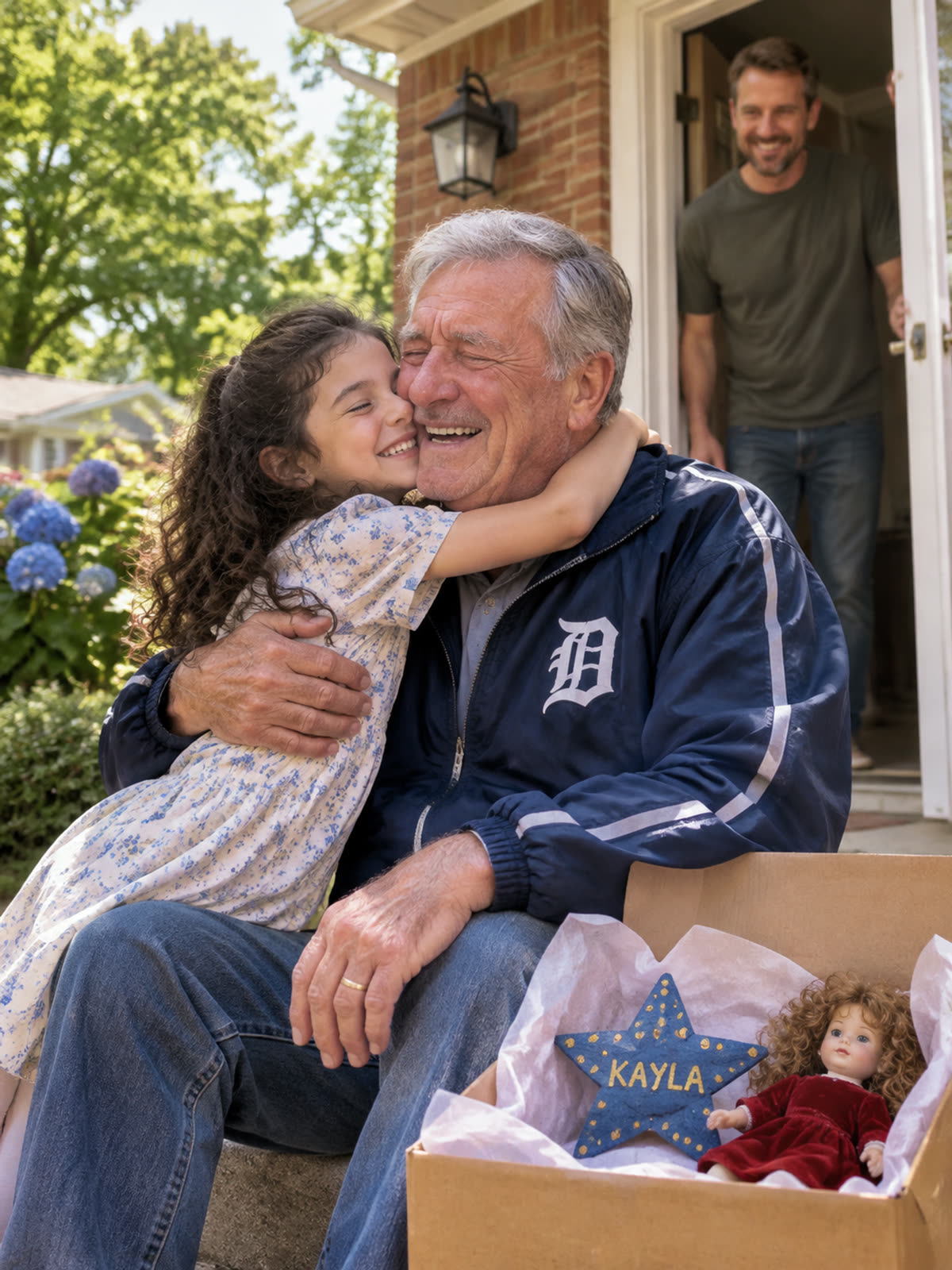
He pulled an envelope from his pocket and offered it to me. “It’s not much,” he said. “Twelve hundred dollars. I sold the PlayStation and both iPhones and the headphones. Tyrese cried for a week.” He swallowed before going on. “I told him why. All of it. I told him those were his cousin’s presents, and we had to give them back.” Then he looked up. “I want to give it to Kayla,” he said. “Not to you. To her. For whatever she wants.” My father made his own visit in June, arriving alone on a Saturday morning. He had driven himself, something his heart condition rarely allowed him to do anymore. He stood on the front porch in his old Detroit Tigers windbreaker, holding a paper toy-store bag. Kayla came to the door and silently studied him. Slowly, carefully, he lowered himself onto the top step until their faces were level.
“Kayla,” he said. “At Christmas, I called you jealous. In front of everybody.” She nodded. “You weren’t jealous,” Dad said. “You were seven, and you asked a question, and you had every right to ask it. Your daddy was right, and I was wrong.” His voice sounded rough. “And I’ve been wrong about a lot of things for a long time. About your daddy, mostly.” He looked toward me, standing behind her in the doorway. “When your daddy was nine,” he said, “his little brother got a bicycle for Christmas, and he got socks. And I didn’t say a word. I let your grandma tell him he should understand. And he understood. His whole life. He understood so much that he paid for my heart pills for six years and never once told me.” Dad offered the paper bag. “I’m sorry,” he said. “I’m sorry I called you jealous. I’m sorry I didn’t see you.” Kayla accepted it and looked inside.
The bag held a baby doll, nothing expensive, just a ten-dollar doll with brown curls and a red velvet dress much like the one Kayla had worn on Christmas Day. Beneath it sat a little cardboard box. She lifted the lid and found a blue clay star tucked into tissue paper. It wasn’t her star. This one was new, uneven and lumpy, with shaky gold dots around the edges. Across its center, in an old man’s unsteady handwriting, was KAYLA. “I made it,” Dad said. “At the senior center. They have a pottery class on Wednesdays.” He gave a shrug. “It’s not as good as yours.” Kayla examined the star for a long time before looking back at him. “It’s pretty good,” she said finally. “For a beginner.” Dad laughed, then began to cry. My daughter, seven years old and more generous than any of the grown-ups in her family had managed to be, wrapped her arms around his neck and held him.
Mom didn’t see Kayla until December. She did write letters, one each month beginning in February, addressed in her precise church-secretary handwriting to Miss Kayla Wallace. Kendra read them all before handing them over. They made no demands. Mom apologized, asked about school, and once enclosed a pressed flower from the garden at the senior apartments. Kayla answered twice, briefly. School is good. I got an A in spelling. Simon lost a tooth. Early in December, nearly a year after the Christmas that had changed everything, Mom called to ask whether she could visit. An hour was all she wanted, just to see the children. Kendra and I discussed it, then put the question to Kayla. She gave it serious thought. “Did she say sorry yet?” she asked. “In person?” “Not in person,” I said. “Then she should come say it,” Kayla said. “That was the rule.”
Mom arrived on a Saturday afternoon. She looked thinner and older. Instead of her reindeer sweater, she wore a plain gray coat. Her hands were empty: no gifts, no shopping bags, only herself. She sat on our couch, while Kayla settled into the armchair opposite with her new doll on her lap. Kendra and I remained in the kitchen doorway. For a while, Mom simply looked at her granddaughter. Then she spoke. “Kayla,” she said. “I took your name. I used it to buy things for other people. I threw away your star. I told you I couldn’t afford a present for you, and that was a lie. All of it was wrong.” Her voice broke. “I’m sorry. I’m sorry for every bit of it. You didn’t deserve any of it. Not one thing.” Kayla listened without interrupting. After a quiet moment, she asked, “Why did you throw away my star?” Mom closed her eyes.
“Because I was ashamed,” she said. “I’d done something terrible with your name, and then you walked in and handed me something you made with your own hands. With my name on it. And I couldn’t look at it.” She opened her eyes again. “So I threw it away. So I wouldn’t have to see it.” Kayla considered that explanation. “That’s not a good reason,” she said. “No,” Mom said. “It’s not.” Kayla climbed out of the armchair and crossed to the Christmas tree in the living-room corner. We had put it up the previous week. She reached for the top branch beneath the angel and removed the broken blue star, with its gold dots and the word GRANDMA. It was the star she had kept hanging through Christmas, spring, summer, and fall. We hadn’t put it away. She returned to the couch and extended it toward her grandmother. “I said you could have it back,” Kayla said. “When you said sorry.”
Mom received the star in both hands and pressed it against her chest. For a long while, she couldn’t speak. “Thank you,” she finally whispered. Kayla remained serious. “You have to keep it,” she said. “You can’t throw it away again.” “I won’t,” Mom said. “I promise. Never.” Satisfied, Kayla nodded, returned to her chair, and picked up her doll. “Okay,” she said. “You can stay for cookies.” We hosted Christmas ourselves that year. Kendra didn’t work. For the first time in five years, she asked for the holiday off and received it. She slept until eight, made cinnamon rolls, and sat on the couch in pajamas while the children opened their gifts. She cried a little, but this time they were happy tears. Some of the restitution money had gone toward a down payment. In March, we would move to a larger house in Royal Oak, with a dry basement, a yard, and separate bedrooms for the children. Before that, we wanted one final Christmas in our little Ferndale bungalow.
Kayla received exactly what she had requested: art supplies, including an easel, brushes, and a proper paint set with thirty-six colors. She wanted them so she could make better stars. Simon received a dump truck and needed nothing else to be happy. At two in the afternoon, the bell rang. Brian entered first with Tyrese and Marcus, each of them carrying one modest wrapped gift. Tyrese went directly to Kayla and offered his. “I bought it myself,” he said. “With my lawn-mowing money. It’s not an iPhone.” He shifted awkwardly on his feet. “Dad told me about last year. I’m sorry about your name.” Inside the wrapping, Kayla found a handsome hardcover sketchbook. “For your stars,” Tyrese said. Dad arrived next, using his cane and wearing the Tigers windbreaker. He brought a coffee can filled with homemade cookies from a senior-center bake sale. Mom was the last one through the door.
She paused on the threshold in her plain gray coat, empty-handed, and looked uncertainly at me. “Come in, Mom,” I said. She stepped inside and took a place on the couch. She spoke little, watching the children instead. When Kayla brought over the new paint set and showed her all thirty-six colors, Mom examined it carefully. “Those are beautiful, honey. You’re going to make beautiful things.” Then she reached into her coat pocket and withdrew a small velvet box. Inside lay the blue clay star, its point still broken, the gold dots still there. A Garden City jeweler had fitted a little gold-wire loop through its top so a ribbon could hold it. “I take it everywhere,” Mom said quietly. “So I’ll remember.” Kayla looked at the star, then smiled.
That evening, after the family had left, the children were asleep, and the wrapping paper had gone into the recycling, Kendra and I sat together in the glow of our Christmas tree. A different star hung on the top branch, directly beneath the angel. Kayla had made it that afternoon using her new paints. It was bright blue, with a careful border of gold dots applied with the tip of a brand-new brush. Instead of clay, she had used cardboard cut from the box her paint set came in. In the middle, printed with the same care she brought to all her schoolwork, was one word: US. Kendra rested her head against my shoulder. “Lance,” she said quietly. Looking at the star, I put an arm around her. “For six years,” I said, “I understood. Everybody’s needs but ours. This year, I finally understood something else.” “What’s that?” Kendra asked.
My eyes stayed on the little blue-and-gold cardboard star beneath the angel. “That being the one who understands,” I said, “doesn’t mean you’re the one who always has to pay.” I thought about Kayla, about her name, about the star finally resting with the person she had made it for. “I think we did the thing that put our kids first,” I said. “Kayla got her name back. She got her star back to the person she made it for. And she got to decide when the sorry was good enough.” Beside me, Kendra asked the question that remained between us: “Do you think we did the right thing? Not sending her to prison?”
Disclaimer: This story is a work of fiction inspired by real-life themes. Names, characters, places and events are fictionalized, and any resemblance to real persons is purely coincidental. It does not represent any person or organization and does not encourage inappropriate behavior. Images are for illustration purposes only.
