

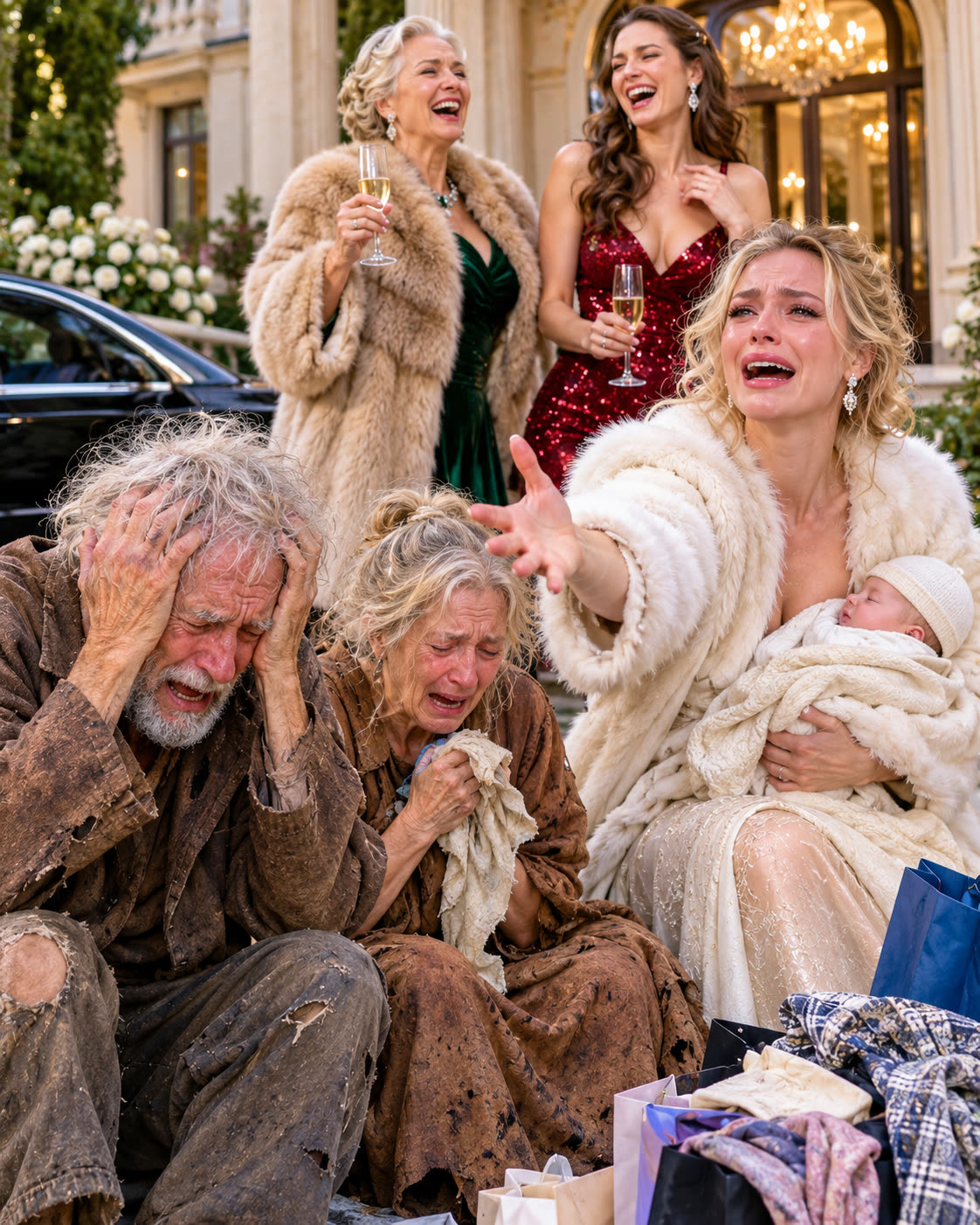
PART 1 — The Notice I Was Never Supposed to See
My name is Elena Vance. I am thirty-six, and twenty-two days earlier, surgeons had opened my abdomen to deliver my son, Leo. Anyone who has recovered from a cesarean knows that those first weeks are not necessarily a peaceful celebration of motherhood. Mine were a sleepless struggle, fought between feedings in the dim rooms of my own house. Every attempt to stand or turn pulled fire across my lower stomach. My hormones left me exposed and easily wounded, yet fiercely protective. I loved my baby with an intensity that frightened me, even while exhaustion made the simplest task feel almost impossible.
It was July fifth in Atlanta, Georgia, and the summer humidity pressed against everything. Outside, the temperature had reached ninety-eight degrees. Inside my spacious mid-century modern house on Oakhaven Drive, the air conditioner struggled to keep the heat at bay. I sat upstairs in the nursery nursing Leo, concentrating on his warmth and the gentle movement of his breathing. That small, steady rhythm helped hold me together. Beyond the nursery, the house seemed quiet enough to trust, and for a little while I let myself believe that feeding my son was the only thing requiring my attention.
I had purchased the property six years before, well before Julian entered my life. Seventy-hour workweeks as a corporate crisis manager had paid for it, and I had made it into the refuge I needed. When my parents, Arthur and Martha, began struggling in their late seventies, bringing them closer had felt natural. Dad’s Parkinson’s tremors were becoming worse, and Mom looked increasingly worn down. I used eighty thousand dollars from my savings to transform the large detached carriage house into an accessible suite. They moved in the previous Thanksgiving. Since Leo arrived, they had brought water, soothed him while I cried, and quietly kept our home functioning.
My husband, Julian, was an emergency room trauma nurse, and he was away working a punishing twenty-four-hour holiday shift. He was dependable and gentle, but avoiding confrontation had become almost instinctive for him. His mother, Beatrice Vance, had made sure of that. She disguised her passive-aggression beneath cashmere and practiced Southern graciousness. She had never accepted that I owned the house, earned more than her son, and had built a life she could not direct. At ten-fifteen that morning, while Leo rested against me, an unfamiliar local number appeared on my vibrating phone. I answered quietly, unwilling to disturb the fragile calm.
“Hello, is this Elena Vance?” a cheerful, businesslike woman asked. “This is Caroline from Magnolia Crest Senior Living . You are listed as the primary emergency contact for Arthur and Martha Hayes. I’m just calling to confirm the logistics for their move-in on Monday morning.” Dread tightened inside me so quickly that, for a moment, I forgot the ache beneath my incision. My mouth went dry. “I’m sorry,” I stammered. “Whose move-in?” Her brightness faded into uncertainty. “Your parents, ma’am,” Caroline said. “Unit 214. They signed the final lease agreement last week. We have the movers scheduled for nine o’clock. Didn’t they… didn’t they tell you?”
I stared at the nursery’s pale yellow wall as the room seemed to tilt slowly around me. My parents were moving out. They had made arrangements, committed their money, and apparently planned to leave in a matter of days without telling me. “No,” I finally answered. “Could you email me their file? Right now. Please.” Five minutes later, Leo was asleep in his crib and I was standing beside the printer in my office. The machine delivered the pages with unbearable steadiness while my hands shook. First came an application completed in Mom’s familiar, uncertain handwriting. Next was a receipt showing that three thousand dollars had been taken from their modest retirement savings for a deposit.
The third page made me stop breathing. It was a badly photocopied Notice to Vacate Premises. Beneath that heading, a short paragraph read: “This carriage house is required for immediate family use. Please make alternative living arrangements no later than July 8th. Do not burden Elena with this transition, given her current postpartum state. This decision is final.” A dark blue signature followed: Julian Vance. Under his name was the title Homeowner. I lowered myself into the desk chair, barely registering the painful stretch across my stitches. My husband’s name was on an order telling my parents to leave the home I had built for them.
Julian did not own this house. His name had never been on the deed, and he had never pretended otherwise. Yet there it was beneath a demand that Arthur and Martha disappear quietly. I remembered Mother’s Day, when Beatrice stood in my kitchen with a mimosa and announced, “When Julian and I need a place to age gracefully, this carriage house will be just perfect. Arthur and Martha can’t stay forever.” Julian had stared down at his shoes instead of challenging her. Now I examined the signature again. It lacked the hurried strokes I knew from his hospital paperwork. The letters looked carefully formed, almost deliberate. Still, why had my parents concealed it? What had persuaded them to leave?
Gravel shifted beneath tires outside. From the window, I watched a catering van enter the driveway with Beatrice’s silver Lexus behind it. I had permitted a small “Sip and See” with a few relatives, not the folding tables, warming dishes, and three dozen chairs being unloaded below. Beatrice stepped out in a crisp linen dress and began pointing toward the backyard like a commander assigning positions. This was not simply an oversized party. She was establishing possession, and I could not tell whether Julian had helped her. I folded the notice into my maternity leggings, went downstairs, and slipped out through the side door. Dense azaleas screened my route to the carriage house. Heat clung to my back, and every step tugged painfully at my abdomen. The curtains were closed. I unlocked the door with my spare key and called, “Mom? Dad?”
The room beyond stopped me in the doorway. The bright, welcoming space I had designed for them was crowded with cardboard boxes. Bare shelves lined the walls. Mom knelt beside the sofa, carefully covering a ceramic figurine with old newspaper, while Dad sat in his armchair staring at a television that was not switched on. His hands trembled in his lap. Both startled when they saw me. Mom hurried upright and moved a roll of packing tape behind her back, as though I had caught her doing something wrong. That small, guilty gesture hurt almost more than the emptied bookshelves. They had already begun dismantling their home, and neither had believed they could tell me.
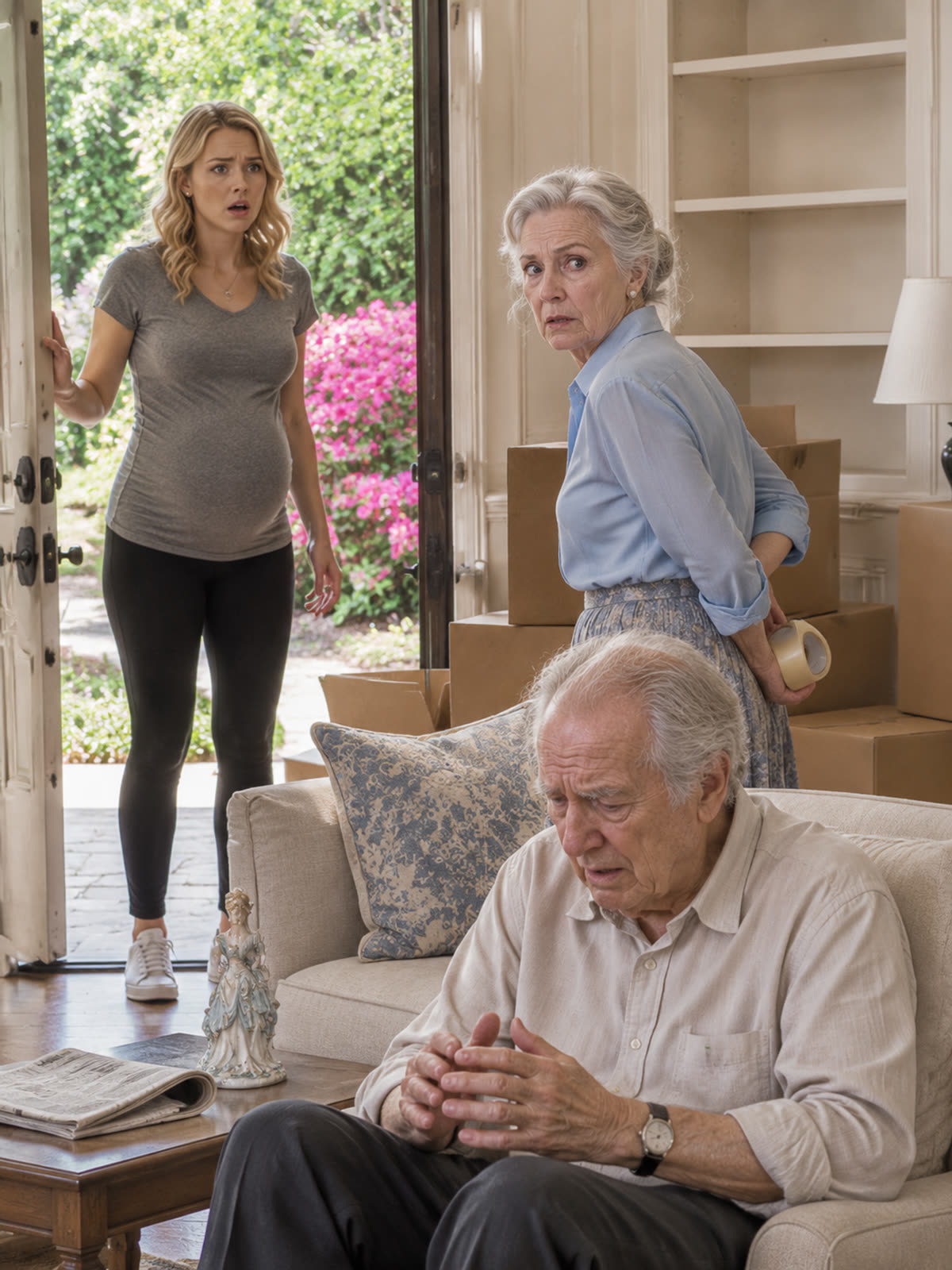
“Elena, sweetheart,” Mom said, breathless and unnaturally bright. “You shouldn’t be walking out here. The heat is terrible for the baby. Where is Leo?” I stepped inside, taking in boxes marked Donate and Storage. “He’s sleeping,” I told her. “Mom, what is this? What are you doing?” Dad kept looking toward the dark television. “We’re just… organizing, Ellie. Getting rid of clutter. Old people collect too much junk.” His attempt to make it sound ordinary only deepened the hurt. “You’re packing,” I said. I moved closer to Mom, noticing the shadows beneath her eyes and how fragile she seemed beside those boxes. “Mom, please. Talk to me.”
“It’s fine, Elena,” she whispered, reaching to pat my arm while tears gathered in her eyes. “You have your own family now. A new baby. A husband. We don’t want to be in the way. We’ve taken up enough of your space.” I nearly raised my voice before forcing it back down. “You are not in the way!” I said. “This is your home. I built it for you. Who told you that you were in the way?” Her eyes darted toward the window and the main house beyond it. “No one, honey. It’s just time. We found a lovely place. Magnolia Crest . It has a pool, and bingo nights.” She managed a smile, and the effort broke my heart.
My fingers touched the paper hidden in my pocket. I wanted to unfold it, ask who had delivered it, and force the whole deception into daylight. But Dad looked utterly defeated, and Mom was working so hard to shield me that I could not bear to confront them there. They believed Julian wanted them removed. Perhaps they also believed I agreed, or that I lacked the strength to object. Showing them the notice now would only strip away their last attempt at composure. “Okay,” I said, arranging my face into a smile as false as hers. “Just… don’t overdo it today. Let the movers handle the heavy lifting on Monday, okay?” Relief softened her expression. “Of course, dear. You go back inside to the baby.”
By the time I reached the main house, anger was burning beneath my skin. Beatrice entered the kitchen as I came through. “Elena, darling!” she sang, leaning toward my cheek for an air-kiss. Expensive perfume and gin surrounded her. “You look absolutely exhausted. Why aren’t you resting? I told you I’d handle everything for the party.” I kept my voice level. “You’re setting up for thirty people, Beatrice,” I said. “I agreed to ten.” She dismissed the difference with a wave. “Oh, you know how family is. Everyone simply had to see the new baby. Julian’s cousins, his aunts. Besides, this house is certainly big enough for a little gathering.” Then she glanced toward the backyard. “Especially with all the extra space opening up soon.”
I curled my hands into fists. Her meaning was unmistakable, and beneath the polished friendliness I could finally see the planning. My exhaustion was not merely something she enjoyed belittling. She had used it. While I struggled through feedings and surgical pain, she had counted on me being too depleted to notice what was happening a short walk from my own back door. The boxes, the senior-living application, the instruction not to burden me—everything fit that calculation. “I need to check on the baby,” I said. I turned away before fury pushed me into something I would regret and made my way upstairs, carrying the question I still could not answer: had Julian let this happen?
I locked the bedroom door and called him. Four rings ended in voicemail. Of course he could not answer; he was in the emergency department. I sat on the bed while the pain in my stomach competed with a much deeper ache. He had always seemed glad my parents were nearby. He had helped carry Dad’s belongings into the suite. But he had also stood quietly through every cutting remark his mother made. “It’s easier to just let her talk, El,” he would tell me, rubbing his temples. There was a terrible distance between refusing to argue with Beatrice and signing a false notice that would drive my elderly parents from their home. I did not know whether he had crossed it.
My phone vibrated again. This time the message came from Mrs. Gable, who lived three houses down. A photograph filled the screen: my parents’ maroon Toyota Camry beneath her enormous oak tree. Dad sat behind the wheel with his head against the headrest and his mouth open, struggling with the heat. Mom was beside him, waving a folded magazine. Underneath, Mrs. Gable had written: Elena, dear. I am so sorry to bother you with the new baby and all. But your folks have been parked out here for over an hour. The engine is running, but that old car’s AC barely works. I offered them to come inside, but Martha said Beatrice told them to ‘make themselves scarce’ until the party was over. She said Beatrice locked them out of the carriage house. Are they alright?
The photograph had been taken two minutes earlier. Outside, the temperature was now ninety-nine degrees. Dad had a heart condition as well as Parkinson’s, and Mom was already worn thin. Beatrice had taken the home I made for them, shut them outside, and sent them away from a celebration for their own grandson. What escaped my throat barely sounded human. It was low and raw, the sound of terror turning into rage. The exhaustion that had weighed on me all morning seemed to fall away. Even the incision’s constant warning disappeared beneath a rush of adrenaline. I could no longer stay upstairs questioning a signature while my parents suffered in a car.
Leo remained asleep in his bassinet, untouched by the ugliness spreading through our home. I lifted him carefully and secured him in his portable car seat. There would be no more sitting on the bed, no more waiting for Julian to call, and no more pretending I had not seen the boxes. My parents were three houses away, believing they had become unwanted burdens. Downstairs, Beatrice was preparing to celebrate the space she expected to claim. I gripped the car seat handle. She had mistaken my recovery for helplessness, and before that party ended, she was going to learn the difference.
PART 2 — The Signature That Stopped the Party
I passed through the house without entering the kitchen, where catering staff were arranging appetizers and handling glasses. The car seat knocked gently against my leg with each step. It was heavy, but the weight barely registered through the adrenaline. Every sound seemed unusually distinct, every movement purposeful. The woman who had sat upstairs aching and uncertain was still there somewhere, but she could wait. My parents could not. I slipped through the front door without joining the relatives collecting in the driveway and headed toward Mrs. Gable’s oak tree. The heat pressed against my chest immediately. Three houses away, the maroon Camry stood exactly where the photograph had shown it.
As I drew closer, I heard the engine laboring and the exhaust rattling beneath the car. I lowered myself beside the passenger window and tapped the glass. Mom flinched and dropped her folded magazine. When she lowered the window, trapped, stale heat spilled toward me. Dad remained still, his eyes closed, breathing in quick, shallow pulls. Sweat covered his forehead and ran through the lines in his face. Looking at him, I felt my resolve threaten to give way to fear. “Mom,” I said, my voice breaking. “What are you doing out here? It’s a hundred degrees.” She looked from me to Leo, who slept in the car seat, and her chin began to shake.
“Beatrice said… Beatrice said the guests were arriving early. She said Julian’s family needed the space to celebrate. She told us to go for a drive, to stay out of the way until it was over.” I fought to keep my voice quiet. “And the carriage house?” I asked. “Why aren’t you in the carriage house?” Mom lowered her eyes and twisted her hands together in her lap. “Beatrice took the key. She said the caterers needed to use our refrigerator for the overflow food. She said it was only for a few hours.” I shut my eyes for a moment. My mother had surrendered her own front-door key because Beatrice had made an invasion sound like an ordinary favor.
The thought of her occupying their sanctuary to support a party for my baby made my stomach turn. I reached through the window and touched Dad’s shoulder. “Dad,” I said. “Dad, look at me.” He opened his eyes slowly. They were red and exhausted, and the sadness in them was almost unbearable. This was the man who had steadied my bicycle and walked proudly beside me at my wedding. Now he looked as though he believed his place in my life had expired. “It’s okay, Ellie,” he wheezed, struggling to smile. “We’re just resting. We’ll be out of your hair on Monday. We don’t want to cause any trouble between you and Julian.”
Hearing my husband’s name hurt like a fresh wound. I lowered my knees onto the hot pavement, pushing through the strain in my abdomen, and took the folded notice from my pocket. “Mom. Dad,” I said. I held the open paper where they could see it. “Did you think Julian wrote this?” Mom covered her mouth with a sharp breath. Dad leaned toward the window to examine it. “Beatrice brought it to us last week,” Mom whispered as tears escaped. “She said Julian was too ashamed to give it to us himself. She said… she said you were struggling with the baby, and that you wanted us gone, but you were too soft-hearted to kick us out. She said if we truly loved you, we would leave quietly, so you wouldn’t have to carry the guilt.”
There it was: the story Beatrice had built around my recovery. She had made silence seem loving and departure seem selfless. My parents had not hidden their plans because they trusted her more than me. They had hidden them because she convinced them that leaving was the last kindness they could offer their exhausted daughter. “I never wanted you gone,” I told them through gathering tears. “Not for a single second. I bought this house for us. I built that suite for you .” Dad was still looking at the paper. “But Julian’s signature…” he said hoarsely. “Is a forgery,” I answered, even though one terrible sliver of uncertainty remained. “Listen to me. Turn the car off. We are going back inside. Right now.”
Panic crossed Mom’s face. Even after everything Beatrice had done, she was afraid of becoming the cause of a confrontation. “No, Elena, please,” she begged. “The party. Beatrice will make a scene. It will ruin Leo’s day.” I could hear how desperately she wanted to preserve something pleasant for me. But no celebration could survive what had already happened, and I refused to keep paying for its appearance with their humiliation. “The party is over,” I said. I opened the car door and helped Dad stand. He leaned into my shoulder, his weight unsteady against mine. I gave Mom Leo’s car seat, trusting that caring for her grandson would help her keep moving.
We made our way slowly along the sidewalk. The distance that had seemed so short from the nursery now had to be covered at Dad’s careful pace. Ahead of us, music carried from the backyard. Luxury sedans and SUVs filled the driveway, and the front door stood open. Laughter drifted across the lawn, mixed with the bright sounds of glassware. Nothing about the scene suggested that anyone inside knew where my parents had been sent. I kept going. Mom and Dad followed close behind, anxious and hesitant, while I climbed the steps of the house I had bought and walked through the doorway without asking permission.
Julian’s extended family crowded the living room. Some faces were familiar only from our wedding; others were nearly strangers. They balanced little plates of appetizers and held champagne flutes while talking beneath my roof. Then I noticed the mantel. The photographs of my parents and friends that normally stood there had been displaced. In their place were silver-framed portraits of Beatrice, Julian, and Thomas. Even the pictures had been rearranged to support her claim. At the far end of the room, beside the fireplace, Beatrice held her champagne and addressed the gathering. Her face shone with triumph and drink. Behind me, my parents fell quiet, and I listened.
“And I just know,” Beatrice was saying, her voice rising easily above the conversation, “that having family close by is exactly what Julian and Elena need right now. Which is why Thomas and I are just so thrilled to announce that we’ll be moving into the carriage house by the end of the month! It will be our new family compound!” Applause and approving voices answered her. For an instant, the whole room seemed distant, as though I were looking down at someone else standing in my doorway. My parents were behind me. My son slept with my mother. In my pocket was the piece of paper that had made this announcement possible.
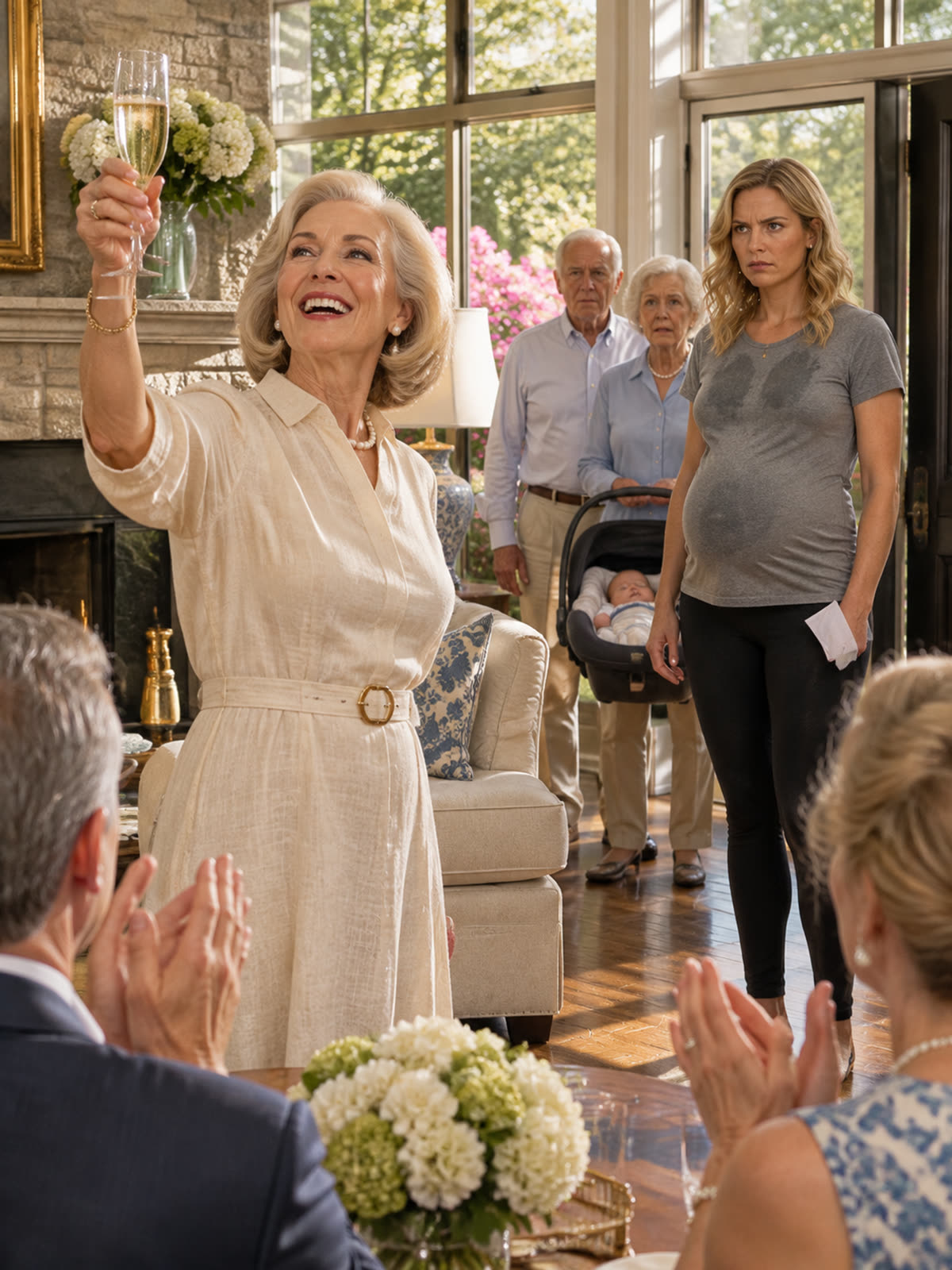
I closed my fingers around it. “Excuse me,” I said. I did not shout, but the applause stopped. Faces turned toward the entrance, their smiles fading as they registered my damp shirt, my pallor, and the elderly couple standing behind me. Beatrice looked straight at me. For one brief second, fear broke through her expression. Then her practiced smile returned, bright and condescending. “Elena, darling!” she called, moving toward us. “You’re out of bed! And you brought Arthur and Martha. How… wonderful.” I offered nothing in return. I stepped into the living room, hearing the floorboards beneath me as the last scraps of conversation died away.
Only the refrigerator’s distant hum and Leo’s quiet breathing disturbed the silence. Pain stabbed through my abdomen, but I stayed where I was. Beatrice stopped partway across the rug, still holding her smile in place. “Beatrice,” I said evenly. “Why are you telling these people you are moving into the carriage house?” A restless murmur traveled through the guests. Near a window, one of Julian’s aunts shifted her weight, her champagne trembling slightly. Beatrice answered with an artificial laugh and a dismissive gesture. “Oh, Elena, sweetheart, you must be so confused. The hormones, the exhaustion. I understand. Julian and I discussed it. Since your parents are relocating to that lovely senior community on Monday, we thought it would be best for us to take over the space. To help you with little Leo, of course.”
“They are not relocating,” I said. “They were never relocating.” Her eyes hardened before she smoothed her expression again. “Now, Elena, don’t make a scene in front of the family. Arthur and Martha agreed it was time. They signed the lease at Magnolia Crest themselves. Julian finalized the paperwork.” I was placing my faith in something I still could not prove. “Julian doesn’t know anything about this,” I said. “Of course he does,” she snapped, turning slightly toward the guests as though they could confirm her version. “Julian has been so stressed, trying to manage a demanding wife, a new baby, and two ailing in-laws taking up half his property. Someone had to make the hard decisions. Someone had to step in and handle it.”
“This is my property,” I said, moving a step closer. A gasp passed through the room. “I bought this house. I paid for the carriage house. Julian’s name is not on the deed. He has no legal right to evict anyone, let alone my parents.” Beatrice folded her arms and scoffed. “Technicalities. He is your husband. What is yours is his. And he wanted them gone.” Before I could answer, the heavy front door opened behind us. Julian entered in navy hospital scrubs, his stethoscope still around his neck. His eyes were bloodshot, his shoulders bowed by the shift he had just finished. He stopped abruptly at the sight of the room.
He looked from his silent relatives to his furious mother, then to me and my parents. “What is going on?” he asked roughly. “Mom, why are there thirty cars in our driveway? I thought this was a small gathering.” Beatrice hurried over and caught his arm. “Julian, thank God you’re home,” she said. Then she pointed at me. “Your wife is having a postpartum episode. She’s completely hysterical. She dragged her parents out of their car and is making a scene in front of the whole family.” Concern and confusion moved across his exhausted face. “Elena? Babe, what’s wrong? You should be in bed.” I walked toward him, ignoring the woman clinging to his arm.
I wanted him to be the man I trusted. I needed him not to be the person behind that paper. My hands shook as I pulled it out and pressed it against his chest. “Read it,” I demanded, my voice cracking. “Read it out loud.” He unfolded the page, frowning as he scanned the lines. In the still room, every movement of the paper sounded sharp. “ This carriage house is required for immediate family use. Please make alternative living arrangements no later than July 8th. Do not burden Elena with this transition… ” He stopped at the signature. The color left his face. He looked at me, then at his mother, and horror replaced his confusion. “I didn’t write this,” he whispered.
Beatrice immediately tried to speak over him. “Don’t lie to her to protect her feelings, Julian,” she snapped. “You told me you wanted the space. You told me they were a burden. I just helped you make it official.” He pulled away from her. “I never said that!” he shouted. “I never said they were a burden. I never signed this paper! This isn’t even my signature! I sign everything with my first initial and my last name, scribbled. This… this is perfectly spelled out.” Rage shook his hands as he raised the notice. “You forged my signature, Mom? You forged an eviction notice to throw my wife’s parents out onto the street?”
His relatives gasped. With every face now fixed on her, Beatrice lost the careful control she had maintained all morning. “I did it for you!” she shrieked. Her face darkened, and the muscles in her neck stood out. “You are too weak to take what belongs to you! You live in a house your wife bought, you let her parents dictate your life! I was taking back our family’s dignity! This house should belong to the Vances!” Julian’s fists tightened at his sides. “It belongs to Elena!” he roared. “And her parents belong here! You are out of your goddamn mind!” For the first time, he was not looking away, lowering his voice, or letting her finish unchallenged.
Beatrice’s expression twisted with hatred. She searched the room, no longer pretending that this was a misunderstanding caused by an overtired mother. “Thomas! Tell him! Tell your son that sometimes hard choices have to be made for the good of the family. Tell him!” Near the hallway, Julian’s father began moving through the guests. Thomas had spent forty years in the shadow of his wife’s forceful personality. He usually seemed to make himself smaller around her, his head lowered and his presence quiet. Now he approached with his slight limp, but he did not look in her direction. He went straight to Julian and carefully took the notice from his shaking hands.
Thomas removed reading glasses from his breast pocket and settled them on his nose. He examined the page for what felt like an impossibly long time. His gaze traveled over the typed lines, the spacing, and the blue signature. Around him, nobody spoke. Beatrice waited, but whatever support she expected did not come. Watching him, I saw his face grow pale. The ordinary defeat in his eyes gave way to a sorrow so sharp it seemed to alter him. He had not merely understood what his wife had done to my parents. Something about that paper had reached backward into his own life, and he was struggling beneath the weight of recognition.
At last he raised his head. He looked at Beatrice with such unmistakable disgust that she stepped back. “I recognize this format,” he said, his voice low and rough. “I recognize the font. I recognize the exact phrasing.” Her face drained white. “Thomas, don’t…” she began. He paid no attention. Instead, he turned toward his son, tears gathering behind his glasses. Julian stared at him, still holding the shock of his mother’s confession. Thomas’s next words made the entire room feel smaller. “Julian… she didn’t just do this to Arthur and Martha.”
PART 3 — The Other Signature
The silence changed after that. A moment earlier, everyone had been staring at an exposed forgery and a son’s fury. Now we were waiting for something none of us understood, except the woman who had gone white beside the rug. Julian looked at his father with a desperate frown. “What do you mean, Dad?” he asked, barely above a whisper. “Who else?” Thomas drew in a shaking breath. He lowered his eyes to the notice and smoothed a crease with his thumb. The gesture was careful and repetitive, as though he needed something simple to do before he could force himself to speak. Beatrice no longer looked angry. She looked trapped.
“Fourteen years ago,” Thomas began, his voice burdened by what he had kept inside. “When my mother, your Grandmother Eleanor, got sick. She was living in the old farmhouse. She was starting to get forgetful, but she loved that house. It was her whole world.” I watched Beatrice while he spoke. The rigid confidence she had used against me was gone. Her eyes moved toward the front door, searching for an exit from a room she had filled with witnesses. She had invited these people to celebrate her victory. Now each of them stood close enough to hear the past being uncovered, and she could not make Thomas stop.
“We had talked about moving her in with us,” he told Julian. “But then, Beatrice told me that Mom had decided on her own to go into an assisted living facility. She said Mom felt she was becoming a burden. Beatrice handled all the paperwork. She packed Mom’s things. When I went to see my mother at the facility, she wouldn’t even look at me. She just sat in her chair, staring at the wall. She died there, two years later, thinking I didn’t want her.” His words seemed to settle heavily over every person listening. The familiar shape of the story was already unmistakable, even before he explained the letter.
Understanding began to spread across Julian’s face, terrible and reluctant. “Dad… what are you saying?” Thomas turned the notice outward so the room could see it. The blue signature that had frightened my parents was no longer only evidence of what had happened to them. In his hands, it had become the reflection of something older. “After my mother died,” he said, and a tear slipped down his cheek. “I was cleaning out her belongings. I found a letter tucked inside her Bible. It was typed exactly like this one. Exact same font. Exact same wording. ‘This house is required for immediate family use. Please make alternative living arrangements. Do not burden Thomas with this transition.’ And at the bottom…”
His voice failed. For a moment, he stood there with the paper raised and grief breaking across his face. Then he finished. “At the bottom, it was signed with my name. In blue ink.” Someone among the aunts made a muffled sound and covered her mouth. By the kitchen doorway, a caterer slowly withdrew from sight. Behind me, Mom gripped the back of my shirt, her fingers trembling through the fabric. I glanced at Dad. He was looking directly at Thomas, and something deeply sad passed between them. Both men understood now what it meant to be told, through a stolen signature, that the people you loved wanted you gone.
Thomas turned to his wife. The grief in his expression was becoming colder, but it had lost none of its force. “You told me it was her choice,” he said. “You told me she wanted to go. You forged my name and threw my mother into a home so you could sell her farmhouse and take the money for our kitchen remodel.” The accusation stripped away whatever remained of Beatrice’s composure. Her explanation came quickly, high and breathless. “Thomas, you’re confused,” she stammered, reaching for his arm. He jerked away from her touch. “It was a long time ago. She was sick! She needed professional care! I was protecting you from the guilt of putting her there!”
“You let her die thinking her only son threw her away!” Thomas roared. The sudden force of his voice made people flinch. He flung the notice down at her feet. “And now you tried to do it again to Arthur and Martha! You are a monster, Beatrice. A cold, empty monster.” The paper landed between them. That morning it had been enough to send my parents into silence, boxes, and a sweltering car. Now it lay on my living room floor while the man whose name she had once stolen condemned her in front of the family. Beatrice had no gracious explanation left that could contain what he had revealed.
She looked around at the guests she had brought into my home. Their faces offered no admiration now. Some stared with open revulsion. Others set their champagne down, the small movements painfully conspicuous in the quiet. A few began edging toward the entrance. The party she had arranged as proof of her place in this family was coming apart around her. She turned back to Julian, desperation replacing the anger she had shown him moments earlier. “Julian. Julian, sweetie, please. You know me. You know how hard I work for this family. Elena is poisoning you against me. She’s manipulative!” Even now, with the forged notice at her feet and Thomas standing before her, she tried to make me responsible.
Julian looked at her as though the familiar face no longer belonged to anyone he knew. I could almost see the years rearranging themselves behind his eyes: every remark he had excused, every manipulation he had avoided confronting, every time he had decided silence was easier. Now those memories had to stand beside what she had done to his grandmother and what she had intended for my parents. When he finally spoke, he did not shout. The absence of warmth in his voice was more frightening than his anger had been. “Give me the key, Mom,” he said, extending his hand. Beatrice stared at his open palm. “What?” she asked.
“The key to the carriage house,” Julian said, keeping his hand steady. “Give it to me.” Beatrice pulled her purse tightly against her chest. “Julian, you can’t do this. I’m your mother.” He did not lower his arm. “You lost the right to call yourself that today,” he said. “Hand over the key, or I will call the police and have you arrested for forgery and trespassing. Right here, in front of everyone.” Her jaw trembled. She searched the faces surrounding her one final time, looking for someone willing to intervene. Nobody did. Even her sister looked down rather than meet her eyes. With unsteady fingers, Beatrice opened her designer purse, found the brass key, and let it fall into his waiting hand.
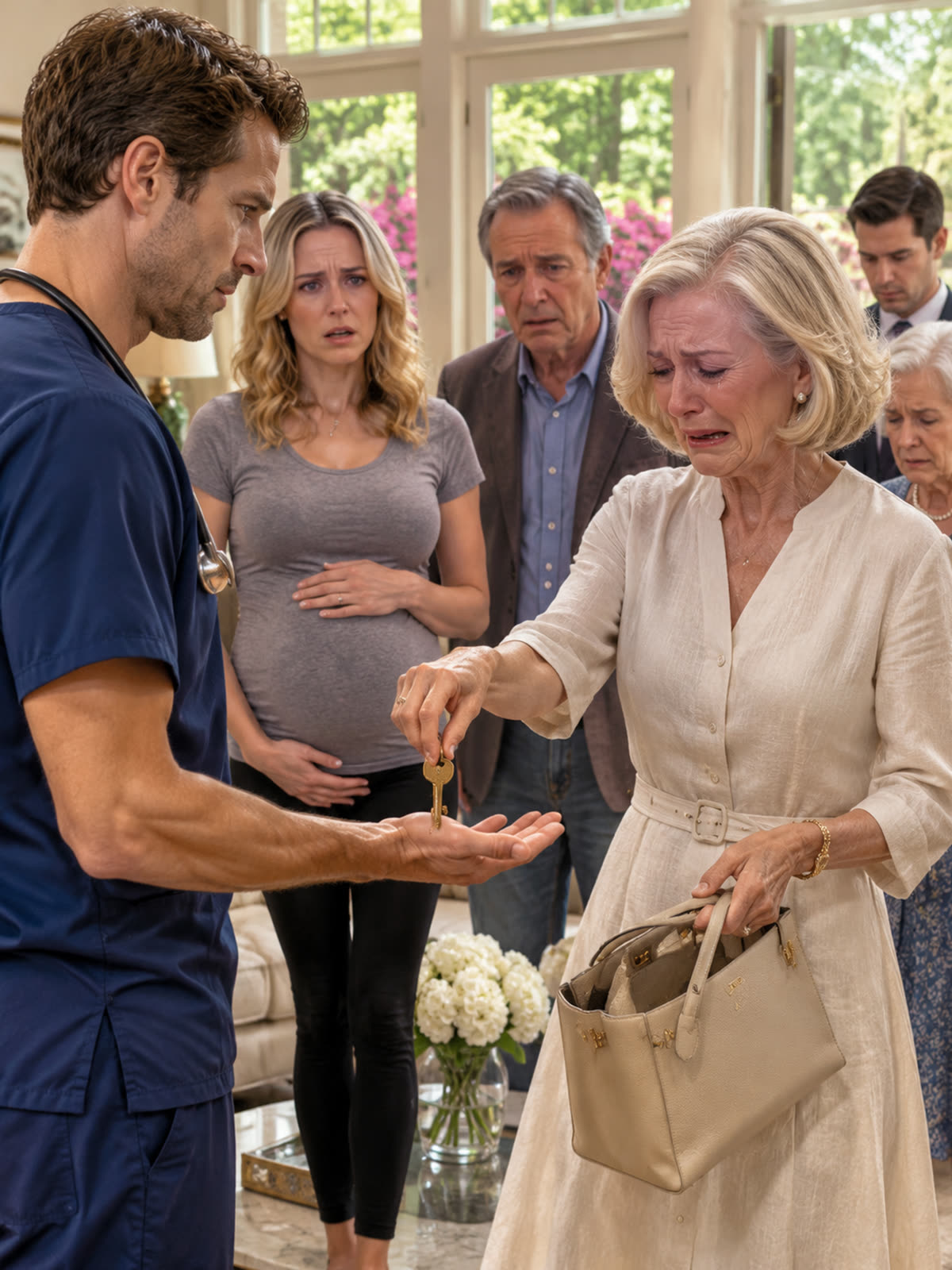
That small piece of metal marked the end of her control over my parents’ door. Only hours earlier, she had taken it from Mom under the excuse of needing refrigerator space. Now she could not even persuade her own son to close his hand gently around it. Julian looked directly at her. “Get out of my house,” he said. “And do not ever come back.” Beatrice straightened as though posture alone might recover some dignity. She smoothed the front of her linen dress and raised her chin. The guests moved aside without a word, leaving her a clear path to the entrance. No one offered to defend her. No one followed her lead.
She crossed the room through the silence she had created. I remained where I was, with my parents close behind me and the ache in my abdomen returning as the adrenaline began to lose its grip. The confrontation was ending, but nothing about it felt simple. Thomas had exposed a grief that had lived beneath his marriage for years. Julian had discovered something devastating about his mother in front of an audience. My parents had heard, at last, that they were wanted. Beatrice had lost the carriage house, the party, and the version of herself she presented to her relatives. Yet when she reached me, she stopped instead of continuing to the door.
She leaned close enough that her perfume and gin surrounded me again. This time her voice was a hiss meant for me alone. “You think you’ve won, Elena?” she whispered. “You’ve just broken your husband’s heart. You’ve fractured this family permanently. He will never look at you the same way again. Every time he looks at you, he’ll remember the day he lost his mother. Enjoy your empty victory.” I stood motionless while she delivered each sentence. Even exposed, even leaving, she had found one more vulnerable place to press. She could no longer convince the room that I was hysterical. Instead, she offered me a different fear: that telling the truth had cost me my husband.
Then she turned away. The heavy oak door slammed behind her, shaking the pictures on the walls. For a moment, I could do nothing but listen to the echo and the words she had left inside it. I had gone downstairs determined to protect my parents, and I had finally heard Julian defend their place in our home. But Beatrice’s last accusation remained lodged in me. I looked toward him. He was staring at the closed door with the brass key clenched tightly in his fist. A tear moved silently down his cheek. And watching it, I could not stop wondering whether the last thing his mother had planted would eventually tear us apart.
Disclaimer: This story is a work of fiction inspired by real-life themes. Names, characters, places and events are fictionalized, and any resemblance to real persons is purely coincidental. Images are for illustration purposes only.
