

PART 1 — The Words He Never Forgot
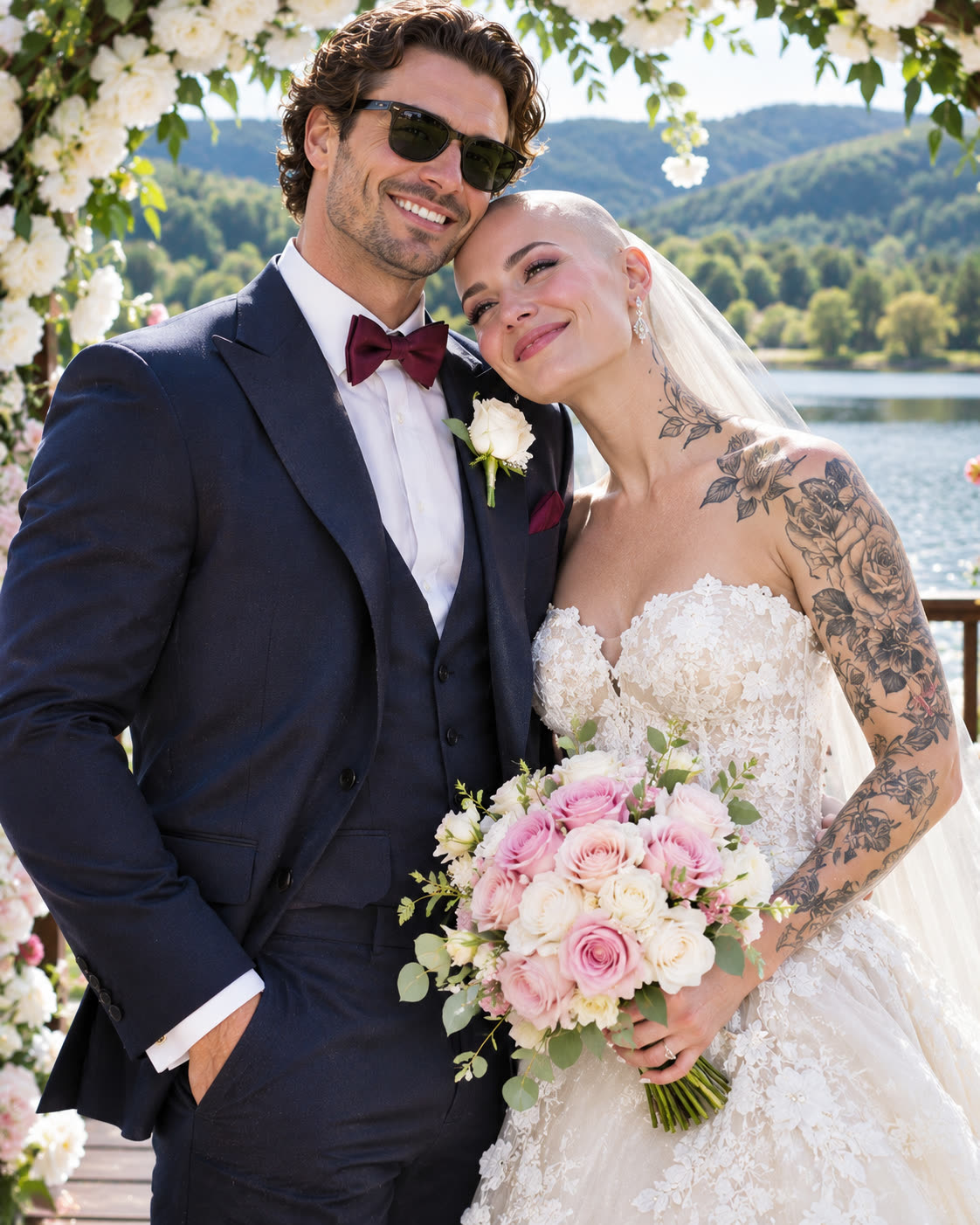
At our wedding, my mother lifted her champagne glass before two hundred guests and announced that my husband would not make it through a year of marriage. Five years afterward, Owen mailed her a plain brown package. She telephoned me with a trembling voice, demanding to know why he would send something like that to her home. When I glanced across at him sitting quietly on the edge of our bed, he only smiled and asked me to switch on the speakerphone. Whatever she had discovered inside that box, he wanted to hear her explain it herself.
My name is Hannah, and until that morning, I had never heard my mother, Carolyn, sound so thoroughly rattled. Her breath came unevenly, and the confidence that usually sharpened every word had disappeared. “Hannah, I just opened the box on my kitchen counter, and my hands are shaking so badly I can barely hold my phone,” she stammered over the line. I stared at Owen, unable to understand how the peaceful expression on his face could belong to the person responsible for her distress.
“Mom, take a deep breath and tell me what is going on right now,” I replied while staring at my husband with wide, confused eyes. Her answer did nothing to clear up the mystery. “The package Owen sent to my front porch arrived ten minutes ago, and I cannot understand why he would send this to me after all these years,” she cried out in a thin, panicked voice.
With my hand cupped over the bottom of the phone, I turned toward him. He seemed astonishingly calm for someone who had apparently overturned my mother’s morning before we had even finished breakfast. “Owen, what on earth did you put inside that box?” I whispered softly while covering the bottom of my phone with my hand. He took my fingers and gave them a gentle squeeze. “I did not send her anything she did not ask for a long time ago, sweetheart,” he answered calmly.
His answer carried me back to our wedding reception in Columbus, five years before. Owen and I had been seated at the head table, surrounded by the soft glow of strings of lights stretched across the banquet hall. My mother rose from her chair with a microphone in one hand and sparkling wine in the other. I remembered looking toward her, waiting for the customary wishes a mother might offer her daughter and new son-in-law.
“To the happy couple, may you find whatever happiness you can,” she began while looking around the crowded room. Then she leaned closer to the microphone and added, “Honestly, I give this marriage twelve months at the very most, because Owen, honey, my daughter is simply far too good for a man like you.” Her words brought the reception to a standstill. Guests stopped eating, their forks suspended above their plates. Somewhere near the back, a few relatives offered uneasy laughs, trying to turn her cruelty into a joke she had never intended.
My mother meant every word. Owen repaired cars for a living, and she had never accepted that a man who earned his wages with his hands could be a suitable husband for me. Her contempt had grown out of what happened to my father, George. When I was twelve, unexpected financial trouble cost us the family home we loved in Toledo. After he died four years later, her fear of having too little hardened into open disdain for working-class men. At the reception, tears burned behind my eyes as I waited for Owen to stand up in anger and leave.
He stood, but not in anger. Lifting his water glass toward her table, he answered with a composure that made her insult seem even uglier. “Thank you for your honesty, Carolyn, and I promise you that I will remember those exact words,” he said evenly. I escaped to the ladies’ restroom down the corridor and cried into a paper towel. Twenty minutes passed before I could wash my face, return to the celebration, and try to look as though my own mother had not publicly humiliated the man I loved.
Owen gathered me close on the dance floor. He whispered that he had made his commitment to me, not to earning my mother’s approval. I held on to the hope that seeing our happiness would eventually change her mind. Instead, she declined to attend the little housewarming we held that autumn. When she spoke about him to her country-club friends, she called him the grease monkey, leaving a deliberate pause around the words as though honest work ought to embarrass him.
Our first Christmas brought another carefully dressed insult. With a stiff smile, my mother passed Owen a glossy silver envelope containing a prepaid appointment with a corporate employment agency in Cleveland. “I thought this might help you find a real career with a desk and a proper salary,” she said sweetly while sipping her tea. Owen thanked her and slipped the voucher into his jacket pocket. I watched him accept it with unfailing politeness while anger surged through me. I wanted to snatch the paper away and rip it into scraps.

Later, I caught my mother in the hallway and challenged what she had done. She offered the same justification she had been using for years, as though concern could make contempt acceptable. “I am only worried about your future, Hannah, because a man fixing brakes will never give you the comfortable lifestyle you deserve,” she insisted stubbornly. Nothing I said seemed capable of making her recognize the difference between protecting me and belittling the person who made me happy.
What she would not acknowledge was that Owen had already given me the life I wanted in the ways that mattered. Our days held laughter, affection, and a steadiness I could depend on. He often arrived home late from the garage, his fingernails still darkened with oil, carrying a bunch of supermarket daisies beneath his arm. My mother saw his work and imagined everything I must be missing. I saw the man coming through our door and knew how much I had.
He put in twelve-hour days, accepted extra shifts on weekends, and set aside every dollar we could spare. He did it without complaint and without turning our life into a contest with my mother. He did not try to win her over with an expensive watch or forceful arguments. Instead, he spent his energy making our future more secure. By our third anniversary, those long hours and careful savings had given him enough money to buy and open an automotive repair shop of his own in Dayton.
I could still picture him coming home with grease on his cheeks and a smile so proud it seemed to fill the room. “We finally did it, Hannah, the keys to the shop are officially ours,” he cheered as he lifted me off my feet in the living room. His reputation grew because he treated people honestly and knew his work. Within the following year, the business expanded to include two more successful locations. The career my mother had dismissed was becoming something she could no longer overlook.
As his success became undeniable, her cutting comments gradually stopped. She started appearing at our Sunday dinners and behaved as though a pleasant manner could erase everything that had come before it. There was never an apology, never a direct acknowledgment of the reception or the employment voucher. She appeared to believe that taking her place at our table was enough. Owen continued to welcome her quietly, and I continued to wish she would understand how much she owed him.
During our fourth year together, he began spending Saturday mornings across town at what he described as a small property investment. As our fifth anniversary drew closer and we prepared for our first baby, I increasingly wanted somewhere quieter than the city. In the evenings, I leafed through old cardboard photo albums and lingered over pictures of our Toledo backyard and the blue birds my father had painted above the kitchen window. Those memories comforted me. I had no idea how closely Owen’s unexplained Saturdays and the home in those photographs were about to become connected.
PART 2 — The Check Inside the Box
On the morning of our fifth anniversary, the smell of fresh coffee drew me awake. Owen sat on the mattress beside me with two ceramic mugs, looking as comfortable and content as he always did in the quiet moments we shared. Nothing about the room suggested that a secret from before our wedding was about to find its way into the open. I took the coffee he offered, still thinking about our anniversary rather than the words my mother had spoken five years earlier.
“Happy fifth anniversary, my love, I cannot believe how fast these years have flown by,” he said as he leaned down to kiss my forehead. I had barely tasted my coffee when he added something that made me look up. “By the way, I mailed your mother a small package yesterday afternoon, and the tracking says it just arrived.” He delivered the news casually, but there was something knowing in his expression.
I pushed myself upright against the pillows. “You sent my mother a package without telling me what was inside?” I asked curiously. Owen did not look the least bit troubled by my surprise. “I sure did, and it is nothing she did not ask for years ago,” he replied with a mysterious glint in his eyes. Before I could ask him to explain, my phone began buzzing on the nightstand. My mother’s name filled the screen.
I picked it up anticipating one of our ordinary, slightly uncomfortable conversations about arrangements for dinner. Instead, I heard the shaking voice that had left me searching Owen’s face for an explanation. As she struggled to describe the package, his wedding-day promise returned to me with startling clarity. He had said he would remember her words. He had never mentioned that awful toast afterward, not through the insults about his work and not even when she handed him the voucher for a different career.
Now a small cardboard box had unsettled her more than any argument ever had. Owen remained beside me, steady and unhurried, while I tried to reconcile his calm with her panic. At his request, I pressed the speaker button. Whatever had been kept between them all these years was no longer going to stay there. I held the phone where we could both hear and waited for my mother to stop circling around the answer.
“Mom, you are on speakerphone right now, so please tell me clearly what Owen sent you,” I said firmly while holding my breath. For several seconds, neither of us heard anything from her end. The silence felt heavy enough to fill the bedroom. I kept looking from the phone to my husband, waiting for someone to explain what could possibly be inside a package that had frightened her so badly.
At last, my mother spoke. “Hannah, please tell me this is some kind of sick joke, because I am looking at a twenty thousand dollar check with my own signature on the bottom,” she whispered raggedly. Her words made no sense to me. I looked at Owen, but his expression had not changed. My mother’s signature, that amount of money, and a check he had apparently kept for years did not fit anything I knew about our life.
“Mom, what are you talking about, why would Owen have a twenty thousand dollar check from you?” I asked as my heart began to hammer against my ribs. The question hung between us. My confusion was giving way to alarm, and the composure I had found reassuring a moment earlier now told me that Owen already knew precisely what she was going to say.
“Two days before your wedding in Columbus, I drove down to the garage where Owen worked and met him in the parking lot,” my mother confessed, her voice cracking with shame and panic. “I wrote him a check for twenty thousand dollars and begged him to take the money, pack his bags, and walk out of your life forever before the ceremony.” I stared at my husband, stunned. For a moment, it seemed as though there was not enough air left in the room.
“Owen, is this true, did my mother really try to bribe you to leave me right before we got married?” I asked barely above a whisper. He let out a quiet sigh and settled his arm around my shoulders. “Yes, Hannah, she came to the shop on a Thursday afternoon and told me that a poor mechanic would eventually ruin your life just like she believed your father had ruined hers,” he explained gently. The care in his voice only made the ugliness of what she had done harder to bear.

My mother began crying through the speaker. “I am so sorry, Owen, I was terrified that Hannah would lose everything and end up miserable,” my mother sobbed over the speakerphone. “When you never cashed the check, I assumed you had torn it up in anger, I never dreamed you kept it locked away all this time.” She had known what she tried to do before the wedding, yet she had watched us marry and continued insulting him afterward.
Owen addressed her without raising his voice. “I did not tear it up, Carolyn, because I wanted to keep a physical reminder of what you thought my love for your daughter was worth,” Owen spoke directly toward the phone, his tone firm yet entirely devoid of hatred. “Every time I worked a double shift in the freezing winter or stayed up late balancing accounting books, I remembered that piece of paper.” Listening to him, I thought of all the work I had witnessed without knowing the private hurt behind it.
Tears ran down my face. For five years, he had carried this knowledge and allowed me to remain unaware of it. I caught hold of his shirt, overwhelmed by what he had endured without asking me to choose between him and my mother. “Why did you never tell me about this, Owen, why did you let me invite her to our house for Sunday dinners?” I cried while gripping his shirt.
He brushed a tear from my cheek with his thumb. “Because I knew how much you loved your mother, and you had already lost your father when you were just a teenager,” he murmured softly while wiping a tear from my cheek with his thumb. “If I had told you what she did before the wedding, you would have cut her out of your life completely, and I could not bear to be the reason you lost your only remaining parent.”
The shock inside me gave way to immense gratitude for him and a fierce anger at what she had put him through. I leaned toward the phone. “Mom, you need to listen to me very carefully right now, because I will never allow you to disrespect my husband or my father’s memory ever again,” I said firmly. “Dad was never a failure for losing our house when the economy crashed, and Owen was never worthless for working hard to build an honest living.”
“Hannah, please, I know I made a terrible mistake, I was blinded by my own fears,” she pleaded tearfully through the speaker. This time, her fear could not end the conversation or excuse the damage. Beside me, Owen reached toward his nightstand drawer. “You owe Owen a sincere apology for trying to buy him out of my life, and you also need to tell me what else was inside that box,” I continued after noticing Owen reach into his nightstand drawer.
When my mother answered, the defeat in her voice was unmistakable. “There is a framed photograph of our old house in Toledo, along with a handwritten letter from Owen,” my mother answered softly, sounding utterly defeated. “The letter says that while I accused him of being unable to provide a proper home for you, I never bothered to ask which home you actually wanted.”
PART 3 — The Home He Had Been Rebuilding
Before I could make sense of the photograph or the letter, Owen brought out a small silver house key with a faded blue ribbon tied around it. He laid it carefully in my palm. The metal rested against my skin while I looked from it to his face, still struggling to understand what my mother had just read aloud. His smile was hopeful now, with a nervousness I had not seen during the rest of the call. “Happy fifth anniversary, sweetheart, I bought your childhood home in Toledo eighteen months ago,” he said with a nervous, hopeful smile.
I stared at the key, and all those Saturday mornings began to arrange themselves into a different picture. The little property investment, the hours away, the work he had mentioned so casually—none of it had meant what I thought. “Wait a minute, the investment property you have been spending every Saturday renovating for the past year and a half was my dad’s old house?” I gasped loudly.
“Every time you looked through your photo albums, your eyes would light up when you talked about that big oak tree and the kitchen where your dad used to cook pancakes,” Owen explained softly. “I wanted to restore every square inch of it before our baby arrived so we could give our child the same happy childhood memories you cherished.” He had been listening while I lingered over those photographs, remembering details I had shared without realizing how carefully he held on to them.
Words would not come through my tears. I put my arms around his neck and clung to him, holding him as tightly as I could. The key, the letter, and his patient explanation had left me overwhelmed. On the other end of the phone, my mother gave a small, broken sob. At last, she understood how wrong she had been about him. The man she had tried to pay to disappear had spent eighteen months restoring a place she knew I had never stopped loving.
“Owen, I am so deeply sorry for the cruelty I showed you and for judging you by your bank account instead of your heart,” she said sincerely over the line. “You have loved my daughter better than I ever knew how to, and I hope you can forgive me someday.” There was no polished excuse left in her words, no attempt to turn the conversation back toward her worries about money. She was finally naming the cruelty for what it had been.
Owen answered with the same kindness he had shown throughout the call. “I forgave you a long time ago, Carolyn, I just needed you to see the truth for yourself,” Owen replied kindly before we said goodbye and ended the call. After five years, the check had gone back to the person who wrote it. In my hand lay something entirely different: a key to the home I had thought belonged only to my childhood.
An hour later, Owen helped me into our truck, and we headed north toward Toledo. The drive was peaceful. We were traveling toward my old neighborhood, toward the house I had revisited so often through photographs and stories. When we finally pulled to the curb, I saw the clean white siding and the great oak spreading its branches over the front lawn. The sight filled me with a happiness so complete that I could hardly take it in.
Owen came around to my side of the truck, opened the passenger door, and offered me his hand. “Are you ready to go inside and see how it looks, Livvy?” Owen asked softly as he opened my passenger door and took my hand. I followed him toward the entrance. The home in my albums was no longer a faded picture balanced on my lap. It stood before me, restored, with Owen beside me and our baby on the way.
Once we crossed the threshold, I covered my mouth with both hands. Tears of happiness slipped down my cheeks as I looked around. Owen had worked from my old photographs and from the stories I had told over the years, bringing back the details that made the house familiar. My father’s old oak kitchen table had been sanded and refinished. Seeing it there, carefully restored rather than merely replaced, made the care behind Owen’s work feel even more personal.
Above the window over the kitchen sink, the little flock of blue birds was back. Owen had arranged for a local artist to reproduce the birds my father painted so many years ago. Then I noticed the pantry doorway, with its crooked pencil marks and dates recording my height on birthdays. My eyes moved from one remembered detail to another before I reached toward the painted birds. “How did you remember all of these tiny details, Owen?” I whispered in awe as I traced my fingers over the painted birds.
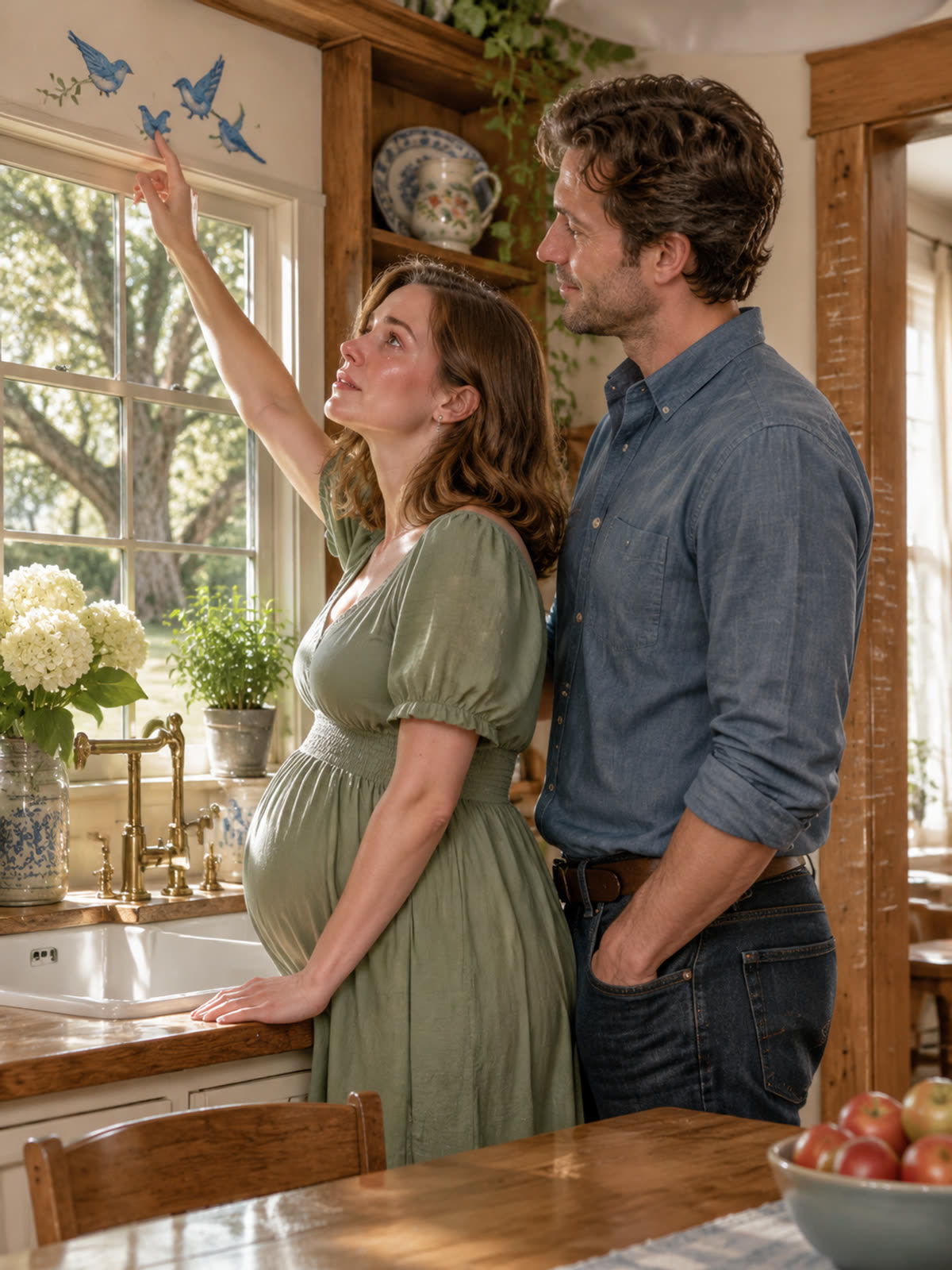
“Because I listen to every word you say, Hannah, and I wanted your dad to still feel like a part of our family,” he answered quietly while resting his hand over my growing baby bump. I stood beside him in the kitchen, surrounded by things I remembered and the patient work that had made them feel close again. He had understood that I missed more than the building. The memories of my father belonged here too, and he had made room for them in our future.
He guided me through the rear screen door and onto the sunlit porch. Beyond it, a solid wooden swing hung from the old oak’s thick branches. Even the heavy knots in the ropes matched the ones my father had tied. The care I had seen inside continued into the backyard, where so many of the memories in my albums had begun. Owen had not overlooked the small things simply because someone else might never have noticed them.
We sat together on the swing in the warmth of the afternoon, with a gentle breeze moving around us. I looked at my husband and understood what I wanted us to do. The quieter life I had been longing for was no longer an indistinct wish I carried while looking through photographs. Here were the rooms, the yard, and the oak tree I remembered. Here was the man who had listened closely enough to bring me back to them.
In that backyard, I understood more clearly than ever that a home could not be measured by money or social standing. My mother had spent years worrying about whether Owen could give me enough, while failing to see what he had already given. He had loved me through her contempt, worked steadily beside me, and rebuilt my happiest memories one careful piece at a time. Sitting there with him, I knew where I wanted our child’s memories to begin.
“Owen, I do not want to go back to our noisy house in the city, I want to move here permanently and raise our baby right inside these walls,” I said earnestly while looking into his eyes. A bright tear slid down his cheek. He drew me closer and kissed the top of my head, his happiness matching my own. Then he laughed softly through his tears, ready with an answer I had not expected.
“I was really hoping you would say that, because I already packed half of our boxes in the garage last night,” he laughed softly through his tears.
Disclaimer: This story is a work of fiction inspired by real-life themes. Names, characters, places and events are fictionalized, and any resemblance to real persons is purely coincidental. It does not represent any person or organization and does not encourage inappropriate behavior. Images are for illustration purposes only.
