

PART 1 — The Space He Wouldn’t Give Me
I was recovering from stitches after giving birth to our nearly 11-pound daughter, but my husband complained whenever I woke him because I needed the bathroom. He refused to exchange sides of the bed or sleep anywhere else. At 3:17 a.m., another solution finally occurred to me. About four hours later, his shouting woke me.
Before Lucy arrived, Mark and I had talked for months about the parents we hoped to become. We worked on the nursery together, and he put the crib together himself. Whenever visitors came over, he seemed eager to show them pictures from our ultrasound appointments. Then our daughter was born, weighing almost 11 pounds, and the life we had imagined gave way to something very different.
The delivery had been difficult. I returned home with stitches, instructions to avoid unnecessary strain, and pain whenever I tried to sit down or stand. Lucy needed to eat throughout the day and night. Sometimes I cried while trying to feed her because no position seemed comfortable. I believed Mark understood how much I was hurting. Our bed was pushed against the wall, and I had always slept on the inside. Before the birth, climbing over him had been easy. Now, even rolling onto my other side could hurt.
On our first night home, I reached over and touched his shoulder. "Honey, could you move? I need to pee." His answer came with a groan. "Again? I have work in six hours." He moved barely enough for me to squeeze past. After I returned, he complained that getting out and coming back had woken him twice. I apologized.
By the fourth night, he would not move at all. "Hold it until morning. You’re ruining my sleep." I tried to explain. "Mark, the doctor said I shouldn’t wait when I need to go." He answered, "And what about my health?" When I attempted to climb over him, pain tugged through my stitches and made me gasp. He shoved my knee away. "Watch it! You nearly kicked me!"
The next morning, I pleaded with him to change sides with me or use the guest room while I recovered. "So we’re not sharing a bed anymore? Nice marriage." I offered another possibility. "Then could you take the couch?" His response was, "You don’t even respect me as your husband." I remained in the doorway with Lucy in my arms, trying to understand how asking for an unobstructed route to the bathroom had become an attack on him.
That evening, Lucy cried for nearly two hours. I held her against my chest and rocked her while Mark stretched out on the bed watching videos. "Please hold her for five minutes," I said. "I haven’t eaten dinner." Without offering to take her, he replied, "You wanted to be a mom. This is what moms do." I told him, "Mark, I’m exhausted." He answered, "My mother raised three kids without complaining. Honestly, if you can’t handle one baby, maybe you shouldn’t have become a mother."
I looked at Lucy’s tear-damp cheeks. The words hurt, but so did the way he delivered them without even lowering his phone. At 3:17 a.m., Lucy finally settled to sleep in her bassinet. Mark was snoring beside me. I lay awake, aching and desperate to use the bathroom, and remembered something my mother had brought over before the birth.
After her knee surgery, Mom had used a folding bedside commode. She had offered it to me, and I had laughed at the idea. "You won’t need this forever," she’d said. "But keep it here in case you’re too uncomfortable to get around." I had tucked it, still folded, into the hall closet and forgotten about it. Lying there that night, I no longer thought the suggestion was ridiculous.
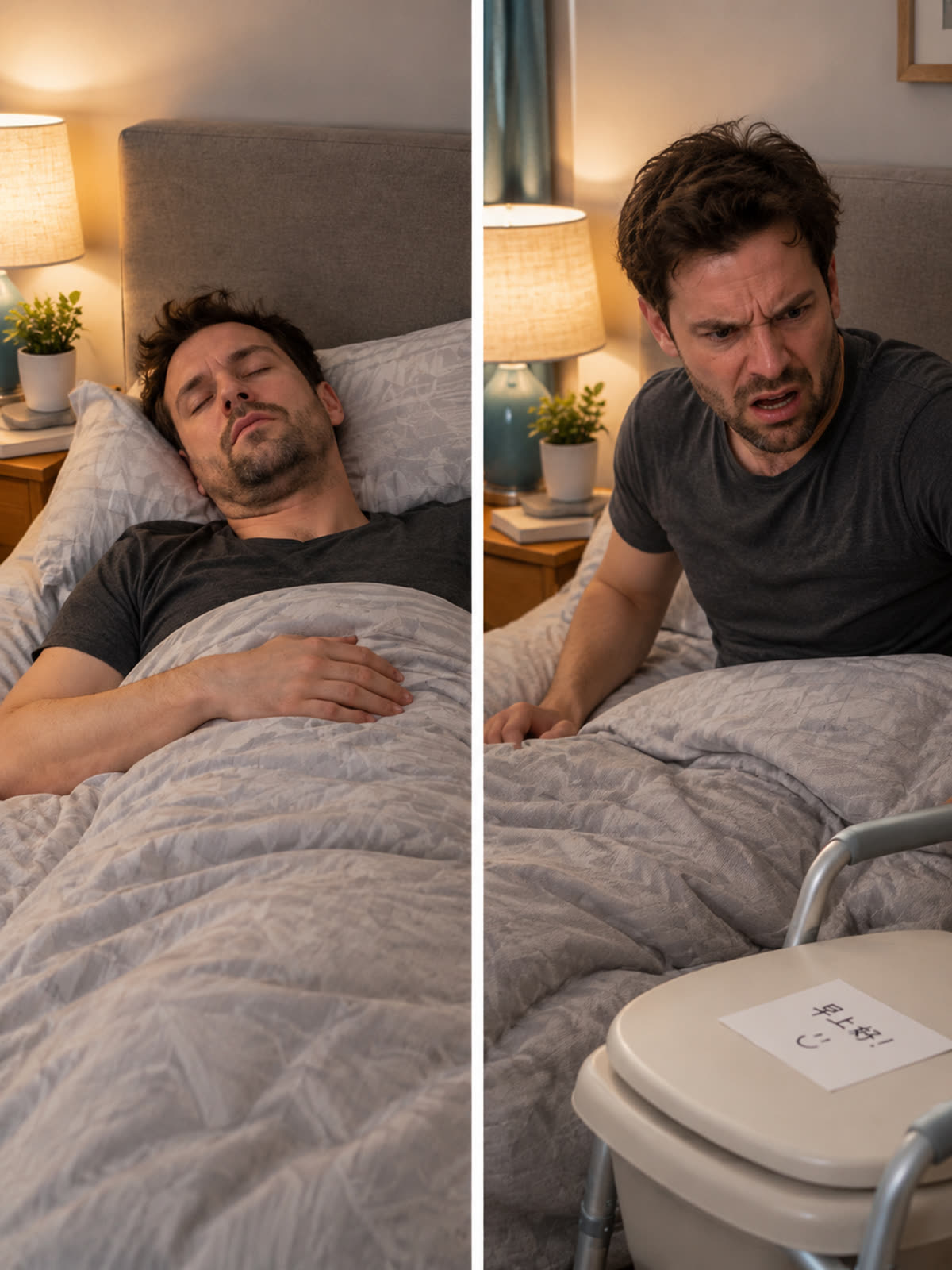
I worked my way out at the foot of the bed, moving carefully to avoid tugging at my stitches. The closet was only a short distance away. The commode was light enough to carry and opened without any tools. I brought it back slowly, pausing when I needed to rest, and positioned it beside Mark’s side of the bed, directly where he would see it when he stood up. I lowered the lid, placed the instructions beside it, and tore a sheet from Lucy’s feeding log. On it, I wrote, "Since you won’t let me get to the bathroom, this is where I’ll have to pee."

I never used the commode. After setting everything in place, I went to the bathroom and made my way back. What mattered was that Mark would have to look at a problem he had repeatedly refused to discuss. I checked on Lucy, eased myself into bed, and finally fell asleep.
At 7:06 a.m., Mark’s hand closed around my shoulder. "What is that?" he demanded. "How is that even possible?" He stood beside the bed, staring at the commode, his face pale with disgust. I carefully pushed myself upright. "It’s a bedside toilet. Mom lent it to me." He stared at me. "You put a toilet in our bedroom?" I answered, "Yes." Then he asked, "Beside my bed?" I said, "There’s no space beside mine. That’s the problem."
His eyes moved to the note. "Are you serious? You expect to do that next to me?" I answered, "I expect to be able to pee when I need to. I’ve asked you to move. I’ve asked to switch sides. I’ve asked to sleep separately." He accused me, "You’re trying to embarrass me." I replied, "I didn’t invite an audience." He grabbed the paper. "This is disgusting." I told him, "I agree. I’d rather use the bathroom like everyone else."
He began folding the commode. "Leave it," I said. He stopped and looked at me, surprised. "Excuse me?" I repeated what needed to happen. "Leave it until we decide on how I’m supposed to get out of bed." Instead of answering that, he said, "I have a job. You get to stay home all day." I stared at him. "You think I’m on vacation?" His reply came quickly. "Don’t twist my words."
I reminded him of what the previous day had actually looked like. "Yesterday I ate my dinner standing at the counter because Lucy wouldn’t settle. I haven’t slept more than two hours at a time. And you told me I shouldn’t have become a mother." He gestured toward the commode. "So this is revenge?" I answered, "No. This is what happens when you refuse the simplest solution."
Mark reached for his phone. "I’m calling Mom. Maybe she’ll explain how unreasonable you’re being." I nearly asked him not to. Linda had always spoken proudly about how hard her son worked, and I could not bear the thought of someone else brushing aside what I was going through. But he had already placed the call.
"Mom, you’ll never believe what she’s done," he said when Linda answered. Then he put the call on speaker. "She put a portable toilet beside our bed because I asked her to stop waking me up."
For a moment, Linda said nothing.
PART 2 — The Question Nobody Had Asked
Then Linda spoke. "Why does she need one?" Mark answered, "Because apparently walking to the bathroom is too much to ask." I leaned closer to the phone. "Linda, our bed is against the wall. Mark sleeps on the outside, and he won’t move when I need to get up. Climbing over him hurts my stitches." Silence followed again. I added, "At least with the portable toilet, I won’t have to make it all the way to the bathroom after struggling to get past him."
"Mark," Linda said, "is that true?" He rolled his eyes. "She wakes me up every night." Linda would not let him change the question. "That wasn’t what I asked." He tried another argument. "Mom, I have to be at work by 8:00 a.m." Her response was simple. "Then switch sides with her." He asked, "Why should I have to rearrange everything?" Linda said, "Because she just gave birth."
Mark opened his mouth, but his mother kept speaking. "Did she ask you to sleep in the other room?" He answered, "She wants to kick me out of my own bed." Linda corrected him. "She wants to reach the bathroom comfortably." He switched off the speaker, though I could still hear her. "Don’t you dare make this about respect. You should be helping her recover."
After ending the call, he turned on me. "Happy now?" he snapped. "You’ve got my mother against me." I answered, "You called her." He said, "She doesn’t know what it’s like working all day and coming home to this." Lucy began stirring in her bassinet. When I reached toward her, Mark shook his head. "Every time we talk, the baby interrupts." I told him, "She’s hungry."
He checked his watch. "I don’t have time for this." Then he dressed and walked out without saying goodbye. Afterward, I stood in the kitchen with Lucy resting against my shoulder and felt my hands tremble. I had no idea whether Mark would return with an apology. What I did know was that I could not spend another night pinned between him and the wall.
I called my mother and explained everything. She let me speak without interrupting. Then she said, "I can come over." I asked, "Can you bring a bag? I think I need you to stay a few days." She answered, "Of course."
Mom arrived before lunchtime carrying groceries and a small overnight bag. While she unpacked, a message from Mark appeared on my phone. "Get that thing out of our room before I come home. And tell your mother to stop interfering." I stared at it. I had not even told him she was coming.
Another message followed. "Mom called me back. Apparently you’re moving to another room now?" I held the phone out for my mother to read. "Don’t answer while you’re upset," she said. "You have enough to deal with." But I wanted there to be no uncertainty about what I needed.
I wrote back, "I’m sleeping in the guest room because I need safe access to the bathroom. Lucy will be with me. We can discuss everything else when you’re home." The typing dots appeared, disappeared, and appeared once more. Eventually, his reply arrived. "Unbelievable."
Mom rested her hand over mine. "I can stay longer if you need me." This time, I did not insist I could handle everything alone. She took Lucy while I sat down with a sandwich. For the first time since we had brought our daughter home, I finished a meal without struggling through it. When I got up, Mom noticed how tightly I held the chair.

"Is the pain worse?" she asked. I admitted, "A little. I think climbing over Mark made it worse." Her answer was immediate. "Call your nurse." So I did. I described the pain and explained how difficult getting to the bathroom had become at night. The nurse told me not to deliberately delay peeing or strain my healing stitches.
She arranged for me to be assessed that afternoon. She also explained that severe pain, fever, or being unable to pee meant I should seek urgent care. Mom drove us to the clinic, with Lucy asleep in her carrier. After examining me, the clinician said my stitches looked intact, but the irritated area needed rest. She advised me to avoid unnecessary climbing or lifting and ask for help with anything that increased the pain.
Then she asked, "Do you have support at home?" I answered, "My mother is helping." She followed with, "And your husband?" I told her, "He says he needs his sleep." There was no lecture. Instead, she asked whether I felt safe returning home and whether I wanted information about additional support. Even after we left, I kept thinking about that question.
By four o’clock, the guest room was prepared. Mom and I brought in Lucy’s bassinet, her changing supplies, and my medication. My mother carried the heavier things while I held the baby. The room was small, but it gave me something our bedroom did not: a straight, clear path to the bathroom without having to climb over another person.
Mark returned shortly after six and found us there. "What’s going on?" he asked. I said, "I’m sleeping in here for now." He glanced at the bassinet. "You’re taking my daughter out of our bedroom?" I answered, "Our daughter is staying with me. You’re welcome to help care for her."
"You’ve had your mother here all day, and now you’re both making decisions without me." I reminded him, "I asked you to switch sides yesterday. You said no." He replied, "I didn’t think you’d turn the house upside down over it." Holding Lucy closer, I told him, "I went to the clinic because my pain got worse."
For the first time, his expression shifted into uncertainty. "What did they say?" I explained, "My stitches are intact, but I need to stop straining myself. The clinician also asked whether I have enough help at home." His eyes went toward my mother. "Great. Now the hospital thinks I’m some kind of monster."
"No one called you that. The clinician asked whether I was safe." He immediately asked, "Did you say you weren’t?" I answered, "I said I had somewhere safe to sleep tonight." He stepped backward as though I had struck him. "I can’t believe you’d talk about me that way."
I looked at him and asked, "Mark, you blocked my only way out of bed and told me to hold it until morning. What would you call that?"
He gave me no answer. He went into our bedroom and closed the door.
PART 3 — What an Apology Couldn’t Settle
That evening, Mom made dinner while I fed Lucy. Mark ate by himself in the kitchen. He neither offered to wash the dishes nor asked how I felt. Later, Linda called me rather than going through her son. "I wanted to check on you," she said. I explained what had happened at the appointment and told her I was sleeping in the guest room.
"I’m sorry," she said. "Mark told me you were being dramatic. I should have asked how you were before this." I answered, "You didn’t know." Linda replied, "I know him. He’s used to being looked after." After a pause, she added, "I didn’t realize he’d taken it this far." I let out a tired sigh.
Then she told me something Mark had never included when he compared me with her. "When my children were babies, I had my sister and his father helping. Mark thinks it was easy. He doesn’t know about the nights I cried." I thought of all the times he had held his mother up as proof that I should manage without complaint. "Would you tell him that?" I asked. Linda answered, "I already have."
The next morning, someone knocked on the guest room door. It was Mark. "Can we talk?" Mom carried Lucy into the living room, leaving us together. Mark lowered himself onto the edge of the empty chair. "I spoke to my mother last night," he said. I answered, "I know."
"She told me Dad used to get up with us before his early shifts." I waited without answering. He continued, "I honestly didn’t remember that." I said, "You also watched me struggle for days." He slowly nodded. "I thought you were making things harder than they needed to be. I was angry about being tired. And I said awful things." I told him, "Yes, you did."
"I’m sorry I pushed your knee away. And what I said about you being a mother… I don’t believe it." I answered, "You said it when I was already scared I wasn’t doing enough." He said, "I know." Then he admitted, "I don’t know how to fix this," he said. My answer was, "Start by taking care of Lucy. And understand that I may need space from you even if you do."
He nodded again. Then Lucy began crying in the living room, and he turned toward the sound. "Can I take her?" I called to Mom, who brought Lucy back into the room. Mark held our daughter awkwardly at first, then shifted her until she rested against his chest.
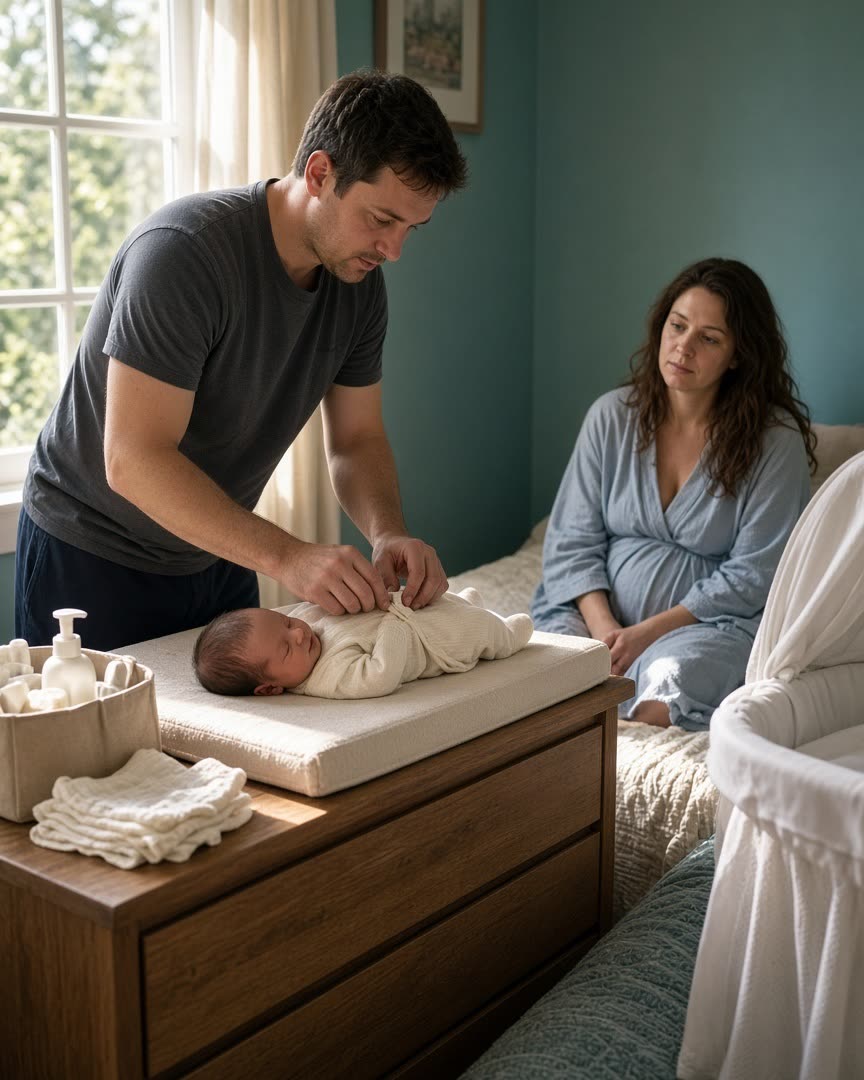
"I can change her," he offered. I told him, "Her supplies are on the dresser." He carried Lucy over and started collecting what he needed. I stayed where I was and watched rather than stepping in to guide every movement.
He needed to ask where the clean clothes were, but he handled the change himself. There was nothing sweeping or miraculous about it. This was one ordinary piece of caring for our daughter, something he had avoided until that morning.
I watched Mark finish changing Lucy on his own. The apology had not erased what had happened, and one completed task could not stand in for everything that needed to change. Still, he had heard her cry, asked to take her, and followed through without handing the work back to me.
During the following week, daily life began to improve. Mark handled dinner and laundry. When he returned from work, he asked which parts of Lucy’s care he could take over so I could rest. He also started waking for some nighttime changes, bringing her to me when she needed feeding and helping her settle afterward.
I did not applaud him for carrying out the responsibilities of a parent. When something he did genuinely eased my day, I thanked him as I would thank anyone who helped me. His participation mattered, but it did not turn the care of our daughter into a favor he was doing for me.
There were still uncomfortable moments between us. Once, he started complaining about being tired, then caught himself. "Sorry," he said. "I know you’re tired too." I told him that acknowledging my exhaustion was a beginning, but the change needed to continue. A better week could not be the whole answer.
Linda offered to stay with Lucy one afternoon so Mark and I could speak without interruptions. We talked about counseling, dividing childcare, and what I would do if he tried to control my movements again. I told him, "I can’t go back to being afraid to wake you." He answered, "You shouldn’t have to," he replied.
I still was not ready to sleep beside him again. This time, when I said I wanted to remain in the guest room, Mark did not argue. There was no accusation about the state of our marriage and no demand that I return to prove my respect. For the moment, he accepted the space I needed.
The following Sunday, Mom came back for the commode. Since that first morning, it had stayed folded in a corner of the main bedroom. Mark carried it out to her car. "I wish she’d never needed it," he told her. Mom looked at him and said, "Then make sure she doesn’t need to ask for help like that again."
After she drove away, I returned to the guest room to check on Lucy. Mark sat in the rocking chair with our sleeping daughter in his arms. He glanced up as I came in. "Do you want me to put her down?" I answered, "Not yet," I said. "She looks comfortable."
I went to the bathroom without having to climb over anyone. When I came back, I sat beside them. For now, the improvement in his behavior was enough. It did not make the previous days disappear, and it did not answer every question about what would happen next. But he was holding Lucy, I had room to recover, and I no longer had to ask permission to meet a basic need.
Did Mark deserve another chance to repair our marriage once he began accepting responsibility, or had the way he treated me during my recovery already done too much damage?
If this story stayed with you, another follows a mother who left her job to care for newborn twins after agreeing with her husband that it made sense. But when Carl began treating one baby as an extra expense, she realized the problem was not love. It was respect. She agreed to return to work—but only after setting one condition.
Disclaimer: This story is a work of fiction inspired by real-life themes. Names, characters, places and events are fictionalized, and any resemblance to real persons is purely coincidental. Images are for illustration purposes only.
