

Part 1: The Man Who Refused to Stand Beside Her
“That walk is for real dads, Kay.”
Travis spoke with his fork balanced against the rim of his dinner plate. I recognized that gesture. He always put his fork down that particular way when he was about to say something he’d already rehearsed during his drive home.
It was a Tuesday evening in mid-October, just two days before senior night.
I’d made tater tot hotdish for supper. It was the only meal I could serve all four members of our family without somebody offering an opinion.
Kaylee had asked her question quickly and directly, the way she always did when she was nervous and wanted to get the words out before her courage disappeared.
“Will you walk me out Thursday?”
And Travis gave her an answer I would spend the next several days wishing I hadn’t heard.
“I don’t want to take something that isn’t mine. That’s for your dad. If he ever shows up. It wouldn’t be right for me to stand in his spot.”
My daughter was seventeen, a high school senior and a middle hitter on the volleyball team. She’d worn her long blond hair in the same braid since fourth grade, when she’d announced that bangs were for babies.
For perhaps three seconds, she simply stared at Travis.
I could almost see her making a decision.
Then she answered.
“Fine.”
Her voice was flat and empty of emotion, like the midday agricultural report on the radio.
She got up, rinsed her plate, placed it properly in the dishwasher for once, and went upstairs.
She didn’t slam her bedroom door.
Part of me wished she had. At least a slammed door gives you something to argue with.
Our son Mason was eight. He was Travis’s biological child and mine, and Kaylee’s younger half brother, although nobody in our family had ever used the word half to describe their relationship.
He sat with ketchup on his chin, watching me.
He expected me to make things right.
That was usually my responsibility. I called coaches, located missing permission slips, and remembered where the good scissors had been put.
But that evening, I said nothing.
I lifted the hotdish pan, scraped the crispy corner pieces into a plastic container, and snapped the lid into place.
I didn’t speak a single word to my husband.
I’ve examined that silence more times than I care to admit. And if I’m going to tell this story, I need to tell it truthfully, even when the truth doesn’t make me look particularly good.
It would be easy to claim I was too shocked to respond.
But I wasn’t shocked.
I knew exactly what I could have said. I also knew that if I said it firmly enough, Travis would agree to escort Kaylee.
He was a man who generally did what people asked of him.
If I’d looked straight across the dinner table and said, “You’re walking her out, and that’s the end of it,” he would have nodded and done exactly that.
But then my daughter would have walked across the gymnasium with a man who was there only because his wife had ordered him to be.
Kaylee would have understood.
And every photograph afterward would have reminded her.
I couldn’t bear that for her.
I wanted Travis to choose her himself.
After nine years together, I wanted him to recognize that place beside her without anyone having to tell him it belonged to him.
So I put the leftovers away.
And waited.
Maybe that decision wasn’t entirely right. Perhaps my own pride was involved.
But that was why I remained silent.
My name is Jodi Brandt. I’m forty-one, and I work as a dental hygienist in a small southern Minnesota town, roughly forty minutes outside Mankato.
Before I explain what happened on senior night, you need to understand something about Kaylee’s biological father.
Because Travis was correct about one thing.
There was another man.
His name was Ryan.
We married when we were twenty-two, in the Lutheran church where I’d grown up.
When Kaylee turned four, Ryan accepted work in the North Dakota oil fields.
The pay was attractive.
Apparently, so was being far away from us.
His trips home became less frequent until they stopped altogether.
For a while, he telephoned Kaylee every birthday.
Eventually, even those calls became occasional.
The final one came on her eleventh birthday. He promised he’d drive down to attend her confirmation.
He never appeared.
That was six years earlier.
His telephone number was still saved in her contacts, but she hadn’t called it since seventh grade.
She’d entered him as Ryan.
Not Dad.
Travis entered our lives when Kaylee was seven.
He sold seed corn and soybeans from a pole shed north of town. We met when he came into the dental clinic with a cracked molar.
For two years, I cleaned his teeth before he finally invited me to supper.
He later confessed that he’d deliberately scheduled his six-month appointments after only five months because he wanted to see me sooner.
On our second date, he asked to meet Kaylee.
It wasn’t some performance intended to win my approval.
He told me he wouldn’t continue dating a woman with a young daughter unless the daughter felt comfortable having him around.
Kaylee questioned him at our kitchen table with all the seriousness of a county commissioner.
Did he own a dog? Could he braid hair? Did he like the Twins?
His answers were yes, no, and only when they were winning.
That summer, he taught himself to braid.
He practiced with orange baler twine tied to a cupboard knob in his seed shed.
I know because I caught him doing it one afternoon.
His ears turned bright red.
We married when Kaylee was eight.
She called him Travis then.
She still called him Travis.
Neither of them ever insisted on changing that arrangement, and I never pushed the issue.
I believed we had found something that worked.
He’d driven her to practically every practice since seventh grade, including the hour-long trips each way when her club team trained in Mankato.
He’d constructed a hitting net behind the shed using old fence posts and cargo netting.
He attended every match.
He recorded statistics on a clipboard nobody had requested.
He knew her kill percentage better than her own coach.
Yet he had never once described himself as her father.
For years, I’d interpreted that as respect.
I assumed he was leaving room for her feelings.
I didn’t realize until that Thursday that being careful could eventually become a form of fear.
After Tuesday’s supper, Travis went outside to the shed.
He always did that when something troubled him. He claimed he needed to check inventory, although there was very little inventory left to check in October.
I went upstairs and knocked on Kaylee’s bedroom door.
“Come in.”
She was stretched across her bed, still wearing her shoes, something she knew drove me crazy.
Her eyes were fixed on the ceiling fan.
“You don’t have to talk about it,” I said.
“Good,” she said. “Because I don’t want to.”
I sat beside her.
The room smelled of the vanilla body spray nearly every girl in her class wore, mixed with the knee pads she constantly forgot to air out.
I decided not to mention the knee pads.
After a while, she spoke.
“He’s not wrong, you know. He’s not my real dad.”
She kept watching the fan turn.
“I just thought, I don’t know. I thought it didn’t matter anymore.”
“It doesn’t,” I said.
“Apparently it does to him.”
I rested my hand against her ankle.
She allowed it to remain there.
At seventeen, those small moments of permitted affection were becoming increasingly rare.
“Who do you want to walk you out?” I asked. “Not who you’re supposed to want. Who.”
She considered the question much longer than I’d expected.
Then she answered.
“Can Grandpa do it?”
My father, Duane Ostrem, was seventy-nine years old.
For fifty-one years, he’d milked Holstein cows on the same quarter section of farmland east of town.
Twice every day.
Every day of the year.
He sold the herd in 2011, the spring after my mother passed away.
He said the cows didn’t need a man who talked to them quite so much.
He still lived on the farm, and he still woke up at four-thirty each morning.
Two winters earlier, he’d undergone a left hip replacement. Since then, he’d relied on a simple hickory cane with a rubber tip that he replaced at the farm store whenever it wore down.
Kaylee had spent her childhood summers following him around that property.
He taught her to drive his old Ford pickup across the hayfield when she was eleven.
The same summer Ryan stopped calling.
“Grandpa walks really slow now, honey,” I said.
“I know,” she said. “I don’t care. I want it to be him.”
She turned toward me.
“And Mom? I want it to be just him. Is that okay? I want him to have it all by himself.”
I won’t pretend those words didn’t hurt a little.
But I understood what she meant.
I would be watching from the bleachers.
She wouldn’t need me to hold her together while she crossed the floor.
“I’ll call him tomorrow,” I said.
The following morning, between my eight o’clock and nine o’clock patients, I telephoned Mrs. Larson, the high school’s activities director.
Every senior had to submit a form identifying the people who would escort them.
Kaylee’s form already listed Jodi and Travis.
I’d filled it in the previous week without giving it a second thought.
Mrs. Larson asked whose name should replace them.
“Duane Ostrem,” I said. “Her grandfather.”
She hesitated.
“Oh, that’ll be nice,” she said.
Then, with the caution of someone who lived in a small town and understood more than people sometimes realized, she asked, “Is everything all right at home, Jodi?”
“Everything’s fine,” I said. “Kaylee asked for her grandpa.”
It was true.
Just not the entire truth.
That Wednesday evening, after supper, I called my father.
He always answered on the fourth ring. The telephone hung on his kitchen wall, while his recliner sat in the front room.
I explained everything.
Tuesday’s conversation.
Travis’s refusal.
Those two words: real dads.
Dad listened without interrupting.
He had the same patient silence he’d used when examining a cow that had gone off its feed.
When I finished, he didn’t criticize Travis.
He didn’t ask what was wrong with my husband.
Instead, he asked something I hadn’t expected.
“Does Travis know you’re asking me?”
“No,” I said.
Silence followed.
I could hear the kitchen clock ticking behind him, the same clock that had hung there since before I was born.
Finally, he spoke.
“Well,” he finally said. “What time do I need to be there?”
I explained that the junior varsity game began at five-thirty, with the senior ceremony expected around quarter to seven.
He promised to arrive by six.
My father had never been late for anything.
“Dad,” I said. “You’d have to walk all the way across the gym floor. It’s a long way. With the cane.”
“I walked a lot farther than that in a snowstorm to get to the barn,” he said. “I suppose I can make it across a gymnasium for my granddaughter.”
I didn’t tell Travis.
I could have.
He might have reconsidered before the game.
But I feared that would be another version of forcing him to participate, this time because he didn’t want his father-in-law showing him up.
I wanted his choice to belong to him.
So he went to bed without knowing.
He kissed me goodnight as usual, set his alarm for 5:15, and said nothing about Kaylee.
Neither did I.
I lay awake beside him, listening to his breathing and wondering what kind of wife deliberately allowed her husband to face embarrassment before an entire school.
I couldn’t find an answer that satisfied me.
I still can’t.
Thursday passed slowly.
I cleaned teeth from eight until four.
Mrs. Bauer, eighty-four and still wearing the same partial plate she’d had since the Carter administration, told me she would attend the game.
“I wouldn’t miss senior night,” she said, around my mirror and my scaler. “I haven’t missed one since my Jim’s sister played. That was 1974. They played in bloomers back then. Or near enough.”
In our town, senior night was an event nearly everybody attended.
Our consolidated school district served three small communities that had merged during the nineties because none could field a football team independently anymore.
There were roughly four hundred students from kindergarten through twelfth grade.
Only six girls on the volleyball team were seniors that year.
Everybody knew them.
I collected Mason from his after-school program at four-thirty.
He’d made Kaylee a poster in art class.
GO KAYLEE, it read, beside a drawing that looked remarkably like a pumpkin.
“It’s a volleyball,” he told me, before I could say anything. “I ran out of white.”
We reached the gym at five-fifteen.
I wore my maroon booster club sweatshirt, with the volleyball emblem on its sleeve.
Travis arrived directly from the seed shed, still dressed in his fleece vest bearing the company logo.
He sat beside me in the front row without much conversation.
The gym carried its familiar mixture of popcorn, floor wax, and the hot electrical odor of the old scoreboard after it had been running for an hour.
Maroon and gold streamers decorated the railings.
Six large posters stood on easels near the scorer’s table, one for each senior.
Kaylee’s showed her airborne during a home match the previous fall, her blond braid streaming behind her.
A bucket of red roses waited on the scorer’s table.
Traditionally, each senior carried one across the floor and presented it to the person escorting her.
Travis glanced toward the roses.
Then turned away.
I noticed.
His hands were clasped between his knees, his thumb rubbing repeatedly against the side of his forefinger.
He did that whenever he was nervous.
“You okay?” I asked him.
“Fine,” he said.
His voice was as flat as Kaylee’s had been on Tuesday.
For an instant, they sounded so alike that I nearly laughed.
But there was nothing funny about the situation.
The visiting junior varsity team won the first set, but our girls took the next two.
Mason cheered enthusiastically for both sides because he still hadn’t entirely worked out which team was ours.
At six o’clock, I began watching the side entrance.
At six-oh-five, I watched more closely.
Dad was never late.
But he’d also never been seventy-nine with a replacement hip on a chilly October evening.
Travis caught me looking.
“Who are you looking for?”
“Nobody,” I said.
The lie left an unpleasant taste in my mouth.
At twelve minutes past six, the side door opened.
My father stepped inside.
And the sight of him made something in my chest finally loosen.
He wore his tan Sunday sport coat, the one he’d worn to my mother’s funeral and Mason’s baptism, and nowhere else in between.
Beneath it was a white shirt buttoned to the collar.
His good green seed corn cap sat on his head.
His shoes were polished.
The hickory cane was in his right hand.
He didn’t come up into the bleachers.
He walked directly toward the end of the gym where the seniors were assembling.
Then he took his place beside Kaylee as naturally as though he’d been appointed to it by the governor.
Travis saw him.
I watched confusion appear on my husband’s face.
Then recognition.
Then an expression I couldn’t identify.
He turned toward me.
I met his eyes.
Neither of us offered an explanation.
“Jodi,” he said quietly.
“She asked for him,” I said. “Tuesday night. After you went out to the shed.”
Travis nodded slowly.
He looked back toward the gym floor.
Kaylee had slipped her arm through her grandfather’s free arm, and she was laughing at something he’d said.
Her laughter carried across the room.
Travis lowered his hands between his knees again.
But his thumb stopped moving.
He became completely still.
And when the announcer finally called my daughter’s name, I realized that the most important walk of her life was about to begin.
Part 2: The Walk That Changed Everything
The junior varsity players cleared the court, and both varsity teams lined up along the opposite sideline.
Our girls wore maroon.
The visiting players wore white.
The seniors waited with their families as Mr. Halvorson approached the microphone.
He’d taught shop at our school for thirty years, and his announcing voice sounded like a man who’d spent his life calling hogs but had managed to acquire a little college education along the way.
He tapped the microphone twice.
“Ladies and gentlemen. Please welcome our senior volleyball players and their families, as we honor them on their final regular-season home game.”
The first senior stepped onto the court between her mother and father.
At center court, she gave her mother the rose.
They posed for a photograph while the crowd applauded.
The second senior walked with her mother and stepfather.
Of course I noticed that.
I didn’t turn toward Travis, but I knew he’d noticed it too.
The girl handed her mother the rose, and her stepfather wrapped an arm around both of them.
The third senior came out with her parents and grandmother, who was in a wheelchair pushed by an uncle.
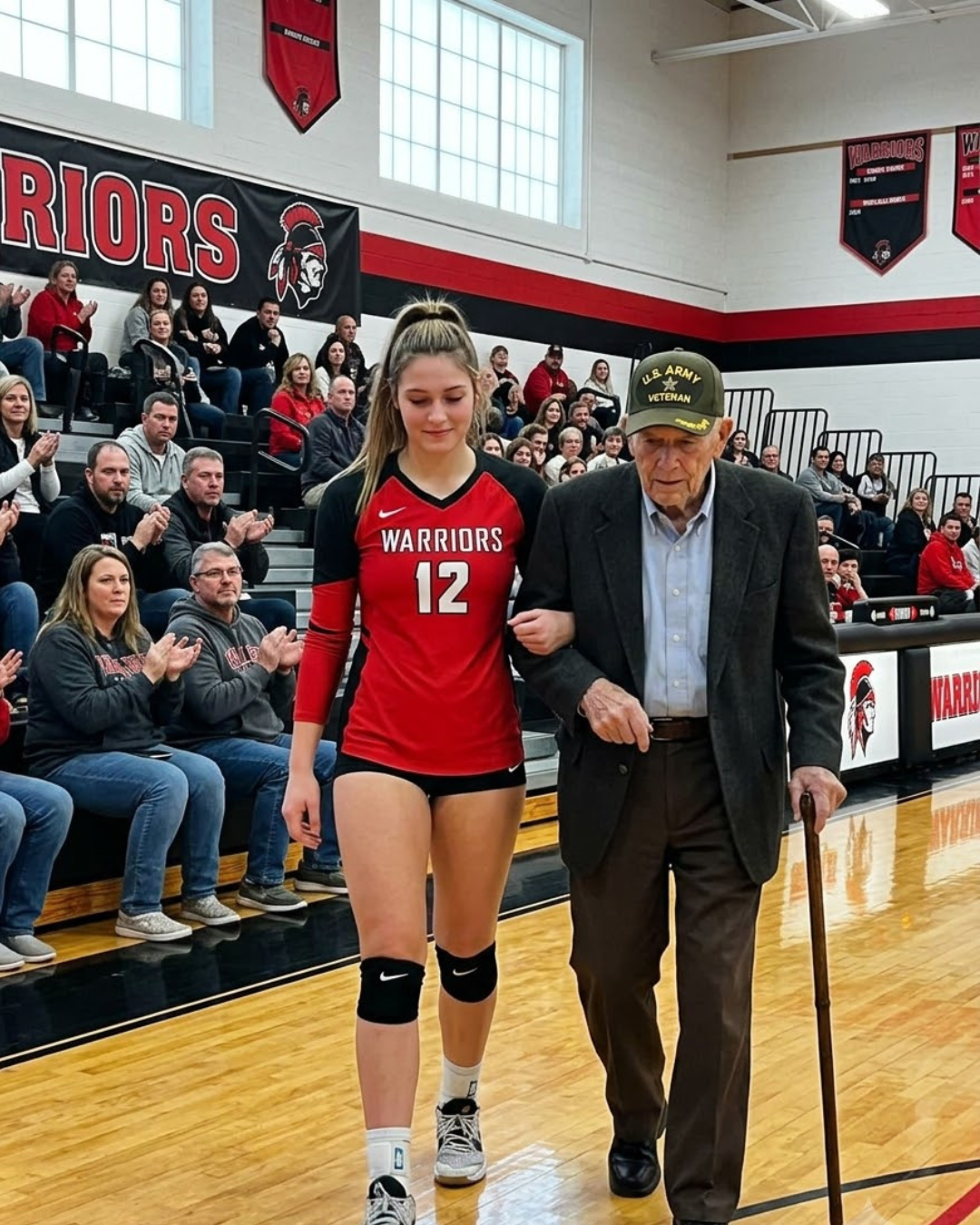
That grandmother received the loudest applause of the evening so far.
Then Mr. Halvorson glanced down at his next index card.
He paused slightly.
It reminded me of Mrs. Larson’s hesitation on the telephone.
And then he announced:
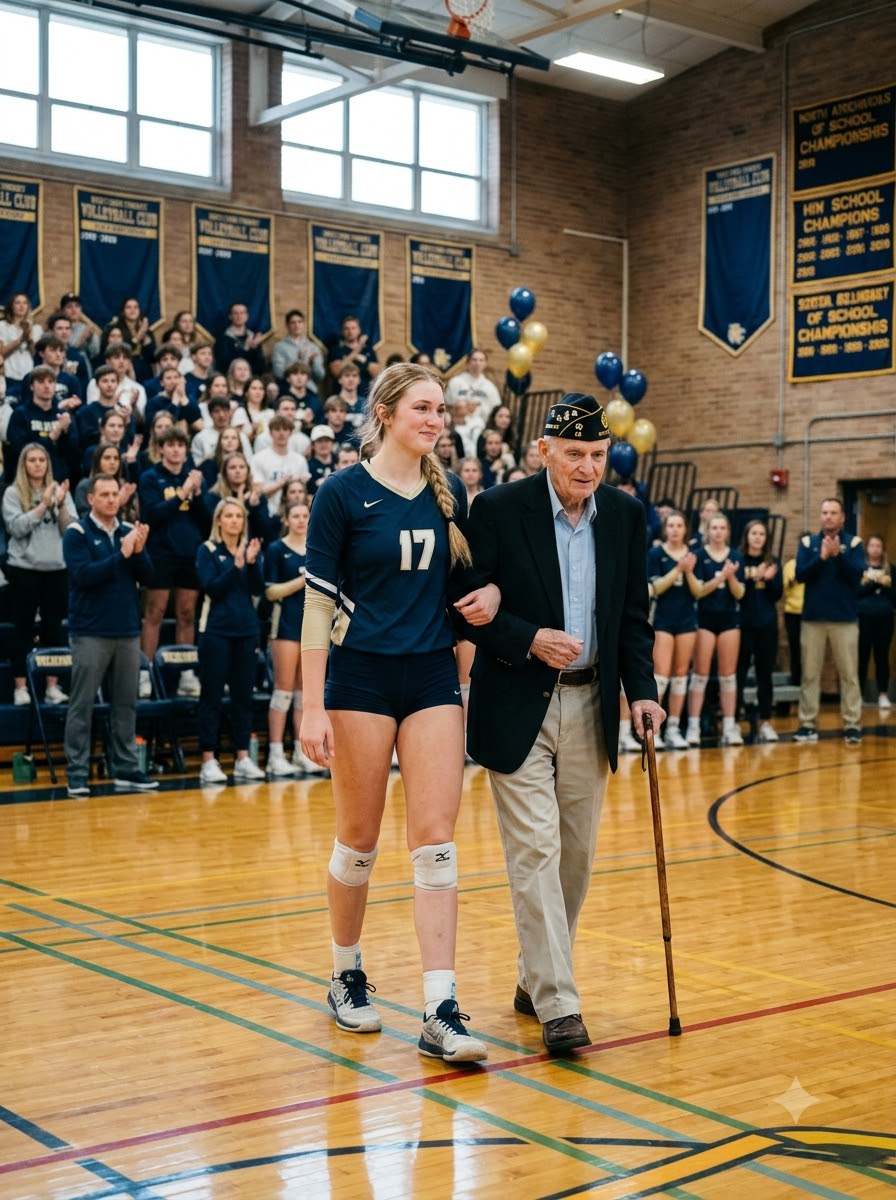
“Number seventeen. A middle hitter and four-year letter winner. Kaylee Brandt. Escorted tonight by her grandfather, Mr. Duane Ostrem.”
A low murmur traveled through the bleachers.
Many of the people in that gym had bought milk from my father over the years. Others had ridden the school bus with him in the seventies or served beside him on church committees.
Kaylee shifted the rose into her left hand and linked her right arm through Dad’s left.
He set his cane on the floor.
And they began walking.
Slowly.
Because slow was the only way my father could walk now.
Cane, step, step.
Cane, step, step.
The rubber tip squeaked against the polished wood each time it touched down.
Even people seated high in the bleachers could hear it.
Mr. Halvorson continued reading from his card.
“Kaylee has been on the honor roll all four years. She is a member of the National Honor Society, and has shown dairy heifers in 4-H for eight years…”
Then someone stood in the top row.
I still don’t know who it was.
I’ve asked around, but nobody has admitted to starting it.
It could have been Mrs. Bauer, although I doubt she could have risen quite that quickly.
The row beneath stood next.
Then the entire upper section.
The movement spread downward through the bleachers like water flowing down a hillside.
One row after another rose until the entire home crowd was standing.
Men who had hauled milk with Dad got to their feet.
Women from his church circle stood.
Children who didn’t know him stood simply because everyone around them had.
Across the gym, the visiting volleyball players began clapping.
Their parents stood as well.
Both my hands flew to my mouth.
I hadn’t consciously raised them.
They simply ended up there, and I could feel tears wetting my palms.
My father didn’t look toward the crowd.
He kept watching the floor in front of his cane, exactly as he’d watched his footing in the barn all his working life.
Kaylee turned her head toward him and said something quietly.
Beside me, Travis rose.
At first, I assumed he was standing with everyone else.
But his hands weren’t clapping.
They hung at his sides.
He was looking toward the steps at the end of our bleacher row.
His jaw moved slowly from side to side.
In nine years, I’d seen that expression only twice.
Once when he proposed to me.
And once at his mother’s funeral.
He placed his hand on the metal railing.
Then he stepped down.
Mr. Halvorson was still announcing Kaylee’s accomplishments.
“After graduation, Kaylee plans to attend Minnesota State University in Mankato, to study nursing…”
Travis descended another step.
Then another.
There were four steps between our front-row seats and the gym floor.
I counted all four.
I couldn’t seem to breathe.
He walked onto the varnished court wearing his work boots and seed company vest.
Dad and Kaylee were about ten feet from center court.
Travis quickened his pace until he reached them.
He didn’t speak.
He didn’t ask permission.
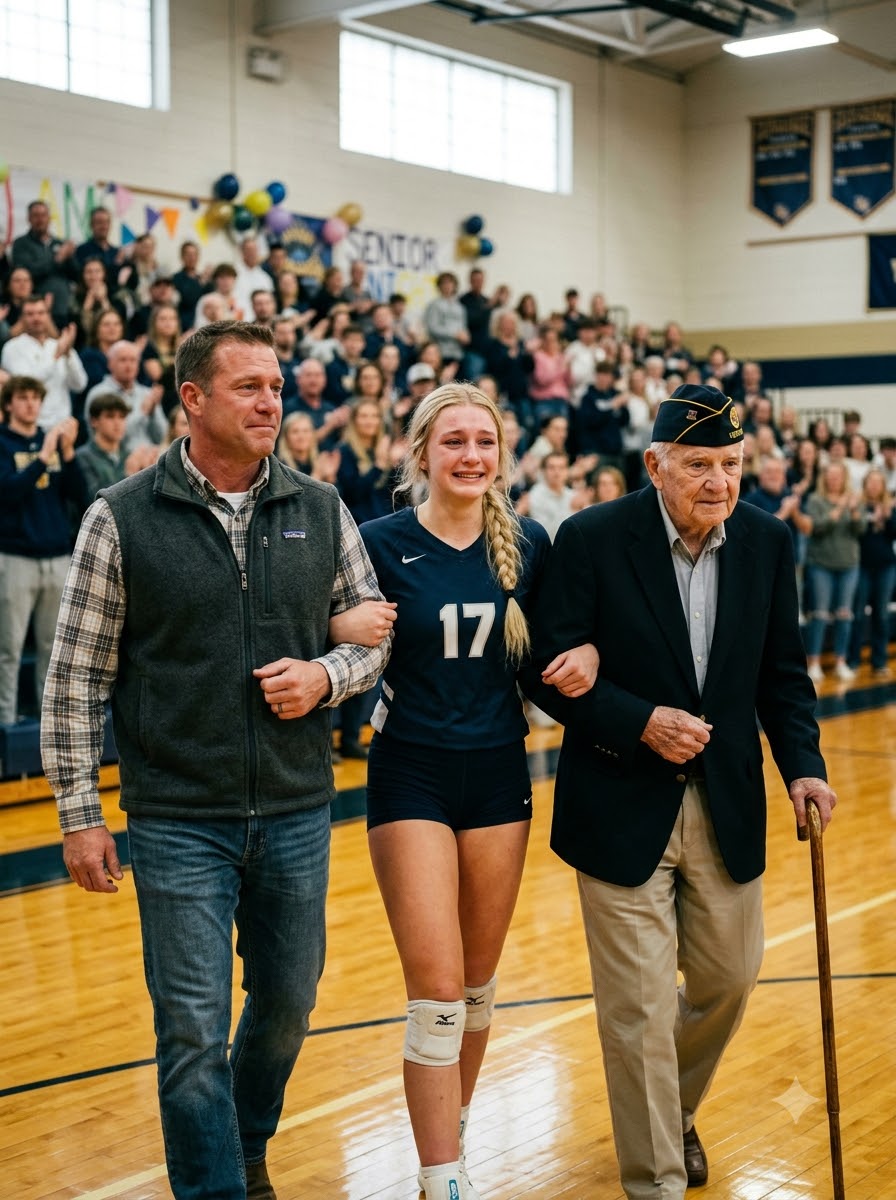
He simply moved to Kaylee’s other side, away from her grandfather’s cane, and offered his arm as though escorting her at a wedding.
My daughter stopped.
She looked down at his arm.
Then up at his face.
From the bleachers, I couldn’t see her expression clearly.
But I could see her shoulders tense.
And then relax.
She slipped her hand through his arm.
Together, the three of them continued toward center court.
Cane, step, step.
Cane, step, step.
Travis adjusted his stride to match my father’s exactly.
The gym erupted.
It had been loud before, but this was a different kind of noise.
Mason bounced on the bleacher seat beside me, shouting as loudly as his little lungs would allow.
“That’s my dad! That’s my dad!”
Mr. Halvorson had finished everything written on his index card.
He stood near the scorer’s table, holding the microphone and staring at the three people now standing together at center court.
Then he made a decision.
He walked onto the floor and handed the microphone to Travis.
Our town was small, and nearly everyone knew my husband, so nobody seemed surprised by the gesture.
Nobody sat down, either.
Travis stared at the microphone as though somebody had handed him a live electrical wire.
He was not a man who enjoyed speaking in front of people.
He sold seed to farmers who disliked salesmen, and he’d built his business by talking as little as possible and always showing up when he said he would.
Gradually, the gym fell silent.
The quiet spread in waves until all I could hear was the old scoreboard humming and a baby fussing somewhere in the corner.
Travis lifted the microphone.
His hand trembled.
I could see it clearly from where I sat.
“I’m Travis,” he said. “I’m Kaylee’s stepdad. I’ve been her stepdad for nine years.”
He stopped speaking.
His eyes dropped to the floor.
Dad remained motionless.
So did Kaylee.
“Tuesday night at supper,” Travis said, “she asked me to walk her out tonight. And I told her no. I told her this walk was for real dads.”
A sound rose from the bleachers.
Not exactly a gasp.
More like hundreds of people releasing a breath together.
“I said it because I thought I didn’t have the right,” Travis said. “I thought I’d be taking something that belonged to somebody else. I’ve thought that for nine years.”
Then he turned toward my daughter.
He looked directly at her in front of the entire gym.
“I was wrong,” he said. “I’ve been your dad for nine years, Kay. I just never had the guts to say it out loud.”
His voice broke.
“I’m saying it now. And I’m sorry.”
He returned the microphone to Mr. Halvorson, who accepted it as carefully as though it were made of glass.
Travis looked as if he wanted to disappear beneath the floorboards.
Kaylee didn’t answer him.
Instead, she turned and buried her face against his fleece vest.
He wrapped both arms around her.
Her long blond braid fell down his back.
Then my father did something I will remember for the rest of my life.
When they’d reached center court, Kaylee had handed him her rose, just as the other seniors had given theirs to their escorts.
He’d been holding it against his cane.
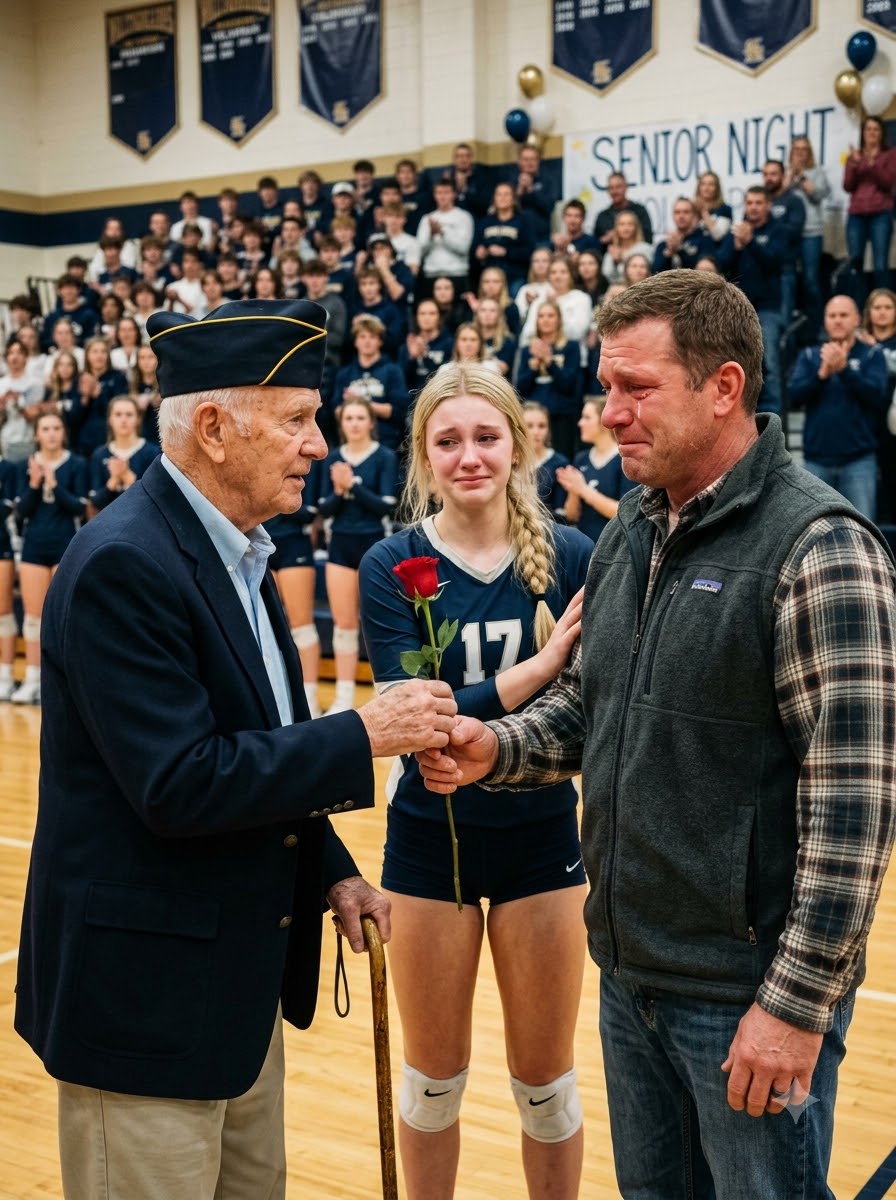
Now, after Kaylee stepped back from Travis, Dad extended the flower toward my husband.
Stem first.
Travis looked at it.
He shook his head.
He wasn’t going to take the rose.
In his mind, it belonged to the man who had walked all the way across the gym on a cane.
But my father didn’t lower his hand.
He waited.
Patiently.
The same way he’d once held a bottle out to a stubborn calf until the animal finally decided to accept it.
The gym was quiet enough that I could hear his words.
“I already raised mine, son,” my father said. “This one’s yours.”
Travis accepted the rose.
Dad touched the brim of his green seed corn cap in Kaylee’s direction, like a farmer greeting someone at the co-op.
Then he turned.
He planted his cane.
And he began the journey back across the court alone.
A sophomore from the junior varsity team stepped forward to help him.
He allowed her to walk beside him but didn’t take her arm.
He reached the bleachers under his own power.
Then he climbed the four steps, slowly, with one hand gripping the rail.
He sat down beside me in the front row.
He was breathing heavily.
He reached over and patted my knee twice.
“Well,” he said. “That went all right.”
I couldn’t manage a reply.
I rested my head against his shoulder, against the tan Sunday sport coat that still carried the faint smell of cedar from his closet.
And I cried harder than I had since my mother died.
On the court, the coach approached with her phone to take a photograph.
Kaylee and Travis stood in front of her senior poster.
He held the rose.
She held his arm.
Both their faces were red.
Then Kaylee looked up toward the bleachers and waved for Mason, Dad, and me to join them.
Mr. Halvorson leaned toward the microphone.
“Come on, Jodi. Bring ’em down here.”
The gym laughed.
So we went.
Dad climbed down those same four steps again without a single complaint.
The resulting photograph showed all five of us at center court beneath the maroon and gold streamers.
It’s the picture on our refrigerator now.
Mason was holding his homemade volleyball poster upside down.
Nobody noticed until after we’d printed it.
We left it exactly that way.
There wasn’t much conversation during the drive home.
Mason fell asleep against the truck window before we reached the edge of town.
Kaylee went with her teammates to their pizza party at Casey’s.
Travis drove with both hands on the steering wheel.
The rose rested on the dashboard, shifting slightly whenever we rounded a curve.
For eleven miles, he said nothing.
Neither did I.
Once we reached home, I carried Mason upstairs to bed.
When I returned, Travis was sitting at the kitchen table.
The same chair he’d occupied on Tuesday.
The rose lay on the oilcloth in front of him.
I made a pot of decaffeinated coffee.
I didn’t question him.
I sat across the table and waited.
I’d spent the entire week waiting.
But now it no longer felt as though I was testing him.
Eventually, I spoke.
“I’m sorry I didn’t tell you Dad was coming,” I finally said. “I should have. I wanted you to decide on your own. But that wasn’t fair to you.”
Travis shook his head.
“You were right not to,” he said. “If you’d told me, I’d have done it for you. I needed to do it for her.”
Then he told me something he’d kept to himself throughout all nine years of our marriage.
Something from his childhood.
And as I listened, I finally understood why a man who had spent nine years showing up for my daughter had been so afraid to call himself her father.
Part 3: What Makes a Father Real
Travis was twelve when his mother remarried.
His stepfather’s name was Dale.
According to Travis, Dale wasn’t a cruel man.
He worked hard, paid the household bills, and never struck anyone.
That spring, Travis played Little League baseball.
At the end of the season, the team held an awards banquet at the American Legion.
When each boy received his trophy, his father was supposed to stand behind him.
Travis asked Dale to attend.
And at their kitchen table, in front of his mother, Dale answered:
“You’re not mine to raise. That’s your dad’s job. I’m not going to stand up there and pretend.”
Travis stared down at the rose lying on our table.
“My dad wasn’t coming either,” Travis said. “So I walked up there alone. I got my trophy. I walked back to my seat. And I never asked Dale for anything ever again.”
He turned the rose slightly on the oilcloth.
“I swore I’d never do that to a kid. I’d never make a kid feel like that.”
He looked at me.
“And Tuesday night, I sat right here in this chair and I said almost the exact same words.”
“Why?” I asked him.
There was no anger in my question.
I needed to understand how he’d arrived at the very place he’d sworn never to go.
“Because I’ve been scared for nine years that I was overstepping,” Travis said.
“Every time I wanted to call her mine, I’d think about her real dad. What if he shows up someday. What if she resents me for it. What if I take something that was never mine to take.”
He rubbed both hands across his face.
“When I said real dads, Jodi, I wasn’t talking about her. I was talking about me. I didn’t think I counted. I didn’t think I was allowed to count.”
For a while, he sat quietly.
Then he continued.
“Then I watched your dad walk her out on that cane,” he said. “A seventy-nine-year-old man. Walking the whole length of that gym. And I thought, what in the world am I doing up here?”
He lowered his eyes to the flower.
“He showed up. That’s all a real dad is. The one who shows up. And I’ve been showing up for nine years, and telling myself it didn’t count.”
I reached across the table and covered his hand with mine.
His skin was rough from handling seed bags, repairing augers, and working in the shed.
He turned his palm upward and held my hand.
We stayed like that until Kaylee arrived home at eleven.
She came through the back door wearing her warmup jacket, her braid partly undone.
She smelled of pepperoni pizza and the gym.
She stopped when she saw us sitting together.
Her gaze settled on the rose.
Then she crossed the kitchen and did something she hadn’t done since she was ten.
She sat on Travis’s knee.
She was five foot ten, a high school middle hitter, and much too tall to fit comfortably on his lap.
It didn’t matter.
“I put my phone away during the party,” she said. “Everybody kept showing me the video. Somebody already put it on Facebook. Grandpa has four hundred likes.”
Travis laughed, although his laughter sounded a little wet.
“Your grandpa doesn’t even know what Facebook is.”
“I know,” she said. “That’s the best part.”
She fell silent briefly.
Then, speaking near the side of his head, she said:
“I wasn’t mad that you said no, Travis. I was mad because I thought you didn’t want to.”
“I always wanted to,” he said. “Every single day. I was just scared.”
“Scared of what?”
He considered his answer.
“Of you telling me I wasn’t your dad.”
Kaylee leaned back to look at him.
Her expression suggested he’d just spoken a language she didn’t understand.
“Travis,” she said. “Who do you think taught me how to braid my own hair?”
That was when I had to leave the table and stand at the kitchen sink for a while.
Friday morning, my father called at 6:15.
For him, that was practically sleeping in.
He wanted to make sure someone had put the rose in water.
He explained that a good rose ought to survive a week if the stem was cut at an angle.
Travis followed his instructions.
He trimmed the stem and placed the flower in a canning jar on the windowsill above our kitchen sink.
It lasted nine days.
Dad declared that a record for a flower-shop rose in October.
Travis never made another public speech about what had happened.
That wasn’t his nature.
But afterward, small things in our family began to change.
And those changes matter more to me than the applause in the gym.
For the first time, Travis began accompanying me to parent-teacher conferences.
Previously, he’d always waited in the truck, insisting the teachers only needed one parent inside.
Now he came into the classrooms.
He sat on the tiny plastic chairs.
He asked Kaylee’s chemistry teacher how she was doing.
The Saturday after senior night, he drove to Dad’s farm.
He spent the afternoon repairing the latch on the machine shed door.
It had been sticking since August.
My father hadn’t asked for help.
Travis simply went.
Dad later told me they hadn’t talked much.
They fixed the latch together.
Afterward, they sat on the tailgate of Travis’s pickup and drank coffee from Dad’s old green thermos.
Dad said, “She’s a good girl.”
Travis answered, “She is.”
That was almost their entire conversation.
With men like my father and my husband, it amounted to quite a long discussion.
As for Ryan, Kaylee’s biological father, he never learned what had happened that night.
I considered sending him the video.
But it wasn’t my decision to make.
Kaylee never brought it up.
So I left it alone.
Her volleyball season ended in November with a five-set defeat in the section semifinals.
She cried for two days.
Then she stopped talking about it.
In April, she brought her laptop to the kitchen table to complete her graduation announcement.
The school used an online ordering form with spaces for the graduate’s name, the date, the open-house time, and the parents’ names.
I was making supper at the stove.
Tater tot hotdish, coincidentally.
I hadn’t planned the menu to remind anyone of that October evening.
Across the table, Travis was using his own laptop to organize spring seed deliveries.
Kaylee typed for several minutes.
Then she turned her screen so we could both see it.
She said nothing.
She simply waited.
Just as I’d waited at that table in October.
Just as my father had waited with the rose extended toward Travis.
My husband looked at the screen.
He removed his reading glasses.
For a long moment, he didn’t speak.
Beneath Kaylee’s name, on the line marked Parents, she’d entered three names.
Jodi Brandt.
Travis Brandt.
Duane Ostrem.
Travis reached across the table and lightly touched the edge of her laptop screen.
Only the edge.
As though the screen might break if he touched it too firmly.
“You spelled Ostrem right,” he finally said. His voice was rough. “Your grandpa will want to know you spelled it right.”
“I know how to spell my own grandpa’s name, Travis.”
“I know you do, Kay.”
Kaylee turned the laptop toward herself again.
She clicked submit.
Then she looked toward the stove.
“Is that hotdish?”
“It is,” I said.
“Good,” she said. “I’m starving.”
And the four of us sat down to supper together.
At the same kitchen table where so much had changed.
In many ways, everything looked exactly as it always had.
The same family.
The same ordinary meal.
The same chairs.
But nobody was sitting there hoping someone else would repair what had been broken.
Nobody needed to be persuaded to take a place at the table.
And nobody had to ask.
