

Part 1: The Man Who Wouldn’t Let Me See His House
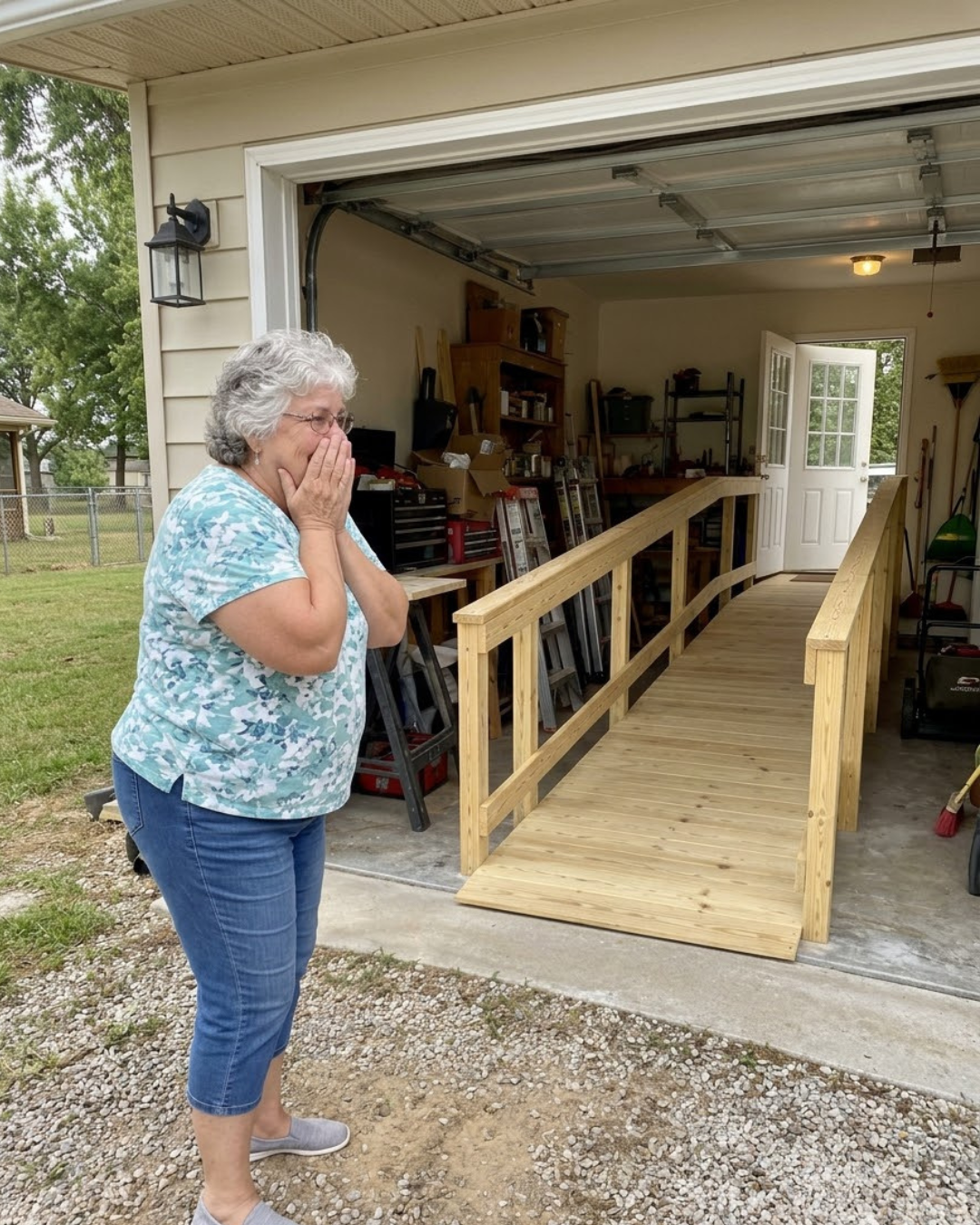
The garage door had been left completely open.
Somewhere inside, an old radio played George Strait, the music soft and slightly distorted. The smell of freshly cut pine mixed with the sharp scent of paint.
I stood at the edge of the gravel driveway, wearing my good shoes and the blouse with the small blue buttons, unable to convince myself to take another step.
My son had already warned me about what I might discover.
Perhaps there was another woman. Maybe a wife. Maybe my boyfriend was hiding an entire life from me while pretending to care, hoping eventually to get his hands on the money my late husband had left behind.
I had driven forty minutes along unfamiliar country roads because I needed to know whether my son was wrong.
Or whether he was right.
By the time I arrived, I wasn’t certain which possibility frightened me more.
Then I looked farther into the garage.
And I noticed something that made me forget every suspicion I’d brought with me.
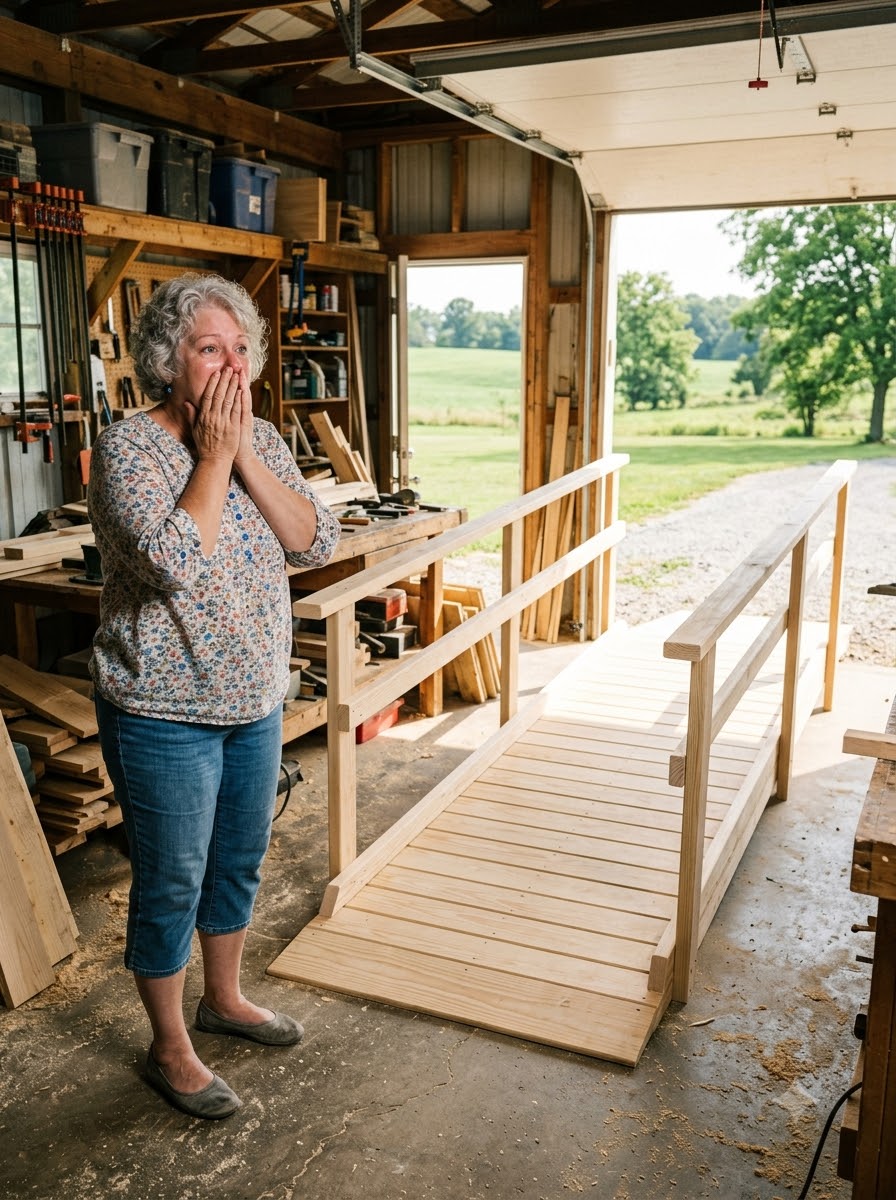
A ramp.
It stretched from the concrete garage floor to the doorway leading into the house.
The lumber looked brand-new, pale and still slightly sticky with sap. Both sides had carefully constructed handrails, sanded until the wood was perfectly smooth.
Before I realized what I was doing, I walked toward it.
I rested my hand on one of the rails.
It was precisely the right height.
Not for Wendell, who stood six feet two inches tall.
For me.
My name is Winona Pruitt.
For thirty-four years, I worked as an emergency room nurse at Baylor in Dallas.
Even after retirement, I still examine people’s faces whenever they enter a room.
It’s a habit I cannot seem to break.
Grayness around the mouth can suggest heart trouble. Yellowing in the whites of the eyes can indicate liver problems. Excessive sweating and flushed skin can signal that someone’s blood sugar is wrong.
Decades spent making rapid assessments don’t disappear simply because you’ve surrendered your hospital badge.
My husband Dwight used to tease me about it.
He claimed I couldn’t even attend a church picnic without mentally diagnosing half the congregation.
“Brother Lyle’s color is bad,” I’d whisper to him over the potato salad.
“Winnie, eat your chicken.”
“I’m just saying. Somebody ought to check his pressure.”
Six weeks later, Brother Lyle suffered a heart attack.
Dwight never made that joke again.
But there was one person whose warning signs I failed to recognize.
My own husband.
For two years, that failure had followed me everywhere.
I could identify a possible heart attack from across a crowded fellowship hall, yet I hadn’t recognized what was happening to the man I’d loved for nearly four decades.
One unusually warm Saturday in November, Dwight came inside after mowing the lawn.
He mentioned that his arm felt strange.
Then he settled into his brown recliner beside the living room window and said a glass of tea would make him feel better.
I went into the kitchen to get it.
When I returned, he was no longer all right.
I performed CPR on our living room carpet until the ambulance arrived.
But I knew.
Even before the paramedics reached our house, I recognized the color of his skin.
I had seen it countless times at the hospital.
Dwight’s recliner remained beside the window in our Seagoville home.
It was made of brown corduroy, with the fabric worn smooth where his hands had rested for years.
Nobody used it.
Every week, I dusted the nearby table, lamp, and windowsill.
Then I carefully cleaned around the chair without touching it, as though it occupied a separate little island inside the room.
My daughter Megan once suggested that I should get rid of it.
“I will,” I said. “When I’m ready.”
That conversation had happened two years earlier.
After Dwight died, my world became very small.
I went to the grocery store, church, and the cemetery along Highway 175.
Those were practically the only places I visited.
My knees didn’t help.
Thirty-four years of walking hospital corridors had taken a terrible toll on them.
By sixty-four, gardening on my knees was impossible.
Some mornings, I descended my porch steps sideways, gripping the railing because bending my knees normally hurt too much.
Last June, my neighbor Carla finally decided she’d had enough of watching me stay home.
Carla was seventy-one and had been a widow for eleven years.
She wore bright pink lipstick even when she was only walking to the mailbox.
Sitting around feeling sorry for herself had never been her style.
One morning, she appeared on my porch with her purse already hanging from her arm.
“There’s a grief group at the senior center,” she said, standing on my porch with her purse already on her arm. “Tuesdays at ten. Coffee’s terrible but the people are nice. You’re coming.”
“I’m not much for groups.”
“You’re not much for anything these days, Winona. Get your shoes.”
So I put on my shoes and went with her.
The meeting took place in a small room with folding chairs, a large coffee urn, and boxes of tissues scattered across the tables.
There were roughly twelve people attending.
A cheerful young woman named Brooke led the sessions.
She asked Carla to write my name on a tag using a thick black marker.
Carla wrote WINONA in enormous letters, each nearly two inches tall.
“Lord, Carla,” I said, peeling the backing off. “I look like a kindergartner.”
“You act like one, too,” she said, and slapped it on my chest.
That was the morning I met Wendell Haskins.
He sat across the circle from me.
He was a large, quiet man wearing a neatly pressed plaid shirt buttoned all the way to his neck.
His name tag read WENDELL in straight, carefully formed block letters.
I remember noticing his hands.
They were enormous, yet he handled everything with surprising gentleness.
Even his flimsy Styrofoam coffee cup rested between his fingers as though he were afraid of crushing it.
When his turn came to speak, he introduced himself.
He was sixty-six, retired after thirty-eight years working as a lineman for an electric cooperative.
His wife Ruth had died fourteen months earlier.
“ALS,” he said. Then he stopped. He looked at his coffee cup for a long time. “That’s all I got today. Sorry.”
Brooke reassured him that he’d shared more than enough.
As the meeting continued, I kept glancing at him.
His coloring seemed healthy.
But I recognized the expression on his face.
I’d seen it countless times on relatives waiting outside emergency rooms in the middle of the night.
He looked like someone who had held his breath for so long that he’d forgotten how to release it.
The following Tuesday, I arrived late.
My knees had been especially painful that morning, and getting down the porch steps had taken longer than usual.
Everyone was already seated when I entered.
Wendell stood immediately.
He walked to the coffee urn, poured a cup, and brought it over to me.
“Two creams,” he said. “Right?”
I stared at him.
“How’d you know that?”
He shrugged and sat back down. “You took two creams last week. I was paying attention.”
For a moment, I couldn’t think of anything to say.
Dwight and I had shared morning coffee for thirty-nine years.
And I wasn’t entirely certain he could have told someone how I preferred mine.
By our third meeting, Wendell had begun walking me to my car afterward.
One afternoon, he mentioned something unexpected.
“Your porch light’s out,” he said.
“How do you know about my porch light?”
“You said it last week. When Brooke asked what’s hardest. You said it was little things. You said the porch light’s been out since your husband passed and you keep forgetting to get a new bulb, and every time you come home at night, it’s dark.”
I barely remembered mentioning it.
Wendell remembered every word.
“It’s not the bulb,” I said. “I tried the bulb. Dwight always said it was the wiring. He kept meaning to look at it.”
“I was a lineman for thirty eight years,” Wendell said. “I can look at it.”
He came over that Saturday with his toolbox.
For two hours, he worked from a ladder on my front porch while I handed him tools and tried not to worry about him falling.
He replaced the faulty switch and a section of damaged wiring inside the wall.
When he finally tested the light, it glowed bright yellow.
For the first time in almost two years, my porch was illuminated again.
I stood in the yard staring at it.
Then I covered my mouth with my hand.
“Winona?” he said from the ladder. “You okay?”
“I’m fine,” I said. “Get down from there before you fall. I’m making you supper.”
That evening, I cooked chicken-fried steak, mashed potatoes, and green beans with bacon.
Wendell ate two servings.
He said it was the best dinner he’d enjoyed in eighteen months.
Afterward, he washed and dried every dish without being asked.
He even wanted to know exactly where each item belonged.
He returned the next Sunday for supper.
And the Sunday after that.
By August, Sunday dinners together had become our routine.
I need to admit something.
After losing Dwight, I never expected to want another man in my life.
Even with Wendell, I wasn’t searching for another husband.
I’d already had a wonderful marriage.
But cooking for two people again felt comforting.
I enjoyed having someone to talk with while peeling potatoes.
I liked hearing a deep male voice laughing at something on television.
Wendell wasn’t especially talkative.
Yet he listened more carefully than any man I’d ever known.
One Sunday in July, my knees were particularly painful.
I was standing at the stove, holding the counter for support as I removed the cornbread from the oven.
“You all right?” he asked.
“Just my knees. Thirty four years on hospital tile.” I laughed. “I’ll end up in a wheelchair like Mama did. You watch. Then you’ll have to push me around.”
I intended it as a joke.
Wendell didn’t laugh.
He studied me for a moment, then lowered his gaze.
“Your mama was in a wheelchair?”
“The last eight years of her life. Arthritis. Her hips and knees both.”
“Where’d she live?”
“Out in Kaufman. The house I grew up in.” I set the cornbread on the table. “Little old farmhouse. She wouldn’t move. My brother and I begged her, but she said she’d been in that house fifty years and she’d die in it.”
The memory made me smile.
“She painted the kitchen buttercup yellow when I was six. I remember sitting on the counter while she did it. She said yellow was the color of a happy kitchen. Every time I walked in, it was like the sun was coming up.”
“Buttercup yellow,” Wendell repeated.
“That’s what the can said. Buttercup.”
Two Sundays later, he unexpectedly returned to the subject.
“That kitchen. Your mama’s. Was it a pale yellow, or a bright yellow?”
“Pale,” I said, surprised. “Like butter. Why?”
“Just wondering.”
Another month passed.
While I was washing dishes one evening, he asked again.
“Did the cabinets match? In your mama’s yellow kitchen? Or were they white?”
“White,” I said. “With little glass knobs. Wendell, why do you keep asking me about my mama’s kitchen?”
He smiled while drying a plate.
“I like hearing you talk about it,” he said. “You look different when you talk about it.”
I didn’t understand what he meant.
And I didn’t press him.
But something else had begun troubling me.
Wendell never invited me to his home.
Not once.
For four months, he came to my house every Sunday.
He repaired my porch light, fixed the garbage disposal, and stopped a leaking faucet in the guest bathroom.
For my birthday, he took me to a Mexican restaurant in Mesquite.
On Dwight’s birthday, he drove me to the cemetery and waited in his truck for an entire hour without complaining.
Yet whenever I suggested visiting him instead, he refused.
“It’s not fit for company yet, Winnie.”
By then, he had started calling me Winnie.
Only Dwight had ever used that nickname before.
“I don’t care what it looks like. I was a nurse. I’ve seen worse than a messy house.”
“Give me till Christmas,” he said. “It’ll be ready by Christmas.”
At sixty-four, I knew men could invent convincing excuses.
Dwight’s brother Earl had maintained a second family in Tyler for eight years.
He told his wife he was away driving a truck route.
When she discovered the truth and attempted to swallow an entire bottle of sleeping pills, I was the one who sat beside her in the emergency room.
So Wendell’s refusal bothered me.
A house unfit for visitors.
A promise that everything would be ready by Christmas.
And I began noticing other things.
Pale sawdust collected inside the cuffs of his jeans.
Sometimes he had tiny curls of wood clinging to his clothing, the kind produced by a power saw.
One afternoon, I discovered a splinter embedded in his palm.
I removed it with tweezers at my kitchen table.
He winced.
“Mean nurse,” he said.
“You’d better believe it.”
There were also traces of paint on his knuckles.
Pale yellow paint.
He had scrubbed his hands, but the color remained trapped in the creases of his skin.
Whenever I asked what he had been painting, he smiled.
“Puttering,” he said.
“Puttering at what?”
“This and that.”
Then one Sunday in September, something happened that I hadn’t expected.
Wendell came into my living room and sat down in Dwight’s recliner.
Nobody had used that chair since my husband died.
I stopped in the kitchen doorway, holding a dish of macaroni and cheese.
I was about to say something.
But Wendell leaned his head against the corduroy, closed his eyes, and fell asleep almost immediately.
His large hands relaxed against the worn armrests, settling in the same places Dwight’s hands had rested.
I stood there for a long time.
Out of habit, I examined his face.
There were gray shadows beneath his eyes.
He looked exhausted.
Not necessarily ill, but terribly tired.
Like someone who had been working far beyond his limits.
I let him sleep for forty-five minutes.
The macaroni grew cold.
I didn’t mind.
Seeing someone resting in that chair brought me a comfort I hadn’t realized I was missing.
When Wendell finally woke, he seemed embarrassed.
“I’m sorry, Winnie. I don’t know what happened. I was up late last night.”
“Doing what?”
He paused.
“Puttering,” he said.
And although I wanted to believe him, the mystery surrounding his home was becoming harder to ignore.
My son Zach had already decided that Wendell was hiding something.
And before long, he would make me question everything I thought I knew about the man who had brought light back to my porch.
Part 2: The Secret Behind the Locked Door
My son Zach disliked Wendell from the moment they met.
Zach was thirty-eight and owned Pruitt Collision, a body shop in Balch Springs.
Eleven years earlier, Dwight had helped him establish the business using money we’d saved together.
Since then, Zach had worked tirelessly to keep it operating.
He was a good son.
He had always been kindhearted.
When he was eight, he gave his entire allowance to a schoolmate whose dog had been hit by a car, hoping the child could afford another puppy.
But after Dwight died, something in Zach changed.
Not long after the funeral, while I was still struggling to get through each day, he sat me down at the kitchen table.
“Mama, I’m going to handle your bank stuff for a while,” he said. “Just till you get your feet under you. Daddy’s insurance came through, and that’s a lot of money. Old people get scammed. I see it on the news every day.”
“I’m not old, Zachary.”
“You know what I mean.” He took my hand. “Just so you don’t get scammed, Mama. Please. Let me do this for you.”
I agreed.
Zach arranged my online banking and kept the password.
Whenever I needed account information, I called him and he checked it on his phone.
At the time, I appreciated having one less responsibility.
After thirty-four years of hospital paperwork, I was happy to avoid dealing with more forms and statements.
Zach first met Wendell at the end of August.
He arrived unexpectedly during Sunday supper and discovered Wendell drying dishes in my kitchen.
My son stopped in the doorway and folded his arms.
He had Dwight’s broad chest, and when he stood that way, he seemed to fill the entire entrance.
“Who’s this?”
“Zach, this is Wendell Haskins. From my grief group. Wendell, this is my son.”
Wendell set aside the dish towel and offered his hand.
“Pleasure to meet you, Zach. Your mama talks about you all the time.”
Zach stared at the outstretched hand longer than politeness allowed.
Then he shook it.
“Does she,” he said.
After that, Zach suddenly began attending Sunday supper every week.
He brought his wife Jordyn and their children, seven-year-old Kaylee and four-year-old Brody.
Before Wendell entered my life, Zach rarely visited on Sundays.
Once a month was more typical.
He was usually busy at the shop.
Now he arrived at precisely five o’clock every week.
I loved having the grandchildren around.
But I understood why their father had changed his routine.
Zach watched Wendell constantly.
Even during meals, his attention remained fixed on him.
And he asked question after question.
“So where’d you say you worked, Wendell?”
“Trinity Valley Electric Co op. Thirty eight years.”
“And you’re retired now?”
“Two years.”
“Pension pretty good?”
“Zachary,” I said.
“What? I’m just making conversation.”
“It’s fine,” Wendell said. He wiped his mouth with his napkin. “It’s a decent pension. Enough for me.”
“Huh.” Zach cut his pork chop into small pieces. “And where do you live?”
“Out past Ferris.”
“Big place?”
“Little place.”
“Never seen it, though,” Zach said, and looked at me. “Have you, Mama?”
I remained silent.
Wendell lowered his eyes to his plate.
Across the table, Jordyn did the same.
She was a gentle, quiet woman who worked as a dental hygienist and was wonderful with the children.
That evening, she barely spoke.
When I went into the kitchen to prepare dessert, she followed to help.
We stood side by side cutting pie.
After a moment, she spoke softly.
“He seems really nice, Miss Winona.”
“He is.”
She nodded without looking up.
Her hands trembled slightly as she continued slicing.
I noticed.
I assumed she was anxious about Zach embarrassing everyone.
And I let the observation pass.
I should have paid closer attention.
After thirty-four years in an emergency room, I should have recognized that something was wrong.
For three weeks, the Sunday dinners continued in much the same way.
Then, on the final Sunday of September, the tension finally erupted.
Wendell had left early because he needed to finish something at home.
The grandchildren were watching cartoons in the living room.
Jordyn was helping me clear the table.
Zach leaned back in his chair, hooking one arm over the backrest just as Dwight used to do.
“Where does he live, Mama? Really?”
“Out past Ferris, I think.”
“You think.” He laughed. “You think. You’ve been seeing this man for four months, and you’ve never been to his house?”
“He says it isn’t fit for company.”
“Mama.” He leaned forward. “For all you know, he’s got a wife out there.”
“He’s a widower. Ruth. She died of ALS. He talked about it in group.”
“He told you that. Anybody can say anything in a grief group.” Zach shook his head. “Mama, wake up. A man who won’t show you his house wants one thing, and it’s Daddy’s insurance.”
Jordyn placed a stack of dishes on the counter.
She didn’t turn toward us.
“He’s never asked me for a dime,” I said.
“Not yet.”
Zach pulled out his phone.
I saw the familiar green logo of my banking app appear on the screen.
“I’m just making sure he’s not in your accounts.”
“Zachary, put that away.”
He ignored me and continued scrolling.
“I’m serious, Mama. Has he asked to borrow your card? Has he asked about your Social Security number? Has he asked you to sign anything?”
Heat rushed into my face.
I could feel it spreading from my neck to my ears.
My own son was speaking to me as though I were a helpless child.
And he was doing it in my kitchen, within hearing distance of my grandchildren.
Kaylee and Brody had stopped watching television and were peeking around the doorway.
“Put that phone away, Zachary,” I said. “Right now.”
He kept looking at the screen.
Then something caught his attention.
He stopped scrolling.
His jaw tightened.
After a long second, he placed the phone face down on the table.
“Everything looks fine,” he said. “For now.”
Two days later, my daughter Megan called from Longview.
Megan was thirty-five, worked as a school counselor, and had two young daughters.
Her husband sold insurance.
She called every Tuesday and Friday without fail.
“Mama,” she said. “Zach called me. He’s real upset.”
I was standing in the kitchen.
I lowered myself heavily onto a stool.
“About Wendell.”
“He says this man’s got you wrapped around his finger. He says he’s at your house every Sunday, sitting in Daddy’s chair.”
“He fell asleep in it one time.”
“Mama.” She sighed. “Zach says if you keep seeing him, he’s done bringing the kids.”
Everything around me seemed to go quiet.
I could hear the refrigerator humming.
The clock above the stove continued ticking.
“He said that?”
“He’s just scared. He doesn’t want you to get hurt.”
“Is that what you think too, honey?”
Megan hesitated too long.
“I think,” Megan said slowly, “that you’re lonely, Mama. And lonely people get taken. I see it all the time. Not just old people. Everybody. When you’re lonely, you see what you want to see.”
I stared through the kitchen doorway at Dwight’s recliner.
It still sat beside the window, surrounded by the little area I dusted so carefully.
“Mama? Are you there?”
“I’m here,” I said. “I’ve got to go, baby. I’ve got something on the stove.”
There was nothing cooking.
That week, sleep became difficult.
At two in the morning, I would lie awake in the bed Dwight and I had bought in 1991.
I listened to the air conditioner turning on and off, the ice maker dropping cubes, and the faint electrical hum of the porch light Wendell had repaired.
I kept wondering whether my children were right.
Perhaps I really was a lonely widow being deceived by a thoughtful man.
Perhaps Wendell had noticed me at the grief group and recognized an easy target.
A woman with a paid-off house.
A substantial life insurance payment.
A woman who desperately missed having someone beside her.
Maybe remembering my coffee order had been deliberate.
Maybe repairing the porch light had been the first step in gaining my trust.
I had witnessed enough suffering to know such things happened.
I remembered elderly women arriving at the emergency room with broken hips while their supposed boyfriends disappeared as soon as medical bills became involved.
I remembered Earl’s wife and the bottle of sleeping pills.
But then I thought about Wendell’s hands.
The pale yellow paint.
The sawdust caught in his clothing.
The splinter I had removed from his palm.
And the way he’d fallen asleep in Dwight’s chair almost instantly.
He looked like a man who had been working twelve-hour days.
A man planning a deception usually doesn’t arrive at supper too exhausted to remain awake.
He doesn’t wash the dishes and carefully ask where everything belongs.
And he certainly doesn’t repeatedly question a woman about the exact shade of yellow in her deceased mother’s kitchen.
My years as a nurse had taught me one lesson above all others.
When someone’s explanation doesn’t match the physical evidence, pay attention to the evidence.
My family insisted Wendell was lying.
But everything I could observe suggested he was exhausted from hard physical work.
And whatever he was doing involved lumber and pale yellow paint.
I needed to see the truth myself.
Back in July, Wendell had written his address on a paper napkin.
He said I should have it in case of an emergency.
I had slipped it into my junk drawer and forgotten about it.
On Thursday morning, I searched through that drawer.
I moved aside rubber bands, twist ties, dead batteries, and expired coupons.
Beneath an old telephone book, I found the folded napkin.
1412 County Road 664. Ferris, TX.
The address was written in Wendell’s familiar straight block letters.
I put on my good blouse with the small blue buttons.
Then I chose my good shoes.
I looked at myself in the hallway mirror, wondering what on earth I was doing.
But I took my keys and left.
The drive lasted forty minutes.
The country roads beyond Ferris passed cotton fields, grazing cattle, and long stretches of open land.
I kept my phone on the passenger seat with the map displayed.
Twice, I made a wrong turn and had to reverse along a gravel road.
Three times, I almost abandoned the trip.
At a gas station in Wilmer, I sat beside the pump and wondered whether this was exactly the foolish behavior my children feared.
When I passed the Ferris sign, I remembered Zach questioning how I could date a man for four months without ever visiting his home.
And when I finally turned onto County Road 664, I saw the house.
It was a small white frame home with green shutters and a chain-link fence.
A large pecan tree stood in the front yard.
Its branches stretched over the roof.
An old tire swing hung from one of the lower limbs, its rope faded gray with age.
Wendell’s truck was parked near a metal shed behind the house.
The garage door was wide open.
Country music drifted outside.
I pulled over and sat with the engine running.
I imagined a woman answering the door.
Perhaps she would be wearing a housecoat.
Perhaps she would look at me and ask why I had come.
My hands trembled against the steering wheel.
For once, it wasn’t my knees giving me trouble.
I switched off the engine.
Then I stepped outside.
The gravel crunched loudly beneath my good shoes as I approached.
My knees ached with every step.
Nobody appeared on the porch.
From the garage came the smell of pine, paint, and turpentine.
George Strait played softly on a radio near the back workbench.
There were sawhorses, a table saw, neatly stacked lumber, and a shop vacuum.
Several paint cans stood in an orderly row on a shelf.
Then I saw the ramp.
It extended from the garage floor to the house entrance, sloping gently upward.
The wood was fresh and carefully sanded.
There wasn’t a rough edge anywhere.
The handrails were wide, smooth, and positioned at exactly the height my hands needed.
I rested my palm on one.
At five feet three inches tall, I was much shorter than Wendell.
Yet the rail seemed perfectly fitted to me.
Because it was.
Somehow, I already knew.
I moved toward the shelf of paint cans.
There was primer, white semi-gloss, and deck stain.
And there were four gallons of interior latex paint.
A pale yellow color sample had been taped to the lid.
Beneath it was a single word.
Buttercup.
I began walking up the ramp.
I don’t remember making the decision.
I simply placed my hand on the railing and followed the gentle incline.
For the first time in what felt like forever, climbing toward a doorway didn’t hurt my knees.
At the top, the door stood slightly open.
I pushed it inward.
Beyond it was a kitchen.
And when I saw what Wendell had done, I could barely breathe.
The walls were painted a soft buttercup yellow.
The cabinets were white.
Each door had a small glass knob.
The countertops were lower than normal, positioned so someone seated in a wheelchair could reach them.
Beneath the sink, the lower cabinets had been removed to create space for a wheelchair.
The doorway to the adjoining room had been widened.
Fresh trim surrounded it, and new hardwood marked the place where part of the old wall had stood.
Grab bars had been installed near the stove and back door.
On the windowsill above the sink sat a pink geranium in a small clay pot.
My mother had grown pink geraniums.
I must have mentioned that to Wendell too.
I couldn’t even remember telling him.
I placed one hand against the counter to steady myself.
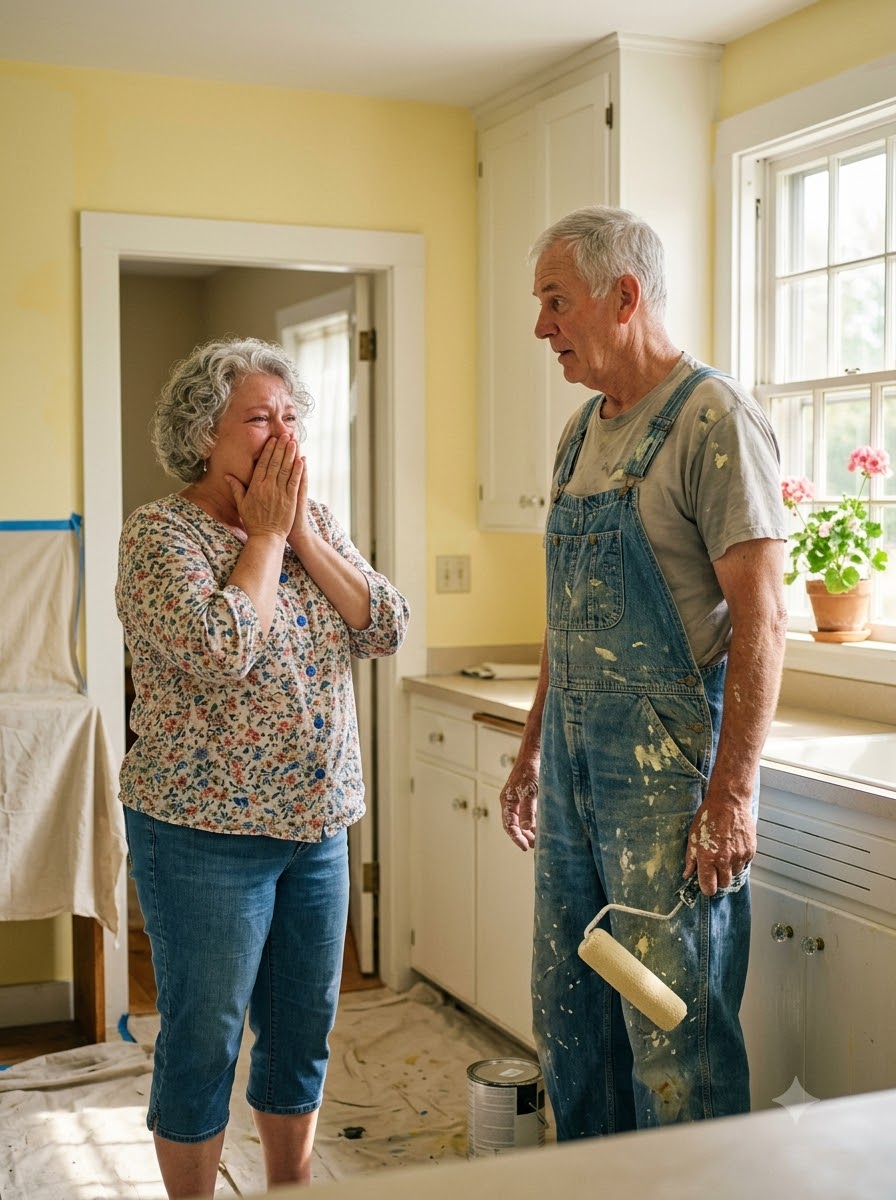
Then the back door opened.
Wendell entered carrying a paint roller and a five-gallon bucket.
He wore old overalls splattered with white and yellow paint.
There was yellow paint on his cheek and in his gray hair.
When he saw me, he froze.
The bucket struck the floor.
The roller fell from his hand.
For several seconds, neither of us moved.
George Strait continued singing faintly from the garage.
“Winnie,” he said finally. His voice came out cracked. “You… you weren’t supposed to see it yet.”
I couldn’t speak.
“It’s not done,” he said. He looked around the kitchen like he was seeing it through my eyes. “The trim’s not painted. I haven’t finished the bathroom. The grab bars in the shower aren’t in. I was going to do the bathroom this week, and the ramp out front by Thanksgiving, and then…”
“Wendell,” I said. “What is this?”
He removed his cap and slowly turned it between his large hands.
“I was going to tell you at Christmas,” he said. “I had it all planned. I was going to drive you out here Christmas Eve and walk you up the ramp and open the door and… I don’t know. I had a speech. It was a pretty good speech.”
He gave a small, nervous laugh.
“I practiced it in the truck.”
“Tell me now,” I said.
He remained silent for a long moment.
Then he pulled out a sturdy kitchen chair with wooden arms.
“Sit down, Winnie,” he said. “Your knees.”
I sat.
And finally, Wendell began telling me about the promise he had failed to keep to his first wife.
Part 3: The Truth That Changed Everything
“Ruth got sick in 2021,” he said. He sat down across the table from me. “ALS. You know about it. You were a nurse. You know how it goes.”
I did.
I knew exactly what that disease could do.
“First it was her hands. She couldn’t button her blouse. Then her legs. By the spring of 2022, she was in a wheelchair. And this house…”
He looked around the kitchen.
“This house had three steps up to the front door. Two up from the garage. Narrow doorways. The bathroom was so small I had to carry her in and out like a baby. She hated that. She was a proud woman. She hated it.”
“I’m sorry, Wendell.”
“I kept saying I’d build her a ramp.”
He lowered his eyes to his hands.
“I kept saying it. Next weekend. After I finish this job. When it cools off. I had the lumber in the shed. I had it sitting right out there in the shed for four months.”
He stopped speaking.
“She wanted to see the pecan tree,” he said quietly. “That last spring. She used to sit out under it every evening, before she got sick. That was her favorite place in the world. And she couldn’t get out there anymore. Because of the steps. Because I never built the ramp.”
Wendell wiped his eyes with his wrist, leaving a yellow streak across his cheek.
“She died in May. In the hospital bed in our living room. Looking out the window at that tree.”
He struggled to breathe steadily.
“I never built her the ramp, Winnie. I had the lumber in the shed the whole time.”
I reached across the table and took his hand.
He held mine tightly.
“When I met you in that group,” he said. “And you were late that second week, because of your knees. I saw you coming down the hall, holding onto the wall. And then you told me about your mama. The wheelchair. You laughed about it. You said I’ll end up in a wheelchair like Mama did.”
His voice broke.
“And I thought, not this time. Not this time. I’m not going to wait till it’s too late again. I’m going to build it first.”
I had no words.
“I didn’t want to ask you anything,” he said. “I didn’t want to just say words. Anybody can say words. Ruth heard four months of words from me about that ramp.”
He looked directly at me.
“I wanted to have it ready. So that whenever you came here, whenever you wanted to come, even if your knees were bad, even if someday you couldn’t walk at all, you could come right in. Like it was your house too. Like you always belonged here.”
His gaze moved around the yellow kitchen.
“I asked you about your mama’s kitchen three times,” he said, “because I wanted to get it right.”
I cried at that table for a long time.
Long enough for the song on the garage radio to change twice.
Wendell didn’t interrupt.
He simply held my hand.
When I needed something to wipe my face, he brought me a roll of paper towels because he didn’t have tissues.
Then he sat beside me again.
Eventually, I managed to stop crying.
I looked closely at him.
The nurse in me was still working.
His eyes had darker gray shadows beneath them than I’d noticed before.
His hands trembled slightly.
Near the coffee pot stood a large bottle of Advil, the five-hundred-count size, already half empty.
“Wendell,” I said. “How many hours a day have you been working on this?”
He turned his face away.
“Wendell.”
“Eight. Ten, maybe. Twelve on Saturdays.”
“For how long?”
“Since August.”
“You’re sixty six years old.”
“I know how old I am.”
“You’ve been sleeping, what, four hours a night? Five?”
He didn’t answer.
He didn’t need to.
I rose from my chair, my knees creaking.
Then I walked around the table and placed two fingers against the inside of his wrist.
It was the same motion I’d performed thousands of times throughout my nursing career.
His pulse was steady, although slightly fast.
“You’re going to sleep tonight,” I said. “Eight hours. And you’re not touching a paintbrush till Saturday. Do you hear me?”
He looked up.
Yellow paint still clung to his hair.
Then he smiled.
It was the first genuine smile I’d seen from him that day.
“Yes, ma’am,” he said.
“I mean it.”
“I know you do. You’re a mean nurse.”
“You’d better believe it,” I said.
I leaned down and kissed the top of his paint-covered head.
Before I left, Wendell showed me the rest of the house.
The bedroom had a wider doorway and a lower bed.
In the bathroom, the old bathtub had been removed.
A walk-in shower was partly completed, with a small tiled bench built inside.
Behind the house, another ramp was framed but unfinished.
It led toward a concrete walkway extending all the way to the pecan tree.
Under the branches stood a new wooden bench.
It was made from the same pale lumber as the ramps.
Wide enough for two people.
“I was going to paint that too,” he said. “But I couldn’t decide on a color.”
“Leave it,” I said. “It’s perfect like that.”
We sat beneath the tree.
Sunlight filtered through the leaves above us.
After a while, I turned toward him.
“Can I ask you something?” I said.
“Anything.”
“Why’d you tell me it wasn’t fit for company? Why not just say you were fixing it up?”
He considered my question.
“Because you’d have wanted to see it. You’d have come out here and seen it half done and figured out what it was. And then it would’ve been words again. Promises. Next weekend.”
He shook his head.
“I wanted you to see it finished. All at once. So you’d know it was real.”
“It’s real, Wendell.”
“I know.”
He took my hand.
“I know that now.”
I drove home with the windows open.
I didn’t turn on the radio.
My thoughts were already loud enough.
I kept remembering Zach’s warning about a man who wouldn’t reveal his home.
Then I remembered something else.
The way Zach had stared at my banking app during Sunday supper.
How his jaw tightened.
How quickly he placed his phone face down after examining something on the screen.
And how he’d said everything looked fine.
For now.
I remembered Jordyn’s trembling hands while she cut the pie.
I remembered Megan’s hesitation when I asked whether she distrusted Wendell too.
Once again, the explanations didn’t match what I’d observed.
I’d trusted my instincts about Wendell.
And those instincts had been right.
Now I had to consider what they were telling me about my son.
The following Friday morning, I went to the bank.
Not through an app.
I visited the First Texas branch on Highway 175 in Seagoville.
It was the same bank where Dwight and I had opened our first account in 1985 with four hundred dollars and a wedding check from his grandmother.
The manager was a young woman named Tamika.
She had long braids and kind eyes.
I told her I wanted complete statements for every account in my name, covering the two years since Dwight’s death.
I also wanted my online banking password changed immediately.
This time, nobody else would know it.
Tamika was careful.
She asked twice whether anyone was pressuring me.
I assured her that nobody was.
She printed the statements and placed them in a manila folder.
I brought the folder home without opening it.
Then I sat at my kitchen table, put on my reading glasses, and began examining the pages.
Dwight’s life insurance policy had paid two hundred and twenty thousand dollars.
Following our financial adviser’s recommendation, I’d placed the money in a money market account.
Aside from the funeral and headstone expenses, I had barely touched it.
I wanted to keep it for whatever came later.
Perhaps surgery for my knees.
Perhaps long-term care.
Perhaps help with my grandchildren’s education.
I expected the balance to be around one hundred and ninety thousand dollars.
Instead, the statement showed one hundred and forty-six thousand.
I read the figure three times.
Then I went through the transactions one by one, just as I used to review medical charts at the end of a twelve-hour hospital shift.
There were transfers beginning in February.
Five thousand dollars.
Three thousand.
Eight thousand.
Then a break.
Four thousand in June.
Six thousand in August.
And eleven thousand dollars during the second week of September.
That was the same week Zach had begun attending every Sunday supper.
Each transfer had gone to the same destination.
The recipient’s name appeared clearly on the statements.
PRUITT COLLISION LLC.
I sat motionless.
I didn’t cry.
I’d spent the previous day crying in Wendell’s yellow kitchen.
Now I simply stared at the paperwork.
Forty-four thousand dollars.
My son had taken forty-four thousand dollars from the insurance money his father had left behind.
And when Wendell became part of my life, Zach had started visiting every Sunday.
He watched Wendell.
Questioned him.
Accused him of wanting my money.
He even threatened to keep my grandchildren away from me.
All while concealing what he himself had done.
His warning about a man wanting Dwight’s insurance money hadn’t been a description of Wendell.
It had been a description of Zach.
That evening, I called Megan.
First, I told her about Wendell’s house.
I explained the ramp, the buttercup-yellow kitchen, Ruth’s illness, and the pecan tree.
Then I told her what I’d discovered in the bank statements.
She remained silent for a long time.
“Oh, Mama,” she said finally. “Oh, Mama. I’m so sorry.”
“Did you know?”
“No. God, no. I swear I didn’t.”
Her voice cracked.
“But Zach called me in September. He was so upset. He kept saying this man was going to take everything. He kept saying it over and over. I thought he was scared for you.”
She paused.
“I didn’t think… Mama, I should have heard it. I’m a counselor. Somebody that scared of being robbed, it’s usually…”
“Usually somebody who’s scared of being caught,” I said.
“Yeah,” she whispered.
“I’m going to talk to him Sunday. At supper.”
“Do you want me to come?”
I considered it.
“Yes,” I said. “I want everybody there. Wendell too.”
“Mama, are you sure? With Wendell there?”
“I’m sure,” I said. “I’ve spent four months listening to my children talk about that man at my table like he wasn’t good enough to sit there. He’s going to sit there. And he’s going to hear the truth.”
That Sunday seemed to last forever.
I prepared our usual supper.
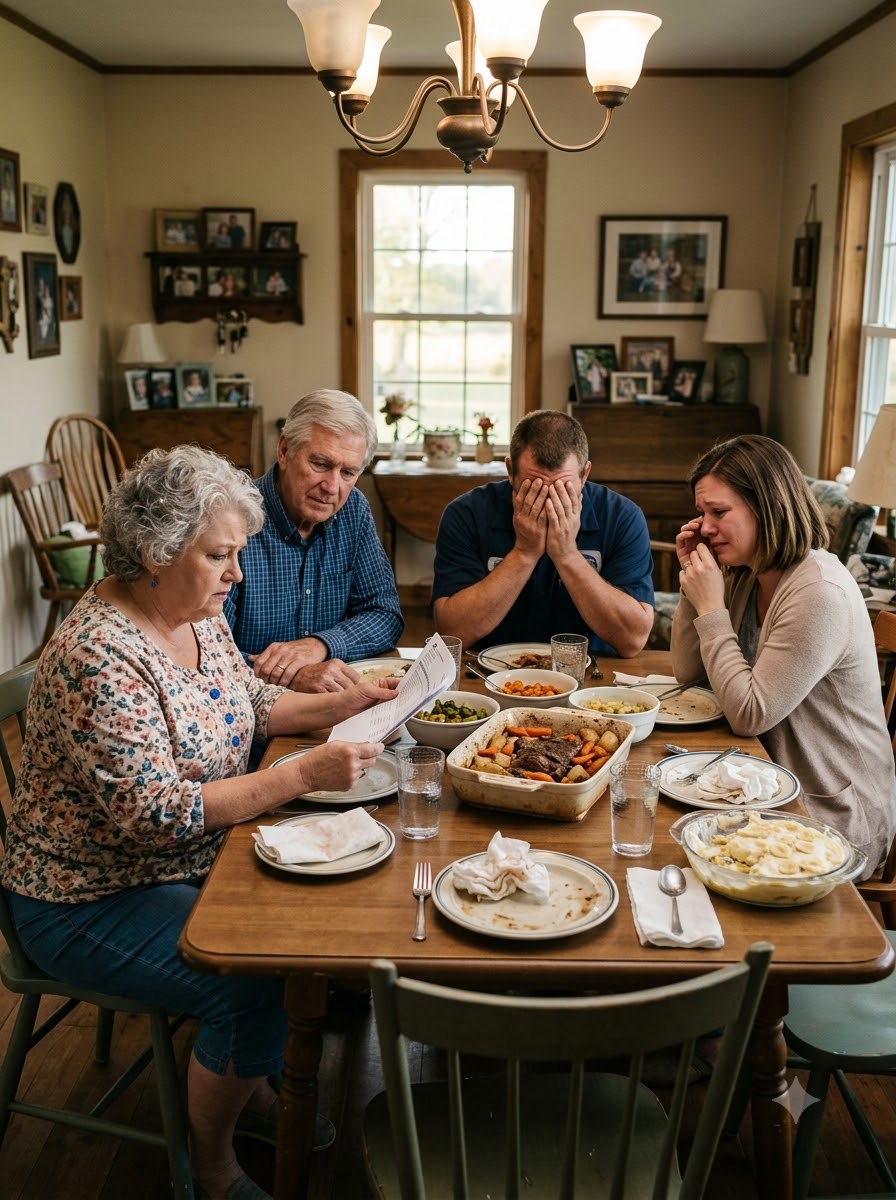
Pot roast with carrots and potatoes.
Fresh yeast rolls.
Sweet tea.
Banana pudding topped with vanilla wafers.
I set eight places at the table.
Megan arrived from Longview at three.
She embraced me in the driveway for a long time without speaking.
Wendell arrived at four-thirty.
He had shaved and was wearing his good plaid shirt, buttoned all the way to the collar.
A faint trace of yellow paint remained along one thumbnail.
When he met Megan, he offered his hand.
“You must be Megan. Your mama talks about you all the time.”
Instead of shaking it, Megan hugged him.
“Thank you,” she said into his shoulder. “For the porch light.”
Wendell seemed uncertain how to respond.
He gently patted her back.
At five, Zach and Jordyn arrived with the children.
Zach noticed Megan’s car outside and frowned.
When he entered and saw Wendell seated at the table, his expression hardened.
“Didn’t know it was a party,” he said.
“Sit down, Zachary,” I said. “Supper’s ready.”
We ate together.
The atmosphere was tense, but the children filled some of the silence.
Kaylee told a lengthy story about a girl in her class who had vomited on the school bus.
Brody spilled his sweet tea.
Jordyn cleaned it up without looking at anyone.
When supper was finished, I asked Jordyn to take the children into the living room and put on a movie.
She looked at my face.
Whatever she saw made her turn pale.
She took the children away without asking questions.
When she returned to the table, I opened the sideboard drawer.
I removed the manila folder and placed it in front of Zach.
“I went to the bank on Friday,” I said.
He stared at the folder without touching it.
“I changed my password. I got the statements printed out.”
I opened the folder and turned the pages toward him.
“Forty four thousand dollars, Zachary. Since February. To Pruitt Collision.”
Nobody moved.
Beside me, Wendell sat perfectly still.
He didn’t look at Zach.
He kept his eyes lowered toward his plate, just as he had during our first grief-group meeting.
Zach’s face turned red.
Then pale.
Then red again.
“Mama,” he said. “It’s not… I can explain.”
“Then explain.”
“I was going to pay it back. Every cent. I swear to God, I was going to pay it back.”
“Explain,” I said again.
He covered his face with both hands.
And slowly, the truth came out.
His body shop had been struggling for two years.
Insurance companies had reduced their payments for repairs.
Two experienced employees had left for a dealership in Mesquite.
A new paint booth had cost twice as much as he’d planned.
Then, in January, an electrical fire broke out in the back bay.
Nobody was injured.
But the fire destroyed sixty thousand dollars’ worth of equipment and three customer vehicles.
His insurance company disputed the claim, arguing that the electrical wiring wasn’t up to code.
Payment could take months.
Possibly years.
“I had payroll,” Zach said. His voice was raw. “I had eleven guys with families. I had a bank loan on the building. I was going to lose everything Daddy helped me build. Everything. And Daddy’s money was just… sitting there. In your account. And I had the password.”
“You could have asked me,” I said.
“I couldn’t.”
He looked up, tears in his eyes.
“I couldn’t, Mama. You’d just lost Daddy. You were barely getting out of bed. How was I supposed to come to you and say, hey, Mama, the shop Daddy was so proud of is going under, can I have his life insurance? I couldn’t do that to you. So I told myself I’d just borrow it. Just a little. Just until the insurance paid out. I’d put it all back before you ever noticed.”
“And then Wendell came along,” I said.
He flinched.
“And you got scared,” I said. “Because he was here every Sunday. Because he pays attention. Because he might ask to see something, or notice something, and then I’d notice.”
I rested my palm on the folder.
“So you came every week to make sure he didn’t. And you told me he was after Daddy’s insurance. You told Megan. You threatened to keep my grandbabies away from me. To protect yourself.”
“No, Mama, I…”
“Zachary.”
He fell silent.
“Look at me,” I said. “Not at the table. At me.”
He raised his eyes.
“Thirty four years in an ER, son,” I said quietly. “I know what a person looks like when they’re lying. I watched you lie to me at this table for four months. I didn’t see it because I didn’t want to see it. But I see it now.”
Then my son broke down.
My strong, broad-shouldered boy, who could lift the front of a car using a jack and a cheater bar, lowered his head onto my kitchen table beside the banana pudding.
He cried the way he had when he was eight years old.
Jordyn rested her hand on his back.
She was crying too.
“I knew,” she whispered. “Miss Winona, I’m so sorry. I knew since June. I begged him to tell you. Every week. Every week I begged him.”
“I know you did, honey,” I said. “I saw your hands shaking.”
Then Wendell spoke.
I hadn’t expected him to say anything.
He had remained so quiet that I’d nearly forgotten he was sitting beside me.
He cleared his throat.
Everyone turned toward him.
“Zach,” he said. “Can I say something?”
Zach raised his head but gave no answer.
“My wife Ruth needed a ramp,” Wendell said. “For four months, she needed it. I had the lumber in the shed. I kept saying I’d build it. I kept saying next weekend. And I didn’t, because I was ashamed I hadn’t done it sooner. And the longer I didn’t do it, the more ashamed I got. And the more ashamed I got, the harder it was to go out to that shed.”
He slowly turned his coffee cup.
“She died without ever seeing her pecan tree again. Because I was too ashamed to admit I’d waited too long.”
Zach stared at him.
“Shame’ll do that,” Wendell said quietly. “It’ll make you keep digging a hole you already know you’re in, just so nobody sees you standing at the bottom of it.”
He looked directly at my son.
“I’m not saying what you did was right. It wasn’t. But I know how you got there. I’ve been there.”
Silence filled the kitchen.
Finally, Zach spoke.
“I called you a con man. In front of my kids.”
“You did.”
“You built my mama a ramp.”
“I did.”
Zach covered his face again.
“I’m so sorry,” he said. “I’m so sorry. To both of you.”
After everyone went home that evening, I remained at my kitchen table for a long time.
Eventually, I walked into the living room.
I stood in front of Dwight’s recliner.
“Well, Dwight,” I said out loud. “Your son’s in a mess.”
Naturally, the chair remained silent.
But I could almost hear my husband’s response.
He would have reminded me that Zach had made a terrible mistake, but that fear didn’t necessarily make him a bad person.
I’d spent enough years caring for frightened people to understand the difference.
Then I did something I hadn’t done since Dwight died.
I sat in his chair.
The corduroy felt cool beneath my hands.
The armrests were smooth from years of use.
There was still a faint trace of Old Spice and grass clippings.
I stayed there until nearly midnight.
I thought about my son crying at the table.
I remembered Wendell explaining the shame he carried over Ruth’s ramp.
And I considered how many people keep making terrible decisions because they’re too embarrassed to admit the first one.
By the time I stood up, I knew what needed to happen.
The following week, I accompanied Zach to a lawyer.
I told him immediately that I wasn’t there to press criminal charges.
I saw his shoulders relax slightly.
But I wanted everything documented legally.
No more hidden arrangements.
No more secrets.
We prepared a loan agreement for forty-four thousand dollars at two-percent interest, with repayment scheduled over six years at five hundred dollars per month.
If the insurance company settled his fire claim, the remaining balance would become due immediately.
Zach signed the agreement with a trembling hand.
“I don’t deserve this,” he said. “You could have called the police.”
“You’re my son,” I said. “Not a stranger off the street.”
“I treated Wendell like a stranger off the street.”
“Yes,” I said. “You did. So you’re going to go fix that.”
And he did.
The following Saturday, Zach drove to Wendell’s house on County Road 664.
He arrived at seven in the morning with a professional paint sprayer from his shop and two employees.
Wendell called me afterward.
He sounded torn between laughing and crying.
“He showed up at seven in the morning,” Wendell said. “With a paint sprayer. A real one, a professional one, from his shop. And two of his guys. He said, ‘My mama says you’ve been working twelve hours a day and she wants you to stop. So show me what’s left.’”
Together, they finished the trim around every window and door.
Zach’s employees stained both ramps.
Zach completed the tilework in the walk-in shower, spending hours on the bathroom floor with a level and trowel.
His hands were steady and precise.
“He’s good,” Wendell told me. “Real good. He’s got an eye for it.”
“His daddy taught him,” I said.
“I could tell,” Wendell said. “He kept stopping to check things twice. Same as you do.”
When the work was finished, Zach stood at the bottom of the front ramp for a long time.
He studied what Wendell had built.
Then he spoke.
“My mama’s going to love this.”
After another moment, he apologized.
“I’m sorry I called you a con man. I’m sorry I said all that. I was talking about myself.”
Wendell answered gently.
“I know, son. I know you were.”
Christmas arrived.
On Christmas Eve, Wendell picked me up at four in the afternoon.
He wore a red flannel shirt, neatly buttoned to the top.
He had gotten a haircut.
And he looked as nervous as Dwight had looked on our wedding day.
As we drove toward County Road 664, he glanced at me.
“You’ve seen it already,” he said, as we turned onto County Road 664. “So I guess the surprise is ruined.”
“You still haven’t given me your speech,” I said. “The one you practiced in the truck.”
His face reddened.
“I don’t remember it anymore.”
“Then make up a new one.”
The house looked beautiful in the winter afternoon.
The white trim was freshly painted.
The front ramp had been stained a warm honey color, and small solar lights lined its railing.
A wreath hung on the door.
The pecan tree had lost its leaves, but white Christmas lights wrapped around its trunk and lower branches.
Several vehicles were parked outside.
Zach’s truck.
Megan’s minivan.
And Carla’s silver Buick, with pink fuzzy dice hanging from the mirror.
“Wendell,” I said. “What did you do?”
“Not me,” he said. “Your son.”
Inside the buttercup-yellow kitchen, my family was waiting.
Zach and Jordyn were there with Kaylee and Brody.
Megan had brought her husband and their two daughters.
Carla stood nearby in a Christmas sweater decorated with a light-up reindeer, wearing her usual bright pink lipstick and holding a plate of fudge.
“Surprise,” Megan said.
Two tables had been pushed together and covered with a white tablecloth.
Twelve chairs surrounded them.
Every chair had sturdy arms.
“Zach borrowed them from the church,” Jordyn said. “So you’d have something to push up on. He made them give us the ones with arms.”
I looked toward my son.
He stood beside the stove wearing a Christmas apron and stirring gravy.
“Daddy’s recipe,” he said. “Your recipe, I mean. I called Megan to get it. I think I messed it up.”
I tasted it.
There was far too much pepper.
“It’s perfect,” I said.
After supper, Wendell asked me to step outside with him.
Everyone suddenly became fascinated with their plates.
Carla winked.
Megan pretended to be busy cleaning Brody’s face.
Wendell guided me through the back door and down the finished ramp.
Small lanterns illuminated the concrete path leading to the pecan tree.
The wooden bench beneath it glowed in the Christmas lights.
We sat together.
The air was cold enough that I could see my breath.
Although I already wore a coat, Wendell removed his own and draped it around my shoulders.
For a while, he said nothing.
Then he began.
“I had a whole speech,” he said finally. “In the truck. It started, ‘Winnie, I’m not a young man.’ And then it went on about Ruth. And the ramp. And how I didn’t want to wait till it was too late again.”
He shook his head.
“It was a good speech. But you already know all of it.”
“I know all of it.”
“So I’ll just ask you.”
He turned toward me.
His large, gentle hands trembled.
“Will you come here? Not to live. Not unless you want to. Not to get married, unless someday you want that. I’m not asking you to leave your house. Or Dwight. Or anything.”
He took a breath.
“I just want you to know you can come. Any day. Every day. Whenever your knees are bad, or whenever they’re good. And that this house will always be ready for you. No matter what happens. That’s all.”
I looked at him beneath the Christmas lights.
I thought about Dwight’s recliner in Seagoville.
I’d sat in it twice more since that night in October.
Lately, I’d been considering giving it to Zach.
Perhaps it belonged in his living room, where Kaylee and Brody could climb across it the way Zach once climbed over his father.
Then I remembered my mother’s yellow kitchen.
And how walking into it had always felt like watching the sun rise.
“Wendell,” I said. “Can I ask you something?”
“Anything.”
“Will you come to my house on Sundays still? For supper?”
He blinked.
“Of course.”
“And can I come here on Wednesdays? And sit under this tree? And you’ll make me coffee?”
“Two creams,” he said.
“Two creams.”
I took his hand.
“Then that’s my answer. For now. Ask me again at Easter.”
Wendell laughed.
It was a big, surprised laugh unlike any I’d heard from him before.
The sound carried across the dark yard and into the bare branches overhead.
“I’ll ask you every Easter for the rest of my life,” he said.
“I know you will,” I said. “You’re stubborn.”
“Takes one to know one, Mean Nurse.”
Ten months have passed since that Christmas Eve.
I still live in my Seagoville house.
Dwight’s recliner now belongs to Zach.
It sits in his living room in Balch Springs.
Every Sunday afternoon after supper, Brody falls asleep in it almost immediately, just as his grandfather used to.
Zach sent me a photograph.
I keep it on my refrigerator.
He repaid seven thousand dollars through regular monthly payments.
Five hundred dollars on the first of every month, without missing a single one.
Then, in August, the insurance company finally settled his fire claim.
The day the payment cleared, Zach repaid the entire remaining balance.
He brought the money to my house personally.
“Daddy’s money,” he said. “I’m sorry it took me so long.”
“It’s not Daddy’s money,” I said. “It’s ours. All of ours. That’s what it was always for.”
I manage my own finances now.
Nobody else has my banking password.
Not Zach.
Not Megan.
Not even Wendell.
I review my accounts at the kitchen table while wearing my reading glasses.
I learned to use the app myself.
After thirty-four years of hospital charting, figuring out a banking screen wasn’t especially difficult.
Megan still calls every Tuesday and Friday.
Now she always asks how Wendell is doing.
In April, she brought her daughters to his house for a picnic beneath the pecan tree.
Her youngest fell asleep on the bench in Wendell’s lap.
Carla still wears pink lipstick to collect her mail.
She insists she knew something special was happening from the very first grief-group meeting.
She remembers Wendell watching me enter late during our second week, holding the hallway wall for support.
“That man looked at you like you were the sun coming up,” she said.
“Oh, hush, Carla.”
“I’m just telling you what I saw. You’re not the only one in this neighborhood who notices things.”
At Easter, Wendell asked me again.
We were sitting beneath the pecan tree as fresh leaves began appearing on the branches.
I told him to ask again in the fall.
He promised he would.
My knees grew worse over the summer.
The doctor believes I’ll probably need both replaced next year.
Some mornings, I can barely manage my own porch steps.
I have to turn sideways and hold the railing.
But every Wednesday, I drive out to County Road 664.
Wendell waits for me in the garage.
He always has a cup of coffee ready.
Two creams.
I rest my hand on the wooden rail he built at exactly the right height.
Then I follow the gentle ramp into a buttercup-yellow kitchen.
And my knees don’t hurt at all.
Not once.
A handrail might seem like a small thing.
After all, it’s only wood and nails.
But that rail was built by a man who listened carefully enough to understand what I needed before I even asked.
I’ve spent thirty-four years watching people arrive through emergency room doors in the middle of the night.
I’ve seen what fear makes people do.
I’ve seen how shame can lead someone into terrible decisions.
And I’ve seen what people are capable of when they truly love someone.
Those years taught me that words aren’t always reliable.
My own son said things at my kitchen table that nearly broke my heart.
But Wendell showed me something different.
He spent months building a place where I would never have to struggle to enter.
He made the kitchen look like the one where I’d been happiest as a child.
And he did it without knowing whether I would ever choose to stay.
Sometimes the clearest proof of love isn’t found in what someone promises.
It’s found in what they quietly build while nobody is watching.
That’s what my experience has taught me.
And that’s the truth I choose to believe.
