

PART 2
Lucas stood motionless in the kitchen doorway, staring at Owen as though he couldn’t believe what he was seeing.
His friend was calmly putting food into our refrigerator while I attended to the babies.
“Dropping off dinner, Lucas,” Owen said stiffly. “Someone has to help Gwen.”
Lucas looked from Owen to me, his expression growing increasingly angry.
“You left me there and came here?”
“Yes.”
For several seconds, neither man spoke.
Then Owen picked up Liam’s bottle and held it toward Lucas.
“Your turn.”
Lucas accepted it almost automatically.
Owen gathered his keys and prepared to leave.
“I’ll bring more food tomorrow, Gwen.”
“Thank you, Owen. I appreciate it more than you know.”
After the front door closed, Lucas placed the bottle on the kitchen counter.
He looked uncomfortable, as though he had returned expecting a completely different reception.
“I’m sorry things got this far, Gwen.”
I looked at him.
“Things didn’t get this far. You took them there, Lucas.”
He lowered his gaze.
“I was overwhelmed. I wasn’t coping with being a father.”
For the first time, he seemed willing to admit that he had been struggling.
But admitting he was overwhelmed didn’t erase what he had left me to endure.
“You were allowed to be overwhelmed. You were allowed to be tired,” I continued. “You were allowed to be scared. You were allowed to admit that you didn’t know what to do.”
He looked up.
“Then why are you treating me like I’m the enemy?”
“Because you weren’t allowed to make me carry your share while calling it my choice.”
His eyes dropped again.
“I want to fix this.”
I reached for a sheet of paper lying on the counter and placed it in front of him.
“What is that?”
“A schedule.”
Lucas began reading.
The page outlined evening feedings, bottle preparation, laundry, overnight responsibilities, medical appointments, and the time I needed to eat, shower, and sleep.
These weren’t extraordinary demands.
They were the everyday responsibilities of caring for three newborn children.
Responsibilities I had been handling almost entirely by myself.
Lucas studied the list.
“This feels like punishment.”
I kept my voice steady.
“Responsibility often feels like punishment when someone else has been carrying yours.”
He stared at the paper.
“And if I refuse?”
I met his eyes.
“Then we stop pretending this is a partnership, and I start planning a life without you.”
Lucas looked up sharply.
“Are you threatening divorce?”
“I’m telling you what refusing would mean.”
He fell silent.
For once, he didn’t argue or try to make me feel guilty.
The following month was difficult.
Lucas didn’t suddenly become the dependable father he had promised to be before our children were born.
He made mistakes.
He confused bottles, forgot wet laundry inside the washing machine, and struggled to remember the routines I had learned through weeks of exhaustion.
One night, he failed to prepare clean bottles before the babies woke for their feedings.
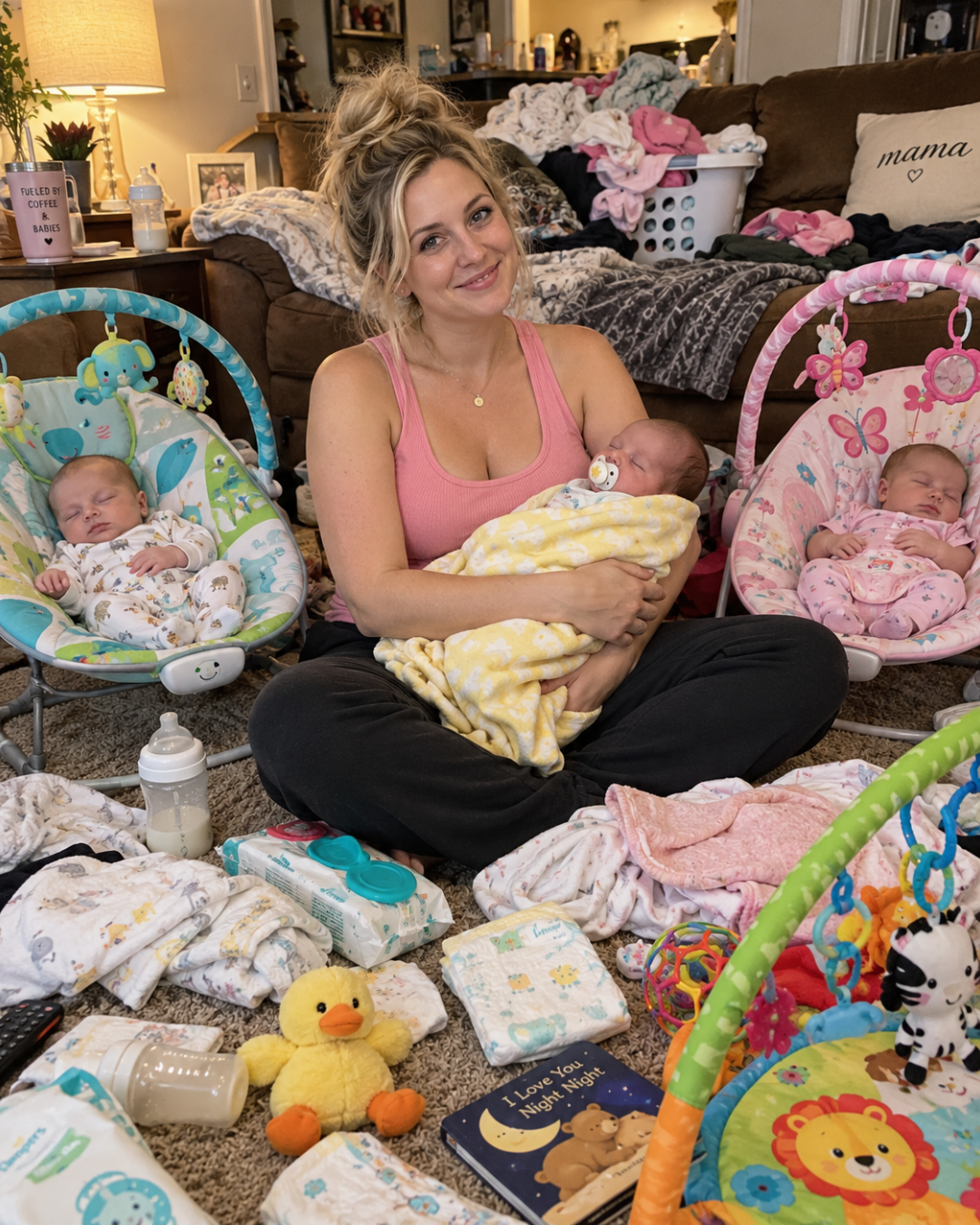
I found him standing at the sink while Aria, Liam, and Nora cried.
He looked completely overwhelmed.
“Tell me what to do,” he said.
“Start washing. I’ll feed them this time. Tomorrow, prepare before they’re hungry.”
He began washing the bottles.
I took care of the babies.
It wasn’t the first time something had gone wrong, and I knew it wouldn’t be the last.
But this time, Lucas stayed and dealt with the problem rather than retreating to the guest room.
A few nights later, he called to me from the nursery.
“Gwen, Liam won’t settle.”
I remained where I was.
“What have you tried?”
“Walking. Rocking. Singing.”
“Then keep going.”
His frustration was obvious.
“He doesn’t want me.”
I looked toward the doorway.
“He doesn’t know you yet.”
Lucas said nothing.
For six weeks, he had avoided the difficult parts of caring for our children.
He had slept through their nighttime feedings and left me to comfort them whenever they cried.
Now he was discovering how much time and patience it took to build that connection.
Instead of handing Liam back to me, Lucas sat down and continued holding him.
He rocked him gently.
Ten minutes later, the crying began to fade.
Liam finally settled in his father’s arms.
I didn’t rush in to congratulate Lucas.
He was doing what our son needed him to do.
And that was exactly what I had been asking for all along.
A week later, Lucas’s mother called.
“I heard he came home early,” she said.
“He did.”
“Is everything fixed?”
I glanced toward Lucas, who was close enough to hear the conversation.
“No. But he’s finally doing the work.”
This time, I didn’t make excuses for him.
I didn’t pretend he was helping more than he actually was.
And I didn’t soften the truth to protect his reputation.
Lucas heard every word.
He didn’t interrupt.
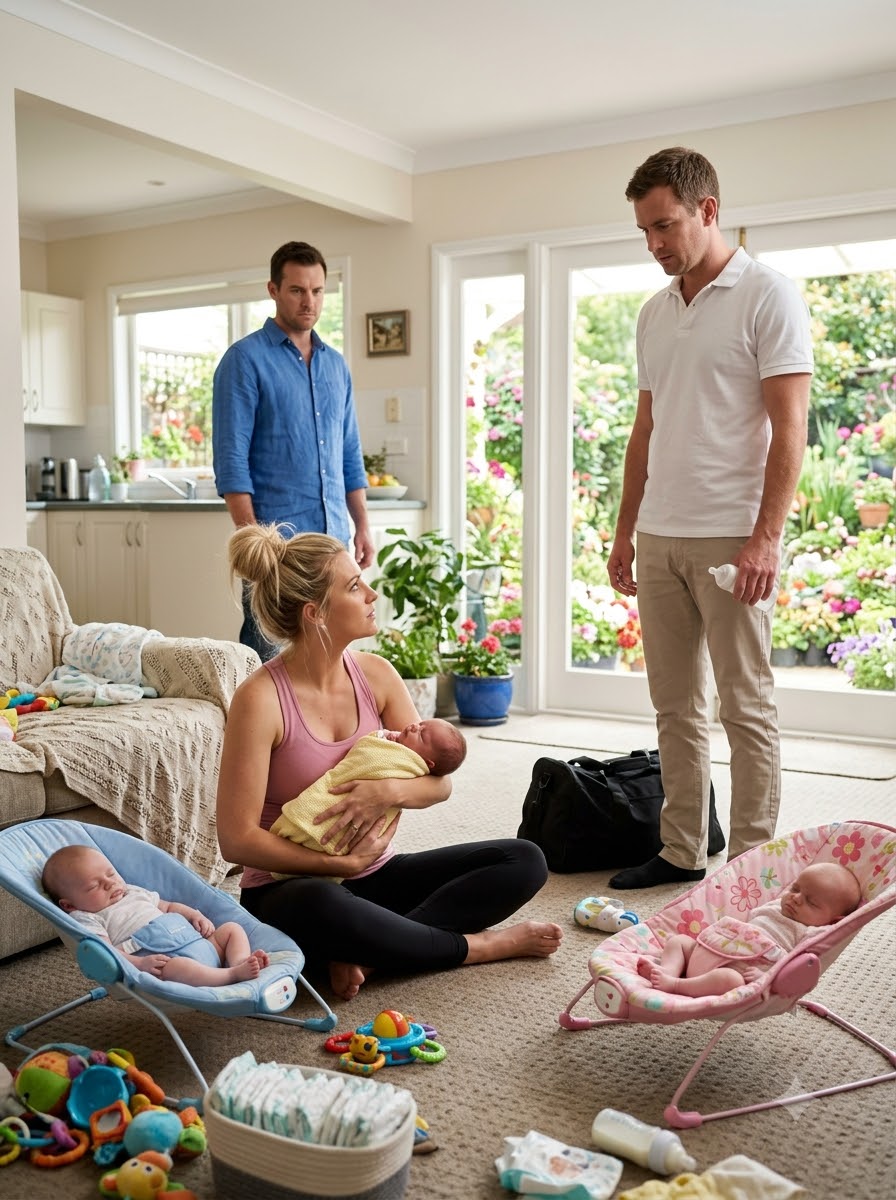
Meanwhile, Owen and Dominic organized a meal rotation with their wives.
They brought prepared food so that I wouldn’t have to worry about cooking while caring for three infants.
I accepted their help.
When someone offered to hold the babies, I used the opportunity to sleep instead of cleaning the house.
I was finally allowing myself the rest I had desperately needed since bringing the triplets home.
The changes weren’t immediate or perfect.
Some nights were still exhausting.
The babies still woke frequently, laundry continued piling up, and bottles constantly needed washing.
But Lucas was beginning to understand that being a parent meant doing the work even when he was tired.
One morning, he discovered the black fatherhood shirt folded neatly on our bed.
It was the same shirt Dominic and Owen had given him at the barbecue before our triplets were born.
The one he had worn proudly while promising to handle diapers, bottles, laundry, and nighttime feedings.
He picked it up.
“Are you giving this back?”
“No.”
He frowned.
I looked at the shirt.
“You wanted the title,” I said. “Now earn it.”
At that moment, Aria began crying from the nursery.
Lucas put the shirt down.
“I’ve got her.”
Then he walked toward our daughter without waiting for instructions.
He didn’t ask me what to do first.
He didn’t complain about being tired.
And he didn’t expect praise for responding to his own child’s needs.
I watched him disappear into the nursery.
Then I sat down at the kitchen table.
A cup of coffee was waiting for me.
I wrapped both hands around it.
For weeks, every cup I made had gone cold before I could finish drinking it.
There had always been another baby to feed, another diaper to change, another bottle to prepare.
But that morning was different.
Lucas was caring for Aria.
Liam and Nora were settled.
And for once, I had a few quiet minutes to myself.
I lifted the cup and took a sip.
The coffee was still warm.
It was such a small thing.
But after everything I had endured, it felt enormous.
Lucas had returned from Cabo expecting me to forgive him simply because he had come home.
Instead, he had discovered that coming home was only the beginning.
He would have to become the partner and father he had promised to be.
I couldn’t undo the weeks I had spent recovering from surgery while caring for our children alone.
I couldn’t forget how he had dismissed my exhaustion, blamed my hormones, or walked away when I needed him most.
And I wasn’t going to pretend that one month of effort erased those choices.
But I could recognize when he began taking responsibility.
He was finally learning the routines of our children’s lives.
He was beginning to understand their needs.
And I was no longer expected to handle every difficult moment while he protected his own comfort.
The suitcase had embarrassed him in front of his friends.
But the real consequence was what happened after he returned.
He could no longer pretend that being a father meant wearing a funny shirt, posing for photographs, or making promises while someone else did the work.
Fatherhood required him to show up.
Every day.
Even when he was exhausted.
Even when the babies cried.
Even when nobody was watching.
I sat at the kitchen table, enjoying my warm coffee while Lucas cared for our daughter.
For the first time since bringing our triplets home, I wasn’t carrying the responsibilities of four people.
And that was the change I had needed all along.
THE END
