


PART 1 — The Woman He Never Thought to Ask
My husband told me to remain at home washing dishes while he escorted his mistress to an exclusive Manhattan gala. He intended to plead with a mysterious billionaire for the financing that might keep his failing company alive. Everett laughed because he considered me a useless wife whose comfortable life depended entirely on him. He had no idea I owned the investment firm he was pursuing—or that my investigators had discovered something far more dangerous than his affair. “Stay home and wash the dishes, Emily. Tonight I need to look successful, not like a man dragged down by a pathetic wife.”
Sabrina, his communications director and longtime mistress, stepped closer and adjusted his bow tie with the easy familiarity of a spouse. “You’re seriously taking her to an official event?” I questioned. Everett answered by reminding me of the room above a shabby print shop where I had lived when we met, my secondhand clothes, and my unreliable car. “Everything you have, you owe to me.” I held his gaze. “Do you actually believe that?” His answer arrived without hesitation. “It’s a fact.” What hurt was not simply his cruelty. It was the certainty with which he dismissed an entire life he had never bothered to understand.
After they left, I went to the oak wine rack. Behind an old bottle, a concealed panel protected a biometric scanner and a private elevator Everett had never discovered. The elevator carried me beneath the estate into an armored financial operations room. My general counsel answered immediately. “Yes, Ms. Sterling?” To Everett, I was a woman quietly managing an inheritance. In reality, I had founded Sterling Investment Group, the firm holding the only financial lifeline available to Hale Enterprises. For weeks, my husband had been trying desperately to reach me without knowing whom he was asking.
“Is everything ready?” I questioned. “Yes, ma’am. The forensic audit is complete.” Investigators had traced millions through fabricated invoices and questionable transfers into a shell company registered under Sabrina’s maiden name. There was also a recording. “Emily is an idiot,” Everett laughed. “She never asks questions. She trusts me completely.” When Sabrina asked what would happen if I sought an audit during a divorce, he had an answer prepared. “If she causes trouble, we’ll have psychiatric reports prepared. Make her look unstable and legally incompetent.” Asked about the property, he said, “With the right lawyers, we’ll walk away with everything.”
The affair had already broken something between us. Hearing them discuss stripping me of my legal judgment reached deeper. Everett had not merely mistaken my privacy for helplessness; he had considered using that mistake against me. By the time I arrived at the Harbourview Grand, he was already there, displaying Sabrina at his side while awaiting the investor who might save him. “Move Everett Hale’s table,” I instructed my attorney. When she asked where, I said, “Front row. Dead center.” She questioned whether I was certain. “Absolutely.” Across the wall, Sterling Investment Group’s emblem glowed above the gathering.
Inside, glass and gold caught the chandelier light, scattering reflections over the polished floor. My attorney checked her tablet and confirmed Everett’s new seat. She reminded me that I would be introduced before the financing announcement. Once I entered that ballroom, the professional life I had kept apart from my marriage would no longer remain private. I touched the small silver locket my mother had given me. I remembered sitting at my father’s desk while he explained that money could solve certain difficulties, but could never determine who I was allowed to become. He had wanted me to build a life that belonged to me.
“Are you ready?” my attorney asked. “No,” I said honestly. “But I’m going.” Across the reception hall, Everett entertained a circle of executives with his practiced smile. Sabrina stood beside him in a dark green dress, her hand resting on his sleeve. Whenever he turned away, her gaze shifted toward the stage. The shell company connected to her name did not yet establish that she had designed the fraud. Still, seeing her there made the affair look like only one part of something much larger. For a moment, I remembered Everett burning onions during our early marriage and insisting dinner was “intentionally rustic.”
My attorney reminded me that I did not have to settle the future of my marriage that evening. “I’m not here to decide whether I still love him.” When she asked what I had come to decide, I answered, “What I’m willing to protect, and what I’m no longer willing to hide.” The host welcomed everyone and spoke about resilience, innovation, and the difficulties Hale Enterprises had endured. Then came the announcement Everett had been waiting for: a representative of Sterling Investment Group would address the guests. I could feel the separation between my two lives narrowing with every word.
“Please welcome Emily Sterling, founder and managing director of Sterling Investment Group.” Everett began to rise, then froze halfway out of his chair. “Emily?” The host introduced me as the person whose decision would determine whether his company received its lifeline. Walking toward the podium, I saw disbelief replace his polished confidence. Sabrina remained standing beside the table, apparently unsure whether to stay near him or put distance between them. The room that had welcomed them as an impressive couple now watched me. I had not come to perform the humiliation Everett had so casually handed me in our kitchen.
“Thank you for being here,” I began. “I know many of you came tonight hoping to hear that Sterling Investment Group is prepared to rescue Hale Enterprises.” I explained that no new financing would be provided until an independent audit and board review were complete. Everett stared up at me while Sabrina’s composure faltered. “An investment is not a gift,” I said. “It is a responsibility to the people who build the business, to the investors who support it, and to the truth that makes both possible.” Then I made the boundary clear. “I will not place money into a company before we understand where its money has already gone.”

Someone asked whether the audit had uncovered misconduct. “I’m saying it uncovered transactions that require explanation.” I could have revealed the false invoices and Sabrina’s connection to the shell company in front of everyone. Instead, I announced a closed board session for the following morning. “Then we can ask questions with the documents in front of us, rather than relying on rumors.” My restraint appeared to disturb Everett more than a public accusation would have. When he approached afterward and said my name, I stopped him. “Not here.” He asked to speak privately. “We can talk where the doors stay open.”
In the corridor, he admitted he had not known I owned Sterling. “You never asked what I did with my time.” He said he thought I managed the trust my father left me. “I was.” I explained the distinction he had never considered. “My father left me enough to begin,” I said. “He did not leave me Sterling Investment Group.” When Everett started asking how, I answered simply, “I built it.” He admitted he should have asked. Then he said he had believed I was content. “You thought I was quiet.” His apology for the kitchen followed, along with the familiar explanation that he had been under pressure.
“That explains why you were tense. It doesn’t explain why you chose to humiliate me.” Then I asked about the recording and the proposed psychiatric reports. Everett called the conversation a discussion of possible legal scenarios, something never meant to become real. “Possible scenarios that involved making me look unstable.” He said he had been angry and had never wanted me harmed. “You were willing to have strangers question my judgment so you could keep control of what I owned.” He claimed he had not expected matters to go so far. “You were discussing it as a plan.” At last, he acknowledged it.
A passing director silenced him until we were alone again. Everett insisted he knew nothing about false invoices. I reminded him that he was chief executive and that denial could not replace evidence. His frightened expression recalled the night I had waited beside him during his mother’s surgery, when he had hidden his worry behind talk about work. That memory did not erase the present. He asked who knew, whether Sabrina had heard the findings, and where the money had gone. “I didn’t tell you anything.” He would receive the same records as everyone else at the board meeting.
“I’m still your husband,” he said at last. “You are,” I said. “But that doesn’t mean you still know me.” He believed he once had. “You knew the parts of me that made your life convenient.” When he said he had loved me, I answered, “I believed you.” What seemed to overwhelm him most was discovering my power. I asked whether that was what frightened him. He denied it and said he feared losing me. I could still remember loving him, but memory no longer gave him the right to define the woman standing before him.
Sabrina approached near a tall window after Everett joined his mother. City lights glittered behind her. She said she had not known I was the investor. “That has nothing to do with what the audit found.” She offered to explain the company structure, and I directed her to the auditors. “Everett didn’t create the whole system.” When I asked what system, she retreated, saying she should not discuss it there. Then she admitted, “I’m not trying to protect him,” she said. “I’m trying to protect myself.” I told her to give the investigators everything and leave every record untouched.
Before walking away, Sabrina added that some invoices had been processed years before her employment. She could not say exactly how long. When I asked whether she had begun the scheme, she reserved her answer for the auditors. For nine months, my investigators had followed money through accounts and corporate records. Her warning turned that trail backward. A director asked whether my financing decision was personal. “Personal feelings are exactly why we need an independent review,” I said. “The audit has to be able to reach a conclusion that no one can dismiss as a family dispute.”
Mara later confirmed an archived authorization under Everett’s credentials, while emphasizing that no one had established who entered them. I refused to treat a login as proof of personal approval and requested the original system logs. At four the next morning, I returned to the operations room. The earliest record had survived two system migrations. Graham Pike, the former finance officer, appeared in old ledger notes questioning consulting charges. He had left before our marriage and died six years earlier. His handwriting still required authentication. “You’re still trying to give him every fair chance.” I answered, “I’m trying to give the evidence every fair chance.”
At nine, the board reviewed those uncertainties. Everett said he did not remember the first invoice. His mother, Margaret, dismissed Pike as someone who saw trouble everywhere, then described caution as inconvenient when a company needed to grow. Everett corrected her when she suggested he had been too young to understand the business. He had been thirty-two and working there for eight years. His shoulders drew inward beneath her familiar judgments. The directors granted access to archived records and suspended employees involved in financial approvals while the review continued. Afterward, Everett admitted how many things he had decided about me without asking.
Sabrina arrived with old expense records and a note from Pike requesting that a consulting payment be held until the vendor and services could be verified. It had been sent to the communications office, not personally to her; she had joined later as a junior assistant. A handwritten instruction said not to route it through the executive office before Pike spoke with the chair. Everett recognized the writing. Gradually, he recalled Pike warning that company money might be supporting a private arrangement. Margaret had summoned Pike afterward. She had been chair then, and Everett had accepted her claim that he was making trouble.
In the car, Mara reported that Everett had been away at a company retreat when the earliest authorization was entered. Several people could have accessed his credentials, including his mother’s administrator, finance employees, and Pike. The first payment had gone to a different consulting firm, not Sabrina’s shell company. Then an archived letter surfaced, addressed to my father. Pike had written about an anonymous investment in Hale Enterprises nearly two decades earlier. My father’s familiar handwriting appeared beneath the photocopied text. The history I thought belonged to Everett’s family had suddenly opened into my own.
Mara called after tracing the authorization behind that original investment. “Emily, we found the account that funded the original Hale investment.” I asked whose account it was. She explained that an intermediary had concealed the source, but the authorization survived. “The archive lists your father as the source of the money.” I had gone to the gala believing I alone would decide whether to rescue my husband’s company. Now I learned my father had helped save it before I ever met Everett—and someone had kept his place in its history hidden.
PART 2 — The Debt My Father Refused to Leave Me
I had believed my father’s financial history was a book already closed. He had built a successful business, established a trust for me, and given me room to choose my own direction. Nothing I remembered connected him to the company I was now being asked to finance. When Mara apologized for how personal the discovery had become, I asked who else knew and whether the letter explained his reasons. The records offered no immediate answer. “Then we find out.” I went to his study, which I had left much as it had been when he was alive.
A photograph showed my parents outside a modest house, laughing while the wind lifted my mother’s scarf. On it, she had written: Choose your own life. Nearby lay a faded bank record tracing a substantial transfer, enough to steady Hale Enterprises when creditors were preparing to retreat. “Your father’s trust was the source,” Mara said. “The intermediary was used to conceal his name.” He had requested anonymity himself. According to an accompanying note, he had met the company’s chair. I assumed Margaret, but Mara corrected me. Everett’s father had held the position then, years before Everett took control.
Another letter, this one from my mother, complicated the discovery. The Hales had approached through a mutual acquaintance while their company struggled to secure financing. Employees faced losing their livelihoods if the next round failed. My mother had urged my father not to act merely because of an earlier promise. One sentence stopped me: “Promise her that she will never be used to settle anyone else’s debts.” I could not remember either parent mentioning the Hales. Their silence now felt different from Everett’s. Still, I needed to understand what promise had made my mother worry about my future.
Margaret arrived carrying a slim leather folder. Mara reminded her that the review was private. She said she had not come to interfere; she had recognized my father’s name. Margaret acknowledged knowing he had once helped the company, but claimed she had not realized I was his daughter when Everett married me. She recognized the connection afterward, during dinner at the family home. “And what did you do with that knowledge?” I asked. “Nothing.” She had considered silence safer for the company and for Everett. When I asked whether that included me, she finally admitted, “Not for you,” she said at last.
I asked her to sit. My father, she explained, had wanted repayment without an announcement or any public attachment to his name. His reasons involved my mother. Years earlier, before the Hales had much money, Margaret’s sister had been ill. My mother, then a nurse, had stayed through a frightening hospital night when Margaret had no one else to call. My father later said he was helping because Margaret’s sister had once been kind to my mother. The rescue had grown from remembered kindness, not a business alliance. Neither of my parents had asked Margaret to conceal it from me forever.
“Because your father made a condition.” I asked what that condition had been. “He said the money was for the company, not for the family. He did not want a personal debt to become an obligation you would inherit.” He had spoken specifically about my freedom, saying I must never be treated as an answer to another family’s financial problems. I asked whether anyone had arranged for me to marry Everett. Margaret said no. My father had expected no place for me in their family and no reward beyond repayment. Her husband had been grateful, but gratitude had not been a marriage contract.
The company had repaid the financing through the intermediary over several years, including interest. Mara confirmed those repayments returned to the trust, although every subsequent movement had not yet been traced. Margaret said my father wanted me free of any burden created by his decisions. I remembered how readily he taught me to read a balance sheet, yet how rarely he discussed his own generosity. He had never presented wealth as permission to control someone. He let me believe my trust was modest because he wanted me to build independently, not measure my future against money already placed in my name.
My mother’s warning still demanded an explanation. Margaret admitted that Everett’s father had once remarked that, if the families grew close, perhaps Everett and I might make a suitable match. It had been a casual comment after the company recovered, she said, not an arrangement. My father had heard it and responded unmistakably. “He told my husband that no money, favor, or family gratitude would ever give him a claim on you.” I could almost hear his voice across the desk. The investment was a financial agreement. My life was not collateral, repayment, or a promise anyone else could make.
Margaret said Everett had not known any of this when we married. She had never told him about my father’s help. At first, she argued that the loan had been repaid and the company was secure. Pressed further, she admitted fearing that Everett might see me as someone carrying a claim against the business—or feel obligated to me. “That would have been his problem.” She had protected him from knowledge while deciding what I could withstand. “You decided what I could carry.” Her answer was quiet. “Yes,” Margaret said. Whatever kindness she believed motivated her, its result had been another secret chosen on my behalf.
At last, Margaret opened the leather folder. She had found the papers among her husband’s belongings after his death and brought them because the audit had disturbed the old history. My father’s letter confirmed that his investment protected workers, not influence over the Hale family. Repayments belonged in the trust. No personal relationship was expected in exchange. One line held me motionless: Emily must remain free to choose whom she loves, where she lives, and what life she wants. Margaret had kept the clearest proof of his conditions while hiding the connection, especially after I married Everett.
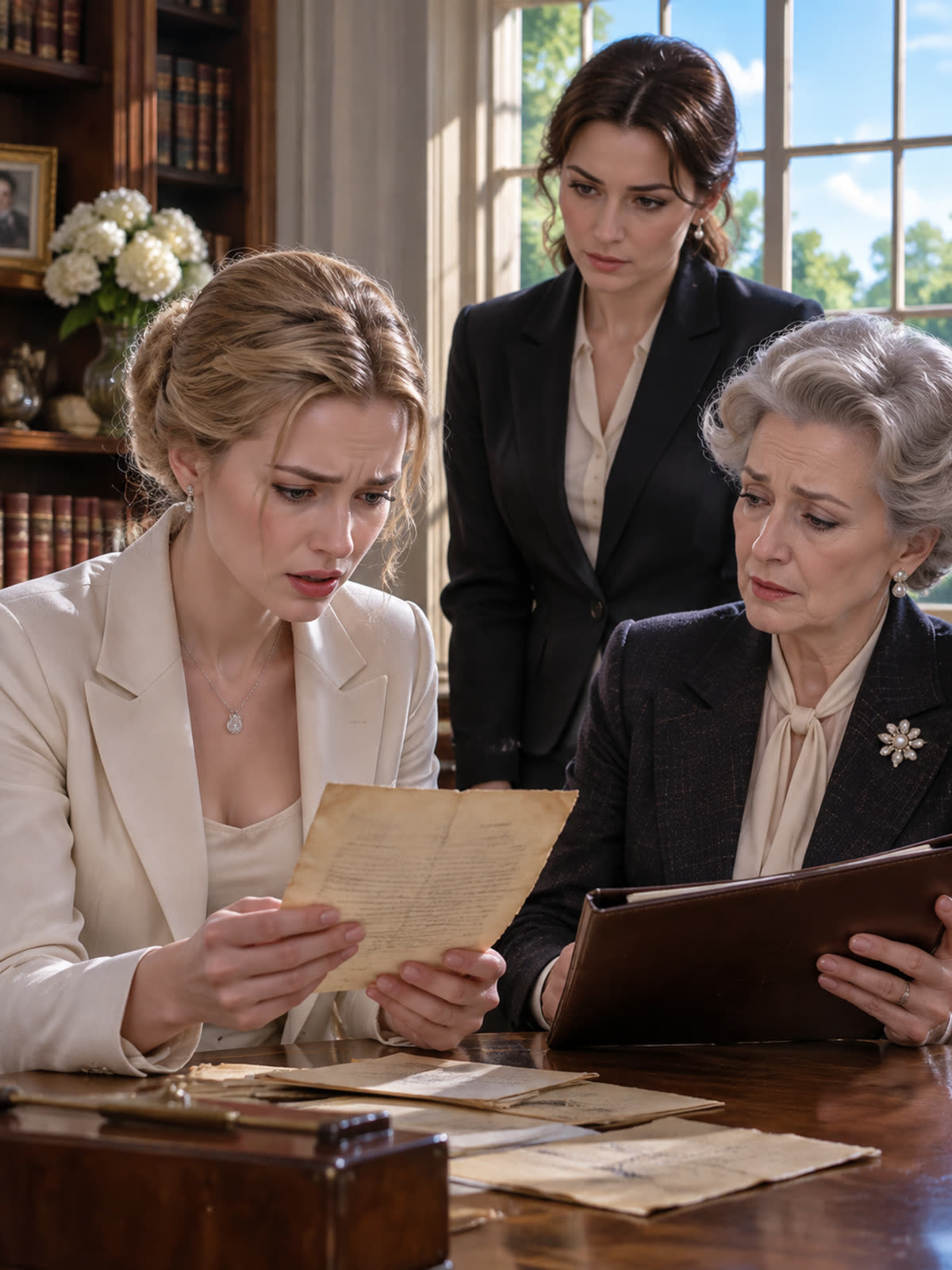
She said she had hoped our marriage could exist separately from the past. I did not know whether it had. If Everett had honestly loved me at the beginning, an undisclosed investment would not erase that love. But neither would it excuse what followed. Margaret could not say what he believed about my inheritance, whether he knew its size, or whether he had ever wondered about it. Mara asked to authenticate the letter against the archives. Margaret agreed. Before leaving, she admitted that she had spent years treating protection of the company and protection of the family as the same responsibility.
“And now?” I asked. “Now I’m not sure they ever were.” She suggested asking Everett about the year his father received the money. I chose to speak with him alone. Financial statements sat before him, unread. He knew I had spoken with his mother but appeared genuinely surprised when I described my father’s investment. “Your father saved the company.” “He helped it survive.” Everett said his father had never told him. This time, I believed his lack of knowledge. I explained that my father had insisted no one treat the investment as a claim on my future.
Everett wished he had known. I asked whether that wish came from wanting to understand my father’s kindness or what I had brought to the marriage. “I don’t know.” He had believed the trust was modest because I said I had used it to get started. That statement had been true, but it had not been the whole account. I was not ready to have my privacy recast as deception while his assumptions escaped examination. He asked whether I was disappointed in him. “I’m still trying to understand what you knew and when.” He said he understood. I was no longer certain what that meant.
I needed to know whether he had married me believing I could help Hale Enterprises. He denied knowing the amount of my inheritance, denied thinking my father’s name would benefit the company, and denied expecting financial help from me. Asked why he married me, he answered, “Because I loved you.” He remembered my kindness and the way I saw through his performances. I asked why he later treated me as if I offered nothing. He could not explain it. “You made me feel small so you could feel certain.” He apologized, but apology could not settle whether he regretted his cruelty or discovering whom he had mistreated.
“Do you remember that because I’m your wife, or because you now know I’m Sterling?” I asked. Everett said either answer would make me doubt him. He was right. He could not prove his feelings had never been connected to what I possessed, and I would not pretend otherwise for his comfort. Then he spoke about Margaret’s lifelong fear of losing the company to lenders or investors. She probably thought concealing my father’s rescue preserved their independence. “By keeping the people who helped you invisible.” He agreed. When I asked whether that sounded like independence, he answered, “No.”
Everett remembered his father saying the company had been saved by people the family could never repay, but he could not place the remark before or after the investment. His uncertainty had become exhausting. “You have to stop using uncertainty as a place to hide.” He said he was trying. Soon afterward, Mara found a second archive box containing correspondence from Graham Pike. Much of his private file had never been scanned. A letter written shortly before he left Hale Enterprises thanked my father for answering questions about the anonymous investment. Pike worried that the company’s records no longer matched the original agreement.
Later transactions, Pike wrote, appeared to use that old investment as justification for fresh payments. One sentence changed the direction of the investigation again: I do not believe Mr. Hale knows the full extent of what is being done under his authority. Everett carefully took the letter and asked which Mr. Hale it meant. His father. If Pike was correct, someone had exploited the company’s financial history without fully informing the man supposedly in charge. The letter did not establish whether Pike’s warning had reached my father in time, or whether anyone had acted on it. It offered another trail, not a verdict.
An old transaction ledger recorded repayment from Hale Enterprises to my father’s trust. Beside it, someone had written: Gift to Emily — per agreement. I asked whether the repaid money had been intended for me. Mara said the records appeared to show my father transferring it into my trust, where some remained and some had been reinvested. His generosity had given me my beginning after all, though it had not built Sterling in my place. The distinction mattered. I could acknowledge what he left without surrendering ownership of what I made from it, just as his assistance had never given the Hales ownership of me.
Everett returned to Pike’s suggestion that his father had not understood the later payments. Margaret had been chair by then. Mara cautioned that bank records were necessary before anyone drew conclusions. For once, Everett and I agreed immediately. The questions had become too tangled for memories alone. An anonymous rescue, repayments, later consulting charges, shared access, and a shell company could not simply be folded into one convenient accusation. If I wanted the truth to survive scrutiny, I had to accept the possibility that different people bore responsibility for different acts, committed years apart and concealed beneath the same familiar company name.
I kept thinking about my father’s letter. He had been clear when clarity mattered most: kindness did not purchase another person’s future. Yet his financial arrangement had become part of a structure whose history even the family running it scarcely understood. My marriage had grown beside that structure, surrounded by assumptions no one tested. Everett had assumed I was dependent. Margaret had assumed silence was protection. I had assumed privacy and trust could live together without questions. Those assumptions were not equally harmful, but each had left room for secrets to harden. I could not undo them by choosing a simpler story.
When Mara called again, the bank records had finally supplied a firmer boundary. After my father’s original investment was repaid, only one person had authority to move money through the intermediary account: Margaret Hale. The woman who concealed my father’s rescue also controlled the channel later used for disputed transfers. That fact did not yet explain where every payment went or why she authorized it. Some of the consulting work might prove genuine. Some might not. But the investigation had moved beyond family recollections and into records bearing a single person’s authority. Margaret could no longer remain merely a witness to the company’s history.
For years, she had described secrecy as the cost of protecting Hale Enterprises. She had kept my father’s name out of sight, left Everett uninformed, and decided that I should not know how our families’ financial histories crossed. Now I had to ask what all that protection had actually preserved. Was it the business and the people earning their living there, or the family’s power over both? The account records could establish access. They could not establish motive. And until we followed the money to its final destination, I could not know whether Margaret had been keeping the company alive—or keeping it captive.
PART 3 — What Rescue Could Not Erase
Over the following days, auditors separated real consulting work from payments supported by no meaningful services. One company had no verifiable staff and an address leading only to a shared-office mailbox. Some money eventually reached the shell company registered under Sabrina’s maiden name. Investigators found no indication that my father knew about the later transfers and no proof that Everett understood the earliest false invoices. But the completed report established something I could no longer set aside: after becoming chief executive, Everett had personally approved several unsupported payments. Secure-device logs and meeting records connected those approvals to him.
The report also made it impossible to dismiss the discussion about psychiatric reports as an idle hypothetical. Everett had considered undermining my legal judgment to stop me challenging his control. Mara offered me time before reviewing the board’s recommendation. I declined. The directors believed the company could not continue under his leadership. Some favored selling; others wanted emergency Sterling financing in return for operational control. Refusal would leave creditors to decide what survived and could cost hundreds of jobs immediately, with further losses among suppliers. Financing could preserve most employment, but only if creditors cooperated and clients remained.
I would not use employees as instruments of punishment, nor protect wrongdoing in their names. The proposed restructuring called for new leadership and an independent monitor. Before deciding, I met three employee representatives: Luis, a production manager; Denise, a payroll supervisor; and Priya, a young engineer. Denise asked whether they would be paid the following month. I explained the payroll protections in the plan and admitted I could not promise what creditors would do without an agreement. Luis wanted a straightforward answer about whether the money existed. “It is.” Then he asked why we were waiting.
“Because the audit found serious misconduct, and I won’t put Sterling’s money into the same structure that allowed it.” Priya asked whether that meant allowing the company to close. It did not. Financing would come with conditions for everyone holding decision-making authority. Luis wanted to know what happened to employees who had done nothing wrong. “They should not pay for decisions they didn’t make.” I could not guarantee every job, but I promised wages would not become leverage. Asked whether being Everett’s wife made the decision harder, I answered, “It makes it sadder,” I said. “It doesn’t make the evidence different.”
Luis said they would be watching what I did. He was right to withhold trust until my choices earned it. At the board meeting, Everett sat away from the chief executive’s chair while a temporary director presided. The auditors confirmed Margaret’s later transfers, Sabrina’s shell-company connection, and Everett’s personally authorized approvals. They also distinguished the earliest invoice, entered before Sabrina joined and while Everett was away. The findings did not offer one villain and one clean explanation. They described failures and decisions made by several people, none entitled to shelter behind another person’s greater involvement.
“I approved several payments that I should have questioned,” Everett said. “I told myself the finance team had verified them, and I accepted explanations that were convenient.” He denied knowing the full extent of the fraud but admitted recognizing vague consulting descriptions and approving payments without proper documentation. He wanted the company to appear stable and told himself matters could be reconciled later. A director then asked whether he had asked Sabrina to prepare psychiatric reports about me. “Yes.” Asked whether he intended to use them, he admitted he believed their possibility could keep me from interfering.
He acknowledged discussing making me appear legally incompetent. “I was wrong,” he said. “I don’t expect that statement to erase what I did.” “No,” I said. When my turn came, I offered emergency financing with conditions. The board would be reconstituted, and anyone connected to the disputed transfers would lose oversight authority. The company would not be sold while the investigation and restructuring remained incomplete. One director called it a rescue. “It is a restructuring,” I replied. “It will not preserve the old company.” It could preserve honest work and the people still willing to do it.
“This financing is not forgiveness.” I made clear that it was no favor to Everett, Margaret, or Sabrina. It was an investment in employees and accountability. Without those conditions, Sterling would provide nothing. The directors signed interim governance documents, and investigators secured the originals. Sabrina afterward promised cooperation. I told her to tell the truth even when it damaged her. Margaret admitted authorizing transfers without proper documentation because she feared losing family control. Asked whether she still thought she had protected the company, she finally answered, “Now I think I was protecting my place in it.”
Everett said he had hoped I would save the business. When he asked whether I had done it because of him, I answered, “No.” He wondered whether letting it collapse would have been justice. “It might have felt like punishment.” He believed punishment was what he deserved. “That isn’t mine to decide.” He apologized without asking me to return or trust him. I believed he was sorry, but sorrow did not repair his choices. As he read the findings and faced losing the position that had defined him, I could not give him absolution simply because consequences had finally become real.
“But being sorry doesn’t restore what you chose to break,” I continued. He admitted that perhaps he did not yet fully understand. Then he asked, “Are you going to be all right?” It was the first question he had asked about me without immediately returning to the company, the audit, or what he stood to lose. Across the conference table, his regret was no longer hidden behind arguments, while the signed restructuring papers lay between us. I did not offer comfort I could not honestly give. “I’m going to find out.”

The immediate financing protected only the next two pay periods while creditors considered the remaining agreement. Until they signed, the future stayed uncertain. Then a later transfer raised another question. The shell company had received money after Sabrina left, from a private rather than corporate account. Another payment led to a firm outside the earlier arrangement, and records showed an interest transferred into a trust. My father’s name appeared above mine. Mara warned that the transfer still required verification. Margaret had authorized the payment, but the trust appeared to have held the voting interest for years.
The recovered history was complicated, but its original purpose became clear. During Hale Enterprises’ earliest crisis, an interest had been placed in my father’s trust to stop outside creditors breaking up the business. He agreed to hold it temporarily, without directing operations or passing any obligation to me. Once the original investment was repaid, he intended its return. Margaret left the paperwork dormant, afraid of renewed creditor pressure. Years later, as instability returned and discovery became possible, she moved the interest into the trust. An arrangement meant to protect the company had become another unresolved secret.
Margaret came to my office without a folder or counsel. She said she had not known I was listed as beneficiary until the auditors found the transfer. She believed the interest belonged back with the company, yet every attempt to address it had yielded to another crisis. After my father died, she kept believing there was time. I could release it, but neither of us could assume that alone made the outcome fair to employees. She admitted that retaining family control had not kept everyone safe. “He knew that helping someone did not give him the right to decide what they became.”
The interest returned to Hale Enterprises under independent board supervision. I refused to accept it as a personal inheritance, and the company did not call its return a favor. New controls required significant payments to be reviewed by people without a private stake in their outcome. Creditors accepted staged financing: first payroll, essential suppliers, and reliable operations; later funds depended on financial and reporting standards. When the first protected payroll cleared, Denise sent a brief message. It was not a promise that every difficulty had ended, but it meant people had been paid for their work.
Margaret cooperated with regulators, lost eligibility for the restructured board, and had to repay part of the money traceable to her decisions. Sabrina testified about the invoices and shell company. The evidence established that Everett personally approved later fraudulent payments even without knowing every recipient. He was removed and required to repay funds tied to approvals knowingly made without adequate documentation. Through our attorneys, he sent a letter acknowledging that an apology might arrive too late to help. I did not mistake accountability for healing, but neither could healing require pretending that accountability was unnecessary.
Our divorce became final on a bright early-autumn morning, with gold beginning to touch the city. “I hope your life becomes what you want it to be,” Everett said. I thanked him. He said he understood he could not ask for forgiveness. I hoped he did. “I hope you become someone you can respect,” I said. “I hope so too.” The conversation could not restore our marriage, and I no longer wanted it to carry that task. We had once loved each other. We had also reached the end of what that history could ask me to endure.
Hale Enterprises stayed open under leaders and directors from beyond the family. Denise helped build a payroll system that exposed delays before they became emergencies. Priya joined the development of energy-efficient equipment. At the first annual meeting under the new structure, Luis spoke about workers being able to examine the books of the business their labor sustained. The applause recognized a beginning rather than a rescuer. “You kept your word,” he told me. “We’re still working on it.” He considered that a moment. “That’s what keeping your word looks like, I think.”
I founded a scholarship in my parents’ names for people studying finance, entrepreneurship, or community development. We began modestly and planned growth through Sterling’s profits. The first grant went to Marisol Vega, who had spent years repairing neighbors’ clothing in her apartment’s back room. She was wary of accepting money that gave someone else power over her business. I asked what she wanted funding to make possible. “A place where I can do good work and teach what I know.” I answered, “Then we’ll build an agreement around that.” Her disbelief reminded me why the terms mattered.
At her opening, Marisol stood smiling in the doorway with a tape measure around her neck. Later, the scholarship brought me to a community college on a rainy afternoon. A student asked whether I had never been frightened. “I was scared often,” I said. “But fear is not always a sign to stop.” Asked what it signaled instead, I answered, “Sometimes it means you care about what happens next.” I was not offering a life without risk. My own certainty had failed too often for that. I was learning that courage could coexist with unanswered questions.
I began sharing dinners with people who knew me without needing anything from Sterling. Margaret wrote that she had started volunteering with a program helping former employees find new work. At the bottom, she acknowledged my mother’s insistence on my freedom. I did not know whether she and I would ever become friends. Her willingness to admit fault mattered, but it could not dictate the shape of whatever relationship followed. For years, she had decided what other people should know and bear. I would not answer by deciding that one letter settled everything between us.
On the gala’s anniversary, I returned to the Harbourview Grand for a scholarship dinner. A young woman named Asha described her hope of creating an affordable bookkeeping service for neighborhood businesses. She once believed understanding money entitled people to decide for everyone else. “Then I learned that money can also give people time, choices, and a chance to be heard.” I thought of my father refusing to let kindness become a claim, and of myself in the kitchen while Everett insisted I owed him everything. Now, when Mara observed that I looked happy, I could honestly say I was.
I had expected happiness to announce itself more loudly. Instead, it felt like being able to choose tomorrow. Hale Enterprises had survived without the family control once mistaken for care. I was Emily Sterling: a loved daughter, a woman who had built something of her own, and someone still discovering what she wanted. Yet one question remained beyond every audit, repayment, and signed agreement. I still did not know whether Margaret and I would ever be friends. What happened between us next could not be settled by money or inherited promises. For once, the choice would be mine.
Disclaimer: This story is a work of fiction inspired by real-life themes. Names, characters, places and events are fictionalized, and any resemblance to real persons is purely coincidental. Images are for illustration purposes only.
