


PART 1 — THE FAMILY HE REFUSED TO CHOOSE
“Your brother and his wife are dead, ma’am. But their four-year-old son survived. He’s asking for you.” The officer’s call came while my fiancé was complaining about how my wedding dress fit. The seamstress let her measuring tape fall. Derek rose from the velvet couch as I began wrenching pins from my $6,800 gown. “Laurel! What the hell are you doing?” Derek shouted. “My brother!” I gasped. “Jonah and Maren are dead!” He caught my shoulders. “What? That doesn’t make sense. They were driving to visit Maren’s parents.” “They were in an accident! Nolan was with them!”
My hands shook too badly to work the zipper. Before the seamstress could reach me, I ripped the silk beside my hip. That gown should have belonged to the happiest day of my life. Instead, it became the final lovely thing I remembered before everything came apart. My name is Laurel Fenwick. I was a successful twenty-eight-year-old architect in Portland, three months away from marrying Derek Sloane. Until that afternoon, I believed he was someone I could depend on through anything. I had no idea that losing Jonah and Maren would also reveal the truth about the man I intended to marry.
An officer approached us outside the emergency department. “Ms. Fenwick?” “Where’s Nolan?” I demanded. “Where’s my nephew?” “He’s safe. He’s been examined. His injuries are relatively minor.” Only then did I manage to ask about the other people who had been inside that car. “And Jonah? Maren?” “I’m very sorry.” I had heard it already, yet those words became more unbearable when spoken in person. A hospital employee took me into a quiet room. Two bodies lay beneath separate coverings. My brother, who had once carried our entire family on his shoulders, was suddenly beyond my reach.
Our parents died when I was thirteen. Jonah had been twenty, hardly old enough to manage his own life, but he took responsibility for mine. He worked construction by day and stocked shelves at night. An old laptop taught him how to braid my hair. When architecture school accepted me, I nearly refused because the cost seemed impossible. Jonah sold his motorcycle. Maren, then his fiancée, gave up the wedding they had spent two years planning. Their savings paid for my drafting computer, books, and supplies. “Build something beautiful with your life,” Jonah told me. Now I stood beside him, whispering, “Jonah, please,” and then, “Please don’t do this.”
A nurse brought Nolan to me. His dark-blond hair was rumpled, his blue jacket stained. He clutched a toy fire truck with a wheel missing. “Aunt Laurel?” “Nolan, sweetheart.” I gathered him into my arms and pressed him close. “Mommy won’t wake up,” he whispered. “Daddy won’t wake up either.” Then came the question that changed something inside me forever. “Are you going to die too?” I kissed his forehead. “No,” I whispered. “I’m here, baby. I’m right here.” “Promise?” “I promise I’ll do everything I can to come home to you.” Across the room, Derek watched with an expression I would eventually understand.
His fear was about what this little boy might mean for our future. When the nurse said Jonah and Maren had named me in their emergency guardianship paperwork, Derek turned abruptly. “Wait,” he said. “You’re taking him home?” “Of course I am.” “Tonight?” “Derek, his parents just died.” “I know. I’m just asking whether the hospital has someone who handles situations like this.” The nurse explained, “Family placement is generally preferred when a suitable relative is available.” Derek persisted. “But there are other options?” I stared at him. “What other options?” “Laurel, can we talk privately?” “No.”
“Please. Just for a minute.” I tightened my arms around Nolan. “If you have something to say about Nolan, say it in front of me. But don’t make him listen to anything cruel.” “I’m not being cruel. I’m being practical.” People considered Derek dependable. He did not resemble the kind of man anyone warned you about. Yet at the worst moment of my life, his instinct was to weigh the inconvenience. That evening, I took Nolan home. He slept during the drive with the broken truck in his hands. I carried him into the guest bedroom, but within minutes he woke screaming for his mother.
I held him almost until morning while Derek remained downstairs with his phone. At 5:17 a.m., he appeared in the doorway wearing his jacket. “Laurel?” Nolan was sleeping against me. “I have to go home. I’ve barely slept.” Then he added, “We really need to discuss what happens next.” “What do you mean?” “With him.” “Derek, Nolan is my family.” “I understand. But he’s not automatically mine.” He continued, “We have a wedding in three months, Laurel. We can’t pretend this changes nothing.” Shortly afterward, he texted: We need to make a decision about the boy before we make any more wedding payments. Nolan’s tiny hand was wrapped around my finger.
Three days after the funeral, Derek arrived with two dozen red roses. Nolan had not slept for more than two hours at a stretch. He ate crackers, panicked whenever I disappeared from view, and screamed when car doors slammed outside. Toys, laundry, and half-finished meals filled my once-orderly townhouse. Derek surveyed the room with obvious disgust. “Good God, Laurel. What happened to this place?” I was on the carpet cleaning chicken noodle soup Nolan had spilled during a panic attack. “I haven’t exactly had time to clean.” He stepped around the mess. “Maybe you should hire someone.” “I’m trying to find a caregiver Nolan feels safe with.”
“Well, at least I brought something to brighten the place up.” Before I could respond, Nolan cried from the hallway, “Aunt Laurel! Don’t leave!” “I’m not leaving, sweetheart.” Derek gave an irritated sound. “Does he do that all day?” “Sometimes.” “How long is this supposed to last?” “His parents died six days ago.” “I know that, Laurel. But kids are resilient. He’ll move on.” “He watched his parents die, Derek.” “I’m saying he can’t be allowed to control everything.” I lifted Nolan and rocked him on the couch until his breathing settled. Twenty minutes later, he finally slept. Derek had opened his laptop at the kitchen table. The soup remained untouched.
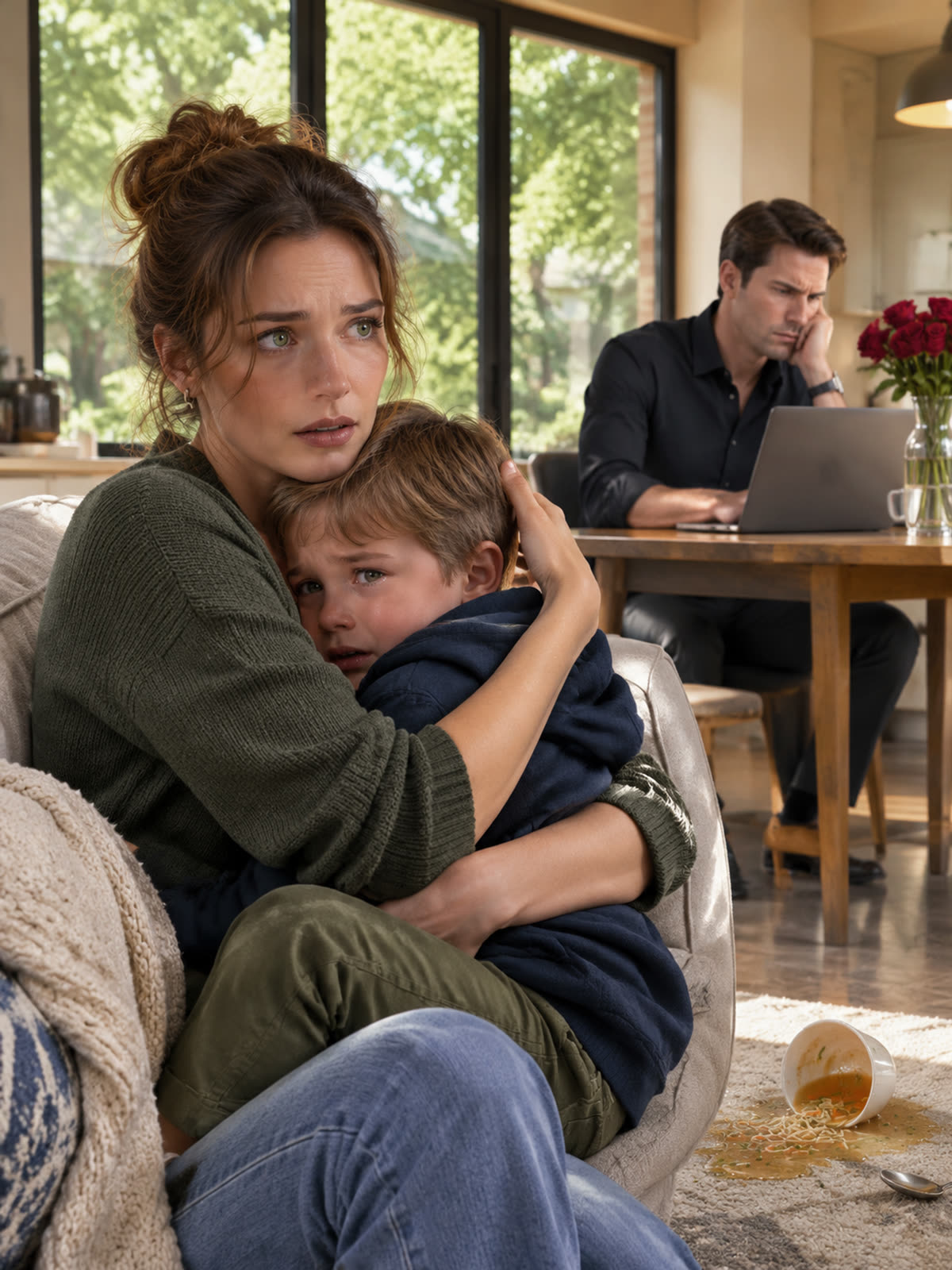
“Okay,” he said, “we need to figure out the second payment to the venue.” “You’re seriously talking about wedding deposits right now?” “We’re three months out. The vendors aren’t going to wait forever.” “Derek, I can barely remember to eat.” “Which is exactly why we need to maintain some normalcy.” “Normalcy?” “Laurel, I love you. But we can’t let this tragedy destroy everything we’ve planned.” In the living room, Nolan lay curled around a blanket Maren had knitted. “He’s four.” “Yes. And we’re adults.” Then Derek suggested the thing I already knew he wanted. “Maybe we should explore a long-term arrangement with another family member.”
“There isn’t anyone else.” “Then maybe someone outside the family.” “You want me to give Nolan away?” “Don’t make it sound ugly.” “What would you call it?” “Finding a more suitable environment.” I remembered Jonah standing in our childhood kitchen after our parents’ funeral. Asked whether he was prepared to become my guardian, he had not hesitated. “She’s my sister. She stays with me.” Now his certainty became mine. “Nolan stays with me.” Derek’s expression hardened. “Then we have a serious problem.” Over the following two weeks, he made that problem unmistakable. Calls went unanswered. Dinner plans disappeared because Nolan’s crying was supposedly too much.
One evening, I asked Derek to collect groceries. Eight hours later, he replied that he had been at the gym. Meanwhile, Nolan looked for his parents behind closed doors and carried Maren’s sweater through the house. Once, I discovered him beneath the dining table, whispering into his damaged fire truck. “Daddy, please come get me.” Two weeks after the funeral, Derek called. “We need to meet.” “Can you come here?” “I’d rather talk somewhere quiet.” My neighbor, Evelyn Pritchard, agreed to watch Nolan for an hour. I drove to a coffee shop near my architecture firm wearing unironed jeans, muddy sneakers, and a sweatshirt marked with chocolate milk.
“You look exhausted.” I sat opposite him. “What’s so important?” “Laurel, I’ve spent a lot of time thinking.” He paused before saying, “I think we should cancel the wedding.” The words seemed to land with physical weight. “Cancel it?” “I can’t do this.” “Do what?” “This new life.” He described the future he thought I had taken from him. “When I proposed, I imagined us traveling, building our careers, buying a bigger house, and maybe having children someday.” “We can still have a life.” “Not the life I wanted.” He looked at me as though my exhaustion were something I had chosen to do to him.
“Every time I visit, there’s screaming, crying, and some new emergency. You’re always tired. You barely have time for me.” “My brother is dead.” “I know.” “My sister-in-law is dead.” “I know, Laurel.” “And their son has nobody else.” “That’s not my fault.” He leaned into his explanation. “I’m thirty-two. I have plans. I’m not ready to become the father of someone else’s traumatized child.” I repeated, “Someone else’s child?” “Don’t twist my words.” “His name is Nolan.” Derek did not soften. “I don’t share blood with him, Laurel. And I refuse to spend the rest of my life carrying a burden I never agreed to.”
A burden. That was his description of a four-year-old who had survived the crash that killed both his parents. “All right,” I said. “What?” “We’ll cancel the wedding.” He seemed startled by the absence of pleading. “Just like that?” “You’ve made your decision.” “Look, I don’t want us to hate each other.” “I don’t hate you.” “Good. Maybe someday, when things settle down—” “No.” “What?” I slipped off my engagement ring and set it between us. “There won’t be a someday, Derek.” “Laurel, you’re being emotional.” “No. For the first time in weeks, I’m thinking clearly.”
“Jonah raised me when he was barely more than a kid himself. He gave up everything because he loved me. Now his son needs me. I’m not abandoning Nolan to make your life more convenient.” Derek stared across the table. “You’re throwing away three years over one conversation?” “No. You’re walking away from the family you promised to build.” I stood. “You can handle the vendor cancellations. Send me my share of the fees.” “Laurel, don’t be ridiculous. We can still be friends.” I thought of the roses, the open laptop, and the spill he had carefully avoided. “A friend would have helped me clean the soup off the carpet.”
I believed I was leaving Derek Sloane behind for good. I had no energy to imagine his return; Nolan needed every bit of strength I possessed. But two years later, Derek would walk into my office convinced that I had regretted losing him every night we were apart. He would approach me like a man returning to reclaim a life that had merely been waiting for him. He would see my success before he noticed my hand. And he would have no idea whose ring I was wearing—or who had held that hand while he was gone.
PART 2 — LEARNING HOW TO STAY
Eight months after Derek left, I stood in my bathroom at 2:13 a.m., crying into a towel so Nolan would not hear. That afternoon, I had lost a $240,000 design contract. That evening, our third babysitter resigned. Twenty minutes earlier, Nolan had awakened screaming because he dreamed I had vanished. My reflection barely resembled the woman from the bridal boutique. My hair was knotted carelessly, my eyes shadowed, my nails broken from boxes, spills, and midnight toy assembly. I kept wondering whether I could possibly be enough. I knew how to rescue a delayed project or revise a rejected proposal. I could not bring two dead parents home.
I had hired experienced caregivers, bought educational toys, and painted the guest bedroom blue, adding shelves shaped like little houses. None of it stopped Nolan from trembling whenever I reached for my keys. “Don’t go on the road, Aunt Laurel.” “I’m just going to work, sweetheart.” “Mommy went on the road.” Eventually, I requested a transfer at Cedarline Architecture. My supervisor, Celia Hartwell, studied the paperwork. “You want to give up field supervision?” “I need to work from home.” “Laurel, you’re one of our strongest project architects.” “I know.” “This will cost you money. Significant money.” “I understand.” “And promotion opportunities.” “I understand that too.” “Are you sure?” “Yes.”
My salary fell, my assignments changed, and younger colleagues began moving ahead. I missed seeing designs rise into steel and concrete. Once, when a caregiver called in sick, I brought Nolan to a client presentation. He colored airplanes beneath the conference table until suddenly he crawled out and clung to my legs. “Don’t leave me!” Then, “Please don’t die, Aunt Laurel!” The following Monday, Celia gave the project to someone else. “We need consistent client coverage,” she explained. I cried in the driveway before going inside. Nolan greeted me with a drawing. “That’s Mommy and Daddy,” he explained. “And that’s me.” “Where am I?” He indicated a distant figure. “You’re coming to get me.”
Even on paper, he expected to be left behind. I called a Portland pediatric grief clinic. Three weeks later, we met Dr. Graham Bellamy, a psychologist who specialized in traumatic bereavement. His faded blue button-down was paired with dark slacks, and his glasses kept slipping down his nose. “Hello, Nolan,” he said quietly. Nolan retreated behind my leg. Graham sat beside a wooden train set instead of approaching him. “Would you like to sit here, or would you rather stay beside your aunt?” He added, “Both are okay.” For twenty minutes, he arranged tracks and moved little wooden cars while Nolan watched without being pressed to participate.
An important client called, demanding revised drawings. “I’m sorry,” I whispered. “I have to take this.” “Of course.” The client immediately began shouting about deadlines. I apologized while keeping Nolan in sight. His fingers tightened around his broken fire truck. Graham opened a picture book. “This train is red,” he said calmly. “It’s traveling over a bridge.” Nolan studied the page. “The bridge is broken,” he whispered. “One part needs repairing.” “Will the train fall?” “Not if the driver waits until the bridge is safe.” Then Nolan asked, “What if the driver doesn’t come back?”
Graham lowered the book. “Then the people who care about the passengers will help them find another safe way home.” My phone almost slipped out of my hand. Nolan had finally shared his fear with someone beyond our house. Afterward, Graham asked me to sit across from him. “Laurel, you’ve been carrying two different kinds of grief.” He continued, “Yours and Nolan’s.” Then, “You’re trying to make him feel safe while you’re terrified of losing him too. And you’re trying to do it without allowing yourself to grieve.” “I should be stronger.” “Why?” “Because he needs me.” “He needs you to be a dependable adult, not an indestructible one.”
He explained that Nolan’s separation anxiety fit the traumatic loss he had experienced. Recovery would take treatment, predictable routines, time, and support for us both. “Some days will be difficult,” he warned. “Progress won’t be a straight line.” “Can he get better?” “Yes. There is reason to hope. But we won’t ask him to forget his parents.” “What will we ask him to do?” Graham glanced toward the train moving beneath Nolan’s hand. “We’ll help him understand that loving someone doesn’t mean they disappear every time they walk out the door.” Before leaving, Nolan placed a wooden train in his hand. “Can you fix the bridge next time?” “We can work on it together.”
In the parking lot, Nolan looked up. “Aunt Laurel?” “Yes, sweetheart?” “I think that doctor knows how to fix broken things.” I could not yet know how much that quiet man would help us rebuild. We began eating breakfast together and following a picture schedule. We practiced short separations and repeated reassuring routines. Whenever I left, I explained where I was going and when I would return. Progress was uneven, just as Graham had said. But the days gradually became more manageable, and Nolan began to trust small promises kept over and over.
The first morning Nolan entered kindergarten without crying, I stood outside his classroom for five minutes, half expecting someone to call me back. He had kissed my cheek, adjusted his backpack, and gone inside. There had been no desperate questions about whether I would return. At the doorway, he turned. “Aunt Laurel!” “Yes?” “Don’t forget chocolate ice cream after school!” Nearly two years after the accident, something finally felt right. By then, he had been seeing Graham for eight months. With school providing predictable hours, I could work steadily again. I completed two major projects and won a regional competition for a community library.
Celia summoned me to her office. “I want you leading our residential design division.” I could scarcely believe her. “Seriously?” “Seriously. You earned it.” That evening, I ordered Nolan the largest chocolate sundae on the menu. He celebrated with whipped cream on his nose, and I experienced one of the happiest evenings of my life. We had not forgotten Jonah or Maren. We had not stopped missing them. Yet for a little while, we were simply enjoying something good together. Through all the difficult months that brought us there, Graham had remained patient and steady, never making me feel like a helpless woman waiting to be rescued.

He helped me recognize when Nolan was overwhelmed and establish routines that supported us both. Sometimes his simplest questions uncovered what I had ignored. “How much did you sleep last night?” “Four hours.” “How many meals did you eat yesterday?” “One.” “Then perhaps we should discuss support for you as well.” Eventually, I allowed myself to mourn Jonah and Maren as people I loved, not only as the parents of the child in my care. I noticed Graham’s gentleness when Nolan spoke about them and the way his expression changed when Nolan accomplished something difficult. Graham never flirted or implied I owed him anything outside our treatment arrangement.
As regular therapy approached its end, he recommended transferring Nolan to another clinician for occasional follow-up appointments. He explained that the aim had always been independence, not permanent dependence on one therapist. At their final scheduled session, Nolan gave him a drawing of a train crossing a bridge. “That’s Aunt Laurel, Mommy, and Daddy,” he explained. A fourth person stood beside the train. “That’s you.” Graham examined the picture for a long moment. “Thank you, Nolan. I’m going to keep this.” “You’re welcome.” For months, that office had been the one place where I did not have to explain the complications of our lives. Leaving it felt significant.
Nolan continued doing well with his new clinician. Graham and I had no personal contact. Then, one Saturday, I encountered him at a public architecture exhibit. He was looking at my winning community library design. “Congratulations,” he said when he saw me. “I didn’t expect to see you here.” “I’ve always been interested in buildings. Particularly ones designed for children.” We discussed the library for almost twenty minutes. For once, I learned things about him unrelated to psychology. He described trying to assemble a bookshelf without reading the instructions and finishing with enough spare pieces for another one. Our conversation felt different outside the clinic.
Then he became serious. “Laurel, there’s something I want to make clear.” “Okay.” “When Nolan was my patient, I had a responsibility to maintain professional boundaries. That responsibility mattered more than any personal feeling.” “Of course.” “I’ve taken advice about whether it would be appropriate to ask you this now that his care has transferred, and I understand the importance of keeping your decisions completely free of pressure.” He paused. “Would you be interested in having coffee with me sometime? As two people getting to know each other?” Instead of hearing the invitation, I heard Derek: I’m not ready to become the father of someone else’s traumatized child.
“Graham, I don’t know.” “That’s all right.” “No, you don’t understand.” I tried to explain the condition that was not negotiable. “Nolan and I come together. There is no version of my life where I can pretend I’m just a woman with a career and no responsibilities.” “I know.” “You don’t know what that means.” “Then tell me.” So I told him about Derek, about the burden he believed Nolan represented, and about my terror of letting someone close enough to hurt us again. “If Nolan grows attached to you and you leave, he’ll be devastated,” I said.
“I won’t promise you that life will never be difficult. That would be dishonest.” Graham did not rush to reassure me with something impossible. “But I can tell you that I take your fears seriously.” Still, I could not move past them. “I can’t do this.” “Then I won’t ask again.” There was no anger in his response. “You don’t owe me a relationship because I helped Nolan. And you don’t have to justify protecting your family.” I left believing I had done the responsible thing. For the next three days, I kept repeating that belief to myself whenever I remembered his invitation.
On the third night, at precisely 2:06 a.m., a violent crash sounded above my home office. Brown water broke through the ceiling. Within seconds, the room where I had worked so hard to rebuild my career was flooding. My computer sparked. The lights went out. Nolan’s scream came from his bedroom, and suddenly I was barefoot in a dark hallway with my phone and a flashlight, listening to an electrical buzzing behind the wall. The life I had painstakingly steadied seemed to be collapsing again. When I found my phone, there was only one person I wanted to call.
PART 3 — THE MAN WHO SHOWED UP
“Aunt Laurel! The house is breaking!” Water ran beneath the furniture. My architectural model, two weeks of careful work, had become sodden cardboard. I hurried into Nolan’s bedroom and lifted him. “Are we going to die?” “No, sweetheart. We’re getting outside.” I carried him through the front door, away from the flooded rooms. Rain battered the porch roof while he shook beneath the blanket I had grabbed. My trembling fingers found Graham’s name. He answered on the second ring. “Laurel?” “Graham, I’m sorry. I know what I said. I know I pushed you away, but something’s happened.” “What happened?”
“My ceiling is leaking. There’s water everywhere. I heard something sparking, and the power went out. Nolan’s terrified.” “Are you outside?” “Yes.” “Good. Stay out of the house. Don’t touch anything electrical. Have you called emergency services?” “Not yet.” “Call now if there’s any possibility of an electrical fire. I’ll contact an emergency plumber and come over.” “Graham—” “Laurel, listen. You and Nolan are the priority. Everything else can be repaired.” He did not question why I had chosen him or mention the invitation I had refused.
Twenty minutes later, his car entered the driveway. Wearing a dark sweatshirt, jeans, and rain boots, he brought two thick blankets and a thermos. “Let’s get Nolan warm.” He started the car’s heat and helped settle Nolan in the back seat. “Hot chocolate.” I stared at the thermos. “You brought hot chocolate?” “For Nolan. And possibly for you.” An electrician confirmed that the house could not safely be entered until the electrical hazards were addressed. A plumber found the damaged pipe and stopped the water. Once professionals cleared the relevant areas, Graham helped move surviving drawings and equipment away from the damage.
He carried ruined boxes into the garage, helped photograph everything for insurance, and covered furniture we could save. When Nolan cried over his soaked bedroom rug, Graham knelt beside him. “We’ll see what can be cleaned,” he said. “And if it can’t, we can choose another one together.” “But Mommy bought that rug.” “Then we should try very hard to save it.” He carefully carried it somewhere dry. I remembered Derek stepping around soup while I struggled alone. Graham stood in a damaged house in the middle of the night, protecting something because it mattered to Nolan.
The repairs would be extensive, and we would need temporary accommodation. At least my essential work files were backed up. When the rain stopped, Graham sat beside me on the front steps, his hands scratched from moving boxes. “Why did you come?” “You asked for help.” “After what I said to you?” “You were frightened. Nolan was frightened. That mattered more than a rejected invitation.” “I’m sorry.” “You don’t have to apologize for saying no to a date.” “That’s not what I’m apologizing for.” I made myself continue. “I judged you because another man hurt me. I decided you would leave before you ever had a chance to show me who you were.”
“Laurel, one night doesn’t prove what someone will do for the rest of their life.” “I know.” “Trust takes time. It should.” I looked at him. “And if I wanted to try?” “Then we could start with coffee.” “An actual date?” “An actual date. Somewhere with reliable plumbing.” That was the beginning we needed. We dated for months before he became a regular presence in our family life. He asked before joining activities and never tried to replace Jonah. He respected Nolan’s memories of both parents. Difficult days did not offend him, and Nolan slowly began asking when he would visit.
Soon Nolan saved the blue construction blocks for Graham’s bridges. One Saturday, he interrupted their building. “Graham?” “Yes, buddy?” “If somebody’s daddy dies, can they still have another daddy?” Graham set down the bridge. “Some children have more than one person who loves them like a dad.” Nolan thought about that. “Would my daddy be mad?” “I can’t tell you exactly what your dad would say. But I know he loved you very much.” “I remember his laugh.” “Then that’s a good memory to keep.” A few weeks later, Nolan began calling him “Dad Graham.”
Two years after Derek canceled our wedding, Nolan was six and thriving at school. My career had recovered, and I had become principal residential architect. At a quiet family picnic beneath a huge oak, Nolan held a little velvet ring box. “I can’t promise a perfect life, Laurel. But I’d like to build a real one with you.” Nolan’s cheering made passing walkers applaud. We planned a small early-autumn wedding with the friends and family who had stayed through the hard days. Two weeks before it, I went to the firm to sign my wedding-leave paperwork.
I crossed the lobby in a cream pantsuit, smiling at Graham’s message: Nolan says we need to buy extra chocolate ice cream for the wedding. Apparently, this is nonnegotiable. Then I heard a familiar voice. “Laurel. Wow. Look at you.” Derek stood nearby. “You look incredible.” “Hello, Derek.” “Two years, and that’s all I get?” “What brings you here?” “Business, actually. My company is opening a new regional office. I recommended your firm for the redesign.” “That’s nice.” “And I specifically requested you.” I kept my answer professional. “I can ask our client services team to arrange a meeting.”
“Actually, I was hoping we could talk privately.” Then, “I think we have some unfinished business,” he said. “No, Derek. I don’t think we do.” “Come on, Laurel. We were almost married.” He continued, “I’ve been watching your social media. You’ve done incredibly well for yourself. Nolan’s older now. Life must be much easier.” Finally, he reached his point. “I think we should talk about starting over.” My engagement ring rested against my finger, unnoticed. “All right, Derek.” His face brightened. “Really?” “Let’s talk.” He followed me inside with the confidence of someone certain that his old life was waiting.

Across the conference table, he leaned toward me. “I made a mistake, Laurel,” Derek said, “And I’m ready to fix it.” Then, “I know you probably thought I’d never come back.” “I didn’t spend much time thinking about it.” “Come on. We were together for three years. You don’t just forget something like that.” “What exactly do you want?” “I want another chance.” He seemed to expect gratitude. “I’ve grown up,” he continued. “I’ve learned a lot. And I’ve realized you’re the woman I should have married.”
“I looked at your pictures online. Your career is going great. Nolan’s in school now, right?” “Yes.” “Exactly. So the really difficult part is behind you.” He made our grief sound like an expired inconvenience. “Back then, everything happened so fast. Your brother died, you suddenly became responsible for a child, and our wedding plans got complicated.” Then, “But now things are different,” he continued. “We can finally have the life we planned.” I listened to the way he reduced two years of suffering and rebuilding to a temporary disruption in his plans.
“Derek,” I said, “do you remember what you told me in the coffee shop?” “I said some things I regret.” “You said Nolan was a burden.” “I was scared.” “You said you refused to raise someone else’s traumatized child.” “People say things when they’re overwhelmed.” “You told me you didn’t want him stealing your youth.” “Laurel, are we really going to keep reopening the past?” I would not let him move past it so easily. “Where were you when Nolan couldn’t sleep because he thought I would die?” “What?”
“Where were you when he cried until he was sick because he was afraid I’d leave for work?” “Laurel—” “Where were you when I lost important clients because I couldn’t find a caregiver he trusted?” “That’s not fair.” “Where were you when my ceiling collapsed at two in the morning and Nolan thought our house was falling apart?” I answered for him. “You weren’t there.” “I know.” “And that’s the point.” He tried again. “Look, I admit I wasn’t ready back then. But I’m ready now. Nolan’s older. You’re doing well financially. We don’t have to worry about all those things anymore.”
“You still don’t understand.” “What don’t I understand?” “Nolan isn’t a phase of my life that I survived. He’s my family.” “Of course.” “And I didn’t rebuild my life just so you could come back when it became convenient.” “I came here to apologize. You don’t have to punish me.” “I’m not punishing you.” “Then why won’t you give me a chance?” “Because I don’t want one.” He looked incredulous. “You can’t tell me there’s nobody else. You’ve been focused on that kid and your career for two years.” Sunlight caught the diamond on my hand.
Derek went still. “What is that?” “An engagement ring.” “You’re engaged?” “Yes.” “To who?” “Someone who loves Nolan.” “Since when?” “Long enough to know I’m making the right decision.” “You’re serious?” “Completely.” He leaned back, his confidence draining away. “I don’t understand.” He had expected a woman waiting beside the wreckage of their canceled wedding. Instead, I had made a life without him. “His name is Graham Bellamy,” I said. “He’s a psychologist. He helped Nolan through some of the hardest months of his life.”
“You fell in love with your nephew’s therapist?” “After Nolan’s treatment ended and enough time had passed for us to build a separate relationship, yes.” “So that’s it? You’ve replaced me?” “No, Derek.” I let the answer stand before explaining. “I didn’t replace you. You left. Someone else came into my life afterward.” “This is unbelievable.” I collected my notebook. “The architecture project can go to another team. I won’t be handling your account.” “Laurel, please.” Before leaving, I finally said the words I had needed two years to understand. “Thank you for leaving.”
“What?” “Thank you for canceling our wedding.” I continued, “If you had stayed out of obligation, I might have spent years begging you to love a little boy who needed a family.” Then, “Instead, I met someone who never asked me to choose between love and responsibility.” I thought of everything Graham had done without demanding recognition. “Someone who doesn’t resent Nolan for needing help. Someone who respects the parents he lost. Someone who understands that being part of a family means showing up even when everything is falling apart.” I met Derek’s eyes. “That’s the man I’m marrying.” He did not follow me.
Three days later, we took Nolan to his parents’ graves. Maple leaves were turning gold and red above the cemetery. Nolan carried white flowers. “Mommy liked white roses,” he explained. “Then white roses are perfect,” I told him. I brushed fallen leaves from the two headstones while he placed the flowers between them. “Dad Graham?” “Yes, buddy?” “Can you help me clean Daddy Jonah’s stone?” “Of course.” They wiped the stones together with a soft cloth. Graham had never tried to remove Jonah from Nolan’s heart. He understood that loving Nolan meant respecting the people Nolan would always love.
When they finished, Nolan stepped back. “Do you think Mommy and Daddy know I’m okay?” “I don’t know exactly what happens after people die, sweetheart. But I know how much they loved you.” Nolan looked between us. “I have two daddies.” “Yes, Nolan. You have a daddy you remember and love, and you have me.” “And two mommies?” “You have your mommy Maren,” I whispered. “And you have me, who loves being your aunt.” “You’re my favorite Aunt Laurel.” “I’m your only Aunt Laurel.” “That’s why you’re my favorite.” Graham put an arm around us both.
“I kept my promise,” I whispered. Jonah had never raised me because he expected repayment. I was his sister; that had been enough. Nolan was my family, and that had been enough for me too. The following afternoon, Graham and I married in a small garden ceremony. Wildflowers filled glass jars. Nolan wore a navy-blue suit and treated his ring-bearer duties with tremendous seriousness. When the music started, he came down the aisle carrying the rings. “Aunt Laurel!” “Yes, sweetheart?” “Don’t worry! I didn’t lose them!”
“I choose you,” Graham said, “and I choose the family we’re building together. Not only on the easy days, but on the difficult ones too.” I answered, “I choose you too. Not because I need someone to rescue me, but because I want to share my life with someone who knows how to stay.” Then Nolan called out, “Can I hug you both now?” That was how our ceremony ended. For the first time, the memory of my broken engagement no longer hurt. It belonged to the road behind us, not the life we were making.
A year later, Nolan was seven. He loved baseball, dinosaur books, and complicated bridges made from wooden blocks. He still missed Jonah and Maren, and sometimes their photographs made him cry. Healing had never required him to stop loving them. One night, after he fell asleep, Graham and I sat on the back porch. Rain scented the evening air, and warm light shone through our windows. “What are you thinking about?” “The day Derek canceled our wedding.” “Does it still hurt?” “No.” “Good.” I considered how differently I understood that day now.
“For a long time, I thought the worst thing that ever happened to me was being abandoned when I needed someone most.” “And now?” “Now I know the greatest thing that happened afterward was discovering I didn’t have to abandon myself.” Inside, Nolan laughed in his sleep. I remembered the woman tearing pins from a wedding gown, unaware of what lay ahead. I could not have promised her easy days. I could only have told her that Nolan would laugh again, that she would create things she loved, and that accepting help would not make her weak.
The man beside me had not chosen only the beautiful portions of my life. He had seen its broken places and helped me build something lasting. I finally understood that love was not measured by promises spoken when nothing challenged them. It was revealed when keeping those promises became difficult. Derek’s departure had left space for someone who stayed. And the life we were building had room for the people we had lost, too—something Nolan showed me one evening when I found him drawing at the kitchen table.
“What are you making?” I asked. “A house.” Several sheets held colorful plans: four bedrooms, an enormous kitchen, and a backyard with a crooked tree. “That’s a beautiful house.” “It’s for us.” “All of us?” “Yep.” He pointed out the rooms. “That’s mine.” Then, “That’s yours and Dad Graham’s.” “What’s that one?” I asked. “It’s where we keep the pictures of Mommy and Daddy Jonah.” I looked at his house, with space for everyone he loved. “Do you like it?” “I love it.” Nolan looked up at me. “Then maybe you can build it. You’re an architect.”
“Maybe I can.” Once, Jonah had asked me to build something beautiful with my life. Now his son had laid a drawing in front of me, leaving room for love, memory, and a future we no longer had to fear. I had spent so long trying to keep our world from falling apart. This time, with Nolan’s plans spread across the table, a different question waited before me: what would we build next?
Disclaimer: This story is a work of fiction inspired by real-life themes. Names, characters, places and events are fictionalized, and any resemblance to real persons is purely coincidental. Images are for illustration purposes only.
