

Part 1: The Woman at the Empty Table
My father-in-law burst out laughing the moment I stepped into the courtroom without a lawyer, mocking me for being too broke to pay for one. What he never understood was that I had spent years as a military attorney. He sat and watched as I stood before the judge and took apart his son’s entire case with a single sentence, one that left the room in absolute silence.
But the silence came later. First came the laughter.
The first person to mock me was my mother-in-law.
Vivian Hale raised one graceful hand to cover her mouth, yet I could still hear the soft laugh slipping out from behind it. Her diamond bracelet caught the courtroom lights as she bent toward her husband and murmured something that made him grin.
Richard Hale didn’t trouble himself to hide it. He sat in the front row of the gallery with his legs crossed and his silver hair swept back exactly the way it looked in every family portrait I had ever been posed for. He let out a low, pleased chuckle that carried across the room.
“Look at that,” he said, not bothering to lower his voice. “She couldn’t even scrape together a retainer.”
A man two seats down smiled. Someone behind him disguised a laugh as a cough.
They were sure I had no means of defending myself.
They believed the woman sitting alone at the table, with nothing but a leather briefcase and a glass of water for company, was someone they could crush without breaking a sweat.
Across the aisle, Preston sat at ease beside three expensive attorneys. Their table was crowded with thick binders, gleaming tablets and meticulously arranged legal arguments. A young paralegal behind them kept passing color-coded notes forward, as though they were preparing for a siege.
My table was nearly empty.
I rested my hands on the briefcase and waited. Long ago I had learned that the person who fidgets in a courtroom is usually the person who has already lost something.
Judge Rebecca Morrison studied me over the top of her glasses.
“Mrs. Hale, do you understand that you are entitled to legal representation?”
“Yes, Your Honor.”
“And you are choosing to handle your own defense?”
“Yes.”
A handful of spectators in the gallery traded amused looks. One woman near the back actually leaned forward, the way people do when they think they are about to watch a car crash in slow motion.
Preston’s lead attorney, Martin Voss, rose and smoothed the front of his expensive suit jacket.
“Your Honor, we are concerned that proceeding without an attorney might create unnecessary difficulties. This is a fairly straightforward matter.”
Straightforward.
That one word nearly made me smile.
It was exactly the word Preston’s family had kept repeating while they tried to wipe out seven years of my life.
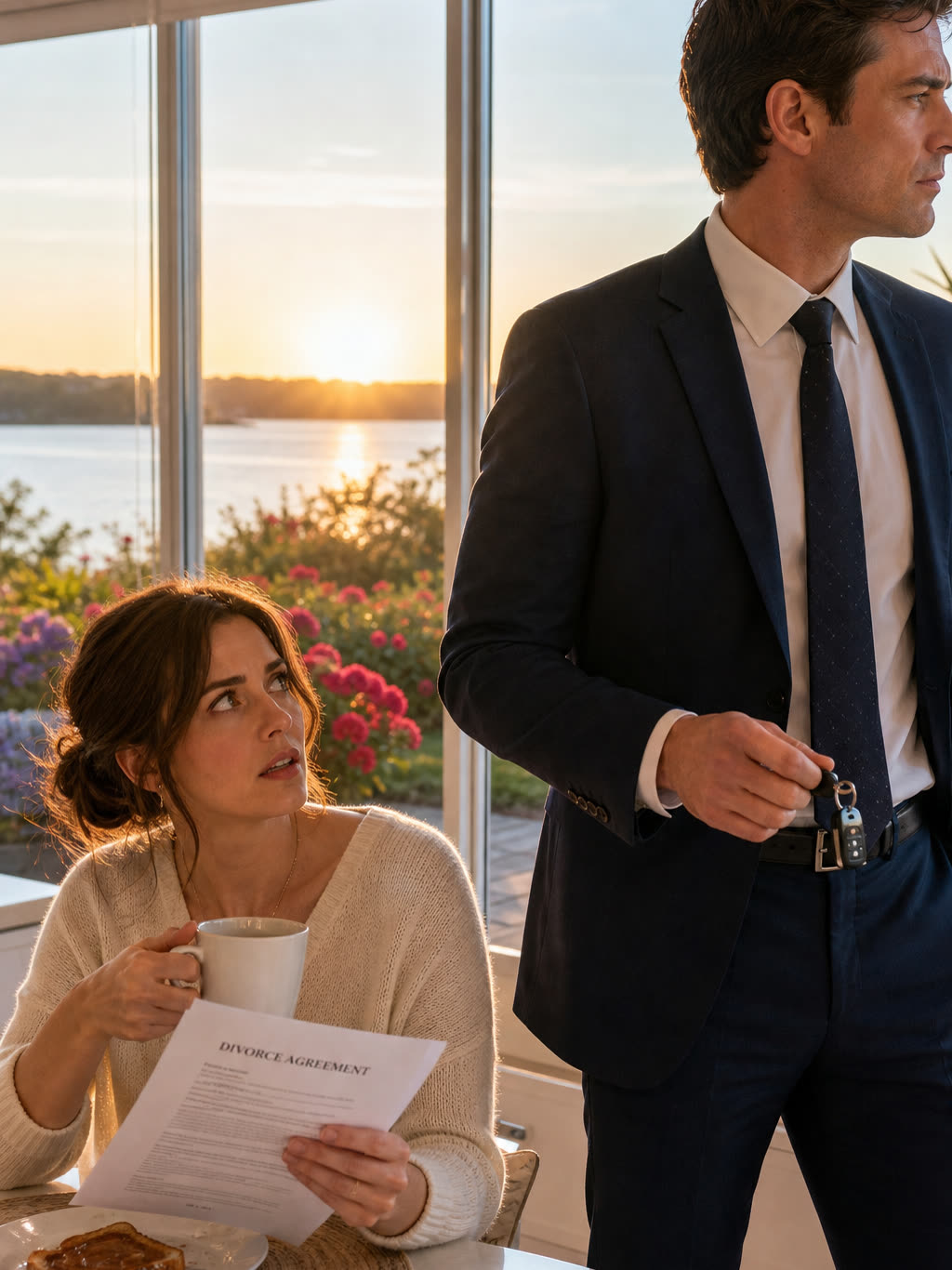
Three weeks earlier, Preston had laid divorce papers beside my breakfast plate with the careless indifference of someone dropping a restaurant receipt on the table.
It was a Tuesday. The kitchen of our house on Larkspur Lane faced east, toward the garden I had planted and the strip of blue water beyond it, and early light was pouring through the tall windows. I was still in my old cream sweater, a cup of coffee warming my hands, when the envelope slid across the table and stopped against my toast.
No apology.
No explanation.
Only a stack of documents that converted our whole marriage into legal phrasing and financial arithmetic.
I read every page. Old habits. Page eleven held the line I knew he had been waiting for me to reach: Respondent made no financial contribution to the acquisition, improvement, or preservation of marital assets.
“I contributed absolutely nothing?” I asked once I had finished the paperwork.
His expression hardly shifted.
“You looked after the house, Amelia.”
“I looked after everything.”
He looked away.
Then he picked his car keys up off the counter. “Dad’s people drew it up,” he said. “It’s fair. Sign it and we can keep this civil.”
The door closed behind him. I sat there until my coffee went cold, watching the light move across the garden. I understood that civil was a word men used when they had already decided you would lose quietly.
For years they had confused my silence with helplessness. All they ever saw was the obliging wife who planned dinner parties, arranged family holidays and stood at Preston’s side while he built his professional reputation.
At Richard’s sixty-fifth birthday party, he had introduced me to a state senator with a heavy hand on my shoulder. “This is Amelia,” he said. “Preston’s little secretary. Keeps his calendar, keeps his house, keeps her opinions to herself.” Everyone laughed. Vivian laughed loudest, then quietly informed me that I was holding my wine glass by the bowl.
I had smiled. I always smiled.
They had never discovered the truth about the woman I used to be.
They had no idea that before I became Amelia Hale, I had been Captain Amelia Carter of the Army Judge Advocate General’s Corps. I had tried cases under enormous pressure and combed through every detail. I knew confidence could tilt a verdict before the first witness ever took the stand.
Preston knew I had served. He believed I had pushed paper in some office on a base he couldn’t name. I never corrected him. Correcting him would have meant talking about the courtrooms at Fort Leavenworth, the case files I still saw when I closed my eyes and the reasons I had walked away from a career I was good at.
I had kept that part of my past buried because all I had wanted was a peaceful marriage.
So I had folded the uniform into a cedar box in the attic. I had quietly kept my bar licenses current, paying the renewal fees every year from my own small account without ever asking myself why.
Maybe some part of me had always known.
The night Preston left the papers, I climbed into the attic for the first time in years. Beneath the cedar box sat a plain accordion file labeled in my own handwriting: SIGNED — KEEP. A military lawyer never throws away anything she puts her name on.
Halfway through it, I found the papers from six years before, from Richard’s attorney’s office in Wilmington. Richard had poured my coffee himself that day, which should have told me something. “Just a formality, sweetheart. Tax reasons. You’re the cleanest name in the family.” I had read every line before I signed, the way I read everything. Then I had added one handwritten paragraph that made Richard’s lawyer sigh and Richard laugh. “Let her have her little clause,” he’d said, waving a hand.
Then I had forgotten about it. Clearly, so had they.
Four days later, certified copies arrived from the Delaware Division of Corporations. I spread them across the kitchen table where the divorce papers had been, and for the first time in three weeks, I slept through the night.
Now I was standing in a courtroom facing the very people who were completely convinced they had already won.
Martin Voss approached the bench with the confidence of a man anticipating an effortless victory. He summarized his client’s position in smooth, practiced sentences: a premarital estate, a modest marriage, and a wife with no income and no claim.
Then the judge turned her eyes back to me.
“Mrs. Hale, you may begin.”
I unlocked my briefcase, removed a single folder and rose to my feet.
The courtroom went entirely still.
I didn’t walk to the lectern the way a frightened wife would. I walked the way I had been trained to walk into a court-martial at Fort Leavenworth: unhurried, shoulders square, eyes on the judge and nowhere else.
Behind me, Richard was still chuckling. I could hear it, the same low, satisfied rumble he had been making since I came through the doors alone, the sound of a man watching a show he’d paid for.
I set the folder down and opened it.
“Your Honor,” I said, “the company my husband lists as his separate property in Exhibit Seven cannot belong to him, because the State of Delaware has recorded me as its sole member for the last six years, and I have never signed that interest away.”
One sentence.
That was all it took.
The laughter behind me cut off as though someone had snipped a wire. I didn’t need to turn around to know that Vivian’s bracelet had gone motionless, or that Richard’s grin had collapsed into something careful and gray.
What I did see was Preston.
He didn’t look at his lawyers. He didn’t look at me. He twisted in his chair and looked straight at his father.
That told me more than any document in my briefcase.
Judge Morrison lowered her glasses. “Mrs. Hale, are you referring to Hale Meridian Holdings, LLC?”
“I am, Your Honor. Hale Meridian holds title to the Harbor Point property, roughly forty acres of waterfront land currently appraised at thirty-eight million dollars. Petitioner’s financial affidavit lists it as an asset he acquired before the marriage. That is not accurate.”
Martin Voss was no longer smiling. He bent toward Preston and whispered something sharp. Preston shook his head once. Then, slowly, he reached inside his jacket, drew out a folded sheet of paper and slid it across the table to his lawyer.
Voss unfolded it, read it, and some of the color came back into his face.
He stood. “Your Honor, Mrs. Hale’s information is outdated. My client has a document that resolves this issue entirely.”
He held the page up for the court to see. Even from where I stood, I recognized the looping A at the bottom.
It was my signature.
And I had never signed it.
Part 2: Nine-Forty in the Morning
For a moment, the only sound in the room was the soft hum of the ventilation overhead.
Martin Voss carried the page to the clerk with the measured steps of a man restoring order. “Petitioner’s Exhibit Twelve, Your Honor. A Membership Interest Assignment, executed and notarized four years ago, by which Mrs. Hale transferred one hundred percent of her interest in Hale Meridian Holdings to my client for ten dollars and other good and valuable consideration.”
Behind me, Richard exhaled. I heard the bench creak as he settled back. Vivian’s bracelet clicked once against the wooden rail.
Ten dollars. Forty acres of shoreline worth thirty-eight million dollars, and they had priced my signature at ten dollars.
Judge Morrison looked at me. “Mrs. Hale, have you seen this document before?”
“No, Your Honor. May I examine it?”
“You may.”
The clerk handed it to me. It was printed on heavy cream stock, with a raised notary seal in the lower corner and my name typed beneath the signature line. I tilted it toward the light from the tall window and studied the ink.
It was good work. Somebody had been patient. The A was mine, the long tail on the H was mine, and so was the tiny hesitation where my pen usually lifts before the e. Whoever made it had studied a real signature, perhaps from our marriage certificate or from the hundred birthday cards I had signed for the Hales over seven years.
But a signature is only one part of a document. In the Army, I had learned to read the parts people forget.
I looked at the date.
October ninth. Four years ago.
I looked at the notary block. Acknowledged before me in the City of Wilmington, County of New Castle, State of Delaware, at nine-forty in the morning, by Amelia C. Hale, personally known to me.
Something cold and very clear settled in my chest. I knew precisely where I had been at nine-forty in the morning on October ninth, four years ago.
“Your Honor,” I said, “I’d like to put one question to the petitioner, through the court, if you’ll permit it.”
Voss began to object. Judge Morrison raised a hand. “Go ahead, Mrs. Hale. Carefully.”
I turned, for the first time that day, and looked directly at my husband.
“Preston, where was I on the morning of October ninth, four years ago?”
He stared at me. For a second there was nothing in his face at all, only the blank politeness he wore at his father’s dinner parties.
Then I watched it reach him. I saw the phone call at four in the morning come back to him, and me doubled over on the bathroom floor. He had driven me to Johns Hopkins in Baltimore with the hazard lights flashing. He had held my hand in pre-op. He had been standing there when the surgeon came out at a quarter past ten and said my appendix had ruptured, and that another hour would have been dangerous.
His mouth opened. Nothing came out.
“I was under general anesthesia in an operating room in Baltimore,” I said, turning back to the bench. “That is seventy miles from Wilmington. Johns Hopkins will have the surgical record, the anesthesia log and every time stamp. The petitioner was in the waiting room. He signed the consent forms as my emergency contact.”
The silence that followed was a different kind of silence. It was no longer the hush of an audience waiting for a joke. It was the stillness of people realizing they were watching something real.
“There is one more thing, Your Honor.” I drew the certified operating agreement from my folder. “Section 9.4 of Hale Meridian’s operating agreement was handwritten and initialed by every party present, including Richard Hale as witness. It states that no transfer of the sole member’s interest is valid unless signed in person, in the presence of counsel of the member’s own choosing, whose name and bar number must appear on the instrument. Exhibit Twelve lists no counsel. It does not comply with the company’s own governing document. Even if I had signed it, and I did not, it would be void.”
Judge Morrison held out her hand. The clerk passed both documents up to her. She read them side by side, slowly, turning the operating agreement to examine the handwritten paragraph and the three sets of initials beneath it. One of them was a bold, slanted R.H.
Then she removed her glasses entirely.
“Mr. Voss. Where did your firm obtain this exhibit?”
Voss cleared his throat. “It was provided by our client, Your Honor.”
“When?”
A pause. “This morning.”
“I am calling a thirty-minute recess,” Judge Morrison said evenly. “During that time, Mr. Voss, I suggest you have a very frank conversation with your client about the penalties for perjury and for submitting a fraudulent instrument to this court. When we return, I want to know who prepared that document. Not who handed it to you. Who prepared it.”
The gavel came down.
I closed my folder and walked out without looking at the gallery. I could feel their eyes on my back, though, the way you feel heat from a stove.
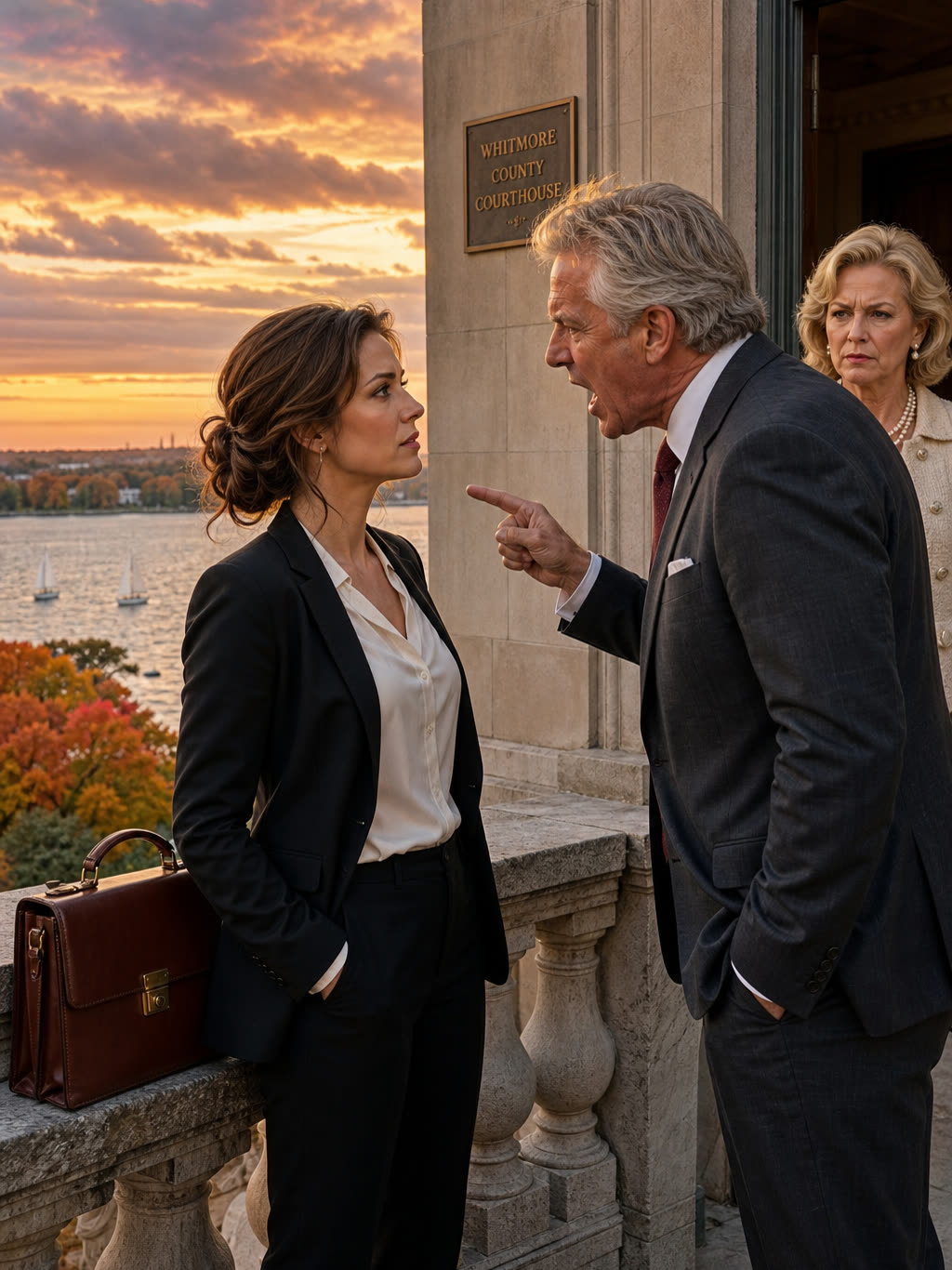
The courthouse had a stone terrace on its east side overlooking the harbor, where the creek met the river and the river widened toward the Chesapeake. It was late afternoon, and the light had turned to gold. Sailboats leaned across the water, their white sails glowing, and the wooded far shore burned with early autumn color. I set my briefcase on the balustrade and breathed for what felt like the first time in hours.
Richard found me in under two minutes.
“That was quite a performance,” he said. He stopped closer than a man should stand to a woman he had just tried to rob. Up close I could smell his cologne, the same one he had worn every Christmas morning.
“It wasn’t a performance.”
“Two million.” He said it the way other men say good afternoon. “Wired Friday. You sign a quitclaim on Harbor Point, you walk away, and everyone forgets about that little piece of paper.”
“You mean the forgery.”
“I mean a misunderstanding.” He jabbed a finger toward the courthouse doors. “You think a judge in this county is going to side with a housewife against—”
“A captain,” I said. “Eight years in the JAG Corps. I’ve cross-examined colonels with far more to lose than you, Richard. Most of them were smarter about it.”
For the first time in seven years, I watched Richard Hale fail to find his next sentence.
The doors behind him opened and Vivian swept out, her cream jacket bright against the gray stone. “Richard. Not here.”
He ignored her. His voice dropped, and what came out wasn’t a threat anymore. It was closer to panic. “You don’t understand what you’re doing. Calder Development closes on Harbor Point in nine days. Sixty million dollars. The bank has already funded the bridge loan against that land, and my signature is on those loan documents as managing member.”
I looked at him for a long moment.
“You’re not the managing member,” I said quietly. “You’re not any kind of member. Which means you pledged land you don’t own as collateral for a loan.”
He said nothing. Out on the water, a gull cried, sharp and thin.
That was when I finally understood. The divorce had nothing to do with love fading or two people growing apart. It was about a closing date. They needed me out before Calder’s lawyers ran their final title search. Preston had set those papers beside my plate because his father needed my signature before the end of the month.
“You were never supposed to read it,” Vivian said. She didn’t say it cruelly. She sounded almost puzzled, as though I were a houseplant that had suddenly started speaking. “You never read anything.”
“I read everything, Vivian. You just never watched me do it.”
Over her shoulder, I saw Preston standing in the open doorway. His tie was loosened and his hands hung uselessly at his sides. He was looking at me as if he had never seen me before.
“Amelia—” he began as I passed him.
I kept walking.
When court resumed, the energy at the petitioner’s table had changed completely. The paralegal had stopped passing notes. One of the junior attorneys had his tablet face-down. Martin Voss stood before the judge looking ten years older than he had that morning.
“Your Honor, the petitioner withdraws Exhibit Twelve and moves to amend his financial affidavit.”
“Denied, for now,” Judge Morrison said. “The exhibit remains with the clerk. Mr. Preston Hale, please take the stand.”
Preston walked to the witness box like a man walking into cold water. He raised his right hand and swore to tell the truth. His voice cracked on the word truth.
“Mr. Hale,” the judge said, “before I ask you anything, you should know that you have the right not to answer questions that may incriminate you. Your counsel can advise you on that. Do you understand?”
Voss half-rose, ready to speak. Preston didn’t look at him.
“I understand.”
“Then I’ll ask you plainly. Did you sign this document, or did anyone sign it in your presence?”
Preston’s eyes moved to the gallery. To his father. Richard gave the smallest shake of his head, the same silent command I had watched him give at a hundred dinner tables.
Then Preston looked at me.
“I didn’t sign it,” he said. “And neither did she.”
Behind me, the bench groaned as Richard Hale shot to his feet.
“My father brought it to me already finished,” Preston said. “And he told me exactly what to say if anyone ever asked.”
Part 3: Section 9.4
“He’s confused!” Richard’s voice boomed off the paneled walls. “He’s under enormous stress. Your Honor, my son doesn’t know what he’s—”
“Mr. Hale.” Judge Morrison didn’t raise her voice. She didn’t need to. “Sit down, or the bailiff will seat you.”
Vivian clutched her husband’s sleeve, her pearls trembling. “Preston, stop talking. Stop talking right now.”
But something had broken loose in him, and he didn’t stop.
“Six years ago, Dennis Kroll sued my father,” Preston said, his voice low and uneven. “He was a former partner, and he claimed he was owed a share of Harbor Point. Dad’s lawyers said the land needed to come out of his name and go to someone with no assets and no history. Someone no one would look at twice.” He swallowed. “He said Amelia was perfect. He said, ‘She doesn’t have anything. Nobody will ever look at her.’”
I kept my face still. Years of practice. Inside, something old and tender quietly gave way.
“When the lawsuit settled, he wanted it back. But she’d written that clause, and he said if we asked her to sign in front of her own lawyer, she’d start asking questions. So he waited. Then the bank wanted proof of ownership for the loan.” Preston pressed his palms against his eyes. “He had someone in Wilmington. I don’t know who. Four years ago he handed me that paper and told me to keep it somewhere safe. I looked at the date and I knew. I knew where she was that morning. I didn’t say anything.”
“And the divorce, Mr. Hale?” the judge asked.
Preston’s gaze found mine across the room. His eyes were wet.
“The divorce was his idea,” he said. “He said if she signed the settlement, the assignment wouldn’t matter anymore. Her signature on the settlement would cover everything. He said she’d sign anything I put in front of her.” His voice broke. “He said she always had.”
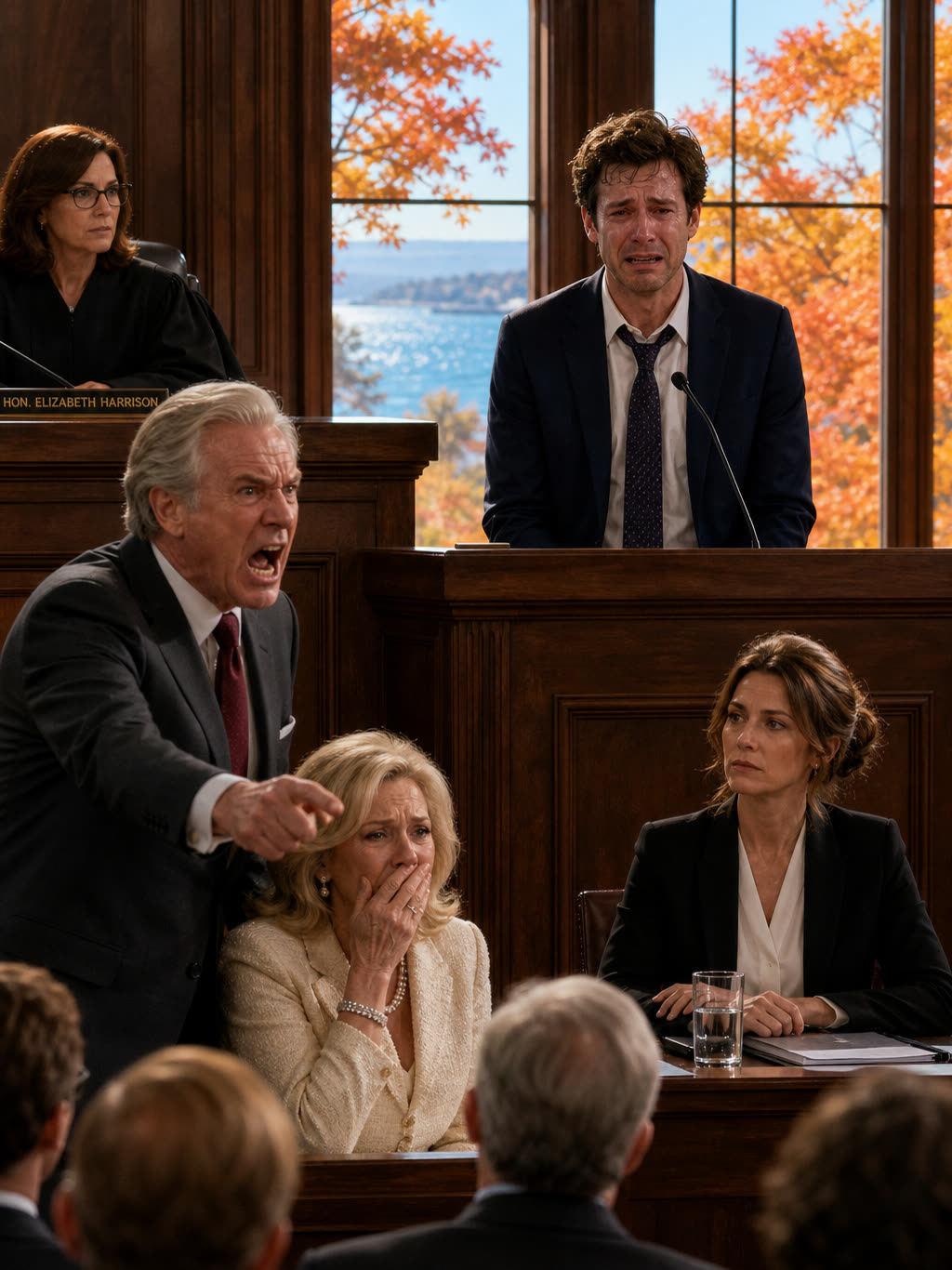
A murmur rippled through the gallery. The woman near the back who had leaned forward earlier now sat with her hand over her mouth.
“I told myself it was just paperwork,” Preston went on. “I told myself she’d be fine and that she didn’t really need—” He stopped and shook his head. “She was in surgery that day. I was holding her hand. And I let him put that date on it.”
I had imagined this moment for three weeks. Lying awake, I had pictured the triumph of it, the Hales humbled and the truth spoken aloud. Now that it had come, I felt no triumph at all, only a hollow, aching tiredness, as if seven years had all landed on my shoulders at once.
“You weak, ungrateful—” Richard was on his feet again, his tanned face mottled red. “Everything you have, I gave you. Everything!”
Preston looked at his father for a long moment.
“That’s the problem, Dad,” he said quietly.
The bailiff moved toward the front row, and Richard sat down hard.
Judge Morrison dismissed Preston from the stand. He made his way back to the petitioner’s table and sank into his chair, shoulders hunched, while Martin Voss leaned close and murmured about withdrawal of counsel and criminal exposure. Preston wasn’t listening. He was staring at me.
“Amelia,” he said across the aisle, his voice raw. “I never thought you’d— I thought you didn’t care about any of it. You never said anything.”
Something in me snapped into focus.
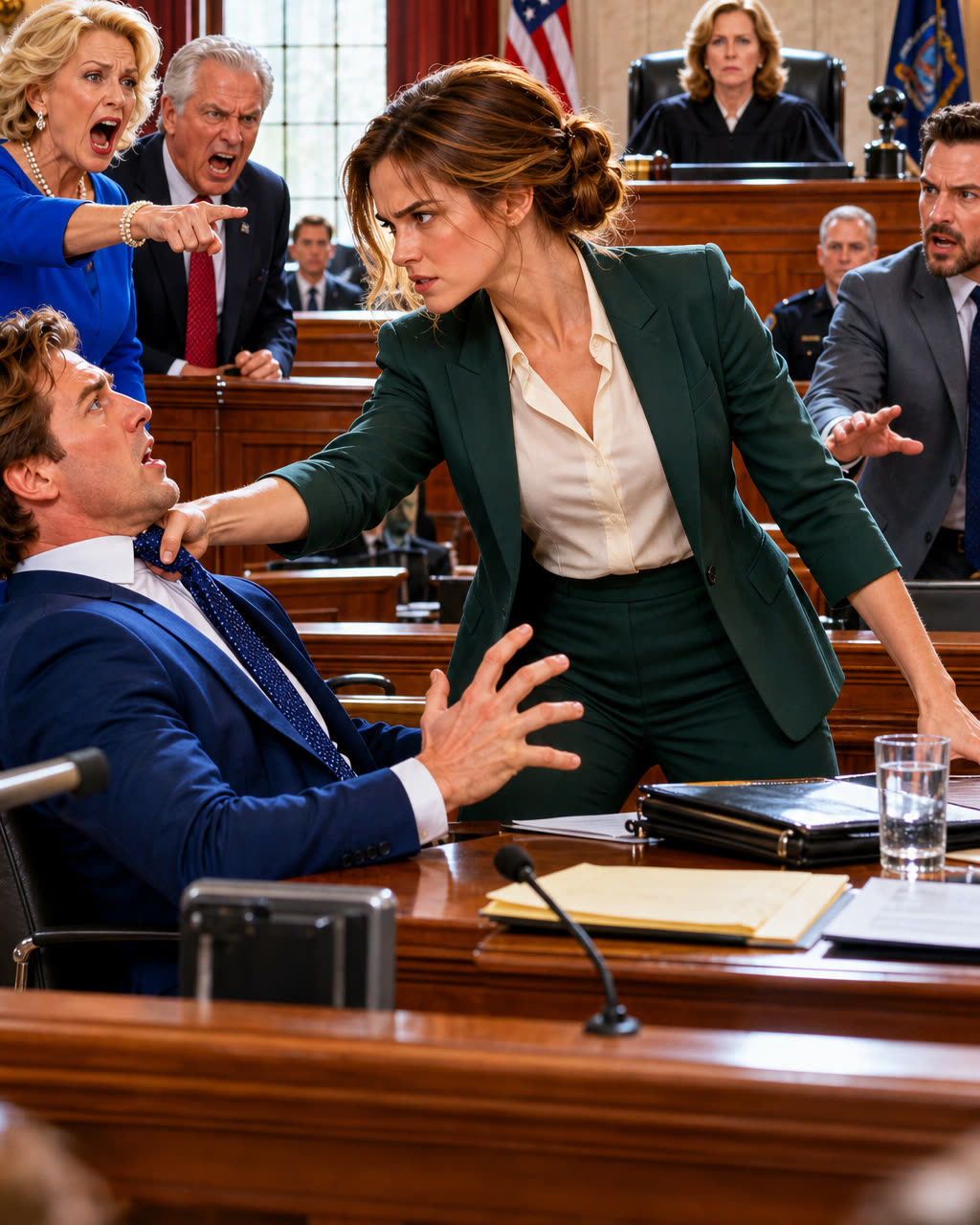
I picked up the certified operating agreement, crossed the aisle in four steps and leaned over his table. I braced one hand flat among his lawyers’ binders and pressed the folded agreement against his chest, right beneath his loosened tie. He jerked back in his chair, eyes wide.
“You told me I contributed nothing,” I said. “Read Section 9.4. I wrote that clause six years ago while your father laughed at me. I protected that land. I protected you from whatever your father would have done with it. That was my contribution, Preston. You just never bothered to look.”
“Get her away from him!” Vivian shrieked, her arm thrust out, her bracelet flashing as she pointed at me. Richard was shouting too, the words lost in the noise. Martin Voss half-stood, one hand reaching toward me. “Mrs. Hale—”
“Mrs. Hale,” Judge Morrison said sharply. “Return to your table.”
I let go of the paper. Preston caught it against his chest with both hands. I walked back to my table and sat down, folding my hands exactly as I had that morning. My pulse was steady. Behind me, the gallery buzzed like a kicked hive.
Preston unfolded the agreement. I watched him find the handwritten paragraph and the three sets of initials, his father’s bold R.H. among them. I watched him understand that the wife he had thought of as furniture had, years ago and in front of all of them, built the very wall that his family’s lie had just crashed into.
He put his face in his hands.
Judge Morrison allowed the room a moment to settle before she spoke. When she did, every word landed like a stone dropped into still water.
“The court finds that the respondent, Amelia Hale, is and has been the sole recorded member of Hale Meridian Holdings, LLC, and that Petitioner’s financial affidavit is materially false. Exhibit Twelve, together with today’s testimony, will be referred to the State’s Attorney and to the Delaware Attorney General for investigation of forgery and fraud. Effective immediately, I am issuing an order prohibiting any transfer, sale, or encumbrance of the Harbor Point property. Notice will go to every lender of record. Sanctions against the petitioner will be addressed at a separate hearing. The divorce will proceed, Mr. Voss, but not on the terms your client brought into this room.”
She looked toward the gallery. “And Mr. Richard Hale, I would strongly advise you to retain criminal counsel before you leave this building.”
The gavel fell.
People filed out slowly, whispering, glancing at me as they passed. Richard didn’t look at anyone. Vivian guided him out by the elbow, her chin high, her steps quick and brittle. Preston stayed in his chair long after his lawyers had packed their binders.
Martin Voss paused beside my table on his way out. “Captain Carter,” he said. “I looked you up during the recess. Had I known, I would have advised my client differently.”
“You’d have advised him to tell the truth?”
He gave a tired half-smile. “I’d have advised him to settle.”
The weeks that followed moved quickly, the way collapses always do. The bank froze the bridge loan within forty-eight hours of receiving the court’s notice. Calder Development withdrew from the deal by the end of the week. Investigators in Wilmington traced the notary seal to a woman who had once worked as a bookkeeper for one of Richard’s companies. Her commission was suspended, and she hired a lawyer of her own and began talking. Richard’s attorneys stopped returning reporters’ calls. Vivian left for the house in Palm Beach and didn’t come back.
I didn’t follow most of it closely. I had spent years watching men like Richard fall, and I knew how the story went.
On a clear afternoon in late October, I drove out to Harbor Point alone.
The road ended at a gravel turnaround shaded by tall loblolly pines. Beyond them, forty acres of marsh grass rolled down to the water in waves of copper and gold, and the Chesapeake stretched away, wide and shining under an enormous blue sky. An osprey circled above the shoreline. The wind smelled of salt and cold earth.
Preston and I had walked here once, in the first summer of our marriage. He had pointed toward the bluff and said that someday we would build a house there, with a porch facing the sunrise. I had believed him. I had believed a lot of things.
I stood on the bluff now with my hands in my coat pockets and watched the light slant across the water. I didn’t know yet what I would do with the land. I might protect it, sell it, or leave it exactly as it was for a while. For the first time in seven years, the decision was mine.
Behind me, tires crunched on gravel.
I turned. A familiar sedan had pulled into the turnaround. Preston climbed out. He was unshaven, wearing the same navy suit he had worn in court, the jacket wrinkled now, as if he had slept in it. He stopped a respectful distance away.
“I won’t stay,” he said. “I just needed to give you something.”
He held out a small brass key on a worn paper tag. I didn’t take it right away.
“It’s a storage unit in Dover,” he said. “My father has rented it under a company name for twenty years. I found the paperwork in his desk last night.” He hesitated, the wind tugging at his hair. “Kroll wasn’t the first person he did this to, Amelia. There are boxes of files in there. Names, deeds, signatures. I don’t understand half of it.” He met my eyes. “I think you might be the only person who can.”
I took the key. It was heavier than it looked, and still warm from his hand.
Preston walked back to his car without another word. I listened to the engine fade down the long gravel road until there was nothing left but the wind in the marsh grass and the cry of the osprey overhead.
I closed my fingers around the key and looked out at the water.
Twenty years of files. Twenty years of people Richard Hale had decided nobody would ever look at twice.
“Well, Captain Carter,” I said quietly to the empty shoreline, “it looks like you’re not retired after all.”
