


PART 1: The Price of Being Useful
Three weeks before Christmas, I told my family that my company had failed and that my entire $212,000 savings had disappeared. My mother’s response was to exclude me from Christmas dinner because she couldn’t accommodate someone who was broke. My father suggested that I sell my car. Neither of them knew that, on Christmas Eve, a nine-year-old girl would show me what their answers really meant. She would arrive through a Minnesota snowstorm with freezing feet and a glass jar holding everything she had.
My name is Maya Lindquist. I’m thirty-four, and I own Lindquist Commercial Refrigeration in Duluth, Minnesota. My company services refrigeration equipment for restaurants, grocery stores, and fish markets. I started it when I was twenty-four, with a battered cargo van, a small loan, and the determination to keep working through exhausting hours. A decade later, I had six technicians, four service trucks, and $212,000 put aside. None of it had appeared overnight. I had built the business through years of difficult work.
My parents, Walt and Carol, lived nearby in Proctor. For thirty-one years, my father had run a hardware store, but competition eventually forced him to close it. Four years before that Christmas, the business was gone, substantial debts remained, and the mortgage on their four-bedroom house had become more than he could manage. When the foreclosure warning arrived, I didn’t wait for either parent to ask for help. I covered six months of missed payments and arranged a monthly transfer of $1,840 toward their mortgage.
I also took over the $412 monthly payment on my father’s pickup. Across forty-eight months, the mortgage and truck payments came to $108,096. My parents never properly acknowledged those transfers. Instead, relatives heard that my father had saved the house through careful financial planning. The pickup had supposedly been a retirement gift from Gerald, a wealthy friend he knew through hunting. I allowed those stories to stand because I thought protecting their pride was another way of helping them. At the time, remaining silent seemed kinder than correcting anyone.
My older brother, Dale, lived nearby with his wife, Renee, and their daughter, Junie. When his vehicle needed a replacement transmission, I sent him $6,300 without hesitation. I didn’t treat the transfer as a loan or expect repayment. He needed help, I could provide it, and I believed that was what family did. For years, I approached my parents’ expenses the same way. I thought generosity would be understood as love, even if nobody said much about it. I hadn’t yet asked myself whether the understanding went both ways.
Then, one Sunday in October, an unanswered speakerphone connection let me hear a conversation I wasn’t meant to hear. My mother was talking to Aunt Pat, who asked how long I would keep paying my parents’ bills. My mother answered without knowing I was listening. “As long as she keeps saying yes. Maya doesn’t have a husband or children, so what else would she spend her money on?” I ended the call without announcing myself. Afterward, I sat in my service truck for nearly forty minutes, unable to dismiss what she had said.
Something inside me had changed. Until then, I had been able to explain away the missing thanks and the stories that erased my help. Hearing my mother speak that way made those explanations much harder to believe. Was I loved as a daughter and sister, or valued because I kept sending money? I didn’t know how to ask that question and trust the answer. Eventually, I decided to find out what would happen if my family believed I had nothing left to give.
On December third, I opened the family group chat while sitting at my kitchen table. Eleven relatives belonged to it: my parents, my brother, aunts, uncles, and cousins. I wrote that Lindquist Commercial Refrigeration had gone bankrupt. I said I had sold the trucks to cover business debts and that legal expenses had swallowed my $212,000 savings. Every part of that financial disaster was invented. The company was still operating successfully, and my money was safe, but I needed to see how they would respond to the possibility that I needed them.
After sending the message, I turned my phone facedown and waited. I imagined that someone might call, reassure me, or ask whether I had enough groceries. Perhaps someone would offer a place to stay if things became worse. I wasn’t preparing a request for money. What I wanted was some indication that losing my ability to help them wouldn’t mean losing my place in the family. The wait lasted only six minutes before my mother answered publicly, where everyone in the conversation could see what she had to say.
“Don’t come on Christmas. We can’t host a broke person right now. It’s too stressful.” There was no question about how I was coping, no offer to talk, and no suggestion that we would work through anything together. Christmas dinner, apparently, was something I could attend only while my finances remained useful. Reading her message hurt even though I had created the test myself. I had suspected that my help mattered more than it should. I still hadn’t been prepared to see that suspicion expressed so plainly.

My father replied almost at once. “Sell the car first.” He didn’t ask whether I could afford food or whether I might lose my home. His attention seemed to settle on the transportation I could liquidate before his own payments were interrupted. Aunt Pat and my cousin Tanya reacted approvingly to my mother’s message. Among the relatives reading the conversation, only Uncle Ray, a retired ferry captain, reached out privately with concern. “You okay, kiddo? Give me a call.” His words mattered more than he probably understood.
I couldn’t bring myself to tell Ray what I had done. I also couldn’t pretend that my mother’s October remark had been a single thoughtless comment that meant nothing. The family’s response had given it context I could no longer ignore. Two days after sending my announcement, I canceled the automatic mortgage and truck payments. If I was supposedly unable to support myself, I couldn’t continue quietly financing my parents while they shut me out. The following morning, my mother called because the bank had notified my father that the mortgage payment hadn’t arrived.
“Your father’s payment didn’t go through, Maya. You need to fix it before the late fee.” I reminded her of the circumstances she believed I was facing. “Mom, I told you I lost everything. I don’t have any money to send.” Her answer was immediate. “Then borrow it. Take out a personal loan.” She explained that Dale couldn’t be expected to help because he had a wife and child to support. My supposed financial collapse hadn’t changed her expectations. Somehow, I was still responsible for preventing consequences in their house.
Dale finally contacted me the next afternoon. His message wasn’t the concern I had hoped for. He warned me not to ask him for money because Renee’s working hours had been cut and Christmas was approaching. I hadn’t asked him for anything. Remembering the $6,300 I had sent when his transmission failed made the warning especially painful. During the next three weeks, my mother called four times, always about the missed mortgage payments or the possibility of my father losing his truck. Nobody came by, offered a meal, or invited me for Christmas.
Uncle Ray kept leaving concerned messages, and I told him I was managing. By December twenty-fourth, I had decided to spend Christmas alone and change my phone number the next day. I wasn’t planning a confrontation. Quietly disappearing seemed easier than trying to explain how disappointed I felt. At nine that evening, I sat on my couch eating vegetable soup. Forty minutes later, a soft knock interrupted the silence. When I opened the door, Junie stood in the snow without boots or a winter coat, clutching a glass jar labeled Rent.
PART 2: Eleven Dollars and Forty Cents
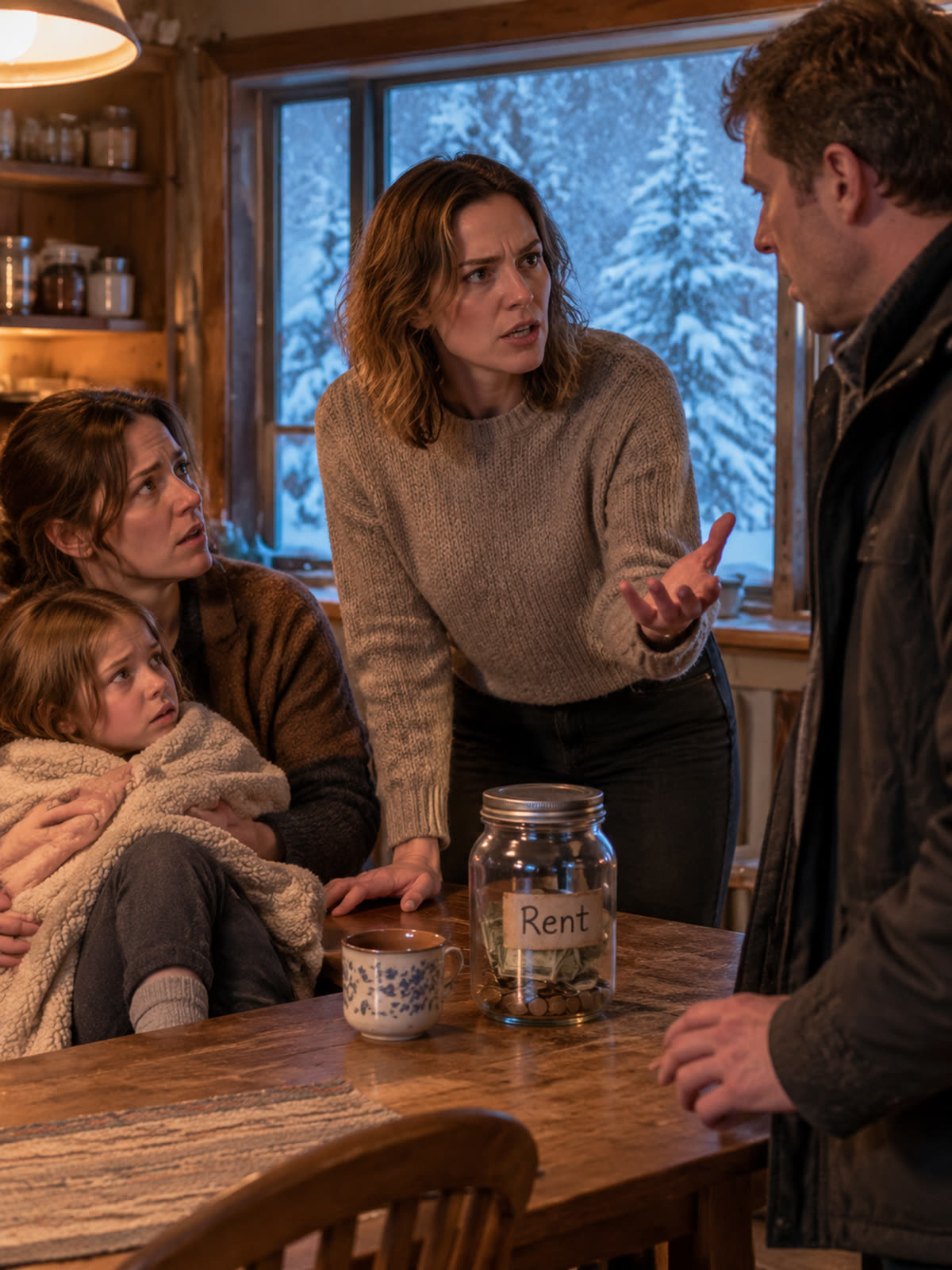
For three weeks, the adults in my family had believed I was facing financial ruin. None of them had appeared at my door. Now my nine-year-old niece stood there in thin socks while a terrible Minnesota snowstorm blew around her. The jar was pressed against her, and she had come because she believed I needed help. “Aunt Maya, I saved this for you. You can have all of it.” Whatever I had expected from Christmas Eve, it hadn’t been this: a child offering me everything while the adults worried about what I could no longer provide.
I carried Junie inside and brought her into the kitchen. Her feet were painfully cold. I wrapped her in a thick fleece blanket, checked her condition, and carefully began warming her feet while asking what had happened. She had no winter coat or boots, and the thought of her walking through that storm frightened me. Before I could make sense of why she was there, I needed to understand where Dale and Renee were and how she had left home without them realizing what she intended.
Junie explained that her parents were at my parents’ house discussing Christmas arrangements. They had told her to stay home and watch a movie. Once the movie finished, she left because she believed there was something more urgent she needed to do. “Grandpa said the bank was going to take your house because you don’t have any money.” She had heard that I was in trouble and understood it in the most direct way a child could. Someone she loved might lose her home, so she had brought the help she possessed.
She pushed the glass jar toward me. Inside was money from lost teeth, birthday gifts, and a lemonade stand. A strip of masking tape showed the total she had carefully worked out. “I have eleven dollars and forty cents. You can use it for rent, Auntie Maya.” I had sent thousands of dollars to my family without asking for acknowledgment. Yet this small collection of money, gathered by a little girl who expected nothing back, carried a kind of generosity I had been searching for throughout the previous three weeks.
When I asked how she had learned about my supposed financial problems, Junie described searching beneath my parents’ dining table for a missing piece of her rock collection. While she looked, she overheard them talking. My father predicted that I would lose my house by spring. My mother complained that I still owed them money for the month, apparently meaning the payments I had stopped making on their behalf. Junie had believed them because she trusted the adults around her. She had no reason to know how much of their conversation was distorted.
She was so frightened by the possibility that I would lose my home that she hadn’t stopped to dress for the weather. Then she offered something beyond the money. “If they take your house, you can stay in my bedroom. It has the good heater, and I can sleep on the floor.” I held her close. For years, I had supported adults who treated that help as an entitlement. Junie was prepared to surrender her savings and her bedroom, not because I owed her anything, but because she couldn’t bear the thought of me having nowhere to go.
I struggled to understand the difference between her response and theirs. My parents had heard that I had lost everything and worried about their bills. My brother had warned me away before I asked for help. Junie had heard the same supposed disaster and immediately looked for what she could offer. The youngest person in the family had shown more compassion than the adults combined. Until that evening, I had planned to disappear quietly. With her wrapped in a blanket beside me and that jar in front of us, I knew I would not leave the truth buried.
I sent Dale a direct message telling him that Junie was safe at my house and that he needed to come immediately. He and Renee arrived eleven minutes later, visibly frightened by their daughter’s disappearance. Renee hurried to Junie. Dale wanted to know why she had left home and why I hadn’t been answering the family’s calls. Their alarm was real, but there was more to explain than Junie’s walk through the storm. I told them what she had overheard and why she believed that reaching my house with her savings was necessary.
Then I showed them the jar. It made the situation impossible to reduce to a misunderstanding about a child wandering away. Junie had acted on what my parents said, and the result was a little girl crossing a snowstorm in socks because she thought I was about to lose my home. I told Dale I would be attending Christmas dinner at our parents’ house the following afternoon. My mother had explicitly excluded me, but I no longer intended to let her version of events remain the only one the family heard.
“I want you sitting beside me tomorrow, Dale. There’s something everyone needs to hear.” He looked confused, and I wasn’t ready to explain everything yet. The conversation waiting for Christmas dinner involved more than the lie about my company. It involved years of payments, years of silence, and the way those years had been described to everyone else. Before they left, I asked Dale to bring Junie’s winter boots and make sure she was properly dressed. She had already done more than enough to help me. I wasn’t going to ignore what helping had cost her that night.
After they left, I went into my home office and opened four years of banking records. The payments were there, one after another: money toward the house, installments on my father’s truck, and the $6,300 I had sent Dale for his transmission. There was nothing uncertain about those records. They documented what I had done while my parents told relatives that my father had managed the recovery himself. For years, I had let those stories protect their pride. Now the same silence was helping them present me as someone who owed them money.
I printed the statements, highlighted the relevant transactions, and arranged the pages inside a thick blue folder. Forty-eight consecutive months of financial support became something the family could hold and examine. The figures weren’t an accusation I had invented in anger. They were the history of money leaving my account to keep my parents’ house and truck paid for. Until then, I had treated those payments as private assistance. After what Junie had heard beneath the dining table, I intended to make clear exactly who had been supporting whom.
The following afternoon, I drove my service truck to my parents’ house in Proctor. Junie came with me, properly dressed and wearing her winter boots. I carried the blue folder under my arm. Sixteen relatives had gathered for Christmas dinner, and the room went quiet when I arrived. My mother approached looking disbelieving and reminded me that she had specifically told me not to come. Nothing about the gathering had changed her position. As far as she knew, I was still broke, and the invitation she had withdrawn had not been restored.
“Junie invited me, Mom. I’m sure there’s room for one more person.” Uncle Ray greeted me warmly and offered the empty chair beside him. His welcome stood apart from the silence surrounding my arrival, just as his private message had stood apart from the group chat. I sat down and rested the blue folder on my lap. Around that table were relatives who had heard stories about my father’s financial recovery, relatives who had watched my mother exclude me, and relatives who knew little about what had happened the night before.
I waited until my father began his usual Christmas prayer. He thanked God for the family’s prosperity and for everything they had supposedly earned through hard work. The words landed differently with four years of bank statements resting beneath my hands. I had once accepted being left out of the story because I believed it spared my parents embarrassment. Now their story had helped send Junie into a storm. As the prayer ended and everyone prepared to eat, I stood. The folder was still closed, but I was finished protecting what was inside it.
PART 3: What the Blue Folder Revealed
I asked everyone to listen. First, I reminded my mother that she had excluded me from Christmas dinner because she believed I was broke. Then I repeated my father’s advice to sell my car. Neither of them, I explained, had asked whether I could afford food or keep a roof over my head. My mother protested immediately, saying that I was creating an inappropriate scene. For years, I had avoided exactly that accusation by remaining quiet. This time, I continued. The truth had stayed hidden long enough.
“There’s something I need to clarify. My business never went bankrupt, and I never lost my savings.” I explained that Lindquist Commercial Refrigeration was operating successfully, with four service trucks and six employees. My $212,000 was still secure. The collapse I had described in the group chat had never happened. I told them about overhearing my mother’s October conversation with Aunt Pat and about the question it had left me unable to ignore. What followed wasn’t a confession that erased their responses. It was the reason I had finally seen those responses clearly.
“I wanted to know whether this family would still care about me if I couldn’t pay anyone’s bills.” My mother demanded to know why I had deceived them. I told her that the previous three weeks had answered something I had been afraid to ask for years. When they believed I could no longer help, she had withdrawn my place at Christmas dinner. My father had directed me toward selling what remained. Their concern had continued to circle their own expenses, even while they believed that my livelihood and savings were gone.
I opened the blue folder and handed copies of the banking statements to Dale and Uncle Ray. They passed the pages around the table while I explained the highlighted transactions. “For forty-eight months, I paid $1,840 toward this house every month. I also paid $412 toward Dad’s truck, totaling $108,096.” Until then, those transfers had been private facts inside my bank records. Now they were moving from hand to hand among the same relatives who had heard that my father had rescued the house through careful planning.
Aunt Pat studied the statements and challenged my mother about what she had told everyone. Carol had insisted that Walt saved the house himself while knowing where the mortgage money came from. Uncle Ray questioned my father’s account of the truck. Months earlier, Ray had personally asked Gerald about the supposed retirement present and discovered that Gerald knew nothing about it. The explanation my parents had offered wasn’t simply incomplete. Both stories had concealed my involvement, and now the records were giving the family a very different account.
My father said nothing while the relatives compared the pages with what they had been told. Dale looked especially shaken as he realized how much I had contributed during the same period when I helped him. “You gave me $6,300 when my car broke down, and you were already paying their mortgage?” I confirmed the transfer. I had never expected him to repay it, and I said so. The money itself wasn’t what had hurt most. It was discovering how quickly my family could turn away once they believed I needed help.
My mother said that she and my father had intended to explain their finances eventually. Dale challenged that explanation. The records showed years of assistance, not a brief situation they hadn’t found time to discuss. More importantly, the consequences were no longer limited to hurt feelings between adults. Junie had overheard their account and believed it. A child had tried to solve the disaster they described because the adults around her spoke as though I was failing them while I supposedly struggled to survive. Dale reminded everyone what that had led her to do.
He described Christmas Eve and finding Junie at my house after she walked through the storm. The jar that had seemed so small beside years of mortgage payments became the center of what he was saying. I had given money because I loved my family. Junie had done the same. The difference was that she had offered her help freely and without treating anyone’s need as an inconvenience. She hadn’t asked whether I could return the favor or whether helping me would interfere with her Christmas.
“My daughter walked through a snowstorm in her socks because she thought Maya was going to lose her house. She brought eleven dollars and forty cents to save her.” The room fell silent. Several relatives looked toward Junie, and I could see that the meaning of her little jar had finally reached them. She had believed every word she heard because she trusted her grandparents. While the adults debated responsibility and explanations, she had already demonstrated the kind of love I had hoped to find when I sent that first message.
I closed the folder and told them that I had canceled the automatic transfers earlier that month. I would not restart them. My parents would need to contact their lenders and take responsibility for their own obligations. “If you need help keeping this house, Dad, call the bank. If you want to know how I’m doing, call me.” I left without eating Christmas dinner. Within minutes, Dale, Renee, Junie, and Uncle Ray came outside after me. Together, we drove to a twenty-four-hour diner on Superior Street and ordered pancakes.

Junie asked enthusiastically for extra whipped cream. The rest of us shared what felt like our first genuinely comfortable Christmas meal in years. The consequences of the confrontation unfolded more slowly. Without my payments, my parents couldn’t maintain the financial stability they had presented to everyone. In February, my father sold his prized pickup to a local dealership. By April, pressure from the mortgage lender forced them to sell the four-bedroom house before foreclosure became unavoidable. They moved into a smaller, two-bedroom condominium near the highway, and my father eventually took part-time work stocking shelves at a garden center.
In late May, he appeared at my refrigeration shop without warning. He waited awkwardly while I worked on a compressor and eventually admitted that he was sorry. The apology was brief and uncomfortable. He never fully acknowledged the years of deception, but I accepted it because holding on to my anger would only continue hurting me. My mother’s response came earlier, in January, when she mailed a greeting card containing one handwritten sentence. “I should have asked how you were.” She said nothing about the money, the false stories, or the confrontation at Christmas dinner.
I left her card on the kitchen counter for two months before deciding whether I wanted a relationship with her. In March, I called and agreed that we could meet occasionally. We now have lunch on the second Tuesday of each month. Our conversations are brief, and I keep boundaries I should have established years before. I no longer pay her bills or take responsibility for her financial choices. When lunch ends, she pays for her own iced tea. I leave without assuming that loving her requires me to solve whatever problem comes next.
Dale surprised me by taking responsibility for his behavior. Although I repeatedly reminded him that the transmission money had been a gift, he insisted on paying back the $6,300. He arranged automatic transfers of $250 a month into my account. I put every payment into a college savings account for Junie. On New Year’s Day, I had already added $20,000 of my own money to it. I wanted her to have opportunities that would not depend on begging relatives for help, and I could provide that without confusing generosity with a duty to purchase affection.
Uncle Ray became a regular part of my life, too. Early in January, he visited the workshop and complained that retirement had left him restless. I offered him part-time work answering calls and helping at the front desk. His practical experience, humor, and willingness to work unusual hours quickly made him popular with my technicians and customers. More importantly, he asked about my health and listened when I was tired. He treated me as a person, not a source of money, and reminded me that genuine concern doesn’t depend on proving how useful you can be.
I continued running the company I had built, but I stopped treating family support as a promise to sacrifice whatever anyone demanded. Junie had never questioned whether I deserved help. She simply believed someone she loved was in trouble and offered everything she had. Her eleven dollars and forty cents showed me what years of financial assistance never had: love should not require surrendering my independence, dignity, or security. I hadn’t lost my family that Christmas. I had discovered who truly cared. The question that remained was whether the others could care about me without expecting me to pay.
Disclaimer: This story is a work of fiction inspired by real-life themes. Names, characters, places and events are fictionalized, and any resemblance to real persons is purely coincidental. Images are for illustration purposes only.
