

PART 1
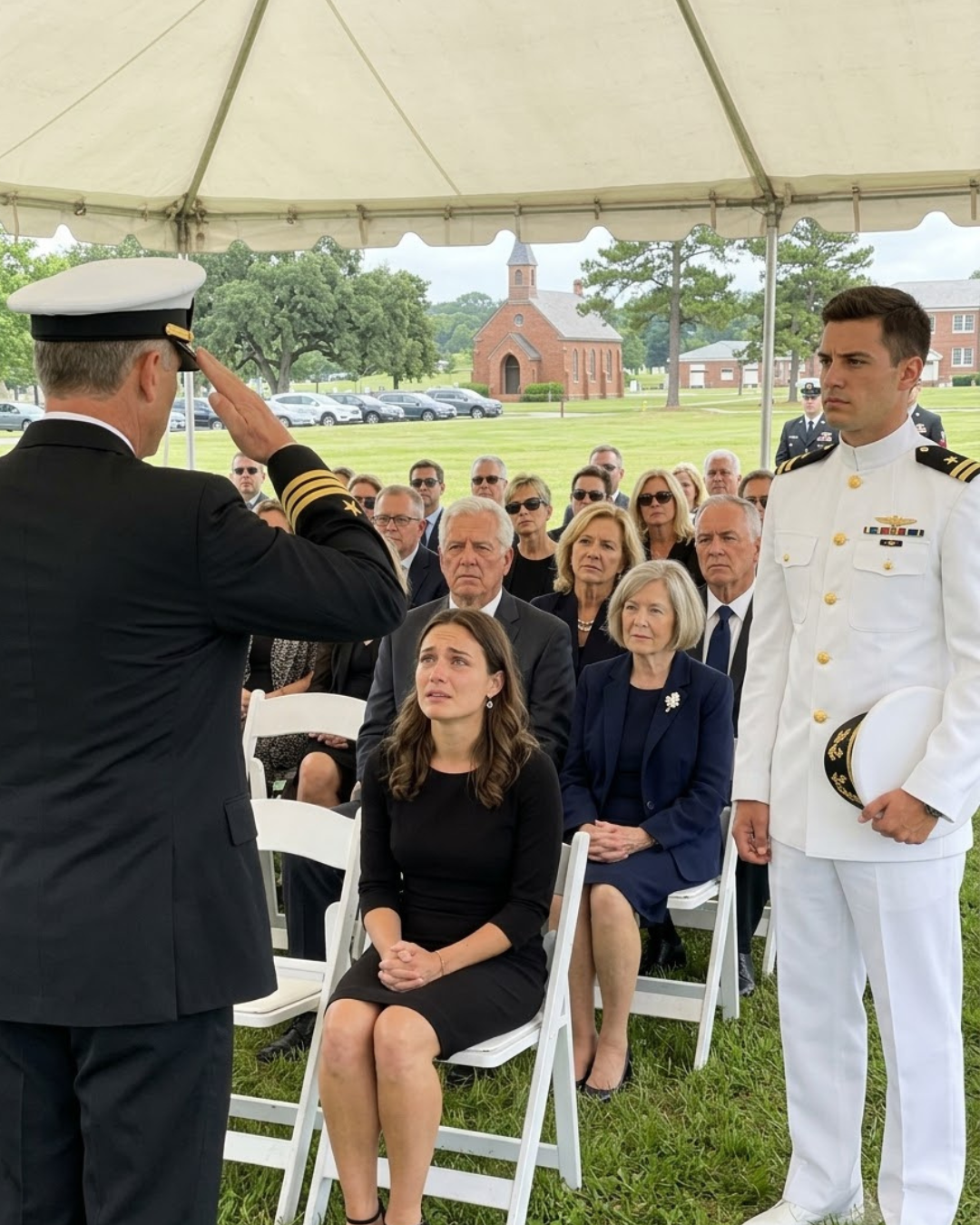
The first thing my mother noticed when I arrived at Naval Amphibious Base Coronado was my black dress.
She didn’t look at my face.
She didn’t acknowledge the visitor badge attached near my shoulder.
And she certainly didn’t notice the small navy-blue folder I was carrying beneath my arm.
Her eyes went straight to my dress, and her expression hardened.
Then she turned to the security guard.
“She is just the disappointing sister,” my mother said softly, as if soft cruelty did not count. “Please don’t let her make this awkward.”
My father laughed.
Thomas Carter never laughed loudly when he wanted to humiliate someone. He preferred a restrained, sophisticated chuckle that encouraged everyone nearby to understand that the family had already decided who deserved respect.
And I wasn’t that person.
The young security guard stood between us, holding a clipboard and my visitor pass.
He looked uncomfortable.
His gaze moved from my mother’s pearls to my father’s expensive watch before settling on me.
I noticed something important on his clipboard.
My name appeared on the family attendance list.
Emily Carter.
But beside that list was another section containing only a few names.
Official Protocol Addendum.
The guard glanced at it.
Before he could say anything, my mother leaned closer.
“Today is about Ryan.”
My brother stood approximately twenty feet away, wearing his immaculate dress whites.
Ryan was everything my parents had always wanted their son to be.
Tall.
Athletic.
Confident.
Handsome.
A former football captain and homecoming king who had now completed BUD/S and SEAL Qualification Training.
Today, he would receive his gold Trident.
My father had spent months talking about it.
He’d told neighbors, relatives, church acquaintances, and practically anyone willing to listen that his son was becoming a Navy SEAL.
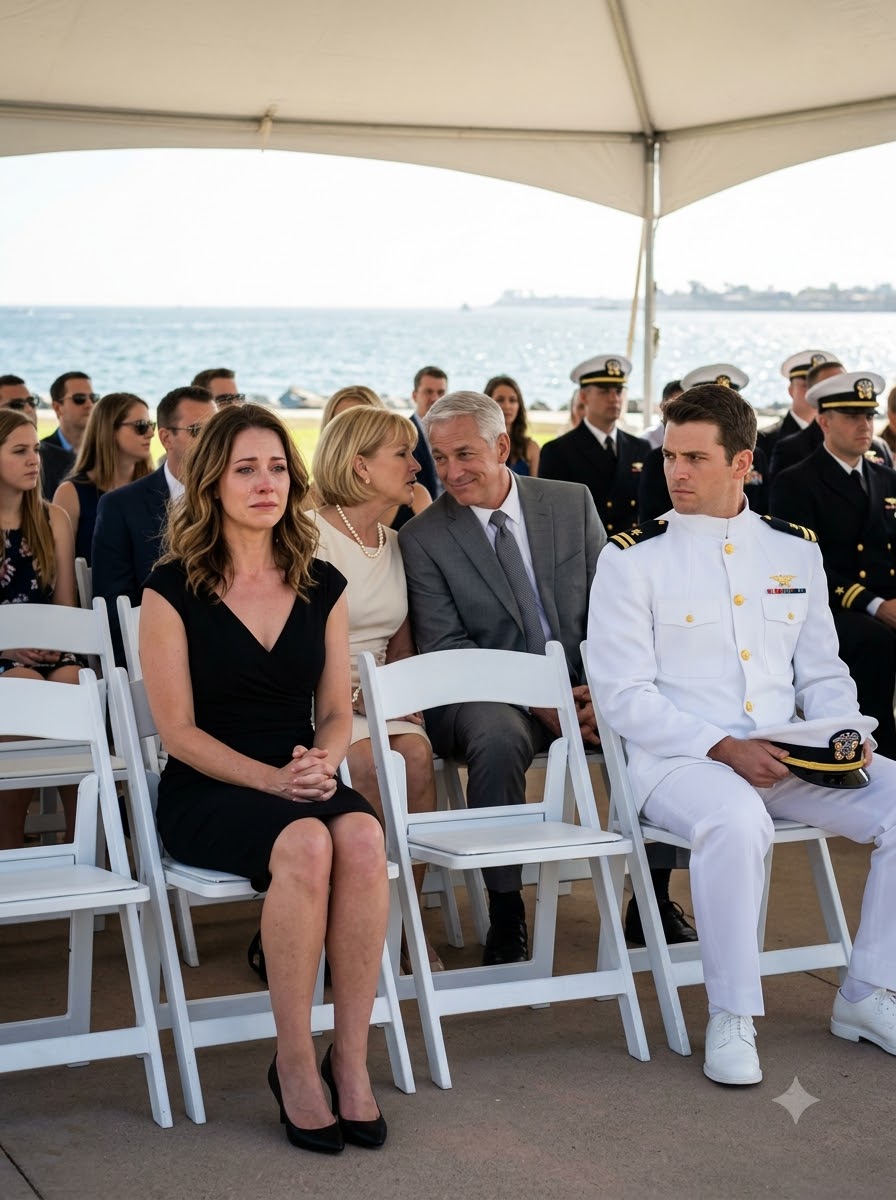
Ryan was the family’s greatest achievement.
I was the inconvenient daughter they preferred not to discuss.
Then Ryan looked directly at me.
“Don’t embarrass me today, Emily.”
I felt the familiar sting.
The morning air smelled of sea salt, sunscreen, warm pavement, and coffee cooling in paper cups.
White tents moved gently in the Pacific breeze.
Families filled rows of chairs, children waved American flags, and proud parents waited for the ceremony to begin.
I’d driven six hours through the night to attend.
All I wanted was to watch my brother receive his Trident.
I hadn’t planned to make a speech.
I hadn’t come looking for recognition.
I simply wanted to clap for him.
So I sat down, folded my hands in my lap, and smiled.
I said nothing.
My silence had always frustrated my family.
If I became angry, they called me dramatic.
If I cried, they accused me of being unstable.
But when I remained quiet, they were forced to hear the cruelty of their own words.
My mother leaned toward Aunt Patricia.
“She wore black,” Mom whispered, loudly enough for three rows to hear. “To her own brother’s proudest day.”
I glanced down at my dress.
Black was practical.
It traveled well, resisted wrinkles, and concealed the evidence of a sleepless drive.
It also hid blood.
But that last reason belonged to a part of my life my family knew nothing about.
They had never entered the places where I’d learned why dark clothing could matter.
They had never seen the injuries beneath my sleeves.
And they had never asked the right questions.
To them, I was still the daughter who had left college, disappeared for long stretches, missed family celebrations, and refused to explain her career.
I sent expensive gifts but rarely revealed where I’d been.
I returned home with scars I couldn’t discuss.
Instead of accepting that some information was restricted, my parents decided I was deliberately mysterious.
That explanation suited them.
It allowed them to dismiss my life while celebrating Ryan’s.
My cousin Madison turned around in her bright red sundress.
“Emily, seriously,” she said, glancing at the seat beside mine, “why are you sitting here? This section is for immediate family.”
“I am immediate family.”
“I mean supportive immediate family.”
Aunt Patricia laughed into her ceremony program.
My parents said nothing.
Ryan heard the exchange.
He stood with the other candidates, looking straight ahead, but I noticed the faint movement at the corner of his mouth.
He agreed with them.
That hurt more than Madison’s insult.
The stage was prepared with an American flag, a podium, polished chairs, and velvet cases holding the gold Tridents.
Families whispered excitedly.
Programs rustled.
Somewhere behind me, a little boy asked his grandfather why I looked sad.
But I wasn’t showing sadness.
I was showing control.
There was a difference.
At 5:42 that morning, I’d received an official protocol email.
At 6:14, my visitor pass had been approved at the gate.
At 6:31, Senior Chief Alvarez had texted to confirm that Commander Nathaniel Hayes knew I was on base.
The email was in my purse.
The protocol addendum was inside my folder.
And I had a telephone number that could resolve the seating confusion almost immediately.
I chose not to use any of them.
I had learned long ago that knowing when to speak could be just as important as knowing what to say.
My father leaned across my mother.
“Emily, after this, don’t try to come to the private reception unless Ryan invites you. This is a military crowd. People will ask questions.”
I turned toward him.
“What questions?”
He smiled patiently.
“About what you do. Where you have been. Why you never talk about it.”
My mother laughed lightly.
“Honey, today is about Ryan. Don’t make it strange.”
“I drove here for Ryan.”
Ryan turned his head.
“No,” he said. “You drove here to be seen.”
The words struck something old.
I remembered Christmas Eve, when my mother hadn’t prepared a place for me despite knowing I was coming.
I remembered my father’s introduction at a funeral, when he’d described me as “our complicated one.”
I remembered Ryan’s thirtieth birthday, when he joked that perhaps someday I’d finally get a real job.
Every memory returned.
For a moment, I wanted to open the folder and show them everything.
I wanted my father to see my rank.
I wanted my mother to understand why the Navy had listed my name in the ceremony’s official protocol.
And I wanted Ryan to realize that the sister he considered embarrassing had been invited for reasons he couldn’t imagine.
But I remained still.
Sometimes the strongest response is allowing people to reveal themselves completely.
My family had been doing that for years.
Growing up, Ryan had always been the favorite.
When I earned straight A’s, Mom barely acknowledged my report card before asking me to help him with homework.
When I won a regional science competition, Dad congratulated me without looking away from Ryan’s football highlights.
When I received a partial university scholarship, my parents spent the celebratory dinner discussing Ryan’s athletic future.
I was three years older, but age had never determined importance in our house.
Ryan was the golden child.
I was the daughter expected to understand.
Yet I remembered another Ryan.
At nine, he’d broken our mother’s porcelain angel while playing indoors.
Terrified of Dad’s reaction, he’d hidden beneath the couch and cried.
I took the blame.
At twelve, after a terrible football practice, he’d sat on the back steps and asked whether being afraid meant he was weak.
I told him fear wasn’t weakness.
It was information.
Courage meant deciding what to do afterward.
He hugged me that night.
But as he grew older, the family’s constant praise changed him.
He began to believe that being celebrated meant being better.
And I gradually became someone he could dismiss.
At nineteen, I left home.
My parents told people I’d abandoned college because I lacked discipline.
The truth was different.
I joined the Navy because it offered a future I could build without their approval.
I enlisted first.
Later, through years of study, training, and determination, I earned my commission.
I learned that competence mattered more than appearances when lives were at stake.
My assignments eventually involved special operations communications, medical coordination, and sensitive joint support missions.
Some details could never be discussed publicly.
I tried explaining that to my family.
My mother called it evasiveness.
My father treated it as an excuse.
Ryan assumed I was exaggerating an ordinary military support job.
Eventually, I stopped trying.
The Navy knew what I contributed.
My family didn’t need to know everything.
But I had hoped they would at least respect what they couldn’t understand.
Three months before the ceremony, Ryan called me.
I was in my San Diego apartment, packing a go-bag while rain tapped against the windows.
“Em?”
“Yeah?”
“I finished.”
I knew immediately what he meant.
His training.
The brutal path he’d worked years to complete.
“I’m proud of you,” I said.
He was quiet.
“Thanks.”
“Are you okay?”
“Just tired.”
“That makes sense.”
Then he asked something unexpected.
“Were you ever scared? In your training?”
“Yes.”
He laughed nervously.
“You don’t seem like you get scared.”
“That just means I got better at filing it.”
After another pause, he admitted:
“I don’t want to mess it up.”
“You will mess things up. Everyone does. The question is whether you become the kind of man who can admit it fast enough to fix it.”
He listened.
Then he asked:
“Will you come?”
“To the ceremony?”
“Yeah.”
“Do you want me there?”
He hesitated.
Finally, he answered:
“You’re my sister.”
It wasn’t quite the answer I’d wanted.
But I remembered the little boy who had once needed me.
“I’ll come,” I said.
And now, three months later, he was accusing me of attending for attention.
I wondered whether the brother who’d called me in the rain still existed beneath the man my parents had taught him to become.
Then something changed.
Near the stage, Commander Nathaniel Hayes stopped speaking to two senior chiefs.
He scanned the family seating area.
Once.
Then again.
His eyes found me.
He looked at the security guard.
Then at the empty reserved chair beside the stage.
Then back at me.
My mother’s laughter faded.
Commander Hayes stepped away from the podium.
The senior chiefs followed his movement.
Ryan noticed immediately.
So did the other candidates.
Commander Hayes began walking directly toward our row.
Conversation gradually stopped.
Madison straightened.
My father leaned forward.
My mother looked confused.
The commander stopped in front of my chair.
He brought his heels together.
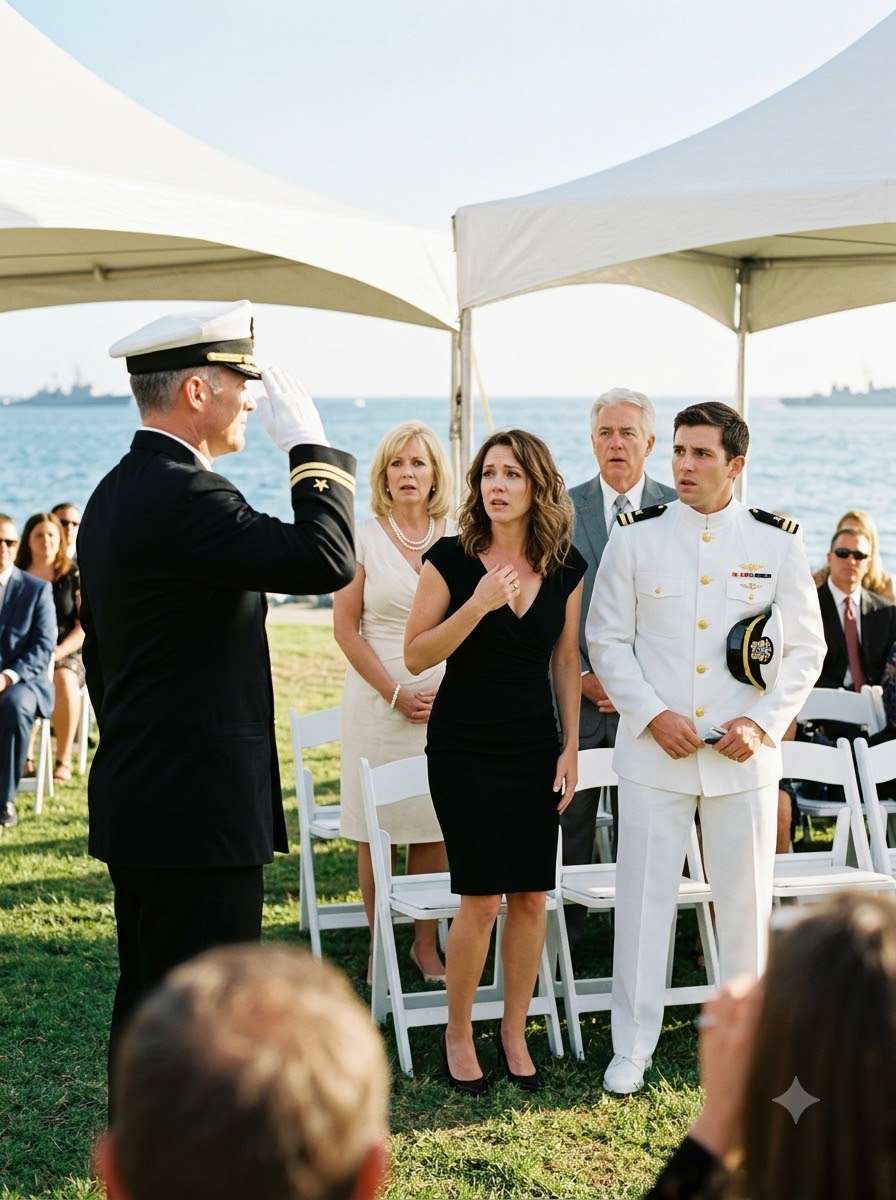
Then he raised his right hand in a formal salute.
“Ma’am.”
The entire family section fell silent.
I rose and acknowledged him.
He lowered his hand.
“We’ve been waiting,” he said.
My mother’s face went pale.
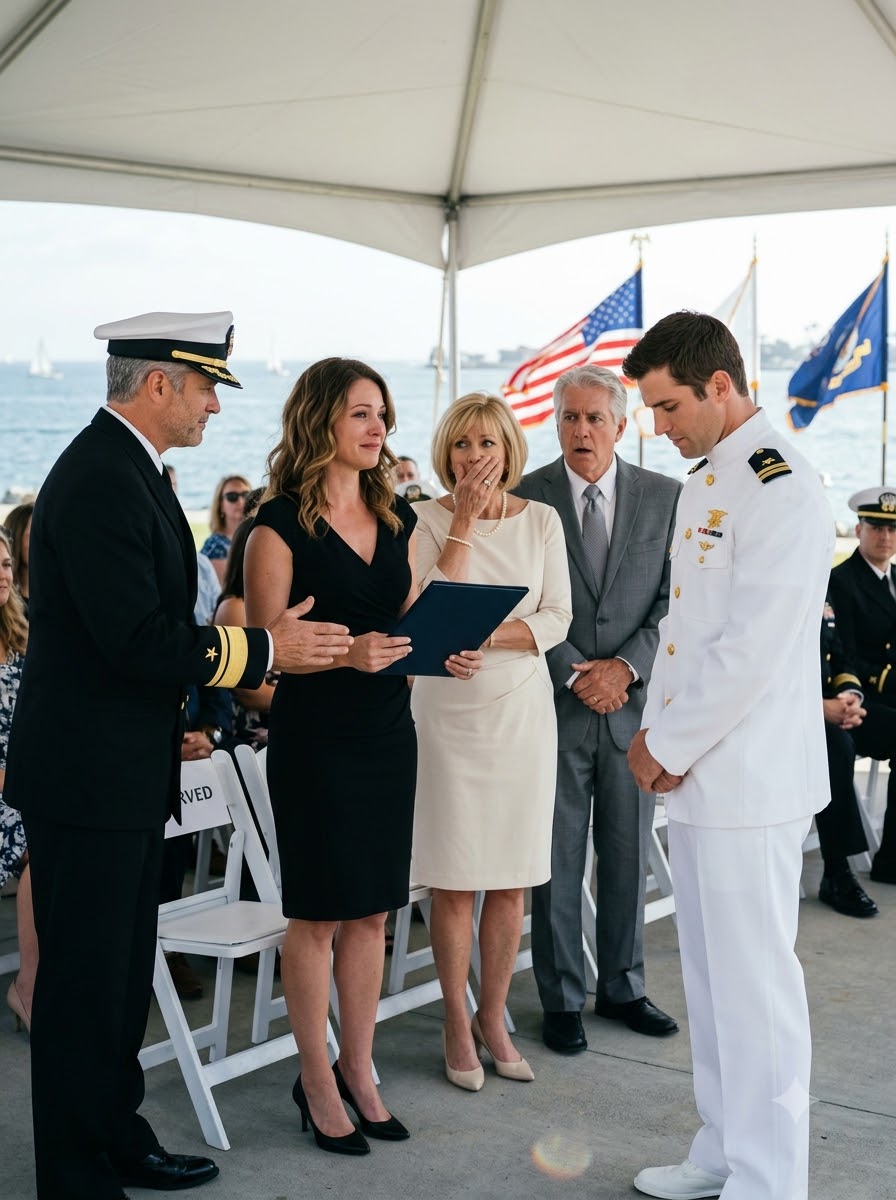
Senior Chief Alvarez approached carrying the official ceremony folder.
He opened it and showed the security guard the protocol addendum.
My name appeared in clear block letters.
Lieutenant Commander Emily Carter.
Special recognition guest.
Protocol hold until seated.
The guard flushed.
Aunt Patricia stopped smiling.
Ryan stared.
My mother whispered:
“Emily. What is this?”
Commander Hayes turned toward the family.
“Lieutenant Commander Carter was not assigned to general family seating,” he said. “That was an error.”
He gestured toward the reserved chair near the stage.
“Your assigned place is waiting, ma’am.”
My father spoke quickly.
“Emily.”
For the first time that morning, he said my name without sounding disappointed.
“Maybe there has been some confusion.”
“There has,” I replied.
My mother reached for my wrist.
I stepped away.
Commander Hayes waited until the movement stopped.
Then he said something nobody expected.
“Before we continue, Lieutenant Commander Carter should decide whether her family remains seated in the front row.”
Every face turned toward me.
My mother looked terrified.
My father stopped speaking.
Ryan swallowed.
“Sir, with respect, she is my sister.”
Commander Hayes looked directly at him.
“Yes. I am aware.”
And suddenly, the family that had spent the morning deciding where I belonged was waiting for me to decide where they could sit.
PART 2
I could have asked Commander Hayes to move them.
Nobody would have questioned the decision.
My parents would have been forced to stand in front of the guests they’d been trying to impress.
Madison and Aunt Patricia would have watched their carefully cultivated superiority collapse.
And Ryan would have remembered his Trident ceremony as the day his sister publicly humiliated him.
But I hadn’t driven six hours for revenge.
I looked at the commander.
“They can stay.”
My mother exhaled.
Then I faced her.
“But they will not speak for me again.”
Nobody answered.
Commander Hayes nodded.
“Understood, ma’am.”
He escorted me to the reserved chair beside the stage.
Senior Chief Alvarez pulled it out for me.
I sat with the navy-blue folder on my lap as the ceremony resumed.
The atmosphere had changed.
People whispered more carefully.
My family remained silent.
And for the first time that morning, nobody questioned whether I belonged.
Commander Hayes returned to the podium.
“Ladies and gentlemen,” he said, “thank you for your patience.”
He spoke about sacrifice, discipline, and the responsibility that accompanied the gold Trident.
He reminded the candidates that the insignia wasn’t simply an award.
It represented an obligation to serve others.
Then his remarks shifted toward the people whose contributions often remained unseen.
“Today we recognize the men who have completed a demanding course and earned the right to wear this insignia. We also recognize that no operator, no team, and no mission stands alone. Some service is visible because uniforms make it visible. Some service stays quiet because silence is part of the duty. But quiet service is still service. And the people who carry it deserve respect whether or not their stories can be told in full.”
My mother turned toward me.
This time, she looked at my face.
Commander Hayes didn’t reveal the details of my assignments.
He didn’t describe the night outside Kandahar when I’d helped coordinate an evacuation while wounded.
He didn’t mention the compromised route identified through a timing correction I’d passed along during another operation.
He didn’t discuss classified locations, personnel, or missions.
Those stories weren’t mine to tell publicly.
Instead, he said what he was permitted to say.
“Today,” Commander Hayes continued, “we have among us a guest whose professional contributions to Naval Special Warfare and joint support operations have shaped outcomes that will never be fully described from a podium. Lieutenant Commander Emily Carter’s presence here is not incidental. It is an honor.”
A murmur moved through the audience.
My father slowly turned toward me.
My mother’s fingers touched her pearls.
Ryan stood in formation, but his expression had changed.
For the first time, he seemed to understand that the sister he’d dismissed had lived a life far beyond the family’s assumptions.
Then the candidates began receiving their Tridents.
One by one, their names were called.
When Ryan stepped forward, I watched him with the same pride I’d felt during our telephone conversation months earlier.
“Ryan Thomas Carter.”
He crossed the stage.
Commander Hayes shook his hand.
Senior Chief Alvarez presented the velvet case.
The gold Trident was pinned to Ryan’s chest.
My mother cried.
My father sat straighter.
And I applauded.
Ryan had earned that moment.
His behavior toward me didn’t erase his achievement.
And his achievement didn’t excuse how he’d treated me.
Both truths mattered.
After the ceremony, families gathered for photographs and congratulations.
The tension from earlier gradually returned beneath the excitement.
My father approached first.
He looked uncertain.
“Why didn’t you tell us?”
I met his eyes.
“I tried,” I said.
His expression shifted.
My mother joined him.
“I didn’t know,” she said.
“I know.”
My father lowered his voice.
“You have to understand how this looked to us.”
“How what looked?”
“You leaving college. Disappearing. Not explaining. Missing holidays. Coming home like a stranger and expecting us to know what to do with that.”
I felt the familiar urge to explain myself.
To make everything easier for him.
But I resisted.
“You never asked what to do with it,” I said. “You decided.”
My mother looked wounded.
“That is not fair,” Dad said.
“No. What was not fair was being nineteen and learning that every version of myself that did not flatter this family would be treated like a defect.”
His jaw tightened.
“You chose to leave.”
“I chose to survive outside a house where love had a ranking system.”
My mother looked away.
For years, those words had remained unspoken.
Now there was no way to pretend they didn’t exist.
Ryan approached us.
His Trident shone against his white uniform.
“Em,” he said.
I looked at him.
“I’m sorry.”
He paused.
“I knew there were things you couldn’t talk about,” he said. “I didn’t know all of it. But I knew enough not to say what I said today.”
My father shifted as if preparing to interrupt.
Ryan raised one hand.
Dad stopped.
That surprised me.
Ryan continued.
“Before BUD/S, I called you because I was scared.”
“I remember.”
“You answered. You helped me. And then today, with everyone watching, I acted like you came here to take something from me.”
He shook his head.
“That was small.”
“Yes,” I said.
His eyes filled.
“I am sorry.”
I studied him.
“The Trident is yours,” I told him. “What you do with the man wearing it is still up to you.”
He nodded.
For once, he didn’t try to defend himself.
At the private reception, my name was already on the seating chart.
I wasn’t listed as Ryan’s sister.
I was an official guest.
The tent overlooked the water, with carefully arranged tables, Navy-colored linens, and refreshments.
People congratulated Ryan, as they should have.
His classmates embraced him.
Senior chiefs offered advice.
Families took photographs.
Then several officers approached me.
Some had worked with me before.
Others knew my name through professional channels.
They shook my hand and thanked me.
A captain I’d known in Bahrain greeted me warmly.
A medical officer mentioned that one of my procedural notes was still being used for training.
Senior Chief Alvarez brought me coffee and apologized for guessing incorrectly about how I liked it.
“I’ve had worse,” I said.
He frowned.
“Ma’am, that is not the standard.”
I almost laughed.
Across the room, my mother watched.
My father observed the senior chiefs treating me with respect.
Aunt Patricia seemed desperate to join a conversation but couldn’t find an opening.
Madison avoided me entirely.
Later, Commander Hayes approached.
“Lieutenant Commander,” he said.
“Commander.”
We shook hands.
“I regret the seating confusion.”
“I’m sure someone regrets it more now.”
He almost smiled.
“I imagine so.”
He glanced toward my family.
“You handled it with more grace than many would have.”
“That’s a generous word.”
“It is also accurate.”
I watched Ryan standing beside our parents.
“I didn’t want to make his day about me,” I said.
“You didn’t. They almost did.”
The words brought unexpected relief.
Commander Hayes lowered his voice.
“There are things in your record that deserve daylight, even if the details cannot have it. That is why you were invited under protocol today.”
“I know.”
“Do you?”
I looked at him.
“Emily,” he said, “quiet service still leaves marks. If no one names it, sometimes the people who carried it start believing it was invisible.”
My coffee cup trembled slightly.
He politely pretended not to notice.
“Thank you,” I said.
He nodded.
“You earned the seat.”
Before leaving, Ryan caught up with me.
“Will you come home for dinner when I’m back in Virginia?” he asked.
I looked at him.
One apology couldn’t erase years of neglect.
But I could see that he was trying.
“We’ll see,” I said.
He nodded.
My mother approached with the black jacket I’d left over a chair.
For once, she didn’t criticize my clothing.
She simply handed it to me.
“I’m proud of you,” she said.
The words sounded strange.
I’d wanted to hear them for years.
Now that she’d finally said them, I didn’t know how to respond.
So I remained quiet.
But this time, my silence wasn’t surrender.
It was a boundary.
I drove back to San Diego that evening.
Before I reached the freeway, my mother had already sent two messages.
The first read:
We need to talk.
Seven minutes later, another arrived.
I am sorry about today.
I read both messages while stopped at a gas station.
Then I put my phone away.
My father called.
I let it go to voicemail.
Ryan waited until almost midnight.
His message was different.
I’m sorry I let them make you a stranger.
I sat on my bed, staring at the words.
Then I replied.
Then don’t do it again.
Three dots appeared on the screen.
Disappeared.
Then returned.
Finally, he answered.
I won’t.
I saved the message.
Not because I believed one promise could repair everything.
But because I wanted to remember the moment my brother first acknowledged what he’d helped destroy.
PART 3
The weeks following the ceremony were strange.
My family suddenly seemed unsure how to speak to me.
My mother sent messages filled with ordinary updates and uncomfortable apologies.
My father wrote an email so formal that it sounded more like a legal defense than a conversation with his daughter.
Aunt Patricia said nothing.
Madison posted a photograph from the ceremony with a caption about family pride.
She cropped me out, although part of my shoulder remained visible.
Ryan began calling every Sunday.
At first, our conversations were awkward.
He talked about training, his upcoming move, and what it felt like to wear the Trident.
I shared the limited, unclassified details of my work.
Gradually, the calls became easier.
On the fourth Sunday, Ryan said:
“Mom asked me what you actually do.”
I paused.
“What did you tell her?”
“That if she wanted to know, she should ask you respectfully and be prepared to accept ‘I can’t answer that.’”
I smiled slightly.
“That’s a decent answer.”
“I’m practicing.”
“I can tell.”
Then he mentioned our father.
“Dad told me he thought you left because you didn’t want to be part of the family.”
I looked out the window.
“What did you say?”
“I told him maybe we made family too expensive for you.”
I went quiet.
He was right.
“Thank you,” I said.
“I should have said it years ago.”
“Yes.”
He accepted that without arguing.
It was a small change, but a meaningful one.
In August, my parents came to San Diego.
I chose a café near the waterfront rather than inviting them into my apartment.
I wanted a neutral place.
Ryan joined us at my request.
For the first ten minutes, we discussed traffic and other harmless subjects.
Then my mother folded her hands.
“I don’t know how to talk to you,” she admitted.
I looked at her.
“You could start by not calling me disappointing to strangers.”
Her eyes filled.
“That was cruel,” she said.
“Yes.”
“I knew it when I said it.”
That surprised me.
She continued.
“I said it because I was embarrassed that I did not understand your life. I made that your fault.”
I listened.
“When you left college, I told myself you were being impulsive. When you stopped telling us where you were, I told myself you were punishing us. When you came home quiet, I told myself you were judging us. Every explanation I chose made me the injured party.”
Ryan looked down.
My father remained silent.
My mother wiped her eyes.
“At the ceremony, when Commander Hayes saluted you, I realized I had been calling ignorance innocence. It wasn’t. I did not know because I stopped trying to know.”
For the first time, I felt she understood part of the damage.
My father cleared his throat.
“I was proud of Ryan because I understood what he was doing.”
He paused.
“He was visible. Football. Training. The ceremony. The Trident. I could point to it and say, that is my son. With you, I did not know what to point to. So I acted like there was nothing there.”
His voice grew quieter.
“That was my failure.”
I looked at him.
“I needed you before Commander Hayes saluted me,” I said.
My mother’s hand covered her mouth.
Dad closed his eyes.
“I know,” he answered.
“No,” I said. “You don’t. Not fully. You know you missed something important. You don’t know what it felt like to come home and watch you all make me smaller so Ryan’s story stayed clean.”
Ryan nodded.
“I did,” he admitted.
I turned toward him.
“You were my little brother,” I said. “I protected you before you knew you needed protecting. I lied about the broken angel. I answered the phone before BUD/S. I came to Coronado to clap for you. And you looked at me like I had arrived to steal something.”
His hands tightened together.
“I’m sorry.”
“I know you are.”
“But it doesn’t fix it.”
“No,” I said. “It doesn’t.”
We talked for more than an hour.
My mother asked whether we could have dinner soon.
I said I wasn’t ready.
My father asked about my public service record.
I told him he could read what was publicly available, but I wouldn’t explain restricted details.
Ryan asked if he could continue calling on Sundays.
I said yes.
When we stood to leave, my mother reached toward me, then stopped.
“May I hug you?” she asked.
For years, she’d treated affection as something she could demand whenever it suited her.
Now she was asking.
“Not today,” I answered.
She looked hurt but nodded.
“Okay.”
It was the first time she’d accepted that boundary without making me feel guilty.
Outside, Ryan walked me to my car.
“I found something,” he said.
“What?”
“The angel.”
I stared at him.
“The porcelain one. Mom kept it. It’s in a box in the attic. The wing is glued wrong.”
I remembered taking the blame when he broke it as a child.
“You remember,” I said.
“I remembered after Coronado.”
He hesitated.
“I think I spent years forgetting things that made you good to me.”
I looked at him.
“What are you going to do with remembering?”
He answered quietly.
“Try to become someone who deserves it.”
It wasn’t a perfect answer.
But it was sincere.
Over the following months, Ryan continued calling.
Sometimes we talked for an hour.
Sometimes only a few minutes.
We still disagreed.
Once, he minimized something our father had said, and I ended the conversation.
The next day, he called back and apologized without making excuses.
My mother began writing letters.
At first, her apologies were filled with careful phrases that avoided direct responsibility.
I sent one back with a short note.
Intention is not the same as impact.
Two weeks later, another letter arrived.
It began:
I hurt you.
I kept that one.
My father had the hardest time changing.
He wanted facts, awards, and dates that would allow him to explain his behavior as a misunderstanding.
But I refused to turn years of emotional neglect into a simple communication problem.
Eventually, he asked Ryan for advice.
Ryan told me about it during a Sunday call.
“Dad asked me how to apologize to you.”
“What did you say?”
“I told him not to make it a speech.”
“Good advice.”
“He did not love that.”
I laughed.
A month later, Dad came to San Diego alone.
This time, I invited him into my apartment.
He arrived carrying a cardboard box.
“I brought your things,” he said.
Inside were pieces of my childhood.
My science competition medal.
A photograph of Ryan and me at the beach.
And a letter I’d written at seventeen but never mailed.
The paper had yellowed.
I picked it up.
“You read it?” I asked.
He nodded.
“I wish I had read it then,” he said.
We sat at my kitchen table.
“I wanted a family I could understand,” he admitted. “I wanted a son who fit the story I knew how to tell. Ryan made that easy. You made me feel uncertain. I did not like that feeling, so I turned it into criticism.”
I looked at him.
“You let me leave.”
“Yes.”
“You let me come home to no plate at Christmas.”
“Yes.”
“You introduced me as complicated.”
“Yes.”
“You laughed when Mom called me disappointing.”
His voice weakened.
“Yes.”
For once, he didn’t defend himself.
“I am sorry,” he said. “Not because Commander Hayes embarrassed us. Not because Ryan is angry with me now. Because you were my daughter, and I treated you like an explanation I did not want to hear.”
I sat quietly.
“I don’t know what to do with that,” I admitted.
“You don’t have to do anything today.”
Before leaving, he asked for a hug.
I said no.
He accepted it.
At the door, he turned.
“I am proud of you,” he said.
This time, the words didn’t sound like an attempt to make me forgive him.
“Thank you,” I answered.
After he left, I opened the old letter.
Dear Mom and Dad, I don’t know why everything I do makes you look tired.
I couldn’t read any further.
I folded it and placed it inside the navy-blue folder from Coronado.
Both documents belonged to my history.
One showed how invisible I’d once felt.
The other proved how much of my life had existed beyond my family’s judgment.
The following spring, Ryan invited me to Virginia.
“Dinner,” he said. “Just me, you, Mom and Dad. No Aunt Patricia. No Madison. No audience.”
“You cook?”
“I can grill.”
“That is not the same thing.”
“I can order food and place it on plates.”
“More honest.”
He laughed.
I agreed to come.
Ryan lived in a small rental house near Virginia Beach.
When I entered, I noticed a framed photograph on the mantel.
It was from his Trident ceremony.
But it wasn’t the official family portrait.
It showed Ryan receiving his Trident while I sat in the front row, applauding.
He noticed me looking.
“I asked for that one,” he said.
“Why?”
“Because it tells the truth.”
Dinner was awkward at first.
My mother offered me water without criticizing my choice.
My father discussed traffic.
Ryan burned the garlic bread.
We ate restaurant pasta and bagged salad.
Then Ryan put down his fork.
“I need to say something.”
Everyone looked at him.
“I wore the Trident for a while like it proved I was the only one in the family who had done something hard.”
He paused.
“I think I needed to believe that because everyone had spent so long telling me I was special. Special is addictive. It makes gratitude feel like something other people owe you.”
My parents listened.
“I don’t want to be that man,” he continued. “And I don’t want a family that requires Emily to stay mysterious so we don’t feel guilty.”
He turned toward them.
“If she says she can’t talk about something, we respect it. If she says no, we respect it. If she comes home, there is a plate. Always.”
Those final words nearly broke me.
There is a plate.
I remembered arriving home on Christmas Eve and discovering that nobody had prepared a place for me.
Now my brother was promising that would never happen again.
“Thank you,” I whispered.
My father nodded.
“There will be a plate.”
My mother added:
“Always.”
Later that evening, Ryan and I stood outside on his patio.
The air smelled of grass and approaching rain.
“You okay?” he asked.
“No.”
He nodded.
“Me neither.”
We laughed softly.
Then he said:
“I keep thinking about when you told me fear was information.”
“I stole that from someone smarter.”
“Still helped.”
“I’m glad.”
He looked toward the dark yard.
“I was afraid at Coronado. When Commander Hayes saluted you. Not because of your rank. Because I realized I didn’t know my own sister, and I couldn’t blame you for it.”
I considered his words.
“That sounds like useful information.”
“What do I do after receiving it?”
I looked at my brother.
The little boy who’d once hidden beneath the couch was still there.
So was the man who had earned his Trident.
“You tell the truth faster next time,” I said.
He nodded.
“I can do that.”
The following morning, my mother handed me a paper bag before I left.
Inside were a sandwich, an apple, a bottle of water, and two cookies wrapped in a napkin.
She looked embarrassed.
“I know you can buy food,” she said quickly. “I just thought…”
She stopped.
I understood.
She wasn’t merely giving me lunch.
She was finally making sure I had a place.
“Thank you,” I said.
At the airport, I ate one cookie before security.
It tasted like cinnamon.
And something that wasn’t quite forgiveness yet.
Years passed.
My family still remembered the Coronado ceremony, but they spoke about it differently.
My father acknowledged that he should have stopped my mother’s behavior.
My mother admitted she’d mistaken ignorance for innocence.
Ryan never told the story without acknowledging that he’d been wrong.
Aunt Patricia avoided the subject.
Madison once tried joking about my black dress at Thanksgiving.
Ryan looked across the table.
“Don’t.”
She never mentioned it again.
I still wore black.
It remained practical for travel, work, and long days.
But I no longer felt as though I was using it to disappear.
On the second anniversary of Ryan’s Trident ceremony, Commander Hayes retired.
I attended in uniform.
Ryan came too.
My parents asked whether they were welcome and sat quietly in the general seating section.
Afterward, Commander Hayes approached me.
He glanced toward Ryan, who was speaking with Senior Chief Alvarez.
“He’s growing,” Hayes said.
“He is.”
“So are they.”
He nodded toward my parents.
“Slowly.”
“That is usually how people grow when the lesson is expensive.”
I smiled.
“You always did make compassion sound like a performance review.”
“And you always did hide gratitude behind dry comments.”
We laughed.
Before leaving, he handed me a small envelope.
Inside was a copy of the protocol addendum from Ryan’s ceremony.
My name was printed clearly.
The document also recorded that my seating had been corrected at 0849.
At the bottom, Commander Hayes had written a single sentence.
You were expected all along.
I framed it.
Not because I needed proof of my rank.
But because it reminded me that my place had never depended on my family’s approval.
The first thing my mother noticed when she saw me at Naval Amphibious Base Coronado was my black dress.
By the end of that day, she’d finally learned to look at my face.
I had arrived simply wanting to celebrate my brother.
I left having been recognized for a life my family had spent years dismissing.
But the most important change wasn’t the commander’s salute.
It wasn’t the reserved chair.
And it wasn’t the title printed beside my name.
It was that I no longer felt responsible for making myself smaller so my family could remain comfortable.
I’d learned to speak when necessary, remain silent when appropriate, and protect the boundaries I’d worked so hard to establish.
My family had spent that morning acting as though I didn’t belong.
The truth had been written into the official record before they even arrived.
They simply hadn’t known how to read it.
