

Chapter 1: The Wedding That Never Happened
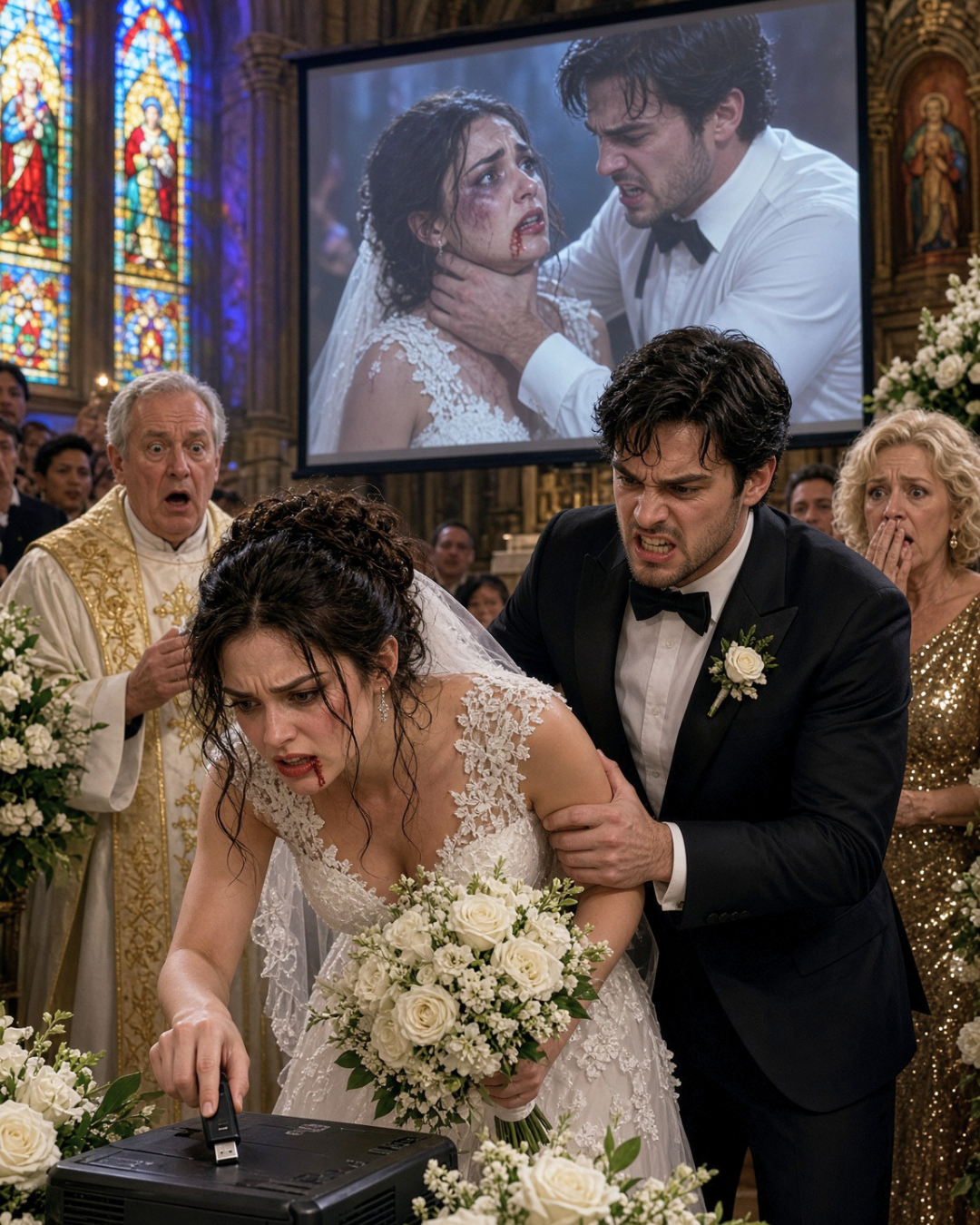
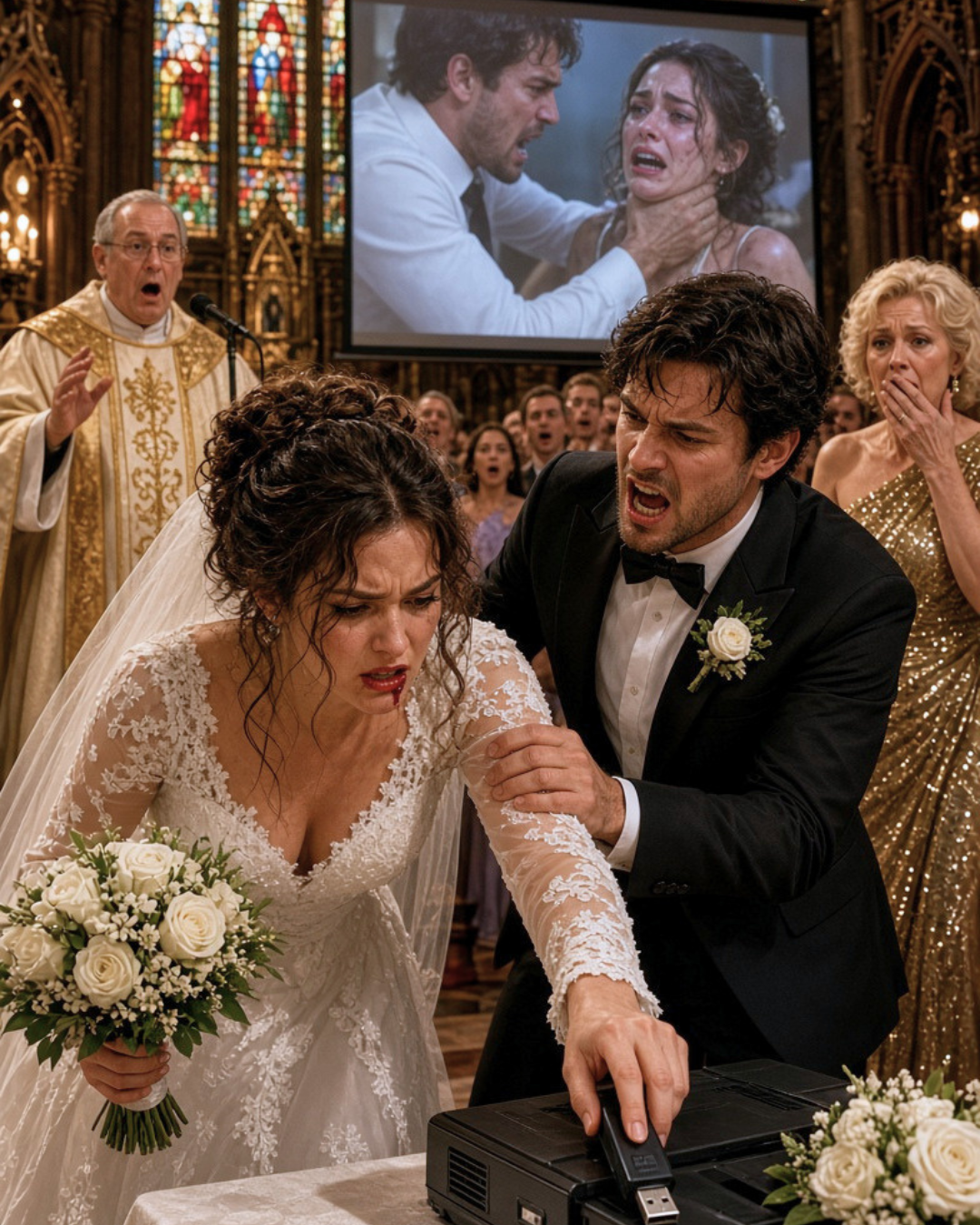
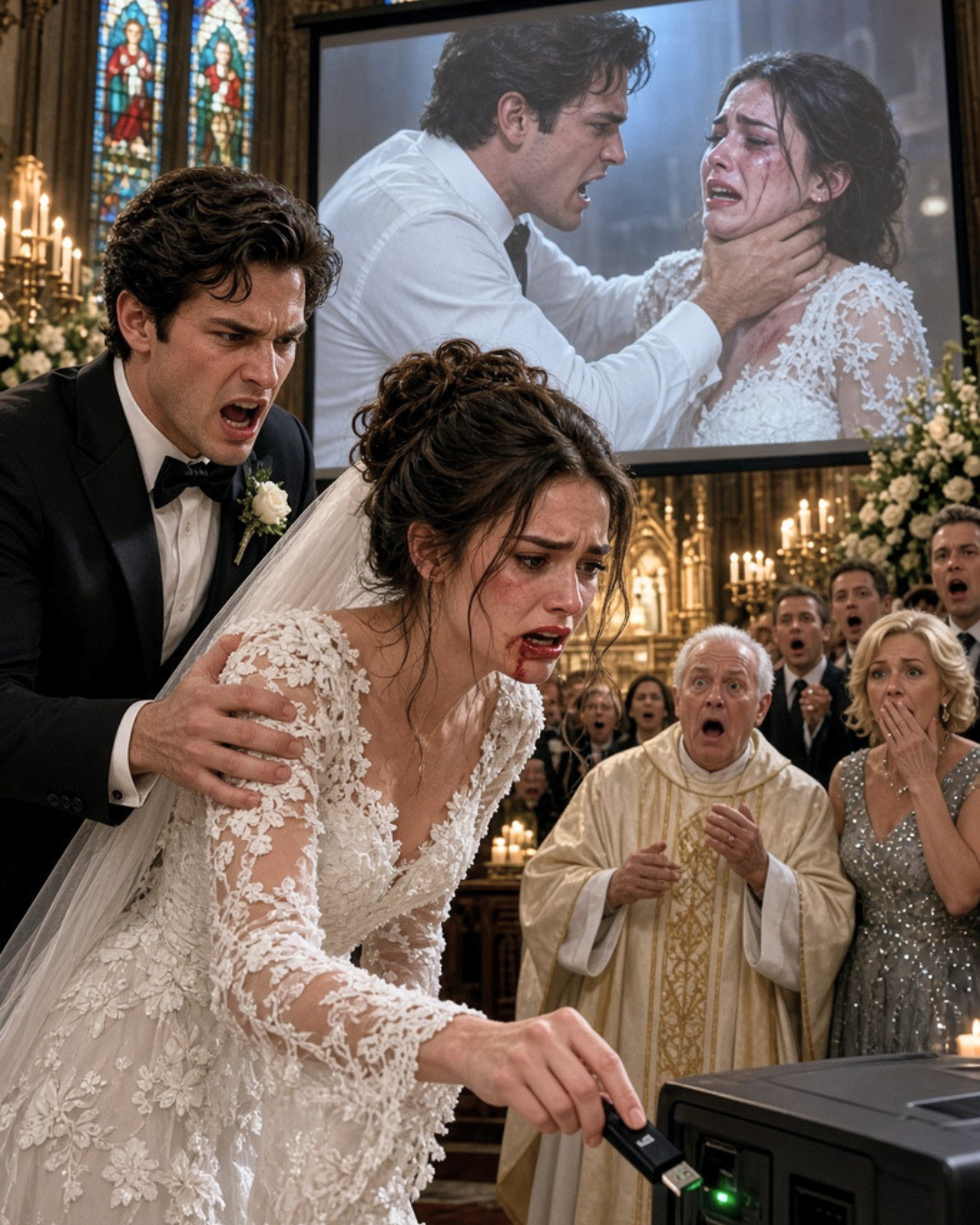
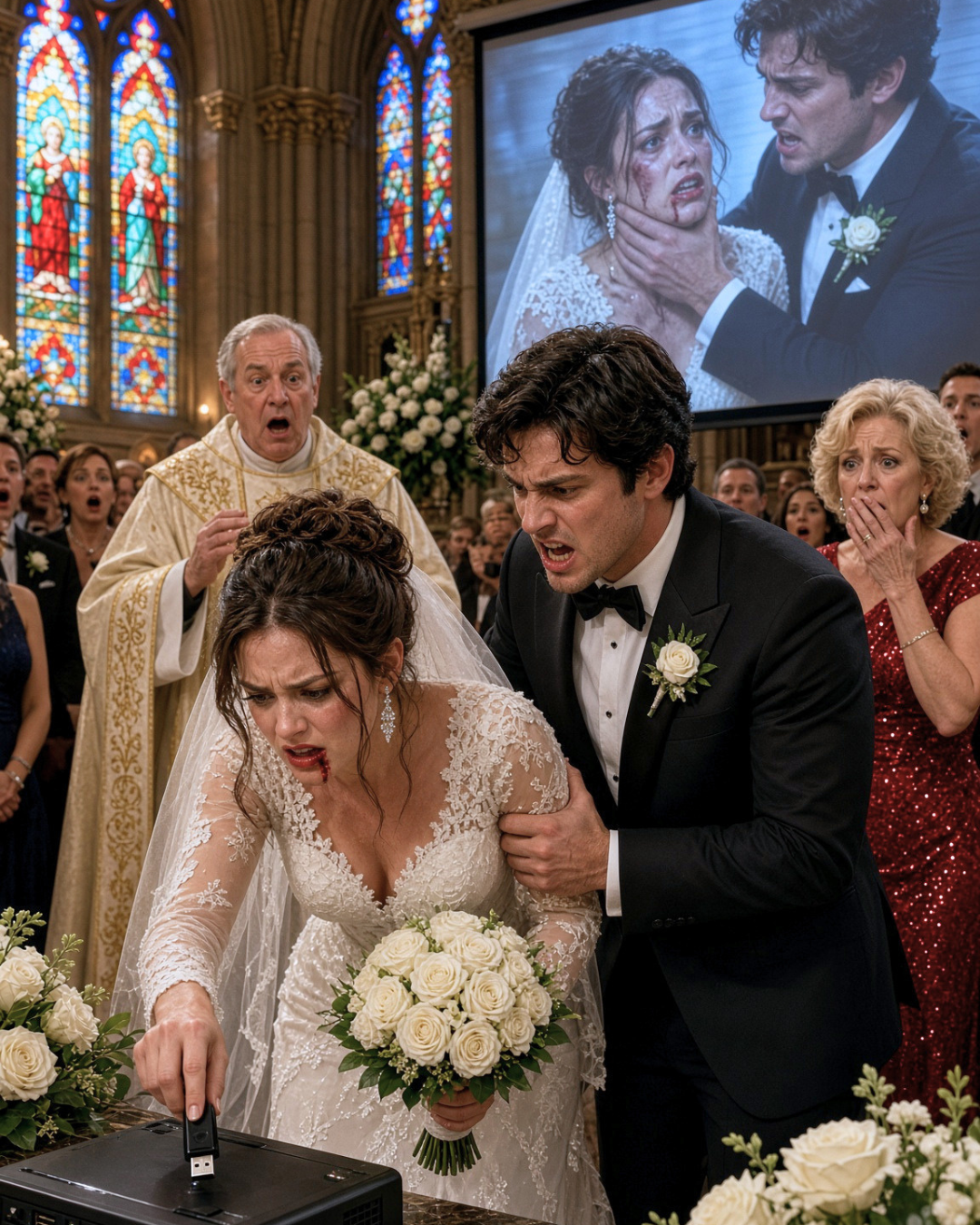
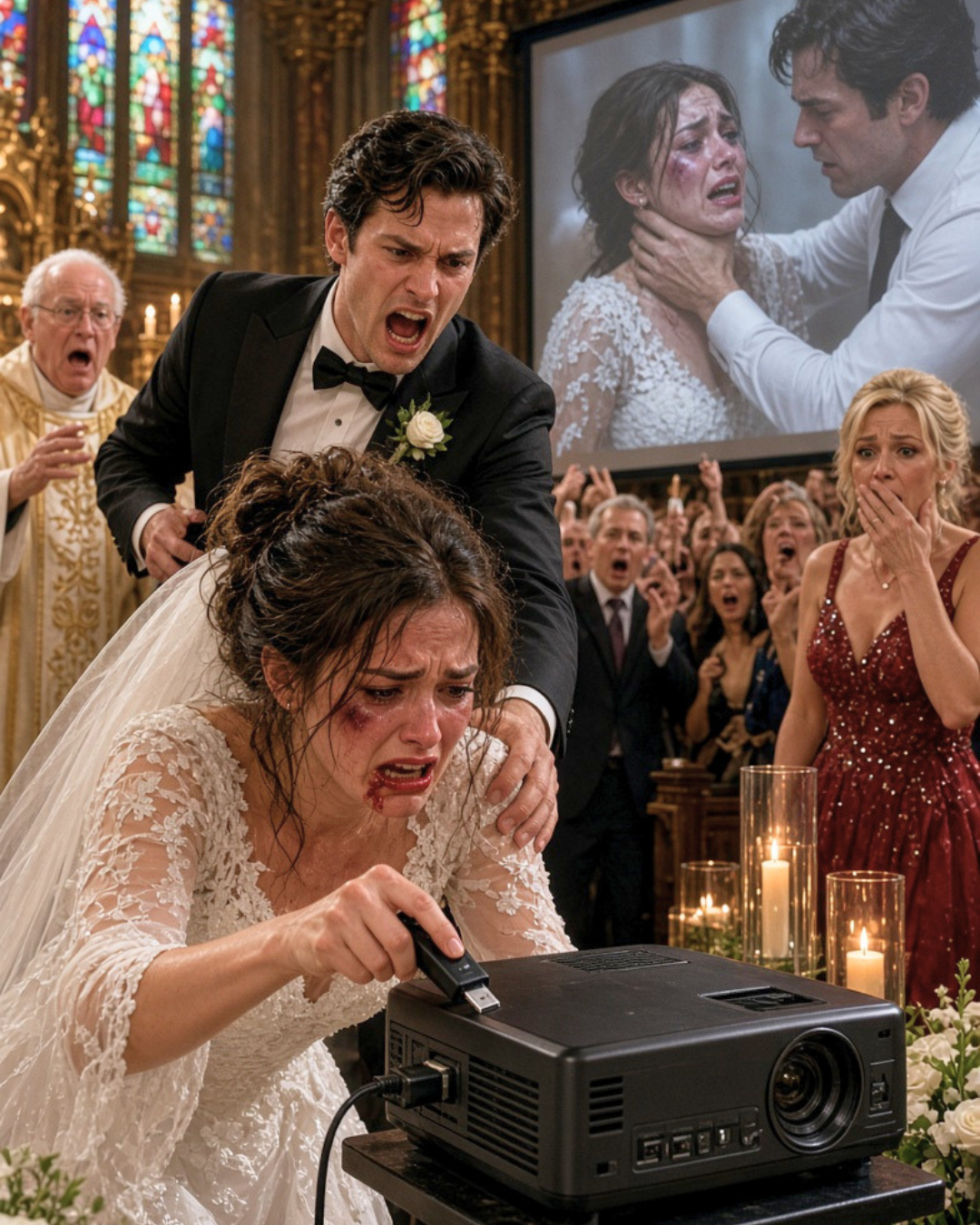
I walked down the aisle with a split lip and a torn veil. My fiancé smirked at his groomsmen and said loudly, “She needed a reminder of who’s boss before we sign the papers.” The entire congregation chuckled, including his mother. I didn’t cry. I calmly reached into my bridal bouquet, pulled out a flash drive, and plugged it directly into the pastor’s projector. “Let’s look at the real reminder,” I whispered, as the screen lit up behind him.
I walked down the aisle with a split lip and a torn veil, while the man waiting at the altar grinned as if he had already won. Before I reached him, Ethan turned to his groomsmen and said loudly, “She needed a reminder of who’s boss before we sign the papers.”
Laughter rolled through St. Matthew’s Chapel.
His mother, Vivian, covered her mouth with a jeweled hand, but she did not hide her smile. Ethan’s brothers chuckled. His business partners whispered. Even the pastor lowered his eyes, pretending not to understand why my lip was bleeding.
I kept walking.
Every step hurt. Ethan had shoved me against the hotel mirror that morning after discovering I had removed one page from our prenuptial agreement. He thought the page concerned money.
It did not.
“You look beautiful,” he murmured when I reached him.
“You look confident,” I replied.
His smile sharpened. “I should be. In twenty minutes, your company becomes mine.”
That was what he believed.
For six months, Ethan had played the devoted fiancé while pressuring me to merge Hartwell Medical Systems, the surgical technology company my late father had built, with his failing investment firm. He had convinced everyone that I was grieving, fragile, and incapable of managing a billion-dollar business alone.
Privately, he called me decorative.
Vivian called me temporary.
What neither of them knew was that I had spent those same six months tracing missing funds, recording threats, and rebuilding the security system Ethan thought he had disabled. My father had taught me never to confront a thief until I knew where he had hidden every stolen dollar.
Three weeks earlier, my investigator had warned me that Ethan’s temper was escalating. He urged me to cancel everything. I refused, not because I still loved Ethan, but because the ceremony gathered every conspirator, investor, witness, and camera in one room. The wedding was not my surrender. It was the boardroom arrogant people would enter without lawyers beside them. Every cruel joke that morning simply confirmed where each guest had chosen to stand.
The pastor began speaking about love, loyalty, and obedience.
Ethan squeezed my bruised wrist hard enough to make me wince.
“Smile,” he whispered. “There are cameras.”
I smiled.
Then the pastor asked whether anyone objected to the union.
Silence filled the chapel.
Ethan exhaled smugly.
I reached into my bouquet, beneath the white roses and silk ribbon, and closed my fingers around a small black flash drive.
Ethan’s expression changed.
“What is that?” he hissed.
I stepped away from him, walked to the pastor’s projector, and inserted the drive.
“Let’s look at the real reminder,” I whispered.
The screen behind the altar flickered to life.
The first thing that appeared on the projector was not a video.
It was a photograph of my father.
Arthur Hartwell stood in front of the first Hartwell Medical Systems laboratory, wearing his favorite navy sweater and holding a prototype surgical instrument in his hands.
Beneath the photograph were seven words.
“A legacy is not a wedding gift.”
For the first time that morning, Ethan stopped smiling.
“What are you doing?” he demanded.
I ignored him.
The projector advanced to a document titled Hartwell Medical Systems — Confidential Financial Review.
A murmur spread through the chapel.
Ethan’s mother, Vivian, rose halfway from her seat.
“Pastor, turn that thing off!”
But Pastor Daniel Reeves did not move.
I had spoken to him privately the night before. He knew I intended to make an announcement, although he had no idea how much evidence I would bring.
“Everyone,” I said, turning toward the congregation, “before this ceremony continues, I believe you deserve to know why my fiancé has been so eager to marry me.”
Ethan reached for my arm.
I stepped away.
“Don’t touch me.”
My voice was quiet, but the microphone beside the altar carried it through every speaker.
A woman in the third row gasped.
Ethan laughed nervously.
“Claire, sweetheart, you’re embarrassing yourself.”
“That’s interesting,” I replied. “Because you told me this morning that embarrassment was an excellent way to teach someone obedience.”
His expression hardened.
“Enough.”
I pressed the remote.
The screen changed.
A security recording appeared, showing Ethan seated inside his private office at Mercer Capital Partners.
The timestamp read 11:42 p.m., three weeks earlier.
Beside him sat Vivian and his younger brother, Brandon.
Ethan’s recorded voice filled the chapel.
“Once we’re married, she’ll sign the management authorization. Then we move the medical contracts into the new holding company.”
Brandon leaned forward.
“What if she refuses?”
Ethan laughed.
“She won’t. Claire still thinks marriage means trust.”
Vivian’s voice followed.
“Your father didn’t spend thirty years building connections just so you could lose everything because some grieving girl suddenly develops a backbone.”
The congregation went silent.
I looked directly at Vivian.
“Would you like me to rewind that part?”
Her face turned pale.
Ethan lunged toward the projector.
Before he reached it, two men standing near the side entrance stepped forward.
They were not wedding guests.
They were licensed security professionals I had hired after receiving threats.
One of them calmly positioned himself between Ethan and the equipment.
“Sir, please step back.”
Ethan stared at him.
“Who are you?”
“Someone making sure this doesn’t get any worse.”
I advanced the presentation again.
A spreadsheet appeared.
Three companies.
Nine suspicious transfers.
A total of $18.6 million.
Money that had disappeared from accounts connected to Hartwell Medical Systems over the previous six months.
I heard someone whisper, “Oh my God.”
Ethan’s business partner, Gregory Shaw, abruptly stood.
“Those numbers are confidential!”
“They were,” I answered. “Until our forensic accountants discovered that the invoices supporting those transfers were fabricated.”
Gregory sat down.
Ethan turned toward me, his voice shaking with anger.
“You have no idea what you’re talking about.”
I looked at him.
“Then perhaps you can explain why one of the companies receiving our money lists your mother’s personal accountant as its registered agent.”
Vivian gripped the back of the pew.
“Claire, you are making a terrible mistake.”
“No,” I said. “The mistake was believing I would never check.”
Then I clicked to the next file.
The screen displayed a photograph of the missing page from our prenuptial agreement.
Ethan’s eyes widened.
I watched the recognition spread across his face.
He finally understood what I had removed.
It was not a financial disclosure.
It was an authorization that would have allowed Ethan to claim broad decision-making powers over my privately held shares through a separate management agreement he had insisted we sign immediately after the wedding.
My attorney had already confirmed that the language was unacceptable and that no such authority would be granted.
But that was not the worst part.
The document carried a signature.
Mine.
Except I had never signed it.
“Ethan,” I asked, “would you like to explain why my signature appears on a document I first saw yesterday?”
He said nothing.
I clicked again.
A magnified comparison appeared.
One signature was genuine.
The other had been copied from a document I signed two years earlier.
A sharp gasp echoed through the chapel.
Then Vivian shouted something that made everyone turn.
“Ethan! I told you not to use that version!”
The silence afterward was extraordinary.
Even the photographer lowered his camera.
I looked at Vivian.
“Thank you. That answers one question.”
Ethan turned toward his mother.
“Mom, shut up!”
And that was when the chapel doors opened.
A woman in a charcoal suit stepped inside, carrying a leather briefcase.
My attorney, Rebecca Sloan.
Behind her walked a man Ethan recognized immediately.
His former chief financial officer.
Thomas Keller.
Ethan’s face lost its color.
“Thomas?”
Thomas looked at me, then at the projector.
“I’m sorry it took me so long to tell the truth, Claire.”
I nodded.
“You’re here now.”
Rebecca approached the altar and handed me a sealed envelope.
“Everything has been delivered to the appropriate authorities,” she said quietly. “And the board has acknowledged receipt of the emergency findings.”
Ethan stared at the envelope.
“What have you done?”
I looked into the eyes of the man I had once planned to spend my life with.
“Exactly what my father taught me.”
Then I opened the envelope.
“Ethan, there’s something you should know about the company you thought you were marrying.”
“My father knew about you.”
Those five words made Ethan take a step backward.
For a moment, the entire chapel seemed to hold its breath.
Ethan blinked.
“What?”
I held up a letter written on my father’s personal stationery.
“Arthur Hartwell knew your investment firm was in financial trouble long before you proposed to me.”
“That doesn’t prove anything.”
“No,” I agreed. “But his investigation uncovered something else.”
I turned toward the congregation.
“My father died eighteen months ago. Before that, he spent nearly four decades building medical technology designed to make surgery safer and more accessible. He believed every patient deserved the best possible care, regardless of their income.”
My voice trembled slightly.
I had rehearsed this speech.
I had promised myself I would not cry.
But seeing my father’s photograph above the altar made my chest ache.
“He used to tell me that a company was only worth owning if you could sleep at night knowing how it earned its money.”
I unfolded the letter.
“Three months before he passed away, he discovered that Mercer Capital Partners had approached several of our suppliers with suspicious financing arrangements.”
Ethan shook his head.
“That’s business. Your father understood business.”
“He did,” I said. “Which is why he refused your father’s proposed investment.”
Vivian stood.
“Arthur and my husband were friends!”
“They attended the same charity events,” I replied. “That isn’t the same thing.”
I read from the letter.
“Claire, if the Mercer family ever offers you a partnership, review every document yourself. Never confuse a polished reputation with an honest one.”
Ethan looked toward the exit.
His groomsmen avoided his eyes.
I continued.
“My father also established an independent trust structure for his controlling shares. The trustees cannot transfer voting control simply because I marry someone. No marriage certificate changes that.”
Ethan stared at me.
“You told me you owned everything outright.”
“I told you I was responsible for the company. I never told you that marrying me would give you control.”
Rebecca stepped forward.
“The proposed management agreement would have required separate, valid authorization and multiple approvals. None were granted. The disputed signature has been referred for investigation.”
Ethan’s jaw tightened.
“You planned this.”
“I planned to protect my father’s company,” I replied. “I hoped I wouldn’t have to protect myself from the man I loved.”
That sentence finally broke something inside me.
Not enough to make me stop.
But enough to remind me that beneath the evidence, the investigators, and the legal documents, I was still a woman standing in a wedding dress before a man who had betrayed her.
I remembered Ethan bringing soup to my office when I worked late.
I remembered the way he had held my hand at my father’s funeral.
I remembered believing his promises.
Some of those moments might have been real.
Others had been carefully performed.
I would never know which.
And that uncertainty hurt almost as much as the betrayal itself.
Ethan must have seen my expression change.
He stepped closer.
“Claire,” he said softly, “we can talk about this privately.”
I looked at him.
“That’s what you said this morning.”
His eyes dropped to my split lip.
For one second, shame flickered across his face.
Then it disappeared.
“You’re making me look like a monster.”
I shook my head.
“I haven’t made you look like anything, Ethan. I’ve shown people what you said and what you did.”
Vivian rushed forward.
“Enough of this nonsense! She’s clearly overwhelmed. Look at her! She’s injured, she’s emotional, and she’s humiliating our family!”
The congregation shifted uncomfortably.
Then an elderly woman rose from the fourth row.
Mrs. Eleanor Brooks.
She had worked alongside my father for twenty-six years, first as his executive assistant and later as director of patient outreach.
She was seventy-four, barely five feet tall, and had never been intimidated by anyone.
“Vivian,” she said, “sit down.”
Vivian froze.
Eleanor continued.
“I knew Arthur Hartwell longer than you knew his bank account. And I watched that young woman keep his company running while she was grieving.”
A few people nodded.
“She doesn’t need to prove she’s strong enough to lead. She already has.”
Vivian opened her mouth.
Eleanor raised one finger.
“And another thing. If you see a bride walking toward the altar with an injured face and your first instinct is to laugh, you have no business lecturing anyone about family values.”
Nobody chuckled this time.
I felt tears gather in my eyes.
“Thank you, Eleanor.”
She smiled.
“Your father would have wanted you to stand up for yourself, sweetheart.”
Ethan turned toward Thomas Keller.
“Why are you here?”
Thomas swallowed.
“Because I helped prepare financial reports that hid the firm’s losses.”
“You signed confidentiality agreements!”
“I know. My attorney is handling that. I’ve provided the original records to the investigators.”
Ethan pointed at him.
“You’re finished in this industry!”
Thomas did not flinch.
“Maybe. But I won’t spend the rest of my life pretending I didn’t know.”
Rebecca opened her briefcase.
“There is one additional matter.”
Ethan looked at her.
“What now?”
She placed a document on the table beside the altar.
“Following an independent review, Hartwell Medical Systems’ board voted this morning to suspend all proposed transactions with Mercer Capital Partners, revoke its access to company systems, and authorize recovery proceedings concerning the disputed funds.”
Gregory Shaw stood again.
“You can’t do that!”
Rebecca looked at him calmly.
“The board already did.”
A phone began ringing.
Then another.
Then three more.
Ethan’s groomsmen checked their screens.
Gregory hurried into the aisle.
Vivian clutched her purse.
And Ethan’s phone vibrated continuously against his tuxedo.
He finally answered.
“Not now!”
A man’s voice was loud enough for those nearest him to hear.
“Ethan, the bank wants an explanation for the transfers. Our credit committee is reviewing the facility. We need you here immediately.”
Ethan closed his eyes.
“Tell them I’ll call back.”
“They’ve already contacted the other partners.”
Ethan ended the call.
For the first time since I had known him, he looked genuinely frightened.
Not because he had hurt me.
Not because he had broken our engagement.
But because the financial empire he had constructed out of borrowed money and borrowed credibility was beginning to unravel.
He looked at me with disbelief.
“You’re going to destroy everything?”
I shook my head.
“No, Ethan. I’m going to stop you from using what my father built.”
Then I turned toward Pastor Reeves.
“Pastor, I won’t be getting married today.”
He nodded slowly.
“I understand.”
I removed my engagement ring.
It was a beautiful diamond.
Three carats, platinum setting, purchased from a jeweler on Fifth Avenue.
I had once believed it represented forever.
Now it felt unbearably heavy.
I placed it on the table.
Ethan stared at it.
“You can’t just walk away.”
I met his eyes.
“I can.”
And I did.
But I had barely reached the first pew when Vivian screamed:
“If you leave this chapel, Claire, everyone will learn what really happened to your father!”
I stopped.
For eighteen months, I had believed my father’s final weeks were a private tragedy.
Now, looking at Vivian’s furious expression, I realized there was another secret.
And this time, I was not sure I was ready to hear it.
I turned slowly.
“What did you just say?”
Vivian’s expression changed.
She seemed to realize that she had spoken too quickly.
Ethan grabbed her elbow.
“Mom. Don’t.”
But it was too late.
I walked back toward the altar.
“Tell me what you know about my father.”
Vivian lifted her chin.
“Your father wasn’t the saint everyone believes he was.”
I felt my stomach tighten.
“Explain.”
She glanced at Ethan.
He shook his head almost imperceptibly.
Vivian ignored him.
“Arthur was preparing to sell part of his company before he died. He knew the business was in trouble.”
I almost laughed.
Hartwell Medical Systems had entered the previous fiscal year with strong revenues, substantial reserves, and a healthy research pipeline.
My father had been careful about debt.
He disliked unnecessary risk.
“That’s not true,” I said.
Vivian smiled.
“Then why did he meet privately with my husband six weeks before his final hospitalization?”
I looked at Rebecca.
She looked equally surprised.
Ethan stepped forward.
“Claire, this is irrelevant.”
“No,” I said. “For once, I’d like to hear your mother finish a sentence.”
Vivian took a breath.
“Your father wanted financing. My husband offered to help him. Arthur refused the terms, and the relationship ended badly.”
“Which terms?”
She hesitated.
“That’s private.”
“Then why bring it up?”
Her eyes flashed.
“Because you’re standing here acting as if your family has never made a mistake!”
Eleanor Brooks spoke from behind me.
“Arthur did meet with Charles Mercer.”
Everyone turned.
Eleanor stood beside the pew, holding her handbag.
“I remember the meeting.”
My heart began pounding.
“Why didn’t you tell me?”
“Because your father asked me not to trouble you while he was ill. And because the meeting wasn’t what Vivian is suggesting.”
She walked toward the altar.
“Arthur was investigating an attempted investment fraud involving a small medical supplier. Charles Mercer had approached the supplier with promises of financing. The company nearly lost its patents.”
Vivian went rigid.
Eleanor continued.
“Your father helped the supplier obtain independent legal counsel. Then he gathered documents and referred the matter to the appropriate professionals.”
I stared at her.
“Why didn’t he tell me?”
“He wanted the matter resolved before involving you.”
She reached into her handbag.
“After his death, I gave his sealed records to his estate attorney. I thought you had received them.”
Rebecca frowned.
“Claire, your father’s estate was initially handled by another firm.”
I nodded.
A terrible memory surfaced.
Six months after the funeral, Ethan had offered to help organize my father’s old paperwork.
He had insisted I needed rest.
He had volunteered to coordinate with the former estate administrator.
And I had trusted him.
I turned toward Ethan.
“Did you know about those records?”
He stared at me.
“Claire, don’t start inventing things.”
“Did you?”
“No.”
His answer came too quickly.
Thomas Keller stepped forward.
“I may know something.”
Ethan looked ready to explode.
“Thomas, keep your mouth shut!”
Thomas ignored him.
“Last year, Ethan asked me to review a folder labeled Hartwell Estate — Historical Transactions. There were letters, old financing proposals, and correspondence involving his father.”
My pulse quickened.
“Where is that folder?”
“I don’t know. But I kept an inventory of the documents I was asked to review.”
He looked at Rebecca.
“I gave my attorney a copy.”
Rebecca nodded.
“We can request those records through the proper channels.”
Vivian suddenly sank into her seat.
Her expensive hat tilted sideways.
For the first time, she looked less like a woman protecting her family and more like someone who had spent years protecting a lie.
I looked toward the photograph of my father.
I wanted to ask him a hundred questions.
I wanted to hear his voice.
I wanted him to tell me everything would be all right.
But he was gone.
And I had spent too much of my life waiting for someone else to make difficult decisions for me.
I turned toward the guests.
“I’m sorry you came expecting a wedding.”
No one spoke.
“I’m sorry this became something painful and public. But I’m not sorry I stopped it.”
A woman near the back began clapping.
Then another.
Soon the sound spread through the chapel.
Not everyone joined.
Some guests looked embarrassed.
Some slipped quietly toward the doors.
Others watched Ethan with expressions that told me their opinion of him had changed forever.
I didn’t need their applause.
But I appreciated the reminder that not everyone believed cruelty was entertainment.
Ethan watched me with cold eyes.
“This isn’t over.”
I nodded.
“No. The legal process is only beginning.”
Then I turned toward Rebecca.
“I’m ready to leave.”
She glanced at my lip.
“First, we’re going to make sure you receive medical care.”
I agreed.
Outside the chapel, sunlight poured over the stone steps.
My wedding photographer, Madison, approached hesitantly.
“Claire?”
I turned.
She held her camera against her chest.
“I took some photographs this morning that might be important.”
My heart sank.
“What photographs?”
Her voice trembled.
“I was in the hallway outside your bridal suite. I heard an argument. I didn’t go inside, but afterward I photographed the broken mirror and the damage to your veil.”
I swallowed.
“Thank you.”
“I didn’t know what to do,” she whispered. “I wish I’d spoken up sooner.”
I looked at her.
“You’re speaking now.”
She nodded, tears filling her eyes.
Rebecca arranged for Madison to preserve the original files and share them through the proper legal channels.
Then she looked at me.
“Claire, there’s something else.”
“What?”
“The security team has confirmed that your car is waiting. But before we go, someone wants to speak to you.”
I turned.
Standing beside a black sedan was a silver-haired man wearing a dark blue suit.
I recognized him immediately.
Dr. Samuel Bennett.
My father’s oldest friend.
He had served on Hartwell Medical Systems’ board for twenty-two years.
He approached slowly.
“Claire,” he said, “your father asked me to give you something when the time was right.”
My breath caught.
“What?”
He handed me a small wooden box.
Inside was a brass key.
And beneath it, a handwritten note.
“For the day you finally understand that courage does not mean staying.”
I stared at the words.
My father’s handwriting.
My father’s message.
And for the first time that morning, I cried.
Chapter 2: The Legacy of Arthur Hartwell
The key was old.
Its brass edges had been polished smooth by years of use.
I recognized it immediately.
It belonged to my father’s workshop.
Not the corporate research facility.
Not the gleaming laboratory where investors toured expensive prototypes.
His private workshop.
A small brick building behind our family’s old house in Charlottesville, Virginia.
When I was a child, Dad took me there on Saturday mornings.
He would give me a notebook and ask me to draw something that could make a person’s life easier.
I designed ridiculous things.
Shoes that tied themselves.
A wheelchair that could climb mountains.
A machine that made pancakes while telling jokes.
Dad never laughed at my ideas.
He asked questions.
“How would it work?”
“Who would it help?”
“What happens if it breaks?”
Those mornings taught me more about leadership than any business school lecture.
I had not entered the workshop since his funeral.
I couldn’t bear it.
Now Samuel stood beside me, holding the wooden box.
“Your father left instructions,” he said. “He wanted me to wait until you were ready to open it.”
“How would you know when that was?”
Samuel smiled sadly.
“He said I’d know when you stopped asking everyone else for permission to live your own life.”
I pressed the key into my palm.
“He really said that?”
“Almost word for word.”
I laughed through my tears.
“That sounds like him.”
Samuel touched my shoulder.
“He loved you, Claire. More than the company. More than anything.”
For months, I had felt trapped between protecting Dad’s legacy and proving I deserved to lead it.
I had convinced myself that if I failed, I would somehow fail him.
Samuel seemed to understand.
“He didn’t build Hartwell Medical Systems so you would spend your life guarding his accomplishments,” he said. “He built it because he believed people could make the world better. Including you.”
I looked down at my ruined wedding dress.
“I’m not sure I feel very capable today.”
Samuel’s eyes softened.
“You just walked away from someone who wanted to control your life, while protecting the people who depend on your company. That’s a difficult thing to do.”
I couldn’t answer.
Rebecca gently interrupted.
“Claire, we need to get you checked by a doctor. Afterward, we can discuss your next steps.”
I nodded.
For once, I didn’t argue.
At the hospital, a physician examined my lip and wrist, documented my injuries, and recommended follow-up care.
Rebecca explained my options for reporting the incident and obtaining legal protection.
I chose to make a formal report.
It was not an easy decision.
Part of me still feared Ethan’s anger.
Another part feared the headlines.
I knew how quickly people could turn a painful experience into gossip.
But I also knew that silence had protected Ethan for too long.
I gave my statement.
I preserved the messages.
I provided the relevant recordings to investigators through my attorney.
Then I went home.
Not to the house Ethan had helped decorate.
Not to the penthouse where he had insisted we live after the wedding.
I went to my father’s old home in Charlottesville.
The place where I had learned to ride a bicycle.
The place where my mother had planted roses before she died.
The place where Dad used to make terrible Sunday pancakes and insist they were perfect.
That evening, I stood before the workshop door.
For a long moment, I couldn’t move.
Then I inserted the key.
The lock turned.
The door opened with a familiar creak.
Inside, everything smelled like cedar, machine oil, and old paper.
Dad’s tools hung neatly above the workbench.
His safety glasses rested beside a stack of notebooks.
A faded photograph of my mother was pinned to the wall.
And in the center of the room sat a small wooden desk.
On it was a blue envelope.
My name was written across the front.
I sat down.
My hands trembled as I opened it.
My dearest Claire,
If you’re reading this, Samuel has decided you’re ready to come back here.
I hope you haven’t forgotten the most important thing I ever tried to teach you.
You are not responsible for making everyone happy.
You are responsible for living honestly.
Some people will love what you can give them. Others will love who you are. It may take time to recognize the difference.
When you do, don’t punish yourself for believing in the wrong person.
You have always been brave, even when you were afraid.
And please remember that Hartwell Medical Systems was never supposed to become a monument to me.
It was supposed to help people.
Make it better than I did.
Love, Dad.
I read the letter three times.
Then I pressed it against my heart.
For eighteen months, I had been trying to preserve my father’s company exactly as he left it.
Now I understood.
He had never asked me to preserve the past.
He had asked me to build a future.
I looked around the workshop.
There were unfinished prototypes on the shelves.
Research notes.
Design sketches.
Ideas that had never made it into production.
And beneath a white cloth on the far table was something I had never seen before.
A small mechanical device.
Beside it lay a notebook titled:
Project Second Chance.
I opened the notebook.
The first page contained a drawing of a lightweight robotic rehabilitation device designed to help patients regain movement after serious injuries.
My father had been working on it quietly during his final year.
There were engineering notes, cost estimates, and a list of hospitals interested in early research.
At the bottom of the page, he had written:
Technology should restore dignity, not merely generate profit.
I sat back.
And suddenly, for the first time in months, I knew what I wanted to do.
Not what Ethan wanted.
Not what investors expected.
Not what frightened board members would consider safe.
What I wanted.
I picked up my phone and called Samuel.
“I found Dad’s project.”
“I hoped you would.”
“Do you think it could still work?”
He paused.
“With the right team and proper testing? Possibly.”
I looked at the drawings.
“Then let’s find out.”
That night, I slept in my childhood bedroom.
My wedding dress hung over a chair.
My phone was turned off.
And for the first time in a very long time, I did not fall asleep wondering whether Ethan was angry with me.
I fell asleep thinking about the future.
The consequences did not arrive all at once.
There was no magical moment when every dishonest person lost everything and every innocent person received perfect justice.
Real life was slower.
More complicated.
Sometimes frustrating.
But the truth had a way of changing what people were willing to ignore.
Within forty-eight hours, Hartwell Medical Systems announced an independent investigation into the suspicious transactions.
The company temporarily restricted access for several outside contractors and appointed a special committee to oversee the review.
I recused myself from decisions involving the disputed documents whenever my personal involvement could create a conflict.
Rebecca insisted on that.
“We want the process to be fair,” she told me. “Not just favorable.”
I agreed.
I had no intention of becoming the kind of person who used power to avoid accountability.
Thomas Keller cooperated with investigators.
He provided financial records, internal emails, and transaction histories that helped establish how the questionable transfers had been structured.
Some of the documents supported the allegations we had already identified.
Others revealed new concerns.
Several transfers had passed through companies connected to Mercer Capital Partners.
Some funds had been used to cover unrelated obligations.
Others were still being traced.
The investigation would take months.
I refused to predict the outcome.
But one fact was already clear.
Ethan’s claim that Hartwell Medical Systems would become his after our wedding had never been legally sound.
He had relied on intimidation, misinformation, and the hope that I would sign whatever he placed in front of me.
The marriage never occurred.
The management agreement was never authorized.
And the board had no intention of rewarding his conduct.
Three weeks after the wedding, Ethan’s attorney contacted Rebecca.
He wanted a private meeting.
I initially refused.
Then Rebecca explained that he had offered to discuss returning certain company records and cooperating with the recovery process.
We agreed to a formal meeting at her office.
No private conversations.
No unexpected guests.
No emotional negotiations.
When I entered the conference room, Ethan was already seated.
He looked different.
His expensive suit was wrinkled.
His eyes were tired.
He no longer carried himself like the most important man in every room.
For a moment, I remembered the man who had proposed to me beneath the cherry blossoms in Washington.
Then I remembered my wedding morning.
I sat across from him.
Rebecca remained beside me.
Ethan looked at my face.
“Your lip healed.”
I nodded.
“Yes.”
He lowered his eyes.
“I’m glad.”
I said nothing.
He shifted in his chair.
“Claire, I never wanted things to happen this way.”
I looked at him steadily.
“Which part?”
He frowned.
“What?”
“Which part didn’t you want? The false documents? The missing money? The threats? Or the fact that people found out?”
His face tightened.
“I made mistakes.”
“You made choices.”
He looked away.
For several seconds, neither of us spoke.
Then he said something I had once desperately wanted to hear.
“I did love you.”
My throat tightened.
I hated that the words still hurt.
Perhaps he had loved some version of me.
The version who never questioned him.
The version who apologized when he became angry.
The version who allowed him to call control protection.
But love that required me to surrender my independence was not the love I wanted.
“I loved you too,” I said.
His eyes lifted hopefully.
“Then maybe—”
“No.”
The word came easily.
Not because I felt nothing.
Because I finally understood that feelings alone could not rebuild trust.
“I loved you,” I repeated. “But I won’t return to a relationship where I’m afraid.”
Ethan swallowed.
His attorney placed a folder on the table.
It contained a proposed cooperation agreement and an inventory of records his client was prepared to produce.
Rebecca reviewed the materials.
She asked questions.
She made notes.
She refused several conditions.
The discussion lasted almost two hours.
At the end, Ethan stood.
He looked at me.
“Do you hate me?”
I considered the question.
“No.”
He seemed surprised.
“I don’t hate you,” I continued. “But I don’t trust you. And I don’t need to hate you to keep you out of my life.”
His eyes filled with tears.
For once, I did not rush to comfort him.
He had people who could help him face his choices.
That responsibility was no longer mine.
After he left, Rebecca closed the conference room door.
“You handled that well.”
I exhaled.
“My hands are shaking.”
She smiled gently.
“Being strong doesn’t mean you never shake.”
I looked down at my fingers.
They were trembling.
But I was still sitting upright.
Still making my own decisions.
Still free.
That afternoon, I called my therapist and scheduled another appointment.
I had started counseling shortly after the wedding.
At first, I thought I needed help understanding why Ethan had treated me the way he did.
Over time, I realized I needed something more important.
I needed to understand why I had spent so long explaining away behavior that frightened me.
The work was uncomfortable.
Some sessions left me exhausted.
Others brought unexpected relief.
I learned that forgiveness was not an obligation.
That boundaries did not require elaborate explanations.
That being kind did not mean being available to everyone.
And that a peaceful life was not a selfish ambition.
Meanwhile, the financial investigation continued.
Several months later, Hartwell Medical Systems recovered a substantial portion of the disputed funds through negotiated repayments and court-supervised proceedings.
Other claims remained unresolved.
Regulators and law enforcement authorities pursued their own reviews.
Mercer Capital Partners lost major clients and eventually entered restructuring.
Ethan resigned from his leadership position.
Vivian stopped appearing at charity events.
Gregory Shaw retained counsel and cooperated with portions of the investigation.
I did not celebrate their difficulties.
There had been employees at Mercer Capital who had done nothing wrong.
Families who depended on salaries.
People who had trusted leadership they believed was competent.
I understood that financial misconduct could harm far more people than those whose names appeared on the documents.
So when reporters asked whether I was satisfied, I gave them one answer.
“I’m grateful that the facts are being examined and that our company can focus on its patients, employees, and responsibilities.”
That was enough.
I no longer wanted my life defined by Ethan’s downfall.
I wanted it defined by what I built afterward.
Six months after the wedding, I stood before the Hartwell Medical Systems board in a navy pantsuit.
No wedding dress.
No expensive diamond.
No man standing beside me telling me how to speak.
Just me.
And a presentation I had spent weeks preparing.
The title appeared on the screen.
PROJECT SECOND CHANCE — REHABILITATION TECHNOLOGY INITIATIVE
Samuel sat near the end of the table.
Eleanor Brooks had joined us as a special adviser to the patient outreach program.
Rebecca was present to review the governance structure.
I took a breath.
“My father began this project before he died,” I said. “He believed our engineering capabilities could help patients recovering from serious injuries regain independence.”
I displayed the prototype drawings.
“Our existing surgical technology division remains strong. But we have an opportunity to expand into a field where affordability and accessibility matter just as much as innovation.”
One director raised his hand.
“What kind of investment are you proposing?”
“An initial research budget of $12 million, released in stages, subject to technical milestones, independent safety reviews, and board oversight.”
Another director leaned forward.
“And the expected return?”
I smiled.
“That depends on whether we define return only in dollars.”
A few people exchanged glances.
I continued.
“We will measure commercial viability. We have to. But we will also measure patient outcomes, accessibility, clinical effectiveness, and whether the devices can be maintained at reasonable cost.”
I clicked to the next slide.
It showed a partnership proposal involving university researchers, rehabilitation specialists, and patient advocates.
“I don’t want us developing technology in isolation. I want patients involved from the beginning.”
Samuel nodded.
I could almost hear my father’s voice.
Who will it help, Claire?
The discussion lasted three hours.
There were difficult questions.
Concerns about regulatory approval.
Concerns about reimbursement.
Concerns about manufacturing costs.
I welcomed every one.
For the first time in my career, I wasn’t trying to prove I deserved my father’s chair.
I was doing the work the chair required.
When the final vote came, the board approved the first phase unanimously.
I sat very still.
Samuel leaned toward me.
“Your father would have been proud.”
I looked at the screen.
“Thank you.”
That evening, I drove to the workshop.
I placed a copy of the approved project charter beside Dad’s notebook.
Then I sat on the old wooden stool.
“We’re going to try, Dad,” I whispered.
The room was quiet.
But it no longer felt empty.
Chapter 3: Rebuilding a Life of Her Own
Over the following year, Project Second Chance became the most meaningful work of my life.
We recruited engineers who cared as much about usability as performance.
We consulted physical therapists.
We met with patients and families.
We redesigned components that looked impressive on paper but were uncomfortable in practice.
Our first prototype failed several important tests.
The second was too heavy.
The third cost more than our target.
Some board members grew impatient.
I did too.
But I remembered my father’s words.
What happens if it breaks?
So we fixed what broke.
We listened.
We improved.
And eventually, we developed a research prototype that was ready for supervised evaluation under the appropriate clinical and regulatory processes.
It was not a miracle.
It did not promise to restore every lost ability.
It was a tool.
A carefully designed tool that might help certain patients practice movement more effectively during rehabilitation.
And that was enough to make me proud.
During one research demonstration, I met a woman named Grace Miller.
She was forty-six, a former elementary school teacher, and recovering from a serious neurological injury.
Grace had spent months working to regain everyday skills.
She had a wonderful laugh.
She also had absolutely no patience for exaggerated corporate promises.
When our engineering team explained the device, she raised one eyebrow.
“So you’re telling me this machine might help me practice reaching for my coffee?”
Our lead engineer nodded.
“That’s one of the movements we’re studying.”
Grace smiled.
“Then you have my attention.”
Over the following weeks, she participated in supervised sessions as part of an approved research program.
Progress was gradual.
Some days were encouraging.
Other days were frustrating.
She worked closely with her rehabilitation team.
One afternoon, I visited during a scheduled demonstration.
Grace was sitting at a table.
A ceramic mug stood in front of her.
With support from the device and guidance from her therapist, she practiced reaching toward it.
The movement was slow.
Deliberate.
Difficult.
But she completed the exercise.
Then she looked at me.
“Claire, do you know what I miss most?”
I shook my head.
“What?”
“Making breakfast for my husband.”
My throat tightened.
She smiled.
“He makes terrible eggs. I love him, but that man should not be allowed near a frying pan.”
I laughed.
Grace looked down at her hand.
“I’m not asking for my old life back exactly as it was. I just want more chances to do ordinary things.”
I thought about my father.
About the notebook.
About the wedding that had nearly destroyed my confidence.
And I understood something.
The most important victories rarely looked dramatic.
Sometimes they looked like a woman practicing a movement.
A family laughing over breakfast.
A person learning to trust themselves again.
That evening, I wrote one sentence in my journal.
Success is not having power over other people. It is using what you have to give people more choices.
I underlined it twice.
Eighteen months after my wedding was canceled, an invitation arrived at my office.
It was cream-colored, with gold lettering.
For a moment, my heart skipped.
Then I read the names.
Thomas Keller and Emily Lawson.
They were getting married.
I stared at the card.
Thomas had become an unlikely friend.
After cooperating with investigators, he had spent months rebuilding his professional life.
He accepted responsibility for his role in preparing misleading reports and completed the requirements of the agreements reached in his case.
His career had changed.
His priorities had too.
Emily was a high school counselor with warm brown eyes and a laugh that made everyone around her smile.
She knew his history.
She had not excused it.
But she believed people could take responsibility, change their behavior, and build better lives.
Inside the invitation was a handwritten note.
Claire, I know weddings may bring back difficult memories. Please don’t feel obligated. But Emily and I would be honored to have you there. Your courage helped me find mine.
I sat at my desk for a long time.
Then I called Eleanor.
“Thomas is getting married.”
“Oh, wonderful.”
“He invited me.”
Eleanor paused.
“And how do you feel?”
I looked out the window.
“I don’t know.”
“Then you don’t have to decide today.”
I smiled.
“That sounds suspiciously like something my therapist would say.”
“Your therapist sounds like a sensible woman.”
I laughed.
Two weeks later, I mailed my response.
I would attend.
Not because I wanted to prove anything.
Because I wanted to celebrate two people who had chosen each other freely.
The wedding took place in a small garden outside Richmond.
There were no towering floral arrangements.
No celebrity guests.
No elaborate business deals disguised as family alliances.
Just friends, relatives, music, and sunlight filtering through oak trees.
Emily wore a simple ivory dress.
Thomas cried when he saw her.
And nobody laughed at him.
During the ceremony, the officiant spoke about partnership.
Not ownership.
Not obedience.
Partnership.
Two people promising to respect each other’s independence while building a shared life.
I felt tears gather in my eyes.
But they were different tears.
Not grief.
Not fear.
Something gentler.
Hope, perhaps.
After the ceremony, I stood near the garden fountain, holding a glass of sparkling water.
A man approached.
“Excuse me. Are you Claire Hartwell?”
I smiled politely.
“Yes.”
He extended his hand.
“I’m Dr. Nathan Cole. Emily’s cousin.”
He was tall, with dark hair beginning to turn silver at the temples.
His smile was easy.
Not polished.
Not rehearsed.
Just kind.
“I work in rehabilitation medicine,” he said. “I’ve been following the research your company is doing.”
I laughed softly.
“Then you probably know how many prototypes we’ve redesigned.”
“That’s usually a sign you’re listening to the people using them.”
I looked at him with surprise.
“That’s exactly what I’ve been telling our engineers.”
We began talking.
About medical technology.
About patient care.
About the difficulty of making useful products affordable.
He asked thoughtful questions.
He listened to the answers.
At one point, someone called him from across the garden.
He glanced over.
“Sorry. That’s my niece. I promised I’d help her find the dessert table.”
I smiled.
“Important responsibility.”
“Extremely.”
He hesitated.
“Would you like to join us?”
I considered the invitation.
Then I nodded.
“Sure.”
That was how I met Nathan.
Not through a glamorous introduction.
Not at a corporate gala.
Not because he knew what my company was worth.
But because his seven-year-old niece wanted chocolate cake.
We spent the next hour discussing whether strawberry frosting was superior to vanilla.
His niece, Sophie, insisted it was.
Nathan argued for chocolate.
I supported Sophie.
She declared me her favorite adult.
Nathan pretended to be offended.
And for the first time in a very long time, I enjoyed an afternoon without wondering what someone wanted from me.
Before I left, Nathan asked whether I would like to have coffee sometime.
I hesitated.
He noticed immediately.
“No pressure,” he said. “You can say no.”
I looked at him.
The words were so simple.
So ordinary.
And yet they felt unfamiliar.
“You really mean that?”
“Of course.”
I smiled.
“Coffee sounds nice.”
We exchanged numbers.
He did not text me twenty times that evening.
He did not demand to know where I was.
He did not ask why I had taken forty minutes to respond.
The next morning, he sent one message.
It was lovely meeting you yesterday. Sophie says you have excellent judgment in cake. Would Thursday afternoon work for coffee?
I laughed out loud.
And I wrote back.
Tell Sophie she’s absolutely right. Thursday works.
Nathan did not rescue me.
I want to make that clear.
By the time we met, I had already rebuilt much of my life.
I had a home I loved.
A career that challenged me.
Friends who respected me.
A therapist who helped me recognize unhealthy patterns.
A company moving toward a future I believed in.
I was not waiting for someone to make me whole.
But I was learning that independence and companionship did not have to compete.
Our first coffee date lasted two hours.
Our second involved a walk through a botanical garden.
Our third was dinner at a small Italian restaurant where Nathan accidentally spilled water on his sleeve and laughed at himself.
He didn’t blame the waiter.
He didn’t demand special treatment.
He simply asked for a napkin.
It was such a small thing.
But I noticed.
I noticed how he spoke to restaurant employees.
How he treated people who disagreed with him.
How he apologized when he was wrong.
How he respected my time.
And perhaps most importantly, how he responded when I said no.
One evening, three months after we met, Nathan invited me to a medical conference in Boston.
I had a board meeting that week.
“I can’t go,” I said.
He nodded.
“Maybe another time.”
I stared at him.
He noticed.
“What?”
“Nothing.”
He smiled.
“Claire.”
I hesitated.
“I’m still getting used to people accepting an answer without turning it into an argument.”
His expression softened.
“Then I’ll keep accepting your answers.”
That night, I told him more about Ethan.
Not every detail.
Not all at once.
But enough.
I explained the wedding.
The investigation.
The way I had gradually stopped trusting my own judgment.
Nathan listened without interrupting.
When I finished, he was quiet for a moment.
Then he asked, “What would help you feel safe in this relationship?”
I looked down at my hands.
“Time.”
He nodded.
“Then we’ll take our time.”
And we did.
There were no grand promises.
No rushed engagement.
No dramatic declarations designed to sweep away my doubts.
There were ordinary days.
Good conversations.
Occasional disagreements handled respectfully.
Sunday breakfasts.
Long walks.
Quiet evenings when we read separate books in the same room.
Once, after a particularly difficult board meeting, I arrived at Nathan’s apartment exhausted.
He opened the door.
“Rough day?”
I nodded.
“Do you want to talk about it, or would you rather have dinner first?”
I stared at him.
Then I laughed.
“Dinner.”
He stepped aside.
“Excellent. I made pasta.”
It was slightly overcooked.
I ate two servings.
Because it had been made with care.
Not as a transaction.
Not as a performance.
Just care.
Six months into our relationship, Nathan accompanied me to my father’s workshop.
I had never brought Ethan there.
Looking back, that fact seemed significant.
Nathan walked slowly around the room, studying the old tools and drawings.
He stopped in front of Dad’s photograph.
“He looks like someone who loved his work.”
“He did.”
Nathan smiled.
“And he looks proud of you.”
I stepped beside him.
“That picture was taken when I graduated from college.”
“What did he say that day?”
I laughed.
“He told me my diploma was impressive, but he’d be more impressed if I finally learned to change a tire.”
Nathan grinned.
“Did you?”
“Yes.”
“Good. Because I’m terrible at it.”
I laughed so hard I had to sit down.
Then I showed him the notebook.
Project Second Chance.
The first sketches.
The handwritten notes.
The dream that had helped me rediscover my own.
Nathan turned the pages carefully.
“He was ahead of his time.”
“He was stubborn.”
“Those qualities sometimes travel together.”
I smiled.
We sat in the workshop until sunset.
At one point, Nathan reached for my hand.
He stopped halfway.
“May I?”
I looked at him.
Then I placed my hand in his.
It was such a simple gesture.
But I remembered another hand.
One that had squeezed my wrist at an altar.
One that had demanded obedience.
One that had mistaken fear for devotion.
Nathan’s hand was warm.
Gentle.
And when I moved mine away to turn a page, he let go without hesitation.
That was when I understood something I wished I had learned years earlier.
Love should never require you to become smaller.
The right relationship makes room for both people to grow.
Two years after the canceled wedding, I received a letter from Vivian Mercer.
It arrived at my office in a plain white envelope.
No return address.
No expensive stationery.
Just my name, written in handwriting I recognized.
I almost threw it away.
Instead, I gave it to Rebecca.
She reviewed it first.
There were no threats.
No demands.
No legal proposals.
Just a letter.
Rebecca handed it back.
“You don’t have to read it.”
“I know.”
But I did.
Claire,
I don’t expect you to forgive me.
I have spent a long time thinking about what happened at the chapel.
For years, I believed protecting my family meant defending everything my son did. I confused loyalty with refusing to see the truth.
I laughed when you were hurt.
That is something I will always regret.
I told myself you were ambitious, difficult, and disrespectful. The truth is that I resented your independence because I had never allowed myself to have much of my own.
None of that excuses my behavior.
I am sorry.
I hope you are happy.
Vivian.
I read the letter twice.
Then I placed it on my desk.
I didn’t cry.
I didn’t feel victorious.
I felt strangely peaceful.
For years, I had imagined what an apology from Vivian might sound like.
I thought I would demand explanations.
I thought I would want her to acknowledge every cruel remark.
But when the apology finally arrived, I realized I no longer needed it to move forward.
I had already moved forward.
That evening, I told Nathan about the letter.
He listened.
“Are you going to respond?”
“I don’t know.”
He nodded.
“You can take your time.”
I smiled.
“You say that a lot.”
“Because I mean it.”
A week later, I wrote Vivian a brief response.
I appreciate your acknowledgment of what happened. I hope you continue making positive changes in your life. I have chosen to move forward, and I won’t be reopening our relationship. I wish you peace.
I mailed it.
Then I let the matter rest.
As for Ethan, I heard occasional updates through the legal process.
He had reached settlements concerning several civil claims and remained subject to professional and financial consequences from the investigation.
Some matters had concluded.
Others took longer.
He eventually moved out of Virginia.
I did not follow his life online.
I did not ask mutual acquaintances for news.
I did not keep track of whether he was happy or miserable.
His future was no longer my responsibility.
Mine was.
And my future was becoming something I never could have imagined while standing in that chapel.
Chapter 4: The Future She Chose
Three years after the wedding, Hartwell Medical Systems held a special event at its research campus.
The occasion was not a product launch.
It was a celebration of the completion of an important clinical research milestone for Project Second Chance.
The device remained subject to further evaluation and regulatory requirements.
We were careful about our claims.
But the research had produced encouraging results, and our partners were preparing the next phase.
Employees gathered in the main auditorium.
Researchers sat beside rehabilitation specialists.
Engineers stood beside patient advocates.
Several participants from the research program attended with their families.
Grace Miller was there.
She wore a bright yellow dress.
Her husband, Robert, sat beside her.
When she saw me, she waved enthusiastically.
“Claire!”
I hurried over.
“Grace! You look wonderful.”
She grinned.
“Robert made breakfast this morning.”
I laughed.
“How were the eggs?”
“Still terrible.”
Robert pretended to be offended.
Grace leaned closer.
“But I helped make the toast.”
Her smile softened.
“It felt good.”
I hugged her.
There was no dramatic music.
No miraculous announcement.
Just a woman celebrating something meaningful in her daily life.
And I thought that if my father could have witnessed that moment, he would have considered the entire project worthwhile.
When the event began, Samuel introduced me.
He spoke about the company’s history.
About my father’s determination.
About the employees who had kept the organization moving forward through difficult times.
Then he said something I would never forget.
“Arthur Hartwell built this company with the belief that technology should serve humanity. His daughter has carried that belief forward, not by copying his work, but by finding the courage to make it her own.”
The audience applauded.
I walked onto the stage.
For a moment, I saw my father everywhere.
In the faces of the engineers.
In the research notebooks.
In the photograph displayed behind me.
In the small brass key I wore on a chain beneath my blouse.
I approached the microphone.
“Three years ago,” I began, “I thought my greatest responsibility was protecting what my father had left behind.”
I paused.
“I was wrong.”
The room became quiet.
“My responsibility was to understand why he built it in the first place.”
I looked toward Grace.
“Technology matters because people matter. Innovation matters because dignity matters. And leadership matters because the decisions we make affect lives far beyond our own.”
I took a breath.
“This project has required patience, humility, and more redesigns than any of us care to count.”
Laughter filled the room.
“But today, I want to thank the people who reminded us what we were working toward.”
I invited Grace and several other research participants to join me.
The applause grew louder.
Grace approached the stage with her husband beside her.
She took the microphone.
“I was told this event would be about technology,” she said.
Everyone laughed.
“But I think it’s really about hope.”
She looked at our engineering team.
“You listened when we told you what was uncomfortable. You changed things when they didn’t work. You treated us like partners instead of problems to solve.”
Her voice trembled.
“That matters.”
I wiped a tear from my cheek.
Grace turned toward me.
“Your father would be proud of you, Claire.”
The audience rose to its feet.
I could barely speak.
For so long, I had associated public attention with humiliation.
With judgment.
With the terrible laughter that had followed me down the aisle.
Now I stood before hundreds of people who were celebrating compassion, effort, and possibility.
I looked at Nathan in the front row.
He was smiling.
Not because I belonged to him.
Not because my success reflected on him.
But because he was happy for me.
And I smiled back.
After the event, Samuel approached.
He handed me a small envelope.
“Found this in your father’s old files last week.”
I opened it.
Inside was a photograph.
I was nine years old, sitting at Dad’s workbench, wearing safety glasses much too large for my face.
On the back, he had written:
Claire Hartwell, future inventor of wonderful things.
I laughed through my tears.
“Dad,” I whispered, “we’re getting there.”
Four years after the wedding that never happened, Nathan asked me a question.
We were sitting on the porch of my father’s house.
The garden was full of roses.
The evening air smelled like rain.
Nathan had cooked dinner.
I had made dessert.
Sophie, now eleven, had spent the afternoon helping us plant lavender near the front steps.
She had gone home with her parents, leaving us alone beneath the porch lights.
Nathan reached into his jacket pocket.
I noticed the movement.
My heart began beating faster.
He looked nervous.
That surprised me.
Nathan was usually calm, even when dealing with complicated medical situations.
“Claire,” he began, “I love the life we’re building.”
I smiled.
“So do I.”
He took my hand.
“I love that you have your work and your dreams. I love that you challenge me. I love that we can disagree and still respect each other.”
My eyes filled with tears.
“I love those things too.”
He opened a small box.
Inside was a simple ring.
An oval sapphire surrounded by tiny diamonds.
It was beautiful.
But that wasn’t what made me cry.
Nathan looked directly into my eyes.
“I would love to marry you. But I don’t want you to feel that our relationship needs a wedding to be meaningful.”
I laughed softly.
“You rehearsed that, didn’t you?”
“About twelve times.”
I squeezed his hand.
He smiled.
“If marriage is something you want, I’d be honored to build that future with you. If it isn’t, I still choose you.”
I stared at him.
Four years earlier, a man had stood at an altar believing marriage would give him ownership of my life.
Now another man sat beside me, offering commitment without demanding control.
I took a breath.
“Yes.”
Nathan blinked.
“Yes?”
I laughed.
“Yes, Nathan. I want to marry you.”
He grinned.
“Are you sure?”
“Very.”
He slipped the ring onto my finger.
Then he kissed me.
And the world did not suddenly become perfect.
We still had busy schedules.
Different opinions.
Complicated families.
Long workdays.
Ordinary worries.
But I knew something I had not known before.
I could face those things beside someone without surrendering myself.
We married six months later.
The ceremony took place in the garden behind my father’s house.
There were forty guests.
No elaborate stage.
No corporate executives attending for business opportunities.
No pressure to impress anyone.
Eleanor helped arrange the flowers.
Samuel walked beside me through the garden.
Rebecca sat in the front row, smiling.
Grace and Robert attended.
Thomas and Emily came with their baby daughter.
Sophie was our flower girl.
She insisted on wearing yellow shoes.
I approved immediately.
Before the ceremony, I stood in my childhood bedroom looking at my reflection.
My dress was simple.
Ivory silk.
Long sleeves.
A delicate veil.
My makeup was light.
My smile was real.
On the dresser sat a framed photograph of my father.
I picked it up.
“Dad,” I whispered, “I think you’d like him.”
A gentle knock sounded.
Samuel entered.
“Ready?”
I looked at him.
“Yes.”
He offered his arm.
We stepped into the garden.
The guests rose.
Soft music played.
Nathan stood beneath an arch of white roses and lavender.
When he saw me, his eyes filled with tears.
He did not smirk.
He did not look toward his friends for approval.
He did not make a joke at my expense.
He simply looked at me as if seeing me was the best part of his day.
And I walked toward him.
Not because I had to.
Not because I was afraid of what would happen if I turned around.
But because I wanted to.
Halfway down the aisle, I stopped.
For one brief moment, the memory of that other wedding returned.
The split lip.
The torn veil.
The laughter.
The fear.
I felt my chest tighten.
Samuel noticed.
“Claire?”
I took a slow breath.
Then I looked toward Nathan.
He waited patiently.
No impatience.
No demand.
Just love.
I smiled.
“I’m okay.”
And I kept walking.
When I reached the altar, Nathan whispered, “You look beautiful.”
I laughed softly.
“So do you.”
He grinned.
“That’s the nicest thing anyone has ever said about this suit.”
The guests chuckled.
But this laughter was different.
It was warm.
Kind.
Shared.
Not directed at someone else’s pain.
During our vows, Nathan promised to respect my independence, support my dreams, and stand beside me through whatever life brought.
I promised the same.
Neither of us promised perfection.
We promised honesty.
Patience.
Kindness.
And the willingness to keep choosing each other.
When the officiant pronounced us married, Nathan leaned closer.
“May I kiss you?”
I smiled through my tears.
“Absolutely.”
And when he kissed me, I felt something I had once believed I might never feel again.
Peace.
Five years after the wedding that changed my life, I returned to St. Matthew’s Chapel.
Not for a ceremony.
Not for revenge.
Not to prove that I had won.
I returned because the chapel had partnered with a local nonprofit to host a community event about healthy relationships, financial independence, and rebuilding confidence after difficult experiences.
Eleanor had suggested I speak.
At first, I refused.
The idea of standing inside that building made my stomach tighten.
But after several conversations with my therapist, I realized something.
The chapel did not belong to my worst memory.
It was simply a place.
And I was allowed to make new memories there.
So I accepted.
The morning of the event, Nathan drove me to the chapel.
He parked near the entrance.
“Want me to come in with you?”
I looked at the stone steps.
Then at him.
“Yes.”
He smiled.
“Then I’m coming.”
Inside, the chapel looked almost exactly as I remembered.
The stained-glass windows.
The wooden pews.
The polished floor.
The projector behind the altar.
I stood in the aisle.
For a moment, I could almost hear Ethan’s laughter.
Almost feel the weight of my torn veil.
Almost hear Vivian’s cruel remarks.
Then Nathan gently touched my hand.
“Claire?”
I turned.
He didn’t ask whether I was all right.
He didn’t tell me to forget.
He simply waited.
I squeezed his hand.
“I’m ready.”
The event began at eleven.
There were local counselors, legal aid representatives, nonprofit volunteers, and community members.
Some attendees had experienced controlling relationships.
Others were there to support friends or family.
I spoke for twenty minutes.
I did not show the old recording.
I did not display Ethan’s face.
I did not repeat every humiliating detail.
I talked about how control can sometimes disguise itself as concern.
How financial pressure can become a tool of manipulation.
How isolation can happen gradually.
How difficult it can be to recognize an unhealthy relationship when you still love the person hurting you.
And how important it is to seek qualified support, preserve your independence, and make safety a priority.
Then I shared something personal.
“Five years ago, I walked down this aisle believing that leaving my fiancé would mean losing the future I had planned.”
The room became quiet.
“I thought I had failed.”
I paused.
“But I hadn’t failed. I had discovered that the future I planned wasn’t the future I deserved.”
A woman in the second row wiped her eyes.
I continued.
“Sometimes courage looks dramatic. Sometimes it means speaking in front of hundreds of people.”
I smiled gently.
“But sometimes courage is quieter. It means making a phone call. Asking for help. Opening a separate bank account. Talking to someone you trust. Setting a boundary. Or simply admitting to yourself that something isn’t right.”
I looked around the room.
“You do not have to prove your strength by staying in a place where you are being harmed.”
A few people nodded.
“And you do not have to earn respect by becoming smaller.”
I glanced toward Nathan.
He smiled.
“My life did not become meaningful because I eventually married someone else. It became meaningful when I understood that I was allowed to make choices for myself.”
I took a breath.
“Love should add to your life, not take away your freedom.”
The room remained silent for a moment.
Then people began applauding.
I stepped away from the microphone.
Afterward, several women approached me.
One said she had recently left a controlling relationship and was trying to rebuild her career.
Another said she was learning to set boundaries with her family.
A younger woman admitted she had been afraid to tell her friends what was happening at home.
I listened.
I did not promise easy solutions.
I encouraged them to work with qualified professionals and trusted support networks.
I knew how important it was to be heard without being judged.
When the event ended, Pastor Reeves approached me.
He looked older.
His hair had turned almost completely white.
“Claire,” he said, “there’s something I’ve wanted to tell you for years.”
I waited.
“On your wedding day, I knew something was wrong. I saw your injuries. I heard Ethan’s remarks. And I did not respond the way I should have.”
His voice trembled.
“I was afraid of making a scene.”
I looked at him.
He lowered his eyes.
“I should have been more concerned about your safety than the ceremony.”
For a moment, I didn’t know what to say.
Then I nodded.
“Thank you for acknowledging that.”
He looked relieved, but I continued.
“I hope if you ever see something like that again, you’ll act differently.”
“I will,” he said.
And I believed he meant it.
As Nathan and I walked toward the exit, I stopped beside the altar.
The projector was still there.
The same place where I had inserted a flash drive and changed the course of my life.
I reached into my handbag.
Nathan looked curious.
“What are you doing?”
I pulled out a small black flash drive.
He blinked.
“Is that the one?”
I smiled.
“No. The original evidence is securely preserved with the relevant records. This is something different.”
I held it up.
It contained photographs and videos from Project Second Chance.
Research milestones.
Employee celebrations.
Patient stories shared with permission.
Images of the workshop.
My father’s notebook.
Our wedding.
The life I had built after leaving Ethan.
I looked toward the projector.
Five years earlier, I had used a screen to reveal a terrible truth.
Today, I wanted to show something better.
Pastor Reeves helped connect the drive.
A photograph appeared.
My father and me, standing in his workshop when I was nine.
Then another.
The first Second Chance prototype.
Then Grace smiling beside her rehabilitation team.
Then our engineers celebrating a successful research milestone.
Then Nathan and me beneath the garden arch.
And finally, one photograph I had never shared publicly.
It showed me standing alone in my father’s workshop, holding his handwritten letter.
My face was still tired.
My eyes were swollen from crying.
But I was smiling.
Beneath the photograph were words I had written myself.
“The day I stopped being afraid was the day I started becoming myself again.”
Nathan slipped his arm around my shoulders.
I leaned against him.
For a long moment, neither of us spoke.
Then he asked, “Ready to go home?”
I looked at the screen one last time.
“Yes.”
We walked out together.
Outside, the afternoon sunlight warmed the stone steps.
A breeze moved through the trees.
Nathan opened the car door for me.
I laughed.
“You know I can open my own door.”
He grinned.
“I know.”
“And I can drive.”
“I know that too.”
“And I own the car.”
He laughed.
“Believe me, Claire, I’ve seen the registration.”
I smiled.
Then I kissed his cheek.
“Thank you.”
“For what?”
“For never confusing kindness with control.”
He took my hand.
“Thank you for letting me share your life.”
As we drove away, I looked back at St. Matthew’s Chapel.
I remembered the woman who had walked inside five years earlier.
She had been frightened.
Exhausted.
Desperate to protect the last pieces of the life she thought she wanted.
I wished I could reach back through time and hold her hand.
I wished I could tell her that the humiliation would not define her.
That the people laughing at her were not the judges of her worth.
That her father’s legacy was safe.
That she would build something wonderful.
That she would laugh again.
That one day, she would walk down another aisle without fear.
But perhaps she had already known some of those things.
Perhaps that was why she had hidden the flash drive inside her bouquet.
Perhaps the courage had been there all along.
Waiting for the moment she finally trusted it.
That evening, Nathan and I returned home.
Sophie, now a teenager, was visiting for the weekend.
She had convinced Nathan to help her bake chocolate cupcakes.
The kitchen was covered in flour.
One cupcake had collapsed.
Another was missing half its frosting.
Nathan looked guilty.
Sophie pointed at him.
“He ate it!”
“I was conducting quality control,” he protested.
I burst out laughing.
The sound filled the kitchen.
Warm.
Unrestrained.
Real.
Later, after Sophie went upstairs and Nathan finished cleaning, I stepped onto the porch.
The roses were blooming.
The lavender had grown thick beside the steps.
The lights inside the house glowed softly through the windows.
I touched the brass key hanging around my neck.
Dad’s key.
The one that had opened his workshop.
The one that had helped me rediscover my purpose.
I looked toward the stars.
“I did it, Dad,” I whispered.
Then I smiled.
“No. We did it.”
Behind me, the door opened.
Nathan stepped outside carrying two mugs of tea.
“Everything okay?”
I turned toward him.
“Everything’s good.”
He handed me a mug.
We sat together beneath the porch lights.
No grand announcements.
No dramatic confrontations.
No need to prove anything to anyone.
Just a quiet evening.
A home filled with love.
And a future that belonged to us because we chose it freely.
I thought about Ethan one final time.
Not with anger.
Not with longing.
But with the understanding that his choices had led me to a painful crossroads, and my own choices had carried me somewhere better.
He once believed that standing beside me at the altar would make him the owner of everything my father had built.
He thought my silence meant surrender.
He thought my kindness meant weakness.
He thought my love meant permission to control me.
He was wrong.
The flash drive had exposed his deception.
The investigation had protected the company.
But neither of those things was my greatest victory.
My greatest victory was the life that came afterward.
The work that mattered.
The friendships that endured.
The boundaries I learned to keep.
The love that never demanded I abandon myself.
And the quiet certainty that I could face whatever came next.
Because I finally understood what my father had been trying to teach me all along.
A person’s worth is not measured by what others can take from them, but by the courage, kindness, and integrity they choose to carry forward.
I leaned against Nathan’s shoulder.
The night was peaceful.
And for the first time, I realized I no longer remembered the exact sound of the laughter that had followed me down that first aisle.
I remembered something else.
The sound of Grace celebrating her progress.
The applause of my employees.
Sophie laughing in the kitchen.
Nathan saying my name.
My father’s voice telling me I could build wonderful things.
Those were the sounds I wanted to keep.
Those were the sounds of my life.
And as the stars appeared above our garden, I smiled at the thought that had once seemed impossible.
The wedding that never happened had not ruined my future.
It had given me the chance to choose one that was truly mine.
THE END.
