

PART 1
His brand-new fiancée mocked my pregnant belly while a stranger nearby started filming the whole thing. I was struggling not to cry when three men in black suits came into the supermarket, followed by the most feared mafia boss in Chicago. Then he walked straight to me, pulled me into his arms, and kissed me in front of everyone, and my ex-fiancé went completely white.
My ex-fiancé flung a hundred-dollar bill at my feet and announced to the whole store that I couldn’t afford to feed the child I was carrying. The worst part was that the baby was his, too.
My name is Tessa Marlowe. I’m twenty-seven, and back then I was five months pregnant. That afternoon I walked into a Chicago grocery store with seventeen dollars in my account and a shopping list scribbled on the back of a doctor’s appointment card. I needed milk, oatmeal, and the prenatal vitamins I’d been putting off for a week. After adding up the prices for the third time, I put the cheese back in the cooler.
“Well, look who’s counting pennies.”
I knew the voice before I turned around. Grant Whitaker had on a watch worth more than a year of my old salary. Next to him stood Brielle, the woman he had been cheating with while he and I were planning our wedding. She now wore the ring he had bought her just two months after he walked out on me.
“Excuse me,” I said, trying to get past with my basket.
Grant stepped in and closed the gap between the coolers.
“So that’s how you plan to raise my kid? On discount milk?”
I went still. Ever since he learned about the pregnancy, he had refused to mention it to his family. Hearing him claim the baby right here, only so he could use it as an insult, made me sick to my stomach.
“Don’t talk about him like he’s a problem you found on the street.”

Brielle burst out laughing.
“Oh, Tessa. You should be grateful Grant still cares about you.”
He pulled a few bills out of his wallet and waved one in my face. A woman nearby stopped pushing her cart. A teenage boy raised his phone and began recording us.
“Here. So nobody can say I abandoned a pregnant woman,” Grant said.
I didn’t reach for it. On my worst nights I had worked out exactly how short I was on rent. Even so, I knew he would twist that money into a story about how generous he was and how helpless I was.
“Keep it.”
The bill fluttered down beside my shoes.
“You were always too proud,” he spat. “And now you don’t even have your dad to bail you out.”
Heat flooded my face. My father, Walter Marlowe, had died six years earlier. Grant knew I still kept his books and a small silver compass he had given me before he passed. He also knew that the official cause of death, medication poisoning, had never let me rest.
“At least my dad knew how to respect people,” I answered.
Grant’s eyes went to the chain peeking out from under my blouse.
“You’re still wearing that cheap trinket. You should sell all his stuff and stop living in the past.”
Something about the remark struck me as odd. In our three years together, he had pushed much too hard for me to get rid of Walter’s filing cabinet. He claimed it took up space and kept me from moving on. I had never understood why a stack of old papers bothered him so much.
“Move, Grant.”
“Or what? You’ll find another rich guy to support you?”
At that moment the automatic doors slid open. Three men in dark suits came in, their eyes on the exits. Vincent Rossi walked in behind them.
In Chicago, people only spoke his name quietly. He owned trucking companies and warehouses, and his former partners had been tied to dealings nobody dared to explain. Some called him the Boss. I had seen him only once before, at my father’s funeral.
Vincent took in the bill on the floor, the phone still recording, and my hand resting on my belly. He walked straight to me. Before I could ask why he was there, he slipped an arm around me and kissed me.
I pulled away. Grant stumbled back, white as a wall.
“Do you want to repeat what you just said to her?” Vincent asked, without raising his voice.
Brielle tugged at Grant’s sleeve.
“Let’s go.”
“It was a joke,” he stammered.
“Then apologize to her. Not to me.”
“Tessa… I’m sorry.”
“I don’t want your apology for the camera,” I said. “I want you to never humiliate me again.”
The store manager came over and told Grant to clear the aisle. He picked up his bill and left with Brielle, avoiding the eyes of every customer around him.
I turned to Vincent.
“You had no right to kiss me, either.”
For a moment he looked down.
“You’re right. That was reckless. It won’t happen again without your permission.”
I expected him to leave. Instead, he took a small silver object out of his pocket. It was the exact other half of my compass.
“Walter asked me to keep this,” he said. “And to tell you the truth when the Whitakers came near you.”
My mouth went dry.
“What truth?”
Vincent glanced toward the exit where Grant had just disappeared.
“That he probably didn’t fall in love with you by chance. His father has spent six years looking for something Walter left you.”
PART 2
“That can’t be true,” I said.
“Don’t believe me because I said it. Check it yourself.”
Vincent held up the silver half but didn’t come any closer. I insisted he tell me how he had known Walter. He explained that my father had audited the payments of one of his trucking companies and found transfers to an organization called the Bridgeway Foundation. Gerald Whitaker, Grant’s father and a financial partner in that company, had approved them.
“And you?” I asked. “You had nothing to do with it?”
“My company collected inflated contracts. I signed balance sheets without asking the questions I should have. When Walter warned me, my first thought was to protect my business.”
His answer didn’t make me trust him, but at least he wasn’t pretending to be innocent.
“If you knew all that, why show up now?”
“Because money has started moving through the same foundation again. And because today I heard Gerald asked to get Walter’s filing cabinet back.”
“You’ve been watching me?”
“Someone who works for me saw Grant come in here and let me know. I shouldn’t have arrived the way I did.”
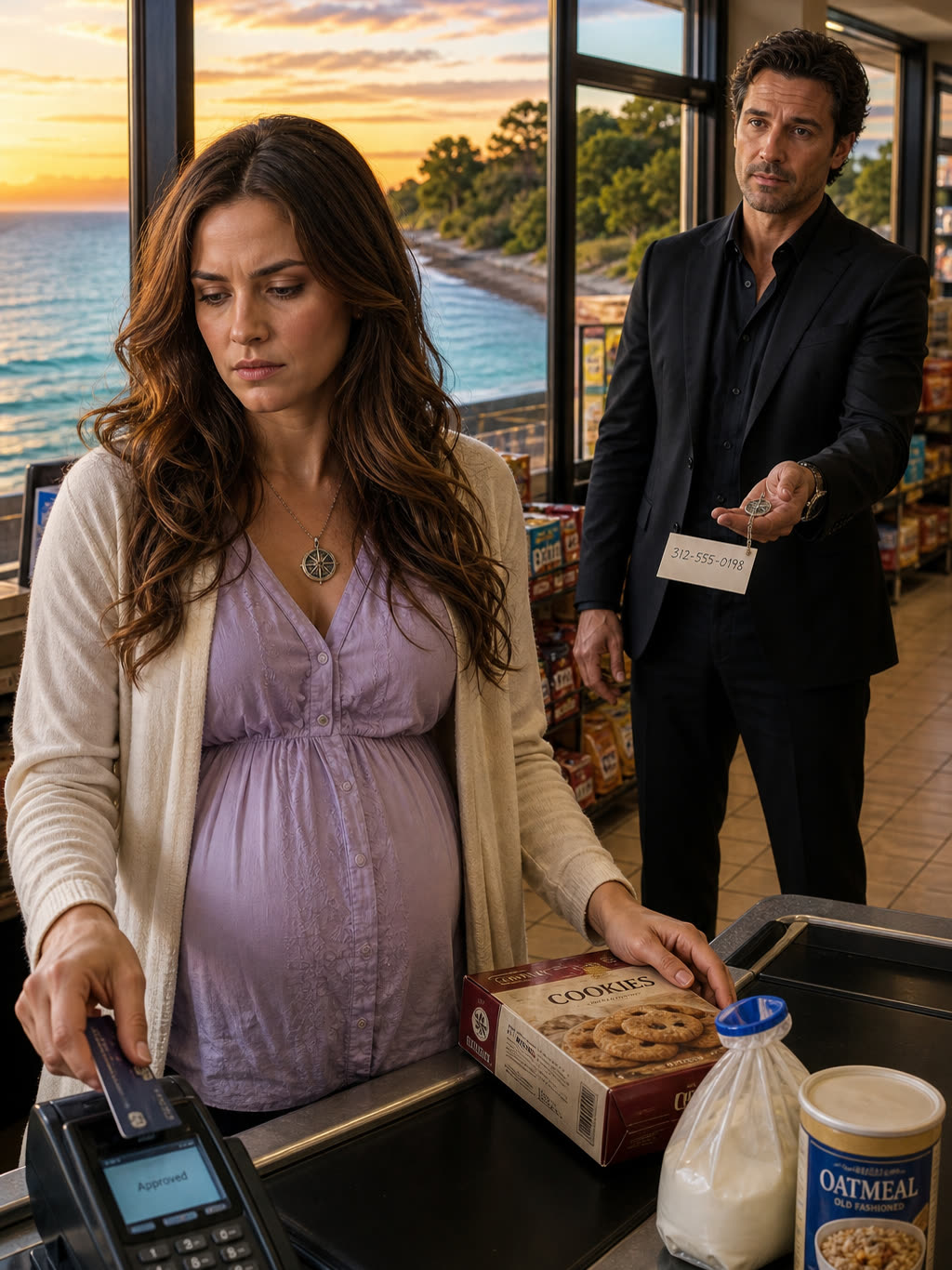
I wouldn’t let him pay for my groceries. The cashier allowed me to put back a box of cookies, and I paid for the essentials with my own card. Vincent waited outside and made no attempt to stop me from leaving. Before we went our separate ways, he gave me his half of the compass and the phone number of Joan Pruitt, an attorney who had once advised my father.
“I don’t want you to owe me anything,” he said.
“Then don’t decide things for me again.”
I rode the bus home to my apartment. On top of a bookshelf sat the wooden filing cabinet Grant had so often wanted to throw away. I took out my compass. There was a tiny slot on the back. When I fitted it together with the other half, two inscriptions appeared: “317” and “F47.”
There was nothing magical about it. Walter had engraved numbers to remind me where to look. In folder 317 of the cabinet I found a green notebook and a sealed envelope. Page forty-seven recorded four transfers, made six years earlier, from one of Vincent’s trucking companies to the Bridgeway Foundation. Next to them was a signature supposedly belonging to Walter, but the last letter of his surname was written backward. My father had never signed his name that way.
Inside the envelope was a page in his handwriting:
“If you’re reading this, don’t hand the notebook to any Whitaker or to Vincent. Find Joan. Ask who ordered the payments, not just whose name appears on them.”
There was also a second letter, yellowed with age, mailed from Madison, Wisconsin, years before. I recognized the name at the bottom: Helen. My mother. According to my father, she had died in an accident when I was five. The letter was dated long after her supposed death.
“Walter, lying to Tessa doesn’t protect her. I want to see her. You can’t keep deciding for both of us.”
I sank to the floor, my legs ice-cold. My father had hidden two different truths in the same piece of furniture. I wanted to call Vincent and demand answers, but I remembered the warning. First I photographed every document, saved copies to a brand-new email account, and wrote to Joan.
She met with me the next morning at her downtown office. She went through the notebook carefully and compared it with a copy of the contracts she kept on file. The account numbers and dates matched. The signature credited to Walter did not.
“This justifies requesting an investigation,” she explained, “but by itself it doesn’t prove who forged the signature or who caused your father’s death.”
She asked me not to alter the files or give the original to anyone. She had watched important cases fall apart because papers changed hands without a record. She wrote down the page numbers, took photographs with my permission, and signed a receipt listing everything she had reviewed. She also advised me to keep any messages from the Whitakers on the phone where I had received them.
“Did you know my mother was still alive?”
Joan looked away.
“I knew Walter had received letters from her. I didn’t know her current address. He should have told you. I should have pushed him harder, too.”
Before I left, Joan showed me one more document: Walter had requested a review of the transfers just four days before he died. That request was later closed with an authorization that, once again, carried his suspicious signature.
When I got outside, I had three missed calls from Grant and a text:
“My dad can help you with the delivery, the rent, and the baby. All you have to do is hand over the green notebook. Don’t make anyone take this to family court.”
My knees gave way. I hadn’t told anyone the color of the notebook except Joan and Vincent. Grant knew exactly what I had.
I called him.
“How long have you known about the green notebook?”
The line went silent for a long time.
“Tessa, don’t ask questions that could hurt our child.”
“Did you get close to me on your father’s orders?”
“At first I only wanted to look through the papers,” he admitted. “Then things got complicated.”
“Was our relationship an assignment?”
“Don’t be dramatic. If we meet tonight and you give me the notebook, I’ll take care of the pregnancy.”
I hung up. A moment later another message arrived, this time with a photo taken from the street: my apartment window, and above it, a warning.
“You have until tomorrow to decide if you want to raise that baby in peace.”
PART 3
I didn’t go to meet Grant. I brought the photo and the messages to Joan, and that same afternoon we filed a report about the threats with the Cook County State’s Attorney’s Office. We also asked for the original messages and the senders’ information to be preserved. Joan warned me that a report wasn’t an instant shield, so I stayed a few days with my friend Dana, whose address Grant didn’t know.
At eight that night, Vincent called. He had heard I wasn’t staying at home anymore.
“Where are you?” he asked.
“Somewhere safe. I’m not giving you the address.”
“I understand. Joan has asked me to come in tomorrow to talk about the payments. I’m bringing my company’s bank statements.”
“Even if they incriminate you?”
“Especially if they incriminate me. I already made the mistake of hiding things.”
I didn’t thank him. I still remembered that kiss in the grocery store and the way he had spoken about my safety as though it belonged to him. Still, he came to the meeting without bodyguards inside the office and handed over copies of his company’s bank transactions, along with contracts for services that had never been delivered. Joan checked the dates and asked for originals or certified copies to back up any complaint.
That was when I finally understood what had happened. Six years earlier, Gerald Whitaker had used the Bridgeway Foundation to collect payments disguised as donations and consulting fees. One of Vincent’s administrators approved fake invoices. Walter spotted the difference between the routes that were actually driven and the charges on the books. When he tried to tell the partners and report it, an authorization bearing his forged signature appeared, making him the one to blame.

“Why didn’t you defend him?” I asked Vincent.
He stared down at his hands.
“Because if I admitted Walter was right, I also had to admit my partners were stealing under my name and that I’d allowed it out of convenience. I pulled away when he needed support the most.”
“My father died soon after.”
“I know. And I have no right to ask you to forget it.”
Joan cut in before the conversation could turn into a fight.
“The poisoning listed in the death record doesn’t prove a homicide. We’ll ask for a review of his medical history and the circumstances of his death, but we’re not going to invent a conclusion, however much it hurts.”
That hurt more than I had expected. For years I had wanted a simple explanation: a villain, a confession, a sentence. Now I had proof of corruption and a troubling death, but no certainty that one had led to the other.
We still had to prove who had given the orders. On the last page of the notebook, Walter had written a file number and the initials “J. P.” Joan recognized the format right away: it was the request he had made to preserve documents in case of a lawsuit. She searched her paper files and found a copy of a corporate email Walter had given her before he died. In it, Gerald instructed his administrator to send money to the Bridgeway Foundation and charge it to the account Walter was auditing. Attached was an authorization sheet with the forged signature.
“This explains why they wanted your filing cabinet,” Joan said. “The notebook ties that email to the transfers.”
For the first time I realized my father hadn’t hidden a treasure. He had saved a way to prove they were using him as a scapegoat. And Grant had spent three years keeping track of where I stored Walter’s things, asking when I planned to sell the cabinet, always offering to “organize” his belongings.
I thought back over three years of love and felt ill. Grant had worked to protect his lie the entire time I trusted him.
With independent counsel, I handed over the copies and pointed out where the original documents could be requested. An investigation into the financial dealings was opened. No squad cars hauled the Whitakers away that night. Instead there were subpoenas, depositions, and a wait that drove me half crazy. Some partners claimed they had never seen the invoices. Others hired lawyers. Vincent had to explain why he had tolerated such weak controls, and he temporarily stepped down from running the company involved.
Grant came after me again, this time through a family law firm. He said he wanted to acknowledge his son and asked for information about my pregnancy. I had no objection to establishing paternity through legal channels. What I objected to was him using it as a threat. My family law attorney kept the messages and prepared everything needed to request child support and set up a parenting schedule once the baby arrived. The focus was on the baby’s well-being, not on a last name or his father’s fortune.
A week later I got an offer from Gerald. He proposed paying for an apartment, the delivery costs, and a trust fund for the baby if I signed a nondisclosure agreement and declared that Vincent had manipulated me into getting the documents.
I read the amount three times. It was enough that I would never again have to count dollars before walking into a grocery store. For a few minutes, I hated myself for wanting that relief.
“You can need that money and still refuse his conditions,” Dana told me as she made decaf coffee.
“The problem is I don’t know if I’ll get another chance.”
“Then let’s look for other options. But don’t sell a lie that could end up hurting your son, too.”
I turned the offer down in writing. I didn’t let Vincent speak on my behalf. I went back to work part-time doing reconciliations for an accounting firm and worked out a payment plan with the clinic. It was far less glamorous than a mansion, but my decisions belonged to me again.
That left Helen.
The letter had an old return address in Madison. Through Joan, I arranged a limited, legal contact search that didn’t request medical records or private addresses. Months later, a reply came to the law office. My mother agreed to meet me at a café whenever I was ready.
I went with Dana, who waited at another table. Helen furrowed her brow exactly the way I do. The moment she saw me, she stood up and then froze, as if she wasn’t sure she was allowed to come closer.
“They told you I was dead,” she murmured.
“My dad told me when I was five.”
Helen nodded. She explained that she had worked in the accounting department of a company connected to Gerald and had discovered payments made in her name. After receiving threats and fighting with Walter, she moved to Wisconsin. Walter decided to tell me she had died. Years later she tried writing to me, but never got an answer, and eventually she gave in to fear and distance.
“You could have found me when I grew up,” I said.
“Yes. I won’t pretend it was all to protect you. I was a coward, too.”
That answer made me cry. I didn’t hug her right away. I asked about my childhood, about her letters, about what she had been doing while I blew out birthday candles in front of a photograph of a woman I believed was dead. She answered every question without asking for forgiveness in exchange for a hug.
We began seeing each other once a month. Some visits were beautiful; others were unbearable. I learned I could love her and feel betrayed by her at the same time. I also stopped idealizing my father. Walter had loved me, but his silence had robbed me of the chance to know my mother much sooner.
I kept my distance from Vincent. He handed over documents, cooperated whenever he was summoned, and stopped asking where I was staying. One day he came to tell me his company had begun an outside review.
“I need to tell you something,” he said. “When I kissed you, I wanted to shut Grant up and look powerful. I disguised it as protection. I’m sorry.”
“You embarrassed me in a different way,” I replied.
“I know.”
“If you ever want to get closer to me, start by understanding that I’m not something you can claim in front of other people.”
He nodded. This time he didn’t try to touch me.
My son, Owen, was born in March, healthy, with lungs strong enough to wake the whole building. Helen sat in the waiting room because I had invited her. Dana stayed by my side through the delivery. Vincent came afterward, with my permission, and stayed only a few minutes. Grant was informed of the birth through the channels arranged with the attorney; the acknowledgment of paternity and financial responsibility moved forward as planned.
By the time Owen was four months old, the investigations into the transfers and into Walter’s death were still open. Accounting records had been secured, and several people had given statements. The documents weakened the financial accusations against my father, but no verdict had settled everything. Gerald could no longer paint him, without consequences, as the only one responsible. Grant and Brielle had called off their wedding; their breakup didn’t bring me the satisfaction I had once imagined. I had more important things to do.
One afternoon I went back to the grocery store with Owen asleep in his stroller. I bought milk and oatmeal without checking my balance three times. I had my job back, I had demanded my rights, and I had accepted help that came with no strings attached.
Vincent was waiting outside. We had been talking for weeks without promising each other anything. He asked if I wanted to take a walk with him, and I said yes. Then he stopped, smiling with a shyness I had never seen in him before.
“May I kiss you?”
I looked at Owen, at the grocery bag, at the street where months earlier I had felt my life was falling apart.
“Today, yes,” I told him. “But don’t mistake that for a promise about tomorrow.”
“I won’t.”
I kissed him because I wanted to. Then we kept walking, with no bodyguards around us and no pretending the past was behind us.
I still have Walter’s compass. I don’t use it to hunt for hidden answers anymore. I keep it to remind myself that even the people who love us can be wrong when they think they have the right to decide for us. And that no amount of safety is worth living without knowing the truth.
