

PART 1 — The Wish We Thought We Understood
I brought my terminally ill ten-year-old son to a professional football game believing I was fulfilling his final wish. I had no idea what awaited our family inside that enormous stadium. Later, when our faces appeared on the giant screen, the announcer would speak directly to Mason and reveal that something about our visit had been kept secret from all three of us. He would ask us to look behind us, and my husband would turn toward the concrete steps and go completely pale. But before that extraordinary afternoon, there had been months when our world scarcely extended beyond a hospital room.
Our son, Mason, had been battling a merciless illness that no child should ever have to endure. An aggressive form of pediatric cancer had overturned our lives almost overnight. Hospital visits, repeated examinations, powerful medications, and punishing treatments soon consumed our days. My husband, Brett, and I could hardly remember what an ordinary, untroubled afternoon felt like. Through countless sleepless nights, we remained beside Mason’s bed, watching illuminated monitors track his vital signs. Every new treatment became another desperate hope, another chance we prayed would finally give our little boy the future he deserved.
Even as exhaustion settled over everything, we kept believing there might still be a miracle. Then, one quiet Tuesday at Cedarbrook Medical Center in Columbus, Mason’s lead oncologist entered his room and asked us to speak privately in the hallway. The solemn weight in his expression made my stomach contract before he said anything. “I am so sorry to tell you this, Hannah, but Mason is not responding to the latest round of chemotherapy the way we all hoped he would,” Dr. Callahan said softly, placing a gentle hand against the doorframe. Brett immediately closed his fingers around mine, holding tightly as though he could keep me from breaking.
The doctor allowed a long silence before continuing with quiet compassion. “At this point, we are deeply concerned that he may have very little time left with us, so our main priority now is making sure he stays comfortable and surrounded by the people he loves most,” he explained. It felt as though the floor had vanished beneath me. Mason was ten. He should have had birthday parties stretching far into the future, a high school graduation in Columbus, a first love, and an entire lifetime of memories still waiting to happen. Instead, we were standing beneath hospital lights, being asked to imagine surviving without him.
“Are there any clinical trials left in Ohio or anywhere else in the country that we can try?” Brett asked urgently, his trembling voice refusing to surrender. “We have consulted with specialists across the region, Brett, and putting him through more aggressive treatments now would only take away his quality of life without changing the outcome,” Dr. Callahan replied gently. I attempted to listen while he outlined palliative care, but the explanation seemed to reach me from somewhere far away. I nodded without truly absorbing it. All I could think about was the child waiting on the other side of that door.
I thought of Mason’s laughter carrying across our backyard and the toy helmets scattered around his endlessly untidy bedroom. I thought of the affectionate way he called Brett “Coach” whenever they watched football on Sundays. The idea that these ordinary pieces of our lives might soon survive only in memory felt unbearable. Later that afternoon, I sat beside his bed, blinking back tears and trying not to let him see my fear. He was supported by a pile of pillows, completely absorbed in a football replay on the small wall-mounted television, when someone knocked gently at the open door.
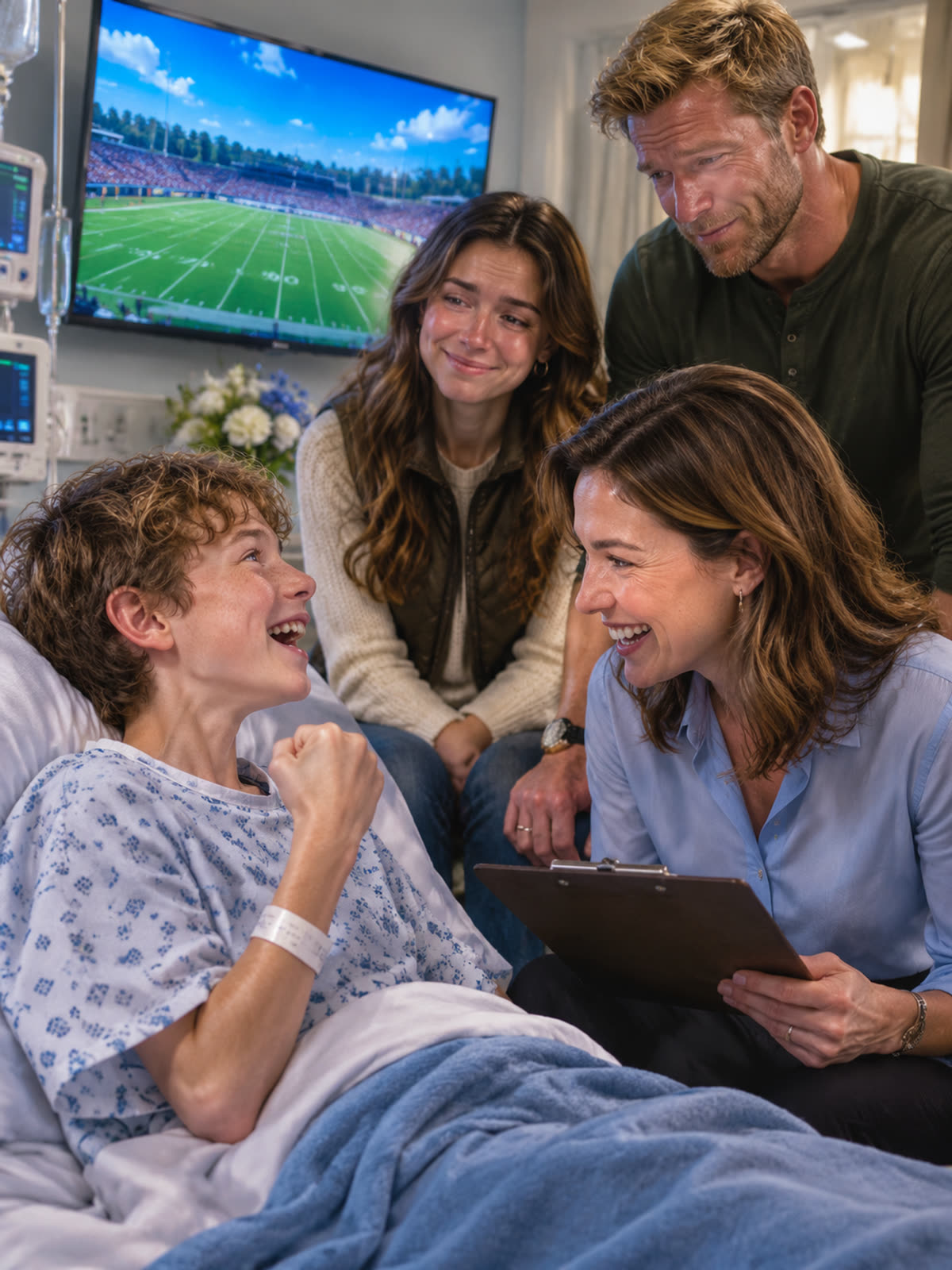
A woman stepped inside with a welcoming smile and introduced herself as Rachel, Chloe’s replacement at the Starlight Dreams Foundation. The organization helped seriously ill children experience something they had always longed to do. She drew a plastic chair beside Mason’s bed and settled with her hands folded in her lap. “Sweetheart, I have been hearing all about how brave you are, and I wanted to ask you a very important question,” Rachel said warmly, bending to meet his eyes. “If you could have one special wish granted right now, what would you choose to do?”
There was not even a moment of uncertainty. Mason’s tired, pale face lit with an energy I had barely seen in weeks. “I want to go to a real football game!” he exclaimed, straightening against his pillows. Rachel’s smile widened at his enthusiasm. “You mean like having a special party here in the lounge to watch one on a big television?” she asked playfully. He immediately shook his head, his eyes bright with excitement. This was not something he needed time to consider. His answer had apparently been waiting for someone to ask the question.
“No, I mean a real professional game inside a huge stadium with thousands of cheering people!” he said, then glanced hopefully toward Brett and me. “And I want Mom and Dad to come with me so we can all sit together.” Sorrow and pride tightened together inside my chest. Football had been his great passion since he was small enough to clutch a foam ball in both hands. Even now, after so many painful months, his dream was wonderfully simple: a field, a crowd, his favorite team, and his parents beside him.
Mason knew every player’s name and jersey number on the Columbus Falcons. He remembered scores from seasons long past and could debate quarterbacks, missed coverage, touchdowns, and penalties more confidently than most adults. Every Sunday, he and Brett claimed their places together on our couch. Even during the hardest treatments, Mason insisted on watching whenever he had enough strength. “That sounds like an incredible wish, Mason, and I promise you that we are going to do everything possible to make it happen,” Rachel assured him, making a quick note on her clipboard. For the first time that afternoon, the room held something besides fear.
Despite loving football for almost his entire life, Mason had never attended a professional game. The cost of tickets had always made it difficult, and then his illness had kept us close to home and the hospital. A few days after Rachel’s visit, the foundation called with the news we had hardly dared to expect. They had arranged everything. Dr. Callahan and the nursing team had given full medical clearance. There would be front-row accessible seats at Heartland Field, private medical transportation, and the support Mason might require during the outing. His biggest dream was actually going to happen.
For the first time in weeks, anticipation began replacing some of the heaviness around him. Mason talked about the game from morning until night. He wanted to know precisely where we would sit and whether we could arrive in time to watch the players warming up. Would the stadium seem as enormous in person as it did on television? Would he be close enough to recognize everyone? And, most importantly, was Brett planning to humiliate him in front of thousands of people by shouting at the officials? Hearing him worry about something so wonderfully ordinary nearly undid me.
“Your dad shouting at the officials? Why, he would never do something like that!” I teased, sending Brett a wink across the room. “Hey, I only yell when they miss an obvious holding call, and everybody in the stadium agrees with me anyway!” Brett protested with a grin. Mason dissolved into bright, genuine laughter. The sound bounced around the hospital room, carefree and unmistakably his. I had missed that laugh so desperately that hearing it again felt like finding water after a long stretch of desert. For a little while, we were simply a family teasing one another about football.
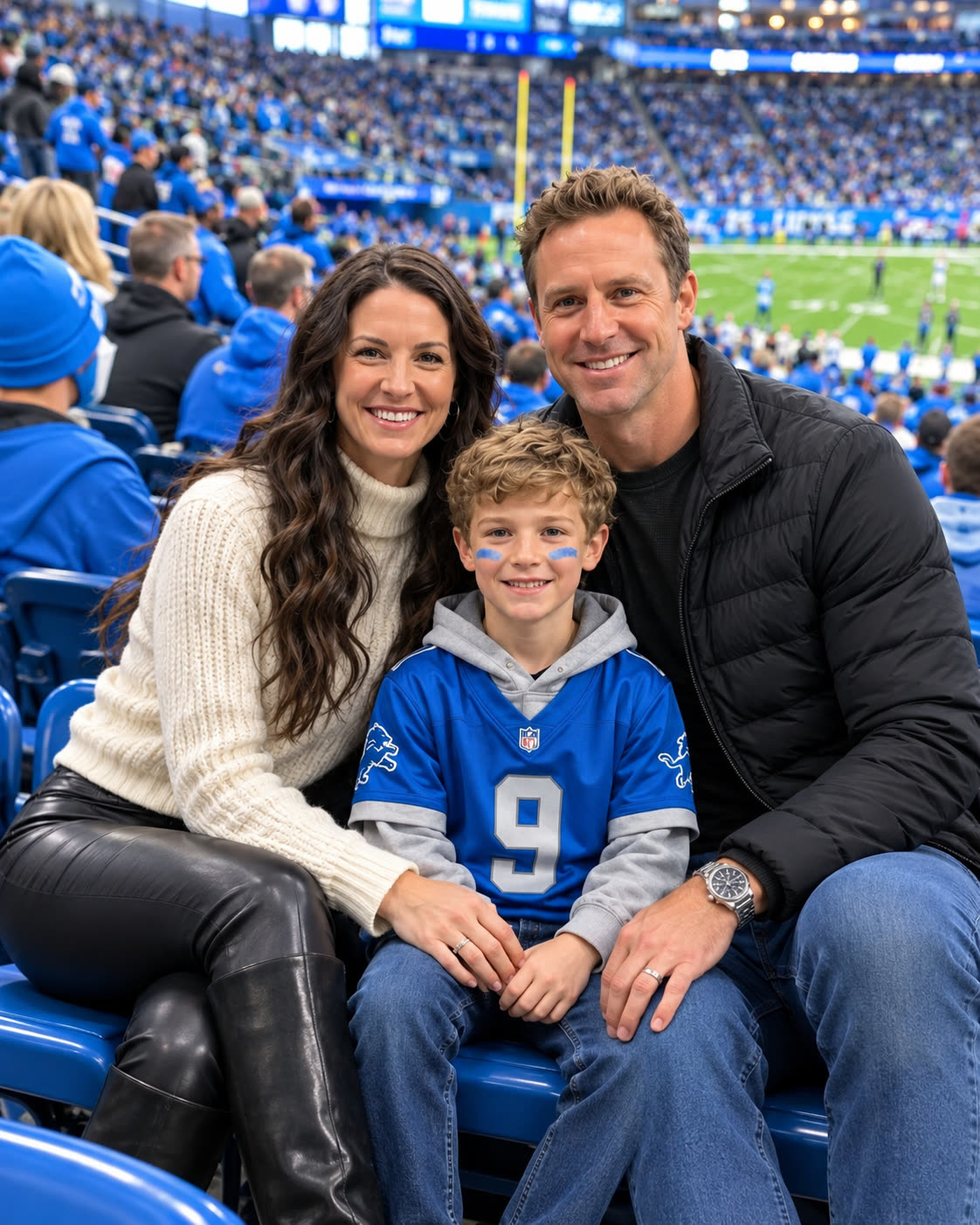
On the morning of the game, Mason woke earlier than he had in months, brimming with excitement before daylight had fully reached Columbus. He insisted on his favorite royal-blue jersey, although it now draped far too loosely over his narrow shoulders. We had intentionally bought it large, back when growing into it had seemed like something we could take for granted. Brett helped him dress and tied his sneakers while I checked the backpack: emergency medications, water, gentle snacks, extra blankets. Taking him beyond the hospital’s protected surroundings filled me with anxiety. Mason, meanwhile, could think of nothing but the afternoon ahead.
When our medical transport arrived at Heartland Field, the scale of the place was already overwhelming. Then we passed through the broad stadium tunnel and entered the main bowl, and Mason went completely still. His eyes widened as he tried to take everything in at once. Thousands of people filled the rising stands. Rock music rolled from enormous speakers, and vendors called from brightly illuminated food stalls. The concrete around us seemed alive with the vibration of voices, laughter, and building excitement. After months inside medical rooms, the sheer abundance of life felt almost impossible to comprehend.
Below us stretched the brilliant emerald field, where professional players were running drills and pulling long passes out of the air. For so long, Mason’s days had been confined to sterile walls, medical equipment, and brief trips home that left him exhausted. Now the world had opened into something enormous, colorful, and loud. “Dad, look down there by the fifty-yard line! That is my favorite wide receiver warming up!” he shouted, pointing eagerly. “I see him right there, Captain, and he looks ready to score three touchdowns today!” Brett replied, leaning close enough to be heard over the crowd.
Mason’s grin seemed to take over his whole face. For that glorious stretch of the afternoon, I could almost see only an ordinary ten-year-old watching the sport he loved. He cheered for the Falcons, argued strategy with Brett, and laughed when the opposing team mishandled the ball. After insisting earlier that he was not hungry, he even demanded a bite of warm soft pretzel. I watched every change in his expression, trying to hold it all inside me. Each smile felt too valuable to lose. Each burst of laughter seemed like something I needed to preserve against everything that waited beyond the stadium.
Again and again, I lifted my phone to take another picture or record another short video. Brett kept an arm around Mason’s thin shoulders, drawing him close. “Are you having fun out here today, buddy?” he asked softly, his voice heavy with feeling. “This is the absolute best day of my entire life!” Mason declared, thrusting both fists into the air. Brett looked across at me with tears bright in his eyes. Neither of us needed to explain what we were thinking. We could not change the diagnosis or slow the passing hours, but we had managed to give our little boy this day.
I believed that was the entire gift: the game, the crowd, the warmth of him sitting between us, and a happiness we could never have arranged on our own. We had followed every instruction, packed every medication, and thanked Rachel for every detail. Nothing in our conversations had suggested another plan. Yet somewhere inside that stadium, people we knew were preparing to approach our section, carrying something that belonged to Mason. Our son understood why they were there. Brett and I did not even know we had misunderstood the wish.
At the time, I was still holding my phone and trying to save another fleeting expression on Mason’s face. Brett was still watching him almost as closely as he watched the field. We thought we were making the most of an afternoon we might never have again. Neither of us understood how different that looked through our son’s eyes. And shortly after halftime, when Mason suddenly seized my hand and pointed above the end zone, the day we believed we understood began to change.
PART 2 — The Man on the Stadium Steps
“Mom, Mom, look up right now!” Mason yelled, pulling at my hand with all his strength. I followed his finger toward the enormous high-definition screen hanging above the end zone. It seemed at least forty feet high, and our family filled it. There were Brett and Mason and me, enlarged above the field beneath the stadium lights. For a moment, I could only stare at the astonishing sight of our ordinary faces looking back at us while tens of thousands of people watched. Then Mason began laughing with such delighted disbelief that I could not help laughing too.
“We are on the big screen! Everybody can see us!” he shouted gleefully. Brett flung both arms into the air, and I waved toward the camera. Around us, strangers applauded and cheered. A few fans leaned into view behind our seats, smiling and waving alongside Mason, pleased to share his moment. I assumed this was an extra kindness the Starlight Dreams Foundation had organized. It already seemed more generous than anything we could have expected. My little boy was glowing, and an entire section of the stadium was celebrating with him. Surely this was the surprise.
But the camera did not move on to dancing spectators or another part of the crowd. It stayed trained on the three of us. The bright music gradually faded, and the atmosphere changed as a deep voice filled the stadium. “Mason, the entire Columbus Falcons organization wants you to know how thrilled we are to have you here with us today,” the announcer said warmly. My son’s laughter stopped. He looked around in open astonishment, his fingers closing around his seat’s armrest. All those people who had been cheering moments earlier began listening.
“We know how much you love the game of football, and we know how deeply special this day is for your entire family,” the announcer continued. Brett gently squeezed Mason’s shoulder. Tears quickly gathered in my eyes, and I tried to steady myself enough to smile. Then came the sentence that sent my pulse racing. “However, Mason, there is something very special about today’s trip that neither you nor your parents know about yet,” he declared. I turned toward Brett at once. He looked just as bewildered as I felt and gave a small shake of his head.
Rachel had reviewed the arrangements carefully with us, and neither of us had heard anything about another surprise. The announcer paused, allowing the suspense to spread through the stands. Then he spoke again. “Mason, Mom, and Dad, we want you to please turn around right now and look behind you,” he instructed. People throughout our section twisted in their seats. Quiet, excited conversations rippled around us. Mason gripped my hand and looked into my face, his eyes wide with questions. I could feel my heartbeat pounding as though the whole stadium might hear it.
“Mom, what is happening right now?” he asked breathlessly. “I truly do not know, sweetheart, let us look together,” I answered softly. He eagerly turned in his accessible chair, and Brett and I followed his gaze toward the steep aisle. At first, all I could make out was a tall man carefully descending the concrete steps. He was smiling, and spectators shifted aside to clear his path. Several other people followed close behind. Between them, I caught glimpses of something bright and colorful being carried toward our row.
Then Brett went rigid beside me. His hand tightened around mine so abruptly that it hurt. When I looked at him, all the color had left his face. He stared up the steps with an expression I could not immediately understand—shock, recognition, and something far more painful all passing through him together. “Brett, honey, what is wrong?” I whispered urgently, leaning toward his ear. He did not answer. His attention remained fixed on the approaching man, as though he needed another moment to believe the person was really there.
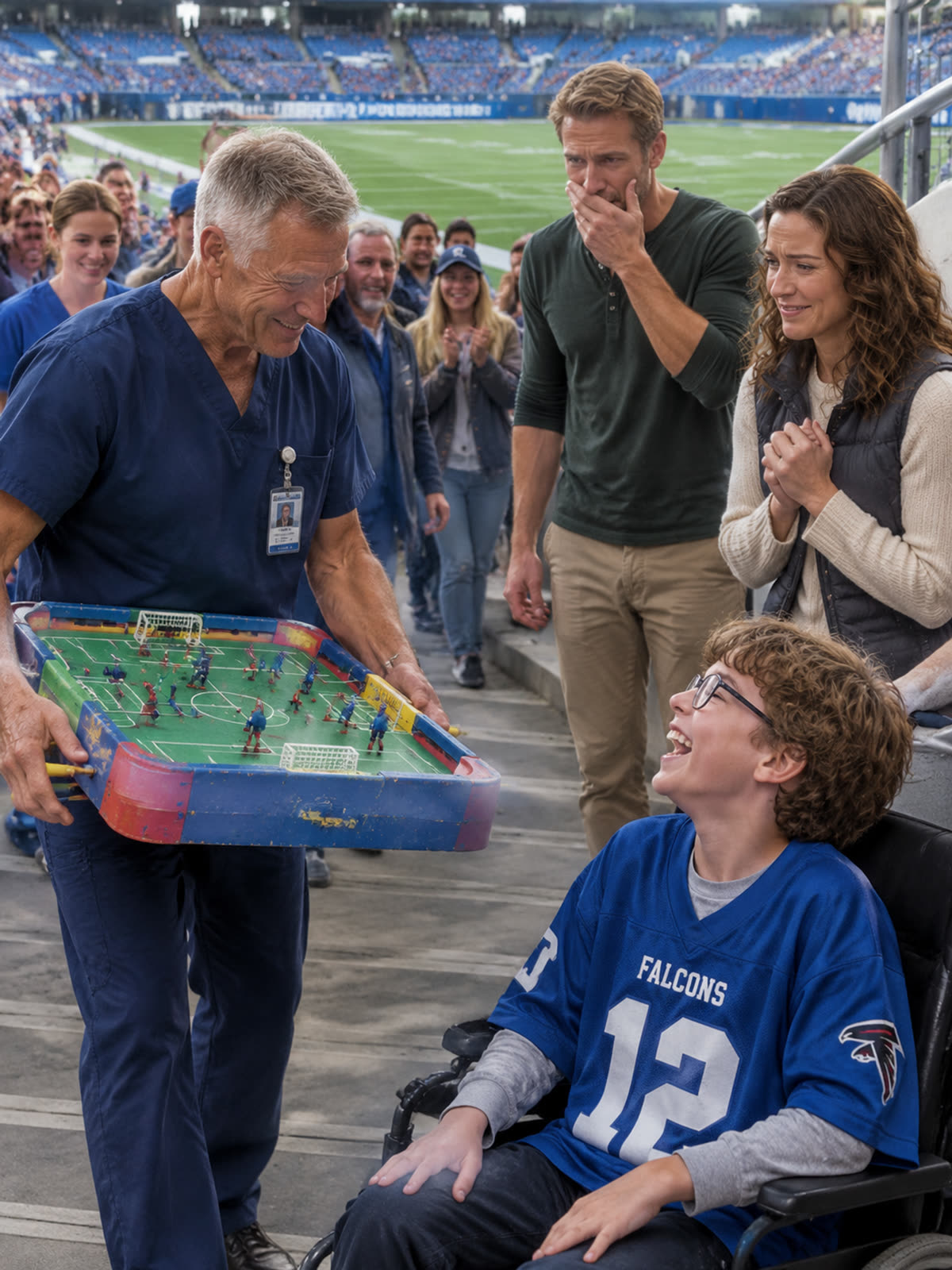
I turned back and studied the face beneath the stadium lights. There was a familiarity in the warm smile, in the weathered kindness of his features. Then recognition caught in my throat. It was Ray, the hospital orderly from Mason’s pediatric oncology floor at Cedarbrook Medical Center. Behind him came three more members of the hospital staff and a couple of young volunteers. These were people who had shared some of our family’s darkest months, people who had spent hours inside the small world that illness had built around our son.
Tucked beneath Ray’s arm was Mason’s battered plastic tabletop football game. As he reached the last steps, he lifted it as proudly as though he were carrying a championship trophy. Mason erupted into the biggest, happiest laugh I had heard since before his diagnosis. Brett slowly stood, still visibly overwhelmed. Ray stopped just a few steps from us and smiled directly at our family. The surrounding applause felt distant to me. I could only look from the familiar little game to my husband’s face and wonder why this sight was affecting him so deeply.
Watching Brett, I began to understand that the foundation had arranged something far more personal than seats at a professional game. Ray and the others had not simply come to add another cheerful surprise to the afternoon. Their presence touched something Brett and I had been carrying for months, something we had never managed to name. Mason was laughing with uncomplicated joy, while my husband stood nearly speechless beside him. Our little boy seemed to understand the meaning of this reunion immediately. Somehow, he had understood more about our family than either of his parents had.
Three months earlier, our lives had still seemed recognizable. We lived in a comfortable three-bedroom house in a quiet Columbus neighborhood, with a mortgage we could manage and the usual collection of ordinary concerns. We worried about cutting the grass before rain arrived, keeping up with utility bills, and persuading Mason to finish his math homework before dinner. Those worries had once seemed important because we had not yet learned how much we depended on having them. They belonged to a life in which the future still felt like something waiting patiently for us.
Sunday afternoons were reserved for football. Brett would pace the living room rug, arguing with the television while Mason delivered corrections with the authority of an experienced broadcaster. “Dad, you cannot blame the quarterback when the left tackle completely missed his block on the outside!” Mason would insist, aiming a pretzel stick at the screen. “Well, if he had stepped up into the pocket like I told him to, he would have had plenty of time to throw!” Brett would answer, grinning. Their arguments were never really arguments. They were part of the comfortable language our family spoke.
I always made a point of announcing that football did not interest me nearly as much as it interested them. Somehow, though, I invariably ended up standing beside the couch, furious over a penalty I thought the officials had gotten wrong. Our home was noisy, untidy, and full of the small disagreements that meant nothing was truly wrong. Then came Dr. Callahan’s conversation in the hospital hallway. After that afternoon, the shape of our family changed. Brett and I were so consumed by what we had been told that we did not notice how differently we began behaving around Mason.
Brett responded by trying to solve everything. He researched alternative medications and experimental treatments whenever he could, driven by his lifelong belief that enough effort could uncover an answer. He had always approached a problem by working harder at it. Watching football with Mason became another place where that fear followed him. He would begin with an attempt at his old enthusiasm, but within minutes the game would lose his attention. Instead of reacting to a play, he would be studying our son’s face, checking for the smallest indication of pain or exhaustion.
“Are you having any pain in your ribs right now, buddy, or do you need me to call the nurse for your medicine?” Brett would ask, troubled by some tiny movement or change in expression. “I am totally fine, Dad, you just missed a forty-yard pass because you were staring at me,” Mason would reply with a quiet sigh. At the time, I heard Brett’s question as love. I understood the panic behind it because the same panic lived inside me. Neither of us stopped to consider what Mason lost each time his father turned away from the game.
My own fear had found a different habit. After the conversation in the hallway, I began photographing and recording almost everything. I wanted to save the precise sound of Mason’s voice and the way the skin around his eyes creased when he smiled. I feared that memory might someday soften those details, and the thought terrified me. My phone filled with thousands of images and videos. Yet while I was trying to preserve my son, I failed to notice how often I placed a little pane of glass between us. I was present beside him, but so much of my attention was on keeping a record.
Brett kept checking whether Mason needed rest. He adjusted blankets again and again, read fearfully into every expression, and asked questions that made sense to anxious parents. I kept lifting my camera, convinced that another photograph might protect something precious from being lost. We believed we were caring for our child as completely as we possibly could. We did not understand that our grief had begun filling the room before anything had actually been taken from us. Mason was still there, still watching football, still waiting for us to join him in the life he had left.
That atmosphere had continued until Rachel arrived to ask about his wish. When he requested a professional game with both his parents beside him, we assumed the explanation was obvious. He loved football. He wanted to see the Falcons on their own field. For us, that was the beginning and end of it. But while Brett and I stepped outside to complete the medical release paperwork, Mason had spoken privately with Rachel. He had made another request, one he never mentioned during all his excited questions about our seats, warmups, and the size of Heartland Field.
Now Ray stood in front of us with the worn tabletop game, and the reason for that private conversation was beginning to take shape. Those hospital staff members and volunteers were not random additions to the afternoon. They had become familiar visitors to Mason’s room, and there was something important about the way they treated him. Something Brett and I, despite all our vigilance and love, had stopped giving him. I had not yet heard the explanation in Mason’s own words, but the feeling on my husband’s face told me that some part of him already knew.
Our son had quietly asked the foundation to bring his favorite hospital friends and seat them directly behind us. He had planned for Ray to be here. He had wanted these people beside our family on the day he called the best of his life. As Mason reached toward his familiar plastic game, I found myself confronting a question I had never imagined needing to ask: what were these visitors giving our little boy that his own parents no longer were?
PART 3 — The Rule We Had Forgotten
Ray and the other hospital visitors had become a steady part of Mason’s days during the preceding months. Unlike so many of the people who entered his room, they always respected the rule he had established for himself. Before anyone discussed blood counts or vital signs, that person had to sit down and play a quick round of his plastic tabletop football game. Mason had created a small boundary inside a world where almost everything happened according to someone else’s instructions. For a few minutes, visitors had to meet him as a player rather than a patient.
“No doctors, no nurses, and no sad faces allowed until you flick the little plastic football through the uprights, Ray!” he would announce when the orderly arrived carrying clean linens. Ray never treated the demand as an inconvenience. “You drive a hard bargain, Captain, so clear off the tray table and prepare to lose!” he would reply, rolling up his sleeves before sending the little triangle across the laminated field. Their exchange had happened often enough to feel ordinary. I understood now that its ordinariness was exactly what made it precious to Mason.
Even at Heartland Field, before the announcement interrupted the game, Brett and I had carried our habits into the stands. Throughout the first half, I had kept my phone raised to record Mason’s reactions. Brett had leaned over repeatedly to ask whether he was cold, tired, or uncomfortable. Just before halftime, Mason finally looked up at his father with frustration and pleading mingled in his eyes. “Dad, please stop watching me like I am going to break, and just start watching the game with me,” he had said quietly. At the time, I had not understood the full weight of it.
Now Ray stepped into the aisle beside our row and presented the battered tabletop game with an exaggerated bow. “We heard there was a big game happening today, Captain, and we wanted to make sure you had your official coaching staff right behind you,” he said cheerfully. Mason met his raised hand in a crisp high-five while the nearby fans applauded. There were hugs and laughter as the familiar visitors gathered around us. Their arrival had brought a piece of Mason’s hospital life into the stadium, but not the part defined by fear. They had brought the part where he was still allowed to be himself.
A few minutes later, a considerate stadium representative approached and offered our family a quiet, private suite just off the main concourse. Mason could rest there briefly, away from the tremendous noise. Ray seemed to recognize that we needed a moment together. He gently suggested that the rest of the hospital group accompany him to the concession stand for sodas while we went inside. I was grateful without quite knowing what I wanted to say. Everything about the surprise had been joyful, yet beneath that joy I could feel something tender and difficult waiting for our attention.
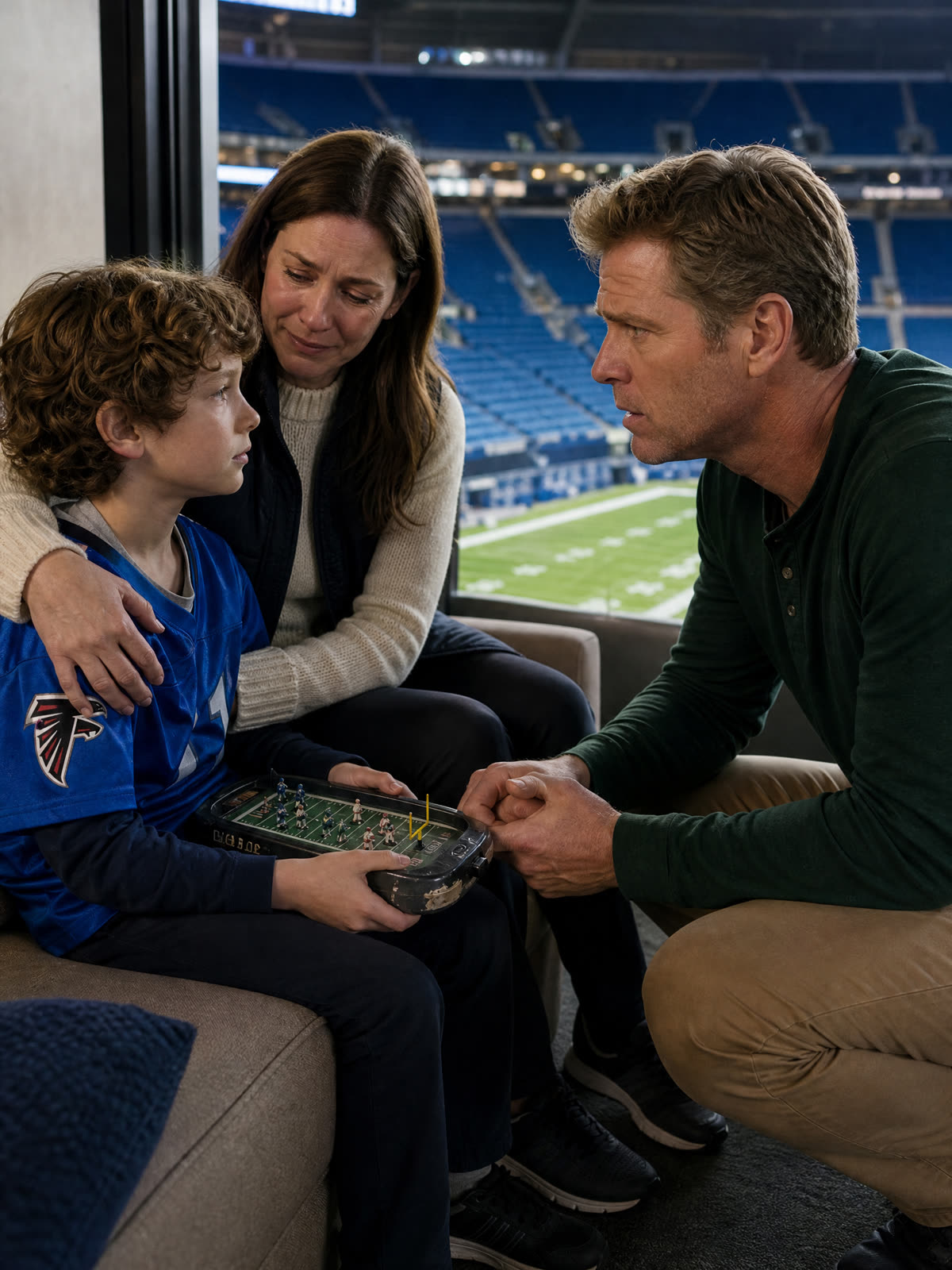
The heavy door closed, softening the stadium’s roar. I sat beside Mason on a cushioned sofa and put an arm around him. He still held the worn plastic football game across his lap, his face bright from the reunion. I brushed a loose curl away from his forehead. “Sweetheart, seeing Ray and everybody from the hospital here was the most wonderful surprise, and I am so glad you are happy,” I said softly. Then I asked the question that had been growing inside me since I recognized the group on the steps.
“Can you tell Mom why it was so important to you to have your hospital friends come to the game with us today?” Mason looked down at the tiny football in his fingers. For a long moment, he did not answer. When he raised his eyes to Brett and me, the gentleness in his expression made him seem far older than ten. “Because Ray and the volunteers are the only people left who still act normal around me, Mom,” he explained quietly. His voice was steady. There was no accusation in it, which somehow made the words harder to hear.
Brett blinked, plainly startled. He lowered himself onto the carpet in front of Mason and took our son’s hands between his own. “What do you mean by that, buddy? Your mom and I are right here with you every single day,” he said gently. Hurt and confusion crossed his face. I felt the same confusion rising in me, followed almost immediately by the fear that I understood exactly what Mason meant. We had devoted every hour to him. Yet perhaps the way we had spent those hours was not the same as sharing them with him.
“I know you are here, Dad, and I love you both so much, but ever since the doctor talked to you in the hallway, the two of you completely changed,” Mason admitted, looking between us. “You do not even watch the football games anymore when they are on television, because you just sit there staring at me to see if I look tired or if I am hurting.” His words brought back all those afternoons beside the hospital bed. We had believed we were watching over him. He had been waiting for us to watch something with him.
Then Mason turned toward me, and guilt struck sharply through my chest. “And Mom, you are always hiding behind your phone camera taking pictures of every single thing I do,” he continued softly, without anger. “I know you are doing it because you love me, but I really hate how you both treat every single second like some giant, sad milestone just because the doctors said I do not have much time left.” I sat beside him with my arm around his shoulders, unable to protect myself from the truth of what he had said. My phone was full of moments I had not completely lived.
Tears spilled down my face. Each time I raised that camera, I had thought I was saving something of my son. I had never considered that I might also be reminding him why I felt the need to save it. While he was still sitting in front of us, still capable of laughing at football and demanding another game, we had begun surrounding him with our mourning. He could feel it even when we believed we had hidden it. All our careful expressions and anxious questions had told him that we saw the ending before we saw the boy.
“I do not want to be treated like a fragile glass statue, Mom,” Mason said, tightening his fingers around mine. “I desperately missed hearing Dad yell at the television when the Falcons drop a pass, and I missed watching you get mad and argue with the referees just like you always used to do.
I just wanted things to feel ordinary again, and I wanted the two of you to actually have fun with me instead of just monitoring every breath I take.” Brett lowered his head. His shoulders trembled as he struggled against his own tears. We had wanted to carry every burden for Mason, yet our fear had become another burden he was carrying.
Mason smiled gently and tapped the tabletop football game resting across his knees. “That is the real reason why I picked a football game for my wish,” he confessed with a quiet grin. “I figured if we came to a real stadium with thousands of yelling fans, you guys would finally have to stop worrying about me and just be normal parents again.” There it was, the wish beneath the wish. He had not only wanted a stadium or a chance to see his favorite players. He had wanted his father arguing about football and his mother forgetting to be careful with her happiness.
I drew him into a close embrace and pressed my face into his soft hair. Brett put his arms around both of us. Inside that quiet room beneath the stands, our ten-year-old had made us understand something we should never have forgotten. Fear of losing tomorrow had been taking today from us. We could not undo the diagnosis by watching him more intensely. We could not preserve him by recording every movement. But while he was here, while he wanted to laugh and play and be our son, we could stop making him feel as though he had already become a memory.
“You are right, Captain, and I am so sorry we forgot the rules,” Brett said, wiping his eyes with his sleeve. A real, crooked smile returned to his face. “From this second on, no more hovering, and I promise you I am going to give those referees an earful if they blow another call.” I reached for my phone, but not to photograph the three of us. “And I am putting my phone away inside my bag for the rest of the afternoon so I can actually watch the game with my favorite guys,” I promised. I pushed it deep into my backpack and closed the zipper.
When we returned to our seats for the final quarter, the stadium seemed lighter, as though something in the air had changed. The difference was inside our family, but it altered everything I saw. Ray and the others cheered when we joined them. We settled into our row without turning every movement into a question about how Mason felt. We were still aware of what he needed. We were still his parents. But we began sharing the afternoon with him instead of standing apart from it, measuring and preserving it while he waited for us to join in.
Midway through the fourth quarter, the Falcons quarterback sent an incomplete pass into double coverage. Brett slapped his knee and threw up his hands. “Why on earth would you throw into triple coverage on third and short when our running back is averaging five yards a carry?!” he bellowed toward the field. A little later, a yellow flag landed on the grass against our defense. I was on my feet before I thought about it. “Are you kidding me, ref?! That receiver tripped over his own shoelaces, nobody even touched him!” I shouted. Between us, Mason tipped his head back and laughed harder than he had in months.
He clapped with pure delight, not because the referee could hear me or because Brett’s complaint would change the play, but because we sounded like ourselves again. With less than two minutes left, our favorite wide receiver pulled in a deep pass near the corner of the end zone and dove over the white goal line for the winning touchdown. The stadium exploded. Mason pulled himself up between us, cheering with an excitement that seemed to belong to every person in the building. As he bounced beside us, the tiny plastic football slipped from his pocket and landed on the concrete beneath our seats.
For an instant, the old impulse returned. I glanced down at the fallen toy, and the thought of reaching into my backpack for my phone crossed my mind. His smile was so bright. Surely I ought to save it. Instead, I kept hold of Mason’s hand and cheered with him. I did not bend for the little football. I did not lift a screen between us. Surrounded by strangers and the people who loved him, I finally understood the rule he had been teaching everyone in his hospital room: everyone played. Nobody was meant to spend the whole game watching from the sidelines.
Love was not only the wish to keep a memory for some lonely day ahead. It was the willingness to be fully there while the moment still belonged to all of us. I left the tiny plastic football where it had fallen and listened to my son laugh without trying to capture the sound. That choice became the greatest gift he ever gave me. Yet the little toy remained beneath our seats, a quiet reminder of how close I had come to missing what was happening right in front of me—and of the choice I would have to keep making whenever fear asked me to stop living and start watching again.
Disclaimer: This story is a work of fiction inspired by real-life themes. Names, characters, places and events are fictionalized, and any resemblance to real persons is purely coincidental. It does not represent any person or organization and does not encourage inappropriate behavior. Images are for illustration purposes only.
