

When I was finally released from the hospital, he looked at me and coldly said, “I was too busy.” I didn’t argue with him. I simply slipped off my wedding ring, set it on top of my medical report, contacted a lawyer, and filed for divorce. He still had no idea what I had uncovered inside that hospital document.
Part 1
“I spent thirty days in the hospital hovering between life and death, and my husband—a surgeon in the very same building—didn’t come up to see me even once.”
On the morning of my discharge, I carefully folded my hospital gown and placed it along the edge of the bed. I had lost thirteen pounds after a ruptured appendix developed into severe peritonitis. Through the seventeenth-floor window of Metropolitan General Hospital in Chicago, I watched gray autumn rain coat the pavement while a nurse went over my discharge instructions.
“Are you sure no one is coming to drive you home, Clara?” she asked softly, glancing at my chart. “Dr. Marcus Hayes works here, doesn’t he?”
I managed a polite smile and nodded. “He’s in a procedure.”
Marcus was among the hospital’s most celebrated cardiovascular surgeons. He worked only five floors beneath my room. During the first twenty days of my hospitalization, he had been involved in a high-profile international organ transplant initiative that operated under strict quarantine protocols. For those three weeks, I had defended him to everyone—my mother, my friends, even the nursing staff. “He can’t leave the unit,” I had repeated like a rehearsed line. “He’s saving lives.”
Then came the final ten days.
During those last ten days, the isolation requirements were over. I saw photographs of Marcus on the hospital’s internal network, smiling at a gala dinner alongside visiting foreign specialists. Then I watched him appear in a local television interview. Then I saw him standing onstage accepting a clinical excellence award.
Yet throughout those ten entire days, the phone in my hospital room never rang.
Not once.
My career as a senior healthcare quality auditor had taught me one essential rule: before reacting, verify the data.
I opened my tablet, signed into the hospital’s administrative portal, and accessed the official protocol guidelines governing the transplant project. Within five minutes, I located Section 4, Paragraph B:
Personnel in isolation may request a temporary dispensation of up to two hours for immediate family medical emergencies, life-threatening illnesses, or surgical procedures, subject to standard re-sanitizations.

Next, I searched the system records for every dispensation request submitted under Dr. Marcus Hayes.
Zero.
Not one request had ever been filed.
He had possessed the explicit right to visit me. He had possessed the means to do it. He simply decided not to. And once the quarantine was completely lifted, he had ten full days to walk toward an elevator, press the button for the seventeenth floor, and come down the hallway.
He chose not to do that, either.
I saved PDF copies of the protocol, his shift records, and the public event registries to a cloud drive. Then I ordered an Uber.
I didn’t return to our brownstone in Lincoln Park. Instead, I went directly to the law office of my university friend, Sarah, a family law attorney.
When Sarah saw how thin and frail I looked, she jumped to her feet so quickly that her chair scraped across the hardwood floor. “Clara! My God, what happened to you?”
“I need you to draft divorce papers,” I said evenly.
At first, she assumed I was speaking from the immediate bitterness of everything I had endured. So I placed my tablet on her desk and walked her through the timeline, the system logs, and the protocol documents.
I didn’t want revenge. I had no desire to take his assets from him. We didn’t have children. I proposed an equal 50/50 division of the equity in the home we had purchased during our marriage, while each of us would retain our own bank accounts, vehicles, and personal belongings.
That afternoon, I returned to the brownstone, packed my clothes, degrees, and books into two suitcases, and placed my wedding ring squarely on top of my hospital discharge summary on the dining room table.
I moved into a furnished short-term apartment in Gold Coast, changed my phone number, and directed every form of communication through Sarah.
Two weeks later, Marcus was attending a catered reception in the hospital’s twelfth-floor conference center to celebrate the completion of his project when a court process server entered the room carrying a manila envelope.
“Dr. Marcus Hayes? Personal service.”
Marcus opened the envelope in front of his colleagues and residents. Within three seconds, the triumphant smile disappeared from his face.
It was a petition for dissolution of marriage.
And Marcus had no idea that losing his wife was only the beginning of what was about to unfold.

Part 2
Marcus folded the legal notice so quickly that the paper ripped along the seam.
“Administrative error,” he muttered to his colleagues, stuffing the document into his coat pocket.
But when he returned to the Lincoln Park house that evening and discovered empty closets, cleared dresser drawers, and his wife’s wedding band sitting on top of an emergency room discharge form, the illusion collapsed.
He couldn’t call me because his number was blocked. So he called my mother. He contacted our mutual friends.
To everyone willing to answer, he repeated exactly the same story: that I was emotionally unstable after my illness, that I didn’t understand the overwhelming demands of a surgeon’s career, and that I was destroying seven years of marriage because of “a missed hospital visit.”
Our friend David called me and attempted to mediate. “Clara, surgeons operate under insane pressure. Sometimes spouses have to show grace.”
“I understand grace during an emergency midnight bypass,” I told him calmly. “What I don’t accept are ten days of galas, television interviews, and award ceremonies without thirty seconds to check if your wife survived peritonitis.”
David fell silent and never raised the subject again.
Several days later, I accepted an assignment leading an independent external quality audit at Metropolitan General—the same hospital where Marcus worked. To prevent any conflict of interest, I specifically recused myself from reviewing the cardiology department, assigning another colleague to that division while I handled administrative compliance, patient safety protocols, and institutional governance.
When Marcus learned that I was inside the building auditing management, he became furious.
Through Sarah, he demanded that we meet. We agreed on a quiet coffee shop close to the medical campus.
He arrived looking immaculate—tailored suit, expensive watch, crisp white shirt. He sat opposite me with the supreme confidence of a man who still believed he controlled the entire room.
“I assume you’ve finished making your point,” Marcus said, leaning back. “Instruct your lawyer to withdraw the petition, and let’s go home.”
I pushed the separation agreement across the table. “Read page three.”

His expression hardened when he saw the 50/50 equity division of the house. “Fifty percent? I paid for that property with eighty-hour workweeks and weekend surgeries! You review spreadsheets for a living!”
I took out my tablet. “Fine. Let’s talk about spreadsheets.”
I opened the transplant quarantine protocol and highlighted Section 4, Paragraph B—the provision allowing two-hour emergency leave for family illnesses.
Then I displayed the hospital server records showing zero requests under his name, followed by timestamped photographs documenting his public appearances during the final ten days of my hospitalization.
“No one held you hostage downstairs, Marcus,” I said, keeping my voice steady and cold. “You chose not to come up to the seventeenth floor because you were up for the Associate Chief of Surgery position, and you didn’t want a personal distraction blurring your image as the dedicated, unencumbered surgeon.”
For the first time since I had known him, Marcus dropped his gaze.
“It was one mistake, Clara,” he stammered.
A cold ache settled behind my ribs. “One mistake?”
I reminded him about a night six years earlier—a night I had spent the following six years trying to erase from my memory.
During the first year of our marriage, I had suffered a miscarriage at ten weeks. I was bleeding, terrified, and barely able to stand. Marcus had promised he would take me to the emergency room, but then his department head called and asked him to attend an unscheduled clinical panel with visiting board members.
There was no emergency operation. There wasn’t a dying patient waiting on an operating table.
Yet he sent me to the hospital alone in a cab.
I spent the night sitting on a cold hospital gurney, signing consent forms with trembling hands while watching other women hold their husbands’ hands. Marcus didn’t arrive until 8:00 AM the next morning.
I had forgiven him then.
“Six years ago, you abandoned your wife for a administrative meeting,” I told him. “This month, you left her in isolation with peritonitis for a promotion. These aren’t accidents, Marcus. This is who you are.”
His face went gray. Yet his pride still refused to bend; he pushed the pen away and declined to sign.
Sarah shut her briefcase, and I gave him my final boundary.
“You have three business days to execute the agreement, Marcus. If you don’t, we proceed with a contested divorce, and I will submit a formal administrative inquiry requesting the medical board review how isolation protocols were applied during your project.”
The anger vanished from Marcus’s face and was replaced by genuine fear.
Because he understood that the next person examining those logs wouldn’t be his forgiving wife.
It would be the hospital’s board of trustees.
Part 3
Marcus’s first instinct was to find someone who could pressure me into changing my mind.
He didn’t call to ask how I was feeling or whether I was recovering. Instead, he visited Dr. Arthur Vance, his former mentor and Metropolitan General’s retired Chief of Staff—a man widely respected throughout the medical community who firmly believed medical families should endure whatever hardships were necessary to remain together.
That evening, Dr. Vance called my cell phone.
“Clara, Marcus came to see me,” the old doctor said gently. “He’s deeply distressed. He explained the intensity of the transplant initiative, the quarantine, the sheer exhaustion. Is it possible you’re making a permanent decision during an emotionally vulnerable recovery?”
I listened respectfully and didn’t interrupt him.
When he finished speaking, I asked him a single question: “Dr. Vance, did Marcus show you Section 4, Paragraph B of the project’s administrative protocol?”
There was a pause. “No. What is that?”
“It’s the clause that explicitly permits project personnel up to two hours of leave for an immediate family medical emergency.”
Silence.
“Did he also mention that for the last ten days of my thirty-day stay, his quarantine had already ended, and he was attending celebratory dinners and TV interviews while I was five floors above him?”
Another long silence followed.
I emailed him the PDF. Several minutes passed as Dr. Vance examined the records on his computer.
When he finally spoke again, his tone had changed completely. “He didn’t tell me the truth, Clara.”
“No, Dr. Vance. He didn’t.”
“I won’t interfere any further,” the doctor said softly. “Your decision is entirely justified.”
Marcus had lost his strongest advocate.
When the three-day deadline passed without his signature, I turned to the professional tool I understood better than almost anyone: institutional auditing.
As a contributor to a national healthcare management journal, I wrote a case study examining institutional ethics. The article explored an anonymous scenario involving a lead surgeon participating in a high-priority clinical project who, despite having clear protocol mechanisms available to respond to a family medical emergency, chose not to use them because of concerns about his professional advancement.
I didn’t identify Marcus. I didn’t identify Metropolitan General. I never mentioned our marriage.
The paper focused on a systemic problem: how high-performing medical institutions frequently claim to value human life while simultaneously encouraging an internal culture that excuses profound dehumanization under the guise of ‘dedication.’
The journal published the article online. Within forty-eight hours, it began circulating throughout medical administrative networks, hospital boards, and compliance organizations.
The difficulty for Marcus was that the operational details matched perfectly with the heavily publicized transplant initiative that had just appeared in the press.
Whispers began spreading through Metropolitan General’s corridors.
The next morning, the Chief Executive Officer summoned Marcus to his office. A printed copy of the article sat on the desk.
When Marcus attempted to dismiss it as a “personal marital dispute,” the CEO responded swiftly and mercilessly.
“I don’t care about your divorce, Dr. Hayes,” the CEO said coldly. “I care that our institution is being used as a shield to justify personal neglect. If the medical community believes we force our staff to abandon dying family members to maintain project metrics, that ceases to be a private matter.”
Marcus’s candidacy for Associate Chief of Surgery was immediately suspended while an internal review examined departmental culture and protocol compliance.
Three nights later, there was a knock at my apartment door.
I looked at the security camera.
It was Marcus.
The pristine, seemingly invincible surgeon was gone. His tie hung loose, his hair was disheveled, and dark circles surrounded his eyes.
I opened the door but remained firmly in the doorway. “Why are you here, Marcus?”
“Please, Clara,” he rasped out. “Can I come in?”
I stepped aside and allowed him into the living room.
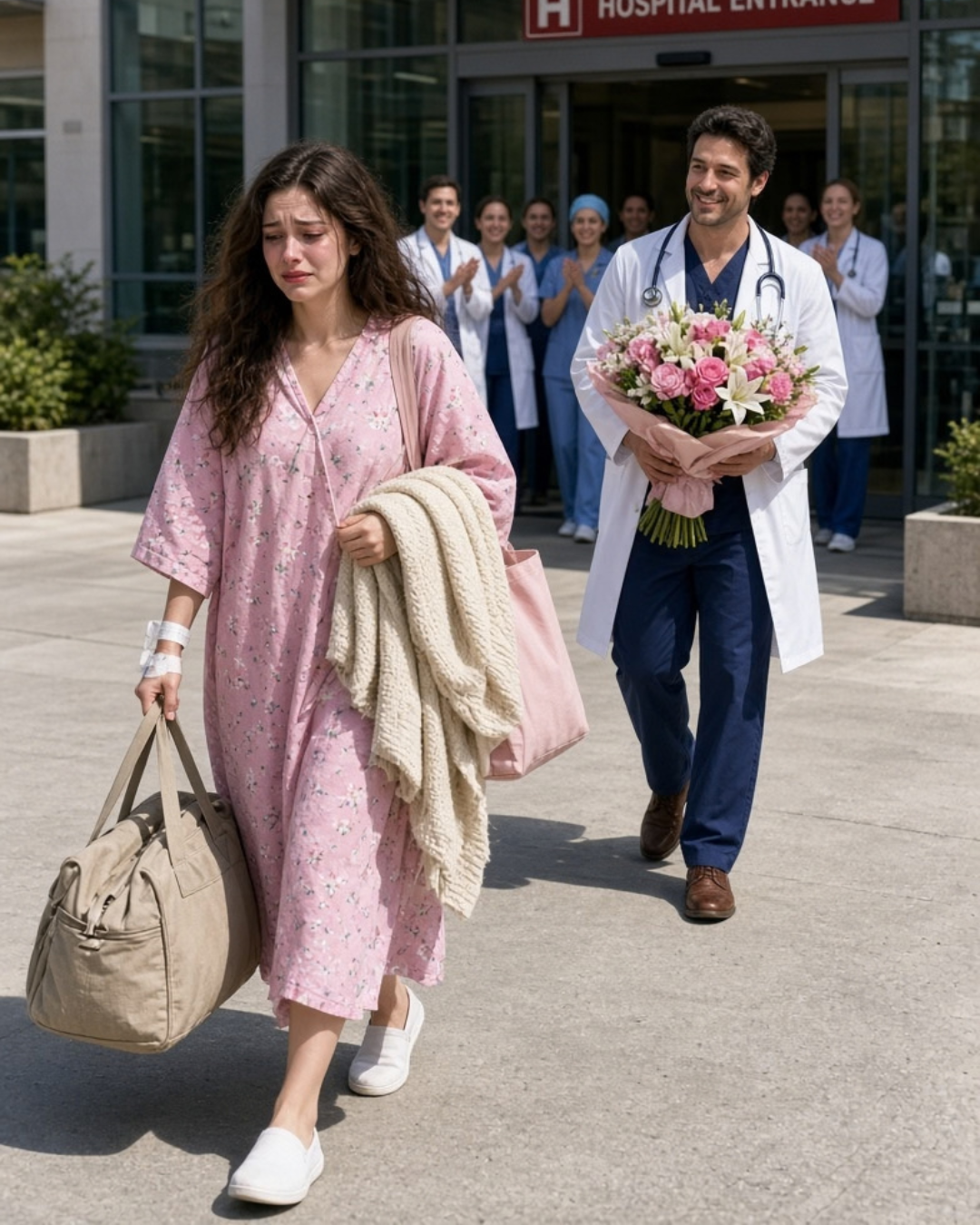
“I made a mistake,” Marcus stammered, stepping toward me. “The board suspended my nomination. Everyone at the hospital is talking. I know I failed you. I know I was an idiot. Just give me one more chance. I’ll change.”
I stared at him silently.
I had waited years to hear those words. I would have welcomed them six years earlier after the miscarriage. I would have welcomed them during the first week of my hospitalization. I might even have accepted them on day twenty, when his quarantine ended.
But he was only saying those words now because his promotion had disappeared.
“Answer me honestly,” I said softly. “If your nomination were still on track, if no one had read that article, and if your colleagues were still treating you like a hero, would you be standing in my living room right now?”
Marcus opened his mouth.
No sound came out.
“That’s what I thought,” I said.
He lowered himself onto the edge of the sofa and buried his face in his hands. “I don’t want to lose you.”
“You lost me the moment you decided five floors was too far to travel for your wife.”
I retrieved the completed divorce agreement from my desk and placed it beside him with a pen.
“I’m not looking to destroy your career, Marcus. But I am moving on. Sign the agreement, let’s end this with dignity, and we can both live with the consequences of our choices.”
Marcus took the pen with trembling fingers. He looked up at me one final time.
“Take the whole brownstone,” he whispered. “I don’t want the equity. Consider it… an apology.”
I shook my head. “No. I will take exactly the fifty percent that is legally mine. I don’t need your guilt to fund my life.”
He signed every document—page after page.
When he finally stood to leave, he hesitated at the doorway. “Did you ever really love me, Clara?”
The question hurt, but I met his eyes directly. “That’s the only reason I stayed for seven years.”
I shut the door behind him. And for the first time since my operation, I slept through the entire night.
Two weeks later, we appeared in family court with our respective lawyers. The property settlement was completed without incident, and neither of us requested a reconciliation delay.
As we descended the courthouse steps into the cool Chicago air, Marcus stopped. “I hope you find peace, Clara.”
“I hope you find perspective, Marcus.”
We headed in opposite directions.
No drama.
No scenes.
Some marriages end with explosive arguments and screaming matches. Ours ended with two people walking away because one of them understood, much too late, that love cannot survive in the absence of respect.

Not long after the divorce became final, a major private hospital network headquartered in Seattle approached me. They were searching for a Regional Director of Healthcare Quality and Patient Safety—a position responsible for restructuring institutional ethics and patient-care protocols across six facilities.
A former colleague who knew I wanted a fresh beginning had submitted my profile months earlier.
I accepted the position, sold my portion of the Lincoln Park brownstone, and purchased a sunlit condo overlooking Puget Sound. It didn’t have marble countertops or a formal dining room created for entertaining hospital board members. It had large windows, enough room for my books, and a peaceful kitchen where I could eat breakfast without hearing someone tell me that his career mattered more than my dignity.
My health returned.
I started running along the waterfront every morning.
I regained the weight I had lost.
I created a life that belonged completely to me.
One year later, Dr. Vance emailed me to say that Marcus was still practicing as a lead cardiovascular surgeon. His clinical abilities remained undisputed, but the board had permanently removed him from consideration for the executive leadership track, concluding that he lacked the human empathy required to lead people.
I didn’t celebrate when I heard.
Nor did I feel sorry for him.
Consequences aren’t always punishments imposed by someone else; sometimes, they are simply the natural outcome of treating people as optional until those people finally choose to leave.
One afternoon, my mother came to visit me in Seattle. While we sat together on the balcony watching ferry boats move across the water, she looked at me softly.
“Do you ever regret not giving him one last chance, Clara?”
I smiled and took a sip of tea. “Mom, I gave him chances for seven years. I just didn’t call them that back then.”
She reached across and squeezed my hand. “Then I’m glad you finally chose to save yourself.”
Her words remained with me.
For years, I had confused being a supportive wife with being a woman willing to tolerate endless neglect. I had convinced myself that loving someone required perpetual understanding, perpetual waiting, and perpetual forgiveness.
I was wrong.
Love requires boundaries.
A surgeon can save hundreds of people inside an operating room and still fail miserably at holding the hand of the person sitting beside him.
A woman can respect her husband’s talent while still deciding that she refuses to survive on the crumbs of his spare time.
Throughout those thirty days, Marcus had been only five floors away from me. For years, I believed that distance could be crossed with enough patience.
It wasn’t five floors.
It was a fundamental difference in the way we understood humanity.
He believed everything could be sacrificed for professional ambition and repaired afterward with a quick apology.
I finally understood that some things, after being abandoned too many times, simply stop waiting.
