

PART 1: The Dresses in the White Box
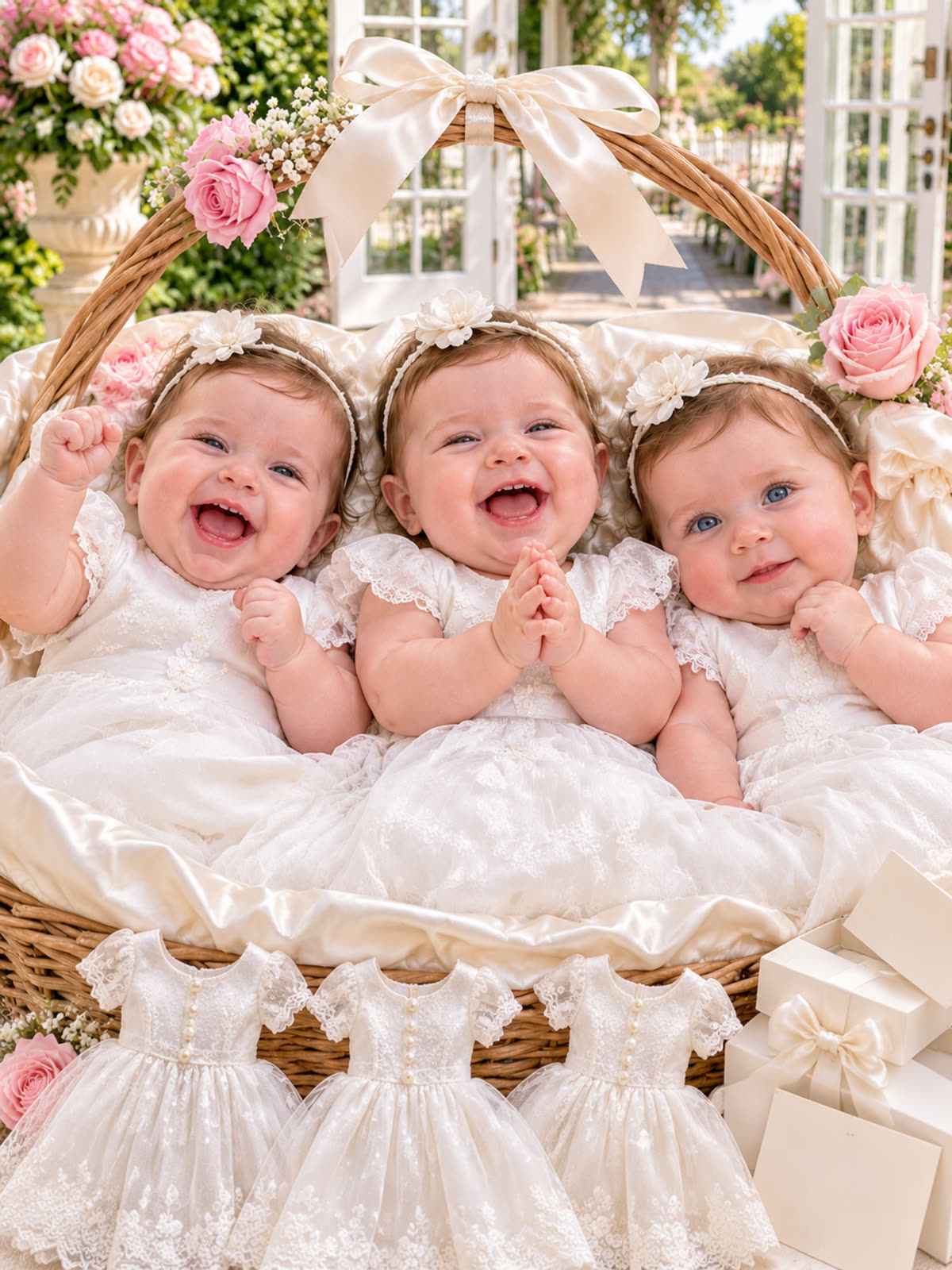
After seven years of hoping and waiting, my daughter Emily gave birth to three healthy girls. That afternoon, I stood in the hospital corridor with tears running down my face, unconcerned about who saw me. Years of disappointment, anticipation, and private prayers had finally given way to the loveliest sound I could imagine: three newborn babies crying together. Everyone in our family was overjoyed. My husband, David, rarely showed much emotion, but when he held his first granddaughter, words failed him. Emily was exhausted and glowing. Her husband laughed through his tears, scarcely believing the nurses had placed three babies in his arms. For that one wonderful evening, our lives felt perfectly complete.
I returned early the next morning with coffee and a bag of blankets Emily had forgotten. Almost as soon as I entered her room, a nurse knocked and came in carrying a large white box tied with satin ribbon. “Someone left this at the reception for your family,” she explained. “There’s no sender’s name. The front desk thought it might be a gift for the babies.” From her bed, Emily smiled sleepily. “Oh, how sweet. Open it, Mom.” I untied the ribbon and lifted the lid. Beneath layers of fine tissue paper lay three miniature wedding dresses.
These were actual gowns, not doll clothes. Each had lace sleeves, neatly arranged pearl buttons, and a fragile veil, all made to fit a newborn. Someone had spent considerable time creating them. The lace was hand-sewn, the pearls attached individually, and the veils almost weightless. “Who would send something like this?” Emily murmured. She lifted one dress carefully between her fingers. “They’re beautiful. But why would anyone send wedding dresses to newborns?” I had no answer. Underneath the dresses, I found a cream-colored card and read its handwritten message aloud before thinking about how strange it sounded. “Three brides. Just as we agreed.”
Uneasiness settled over me, and the room suddenly felt far too quiet. “Agreed?” Emily glanced toward me. “Mom, did we agree to anything?” “No,” I answered. “Nobody agreed to anything.” The back of the card was blank. I checked the box for a receipt, a signature, an address, anything that might identify whoever had sent it. There was nothing. Hoping to soften the discomfort, I suggested an unusually elaborate joke from a well-meaning friend. Perhaps someone at her husband’s workplace had organized the surprise. I offered possibilities, but neither of us seemed persuaded by them.
About an hour later, my mother-in-law arrived. Margaret was seventy-nine, dignified and particular, the sort of woman who ironed her pillowcases and never forgot a family birthday. Her handbag rested over one arm, and her face was bright with anticipation. “Where are my girls?” she asked affectionately. Emily pointed toward the bassinets by the window. Margaret bent over the sleeping babies and rested a hand against her chest. “Oh, look at them,” she whispered. “Look at those little fingers.” Then she noticed the dresses spread across the nearby table.
The change in her face was immediate. Her smile vanished, and recognition gave way to unmistakable concern. Color drained from her cheeks. She took several uncertain steps toward the table, picked up a gown, and examined its collar with shaking fingers. Three tiny blue stitches were concealed under the lace along the lining. “Oh, dear God,” she whispered. “Margaret?” I moved toward her. “What’s wrong?” Rather than answer, she reached for the other dresses and checked their collars one by one. Her hands continued trembling against the delicate cloth.
“Who brought these here?” she asked in a voice I barely recognized. “We don’t know. A nurse said someone left them at reception. There was a card.” “What did it say?” I repeated the message. Margaret swayed. Before I could reach her, she collapsed beside the table. Nurses rushed into the room. One called for a doctor while another supported her head. Emily tried to get out of bed, but a nurse gently urged her to stay where she was. I knelt beside Margaret, holding her hand and saying her name again and again.
She regained consciousness within a few minutes. After examining her and checking her vital signs, the doctor explained that a sudden emotional shock might have caused her to faint. As a precaution, they moved her to a quieter room farther down the corridor for observation. I went with her. When her eyes finally settled on me, she caught my wrist with surprising strength. “Listen to me carefully,” she said. “Don’t let Emily put those dresses on the babies.” “Margaret, why? What do the dresses mean?” She looked as though she was about to answer when my phone vibrated.
I nearly ignored it. An unfamiliar number filled the screen, but something about the timing made me take the call. I walked to the window and listened. For several seconds, there was only faint breathing. Then a man spoke in a calm, deliberate voice. “Ask Margaret what happened to her daughter Laura. And don’t believe her when she says Laura died without children.” The line went dead. I remained at the window, staring at the phone, trying to make sense of what I had heard. In twenty-six years of marriage, Laura’s name had surfaced only occasionally.
Laura was Margaret’s only daughter and David’s younger sister. We had always been told she died in a car accident at twenty-four, years before David and I met. Whenever he mentioned her, Margaret grew quiet and distant. Eventually, we stopped asking questions because we understood that remembering Laura hurt her. Her name became a closed door in our family, acknowledged but never opened. Now a stranger was telling me she had been a mother. Behind me, Margaret began to cry. “Who was that?” she asked faintly. I repeated his words exactly.
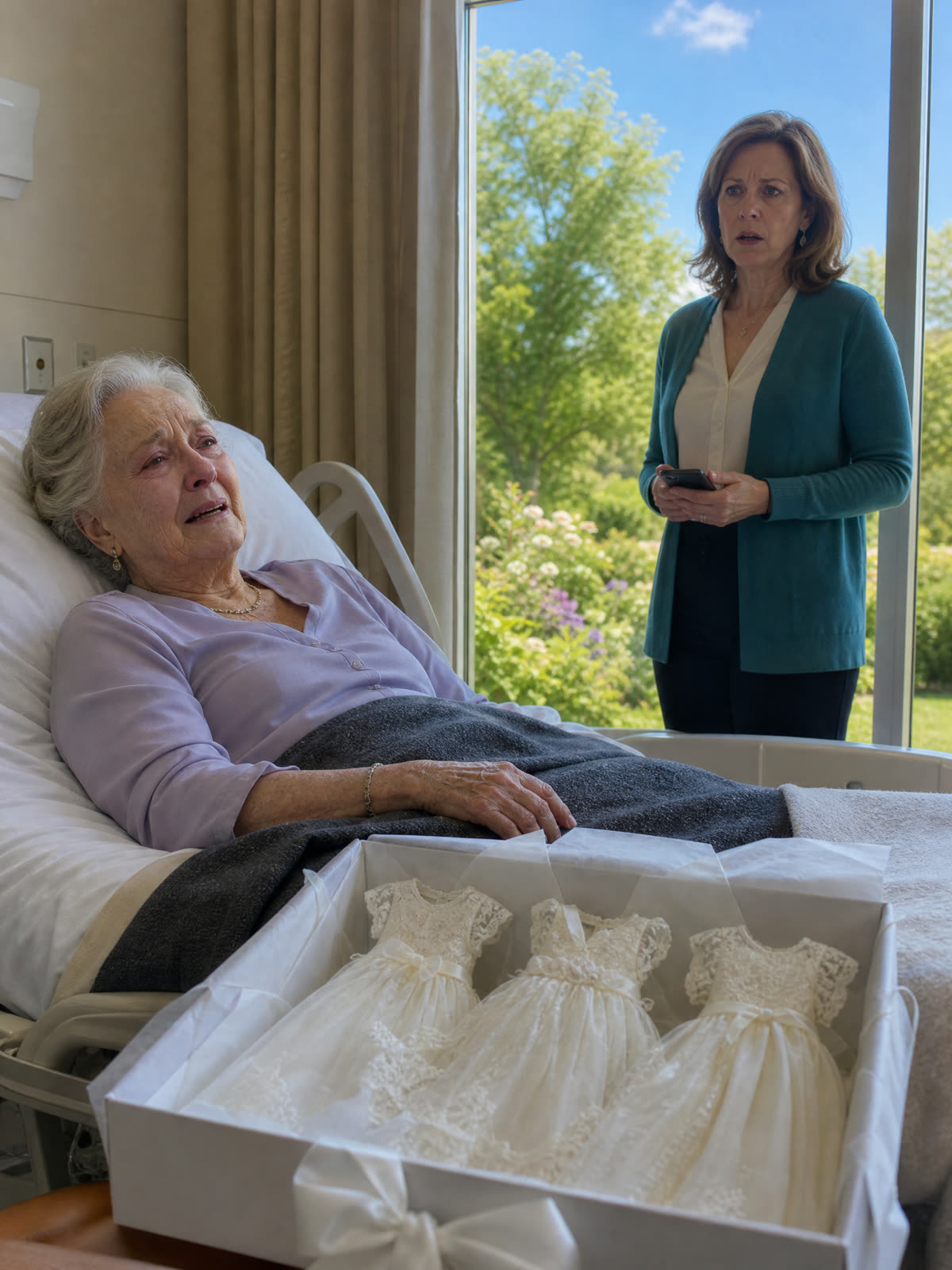
Margaret looked overwhelmed. For a moment, she seemed unable to speak. Then she turned toward the wall separating her room from Emily’s, where my daughter was resting with her newborn girls. “Please,” Margaret murmured. “Not now. She has just given birth. Don’t do this to her.” “Don’t do what?” I asked, trying and failing to steady my voice. “Tell us the truth?” Margaret dropped her gaze. “I never wanted this to happen.” I understood then that the dresses were probably no strange joke. They belonged to something she had hidden for decades, and someone had chosen our celebration as the moment to uncover it.
David arrived twenty minutes later, breathless from hurrying to the hospital. In the corridor, I showed him the gowns and card and told him about the call. He studied the blue stitches under one collar and went silent. Back in Margaret’s room, he asked, “Is this about Laura?” His mother looked stricken. “Please, David.” “Mom, what is going on?” She pressed her fingers to her temples. “I need time.” “For what?” I asked, struggling to stay composed. “Someone delivered wedding dresses to the hospital, you fainted after seeing them, and a stranger claims Laura had children. How much time do you need?”
Margaret did not answer at once. Instead, she watched through the glass toward the nursery, where Emily’s babies lay peacefully. Finally, she whispered, “Those stitches,” and David asked, “What about them?” “Laura put them on everything she made. She called them her signature. Three blue stitches, always in the same place, hidden under the collar.” David considered this. “Then whoever sent these knew Laura,” he said thoughtfully. Margaret nodded. “Whoever it is knows more about my daughter than either of you.” “Then tell us what you know,” I urged. She shook her head. “I can’t.”
I had never seen Margaret so shaken. Usually, she settled family disagreements with quiet authority and an expression that never faltered. For fifty years, she had presided over our important occasions with complete assurance. Watching that certainty disappear made everything feel unfamiliar. Eventually, David took her home, promising to return later. Before they left, she stopped beside me with her coat over one arm. “Whatever you hear,” she said, “remember that I was trying to protect my family.” Then she was gone, leaving me with the dresses and the card.
I kept rereading those words: Three brides. Just as we agreed. Who had agreed to what? Why had those tiny gowns frightened Margaret so badly? That evening, after Emily went home with her babies and settled in, I went into the spare bedroom where we kept the family albums. Sitting on the floor, I turned the pages slowly until a photograph caught my eye. It had been taken in the garden of Margaret’s old house. A dark-haired young woman stood in a white dress with delicate lace around its neckline, laughing at something outside the picture.
It was Laura. Most photographs I had seen showed her at the edge of a larger group; this was one of the few clear pictures of her alone. I brought it closer to the lamp. Beside the lace at her collar were three tiny blue stitches. My pulse quickened. The same hidden signature lay on the gowns delivered to my daughter’s hospital room. I could no longer leave Laura behind the closed door where our family had kept her. Rather than wait until morning, I called David, who was still with Margaret, and told him I would be there early the next day.
PART 2: The Daughters Laura Never Forgot
When I arrived the next morning, Margaret was sitting at her kitchen table over a cup of tea she had not touched. She looked far older and more tired than she had a day earlier. I sat opposite her and placed Laura’s photograph between us. Her eyes closed immediately. “Tell me about Laura,” I said. For a long time, she said nothing. The kitchen clock ticked. A little bird landed briefly on the windowsill and flew away. At last, Margaret began speaking, slowly and with pauses, as though each memory had to be pulled from somewhere she had kept shut for years.
“Laura was twenty-three when she became pregnant,” she explained. “The father was a married man. He refused to acknowledge the child. He wouldn’t even speak to her. I was terrified of the scandal, of what the neighbors and the church would say. I persuaded her to keep it quiet.” “Did she?” “She stayed indoors for most of the pregnancy. And when she discovered she was carrying three babies, she was frightened. So was I.” “Three,” I repeated, barely above a whisper. “Margaret. Triplets.” “Yes.” She looked directly at me. “Just like Emily’s.”
“What happened to them?” Margaret wrapped both hands around her cold cup. “Laura had no money of her own. The man had abandoned her. I told her that adoption would give the babies a better chance than she could.” “Did Laura agree?” “At first,” Margaret replied, her voice wavering. “She signed the papers. The girls were placed with different families. But she regretted it almost immediately.” I remained motionless. “And you told everyone she lost the baby.” “I know.” “You let your own family believe your grandchildren never existed.” “I thought I was protecting her.” “From what?” I asked. “From being a mother?” She turned away. Her silence told me there was more.
For months, Laura had tried to locate the families who adopted her daughters. She wrote letters, made call after call, and sat crying on the stairs, begging her mother to help. Margaret refused. She believed returning to the adoption would keep Laura from rebuilding her life. “Then, six months after the birth,” Margaret said quietly, “she died in a car accident. She was coming home from visiting a friend. The police said she lost control on a wet road. There was nothing anyone could do.” “And the letters she wrote?” I asked. Regret crossed her face. “I kept them.” “Where?” “In a box in my bedroom.”
When I asked to see them, Margaret rose without arguing and led me upstairs, one hand on the railing. From the back of her wardrobe, she brought out an old wooden box that looked untouched for years. Its hinges creaked as she set it on the bed and raised the lid. Inside were folded letters, hospital documents, and a photograph of three newborn girls lying together in little white gowns. I turned it over. Delicate handwriting on the back read: “My three little brides. One day, I hope you find one another.” Suddenly, the phrase on the hospital card belonged to someone real. It belonged to Laura.
But why had someone repeated her words now? Margaret lifted a letter and held it against her chest. “I promised Laura I would help her find the girls,” she said. “Right at the end, I promised.” “Did you ever try?” “After she died, I couldn’t face it. I told myself they were happy with their new families. I told myself they were better off not knowing.” I looked again at the three babies in the photograph. The new dresses were not exact replicas, but their resemblance to Laura’s work was clear. Whoever had sent them knew her letters and patterns and wanted Margaret to face what she had done.
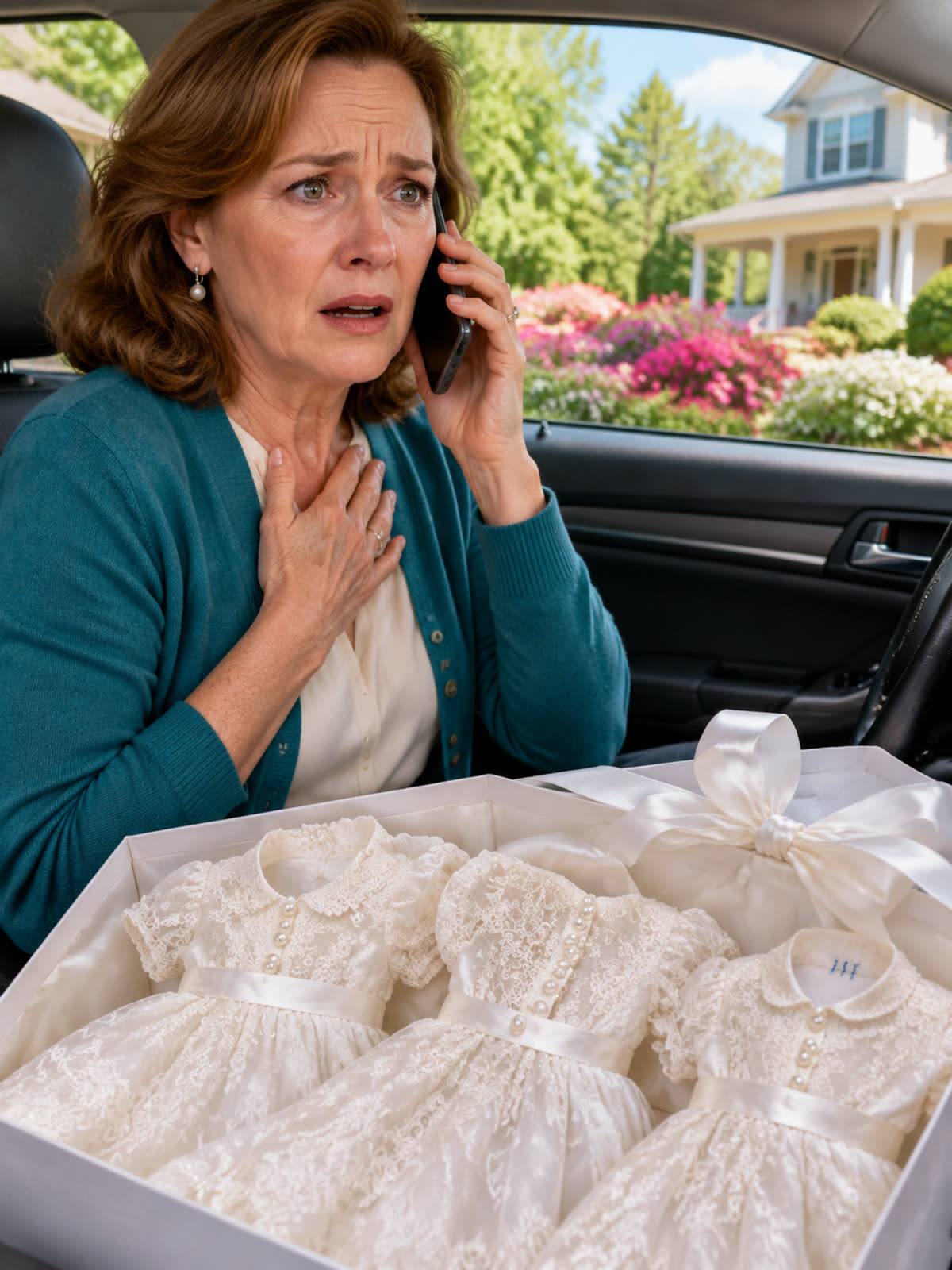
That afternoon, the unknown caller rang again while I sat in my parked car outside Margaret’s house. I answered at once. “Who are you?” I demanded. “What do you want from Margaret?” “My name is Michael,” the man replied. His voice was steady but tired. “I’m the husband of the woman who has been searching for her biological family.” I let out a slow breath and leaned back against the seat. “Your wife?” “She was adopted as a baby. A few months ago she found documents that led her to Laura, and then to Margaret.”
“How did you know about Emily’s triplets?” “My wife spent years searching for her sisters. She found one adoption record, then another.” He paused. “She also discovered that Laura’s mother was still alive. She has not been able to bring herself to confront Margaret. Then I saw the post your family shared online. Your daughter had given birth to triplets, and Margaret was named as the great-grandmother. I thought she might finally understand what she had done.” “So you sent the dresses.” “Yes.” “Why wedding dresses?” “Because of Laura’s letters.”
Michael explained that Laura had given duplicate letters to the adoption agency, asking that they be passed to her daughters if they ever sought information about their birth mother. In them, she called the girls her three little brides. She pictured them finding one another, marrying someday if they chose, and building families of their own. “The dresses were her way of imagining a future she was afraid she would never see,” he explained. I looked at the white box on the passenger seat. Without quite understanding why, I had brought it with me. “And the blue stitches?” “My wife learned about them from the baby dresses Laura gave the agency. One of them was the dress she wore on the day she was adopted.”
“Why send them to a hospital?” I asked. “Why not call Margaret? Why not write to her?” “Because I learned her family was celebrating another birth.” His voice softened. “I wanted her to see what she took away from her own daughter and from my wife. I wanted her to understand that the children she gave away grew up.” I hesitated before asking, “Who is your wife?” “Her name is Sarah.” He gave a surname I had seen among the adoption papers in Margaret’s box. Sarah was one of Laura’s daughters. The children in that faded photograph were no longer an unanswered question from the past.
“Are her sisters alive?” “Yes. I found one of them. Her name is Rebecca, and she lives a few hours away. The third is still difficult to trace.” “And what do you want now?” “I want Margaret to tell the truth to everyone she lied to.” He hesitated, then continued. “I don’t want money. I don’t want to hurt anyone else, least of all your grandchildren. I want the truth my wife has spent her life looking for.” For the first time since the delivery, I understood the feelings behind it. The gowns were not a warning about Emily’s babies. They were a demand that a hidden family history finally be acknowledged.
That evening, David and I sat with Margaret in her living room. I spread Laura’s photograph and several letters across the coffee table. “Michael called again,” I explained. “His wife is Sarah. She is one of Laura’s daughters.” Margaret covered her mouth. “Sarah?” “You knew her name?” “No. But I remember the family who adopted the first baby. They lived in another county. They wrote to me once, years ago, asking about Laura. I never replied.” David slowly turned toward her. “You received a letter from your granddaughter’s family and ignored it?”
Margaret began to cry. “I was ashamed. Every time I thought of those children, I remembered Laura begging me to help her find them. I couldn’t bear to admit I had been wrong.” “You weren’t just wrong,” David replied. “You made a decision for three children, and then you hid it from everyone who loved you.” “I know.” “No, Mom. I don’t think you do.” He spoke quietly, but there was no mistaking his disappointment. Margaret reached for his hand. He gently pulled it away. “I thought I was protecting Laura,” she murmured. “And what happened instead?” I asked. Looking down at her daughter’s photograph, she answered, “I lost her anyway.”
For once, Margaret did not defend herself or offer a reason for what she had done. Beneath the living room lamp, she sat with her shoulders lowered, considering everything we had said. The photographs and letters remained spread between us, no longer hidden at the back of a wardrobe. David had learned that the sister he mourned had left three daughters behind. I had learned how much of our family’s history rested on things none of us had been allowed to know. Then Margaret spoke again, and David’s attention sharpened. “There is one more letter,” she said. “I haven’t shown it to anyone.”
PART 3: The Sisters at the Same Table
Margaret went upstairs and returned with an envelope whose edges had yellowed. Laura had written it about two weeks before the accident. In the letter, she explained that she planned to search for her daughters herself. She could no longer accept that they would necessarily be better off never knowing her. “Why didn’t you give it to the girls?” David asked. “Because I was afraid they would hate me.” “They have every right to be angry,” he answered. Margaret nodded. Her fingers shook slightly as she passed the letter to me, and I carefully read the last passage aloud.
“I hope my girls find one another. I hope they know that I loved them, even when I was too frightened to fight for them. If they ever come looking, please tell them I never stopped thinking about them.” Nobody spoke for several minutes. The mantel clock ticked while David stared at the floor, struggling visibly with his feelings. Margaret wiped away tears. Finally, she said, “I want to meet them.” David looked at her, his expression unreadable. “You should have wanted that thirty years ago.” She did not argue. “Yes. I should have.”
Rebecca arrived three days later. She was around thirty, with Laura’s dark hair and the same broad smile I had seen in the garden photograph. Margaret answered the door herself. They stood facing each other in silence before she finally said, “You look like your mother.” Rebecca’s eyes filled. “I don’t know what she looked like beyond the photographs I found.” Margaret moved aside. “I have more.” As she entered, Rebecca explained, “I came because Sarah wants me to find our sister. Sarah still can’t face you.” Margaret lowered her head. “I’m sorry.” “I also want to know about my mother.”
Margaret brought out Laura’s photographs, letters, and old sewing patterns. For hours, she and Rebecca sat at the dining table, examining them together. David and I made tea in the kitchen, occasionally hearing their low voices from the next room. Those papers could not return the years that had passed, but they contained things Rebecca had come to learn: her mother’s face, her handwriting, the work she had made with her own hands. Before leaving, Rebecca agreed to help locate their other sister. The search continued for several weeks, drawing on Sarah’s collected records and information supplied through the adoption agency.
Eventually, they identified the third daughter. Her name was Helen. She had been raised by a loving adoptive family and had never suspected that she had two biological sisters. When Rebecca first contacted her, Helen said nothing for nearly a minute. “Are you sure?” she finally asked. Rebecca sent copies of the records and family photographs. Two days later, Helen replied and agreed to meet. Sarah would be there, too. After decades spent living separate lives, Laura’s three daughters were finally going to sit together.
Their first meeting was emotional and awkward in understandable ways. They traded childhood memories, smiled over similarities they had never expected, laughed about their differences, and considered all the years they had spent apart. Each woman had become her own person, shaped by her experiences and by the family who raised her. Still, Laura was recognizable in all three—in their expressions, their gestures, and little details that emerged as they talked. Margaret came to the reunion but stayed near the doorway at first, giving the sisters room to be together. Eventually, Rebecca asked her to join them.
That invitation did not mean everything had been forgiven. It offered the possibility of beginning something honest instead of continuing to live with unanswered questions. I told Emily the whole story as well: Laura’s pregnancy, the adoptions, Sarah’s search, and the sisters who had finally found one another. Emily listened closely, her daughters asleep beside her and in her arms. When I finished, she lifted one of the miniature gowns and examined the three blue stitches hidden below its collar. “She called them her little brides,” Emily whispered. “Yes.” “She wanted them to find one another.” “She did.”
Emily looked toward her daughters, sleeping close together in their bassinets. “I can’t imagine being separated from them. I can’t imagine spending the rest of my life not knowing whether they were safe.” Neither could I. The next day, she invited Margaret over. Margaret brought a small album of Laura’s photographs and sat beside the babies. For several minutes, she simply watched them sleep. Then she spoke. “I’m sorry,” she told Emily. “I can’t undo what I did. I can only tell the truth now.”
Emily took her hand gently. “I don’t know if I’ll ever understand why you did it. But I hope you understand what it cost them.” Margaret nodded and brushed tears from her cheeks. “I do now.” She stayed for about an hour, sharing memories of Laura. She described the tiny dresses Laura used to sew for her dolls, the tunes she hummed as she worked, and the way her whole face brightened when she laughed. For the first time I could remember, Margaret talked openly about her daughter without retreating into silence or steering the conversation elsewhere.
Before leaving, Margaret asked whether Emily planned to keep the dresses. Emily said she did. They would never be treated as wedding gowns for her babies or as expectations about whom those little girls might someday marry. They would be reminders of a young mother who had loved three daughters she never got to raise. They would also preserve the family history that had separated those sisters for so long. Beside the sleeping babies, the tiny gowns no longer seemed like the threatening objects that had arrived in a nameless box. Their meaning had changed because the truth behind them was finally being spoken.
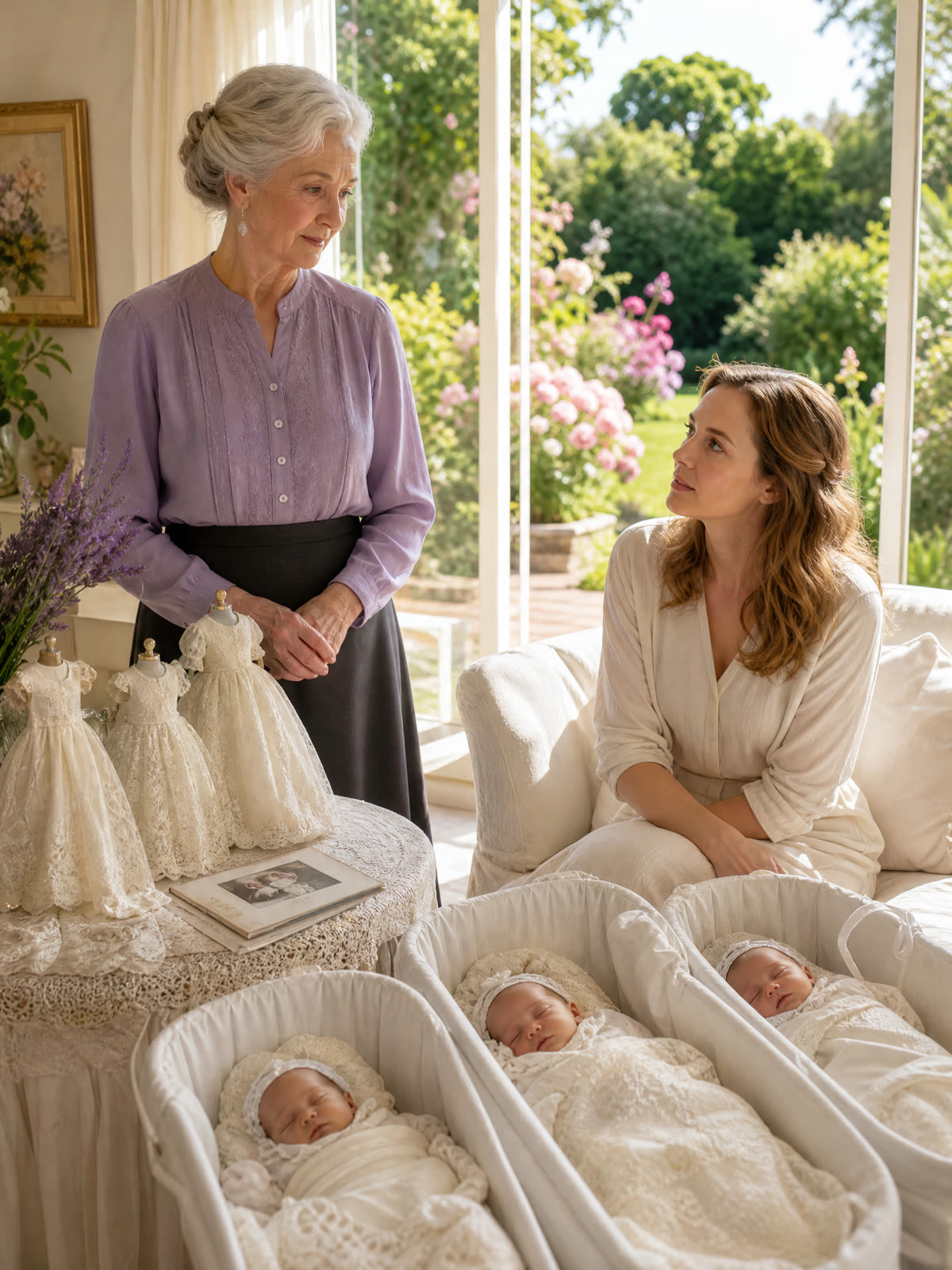
Margaret had once believed that hiding painful information would protect her family’s happiness. Instead, the silence outlived Laura and reached generations who deserved to know their own history. The dresses first came to us as an unsettling mystery. Gradually, they became evidence that a family story does not disappear simply because remembering it hurts. Laura’s letters had survived. Her photographs had survived. The blue stitches she tucked beneath a collar had survived. Through those things, her daughters learned that she had thought about them, wanted to find them, and hoped they would eventually find each other.
On the last Sunday of that month, everyone gathered at Emily’s home. Sarah, Rebecca, and Helen sat side by side on the living room sofa. The house smelled of fresh coffee and warm bread. Watching Emily cradle her three newborn daughters, I finally understood the most heartbreaking part of the secret Margaret had kept. Laura had not truly wanted her little girls to become brides. More than anything, she had wanted them to know one another as sisters. That afternoon, surrounded by family, they finally did.
David stood quietly by the doorway for a while before crossing the room and sitting beside Margaret. He reached for her hand, and she held it gently, as though that small gesture carried thirty years of things left unsaid. The sisters were together. Laura’s story was no longer hidden. Margaret had finally begun telling the truth. But David did not announce that he had forgiven her.
Disclaimer: This story is a work of fiction inspired by real-life themes. Names, characters, places and events are fictionalized, and any resemblance to real persons is purely coincidental. Images are for illustration purposes only.
