

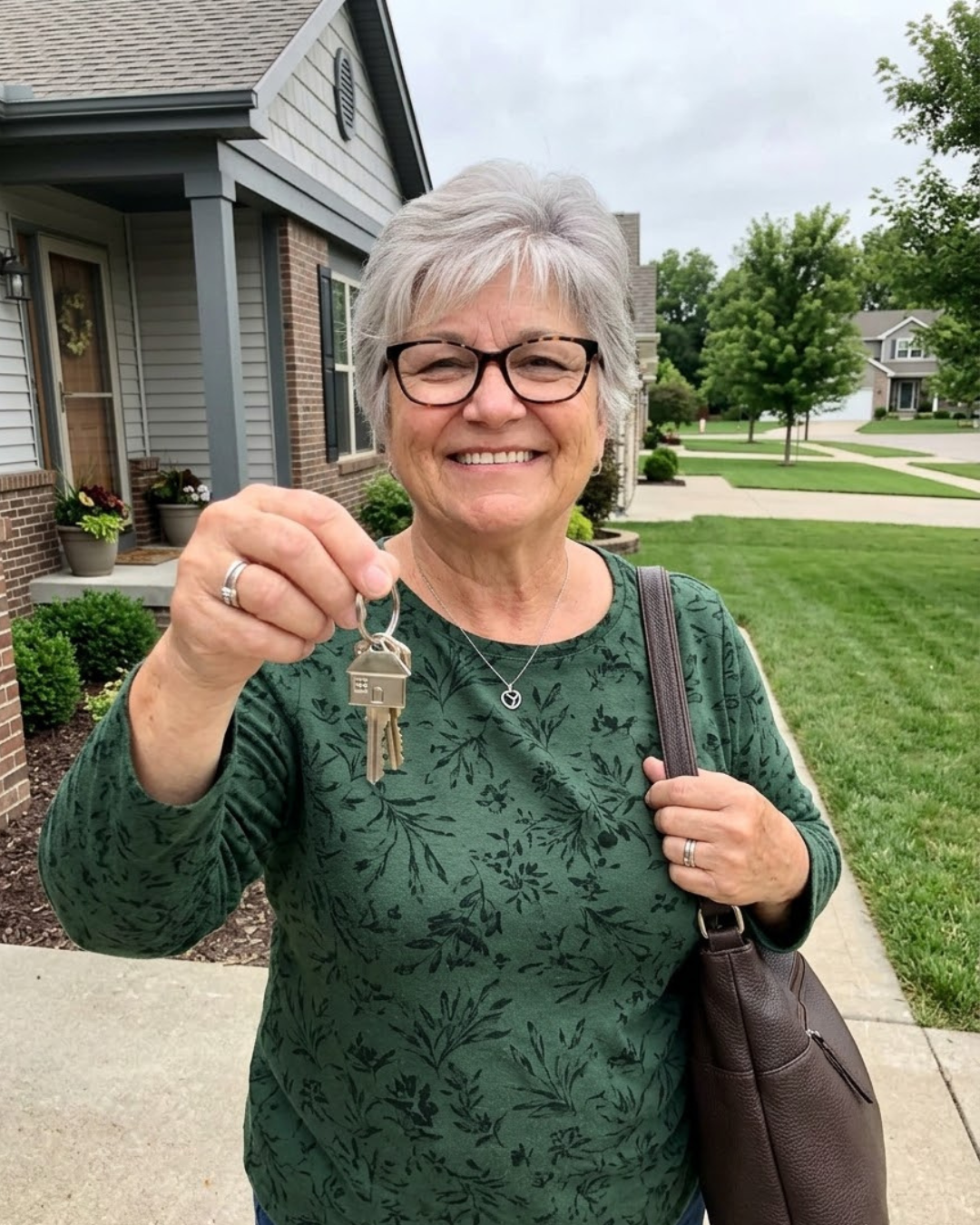
Part 1 — The Price of a Place in My Daughter’s Home
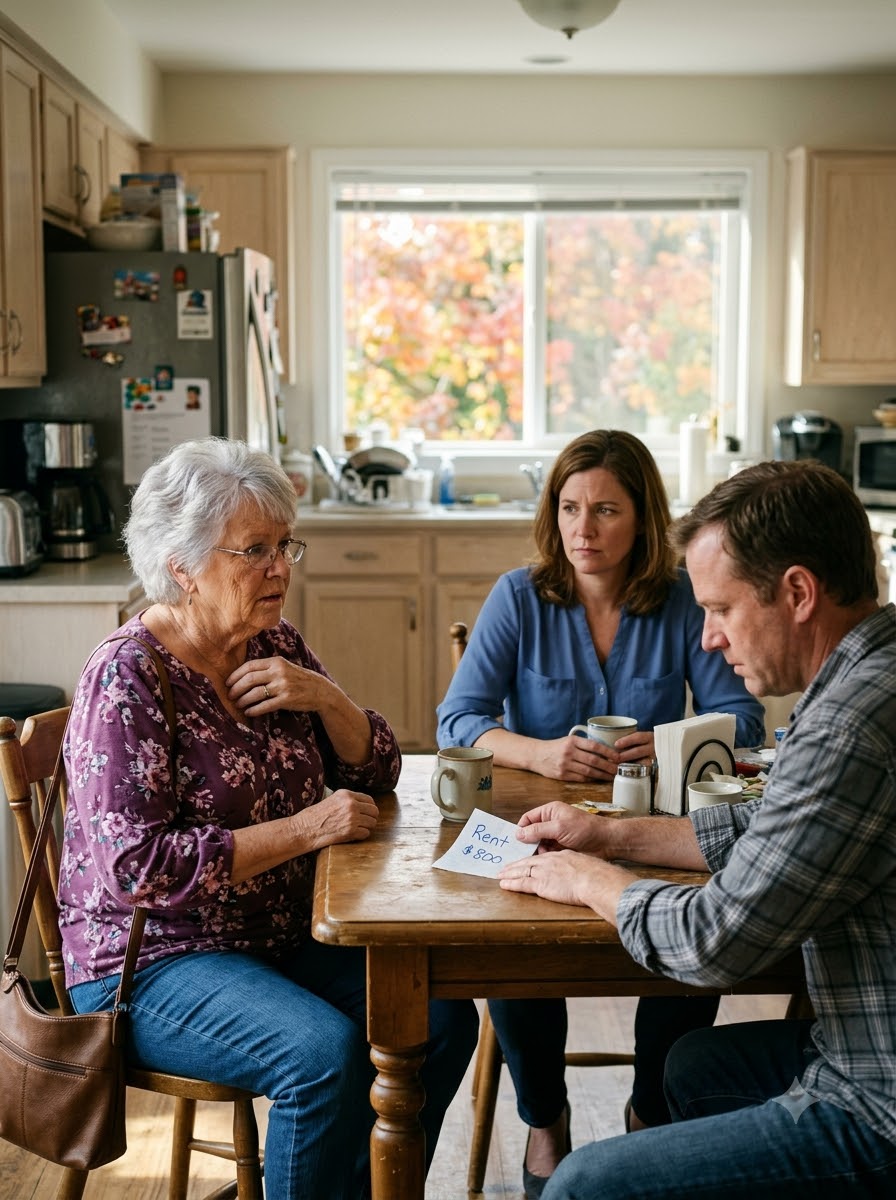
My son-in-law pushed a torn sheet of notebook paper toward me across the kitchen table. Written in the center was a single number, circled two times.
$800.
“That’s rent, utilities, and your share of the groceries,” my daughter said. She held a coffee mug between both hands, although the coffee inside had been cold for quite some time. “And then four days a week with the kids. So you’d be earning your keep, Mom. It wouldn’t be charity.”
Earning my keep.
Those three words stayed with me longer than anything else said that afternoon.
It was Saturday, shortly after lunch, during the first week of October. Someone had opened the kitchen window just enough to let the outside sounds drift inside. From there, I could hear the grain elevator’s dryer fans running. During harvest in Holdrege, that sound seems to reach every corner of town. It is a deep, constant rumbling, something like a river rushing without ever arriving anywhere.
I stared at the paper.
Todd had torn it from a spiral notebook. The perforated edge was still ragged, and the writing was unmistakably his. He formed the number eight with two separate circles, one sitting on top of the other, just like children learn to write it in elementary school.
“Eight hundred,” I said.
“A one-bedroom at the apartments out by the highway is seven seventy-five,” Todd said. His eyes remained fixed on the salt shaker rather than on me. “We looked it up. So it’s fair. It’s right at fair.”
“And you’d have family,” Michelle said. “You wouldn’t be by yourself out there anymore.”
At sixty-seven, I knew exactly how far my money could stretch.
My monthly Social Security payment, the survivor benefit I received after Dale died, was $1,640. Before retiring, I had spent twenty-two years handling the accounts at the lumber yard. I could subtract eight hundred from sixteen hundred and forty without reaching for a calculator.
That would leave $840.
Out of that, I would need to pay for car insurance, my Medicare supplement, gasoline, prescriptions, my church tithe, and Christmas gifts for my two grandchildren.
In exchange, I would also be looking after Michelle’s children four days every week.
I would be paying to live in her house while doing the work of someone she would otherwise have to hire.
And the part that hurt most was how casually she had presented it.
I have thought about that afternoon many times since, and I want to give my daughter the fairness she deserves. Michelle was not trying to sound cruel. She spoke pleasantly, although there was a hurried quality to her words.
It reminded me of someone explaining the conditions of a used-car purchase.
I suspected she had rehearsed what she wanted to say, perhaps while standing in front of her bathroom mirror, and now she wanted to finish before her courage disappeared.
“Can I see it again?” I asked. “The basement.”
“Sure, Mom. Of course.”
Michelle stood, and we headed downstairs.
Todd remained at the kitchen table.
I could tell they had made an effort to prepare the space. A leftover piece of tan carpeting covered the concrete floor. They had brought in a double bed with an actual frame, along with a lamp Michelle had once kept in her childhood bedroom.
A dehumidifier hummed in one corner. Its drainage hose ran across to the floor drain.
Near the ceiling was the basement’s only window. It was barely larger than a cake pan, and the view consisted entirely of the lower boards of the neighbor’s fence.
The air carried the mixed odor of damp cardboard and laundry detergent.
“Todd’s going to put up a wall here,” Michelle said, gesturing toward the open area. “So you’d have your own room. Your own space. And the bathroom’s just up the stairs.”
“Up the stairs,” I said.
“It’s only thirteen steps.”
On our way back to the kitchen, I counted.
Thirteen steps, exactly.
Michelle had been right about that.
Sadie had followed us downstairs. My granddaughter was four years old, and that afternoon she was wearing a princess nightgown and only one sock, despite it being one o’clock.
She stood on the lowest stair with her thumb hovering near her mouth. She was trying to break the habit, so she kept it close without actually putting it between her lips.
“Grandma,” she said, “are you going to live in the under?”
“We’ll see, sweet pea.”
“There’s a spider in the under. Eli named him Kevin.”
“Well,” I said, “then I’d have company.”
I smiled for her.
But as I climbed those thirteen steps, I felt something heavy settling inside my chest.
Later, when I told my friend Brenda from church what had happened, she did not bother hiding her opinion.
She wanted to know why I had not refused immediately. Why I had not reminded Michelle that I was her mother, not a tenant applying for permission to enter the family.
The truth is, I nearly did.
The words were ready. I could practically feel them pressing against my teeth.
But I knew my daughter.
A refusal delivered across her kitchen table might turn into an argument. An argument might become a shouting match. And once people begin saying things out of anger, some of those words cannot be gathered up and put away again.
Michelle is my only child.
I had already lost Dale.
I could not bear the thought of damaging my relationship with the one other person who still remembered the sound of his voice.
Not over a torn sheet of notebook paper.
So I chose my answer carefully.
“Thank you, honey. That’s a real offer, and I can see you two worked on it. Let me think on it.”
Michelle released a breath she seemed to have been holding.
“Okay. But, Mom, you’ve got to be out of the farmhouse by the first. So.”
“I know when I have to be out.”
I picked up Todd’s paper, folded it once, then folded it again. I slipped it into my purse beside my checkbook.
Todd watched the whole thing without speaking.
Something crossed his expression, something I could not identify then.
I would understand it later.
For the moment, I simply went outside, climbed into my Buick, and sat behind the wheel with both hands resting on it.
To understand why I was considering a basement at all, you need to know about the farmhouse.
My husband, Dale, had been a hired farmhand.
I have never felt ashamed of that. Quite the opposite.
For thirty-one years, he worked for Jim Olson on a farm south of town. During those same thirty-one years, we lived in the house provided for the hired man.
It was a square, white, two-story farmhouse. The north wind could find its way through almost anything in that building, but the garden soil was the richest I had ever worked.
I could put a spade into that ground and feel how good it was.
The house belonged to the Olsons.
We paid no rent, but we owned none of it. Our right to live there came with Dale’s employment.
That arrangement was common in our part of Nebraska, and it had given us a good home in which to raise Michelle.
Dale died two years earlier, in March.
He had been working in the machine shed, greasing the planter. At some point, he sat down on an overturned bucket to rest.
He never got up again.
Jim Olson found him there.
At the funeral, Jim cried harder than I did.
My tears had not begun yet.
Technically, I should have moved out that spring. The house had always been part of Dale’s job, and Dale was gone.
But Jim and his wife would not hear of rushing me.
They let me remain there for another two years and seven months, without ever asking when I planned to leave.
Every August, Jim’s wife brought me sweet corn. Each winter, Jim cleared my lane with the plow, even when I had not asked him.
They were good people.
Then their son decided to return to the farm.
He and his wife already had a baby, with another child expected. They had been renting a place in Kearney, and the farmhouse was the only available home on the Olson property.
In August, Jim appeared at my door holding his cap in both hands.
He struggled for nearly ten minutes to tell me what needed to happen.
“You take until November, Judy. You take longer if you need it.”
“I won’t need longer,” I told him. “That house was always yours, Jim. You’ve been good to me past what anybody could ask.”
I meant every word.
There was no cruelty involved, no one taking advantage of me.
A young family needed somewhere to live, and I was a widow occupying five rooms in a house I did not own.
That was the simple truth.
And that was why, on that October Saturday, I found myself sitting outside my daughter’s split-level house with an eight-hundred-dollar proposal in my purse.
I started the Buick, intending to return to the farmhouse.
But after four blocks, I changed my mind.
Instead, I pulled up outside Brandt’s feed store.
That store had stood on its corner longer than I had been old enough to drive. The wooden floor had worn down into a shallow path between the entrance and the counter.
Inside, it smelled of molasses, leather, and the sweet dust of calf starter.
Dale had bought mineral blocks and fence staples there for three decades.
Mr. Brandt was seventy-four, but he still carried fifty-pound feed sacks to customers’ trucks. He simply lowered them more cautiously than he once had.
For the past three weeks, a small index card had been taped beside his cash register.
Every time I came in for birdseed, I read it.
And every time, I told myself not to interfere in something that did not concern me.
The card read:
House for rent. Two rooms and bath. See Brandt.
On Saturdays during harvest, the store stayed open until four.
My dashboard clock showed 2:20.
“Judy,” Mr. Brandt greeted me when I walked in. “Black oil sunflower?”
“Not today.”
I approached the counter and touched the index card.
“Is this still for rent?”
He looked at the advertisement, then back at me.
I could almost see him putting the circumstances together. News traveled quickly in Phelps County, and everybody knew Jim Olson’s son was coming home to farm.
“It isn’t much,” he said.
“Where is it?”
“Right behind the elevator. On the side street. It was my mother’s, the last eleven years of her life. I had a young fellow from the co-op in it till he got married in June.”
He reached toward a nail on the wall and lifted down a ring of keys.
“Come on. I’ll show you. Roy, watch the counter.”
We walked the short distance together.
It was only a block and a half.
Harvest traffic had backed up from the grain scale all the way toward the railroad tracks. Golden corn rose above the sides of the trucks.
Drivers sat with their windows open and their arms hanging out, talking to one another while they waited.
Red chaff floated through the air, the kind that gets caught in your hair and somehow ends up between your teeth.
Above everything stood the elevator, tall and white, almost like a church that had never been given a steeple.
And there, sheltered beside it, was the smallest house I had ever seriously considered living in.
It looked like a chick tucked beneath a hen.
The siding was white. The shingled roof was green.
A narrow front porch held a swing suspended by chains, its seat painted recently enough that the finish still looked fresh.
Between the walkway and the porch was a single step.
Just one.
“Mother couldn’t do stairs,” Mr. Brandt said when he noticed where I was looking.
He unlocked the door.
The first room served as both living room and kitchen.
There was a sink beneath a large window, a four-burner gas stove, and a humming refrigerator. Along one wall was space for a table. Across from it, there was enough room for a couch.
A heating stove occupied the corner.
A doorway led into a bedroom with a closet. Beyond that was a bathroom, complete with a bathtub and a grab bar firmly attached to the wall studs.
That was everything.
Standing in the center of the main room, I could see nearly every part of the house.
From the kitchen window, the elevator, scale, and waiting trucks were all visible.
“It’s loud in harvest,” he said. “The fans run all night. And the train comes through about two in the morning and again around five. Mother said she quit hearing it after a month.”
“I’ve been listening to a quiet house for two years, Mr. Brandt. I believe I could stand some noise.”
He scratched the back of his neck.
“There’s corn dust on everything from now till Thanksgiving. I won’t lie to you about that.”
“What are you asking?”
“Five fifty. You pay your own lights and gas. I keep up the roof and the furnace, and I mow it when I mow the store.”
Five hundred and fifty dollars.
Subtracting that from my $1,640 monthly check left $1,090.
Again, I did not need a pencil.
“It isn’t much,” he said again.
“It’s got a door,” I said. “I’ll take it.”
He stared at me, surprised.
“You want to think it over? Talk to Michelle?”
“I’ve been thinking it over for three weeks. Every time I bought bird seed.”
I wrote him a check on the hood of my Buick.
I was afraid that if I returned to the store first, I might give myself enough time to talk myself out of it.
Mr. Brandt tried to refuse a deposit. He said Dale’s widow did not need to give him one.
I insisted on paying the first month and told him he could hold the deposit in trust.
He removed two keys from his large ring and placed them together on a smaller one.
“Front and back,” he said.
I opened my hand beneath them.
Two brass keys, still carrying the warmth of his pocket.
At nineteen, I had moved straight from my father’s house into the home that came with Dale’s job.
All my life, I had lived under a roof provided through someone else.
First as a daughter, then as a wife.
I was grateful for those homes. I always had been.
But now, at sixty-seven, I was holding the keys to a house I had chosen entirely for myself.
I turned toward the elevator because I did not want Mr. Brandt to see the tears gathering in my eyes.
For the first time in my life, I had a home with a door that was mine to open.
And I had just made a decision my daughter knew nothing about.
Part 2 — Two Brass Keys and Ten Days of Silence
There is something about the next part that still makes me uncomfortable.
I did not tell Michelle I had rented the little house.
Not that Saturday, and not during the week afterward.
When she telephoned on Monday to ask whether I had made up my mind about the basement, I told her I was still considering it.
That was not exactly truthful.
I had already signed on to the house behind the elevator.
Still, I was thinking constantly.
Mostly about where my furniture would fit.
Jim Olson and his son came to move me on a Wednesday. They brought a flatbed truck to the farmhouse porch and insisted that I carry nothing heavier than a lamp.
I packed my bed, my couch, and the kitchen table Dale and I had purchased at a farm auction in 1981.
Four chairs went with it.
I brought my sewing machine, Dale’s recliner, and nine cardboard boxes.
Thirty-one years of married life in that farmhouse, reduced to one flatbed load and whatever I could fit in the Buick’s trunk.
Everything else went to Jim’s son and his wife.
She cried when I handed over the canning jars.
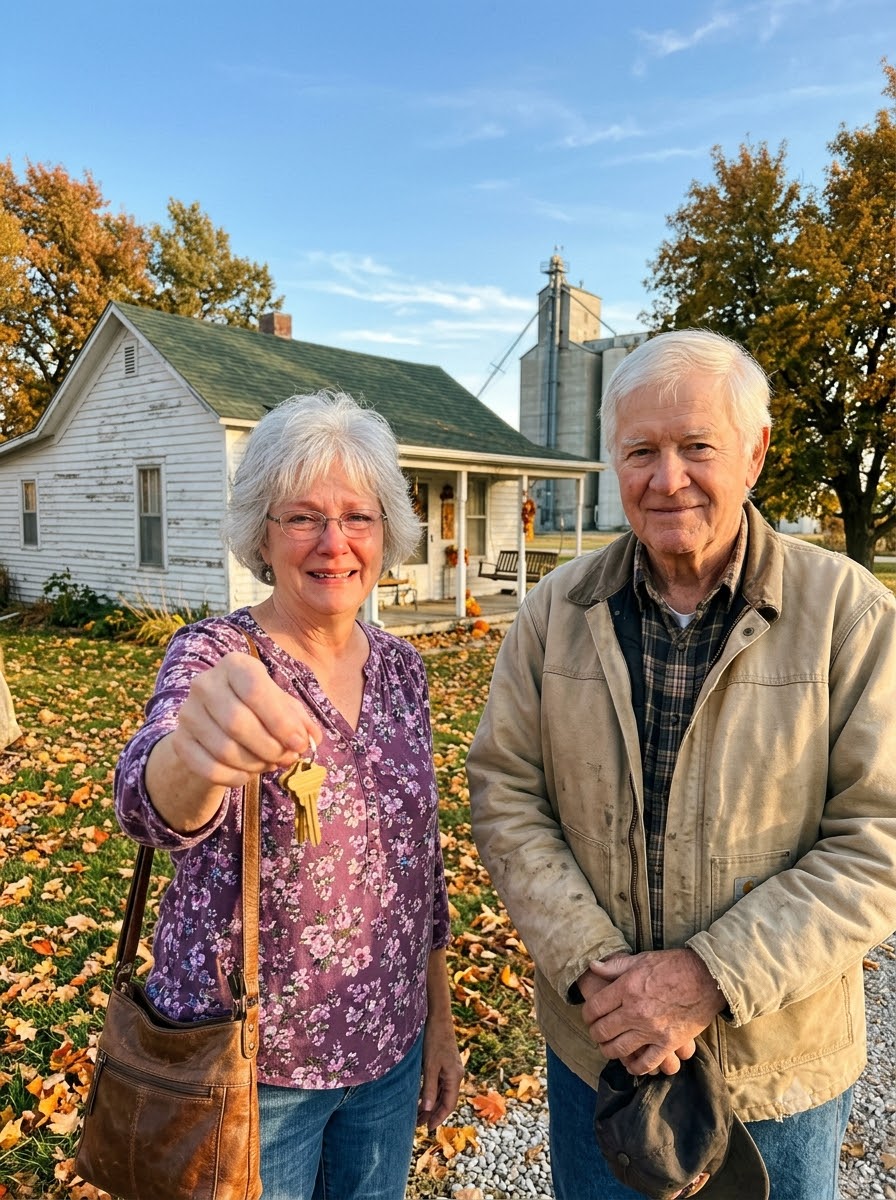
At my new place, Jim stood in the front room with his cap removed and slowly turned to take everything in.
“Well, Judy. It’s snug.”
“It is.”
“Dale would’ve had that porch step shimmed level before I got the truck unloaded.”
“He would have,” I said.
We laughed together.
Then the laughter stopped, and for a moment we simply stood there remembering him.
After they left, I began making the place mine.
I hung curtains.
I positioned Dale’s recliner beside the heating stove, facing the kitchen window.
My African violets went onto the sill above the sink, where they could look out over the trucks lining up at the grain scale.
That first night, the elevator fans ran without stopping.
At two in the morning, a train passed through town and made the water tremble inside the glass beside my bed.
I lay awake wondering whether Judith had finally lost her good sense.
By the second night, I slept until five.
It was Todd who eventually discovered where I had gone.
His drive to the plant took him directly past the elevator every morning before first shift.
On my ninth morning in the house, a Monday, he passed at about 5:45.
He saw my Buick parked outside.
He saw the light shining from the kitchen window.
And he saw an older woman wearing a housecoat, standing at the sink watering African violets.
Michelle called that evening at seven.
The instant she said “Mom,” I knew Todd had told her.
“You rented a house.”
“I did.”
“From Mr. Brandt. By the elevator. Todd saw your car.”
“That’s right.”
“You have been living four blocks from me for over a week, and you let me keep asking if you’d thought about it.”
I could not argue with her.
“That was wrong of me,” I said. “I should have told you the day I did it. I was afraid of this phone call, and I put it off, and that was cowardly. I’m sorry for that part.”
For a while, she said nothing.
I could hear a cartoon playing somewhere behind her.
“What did you pay?”
“Five hundred and fifty.”
“So it wasn’t even the money.” Her voice grew thin and sharp. “It’s two hundred and fifty dollars’ difference. You’d rather pay a stranger than your own family?”
“Mr. Brandt isn’t a stranger. And no. I’d rather be your mother than your renter, Michelle. That’s all it is.”
“We made a place for you!”
“You did. I saw the work in it.”
“I told the daycare we might be pulling Sadie out. I told my boss I might be able to pick up Fridays.”
“I didn’t know that.”
“Because you didn’t ask! You just smiled and said thank you and went and did whatever you wanted!”
I kept my voice calm.
In all the years I had been Michelle’s mother, shouting had never helped me reach her. It had not worked when she was fifteen, and I doubted it would work now.
“Honey,” I said. “I’m going to say one thing, and then I’ll let you go, because you’re upset and it’s the kids’ bedtime. I would have come and watched those babies for nothing. I’d have done it gladly. But you told me I’d be earning my keep. I earned my keep with you a long time ago. I don’t believe I owe on it.”
She ended the call.
I lowered the telephone onto the old kitchen table, the one Dale and I had bought back in 1981.
Then I sat there until the last daylight disappeared and the elevator’s lights came on outside.
For ten days, I heard nothing from my daughter.
There were no phone calls.
No pictures of the grandchildren.
Before that, Michelle had sent photographs nearly every evening.
Sadie with spaghetti smeared across her forehead. Eli proudly showing the gap where a tooth had fallen out.
My phone stayed silent.
Those ten days were harder than I expected.
Every evening, I put on my denim jacket and sat on the porch swing, watching trucks roll toward the scale.
I had my own front door.
I had two brass keys.
I had my violets and a porch swing and a house where I could make my own decisions.
Yet I kept wondering whether I had paid too much for those things.
The basement itself had never frightened me. I had lived in simpler places.
Even the eight hundred dollars was not the deepest injury, although it would have taken almost half my income.
What troubled me was the idea of living under conditions.
Every time someone bought groceries, I would be calculating my portion.
Every Thursday when I felt tired and wanted to rest, I would hear Michelle’s words repeating inside my head.
Earning your keep.
A grandmother who lives under a work agreement becomes something different.
She becomes the hired help who happens to love the children.
And what would happen when the children grew older and no longer needed daycare?
Would my value to the household change?
I wanted to be close to Sadie and Eli.
I simply did not want my place in the family measured by the services I provided.
Still, I would have surrendered the porch swing, the violets, and both keys for five minutes with Sadie sitting in my lap.
That was what made the silence so painful.
Something unexpected helped me endure it.
A shoebox.
On my second day in the new house, I walked into Brandt’s to buy sunflower seed.
Mr. Brandt was behind the counter, surrounded by what looked like two hundred loose pieces of paper.
There were invoices, charge slips, and a bank statement marked by a circular coffee stain.
His reading glasses rested on his forehead.
“Lois did all this,” he said, almost as if he were talking to himself.
Lois was his wife. She had died four years earlier.
“Forty-three years she did it, and I never once asked her how. Now the accountant in Kearney wants the third quarter by the fifteenth, and I can’t tell you if Don Swanson has paid for his creep feed since May.”
I placed my purse on the counter.
“Do you have a ledger? Or does it all live in the box?”
“There’s a ledger. I quit being able to make it come out about a year ago.”
“Mr. Brandt, I kept the books at the lumber yard for twenty-two years. Double entry. Give me that ledger and that shoebox and a pot of coffee.”
He stared at me as though I had offered to lift every fifty-pound sack in his storeroom.
I spent three afternoons working at the little desk in the back of the shop, beside the veterinary supplies.
When I finished, I had discovered that Don Swanson had indeed not paid for his creep feed since May.
Four other customers had unpaid accounts as well.
A July deposit had accidentally been recorded twice.
I corrected the entries until the ledger balanced exactly, down to the last penny.
I also found more than two thousand dollars in charge tickets that had never been billed.
That Friday evening, Mr. Brandt came to my porch.
He stood on the single step, holding his cap in his hands.
Men of his generation seem to do their most serious talking that way.
“I’d like you to do that every Friday,” he said. “I can’t pay what it’s worth. But I can knock the rent down to four hundred, if that’d be agreeable.”
“That would be agreeable.”
“It isn’t a favor, Judy. I want you to understand that. You’d be saving my hide.”
“I understand it,” I said. “That’s why I’m saying yes.”
After he left, I remained on the swing.
I held one of its chains and considered the difference between the two offers I had received.
Mr. Brandt had approached me because he needed something I knew how to do.
He had asked plainly.
Then he had offered what he could afford in return.
He had not told me I would be earning my keep.
He had told me I would be saving his hide.
I realized that was all I had wanted from Michelle.
To be asked.
On the tenth day, a Thursday, I was frying potatoes for supper when I heard a pickup door slam outside.
I recognized it immediately.
Todd’s Ford had made that particular noise ever since he backed into the mailbox and damaged the driver’s-side door.
I lowered the burner and looked through the window above the sink.
Michelle was climbing out of the passenger seat.
She still wore her work scrubs from the dental office, the ones decorated with little cartoon teeth.
Her eyes were red all around.
Todd walked around the front of the truck carrying a yellow legal pad.
Even from inside the house, I could see that his handwriting covered the entire top sheet.
Neither child was with them.
I wiped my hands on the dish towel and opened the screen door before they reached the porch.
For a moment, nobody spoke.
Behind them, a grain truck slowed and shifted gears.
“Judy,” Todd said.
At six feet two inches, he was a large man, but standing there on my front walk, he looked like a schoolboy who had been summoned to the principal’s office.
“I wrote that number. The eight hundred. That was me, not her. I want that said first.”
“All right.”
“Can we come in?”
“You can always come in. The potatoes are about to burn, so somebody’s going to have to eat them.”
Michelle made a small sound that was almost a laugh.
She climbed my single step and entered.
Her gaze moved around the room, taking in the couch, Dale’s recliner, and the African violets in the window.
Then she noticed the kitchen table.
She crossed the room and placed her palm on its surface.
Her hand rested directly over the burn mark she had made at eleven years old by setting down a hot pan.
“You kept the table,” she said.
“Of course I kept the table.”
I served the potatoes and sliced the remaining ham.
We sat together, although none of us ate very much.
Finally, Todd placed the yellow legal pad in the center of the table.
He turned it toward me.
“I need you to look at this,” he said. “I should have shown you this instead of that other paper. I didn’t want you to see it. I didn’t want anybody to see it.”
I lowered my eyes to the page.
It was a household budget.
And after one look at the numbers, I understood that the eight-hundred-dollar offer had never really been about giving me somewhere to live.
Part 3 — The Books Finally Balanced
The figures on Todd’s legal pad told a story neither he nor Michelle had been willing to tell me.
It was a proper budget, written out line by line.
The kind a worried man might put together in the middle of the night after finally admitting to himself that the numbers no longer worked.
At the top, he had written their combined monthly take-home pay.
Todd’s wages from the plant and Michelle’s income from the dental office came to $5,400.
Below that were their expenses.
The mortgage payment, including taxes and insurance, was $1,180.
The truck payment was $612.
Daycare was $1,080, and Todd had underlined that amount.
There were entries for groceries, electricity, and the other regular bills.
Then there was the credit card.
They had charged $4,800 to replace the furnace in January after the old one failed during a stretch of bitter weather.
The interest rate was enough to make me draw air through my teeth.
Altogether, Todd had listed fourteen expenses.
At the bottom, he had boxed the monthly total.
$5,710.
“That’s three hundred and ten dollars short,” I said.
“Every month. Since June.”
Todd rubbed his jaw before continuing.
“They cut the overtime in June. I’d been getting ten, twelve hours a week for three years, and we built everything on it like it was wages. That was my mistake. When it went away, I figured it’d come back by fall. It didn’t. We’ve been putting the difference on the card.”
Michelle kept her eyes on her plate.
I looked back at the figures.
Three hundred and ten dollars short every month, with the difference going onto a credit card already carrying a furnace bill.
They were not simply trying to improve their finances.
They were struggling to keep from falling further behind.
Todd continued.
“So when your place came up,” Todd said, “I sat down and I thought, if Judy’s in the basement, that’s Sadie out of daycare most of the week, and Eli out of after-school. And then I looked up what an apartment costs, and I wrote down eight hundred, and I told myself it was fair because it was the going rate.”
This time, he did not look away.
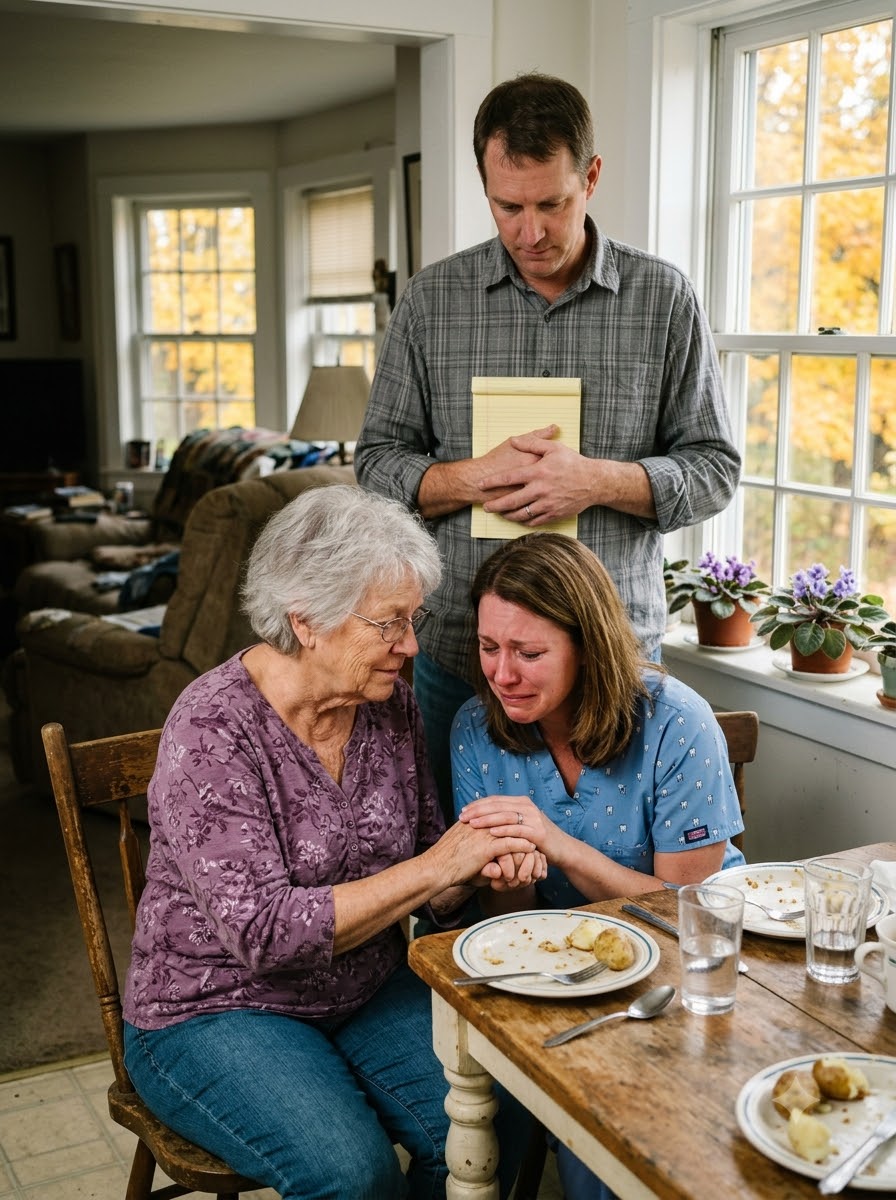
He met my eyes and held them.
“It wasn’t fair. I was plugging a hole in my boat with your Social Security check. And I knew it when I circled it. And I slid it across the table anyway, because I was scared. I’m sorry, Judy. Dale would’ve taken me out behind the machine shed.”
“Dale would have shown you how to read your own pay stub first,” I said. “Then the machine shed.”
Todd exhaled.
And suddenly, I recognized the expression I had seen on his face that first Saturday when I folded his paper and put it into my purse.
It had been shame.
He had known the arrangement was wrong even before presenting it.
I turned toward Michelle.
“And the other part,” I said. “The earning my keep.”
Her chin began trembling.
I remembered that exact expression from when she was a little girl.
“I’ve heard it in my head every night since,” she said. “I don’t know how to explain it so it doesn’t sound worse.”
“Try.”
She pressed the heel of one hand against her eye.
“I didn’t want to be taking from you. You and Dad never had anything extra. Ever. And you never once asked anybody for help. Not once. So I couldn’t just say, Mom, we’re going under, I need you. I couldn’t get my mouth to do it.”
She shook her head.
“I thought if I made it a deal, with a number, and you were paying and working and we were giving you a place, then it was even. Then nobody was begging, and nobody was charity. I thought that was the respectful way. And then it came out of my mouth. Earn your keep. To my own mother. And I heard it, and I saw your face, and I just kept going because I didn’t know how to stop.”
I reached across the table, gently moved her hand away from her eye, and held it.
“Michelle. Look at me. Who taught you that you can’t ask?”
She gave a tearful little laugh.
“You did.”
“I expect I did.”
And I knew she was right.
For thirty-one years, I had lived in a house belonging to another man, taking pride in the fact that Dale and I had never needed to ask anyone for anything extra.
Michelle had grown up watching that.
She had learned the lesson right there at the same kitchen table where we now sat.
“Well, I was wrong to,” I said. “I found that out this month. A man came to my door and asked me for help. Plain. With his cap in his hand. And it was the nicest thing anybody’s done for me since your daddy died.”
Then I pulled Todd’s legal pad closer and took my reading glasses from the pocket of my jacket.
“Todd. Hand me that pencil.”
“Judy, we didn’t come here to—”
“I know what you came for. You came to say sorry, and you’ve said it, and I’ve taken it. Now you’re sitting at a bookkeeper’s table with a set of books that don’t balance, and I’m not going to be able to sleep tonight, fans or no fans. Give me the pencil.”
He handed it over.
I studied the budget again.
I had balanced accounts for twenty-two years at the lumber yard.
I was not about to let a page full of figures defeat me now.
“Here’s what I’ll do,” I said. “And it’s what I would have done if anybody had asked me straight. Tuesdays and Thursdays. Both kids. I’ll pick Eli up from school, and Sadie’s mine all day. Here. At my house. Not yours.”
“Mom, you don’t have to—”
“I’m not through. I do it as their grandmother. That means no charge. It also means it’s my kitchen and my rules. And if I’ve got a doctor’s appointment in Kearney on a Tuesday, I tell you a week ahead and you work it out. I am not staff. And Fridays I keep Mr. Brandt’s books, and that isn’t moving.”
Todd looked surprised.
“You keep his books?”
“I do. It took a hundred and fifty dollars a month off my rent.”
I put pencil to paper.
“Now. Does the daycare have a three-day rate?”
Michelle nodded.
“Thirty-eight a day for Sadie. Twelve for Eli after school.”
I calculated the savings in the margin, just as I used to calculate board feet during my years at the lumber yard.
Two days of Sadie’s daycare and two afternoons of Eli’s care added up to one hundred dollars each week.
That was approximately $433 a month.
I crossed out the original daycare figure of $1,080.
Beside it, I wrote $647.
“That’s your three hundred and ten,” I said. “And a hundred and twenty-three to spare. Every dime of that spare goes on the furnace card until it’s dead. Not to the truck. Not to Christmas. The card.”
Todd stared down at the page.
“That’s black ink,” he said slowly.
He sounded like someone trying to understand a word he had never heard before.
“It’s thin black ink. But it’s enough to quit borrowing. And if the plant gives you your overtime back, you don’t build on it this time. You put it by.”
“Yes, ma’am.”
I laid down the pencil.
“And one more thing, and then I’ll get the pie out.”
I removed my glasses.
“I love you both. I’m not going to carry this around. But I want it understood, kindly, that I won’t be spoken to that way again. Not about keep, and not about earning. If you need me, you come to my door, and you ask me. You may be surprised how often I say yes.”
Michelle lowered her head onto her father’s old table.
Her forehead came to rest on the burn mark she had left there as a child.
And she began crying harder than she had cried at Dale’s funeral.
Todd placed his large hand gently against her back.
I went to get the pie.
The crust was store-bought, but the filling was made from apples that had grown on the Olsons’ tree.
Todd and Michelle each ate two slices.
That evening happened three weeks ago.
On the first Tuesday of our new arrangement, Sadie came walking up my front path with a backpack that looked almost bigger than she was.
She reached the porch and stopped.
“Grandma. You have a swing on your house.”
“I do.”
“Is it for me?”
“It’s for whoever’s sitting on it.”
So we sat together on the swing until her nose grew cold.
She wanted to know what each passing truck was carrying.
I answered as they went by.
Corn, corn, corn, beans, and corn.
At three o’clock, I walked to the school with Sadie’s mitten in my hand.
Eli came out through the first-grade entrance.
He spotted me waiting near the flagpole among the other mothers and grandmothers.
Then he ran.
He had not run toward me with that much excitement since he was three.
Before, I had been the grandmother who visited his house and sat in the chair in the corner.
Now, I was somewhere he could go.
That difference meant more to me than I can explain.
Then came Saturday.
Michelle had visited me after work on Wednesday.
She knocked on my door and asked, “Mom, Todd and I haven’t been anywhere, just the two of us, since before Sadie. Would you want to keep them Saturday night? You can say no.”
“I can,” I said. “I’m not going to.”
My little house did not have a guest bedroom.
Truthfully, it did not have much extra space of any kind.
So I spread every quilt I owned across the front-room floor, making a soft pallet for the children.
The top quilt was the wedding ring pattern my own mother had pieced.
I told Sadie and Eli it was a nest.
We ate pancakes for supper, because Grandma’s house is the kind of place where pancakes can be supper.
Afterward, we played Old Maid.
Eventually, Eli realized Sadie was deliberately showing him her cards.
Before bedtime, I washed two little faces at the kitchen sink.
Outside the window, the elevator glowed with its nighttime lights.
I had planned to sleep in my own bedroom, but Sadie had other ideas.
So I settled onto the couch in my housecoat and turned the lamp down low.
The children lay beside me on the floor, tucked beneath the quilts.
Outside, the grain fans kept up their familiar humming.
“Grandma,” Sadie said in the darkness.
“Go to sleep, sweet pea.”
“Is this your whole house?”
“This is the whole thing.”
She was quiet for a moment.
I could almost hear her thinking.
“I like it,” she said. “I can see you from everywhere.”
My throat tightened.
I needed a little time before I could speak.
“I can see you from everywhere too.”
“Grandma?”
Now it was Eli, propped up on one elbow.
“Mom said you were going to live in our basement, and then you didn’t want to.”
“That isn’t quite it, buddy.”
“Did you not want to live with us?”
There are questions from children that deserve especially careful answers.
That was one of them.
“I wanted to live near you,” I said. “That’s different. If I lived in your basement, I’d just be somebody in your house. Like the couch. This way, you have to come over. You come see me on purpose.”
I reached down and rested my hand against the top of his head.
“I wanted to be somebody you’d come see on purpose.”
He lay back down.
“I’d come see you on purpose,” he said. “I’d come even if you lived in the elevator.”
“Well, I couldn’t afford the elevator.”
He giggled.
Sadie giggled too, simply because her brother was laughing.
Within four minutes, both children were asleep.
I stayed awake.
Not because I could not sleep.
Because I did not want to miss a moment of it.
I lay on the couch listening to their breathing beneath my mother’s quilt.
We were all together in a house scarcely bigger than a postage stamp.
A house I had rented for myself after writing a check on the hood of my Buick.
At two in the morning, the train came through.
The glass on the windowsill rattled.
Sadie sat straight up, her hair sticking in every direction.
“It’s only the train,” I whispered. “It comes every night. It’s just going by.”
“Is it saying goodnight?”
“I believe it is.”
She climbed from her nest of quilts and crawled onto the couch beside me.
She tucked herself against my body, all elbows and knees, her cold little feet pressing against my shins.
Before the final train car passed, she had fallen asleep again.
I spoke to Dale silently, the way I often do.
I told him that he would have fixed the porch step by now.
I told him that the books balanced.
And I told him I had both grandchildren right there beside me.
I was not earning anything.
I was simply their grandmother.
Michelle arrived to collect them the following morning, before church.
Through the window above my sink, I watched her van pull up.
I was standing at the stove holding a pancake turner.
Sadie and Eli were seated at the old table in their pajamas, with syrup smeared nearly to their elbows.
Michelle walked toward the house.
She climbed the one step to the porch.
Todd had come over the previous Saturday and leveled it, just as Dale would have done.
He used a cedar shingle and the old torpedo level that had belonged to Dale, the one I had given him.
Michelle stopped outside the screen door.
The inside door stood wide open, and from where she stood, she could see all of us.
She could see her children at the table.
She could see me at the stove.
She could see the entire little house.
And even though the door was open, my daughter knocked.
“It’s open,” I called. “Come in, honey. There’s plenty.”
She entered, kissed the tops of both sticky little heads, and then kissed mine.
She took a plate from the cupboard and sat down in the fourth chair.
Beyond the window, the first grain truck of the morning rolled onto the scale.
I am sixty-seven years old.
My home has two rooms.
I have two brass keys, two grandchildren who come on Tuesdays and Thursdays, and a shoebox full of bookkeeping work every Friday.
My rent is four hundred dollars a month.
The house is small enough that I can stand in the middle and see nearly all of it.
And when my family wants to visit me, they climb one step onto my porch and knock at my door.
I always let them in.
