

Part 1 — Nine Weeks of Work and an Empty Envelope
The biggest confrontation our family ever experienced did not start with screaming, shattered dishes, or slammed doors.
It began with a silence so uncomfortable that nobody at the dinner table knew what to do with it.
My name is Francis, and I own a small production company that specializes in paranormal documentaries.
Before anyone gets the wrong idea, I do not spend my evenings fleeing abandoned hospitals because a curtain moves. I am a skeptic who makes documentaries about people who believe in ghosts.
Our assignments have taken us into historic hotels, abandoned medical facilities covered in ivy, and even a supposedly haunted miniature golf course in Ohio.
That last assignment was particularly embarrassing. Television executives insisted on it.
Admittedly, the mechanical clown at Hole 7 turned its head despite having no electrical power. I continue to maintain that a small, localized seismic disturbance was responsible.
My older brother, Martin, operates Sparkle King Car Wash.
His business consists of three excellent locations, twelve industrial-strength vacuum stations, and a level of self-confidence that is difficult to justify in a man who once reversed his pickup into his own brick mailbox while explaining the proper technique for parallel parking.
To understand what happened when my son turned sixteen, you need to understand the relationship Martin and I have had since childhood.
For forty years, we competed over practically everything.
Who could balance on bicycle handlebars longer.
Who could eat more pancakes.
Who could find the tallest Christmas tree.
Our mother encouraged the rivalry.
“Iron sharpens iron,” she would say whenever we argued over board games.
What she actually produced were two adult men incapable of opening a stubborn jar of pickles without first agreeing on competition rules.
When I got married, Martin wanted to know how much the catering cost before asking about the ceremony.
When he purchased his first colonial-style house, he sent me the square footage before sharing the address.
When one of my documentaries received a regional broadcasting award, he texted:
“Nice job. My Ultimate Poly-Shine package just won ‘Best Car Wash’ in the county.”
There were four car washes in the entire county.
One had recently burned down.
Nevertheless, Martin put his certificate in a mahogany frame and displayed it prominently in the lobby of his flagship location.
I cannot pretend I was innocent.
When Martin bought a fiberglass fishing boat, I signed up for private sailing lessons.
When he installed a pizza oven in his backyard, I purchased a commercial smoker large enough to feed a small army.
We competed over our lawns, vacations, and even Thanksgiving dinners.
His turkey featured imported truffle butter.
Mine had a bourbon glaze.
Neither bird reached a safe serving temperature before ten that night, and Mom ended up eating cold cereal at midnight.
So when Martin approached me during our mother’s sixty-fifth birthday dinner with a proposal he called “The Great Cousin Skill Exchange,” every survival instinct I possessed told me to abandon dessert and leave immediately.
Both our children were sixteen.
My son, Ethan, was quiet, intelligent, and observant.
Martin’s daughter, Chloe, had celebrated her sixteenth birthday two months earlier.
Martin tapped his crystal glass.
“The youth of today,” he announced to the table, adopting the cadence of a politician addressing a failing state, “possess absolutely zero concept of genuine labor.”
Chloe put down her spoon.
“Dad, I have a job.”
“You supervise toddlers,” Martin scoffed.
“Babysitting is labor,” she countered, her cheeks flushing.
Martin waved off her objection.
Ethan looked at me, already anticipating trouble.
“My dad makes me haul titanium camera cases through the basements of abandoned penitentiaries at three in the morning.”
My brother snorted.
“Exactly my point. Fake work.”
I carefully straightened my silverware.
“Excuse me? You believe documenting history, managing complex audio-visual equipment, and interviewing traumatized locals is fake? You spray neon-colored detergent onto Honda Civics, Martin.”
Mom clapped enthusiastically.
“Boys! Passion is wonderful. Keep that fire alive.”
Martin pointed at me.
“My enterprise provides a tangible service that society requires. The Sparkle King premium wash includes a proprietary blueberry-scented foam. The public goes rabid for the blueberry. You, Francis, sell invisible campfire stories to gullible insomniacs. At least a Toyota is a physical object you can touch.”
Chloe covered her face.
Ethan leaned toward me.
“Brace for impact.”
Martin bent forward across the table.
“Let’s settle this.”
Those three words should have been classified as a biological weapon.
“How, exactly?” I asked, already recognizing that I was walking into a trap.
“A swap,” Martin declared, looking delighted with himself. “For the duration of summer vacation, Ethan clocks in at Sparkle King. Chloe shadows your little ghost-hunting brigade. Nine consecutive weeks. Identical scheduled hours. At the end of August, we evaluate which teenager acquired more practical, real-world utility.”
He smiled.
“My girl will easily survive your spooky little hobby. And your boy might just learn how a haunted conveyor belt operates.”
“The machinery isn’t haunted,” I replied evenly. “Though your Yelp page suggests a demonic possession in the transmission alignment track last Tuesday.”
“That was a singular mechanical anomaly,” Martin hissed.
We shook hands.
Our children exchanged the resigned expressions of diplomats watching their governments declare a war neither had authorized.
Before letting go, I raised one finger.
“I have a non-negotiable condition. If Chloe works for my production company, she is an employee. I will pay her a standard wage.”
Martin laughed.
“Fine. Throw your money away. I’ll pay Ethan, obviously. It’s a business.”
We shook hands again.
I had no idea that this simple agreement would eventually threaten the reputation of everything Martin had built.
As the birthday dinner ended, my brother continued boasting about his brilliant summer experiment.
But I noticed Ethan studying what his uncle was saying with unusual concentration.
He looked as though he were working through a problem the rest of us had not yet noticed.
The summer began.
And, to my surprise, Chloe turned out to be an excellent documentary assistant.
Her first overnight assignment took place at the Bellweather Inn, an old Victorian hotel where frightened employees claimed to hear heavy footsteps along the deserted third-floor hallway.
For three hours, I trained her to organize lithium batteries, log encrypted audio, adjust infrared lenses, and stay away from our sound technician Gary whenever he had eaten burritos from a gas station.
That final instruction was especially important.
At 1:17 in the morning, a tremendous BANG came from Room 314.
Chloe froze.
Gary dropped an XLR cable.
I raised my hand, signaling everyone to remain quiet.
We waited.
The air felt heavy and metallic.
BANG.
“Uncle Francis,” Chloe whispered, her voice trembling like a plucked string. “What is the protocol?”
“The protocol,” I murmured, clicking my flashlight on, “is that we investigate.”
She took a breath and followed me toward the wooden door.
I opened it and directed the flashlight toward the window.
A decorative shutter had broken loose from its rusted hinge. Whenever the heating and cooling system switched on, the shutter struck the outside wall.
Chloe stared.
“That’s it? That’s the ghost?”
“That is usually the ghost,” I said, powering down the main camera.
“You flew a crew of six professionals to a different state because of a rusty screw?”
“Welcome to the glamorous underbelly of independent filmmaking, Chloe.”
By the third week of July, she had become invaluable.
She reorganized our cables, identified a wardrobe continuity mistake that saved us $3,000 in reshoots, and convinced an eighty-three-year-old historian to sit for a twenty-minute interview.
The historian had previously refused to speak with me because he claimed I possessed “the untrustworthy eyebrows of an IRS auditor.”
Every Friday, I paid Chloe for her documented working hours.
She received a proper paycheck, not a symbolic allowance.
When she opened her first pay envelope, she stared at the figures.
“Uncle Francis… this is a mistake. This is too much.”
“It is the exact mathematical sum we agreed upon, minus standard tax withholdings,” I replied, sipping my coffee.
“But Dad explicitly said this entire summer was supposed to be strictly educational.”
“It is highly educational,” I smiled. “Lesson one of adulthood: When you surrender your finite time and labor to an enterprise, that enterprise compensates you. Never let a title replace a paycheck.”
She examined the numbers again.
Then she smiled.
“Can lesson two involve upgrading the snacks at craft services?”
“I’ll see what the budget allows.”
Meanwhile, Ethan was learning what life at Sparkle King was really like.
His shifts began at seven each morning.
He spent nine weeks scrubbing tires, cleaning bug-covered bumpers, clearing vacuum filters, carrying heavy hoses, and emptying overflowing trash bins in the summer heat.
He also dealt with angry customers whenever the payment kiosk malfunctioned.
Every evening, he returned home smelling of hot rubber, degreaser, and artificial blueberries.
“How are you holding up?” I asked after his first exhausting week.
“It’s fine,” he replied, staring blankly at the kitchen wall.
“Is your Uncle Martin behaving himself?”
“Uncle Martin is being Uncle Martin.”
That was not reassurance.
It was a medical diagnosis.
By the second week, Ethan’s forearms were badly sunburned.
During week three, a license-plate frame cut his knuckles.
By the fourth week, he understood the conveyor equipment well enough to recognize a failing roller bearing by its squeak.
He identified the problem before Martin noticed, preventing a breakdown.
My brother called that evening.
“I gotta admit, Francis,” he shouted over the roar of water in the background, “the kid isn’t totally useless. He’s got an ear for the machinery.”
Coming from Martin, that was remarkable praise.
“I’m glad he’s adapting,” I said. “He gets his work ethic from our side of the family.”
“He is our side of the family, you idiot.”
“You know exactly what I mean.”
Unfortunately, he did.
Around that time, Martin decided our experiment needed an official scoreboard.
He installed an enormous whiteboard in the employee breakroom.
Across the top, he wrote:
FRANCIS VS. MARTIN: REAL WORLD COMBAT EDITION.
Chloe’s name appeared under mine.
Ethan’s appeared under his.
Martin assigned points according to rules he seemed to invent as he went.
Perfect tire shine earned three points.
Clearing a clogged drain earned five.
Carrying a tripod for my film crew earned one.
Distinguishing raccoon sounds from a Class-Three Poltergeist earned zero.
Beside that last category, he wrote: Demons are a hoax.
When Chloe sent me a photograph, my competitive instincts returned immediately.
I installed my own scoreboard in the production office.
Chloe earned ten points for independently attaching a microphone, twenty for synchronizing four cameras, and fifty for entering a basement alone after Gary claimed a ghost had whispered his name and suddenly remembered he had “a bad knee.”
Martin texted almost immediately.
“You cannot legally award 50 points for walking down a flight of stairs!”
I replied:
“The stairs were structurally compromised by dark energy.”
He answered:
“Prove it.”
I sent him a photograph of Gary hiding behind Chloe.
Martin conceded.
By the seventh week, neither teenager cared about the competition anymore.
Their fathers, however, remained completely invested.
Then, during week eight, Chloe mentioned something that made me uneasy.
We were in the editing bay reviewing expense receipts when she said:
“Dad says Ethan is going to get a massive surprise at the end of next week.”
I stopped working.
“What manner of surprise? Did he specify?”
She shrugged.
“He wouldn’t say. Maybe a performance bonus?”
“A bonus?”
“He just kept laughing and saying Ethan was going to receive a lesson he would remember until the day he died.”
I knew my brother’s idea of teaching lessons.
When I was eleven, he beat me in a race and made me wear a cardboard medal during Sunday dinner.
It read “Second Place is Just the First Loser.”
Mom took a photograph for the family album.
That evening, I approached Ethan in the kitchen.
“Has your uncle discussed your final compensation package with you?”
He filled a glass with water.
“No.”
“You’ve been meticulously logging your hours in the scheduling app every single shift, correct?”
“Yes. And on physical timecards. He loves his vintage punch clock.”
“Excellent.”
I studied his face.
“Look at me.”
Ethan sighed.
“Dad.”
“Yes?”
“Do not intervene.”
“I have no intention of intervening.”
“You are currently wearing your ‘I am going to call Uncle Martin and start a thermonuclear war’ face.”

“I possess a face for all occasions.”
“You possess three faces, Dad. That was definitely number two.”
I raised both hands.
“I promise. I will remain a neutral party.”
I regretted that promise almost immediately.
But Ethan was sixteen, and I understood that he needed the opportunity to defend himself.
What I did not realize was that he had already started preparing something far more effective than anything I could have said.
The nine weeks ended.
Our family gathered for Sunday dinner at Mom’s house.
Martin arrived wearing an immaculate neon-blue Sparkle King polo shirt, even though he had not worked that day.
He carried two thick, cream-colored envelopes.
After an uncomfortable meal of roasted lamb, the dessert plates were cleared away.
Martin pushed back his chair.
“I believe,” he began, adopting the solemnity of a judge delivering a verdict, “that our little summer experiment has empirically proven my original thesis.”
“Oh, merciful God,” Chloe muttered into her water glass.
Mom smiled.
“It was such a visionary idea, Martin. Look how much they’ve grown!”
Martin began pacing behind the table.
“Chloe learned that the realm of fantasy filmmaking isn’t entirely devoid of logistical value.”
“Your praise is overwhelming,” I said dryly.
“And Ethan,” Martin pivoted, locking eyes with my son, “finally learned what the unforgiving landscape of real, back-breaking work looks like.”
“I certainly learned how to chemically strip brake dust off a rims of three hundred minivans,” Ethan replied smoothly.
Martin laughed and handed Chloe the first envelope.
Inside was an elaborate gold-bordered certificate.
It read:
Sparkle King Summer Skill Challenge: Participant.
She stared at it.
“Dad. I never worked a single day at the car wash.”
“It is a symbolic gesture, sweetie,” Martin proclaimed.
“Symbolic of what, exactly?”
He hesitated.
“Of… family legacy.”
Chloe looked toward me helplessly.
Ethan was staring down at his water glass, apparently fighting a smile.
His calmness made me nervous.
Martin approached him.
“And here is your reward, champ. You earned it.”
He dropped the second envelope onto Ethan’s plate.
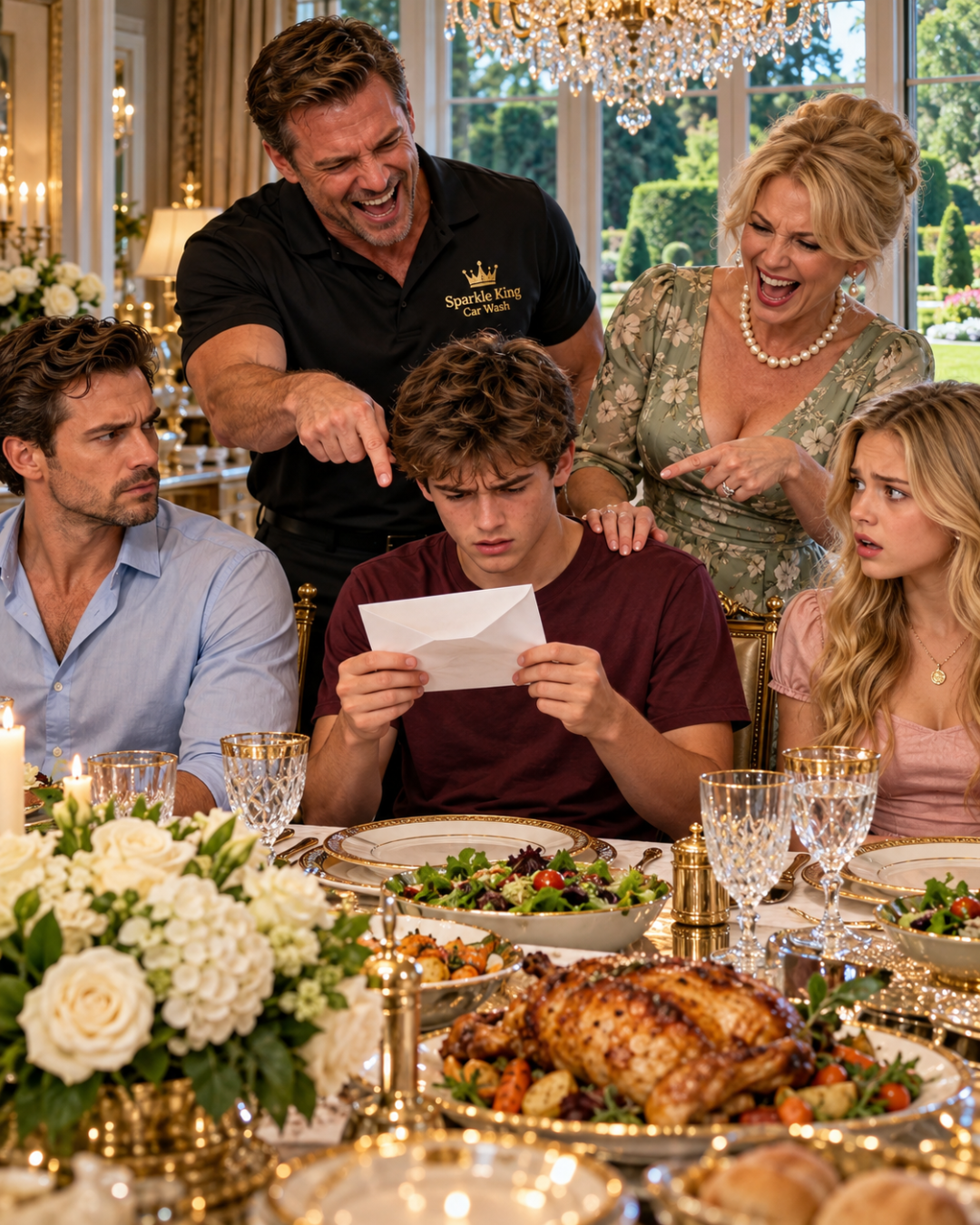
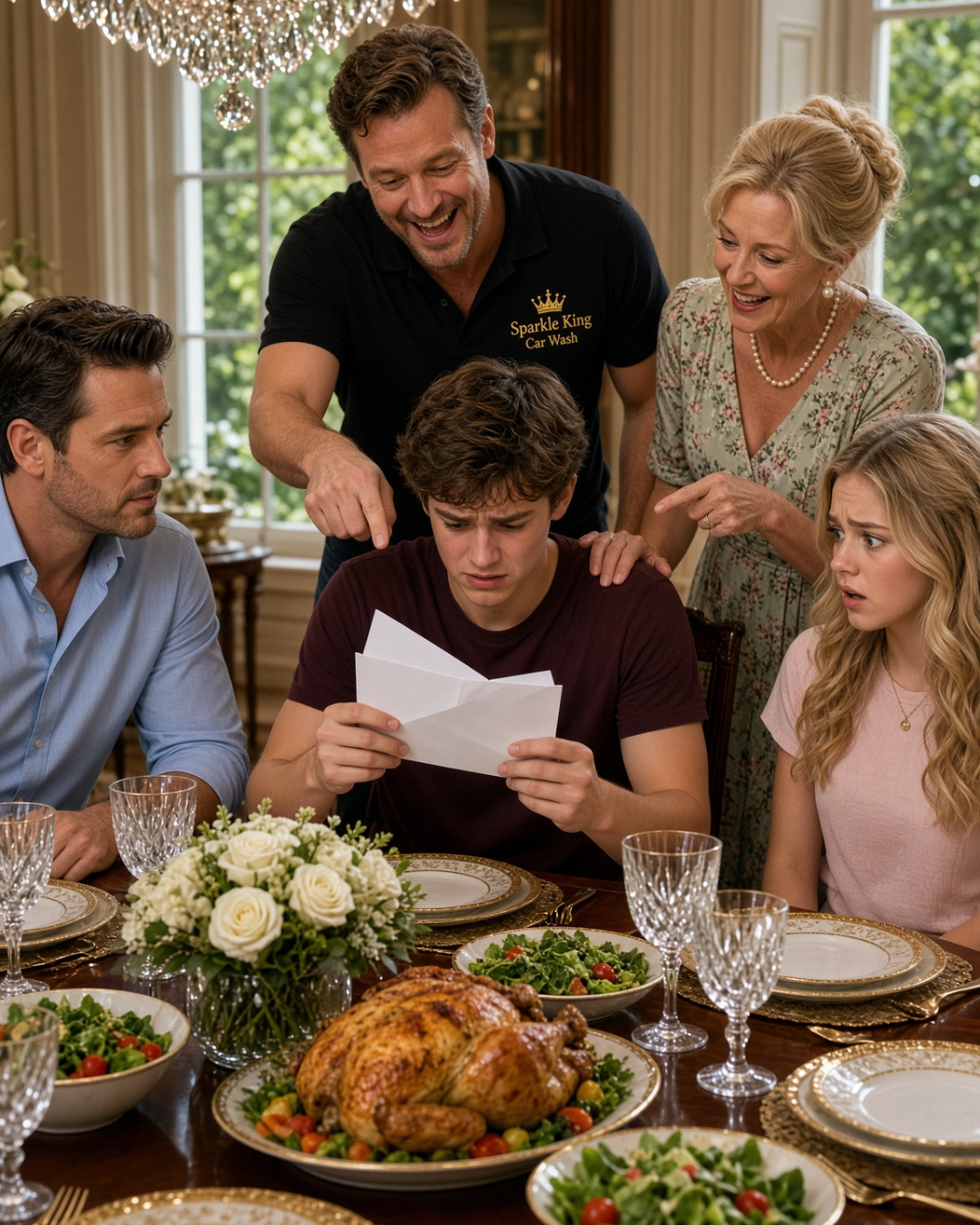
The room went quiet.
My son carefully opened the flap.
He looked inside.
Then he tilted the envelope, examined the corners, and flattened it against the table.
There was nothing in it.
“Uncle Martin,” Ethan said, his voice entirely devoid of inflection. “There is no check in here.”
Martin folded his arms.
He was grinning.
“You received something infinitely more valuable than taxable income, kid.”
“Did I?”
“You received a family experience. You received character.”
Martin burst into exaggerated laughter.
Mom joined him.
“He’s right, Ethan,” she chimed in, entirely blind to the cruelty. “You should be profoundly grateful. Your uncle took you under his wing. He taught you the mechanics of the real world.”
Anger rushed through me.
I planted my hands on the table, ready to say everything I had been holding back for forty years.
Then something struck my ankle beneath the table.
Ethan had tapped me sharply with his foot.
I looked at him.
He gave the smallest shake of his head.
Don’t interfere.
I swallowed my anger.
Martin continued, enjoying himself.
“That is the fundamental difference between our philosophies, Francis. I prepare them for reality. You throw discretionary funds around, coddling them, pretending every participant deserves a financial prize.”
Chloe looked up immediately.
“Wait. Dad. Uncle Francis didn’t throw money around. He paid me an hourly wage.”
Martin’s smile disappeared.
“What did you say?”
“He paid me. Every single Friday.”
Mom looked astonished.
“You put her on payroll? Francis, she’s family!”
Martin turned toward me.
“How much did you pay her?”
“That is strictly between my production company and its contracted employees,” I said, my voice glacial.
“How much, Chloe?” Martin demanded.
She told him her hourly rate and the overtime she had earned.
Martin looked horrified.
“You paid a sixteen-year-old girl more than the state minimum wage?”
“She was exceptionally competent,” I replied.
“You did this deliberately,” Martin sneered, his finger trembling as he pointed at me. “You orchestrated this entire thing just to make me look like a cheapskate!”
“No, Martin,” I said softly. “I believe your reputation as a cheapskate is a completely independent, self-funded project.”
Ethan disguised his laughter with a cough.
Martin slammed his hand against the table.
“This is classic! This is exactly what you always do! Every single thing in this family has to be a twisted competition to you!”
Even Mom fell silent at that.
“That,” I whispered, “is the most astonishing sentence I have ever heard a human being speak.”
Martin shoved back his chair.
“Whatever. The point stands. Ethan learned more grit and resilience in the mud with me than Chloe learned chasing invisible boogeymen with microphones.”
Ethan folded his empty envelope into a small, neat square.
“Are you alright with this?” I asked him.
“I’m perfectly fine,” Ethan said.
“Do you require my assistance in handling this matter?”
“Nope. I’ve got it.”
Martin laughed uneasily.
“See? The kid understands the chain of command.”
Ethan slipped the folded envelope into his pocket.
Then he stood.
“Thank you for the wonderful roast, Grandma. Would you like me to help clear the dishes?”
We drove home without speaking much.
Three separate times, I offered to confront Martin.
Three times, Ethan declined.
At 9:30 that night, I passed my son’s bedroom.
The door was partly open.
He was typing rapidly on his laptop.
“What are you working on?” I asked from the doorway.
“Homework.”
“It is the second week of August. You don’t have school.”
“It’s life homework, Dad.”
I should have recognized the significance of that answer.
Quiet people are often the ones who have been keeping the most careful records.
And by Wednesday afternoon, I was about to discover exactly what my son had been writing.
Part 2 — The Google Review That Changed Everything
Monday passed without incident.
Tuesday was just as uneventful.
Then Wednesday afternoon, Chloe called while I was reviewing documentary footage.
She was laughing so hard that I could barely understand her.
“Uncle Francis!” she gasped, sounding genuinely unhinged.
“Chloe? Are you hyperventilating?”
“Have you… have you checked Dad’s Google Business page today?”
I opened the listing for Sparkle King’s main location.
At the very top, above years of customer reviews, was a new one-star rating.
The author was Ethan.
My pulse quickened as I began reading.
“I was employed at this establishment for a duration of nine weeks, from June 8th through August 7th. I am sixteen years old. My total recorded and verified time on site was 212 hours and 24 minutes. My total wages received for this labor amounted to exactly $0.00.”
I lowered myself into my chair.
The review continued with an organized record of his weekly hours.
He listed his clock-in and clock-out times, the vacuum canisters he cleaned, the conveyor alignment adjustments he helped perform, the wheels he scrubbed, and the shifts he worked without adult employees present when others called in sick.
There was no name-calling.
No exaggerated accusation.
Only a precise account of the work he had performed.
Then I reached the next paragraph.
“When the time came for final compensation, management handed me an empty paper envelope and described my payment as a ‘family experience.’ I cannot personally confirm whether ‘family experience’ can be deposited into a checking account, because the mobile application for my bank does not currently support that feature.”
I started laughing.
I laughed so hard that I knocked a stack of DVDs from my desk.
My sleeping cat jumped.
But Ethan had not finished.
“Despite the lack of financial compensation, I did acquire several critical life lessons. For example: industrial tire shine should never be atomized against a strong headwind. Patrons become highly combative when the payment kiosk is trapped on the ‘Processing’ screen for twelve uninterrupted minutes. And finally, if your employer laughs in your face while handing you an empty envelope for 212 hours of manual labor, you should always ensure you kept your own meticulous time records.”
Below the text, he had uploaded photographs.
There were weekly schedules.
Physical timecards.
A picture of the empty envelope lying on Grandma’s floral dinner plate.
And a photograph of Martin’s enormous scoreboard.
FRANCIS VS. MARTIN: REAL WORLD COMBAT EDITION.
Under Ethan’s name were dozens of completed assignments written in Martin’s own handwriting.
The review ended:
“The washing mechanism itself functions adequately. The adult employees are deeply sympathetic. I would recommend the Basic Wash package. I would heavily advise against applying for the Unpaid Nephew position.”
It had been online for approximately sixteen hours.
Already, 312 people had marked it helpful.
The comments were brutal.
One person wrote:
“The ‘Unpaid Nephew’ package sounds like a human rights violation.”
Another asked:
“Does the ‘Family Experience’ include the undercarriage rust inhibitor?”
Someone else wondered whether character-building could be exchanged for a pine-scented air freshener.
By noon, it was the most-engaged review in the county.
At one, screenshots appeared in a local Facebook neighborhood group.

By two, Sparkle King had quietly changed its longtime slogan.
The original read:
“We Treat Your Car Like Family.”
The replacement said:
“Locally Owned Since 2009.”
Apparently, Martin had discovered that the word family was no longer helping his public image.
At 2:17, my phone rang.
Martin.
I answered cheerfully.
“Good afternoon, Sparkle—”
“Take it down,” he snarled, bypassing any greeting.
“Take what down, brother?” I asked, feigning utter innocence.
“Do not play games with me, Francis. You know exactly what I am talking about. The review.”
“I genuinely have no jurisdiction over the internet.”
“You ordered him to write it!” he shouted, his voice cracking with panic.
“I did no such thing.”
“You helped him draft it! It reads like one of your pretentious documentary scripts!”
“I assure you, I was completely blind to its existence until your own daughter called me, weeping with laughter, to inform me.”
He stopped.
“Wait. Chloe called you?”
“She did.”
“Why the hell is my own flesh and blood laughing at my destruction?”
“I couldn’t say, Martin. Perhaps it’s a symptom of ‘Family Experience’?”
He made a strangled sound.
“This is annihilating my digital footprint! My rating has dropped an entire star in four hours!”
“Is there a single factual inaccuracy in the text he posted?” I asked calmly.
“That is entirely beside the point!”
“It is the only point, Martin.”
“He is my nephew! He was an intern! He was learning the ropes!”
“Chloe was learning the ropes. I still compensated her for her labor.”
“You only paid her to humiliate me on the scoreboard!” he screamed.
“While spite may have marginally increased my enthusiasm to sign the checks, it did not invent the concept of wage laws.”
Martin hung up.
At four that afternoon, Mom called.
“Francis, you must force Ethan to delete that internet post immediately.”
“No.”
“Martin is having a nervous breakdown in his office. He is humiliated.”
“Ethan scrubbed tires in the summer heat for nine weeks for zero dollars. The humiliation is earned.”
“He is sixteen years old!” she pleaded. “He doesn’t have a mortgage! He doesn’t have overhead expenses! Martin gave him an invaluable life experience.”
I turned toward my office window.
“Mom, that is a fundamental misunderstanding of capitalism. If Martin believes experience is a valid currency, I suggest he attempt to pay his commercial property taxes with it.”
“He was just trying to teach the boy a lesson about reality!”
“He succeeded brilliantly,” I said, unable to hide my pride.
“What did he teach him?”
“He taught him the devastating power of documentation.”
By Thursday, the situation had grown beyond Ethan’s review.
Two former teenage employees found the post and began sharing their own experiences.
One described unpaid Saturday training sessions.
Another claimed employees were required to finish cleanup duties after clocking out.
A mother involved with the local PTA shared the story and asked:
“Did anyone else’s teenager work here this summer?”
Numerous families responded.
By Thursday evening, Ethan’s review had accumulated more than six hundred helpful votes.
Martin called my son directly.
I happened to be standing near the kitchen island when Ethan answered and placed the call on speakerphone.
“Buddy,” Martin began.
His voice sounded completely different from the confident man who had handed Ethan the empty envelope.
“Listen, this whole thing has gotten massively out of hand.”
Ethan continued stirring his cereal.
“I simply documented the events of the summer, Uncle Martin.”
“You painted a picture that makes me look like some kind of sweatshop operator! You made me look like I exploit children!”
“I wrote exactly what happened.”
“You don’t understand the nuances of running a small business, Ethan.”
“I understand the nuance of the number zero,” my son replied.
Martin fell silent.
Then he tried a friendlier tone.
“Listen,” Martin said, adopting a tone of false camaraderie, “I was always going to make it up to you. You know that, right? The empty envelope was just… a temporary gag. A joke.”
I retreated into the pantry before I said something that would break my promise not to interfere.
Martin lowered his voice.
“Take the review down,” Martin whispered, dropping the act. “Delete it tonight, and I will personally hand you five hundred dollars in cash tomorrow morning.”
Ethan stopped stirring.
“You are offering me five hundred dollars for 212 hours of labor?”
“It’s a gesture of good faith!”
“That equates to roughly two dollars and thirty-five cents an hour. I cannot purchase gasoline with a gesture.”
Martin inhaled sharply.
“What do you want, kid? Name it.”
“I want my legally accrued wages.”
“You’re being incredibly difficult.”
“No, Uncle Martin. I am being incredibly specific.”
Then Ethan said something I will remember for the rest of my life.
“I didn’t ask my dad to fight my battles,” Ethan said into the speaker. “I didn’t complain to Grandma. I didn’t whine to Chloe. I performed the labor you assigned me. You made a conscious decision not to pay me, and then you chose to mock me in front of my family. I wrote the objective truth on the internet. If you want the review to stop being true, that is entirely your problem to solve.”
He ended the call.
I emerged from the pantry.
Ethan went back to eating cereal.
“You,” I said, my voice thick with emotion, “have been waiting your entire adolescence to deliver a speech like that, haven’t you?”
He smiled.
“Pretty much.”
By Friday morning, Martin had apparently abandoned every reasonable strategy for handling a public relations crisis.
A sensible business owner facing allegations of unpaid wages would have consulted an accountant or attorney.
My brother decided to call a radio station.
At 8:10 that morning, a sponsored advertisement aired on a local Top-40 station.
At the same time, Sparkle King posted an announcement across its social media accounts.
SPARKLE KING’S ULTIMATE FAMILY WORKDAY!
Come down and witness what REAL WORK looks like!
Free Deluxe Washes for the community from 10:00 AM to 12:00 PM!
He tagged my company page.
Then he tagged my personal account.
Underneath, he added:
“Hey Francis, bring your cameras. Let’s settle this like men.”
I stared at my screen.
My production manager, Lena, approached carrying her black tea.
“Are we legally obligated to go to this?” she asked.
“No.”
She looked at my expression.
“Are we going anyway?”
I sighed.
“We are absolutely going. Grab the 4K rig.”
By ten, Sparkle King looked like a county fair that had gotten out of control.
Martin had rented a giant blue-and-gold balloon arch.
A DJ was playing dance music from the early 2000s.
Boxes of glazed donuts sat melting in the summer heat.
A huge banner stretched above the entrance.
REAL JOBS. REAL RESULTS.
The line of cars waiting for free washes extended three blocks.
But not everyone had come to get their vehicle cleaned.
Plenty had read the Facebook discussion and were there to watch the spectacle.
A teenager standing beside a Honda Civic wore a homemade shirt.
I ACCEPT MY SALARY IN CHARACTER.
Martin spotted it.
A vein began pulsing near his temple.
I had brought a handheld camera.
Chloe arrived on her bicycle carrying the professional DSLR I had trained her to operate.
Martin immediately approached her.
“Why are you holding that equipment? Put that away!”
Chloe adjusted the lens.
“I’m just securing some educational experience, Dad.”
I turned away before my smile became too obvious.
The DJ increased the volume.
Martin took the microphone and began delivering a speech about the importance of hard work.
Then an unmarked gray sedan entered the VIP detailing area.
A man and woman, both apparently in their late forties, stepped out.
They wore formal trousers and carried clipboards and a tablet.
Unlike the other visitors, they did not seem interested in free donuts.
The woman walked straight toward the DJ booth.
“Are you Martin Bell?” she asked, speaking loudly enough to be heard over the music.
“I am,” Martin said brightly, straightening his shoulders. “Welcome to the family!”
She did not smile.
Instead, she opened a leather folder.
She introduced herself and her colleague as senior investigators from the State Department of Labor and Wage Enforcement.
I watched Martin’s confidence vanish.
At that exact moment, the DJ switched songs.
Bachman-Turner Overdrive’s “Takin’ Care of Business” began playing.
I had absolutely nothing to do with that choice.
The timing was simply extraordinary.
Martin turned toward me.
“You,” he hissed. “You called them.”
“I did no such thing,” I replied smoothly.
Ethan stepped forward from the donut table.
“I didn’t call them either.”
The investigator adjusted her glasses.
“We do not operate solely on phone calls, Mr. Bell. We received multiple digital complaints, and our office opened an inquiry after a highly publicized online review prompted several of your former employees to file formal grievances regarding unpaid wages.”
Martin stared at Ethan.
My son gave a small shrug.
“I left a review.”
The male investigator tapped his tablet.
“We are going to require immediate access to your employee time records, payroll logs, and scheduling archives for the past thirty-six months.”
Martin looked devastated.
And suddenly, I recognized the full irony of what was happening.
My brother had been obsessed with documenting the summer competition.
He had preserved Ethan’s shifts in the scheduling system.
He had physical punch cards.
High-definition security footage.
And an enormous scoreboard recording the tasks Ethan had completed.
Martin had wanted evidence that his teenager could outperform mine.
Instead, he had created a remarkably thorough record of unpaid labor.
I exchanged a glance with Chloe.
Neither of us spoke.
“Regarding the specific complaint outlined by the minor,” the investigator continued, “do you possess records indicating Ethan Bell’s clocked hours?”
Martin swallowed.
“He… he wasn’t technically classified as an employee. It was an internship. An exchange.”
The male investigator looked through the breakroom window.
He stopped walking.
Then he raised his pen.
“What,” the investigator asked, his voice echoing over the music, “is that?”
Martin turned.
Inside the breakroom stood the giant whiteboard.
ETHAN: 212 HOURS.
Below it were dozens of recorded manual tasks.
Martin stared.
“Oh,” he whispered.
The DJ, apparently unaware of the situation, shouted into his microphone:
“WHO WANTS A FREE TIRE SHINE?!”
Nobody answered.
And the investigators had not even begun examining the payroll records.
Part 3 — The Labor Board, the Back Pay, and the Final Score
The investigator approached the breakroom window.
“Mr. Bell, what exactly does the figure ‘212 hours’ refer to under this minor’s name?”
Martin opened his mouth.
Closed it.
Then tried again.
“Family experience.”
The investigator looked at him without the slightest amusement.
He entered something into his tablet.
I sat down on an overturned bucket of industrial wax.
I was beginning to feel as though I had wandered into one of my own documentaries, except the supernatural activity had been replaced by my brother’s spectacular inability to stop making things worse.
Then the car wash alarm sounded.
WEE-OOO! WEE-OOO!
Inside the automatic tunnel, a silver Honda Odyssey had slipped off the conveyor track.
The teenage operator responsible for monitoring the equipment had abandoned his station to watch the investigation through the window.
Blueberry-scented foam continued pouring over the stranded minivan.
Its driver leaned on the horn.
The DJ panicked and increased the music volume.
“TAKIN’ CARE OF BUSINESS” thundered across the parking lot.
A sudden gust of wind knocked a twenty-foot inflatable tube man across one of the vacuum stations.
Its fabric arms became tangled around a customer’s legs.
Near the refreshments table, a toddler stuffed six glazed donuts into his shirt and ran toward the street.
Martin turned toward the malfunctioning tunnel.
“Mr. Bell,” the female investigator snapped, her voice cracking like a whip. “We are not finished here.”
He stopped.
On one side stood the investigators.
On the other was a minivan disappearing beneath a mountain of blue foam.
The horn continued blaring.
The DJ shouted:
“WE HAVE A CODE RED IN THE TUNNEL!”
Chloe stood on a concrete parking block, filming.
Ethan watched beside her with both hands in his pockets.
I had spent two decades recording supposedly haunted buildings.
I had listened to stories about Victorian ghosts and explored dark corridors in abandoned institutions.
Yet nothing in my professional experience compared to watching Martin attempt to handle six disasters at once, each resulting from a decision he had made himself.
Then Mom arrived.
She appeared without warning, wearing tennis shoes and the expression of a woman fully prepared to restore order through maternal authority.
She hurried across the wet pavement, pushing aside part of the collapsed inflatable.
“What in the name of God is going on here?” she demanded, swatting away the flailing arm of the collapsed tube man.
Martin pointed at Ethan.
“His review! His review brought the feds down on me!”
Mom marched toward my son.
“You need to fix this immediately, young man. Tell them it was a misunderstanding.”
Ethan remained perfectly composed.
“I cannot fix it, Grandma.”
“You can take your little phone out and delete that nasty internet post right now!”
“Deleting the post,” Ethan explained softly, “does not delete the hours I worked. Nor does it rewrite labor law.”
Mom blinked.
For the first time, I saw her beginning to understand.
I looked away toward a puddle of soap, giving her a moment to absorb what he had said.
The male investigator returned.
“We will be requesting full payroll disclosures for the previous three quarters. We also need to speak privately with any current employees regarding off-the-clock compensation.”
Near the towel-drying station, a tall, thin teenager raised his hand.
“Um, excuse me? Should I tell you guys about the mandatory Sunday setup stuff?”
Martin spun toward him.
“NO, KEVIN!” he roared.
The investigator immediately looked at the teenager.
“What mandatory Sunday setup?”
Kevin slowly lowered his hand.
“Oh. Never mind.”
Martin closed his eyes and tipped his face toward the sky.
Behind him, another gust of wind tore loose the fasteners on one side of his promotional banner.
The vinyl folded over itself.
Most of the slogan disappeared.
Only two words remained visible.
JOBS. RESULTS.
Under the circumstances, I thought they were remarkably appropriate.
The Department of Labor did not close Sparkle King that afternoon.
Actual investigations do not conclude as conveniently as scenes in television dramas.
Instead, the officials began a comprehensive audit.
They obtained hard drives and reviewed records.
They interviewed twelve frightened teenagers.

And they uncovered a pattern of unpaid preparation time and training hours that extended well beyond Ethan’s nine weeks.
Martin had to calculate and distribute substantial back wages.
He also faced significant penalties.
He hired an independent payroll management company to correct his business practices.
The state required him to attend a two-day managerial compliance seminar in a windowless hotel conference room.
I suspect that particular punishment damaged his pride more than the financial penalties.
Six weeks later, autumn had arrived.
Ethan received a certified letter.
Inside was a watermarked check.
It was not a gift.
It was not a favor from me.
And it had not been obtained because anyone threatened Martin.
The payment came directly from Sparkle King’s corporate accounts.
It covered Ethan’s documented hours and all applicable overtime.
That evening, Martin drove to our house unexpectedly.
He carried the final ledger.
Ethan stood beside me when I opened the door.
My brother looked exhausted.
The competitive energy he usually carried had been replaced by the weary expression of a man who had spent weeks dealing with legal paperwork.
He handed the documents to Ethan.
“There it is. Signed and cleared.”
Ethan examined the amount.
“Thank you, Uncle Martin.”
Martin avoided looking at me.
“Are you happy now, Francis?” he muttered.
I leaned against the doorframe.
“This wasn’t my war to win, Martin.”
His jaw tightened.
He knew I was right.
For years, Martin and I had competed over money, intelligence, professional accomplishments, and which of our children was tougher.
But Ethan had approached the problem differently.
He had not shouted.
He had not demanded revenge.
He had not asked me to fight for him.
He had recorded what happened and allowed the evidence to speak for itself.
Martin looked at my son again.
“You really didn’t ask your dad to help you write that thing?”
“No,” Ethan said.
“You orchestrated that entire digital nightmare by yourself?”
“Yes.”
Martin rubbed his face.
“That line about the bank app… that was pretty ruthless.”
Ethan smiled.
“I appreciate that.”
I tightened my grip on the door handle to keep from laughing.
That was the nearest Martin had come to admitting defeat since the winter of 1994.
Naturally, our family did not become completely different overnight.
Martin was still Martin.
Two months after the audit, he sent me a photograph of Sparkle King’s new automated license-plate recognition system.
The caption read:
“Bet your little ghost cameras can’t run algorithms like this.”
I responded with a high-definition image from our latest documentary.
It appeared to show a remarkably clear, translucent human figure standing at the far end of an abandoned asylum corridor.
Martin replied:
“It’s just a janitor.”
I answered:
“He died of tuberculosis in 1978.”
Martin did not respond for three hours.
I counted that as a victory.
Chloe continued assisting my production crew on weekends.
She received her full hourly wage.
Recently, she began investigating university programs in filmmaking and cinematography.
Martin now proudly claims that her interest in the industry was his idea because he invented the “Skill Exchange.”
I let him have that one.
Life is short.
And I am tired.
Ethan used his entire back-pay settlement to buy a dependable used sedan.
The day after purchasing it, he drove to Sparkle King’s main location.
Martin came outside and walked around the vehicle.
He kicked the front-left tire and nodded approvingly.
“You know,” my brother said, “immediate family members are entitled to free washes.”
Ethan looked directly at him.
“Free?”
Martin froze.
The color drained from his face.
Chloe, who was cleaning a dashboard nearby, began laughing.
I joined her.
Then Ethan laughed too.
Eventually, even Martin managed a reluctant chuckle.
“Fine,” he grumbled, waving us away. “Poor choice of vocabulary.”
Mom still believes the disagreement should never have become so public.
Once, she privately told Ethan he ought to have handled the problem behind closed doors.
He simply asked:
“You mean, like my private paycheck?”
She has not raised the subject again.
Ethan’s original Google review is still online.
Martin has awkwardly asked him twice whether he intends to delete it now that the wages have been paid.
Ethan told him he would update the review to reflect the outcome.
And he did.
“UPDATE: Following a comprehensive investigation by the Department of Labor, I have received full financial restitution for my hours. Management has aggressively restructured its payroll practices. My uncle also experiences visible physical discomfort whenever someone utters the word ‘experience’ in his presence. The car wash service remains excellent. Avoid visiting on Saturdays unless you enjoy witnessing family trauma.”
The update attracted another four hundred helpful votes.
Ironically, Sparkle King eventually recovered completely.
Its quarterly revenue even increased.
Apparently, customers appreciated a company that corrected its payroll problems, acknowledged its mistakes, and continued delivering excellent washes with blueberry-scented foam.
Martin despises the fact that the review which nearly ruined his reputation now attracts curious customers.
I find the irony delightful.
Our lifelong rivalry continues, of course.
I suspect we will keep competing until one of us dies.
At that point, the survivor will probably boast about having lived longer.
But there is one subject Martin no longer challenges me on.
Parenting.
That Christmas, our family gathered around a table overflowing with food.
A fire burned nearby, and the events of summer seemed comfortably distant.
Naturally, Mom could not resist bringing up the competition.
She raised her wine glass.
“So, looking back, who do we think truly won the Great Cousin Skill Exchange?”
Martin and I immediately prepared our arguments.
Before either of us could speak, Ethan raised one hand.
The entire table went quiet.
“Chloe earned a substantial wage and discovered a passion for documentary production,” Ethan said clearly to the table. “I learned the intricate mechanics of a car wash, the nuances of federal labor law, and the devastating art of digital reputation management. Therefore, I would confidently state that the youth won.”
Chloe lifted her glass of sparkling cider.
“I also learned to never, under any circumstances, engage in labor for my father without a notarized contract.”
Martin pointed his fork at her.
“You are getting way too comfortable in my house, young lady.”
She grinned.
“Uncle Francis pays me enough to afford my own confidence.”
I laughed so hard that I spilled red wine down my shirt.
Martin looked from me to Chloe, then Ethan, then Mom.
For a moment, I thought he might overturn the table and declare the competition open again.
Instead, he reached for the mashed potatoes.
“Fine,” he muttered, aggressively spooning potatoes onto his plate. “The kids won.”
Everyone fell silent.
I stared at him.
“Did you… did you just publicly admit defeat?”
“No,” he snapped.
“You absolutely did,” I pressed, leaning forward. “You said the kids won. Which logically dictates that you lost. And by extension, I lost as well. I am fully prepared to share second place with you, Martin, if you are capable of the humility.”
His eyes narrowed.
“There is no such thing as a shared second place, Francis.”
And just like that, our temporary peace ended.
By dessert, Martin and I had developed an unnecessarily complicated scoring system to determine whose wife had made the better Christmas cookies.
Mom applauded.
She called it “the spirit of healthy competition.”
While we argued over frosting consistency, I noticed Ethan quietly taking out his phone.
“What are you doing over there?” I whispered to him.
He looked up.
A small smile appeared.
“I’m just documenting.”
Across the table, Martin immediately dropped his cookie.
He glanced toward the windows as though a SWAT team might appear outside.
And that was when I realized my sixteen-year-old son had discovered something more powerful than money, pride, ghost stories, or two grown brothers determined to defeat each other.
Receipts.
Always, always keep the receipts.
