

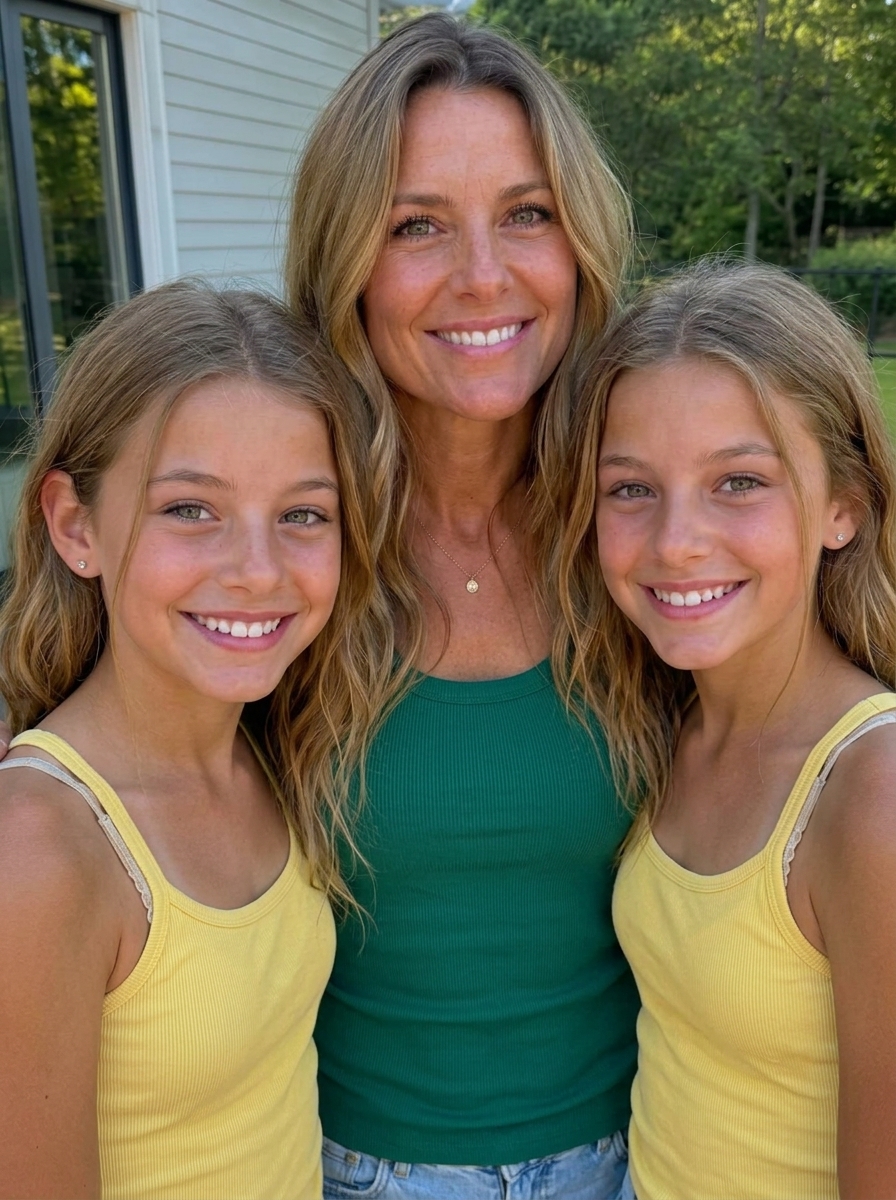
One year after Maya disappeared at summer camp, I found her old shoebox hidden beneath her twin sister’s bed and called the police before I even understood what I had uncovered. I thought I had found evidence explaining Maya’s disappearance. Instead, I discovered that the daughter still living with me was quietly disappearing before my eyes.
The shoebox didn’t explain what happened to my missing daughter.
It exposed what had been happening to the daughter who was still in my home.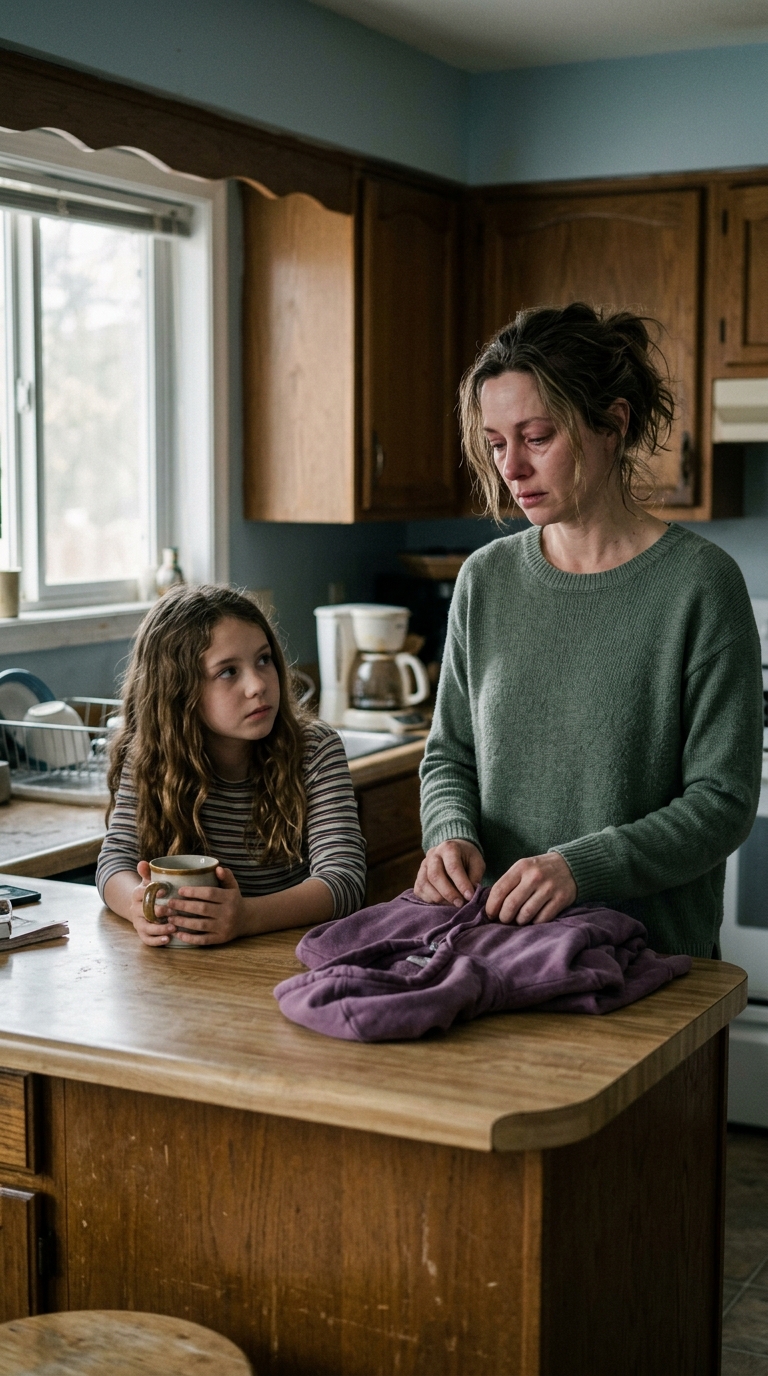
And when I finally understood the difference, forgiving myself felt nearly impossible.
That shoebox should have been my warning.
At forty-one, I had spent an entire year learning one brutal truth.
A missing child never truly leaves the house.
She remains in the second toothbrush still standing in the bathroom cup.
She lingers in the empty breakfast chair by the window.
She lives inside the purple hoodie I kept washing because I was terrified the scent of lake water would someday disappear forever.
I washed it again that morning.
And I overlooked what truly mattered.
Sophie walked into the kitchen and quietly watched me fold it, wearing the same cautious expression she had carried all year.
Not like a daughter watching her mother.
More like someone watching another person stand too close to the edge.
She sat down at the kitchen island without saying a word.
She had taken Maya’s seat.
That wasn’t the first sign.
I noticed.
I always noticed.
But something about the way Sophie wrapped both hands around her coffee mug kept me from mentioning it.
Instead, I slid her plate of eggs across the counter.
She pulled it closer, and we ate in the silence that had slowly become its own language between us.
Something inside our home was wrong.
And the truth was hidden only a few feet away.
I believed Sophie’s silence was simply grief.
She had returned from camp clutching Maya’s duffel bag tightly against her chest, and ever since then, she had barely let it out of her sight.
I assumed silence was just how twelve-year-olds survived something unimaginable.
That year, I assumed many things.
Most of them were wrong.
And one mistake outweighed all the others.
Two weeks after the first anniversary of Maya’s disappearance, I knelt on the floor in Sophie’s bedroom searching for a missing math workbook.
Her room looked the way it always did—a quiet sort of mess.
Textbooks piled on top of sketchpads.
A half-eaten granola bar resting on the windowsill.
The kind of gentle clutter that felt ordinary, lived-in, and alive.
I had been pulling things out from beneath the bed and checking along the baseboards when the side of my hand struck something solid near the back wall.
Cardboard.
Firm.
Heavy.
Deliberately pushed deep into the darkness.
I recognized that immediately.
“Mom?”
Sophie stood in the doorway, still wearing her school uniform jacket.
“What are you doing here?”
Her voice stayed calm.
Steady.
That frightened me even more.
I pulled the box into the light.
It was Maya’s old sneaker box.
I recognized the faded logo the moment I saw it.
Someone had wrapped it shut with three layers of silver duct tape.
Someone had desperately wanted it hidden.
Sophie crossed the room in three quick steps.
“No, please don’t touch that.”
“It’s nothing, Mom. It’s just some stuff I wanted to keep. Please give it back to me.”
I should have listened.
Her voice remained controlled.
Careful.
But her eyes had widened in a way that made my heart race.
Over the past year, I had learned the difference between a child who was nervous…
And a child who was terrified.
This was something else entirely.
I set the box down on the floor between us.
“I’m going to open it,” I said.
“Mom—”
The tape peeled away in long, stubborn strips.
I lifted off the lid and placed it beside me.
For three full seconds, I couldn’t make sense of what I was looking at.
Then one detail changed everything.
Friendship bracelets sealed inside a small plastic bag.
A stack of photos from camp week.
Birthday cards.
A ticket stub from the county fair the previous summer.
Maya’s favorite hair clip.
Tiny keepsakes.
Completely harmless.
One question immediately began echoing through my mind.
Then my fingers reached the envelopes.
A thick bundle held together with a rubber band.
Every one of them addressed in Sophie’s handwriting.
State Missing Persons Unit.
Camp Investigations Division.
The county sheriff’s office.
There were at least a dozen letters.
Maybe more.
They should never have existed.
“Sophie.”
My own voice sounded distant.
Almost unfamiliar.
“Why do you have letters addressed to the investigators?”
Her reaction terrified me.
She didn’t answer.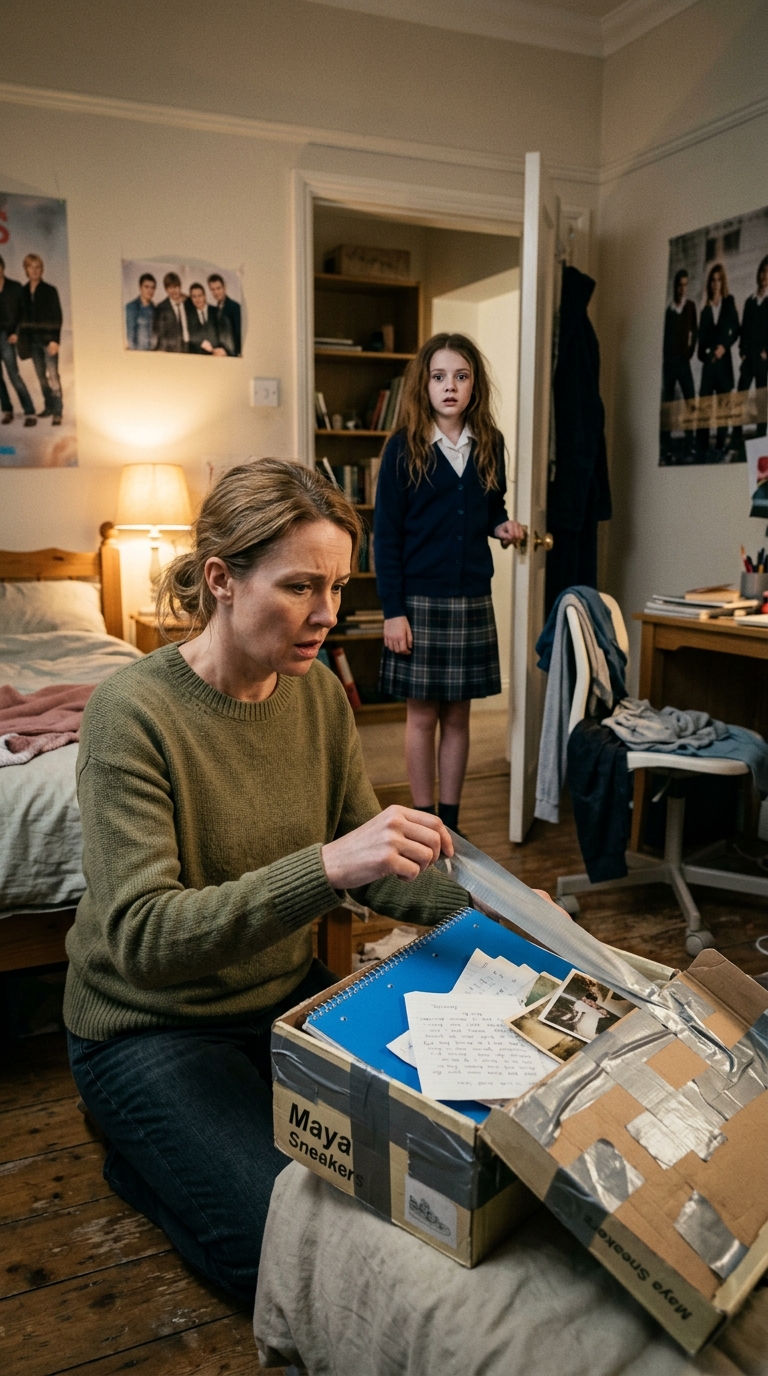
She simply watched me the same way she had watched me fold Maya’s hoodie that morning—with the careful, measuring expression I had spent an entire year mistaking for grief.
I gently set the envelopes aside.
At the very bottom of the box rested a blue spiral notebook.
I almost left it untouched.
I assumed it belonged to Maya.
I couldn’t have been more wrong.
The handwriting on the first page belonged to Sophie.
Smaller.
Tighter.
The kind of handwriting people use when they’re trying to take up as little space as possible.
I turned to the first entry.
“Dear Maya, Mom still leaves your toothbrush out. I don’t think she’s noticed mine needed replacing.”
I read the sentence twice.
Then I read it a third time. The dispatcher picked up on the second ring.
“My name is Jennifer,” I said. “I need someone to come to my house. I found something in my daughter’s room. My other daughter. The one who came home.”
I gave her my address, then placed my phone face down on the carpet.
Sophie was still standing in the doorway.
She hadn’t moved.
“Read the next line,” she said quietly.
I wish I had stopped right there.
I looked back down at the notebook.
My hands were shaking now.
The second entry was dated three weeks after she came home from camp.
“Dear Maya, everybody keeps asking if I remember anything from the lake. Nobody asks how I am.”
As I continued reading, the entries became harder to bear.
The third one was written in October.
“Dear Maya, I got an A on my science exam today. Mrs. Ellison gave me extra credit. Nobody asked if you would have gotten one too. It was getting harder to breathe.”
I flipped to a page near the middle.
Her handwriting had grown even smaller, packed tightly together, as though Sophie had been trying to fit far too many emotions into far too little space.
“Dear Maya, I think Mom is disappearing too. She washed your hoodie again today. She called the camp director again today. She drove past the search site again. I don’t know what to do. I don’t know how to tell her that I need her to come back.”
I closed the notebook.
Then I picked up the bundle of envelopes.
I opened the first one.
The letter inside was covered front and back with Sophie’s handwriting, each word pressed deeply into the page, every stroke firm and deliberate.
“Dear Officers, My name is Sophie. I’m 12 years old. My twin sister, Maya, went missing from Pinewood Summer Camp 14 months ago. I’m writing because I need to know you haven’t stopped looking. Please write back. Please tell me you haven’t stopped.”
The letter had never been mailed.
None of them had.
I heard the siren before the flashing lights came into view.
The police pulled into the driveway while I was still sitting on Sophie’s bedroom floor, the letters scattered around me across the carpet.
I went downstairs and opened the front door.
Officer Davies looked to be in his mid-forties, carrying the calm expression of someone used to stepping into difficult situations.
He glanced past me into the house.
“I did,” I said. “I’m sorry. I think I panicked. I found something under my daughter’s bed and I didn’t understand what it was, and I called before I finished reading it.”
He studied my face.
“Is your daughter safe?”
“She’s upstairs. She’s fine.”
I hesitated.
“She’s actually the opposite of fine. She’s been not fine for a year and I completely missed it.”
He gave a slow nod.
“Do you need emergency services?”
“I need a grief counselor’s number,” I answered. “For both of us. Do you have one?”
He handed me a card.
I thanked him and gently closed the door.
When I turned around, Sophie was sitting on the bottom step of the staircase.
For a long time, we simply looked at each other across the hallway.
“Why didn’t you mail them?” I asked.
She wrapped her arms around her knees.
“Because if they had sent a letter back saying they’d closed the case, it would have killed you.”
“Sophie… honey…”
“You were barely keeping it together already, Mom,” she said. “Every time someone said something official about Maya, you went away for days. You’d just sit in her room. You’d stop eating. I couldn’t let them send you a letter like that.”
Sophie had been protecting me.
I walked over and sat beside her on the second step.
“You’ve been carrying the whole search by yourself,” I whispered.
No child should ever have believed that.
“That was never supposed to be your job, Sophie.”
“I know.”
Her voice became almost a whisper.
“But it also wasn’t supposed to be my job to grieve alone. And I’ve been doing that too.”
There was no answer to those words.
None that mattered.
I thought about every sleepless night I had spent replaying theories about what happened at camp.
Every missing-person flyer I had printed.
Every search meeting I had attended.
And every single time I had asked Sophie if she remembered anything new—anything at all—from that morning.
I had been so desperate to bring Maya home that I had treated Sophie like a witness.
Like a source of information.
Not like a little girl who had lost her twin sister and was now quietly losing her mother.
I had looked right through her.
“I thought if I accepted that Maya was gone,” I said slowly, “then she’d really be gone. Like saying it out loud would make it real.”
“I know,” Sophie replied.
“I know, Mom.”
She leaned her head against my shoulder.
I felt the warmth of her beside me, real and alive, and something inside my chest finally gave way.
“Every time I said her name,” Sophie whispered, “you cried. So I stopped saying it. And then I had nobody to talk to about her. I had nobody at all, Mom.”
“I’m so sorry, baby,” I said. “I am so sorry I made you feel alone in this.”
“I just wanted my twin sister back,” Sophie continued.
Her voice stayed calm, the way people sound when they’ve practiced the same words over and over.
“But I wanted my mom back, too.”
We remained on those stairs until the daylight outside faded into gray.
For an entire year, I had poured every ounce of myself into trying to save the daughter I had lost.
I never realized I was slowly losing the daughter who was still beside me.
I came dangerously close to losing them both.
One week later, Sophie and I drove back to the lake.
It was the same road leading to camp.
The same narrow turn surrounded by trees.
The same gravel crunching beneath the tires.
As I parked, Sophie gazed out across the water, resting her chin on one hand.
For the first time since Maya disappeared, her expression looked lighter.
More open.
Together, we walked to the end of the dock.
The lake still shimmered with the same pale blue-green color, impossibly beautiful despite everything it might have been hiding.
“I think she liked it here,” Sophie said after a long silence. “She always said camp was the one place that felt like something was actually happening.”
“She hated being bored,” I replied. “Even for five minutes.”
Sophie smiled.
Not the careful, guarded smile I had grown used to.
A real one.
“Do you remember the summer she made us take the paddleboat out at six in the morning? She wanted to watch the mist come off the water.”
“I remember I was furious,” I said.
“It was beautiful,” I agreed.
For a long time, we talked about Maya.
Not the investigation.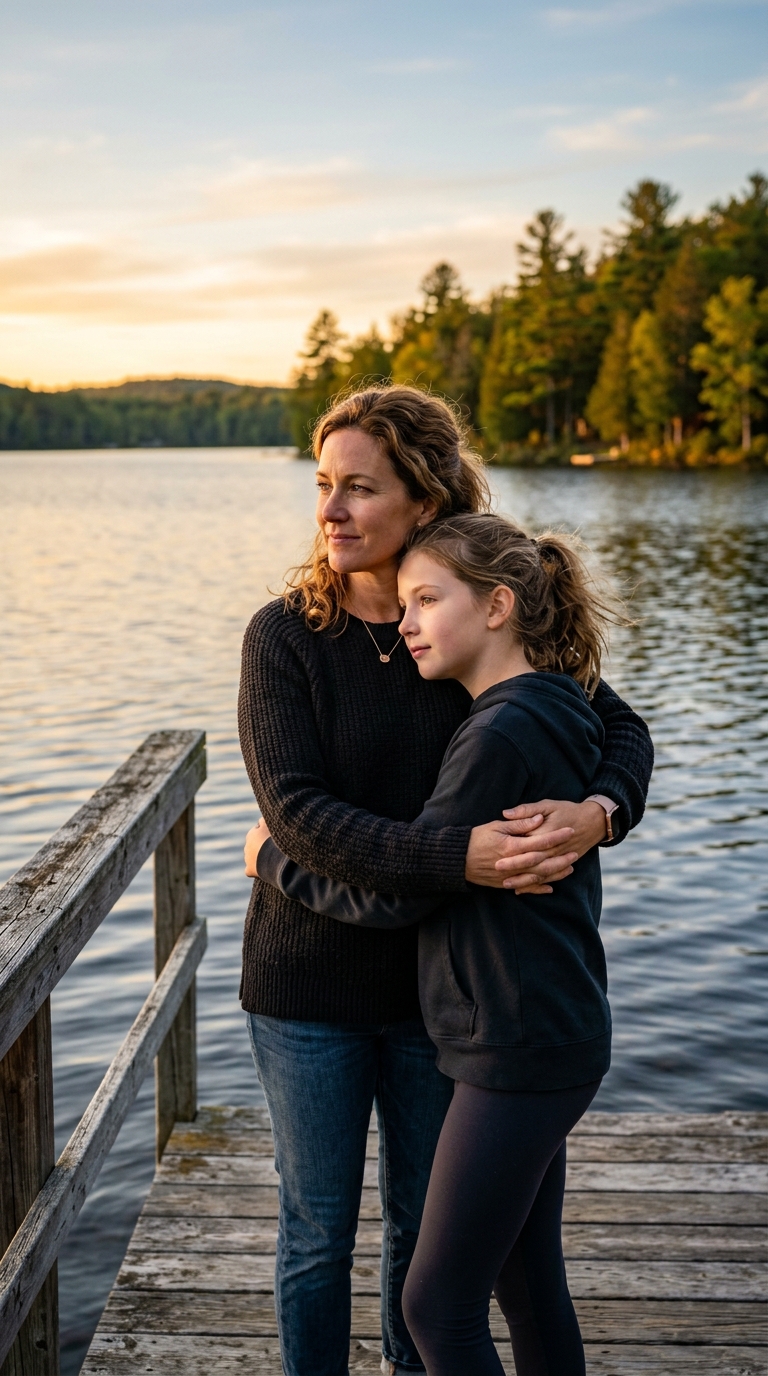
Not the search.
Not the case, the camp, or the endless questions that still had no answers and perhaps never would.
We talked about her.
How she ate cereal dry because she hated warm milk.
How she always fell asleep in the car within four minutes.
How she laughed—loudly, suddenly, without holding anything back.
Maya had lived.
And as long as we remembered her, she would keep living inside us.
