

Part 1
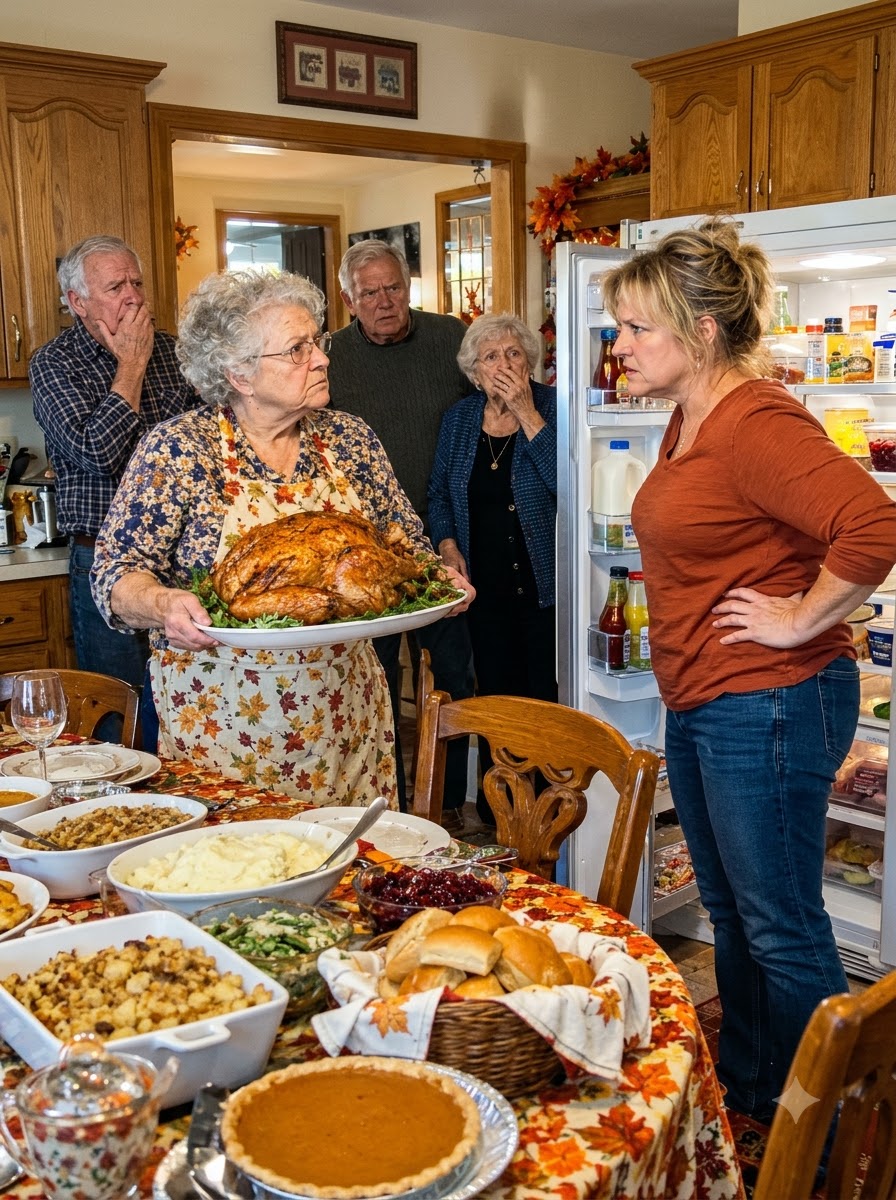
My daughter-in-law pointed toward the refrigerator with one perfectly manicured finger.
“Dorothy, there’s plenty in the fridge for you. This dinner is for our guests.”
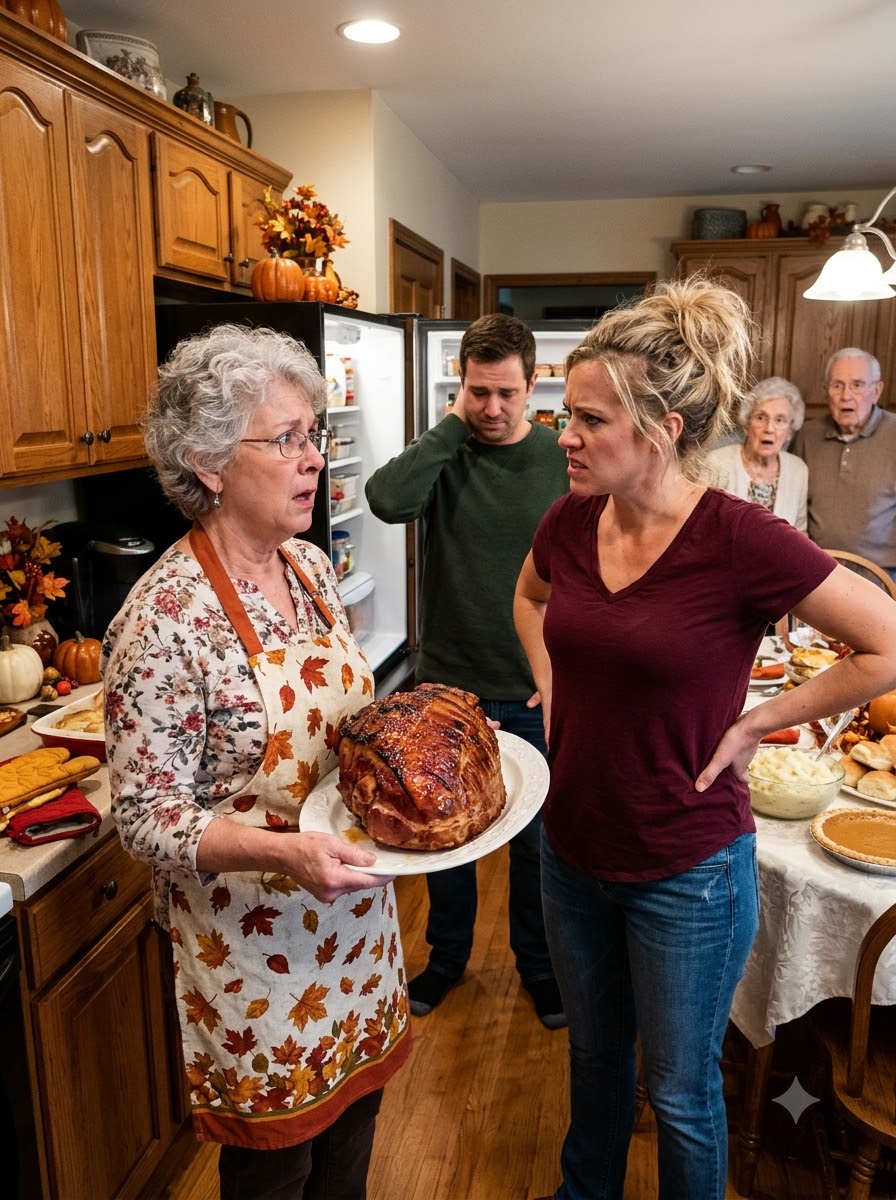
I stood motionless in my son’s kitchen, holding a twelve-pound honey garlic glazed ham.
The roasting pan was still warm against my oven mitts. I had spent most of Saturday preparing that ham, carefully glazing it and basting it until the outside was golden and shining.
For several seconds, nobody spoke.
My daughter-in-law, Christa, had been married to my son, Owen, for six years.
During those six years, I had gradually learned where I belonged in her version of the family.
Somewhere below useful.
Just slightly above inconvenient.
But even after everything that had happened, I hadn’t expected this.
Perhaps that was what surprised me most.
I thought I had already discovered every possible way she could make me feel unwelcome.
Apparently, I was wrong.
I glanced toward the refrigerator.
Through its glass door, I could see a plastic container of pasta that had been sitting there since Thursday, a half-used block of cheddar with a dried-out corner, and a takeout bag from a Thai restaurant I didn’t recognize.
Then I looked into the dining room.
Owen had brought the large table upstairs from the basement specifically for this dinner.
A beautiful white linen tablecloth covered it.
Christa’s mother’s china had been arranged carefully at each place setting.
Fresh eucalyptus and white tulips stood in the center.
I knew the flowers were expensive because Christa had mentioned the florist twice that week.
Her parents, Gerald and Elaine, were already sitting comfortably at the far end.
They looked like people who had never once been directed toward somebody else’s refrigerator while everyone else prepared to enjoy a proper dinner.
Elaine was wearing a blazer.
In October.
In Ontario.
Inside the house.
That told me exactly what sort of evening Christa had planned.
My son stood near the hallway entrance.
His phone was in his hand, but he wasn’t looking at the screen.
He was staring at the floor.
Not at me.
Not at Christa.
Just the floor.
I am sixty-three years old.
I raised Owen alone after his father left when he was nine.
I worked as an office administrator for thirty-one years, lived in the same Barrie house throughout my adult life, and finished paying off my mortgage two years before retirement.
I have never shouted at a cashier.
I’ve never honked impatiently at another driver.
And I have never caused a scene inside someone else’s home.
I wasn’t about to start that evening.
I looked at Christa.
“I see,” I said quietly.
Then I tightened my grip beneath the roasting pan, turned around, and carried my ham out through the side door.
Nobody tried to stop me.
I crossed the cold driveway and carefully placed the pan on the passenger seat of my Honda Civic.
Then I did something that still makes me laugh.
I fastened the seat belt around it.
You need to understand why that ham mattered so much.
It wasn’t simply a piece of meat.
On Thursday, Owen had called me.
“Mom, Christa’s parents are driving up from Oakville on Sunday. She really wants it to be nice. Could you maybe do one of your hams? Christa says nobody does a ham like you.”
Those words warmed my heart.
Nobody does a ham like you.
I even wrote them on the notepad beside my telephone, as though they were a compliment worth preserving.
Friday morning, I visited Mr. Kowalski’s butcher shop on Bayfield Street.
I’d been buying meat from him for twenty-five years.
“Big occasion, Dorothy?” he asked while wrapping my purchase.
“My son’s in-laws are coming.”
“Then you’d better get the good one.”
He disappeared into the back and returned carrying a beautiful bone-in ham.
“Twelve pounds. Smoked it myself.”
It cost eighty-four dollars.
I paid without hesitation.
Saturday morning, I got up at six.
I scored the fat into the diamond pattern my mother had taught me, pressing a clove into each diamond.
Then I prepared the glaze from scratch.
Honey, brown sugar, Dijon mustard, an entire head of roasted garlic, and a splash of apple cider.
For four hours, I basted the ham every twenty minutes.
My house smelled like Christmas.
I also made scalloped potatoes because my granddaughter, Maya, adored them.
She was ten and had called them “the cheesy ones” since she was little.
Sunday afternoon, I wrapped everything in towels, loaded the car, and drove forty minutes south to Owen’s house.
Christa opened the side door when I arrived.
Her eyes moved from the roasting pan to my face.
“Oh,” she said. “You brought it.”
“You asked for it, honey.”
“Owen asked for it.”
She stepped aside.
“Just put it on the counter. Mom and Dad are already here.”
I carried everything inside and removed my coat.
Elaine looked up from the dining room and greeted me with a small wave of her fingertips.
“Dorothy. How nice. Did you drive all the way from Barrie?”
“I did.”
“In that little car?”
She laughed.
“Brave.”
Gerald didn’t bother looking up from his wine.
Then Maya came racing downstairs.
“Grandma!”
She wrapped her arms around my waist.
“Did you make the cheesy ones?”
“I made the cheesy ones.”
“Yes!”
Before I could hug her properly, Christa interrupted.
“Maya. Go wash your hands and sit down. Grandma’s helping in the kitchen.”
Helping in the kitchen.
I didn’t think anything of it at first.
I always helped.
I carved the ham into beautiful slices, arranging them on Christa’s large white platter with the glazed sides facing upward.
Then I transferred the scalloped potatoes into a serving dish.
Everything looked wonderful.
I glanced toward the dining table.
And counted the plates.
Five.
Gerald.
Elaine.
Christa.
Owen.
Maya.
I counted again.
Still five.
I stood there holding the serving spoon, wondering whether another place setting was hidden somewhere.
There wasn’t.
That was when Christa returned to the kitchen and directed me toward the refrigerator.
“Dorothy, there’s plenty in the fridge for you. This dinner is for our guests.”
And suddenly, everything became painfully clear.
I had been invited to cook.
Not to eat.
Not to join the family.
Just to provide the meal.
So I took it home.
My phone lit up before I had even reached the end of Owen’s street.
A message from him.
“Mom, where are you going? Christa’s parents haven’t eaten yet.”
I read it while stopped at an intersection.
Then I placed my phone facedown in the cup holder.
That message hurt more than I expected.
He hadn’t asked whether I was all right.
He hadn’t apologized.
He was concerned that Christa’s parents hadn’t eaten.
I didn’t respond.
I drove north on Highway 400 with the radio switched off and the windows slightly open.
The ham sat securely beside me, still filling the car with the smell of garlic and honey.
During those forty minutes, I thought about things I had spent years trying not to notice.
Thanksgiving two years earlier.
Christa’s parents had visited my house because their kitchen was being renovated.
I’d cooked for two days.
When Elaine entered my hallway, she sniffed the air.
“Well. It smells very lived in.”
Christa laughed.
Owen took Elaine’s coat without saying anything.
I remembered every Sunday dinner I’d prepared at their home.
I always brought ingredients from my own pantry because Christa never seemed to have what I needed.
Butter.
Flour.
A decent onion.
I thought about the ten birthday cakes I’d baked for Maya.
Chocolate with raspberry, every year, because she’d requested it when she turned four.
I remembered helping Owen and Christa move into their house.
I was sixty-one.
I carried boxes upstairs for nine hours while Christa stood in the hallway directing everyone.
“Dorothy, not there. That one’s for the guest room.”
Then I thought about Owen’s phone bill.
His line had been on my family plan since he was twenty-two.
When he married Christa, I added her number.
Thirteen years later, I was still paying for both.
Nobody had ever suggested changing that arrangement.
Then there was the cottage.
That August, Owen and Christa had taken Maya to Prince Edward Island for a week.
A month before the trip, Owen called.
“Mom, the cottage rental is a bit more than we figured. We’re a little short this month.”
I paid the entire fourteen hundred dollars.
Christa posted forty vacation photographs.
I wasn’t mentioned in any of them.
Nobody thanked me afterward.
Somewhere near the Innisfil exit, a realization made my fingers tighten around the steering wheel.
I had made myself useful enough to be taken for granted.
And insignificant enough to be managed.
One favor at a time, I had taught them that my generosity came without limits.
And that evening, standing in their kitchen, I had finally seen what those six years had become.
A woman holding the dinner she had prepared.
Being directed toward leftovers.
When I reached home, I carried the ham inside and placed it in the oven on low heat.
Then I poured myself a glass of Shiraz and sat at the oak kitchen table I’d purchased in 1991.
I opened my laptop.
I wasn’t shaking with rage.
I wasn’t crying.
I didn’t feel the need to call my friend Cecilia and recount every insult.
I simply felt clear.
Clearer than I had in years.
First, I logged into my mobile carrier account.
Owen and Christa were listed as secondary users on my family plan.
I found the option labeled “Transfer line ownership.”
I hovered over it briefly.
Then I clicked.
Eight minutes later, both lines had been moved to their own account.
Their separate billing would begin with the next cycle, four days away.
They would receive notifications by email and text.
I confirmed the changes.
Next, I called the after-hours number for my insurance broker, Patricia.
She had handled my policies since before Owen learned to drive.
“Patricia, it’s Dorothy Hale. Sorry to call on a Sunday. I’d like to remove my son’s vehicle from my policy at renewal. That’s in six weeks, I believe. Please call me Monday if you need anything from me. Thank you.”
I hung up and wrote myself a reminder to follow up.
Then I opened my bank account.
That was the difficult part.
For two years, I’d transferred four hundred dollars into Owen’s account on the first day of every month.
I had always considered it assistance with Maya’s expenses.
Swimming lessons.
School trips.
Winter boots.
Maya was the reason I’d accepted so much over the years.
She was why I drove forty minutes every other Sunday.
Why I tolerated Elaine’s remarks.
Why I kept arriving with groceries and homemade cakes.
I stared at the recurring payment.
Then I asked myself a question.
How much of that money had actually been spent on Maya?
I didn’t know.
I’d never asked.
And perhaps I’d avoided asking because I was afraid of the answer.
I canceled the transfer.
Then I closed the laptop.
I removed the ham from the oven, carved two generous slices, and served them beside a helping of scalloped potatoes.
I ate at my own table.
On my own good plate.
It was the finest ham I’d ever made.
At 9:40 that evening, Owen sent another message.
“Christa says you’re overreacting. Her parents ended up ordering pizza. Can we talk tomorrow?”
They had ordered pizza.
I read the message twice.
Then I switched off my phone.
I went to bed before ten.
And slept better than I had in months.
Part 2
Monday morning, I remembered one more arrangement that needed to change.
Three years earlier, Owen had undergone an appendectomy.
During his recovery, I’d been helping drive Maya to school, and Christa needed access to my house to drop off belongings and lunches.
I’d given her a spare key.
It was supposed to be temporary.
She never returned it.
And I never asked.
At nine o’clock, I called Dunlop Lock and Key.
A young locksmith named Tyler arrived around eleven in a white van.
He replaced the locks on both my front and back doors.
He didn’t ask why, which I appreciated.
“You want spares?” he asked.
“Two,” I replied. “Just two.”
I attached one key to my key ring and placed the other in the kitchen drawer beside the stove.
Nobody else received one.
Patricia called after lunch.
“Dorothy, I got your message. Is everything all right? You’ve had Owen on your policy for fifteen years.”
“Everything’s fine,” I assured her. “He’s thirty-five. He can insure his own car.”
She paused.
“Good for you,” Patricia said quietly.
Then she promised to send him the necessary notice.
Tuesday morning, I was shopping for vitamins at Shoppers on Dunlop Street when Owen called.
I let it go to voicemail.
He called again while I was waiting at the checkout.
The young cashier glanced at my vibrating purse.
“You want to get that?”
“No, thank you, dear.”
Once I reached my car, I listened to his message.
“Mom, something happened with our phones. Christa got an email saying the plan is changing. Can you call me back? And also, did you call about the car insurance? The broker’s office left me a message. Is everything okay?”
He sounded genuinely confused.
Not angry.
Just confused.
And somehow, that was almost more painful.
Owen had never been a cruel man.
His weakness was passivity.
He loved me, but he allowed things to happen to me because confronting Christa seemed more difficult than remaining silent.
He was exceptionally good at calculating what standing up for someone might cost him.
That evening, after supper, I returned his call.
“Mom! Finally.”
He exhaled heavily.
“What’s going on? Christa says our phones are switching to a separate plan, and it’s going to be like two hundred and forty dollars a month for both of us. Did something happen with your account?”
“Nothing happened with my account,” I replied. “I’ve been tidying up my finances. Now that I’m fully retired, I need to be careful about what I’m spending. So I’m streamlining.”
“Streamlining?”
He repeated the word slowly.
“Mom, you’ve been paying for our phones for years.”
“I know. That was my choice. And now I’m making a different choice. You’re thirty-five, Owen. You have a good job. You can manage a phone plan.”
A long silence followed.
I could hear a hockey game playing in the background.
“Is this about Sunday night?” he finally asked.
“Sunday night clarified some things for me,” I said. “But my finances are my own. I don’t need to justify them to anybody.”
“Christa feels terrible.”
Something tightened inside my chest.
Not because I believed it.
Because I could hear how badly Owen wanted to believe it.
“She said she didn’t mean it the way it came out,” he continued.
I waited.
“What way did she mean it?”
He said nothing.
I could hear Christa speaking somewhere behind him, her voice sharp and low.
“Mom,” he finally said.
Just that.
“Mom.”
“You don’t have to figure this out tonight, sweetheart,” I told him. “Enjoy your evening.”
I ended the call gently.
Then I sat beside my window and returned to the library book I’d been trying to finish for three weeks.
The following days were quiet.
Owen sent brief messages.
“Hope you’re okay.”
“Call if you need anything.”
I answered both kindly.
“I’m fine, honey. Talk soon.”
Christa didn’t contact me.
Friday afternoon, I was working in my backyard, preparing the garden for winter.
I pulled out tomato cages and cut dead hostas close to the ground.
My knees were dirty, and I wore my old green gardening gloves with the hole in the left thumb.
Then I heard a vehicle approaching much too quickly.
My street is a cul-de-sac.
Nobody drives that fast down it unless they’re angry or lost.
I stood, removed my gloves, and walked around the side of the house.
Christa’s white SUV had stopped abruptly behind my Civic.
She climbed out before the engine had completely settled.
She wore leggings, a puffer vest, and her hair pulled back.
She looked dressed for errands rather than a confrontation.
That suggested she’d made the decision to visit rather suddenly.
She hadn’t noticed me.
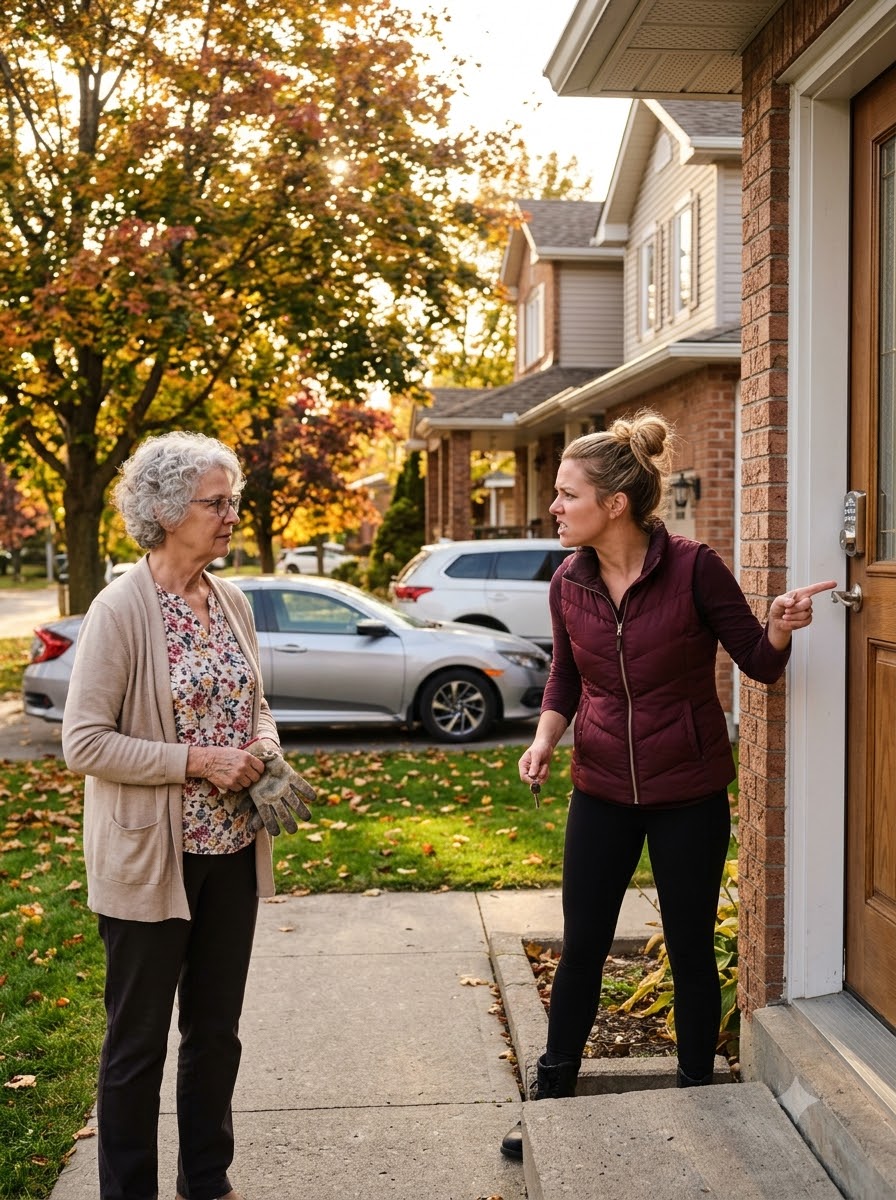
Instead, she marched straight up my front steps, took out her key ring, and inserted her key into the lock.
It went halfway in.
Then stopped.
She pulled it out, examined it, and tried again.
The result was the same.
She stood motionless for a moment.
Then she turned and saw me standing on the lawn.
“You changed the locks.”
It wasn’t quite a question.
“I had some work done on the doors,” I replied. “Can I help you with something, Christa?”
She walked down the steps toward me.
Christa rarely shouts.
Her anger is much more precise.
She has a way of speaking that makes every sentence feel like a small, carefully sharpened blade.
“Owen told me what you did with the phone plan,” she began. “And the insurance. And apparently the transfers to Owen’s account have stopped as well.”
“That’s right.”
“Dorothy.”
She said my name with the patient tone she used when explaining something to Maya for the third time.
“I understand you were upset on Sunday. But pulling financial support out from under us with no warning, no conversation, nothing? That’s not a mature way to handle this.”
I’d spent five days thinking about what I wanted to say.
I hadn’t rehearsed a speech.
I hadn’t planned an argument.
But I’d made one important decision.
I would no longer allow the word mature to mean silently accepting disrespect.
For years, people had used that word to suggest that the responsible person should absorb every insult.
Stay gracious.
Remain quiet.
Don’t make anyone uncomfortable.
I had done that for six years.
“Christa,” I began, “last weekend, I spent two days making a meal for your family.”
She opened her mouth.
I continued.
“I bought a twelve-pound bone-in ham from a butcher I’ve known for twenty-five years. I got up at six in the morning to glaze it. I made Maya’s potatoes. I drove forty minutes to your home, and I stood in your kitchen ready to serve it.”
My voice remained calm.
“And you counted five plates. And you sent me to eat Thursday’s leftovers out of a plastic container, while your parents sat down to my food on your mother’s china.”
Her expression shifted slightly.
“I wasn’t upset,” I said. “I was done.”
She crossed her arms.
“We had guests.”
“So did you,” I replied. “I was your guest, Christa. It never occurred to you.”
A gust of wind scattered leaves across the driveway.
Across the street, my neighbor Mr. Halvorsen had been examining his mailbox for an unusually long time.
Christa looked down.
Then she raised her eyes again.
“Okay,” she said. “If this is about feeling included, we can talk about that.”
“Can we?”
“Yes. But cutting off support isn’t going to make Owen and me want to run toward you, Dorothy. You understand that, right? You’re only pushing us away.”
There it was.
The truth behind the last six years.
In Christa’s mind, being welcomed into their family was something I had to keep earning.
My financial support was the price of admission.
The groceries, birthday cakes, moving boxes, and vacation rentals weren’t acts of love to her.
They were payments.
And if I stopped paying, she was warning me that I might lose my place.
For the first time, I understood exactly what I’d been purchasing.
And I realized I no longer wanted it.
I smiled.
Not cruelly.
Just with genuine relief.
“Then I suppose we’ll both be adjusting,” I said.
Christa blinked.
“Have a good afternoon, Christa.”
I walked past her, climbed my front steps, and opened the door with my new key.
Then I stepped inside and closed it.
I didn’t slam it.
I simply shut the door.
In the kitchen, I washed the dirt from my hands.
Through the window above the sink, I could see Christa standing on my lawn.
She remained there for almost a minute.
She looked at the front door, then at the useless key in her hand.
Once, she pulled out her phone as though considering a call.
Then she put it away.
Finally, she returned to her SUV and drove off.
Much more slowly this time.
Mr. Halvorsen closed his mailbox and went indoors.
I dried my hands.
They weren’t trembling.
The following morning, I called Tyler at Dunlop Lock and Key.
“Something wrong with the locks, Mrs. Hale?”
“No,” I said. “The locks are perfect. I’d just like a second deadbolt on the front door. For peace of mind.”
He installed it that afternoon.
After he left, I stood in my hallway and turned the deadbolt several times.
Click.
Click.
A solid, reassuring sound.
The sound of a door that belonged to me.
Three quiet weeks followed.
Owen continued sending occasional messages.
“How are you doing?”
“Weather’s turning, hope your furnace is okay.”
I answered kindly and briefly.
Christa remained silent.
I won’t pretend those weeks were completely peaceful.
Some evenings, I wondered whether I’d made a terrible mistake.
Had I damaged my relationship with my son?
Had I sacrificed time with Maya over a phone bill?
Was I being too proud?
Then I remembered the refrigerator.
The old pasta.
The five plates.
And I knew why I’d left.
One Wednesday evening, my phone rang with a FaceTime call.
The caller’s picture was a cartoon unicorn.
I answered.
Maya’s face filled the screen, so close that I could see only one eye and part of her nose.
“Grandma? Can you see me?”
“I can see one eyeball, sweetheart.”
She giggled and moved the iPad farther away.
Her hair was pulled into a messy ponytail, and something purple was smeared across her cheek.
She was sitting in her bedroom, with her horse poster visible behind her.
“Mom said I could call you on my iPad if I did my homework first. And I did my homework first.”
“Well, look at you.”
“Grandma, I’m reading a book at school and it’s SO good. Can I tell you about it?”
“I would love that more than anything.”
She spent nearly forty-five minutes telling me about a girl living in a lighthouse during a terrible storm.
She explained every chapter, every character, and every surprising twist.
She performed different voices and made me guess what would happen next.
Whenever I guessed incorrectly, she shrieked with laughter.
Near the end of our conversation, she became quiet.
“Grandma?”
“Yes, honey?”
“Are you mad at us?”
My heart seemed to stop.
“Why would you ask that?”
“Because you left before dinner. And you didn’t come last Sunday. And Mom and Dad keep talking in the kitchen with the door shut.”
I took a slow breath.
Throughout everything that had happened, I’d promised myself one thing.
Maya would never become a messenger between adults.
She would never be used as a weapon.
And she would never be made responsible for repairing our relationships.
“Maya,” I said, “listen to me. I am not mad at you. Not even one tiny bit. You are my favorite person in the whole world. Grown-ups sometimes need to sort some things out. That’s all. And it is not your job to fix it.”
She studied me through the screen.
“Promise?”
“I promise. Cross my heart.”
She smiled.
“Okay. Can I call you next Wednesday too? I’ll be on chapter eleven.”
“You can call me every Wednesday for the rest of your life.”
After we hung up, I sat in my dark kitchen with the phone resting in my lap.
That conversation was the happiest moment I’d experienced all month.
And it reminded me that loving Maya didn’t require me to keep paying her parents’ bills.
Part 3
My friend Cecilia lived two streets away.
We’d known each other since our children attended the same dance class in the 1990s.
Her daughter had been a tiny ballerina.
Owen was the only boy in the class because his best friend’s mother had signed both boys up as a joke.
To everyone’s surprise, Owen refused to quit.
One Thursday, Cecilia came over for dinner.
I made shepherd’s pie.
After she’d taken a second helping, I finally told her everything.
The ham.
The five plates.
The refrigerator.
The seat belt.
The phone plan.
The insurance.
The changed locks.
Christa standing on my lawn with a key that no longer worked.
Cecilia listened without interrupting.
That’s something I’ve always loved about her.
She lets people finish.
When I reached the end, she put down her fork.
“You buckled the ham in,” she said.
“I did.”
She began laughing.
Then I started laughing too.
We laughed until Cecilia had to wipe tears from her eyes and I was holding the edge of the table.
When we finally settled down, her expression grew serious.
“How do you feel, Dot? Really.”
I considered the question.
“Like myself,” I said. “I feel like myself.”
It was the most accurate answer I could give.
For years, I’d felt like a smaller version of myself.
The woman who faded into the background of other people’s plans.
The one who arrived early, helped wherever needed, and left without complaining.
“Somewhere in the last six years,” I told Cecilia, “I became completely unimportant to my son’s life. And completely necessary to his bills.”
Cecilia nodded.
“That happened to me with my Rick’s family,” she said. “After he died. I paid for his brother’s mortgage for two years. Two years, Dot. And at the funeral reception, his sister asked me to help the caterers bring out the sandwiches.”
I stared at her.
“You never told me that.”
“I never told anybody.”
She picked up her fork.
“I was ashamed. Like it was my fault for letting it happen.”
“Was it?”
“Partly.”
She smiled sadly.
“Same as yours was partly yours. That’s the hardest part to swallow. But it’s also the good news.”
“How is that good news?”
“Because if you helped build it,” Cecilia said, “you can stop building it.”
I have thought about those words almost every day since.
The call I’d been expecting finally arrived on a Friday afternoon in November.
The season’s first snow was beginning to fall.
Heavy, wet flakes melted as soon as they touched the driveway.
“Mom,” Owen said, “can I come by? Tomorrow maybe? Just me.”
Just me.
I wondered whether Christa had agreed to the visit or whether he hadn’t told her.
“Of course you can, honey.”
He arrived Saturday at one o’clock.
He knocked.
My son hadn’t knocked on my front door since he was seventeen.
When I opened it, he glanced at the new deadbolt.
He said nothing.
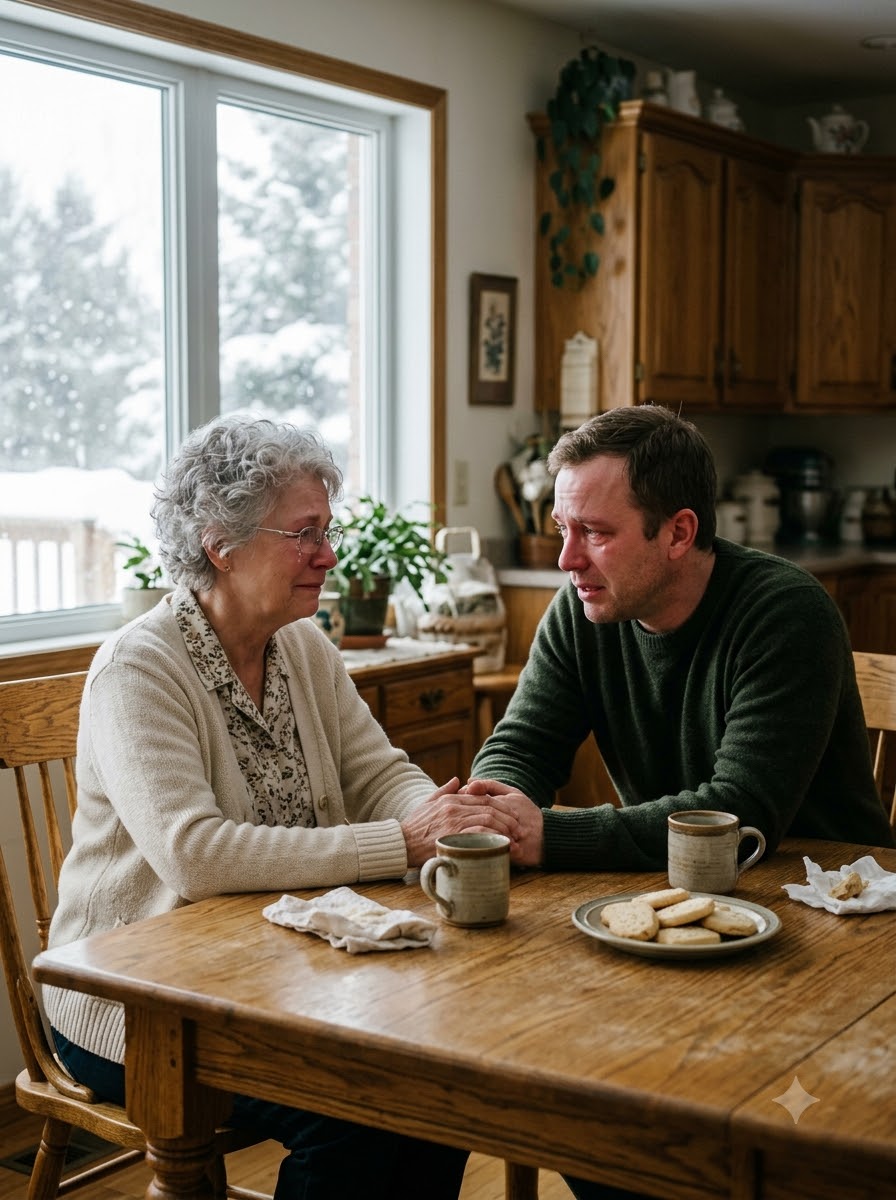
We sat at my old oak kitchen table.
The same table where he’d completed homework, eaten thousands of bowls of cereal, and told me about his first girlfriend, his first heartbreak, and his acceptance into university.
Owen has always been tall.
But whenever he’s uncomfortable, he seems to fold inward and become smaller.
He looked exactly as he had at eleven when he’d broken something and didn’t know how to tell me.
I made coffee and placed a plate of shortbread between us.
He didn’t touch it.
“I’ve been doing a lot of thinking,” he said.
“I imagined so.”
He slowly rotated his coffee mug.
“I haven’t been fair to you, Mom.”
I remained quiet.
He continued.
“I knew things were…”
He stopped.
Then tried again.
“I knew Christa had certain ways of doing things. With you. And I told myself it was just different personalities. Her family’s different from ours. They’re more formal. That’s all it was.”
He shook his head.
“And every time something happened that bothered me, I’d just wait for it to pass. Because waiting was easier. Because if I said something, there’d be a fight, and the fight would last three days, and I’d lose anyway.”
“I know,” I said.
He looked up.
“The thing with the ham.”
His voice cracked slightly.
Under different circumstances, I might have laughed at the seriousness with which he said ham.
“I should have said something right then. I should have said something to her before you even got your coat on. And I just stood there, Mom. I stood there looking at the floor.”
“I saw.”
“I know you saw.”
He rubbed his face.
“After you left, Gerald asked where you were going. And Christa said you weren’t feeling well. And I let her say it. I sat down and ate pizza with them and let her say it.”
He looked toward the snowy window.
“Maya didn’t eat anything. She kept asking where the cheesy potatoes went. And Christa told her to stop being dramatic.”
I closed my eyes.
“Then after her parents left,” Owen continued, “I went out to the garage and sat in my car for an hour. I didn’t even turn it on. I just sat there.”
“Why?” I asked.
“Because I realized you’d been doing that for six years.”
He met my eyes.
“Sitting somewhere by yourself after one of our dinners. Feeling like that. And I never once noticed. Or I noticed, and I pretended I didn’t.”
The kitchen fell quiet.
The furnace started with its familiar groan.
“I’m sorry, Mom,” he whispered. “I’m really sorry. Not because of the phone plan. I want you to know that. I would be sitting here even if you were still paying it.”
I studied my son.
I’d expected him to negotiate.
Perhaps he’d ask me to restore the phone plan.
Perhaps he’d suggest forgetting everything.
Perhaps he would deliver another carefully worded message from Christa.
I hadn’t expected an honest apology.
For the next hour, we talked.
Really talked.
Owen told me about his marriage, his choices, and the arguments he had avoided.
He admitted he was tired.
Sometimes, he said, he felt like a guest in his own house.
He had even started counting the weekends they spent with Christa’s parents in Oakville.
At one point, they’d visited eleven weekends in a row.
“Eleven, Mom. And I couldn’t remember the last time we came up here without it being a holiday.”
“I remember,” I said. “It was April. Of last year.”
He winced.
I didn’t forgive everything instantly.
I wasn’t going to pretend six years of hurt could disappear in one afternoon.
But I listened.
And then I told him everything I’d been holding back.
The moving boxes.
Elaine’s “lived in” comment.
The cottage rental.
The groceries.
The birthday cakes.
The five plates.
He didn’t argue.
He listened, sometimes nodding, sometimes staring at the table.
Once, he wiped his eyes with the back of his wrist, exactly as he had when he was a little boy.
For the first time in years, I felt heard.
When he was preparing to leave, Owen stopped near the door.
“Mom. The phone plan. The insurance. The money.”
I waited.
“Don’t turn any of it back on,” he said. “Please. I mean it. I should have been handling it years ago.”
I reached up and straightened his collar, as I used to do before school.
“I wasn’t going to, honey.”
He laughed.
A genuine laugh.
“Yeah,” he said. “I figured.”
And I didn’t write another check.
The recurring transfers remained canceled.
The phone plans stayed separate.
Owen arranged his own car insurance when the policy renewed.
Patricia even sent me a little card with a sunflower on the front.
Inside, she’d written:
Proud of you.
Over the following months, I discovered something unexpected.
My retirement budget had far more room than I’d realized.
For years, I’d told myself I couldn’t afford certain things.
I needed to be careful.
I had to save.
But the truth was that I had been spending a significant portion of my money supporting other adults.
So I began using it for myself.
I replaced my aging furnace before it finally broke down.
It had been groaning through three winters.
I booked a spring trip to Cape Breton with Cecilia.
We’d talked about driving the Cabot Trail since 1998.
And I enrolled in cello lessons.
I’d wanted to play the cello since I was eleven and heard one during a school concert.
For decades, I told myself it was too expensive, too impractical, or simply too late.
My instructor was a twenty-six-year-old woman named Priya.
She had a nose ring and seemingly endless patience.
During our first lesson, I drew the bow across the strings and produced a real note.
Low.
Warm.
Resonant.
I stopped moving and sat very still.
“You okay, Dorothy?” Priya asked.
“I’m wonderful,” I replied. “Let’s do that again.”
Owen and I began talking every Sunday evening.
Not quick check-ins.
Actual conversations.
Sometimes we spent an hour discussing a television show, a recipe, or something that had happened at his job.
He started taking more responsibility for his household finances.
I didn’t ask how he managed it.
I didn’t need to know.
There was something different about him.
He seemed more certain of himself.
When he promised to do something, he followed through.
I don’t know exactly what changed between him and Christa.
I don’t ask.
Their marriage belongs to them.
Christa and I remain polite.
She sent a Christmas card signed by all three of them in her tidy handwriting.
I sent one back.
For now, that’s enough.
The memory of that Sunday dinner still hurts occasionally.
I can still picture myself standing in her kitchen with the ham I’d spent hours preparing, while she directed me toward old leftovers.
But pain doesn’t have to last forever.
I’m old enough to understand that.
In March, Maya came to stay for a long weekend.
It was Owen’s suggestion.
He drove her to my house on Friday afternoon with a pink suitcase and a backpack full of books.
At the door, he hugged me for a long time.
“Sunday at four?” he asked.
“Sunday at four.”
Maya and I had three wonderful days.
Friday evening, we prepared chicken noodle soup from scratch.
We rolled the dough on my floured kitchen counter and cut the noodles with a pizza cutter.
Maya made them all different sizes.
Some were thin as string.
Others were almost as wide as her fingers.
“They’re supposed to be different,” she explained seriously. “It’s more interesting that way.”
“You’re absolutely right.”
Saturday, we watched old movies beneath a blanket.
The Sound of Music.
Then Mary Poppins.
She had never seen either film.
When Julie Andrews began spinning across the mountaintop, Maya grabbed my arm.
“Grandma, this is the best thing I’ve ever seen.”
That evening, she taught me a card game called Spit.
It involved quick movements, loud reactions, and repeatedly slapping the table.
She beat me eleven times in a row.
“You’re really bad at this, Grandma,” she announced happily.
“I’m sixty-three, sweetheart. My hands don’t slap that fast anymore.”
“You’re still really bad.”
“I know.”
Sunday morning, I made pancakes.
Maya helped set the dining room table.
Not the kitchen counter.
The good table.
She chose the blue placemats with white flowers that I normally saved for holidays.
She folded the napkins into triangles.
She poured orange juice into proper glasses.
Then she placed two plates on the table.
Two.
One for her.
One for me.
She stepped back, rested her hands on her hips, and admired her work.
“Grandma, your house always feels nice.”
I stopped with the spatula in my hand.
“Thank you, sweetheart,” I replied. “That’s one of the finest things anybody has ever said to me.”
She rolled her eyes, assuming I was joking.
I wasn’t.
I’d spent so much of my life making sure other people were comfortable.
Making sure they had enough food.
Making sure there was something warm waiting when they arrived.
Bringing groceries.
Carrying boxes.
Paying bills.
Helping whenever I was needed.
And I’ll probably continue doing many of those things.
I enjoy caring for people.
I love cooking.
I love seeing a full table.
But at sixty-three, I’ve finally learned something I should have understood years ago.
Generosity should not mean allowing people to take everything while offering nothing in return.
When kindness flows in only one direction for years, without gratitude, courtesy, or even a chair at the table you helped prepare, it stops feeling like generosity.
It becomes a habit.
A habit that benefits someone else.
And habits can be changed.
Cecilia was right.
If you helped build it, you can stop building it.
Owen arrived at four o’clock on Sunday, exactly as promised.
Maya ran toward the car carrying her pink suitcase.
Then she suddenly turned and raced back up the steps to hug me again.
“Same time next month?” she asked.
I looked toward Owen.
“Same time next month,” he answered.
After they left, I stepped inside and turned the deadbolt.
Click.
I went into the kitchen and opened the refrigerator.
Inside was a container of leftover chicken noodle soup.
The noodles were all different widths.
I warmed it and carried the bowl to my table by the window.
Outside, the evening light slowly faded over the backyard.
I ate my soup in peace.
Some leftovers are worth keeping.
But people always ask what happened to the ham.
And I can tell you exactly.
It was excellent.
The best ham I’d ever cooked.
That Sunday evening in October, after buckling it into my passenger seat and driving home, I enjoyed two thick slices with scalloped potatoes, a glass of Shiraz, and a good podcast.
I wrapped the rest carefully.
I took some to Cecilia.
I gave some to Mr. Halvorsen across the street, who looked at me as though I’d handed him gold.
Then I used the bone to make split pea soup.
Every bit of that ham was enjoyed by someone who appreciated it.
And I didn’t save a single slice of it as leftovers.
Some things you don’t put back in the fridge.
