

Part 1
My college sweetheart disappeared during the war fifty-five years ago. Every year, I took a flight to visit the memorial bearing his name. But on my most recent journey, the airline captain suddenly addressed me over the intercom—and what he revealed changed everything I believed about the man I had spent a lifetime mourning.
I was twenty-one when Patrick Mercer vanished during a military mission.
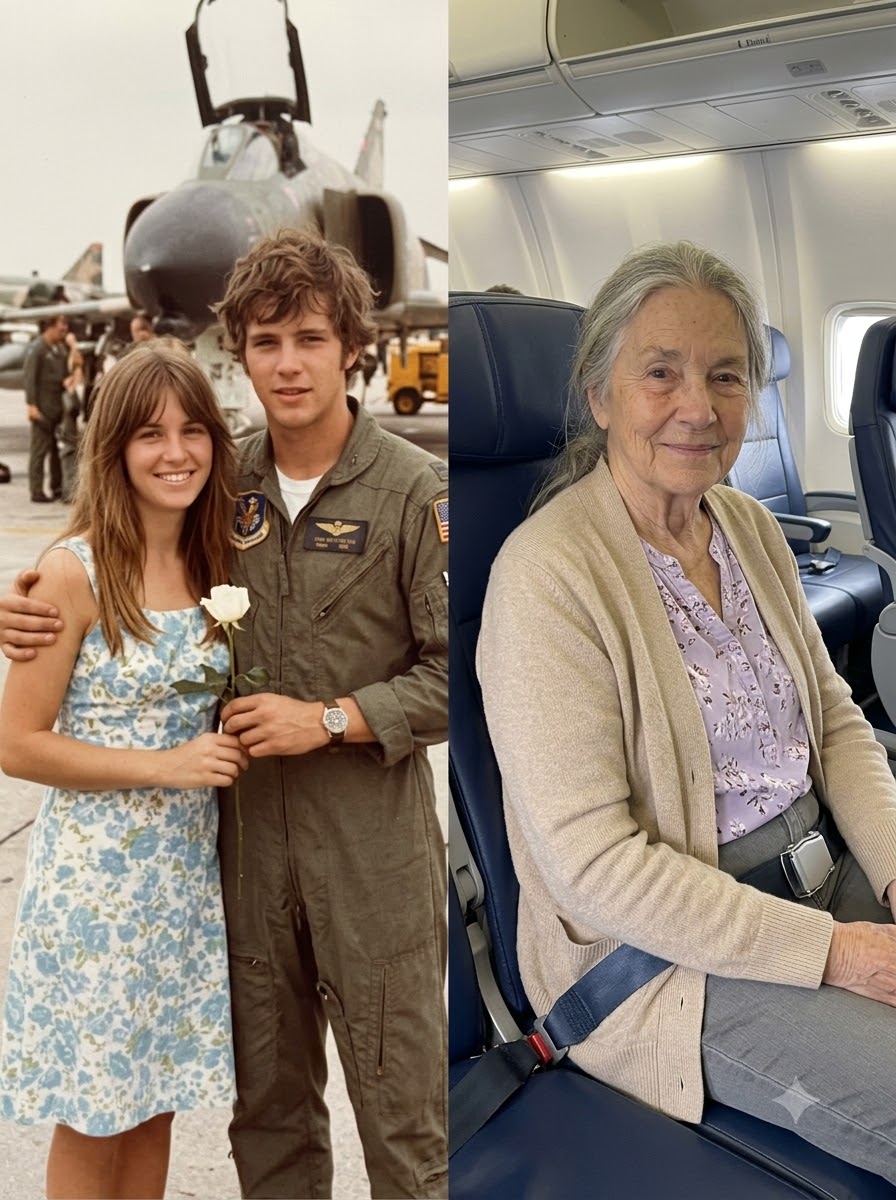
We had met three years earlier at college, when he offered to split his coffee with me because neither of us had enough money to purchase another cup.
“You can have the bigger half,” he said, sliding the cup across the table.
“That doesn’t sound like something an engineering student should say.”
Patrick flashed his crooked smile.
“I’m hoping you’ll be impressed enough to overlook my terrible math.”
I was studying English literature, and Patrick loved making fun of the romantic novels I carried around campus. He was convinced that nearly every difficulty could be solved with enough preparation and logic. I thought human beings were far too complicated for that.
Strangely enough, we were perfect together.
By our third year as a couple, marriage was already part of our plans.
Patrick dreamed of a modest home with a front porch, a dog, and plenty of shelves for the books I could never resist buying. Once, he even sketched a floor plan on the back of one of my college notebooks.
I treasured that drawing for years.
After finishing his engineering degree, Patrick entered the military and began training as a pilot. His decision frightened me, but I understood that flying had always been one of his greatest passions.
Throughout his training, we exchanged letters. Whenever he received leave, he came home, and we tried to squeeze weeks of happiness into whatever days we had together.
On the evening before his departure, we sat on my parents’ porch until nearly midnight.
Patrick held my hand and promised to buy me a proper engagement ring when he returned.
“You’ve already asked me to marry you three times,” I teased. “I think the answer is fairly obvious.”
“Then I’ll ask you a fourth time when I get back.”
Before we parted, he rested his forehead against mine.
“Promise me something, Leona. Don’t let me become some sad story you tell people when you’re old.”
I forced a smile.
“Then you’d better come home.”
“I will, sweetheart.”
Those were the words I carried with me for the next fifty-five years.
Six months later, two military officers appeared at my parents’ front door.
Patrick’s plane had disappeared during a mission.
There was no confirmed crash location. No wreckage had been identified, and nobody could tell us exactly what had happened.
He had officially been classified as missing in action.
I still remember sitting at our kitchen table while my mother prepared tea that none of us could bring ourselves to drink.
One officer explained that there was still a chance Patrick had survived.
I clung to that possibility with everything I had.
When American prisoners of war began returning home in 1973, I searched the newspapers every morning.
I contacted military offices, wrote countless letters, and examined every available list of returning servicemen.
Patrick’s name never appeared in the information I was given.
Eventually, friends and relatives stopped asking whether I had received news.
My parents gently encouraged me to consider meeting another man.
My younger sister, Mabel, even introduced me to a thoughtful gentleman from her church. He was kind and respectful, but I couldn’t bring myself to accept a second dinner invitation.
That didn’t mean I spent my entire life consumed by grief.
I completed my education and became a high school English teacher. I purchased a little house of my own, traveled during summer vacations, and spoiled my nieces and nephews whenever the opportunity arose.
There were celebrations, holidays, friendships, and countless beautiful afternoons.
Much of my life was genuinely happy.
Yet Patrick’s photograph remained beside my bed.
Whenever I heard an airplane flying overhead, I would blow it a kiss and place my hand over my heart.
It was a silly little habit I had developed as a young woman, but I never managed to abandon it.
Every year on Patrick’s birthday, I boarded a plane to visit the veterans’ memorial where his name had been engraved after his disappearance.
I always carried a single white rose and an old photograph of the two of us standing outside our college library.
Sometimes I remained at the memorial for an hour, telling Patrick about my students, Mabel’s children, or the flowers blooming in my garden.
Other times, I was furious with him for making a promise he had never been able to fulfill.
That became my tradition.
Fifty-five years passed.
This year, Mabel’s granddaughter offered to accompany me.
“Aunt Leona, you don’t have to make the trip alone,” she insisted.
I appreciated her concern but assured her I could manage.
At seventy-six, I certainly moved more slowly than I once had. Still, I was perfectly capable of handling my suitcase and navigating an airport.
Besides, visiting Patrick had always been something I preferred to do alone.
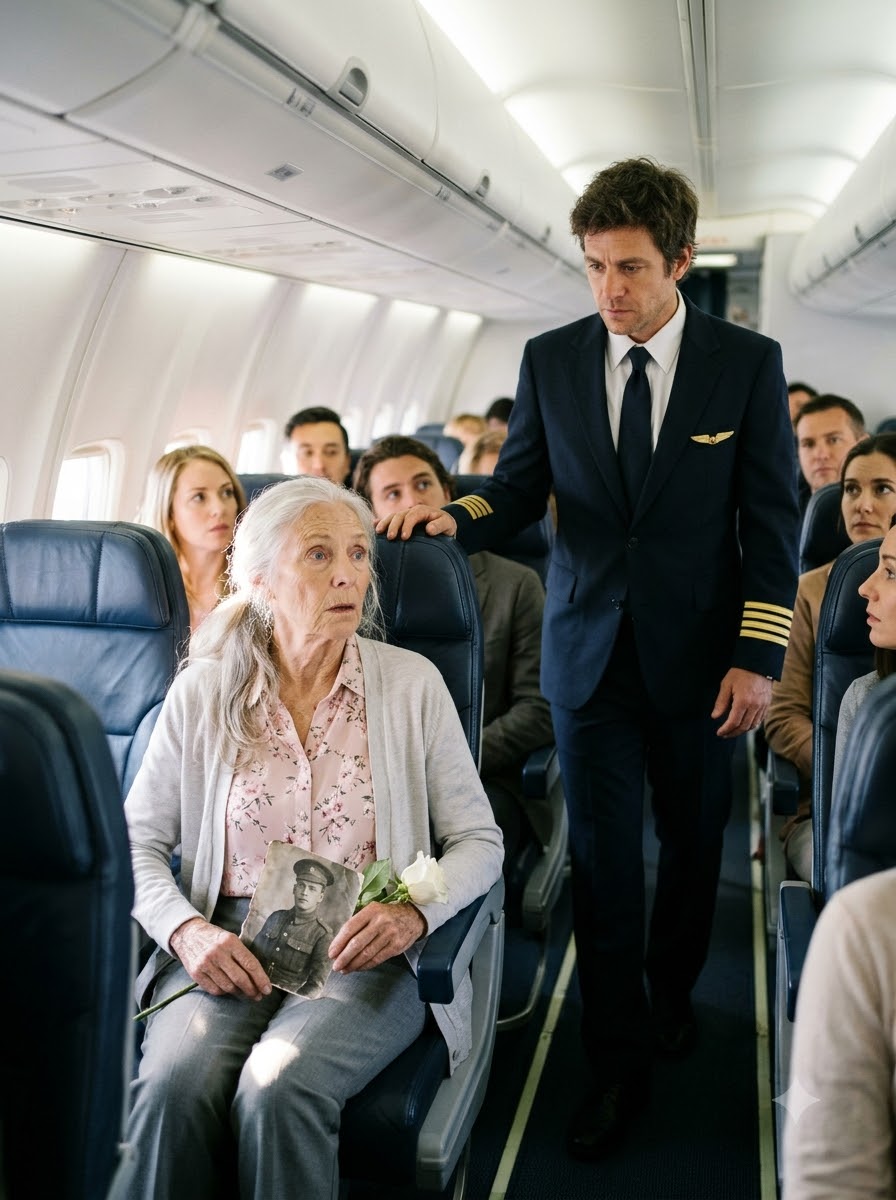
My flight was approaching its destination when the captain’s voice sounded through the cabin speakers.
“Ladies and gentlemen, we’ll be landing shortly. Before we begin our descent, I have a personal announcement.”
I barely lifted my eyes from the book I was reading.
Then I heard my name.
“Ms. Leona Whitcomb? If you’re seated in 12A, I’d like you to listen carefully.”
I stared up at the speaker.
Several passengers turned to look at me.
“I understand you’re traveling today to visit a memorial,” the captain continued. “And I believe you’re bringing a white rose for a pilot named Patrick Mercer.”
My book slid from my fingers onto my lap.
How could an airline captain possibly know something so private?
After a brief pause, he spoke again.
“Ms. Whitcomb, someone has been trying to find you. There’s something about Patrick’s disappearance that you deserve to know.”
My heartbeat became so loud that I could barely hear anything else.
A flight attendant approached my seat and softly asked whether I was feeling all right.
I couldn’t answer.
After the plane landed, she requested that I remain seated until the other passengers had disembarked.
I watched them collect their belongings and walk down the aisle.
Perhaps there had been a mistake.
Perhaps another woman shared my name.
Perhaps somebody had misunderstood something about Patrick.
I repeated those possibilities to myself until the cabin was completely empty.
Then the cockpit door opened.
A young pilot stepped out.
He appeared to be around thirty-eight, with dark hair, broad shoulders, and a crooked smile so familiar that my chest tightened painfully.
For one impossible instant, I thought I was looking at Patrick as he had been more than half a century earlier.
The plastic cup of water slipped from my hand and struck the floor.
The pilot hurried toward me.
“Ms. Whitcomb, I’m terribly sorry. I should have spoken to you privately instead of making that announcement.”
I could barely form the words.
“Who are you?”
He knelt beside my seat.
“My name is Gavin Mercer. Patrick Mercer is my grandfather, and he’s alive.”
I stared at him.
Nothing about the sentence made sense.
I gripped the armrest to steady myself.
“Your grandfather?”
Gavin nodded.
“Patrick survived the war. He came home many years ago.”
For a moment, breathing became difficult.
I had spent more than fifty years believing Patrick was somewhere beyond my reach.
Now a stranger was telling me he had returned to the United States and built a life while I continued bringing flowers to a memorial engraved with his name.
“When?” I whispered.
Gavin leaned closer.
“I’m sorry?”
“When did he come home?”
He hesitated.
“1973.”
The cabin seemed to tilt beneath me.
The very year I had searched every newspaper, called every military office I could find, and prayed every night that Patrick would appear at my parents’ door.
I looked into Gavin’s familiar eyes.
“Why didn’t anyone tell me?”
And suddenly, I was more frightened of the answer than I had ever been of not knowing.
Part 2
Gavin remained kneeling beside my seat, looking deeply uncomfortable.
“Granddad always said you lost touch after the war. I didn’t know you believed he was still missing until recently.”
I stared at his face.
Those eyes belonged to Patrick.
I had spent decades looking at them in an old photograph, and now they were staring back at me from a man who had not even been born when Patrick disappeared.
“Does he know you’re here?” I asked.
“Yes. He asked me to find you.”
I swallowed hard.
There was one question I was already afraid to ask.
“Does he have a family?”
Gavin lowered his gaze.
“He married my grandmother. They had two children.”
I turned toward the airplane window.
Outside, airport workers were unloading luggage while passengers hurried through the terminal.
A little boy stood behind the glass, enthusiastically waving toward the aircraft.
Everything outside looked painfully ordinary.
Yet my entire understanding of the past had just been overturned.
“I need to call my sister,” I said.
Gavin stepped away to give me privacy.
When Mabel answered, I could barely speak.
“Patrick’s alive.”
Silence followed.
“Leona, where are you?”
“At the airport. His grandson found me.”
“Please tell me you’re not going anywhere with a stranger.”
I explained everything I knew and promised to send her Gavin’s full name, telephone number, and the address where Patrick lived.
Mabel urged me to come straight home.
But after fifty-five years, I could not leave without hearing the truth from Patrick himself.
Gavin drove me to a peaceful neighborhood approximately forty minutes from the airport.
During the journey, he explained that Patrick’s aircraft had gone down during the war and that he had been captured.
He eventually returned to the United States with other servicemen in 1973.
After his return, he spent several months recovering at a military hospital.
That was where he met a nurse named Celia.
They married the following year.
“Grandma passed away four years ago,” Gavin told me gently. “Granddad’s health hasn’t been good lately.”
I watched the houses passing outside the car.
“Did your grandmother know about me?”
“I don’t think she knew much. He told us you were his college sweetheart and that the two of you lost touch.”
Lost touch.
Those two words made my stomach twist.
I had not lost touch with Patrick.
I had searched for him.
I had written letters and made phone calls.
I had waited.
“How did you find me?” I asked.
Gavin explained that he had discovered an old photograph while helping his grandfather organize his belongings.
On the back were my full name and the name of the college Patrick and I had attended.
He searched online and found an article announcing my retirement from teaching.
Another newspaper piece mentioned my yearly visits to the memorial.
“When I realized where you were going, I checked whether you were booked on my flight,” he admitted. “I shouldn’t have used the announcement like that. I was afraid I’d miss my chance to speak to you.”
I remained silent.
Gavin had managed to locate me within a matter of weeks.
Patrick had had more than fifty years.
When we arrived, Gavin helped me climb the front steps of a tidy white house.
Family photographs lined the hallway.
Children celebrating birthdays.
Christmas mornings.
Graduations.
Weddings.
An entire lifetime hung on those walls.
I found myself looking at each picture, wondering where I had been when it was taken.
Perhaps grading essays.
Perhaps celebrating a niece’s birthday.
Perhaps standing alone at a memorial, holding a white rose.
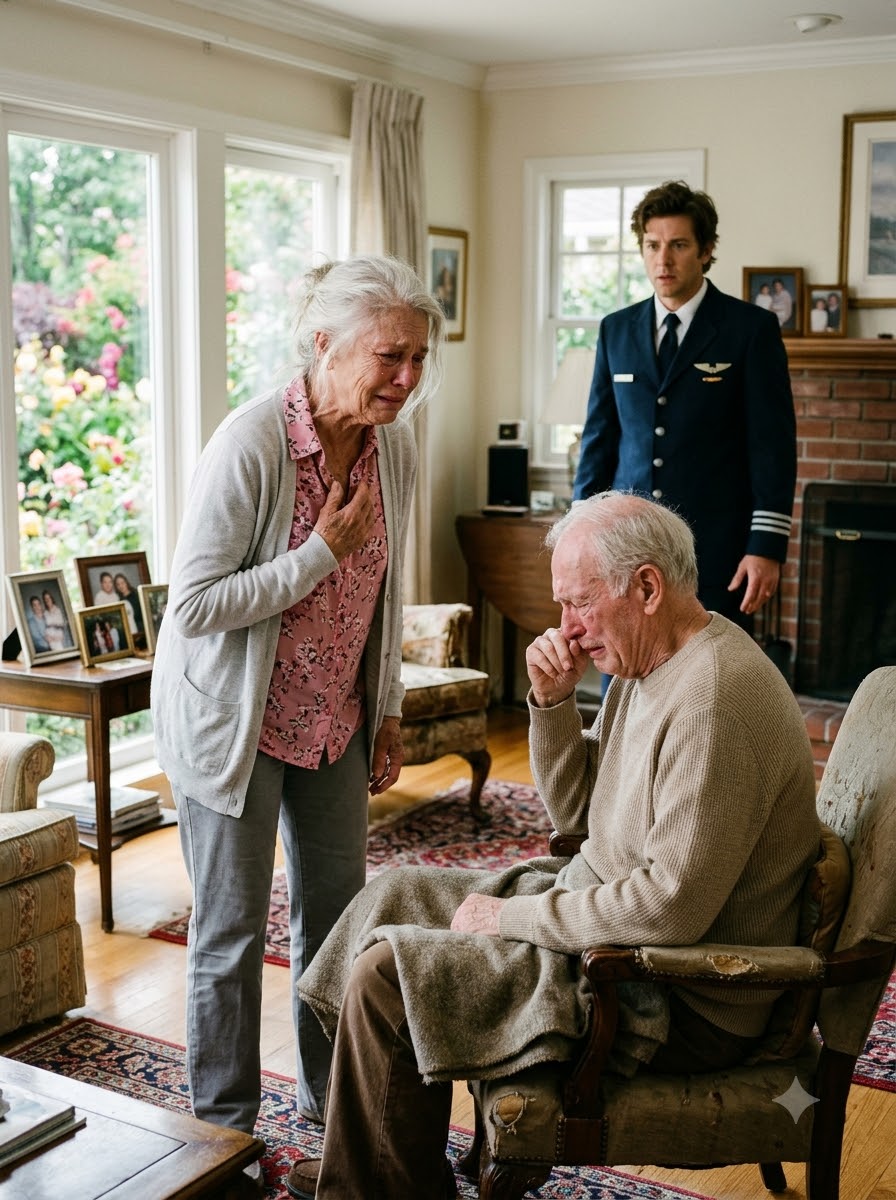
Patrick was seated beside the living room window.
His hair had turned completely white, and his shoulders were narrow beneath a cardigan.
A blanket covered his knees.
His hands trembled slightly as he reached toward me.
But I recognized him immediately.
“Leona,” he whispered.
I had imagined hearing that voice say my name thousands of times.
In my dreams, I always ran into his arms.
Now I stood motionless beside the doorway.
“Tell me why you never came back for me.”
Patrick glanced toward Gavin.
“Could you give us a little privacy?”
“No,” I replied. “Your grandson brought me here because you wanted me to know the truth. Let him hear it.”
Patrick lowered his eyes.
He began describing his return from captivity.
He had been terrified, exhausted, and struggling with nightmares.
Ordinary life had felt unfamiliar.
He had difficulty sleeping, trusting people, and adjusting to the world around him.
Celia had been one of the nurses who helped him during his recovery.
“She understood what I’d been through,” he said. “I never planned for things to happen the way they did.”
I sat in the chair opposite him.
“Did you tell her you were engaged?”
“Yes.”
“And did you tell her that I was waiting for you?”
He rubbed his trembling hands together.
“I told her we’d probably moved on with our lives.”
I looked directly at him.
“But you never asked me.”
Patrick’s eyes filled with tears.
“Celia became pregnant. I wanted to do the right thing.”
“Then you should have told me.”
“I tried writing several times.”
“Did you mail those letters?”
He shook his head.
Something inside my chest tightened.
“Patrick, I spent years wondering whether you were hungry, frightened, or lying somewhere injured. I thought about you every time a plane passed over my house.”
His face crumpled.
“I was ashamed, Leona.”
I stared at him.
“Were you ashamed in 1974? What about 1984? Or 1994?”
He could not answer.
I thought of his parents.
They had known me well. His mother had once told me that I was the daughter she hoped to have someday.
“Surely they knew you were home,” I said. “Why didn’t they contact me?”
Patrick turned toward the window.
“I told them I’d written to you.”
“And?”
“I said you knew I’d returned, but you’d asked me not to contact you again.”
For several moments, I could only stare.
He had allowed his own parents to believe I had rejected him.
That explained why his mother had stopped answering my letters.
It explained why the Mercer family had gradually disappeared from my life.
“You made them think I didn’t want you anymore?”
Patrick began to cry.
“I couldn’t face telling everyone what I’d done.”
Gavin stood near the fireplace, visibly shaken.
“Granddad, you told us she ended the relationship.”
Patrick covered his face.
I wanted to scream.
I wanted to ask how he could have watched the years pass while knowing I might still be waiting.
Instead, an overwhelming exhaustion settled over me.
For decades, I had cherished the memory of a young man who promised to return and build a future with me.
The elderly man sitting across from me had come home, chosen another future, and left me believing he was missing.
Then a car pulled into the driveway.
A woman and a man entered the living room carrying bags of groceries.
Gavin introduced them as his mother, Anne, and his uncle Colin.
Anne smiled warmly when she saw me.
“You must be Leona. Dad told us he hoped you could finally catch up.”
Her smile faded when she noticed our expressions.
“What happened?”
Gavin explained what he had just learned.
Anne slowly turned toward her father.
“Dad, did you know she thought you were still missing?”
Patrick wiped his eyes.
“I thought she’d eventually find out.”
“Then why didn’t you tell her yourself?” Colin demanded.
Patrick looked helplessly at his children.
“I loved your mother. I didn’t want to hurt her or lose the family we had.”
Anne sank into a chair.
“But you let Leona spend all those years believing you never came home?”
Patrick whispered that he was sorry.
I believed his remorse was real.
I could see it in his face and in the devastation of his children as they began to understand what he had done.
But remorse could not return the years I had spent waiting.
Eventually, Patrick reached toward my hand.
“I don’t expect you to forgive me today. I only hoped we might have a little time together now. However much I have left.”
He looked so fragile that my heart ached despite everything.
I remembered the young engineering student who had shared his coffee with me.
I remembered the house he had drawn in my notebook.
I remembered our walks across campus and our ridiculous arguments about books.
Those moments had been real.
But so had his decisions afterward.
“I hope you’re comfortable, Patrick,” I said quietly. “And I hope your family takes good care of you.”
He waited for me to continue.
“But I can’t come back into your life as though nothing happened.”
“Leona, please. We lost so much time.”
I looked around at the photographs on his walls.
“You had Christmas mornings, children to raise, and someone beside you when you grew old. I’m glad your family has those memories. But you didn’t lose the same things I did.”
Patrick began to cry again.
I did not move to comfort him.
For fifty-five years, I had carried the sorrow of losing him.
I could not carry the sorrow of his choices as well.
Part 3
Gavin accompanied me outside.
At the car, he paused before opening the passenger door.
“I’m sorry,” he said. “I never meant to hurt you by bringing you here.”
I looked at the young man.
He had Patrick’s eyes and the same crooked smile, but he was not responsible for the decisions his grandfather had made.
“You believed what your grandfather told you,” I said. “I understand that.”
Gavin nodded, though he still looked troubled.
“Where would you like me to take you?”
For a moment, I considered asking him to drive me straight to a hotel.
I wanted to close the curtains, lie down, and avoid speaking to anyone until I could make sense of what had happened.
Then I looked at the white rose resting in my handbag.
“Take me to the memorial.”
He glanced at me.
“Are you sure?”
“Yes.”
He did not question me again.
We drove in silence.
The afternoon sun was already descending when we reached the memorial grounds.
Long shadows stretched across the paths, and the trees stood quietly beneath the fading light.
I had walked those paths every year for more than half a century.
Sometimes I came in the rain.
Sometimes the air was so cold that my fingers ached around the stem of the rose.
Sometimes the memorial was crowded with visitors.
Other times, I stood there entirely alone.
But no matter the weather or the circumstances, I always came.
I had believed Patrick was missing, perhaps buried somewhere no one had ever discovered.
I had imagined him frightened and alone during his final moments.
I had wondered whether he remembered my face.
Whether he remembered our porch.
Whether he had thought about the engagement ring he promised to buy.
Now I knew he had survived.
He had returned home.
He had married, raised children, celebrated holidays, and grown old.
And throughout those years, I had continued traveling to a memorial that carried his name.
Gavin waited near the entrance while I walked toward the engraved names.
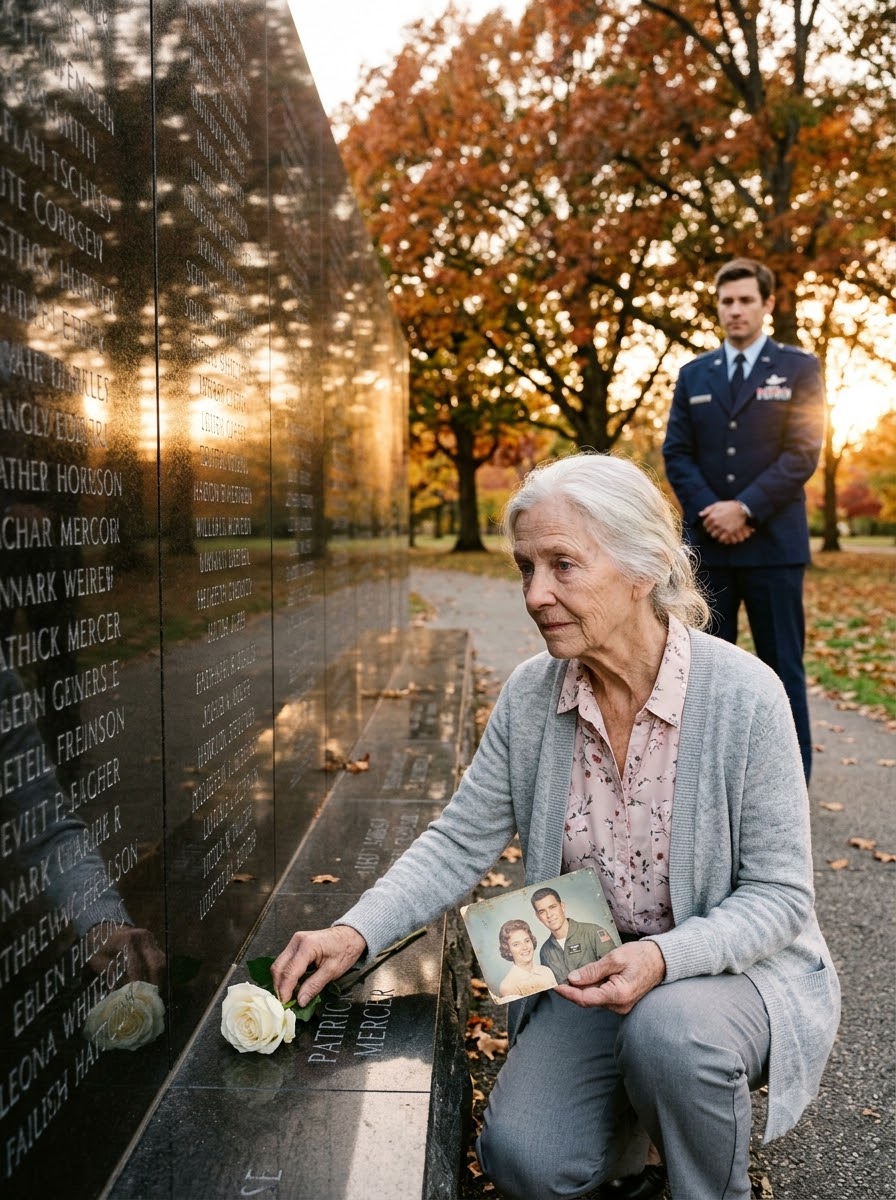
I held the white rose in one hand and our college photograph in the other.
When I reached Patrick’s name, I stopped.
For fifty-five years, I had stood before those letters hoping that, somehow, he knew I was remembering him.
Now I understood that he had been alive through every one of my visits.
I looked down at the photograph.
There we were, barely more than children ourselves.
Patrick stood outside our college library with one arm around my waist.
I was laughing at something he had said just before the picture was taken.
I could almost remember the sound of his voice that afternoon.
The breeze.
The weight of the books in my arms.
The feeling that our future was something we could plan together.
For one brief, angry moment, I considered tearing the photograph into pieces.
Then I stopped.
That young man had made me happy.
We had loved each other.
We had shared dreams, jokes, and ordinary afternoons that still mattered to me.
Learning how our story had ended did not mean those earlier years had been false.
Patrick’s betrayal did not erase every happy memory.
I carefully slipped the photograph back into my purse.
Then I knelt and placed the white rose beneath his engraved name.
Usually, I would spend a long time talking to him.
I would tell him about my students, the books I was reading, Mabel’s family, or the flowers growing outside my little house.
Sometimes I told him about the things that had gone wrong.
Sometimes I asked him questions that no one could answer.
But this time, I said nothing.
I stood quietly before the memorial.
There was no longer a reason to tell him about my year.
He was alive.
He had been alive all along.
And the woman who had spent fifty-five years waiting for him was finally beginning to understand that she did not have to wait anymore.
When I turned away, Gavin was still standing near the entrance.
He did not ask what I had said.
He simply walked beside me to the car.
I was grateful for that silence.
That evening, I called Mabel from my hotel room.
She answered almost immediately.
“Leona?”
“I’m here.”
“Are you all right?”
I looked at the suitcase standing beside the bed.
“I don’t know yet.”
“Tell me what happened.”
So I told her.
I explained that Patrick had returned in 1973.
That he had married a nurse named Celia and raised two children.
That he had told his parents I no longer wanted him.
That he had written letters but never mailed them.
That he had known, at least in part, that I might still be waiting.
Mabel listened without interrupting.
When I finished, I heard her crying.
“Oh, Leona.”
I sat on the edge of the hotel bed.
“I thought I would be furious when I found him.”
“Weren’t you?”
“I was.”
“And now?”
I looked toward the window.
“Now I’m tired.”
She was quiet for a moment.
“Do you want me to come and get you?”
“I have a flight tomorrow,” I said. “I’ll be home by lunchtime.”
“Then I’ll be waiting.”
After we ended the call, I opened my handbag and took out the photograph again.
For years, I had kept it carefully protected, as though it were proof of something the world had forgotten.
Now I studied our younger faces with different eyes.
I remembered how Patrick used to tease me for carrying romantic novels everywhere.
He thought life was something you could solve through planning and logic.
I had always insisted that people were more complicated.
Perhaps we had both been right in ways neither of us understood.
Patrick had survived the war, but he had not found the courage to face the life he left behind.
He had chosen silence because telling the truth would have been difficult.
And I had built my own life around the belief that his absence had been beyond his control.
Neither of us could change those years.
But I could decide what happened next.
I placed the photograph inside my suitcase.
Then I turned off the light.
For the first time in a very long time, I did not fall asleep wondering where Patrick was.
I knew.
And knowing meant I could finally stop searching.
The following afternoon, Mabel met me at the airport.
She hurried toward me as soon as she spotted me, her arms already open.
I hugged her tightly.
For a moment, neither of us spoke.
Then she took my suitcase.
“Come on,” she said. “I made lunch.”
She drove me straight to her house.
The kitchen smelled of chicken soup, and there was a loaf of fresh bread from the bakery waiting on the table.
It was my favorite meal.
I smiled when I saw it.
“You always know what I need.”
Mabel shrugged.
“I’ve had plenty of practice.”
We sat together for hours.
We talked about Patrick.
We talked about our parents and the years when we were young.
We remembered family holidays, childhood arguments, and the little adventures we had somehow forgotten.
We also talked about ordinary things.
The neighbors.
Her grandchildren.
The garden I wanted to plant in spring.
There was something comforting about those conversations.
For so long, Patrick had occupied a quiet corner of my life that no one else could enter.
Now I was allowing my sister to sit beside me in that place.
And I discovered that sharing the pain did not make it larger.
It made it easier to carry.
At one point, Mabel put down her spoon.
“What do you want to do next?”
I looked at her.
It was such a simple question.
Yet for years, whenever I thought about the future, there had always been an invisible condition attached.
Perhaps one day I would hear news about Patrick.
Perhaps one day someone would explain what happened.
Perhaps one day I would finally know.
Now that day had arrived.
And there was still a future waiting beyond it.
I remembered a little seaside town Mabel and I had talked about visiting.
Years earlier, we had found a photograph of a beach cottage in a travel magazine.
It had white shutters, a small porch, and a view of the ocean.
We had admired it, laughed about how lovely it would be to stay there, and then put the magazine away.
“Do you remember that beach cottage we found in the travel magazine?” I asked.
Mabel smiled.
“Of course. You said it was too expensive.”
“I’ve been saving money for a long time,” I replied. “Perhaps we should finally go.”
Her face brightened.
“Are you serious?”
“Why not?”
She reached across the table and took my hand.
“We should.”
I smiled.
For the first time in days, the smile felt completely natural.
We began talking about when we might travel, what we would pack, and how many books I would insist on bringing.
Mabel teased me about filling an entire suitcase with novels.
I told her that some habits were too good to abandon.
We laughed.
And I realized that the laughter did not feel like a betrayal of the young man I had once loved.
It felt like my own life returning to me.
Later that evening, Mabel washed the dishes while I stood near the kitchen window.
The sky had turned a soft shade of blue-gray.
A few lights were beginning to glow in the neighboring houses.
Then I heard it.
The familiar distant sound of an airplane.
I looked up.
A plane was moving slowly across the evening sky.
For fifty-five years, that sound had made me think of Patrick.
Sometimes I imagined he was flying somewhere above me.
Sometimes I imagined he was watching over me.
And every time, without fail, I blew a kiss toward the sky and pressed my hand against my heart.
My hand began to rise automatically.
The old gesture was as familiar as breathing.
But this time, I stopped.
I thought of Patrick sitting in his white house, surrounded by photographs of the life he had chosen.
I thought of the young man outside our college library.
I thought of the white rose I had placed beneath his name.
And I thought of Mabel standing in the kitchen, humming softly as she washed the dishes.
There were people who had remained beside me.
There were places I had not yet visited.
There were mornings I had not yet lived.
I did not need to spend the rest of my life looking toward the sky for someone who had already come home.
Slowly, I lowered my hand to the windowsill.
The airplane continued across the fading light.
I watched until it disappeared beyond the rooftops.
And for the first time in fifty-five years, I let it go without blowing a kiss.
