


PART 1: The Easter Celebration I Refused to Host
“You call this cooking? No wonder nobody wants to eat your food.” My daughter-in-law, Vanessa, let the spoon fall onto the kitchen counter after sampling the rosemary sauce I had worked on all morning. Daniel, my forty-one-year-old son, stood against the refrigerator beside her, smiling. He offered no defense and showed no embarrassment. I untied my apron and took it off slowly. “Then I suppose you won’t need my house for your Easter party.” Vanessa laughed. “Margaret, don’t be ridiculous. Forty guests are coming.” I looked at her. “Then you’d better tell them the celebration is canceled.”
My name is Margaret Whitmore. Before retiring, I had practiced real estate law, and the home surrounding us had been in my family for generations. My late husband, Thomas, and I had devoted decades to caring for its twelve acres. He had restored the oak doors, repaired the terraces, and planted the gardens around the house. After his death seven years earlier, I had promised myself I would protect what we had built together. It had never occurred to me that keeping that promise might mean protecting our home from our own son.
Daniel and Vanessa had arrived three months before Easter, asking to stay temporarily after his business failed. Because they were family, I welcomed them, although I required Daniel to sign a written occupancy agreement. He regarded the document as a needless formality. Vanessa, meanwhile, quickly began acting as if ownership had already passed to her. She moved my furniture around, dismissed Rosa, my longtime housekeeper, and referred to the property as “our estate” when friends came over. Every change made it clearer that her idea of being a guest differed considerably from mine.
Then Vanessa declared that she was organizing an elaborate Easter celebration. Without seeking my permission, she invited forty people, ordered flowers, rented costly table settings, and arranged champagne service. When I objected, Daniel behaved as though I was the problem. “Mom, Vanessa is just trying to make the place more modern.” By Easter morning, I had learned that almost $4,800 in celebration expenses had been billed to my household account. Vanessa had also put personal purchases on my credit card. Yet even those charges were not the discovery that frightened me most.
Two days earlier, an unfamiliar refinancing application had appeared in my home printer’s queue. It identified my property as collateral and carried a signature that closely resembled my own. I had never signed it. Alongside it was a power-of-attorney document that supposedly gave someone else permission to act for me. My legal experience told me immediately that something was wrong. So when Vanessa insulted my sauce and suggested I stay upstairs during her sophisticated gathering, I did not waste time defending my cooking. I had far more urgent matters to address.
In my study, I called the caterer and canceled the arrangements charged to my account. I then contacted a locksmith about securing my private rooms and telephoned Ellen Pierce, my former law partner, to discuss legally ending Daniel and Vanessa’s occupancy. Ellen cautioned me against changing the outside locks while they retained lawful possession. “The court must handle any contested removal,” she explained. “I understand. But I want them out.” Her answer was firm. “We’ll do it properly. First, preserve those documents and contact the bank.”
I went out onto the terrace and reached the bank’s fraud department. Using the reference number I had copied, a supervisor named Helen Richards found the refinancing application. “Mrs. Whitmore, our records indicate that you authorized this request.” I answered without hesitation. “I absolutely did not.” Helen put me on hold to examine the file. When she came back, her tone was different. “No funds have been released under this application. However, there’s a related request for an expedited property valuation.” My hand tightened around the terrace railing.
“Who requested it?” I asked. “I can’t disclose every detail yet, but Daniel Whitmore’s name appears in the file.” For a few seconds, I could not find my voice. Then I asked Helen to flag the application as suspected fraud and retain the submission records. She wanted to know whether anyone could have gained access to my identification documents. Her question brought back something I had tried not to dwell on: Vanessa had entered my study three weeks earlier, claiming she needed a passport copy for an anniversary surprise.
I had refused to give it to her. Later that same afternoon, however, I had noticed that my locked document drawer was slightly open. Remembering it now, with the bank’s warning still in my ears, made the incident impossible to dismiss. Daniel had spent years coming to me whenever his finances collapsed. I had repeatedly helped him, believing I was giving him another chance to recover. This time, it appeared he had tried to put my home behind his obligations without ever asking me.
When the call ended, I looked through the kitchen window. Daniel stood beside the silver serving tray Thomas had given me for our thirtieth anniversary, helping himself to strawberries. Nothing in his expression suggested concern. I remained on the terrace, trying to reconcile that casual picture with the documents I had found. The celebration, the charges, and Vanessa’s assumption that she could send me upstairs no longer seemed like separate offenses. I was beginning to think the Easter party was merely the visible edge of something much larger.

Daniel came outside shortly afterward. “Mom, can we talk? Vanessa is furious about the party.” I turned to face him. “Your wife insulted me in my own kitchen, and you stood there smiling. Why?” He shifted uncomfortably. “Sometimes you make things difficult. You keep reminding us that everything belongs to you.” I held his gaze. “Because it does, Daniel.” His reply came quickly. “Legally, sure. But we’re family.” I let a moment pass before asking what I had really been waiting to ask. “Then why did you submit a refinancing application using my signature?”
His face changed at once. “I don’t know what you’re talking about.” I continued. “What about the power of attorney?” He glanced toward the open kitchen window. “Lower your voice, Mom.” I stayed exactly where I was. “Did you forge my signature?” Daniel rubbed his forehead. “Things got complicated with the business. There are investors expecting their money back.” His first company had closed six months before, but now he admitted that he had launched another property investment venture with people Vanessa had introduced to him.
“How much money are we talking about?” He paused before answering. “Just under two million dollars.” I could only stare. He went on to admit that he had reassured those investors that significant family assets could support the venture. The family asset he meant was my house. “You offered my property as security without asking me?” He tried to appeal to the person whose absence still hurt most. “I thought you’d understand. Dad would have helped.” I answered him plainly. “Your father would have helped you tell the truth.”
The front gate intercom sounded before he could respond. Several of Vanessa’s guests had been invited to arrive early. Inside, she was still protesting the canceled catering and champagne. When I told her the gathering would not proceed, she insisted I had no right to humiliate her. I reminded her that Daniel had signed an occupancy agreement and would receive formal notice. She turned toward him, incredulous. “You told me your mother wanted us to live here permanently!” Daniel looked down. Then Vanessa added, “You promised this house would eventually be ours!”
Before I could press him about that promise, a black sedan pulled up, followed by a silver SUV. The arriving visitors were dressed for business rather than an Easter meal. Vanessa moved quickly toward the entrance. “These are our investors, Margaret. Please don’t ruin this.” I looked at my son. “What exactly are they investing in?” Vanessa answered with unmistakable pride. “The Whitmore Estate Collection. It’s a luxury hospitality venture.” My stomach tightened. She had been presenting my house as the centerpiece of a business to which I had never consented.
I reached the front door first. A man in a charcoal suit introduced himself as Charles Bennett. With him were investment adviser Patricia Lowell and her client, Beatrice Hall. Charles greeted me warmly. “Mrs. Whitmore, it’s wonderful to finally meet the principal owner.” I asked, “Principal owner of what?” He answered, “The proposed hospitality development.” I looked straight at him. “Who told you I authorized this project?” His smile disappeared. “We received signed documentation.” He opened his portfolio and handed me an agreement carrying my name.
The signature was close to mine, but its final stroke was incorrect. The date mattered even more: March seventeenth. I had been in Boston that day for a medical appointment. “I didn’t sign this,” I told him. Vanessa cut in immediately. “Margaret has been under a lot of stress lately. She’s becoming forgetful.” Beatrice frowned at her. “Are you suggesting she’s incapable of managing her affairs?” Vanessa hesitated. I asked Charles to take the documents into my study, where I could examine exactly what these people had been shown.
Charles laid out a refinancing schedule, a valuation, and a letter that supposedly authorized the venture. I had approved none of them. An unfamiliar notary stamp appeared on the agreement. He acknowledged that no one had met with me or independently confirmed my consent. I told him to retain every communication and halt further transactions. At last Daniel spoke. “I thought Mom would agree eventually.” Charles repeated the word in disbelief. “Eventually?” Daniel lowered his eyes, then admitted that he and Vanessa intended to move me into the guest cottage while converting the main house for their business.
They had been discussing that arrangement since January, shortly after moving in. I sat behind my desk, struggling to grasp how my son could accept my hospitality for three months while planning to displace me. As Charles collected the paperwork, Beatrice noticed a photograph of Thomas. “Thomas Whitmore,” she said softly. “I knew him years ago.” Her name suddenly became familiar. She had been among my husband’s earliest business supporters. Then she reached into her handbag and brought out a cream-colored envelope.
“Margaret, Daniel contacted me privately last month. He told me you were planning to sell the estate and move abroad.” Inside the envelope was a letter headed NOTICE OF INTENT TO SELL, marked with another signature I had not written. A medical certificate was attached, alleging that I suffered significant memory impairment. I read the physician’s name, then read it again: Dr. Samuel Everett. He had been dead for two years. Across the desk, Daniel had gone pale. Someone had invoked a dead doctor to undermine my capacity while arranging the sale of my home—and the people in my study appeared to know more than they had admitted.
PART 2: The Signature They Thought I Would Never Question
I raised the medical certificate so Daniel could see it. “Explain why a doctor who died two years ago supposedly examined me last month.” He kept his eyes on the floor. Vanessa moved forward. “Margaret, you’re making this sound much worse than it is.” I looked at her. “Which part is a misunderstanding? The forged signature or the dead physician?” Charles examined the certificate while Patricia searched the doctor’s name on her phone. His obituary appeared within seconds. Beatrice faced Daniel. “Your father spent his life building trust. Is this what you’ve done with it?” He offered no answer.
I asked the visitors to leave the study, then instructed Daniel and Vanessa to go, too. I could not think clearly with another explanation or accusation waiting to interrupt. After locking the door, I sat at Thomas’s desk. During our final Christmas together, he had given me a little blue notebook. In it, he had reminded me to fill our home with laughter without giving up my peace. I read his words and cried. For years I had paid Daniel’s debts, helped him find work, and covered expenses he could not manage. Somewhere along the way, he had begun to mistake generosity for something he was owed.
When I called Ellen and described the latest documents, she no longer treated the situation as a housing disagreement. “This is no longer just an occupancy dispute,” she said. “You need to report the suspected forgery and preserve every document.” She had also found that Whitmore Residential Services, a company Daniel previously used to reimburse household expenses, had recently been reactivated. Daniel and Vanessa were named as managers. The company had submitted paperwork asserting management authority over my property. “Does that give them any rights?” I asked. Ellen answered, “Not simply because they filed the paperwork. But it could mislead people who don’t verify ownership.”
Charles and the investors immediately came to mind. Ellen advised me to get certified property records, secure my financial accounts, and use the courts to address Daniel and Vanessa’s occupancy. When I stepped back into the hallway, Vanessa was receiving more visitors. She introduced me as Daniel’s mother and continued talking about renovations. I spoke directly to the guests. “This event has been canceled. I have not authorized any hospitality development involving this property.” Lawrence Price, an attorney representing one investor, asked whether I disputed the signed agreement in its entirety. “Yes. I never approved it.”
The guests started leaving. Before Lawrence went, he told me that some investors understood the estate was already under contract for sale to Bellweather Capital Holdings. Vanessa seized Daniel’s arm as soon as the name was mentioned. Neither of them would explain the company’s role. A few minutes later, Ellen called again. A title alert had identified a document filed against my property that morning. It asserted purchase rights under an agreement supposedly bearing my signature. “Who controls Bellweather?” I asked. Her answer brought the scheme closer still. “Vanessa’s father, Richard Bell.”
I remembered Richard walking around the estate during Daniel’s wedding reception, asking questions about the acreage and its development possibilities. Ellen continued. “The filing refers to an option to purchase your home for one million dollars.” The property was worth more than eight times that figure. Then she added, “The option supposedly expires at midnight.” Nausea rose in me. My home was not simply being offered as backing for Daniel’s latest venture. Vanessa’s father was claiming a right to buy it for a fraction of its value, under paperwork I had never knowingly approved.
Ellen asked whether I had ever signed anything Daniel brought me without reading it closely. A memory returned: three months earlier, when I was seriously ill, he had brought me what he described as a household insurance authorization. I had trusted him. Turning toward my son, I asked, “What did you make me sign while I was sick?” He began to shake. “Vanessa said it was temporary.” I pressed him. “What was temporary?” His answer was barely more than an admission. “The transfer.” Before I could question him further, Vanessa appeared at the top of the stairs.
Behind her stood Richard Bell, silver-haired and wearing a dark suit. He descended several steps with a thick white folder in his hand. Vanessa watched me with quiet satisfaction. Richard opened the folder and showed another collection of property documents, claiming that Bellweather now held an interest in the estate. I kept Ellen connected on the phone and examined what I could see from where I stood. Whatever Daniel had signed, whatever Vanessa had organized, and whatever Richard imagined he had acquired, one fact remained unchanged: I had never agreed to sell my home.
“Margaret, there’s no reason for this to become unpleasant,” Richard said. “These documents represent a legitimate business arrangement.” I kept my voice steady. “Then you won’t object to my attorney examining the originals.” His expression tightened when Ellen identified herself through the phone. She told him that we were contesting the purchase option and requesting the records behind it. Richard immediately redirected his attention toward Daniel. “Your son assured us he had the necessary authorization.” I understood his purpose. He was already positioning my son to bear responsibility for the entire arrangement.
“Daniel,” I said, “tell us what happened.” He looked at Vanessa, who gave a sharp shake of her head, and then began to speak. His new investment business was in serious trouble. Nearly two million dollars had come from investors, and several were threatening legal action. Vanessa had proposed asking her father for emergency financing. Richard agreed on the condition that my estate serve as collateral. The white folder remained in his hand as Daniel finally admitted what had followed. “When Mom didn’t agree, Vanessa said she’d never notice,” he said.

Vanessa stepped toward him. “Stop lying!” For once, Daniel faced her instead of looking away. “You said she was getting old. You said the house would be ours eventually anyway.” Those words hurt more than the insult about my cooking. In Vanessa’s calculations, my life and memories seemed to count for nothing. I was merely standing between her and a valuable asset. I asked Daniel about the certificate carrying the dead doctor’s name. He glanced toward Richard. “Richard arranged it. He said it would explain why Mom wasn’t participating directly.”
Richard insisted that Daniel had expressed worries about my mental capacity. Daniel denied that, but Richard reminded him that he had signed a supporting statement. Ellen instructed everyone to preserve their documents and communications. She was already arranging independent legal assistance regarding the suspected financial crimes. Richard attempted to bring the conversation to an end, and I made no effort to stop him. Instead, I returned to the study and opened the security records I had been examining since finding the refinancing application. By then, I knew that competing accusations would not be enough.
Three weeks earlier, I had installed software to record printer activity, changes to documents, and attempts to enter protected files. The house also had visible security cameras monitoring the entrances, driveway, and doorway to the study. I searched for March seventeenth, the date on the authorization I had not signed. That was the day I had traveled to Boston. I had left at 6:40 that morning. At 11:14, the recording showed Vanessa entering the study corridor with Richard, who was carrying a black briefcase. They stayed inside for thirty-eight minutes.
When they came out, Richard had papers in his hand. Daniel joined them in the hallway. I turned from the footage to the printer history and found an entry at 11:27. Six documents had been processed: the disputed authorization, the purchase option, the medical certificate, the valuation request, the financing application, and preliminary transfer instructions. The jobs had originated on Vanessa’s laptop. I had just watched her father carry papers out of my study on the day I was away. Now the printer records connected her computer to the documents they were asking me to accept.
PART 3: The Price of Coming Home
I copied the relevant recordings and logs, then telephoned Ellen. “Preserve the original files,” she instructed. “Don’t edit or circulate anything. We’ll arrange for the evidence to be reviewed properly.” When I came out of the study, Richard was speaking quietly into his phone. I addressed him directly. “Mr. Bell, I’ve located security footage and printer records from March seventeenth. My attorney will be reviewing them.” Vanessa stared at me. “You recorded us?” I answered, “The security cameras were visible, and everyone living here knew where they were installed.”
Richard shut his folder. “This conversation is finished.” He moved toward the front door and instructed Vanessa to come with him. She turned to Daniel. “Are you coming?” He stayed seated on the staircase. “No.” Vanessa called him a coward and left with her father. After the door closed, Daniel covered his face. “Mom, I’m sorry.” I watched him for a long moment. “An apology doesn’t undo what you’ve done.” He answered, “I know.” I told him, “Then start by telling investigators the truth. Get your own attorney, and take responsibility for the money you owe.”
He nodded. I also told him that he and Vanessa would have to leave through the appropriate legal process. During the following days, Ellen coordinated with the bank, property records specialists, and investigators. No money had been released through the refinancing application. No completed conveyance of the proposed transfer had been recorded. Bellweather’s claimed purchase rights were being formally contested, and my name remained on the title. Those facts mattered enormously, but they did not mean the investigation was over. There were still documents to examine and explanations to test.
On the third evening after Easter, Daniel knocked at my study door and put a small brass key on the desk. I knew it at once: Thomas’s workshop key. “Vanessa wanted me to search Dad’s files,” he admitted. “She thought there might be more property documents.” He told me he had gone inside and opened the filing cabinets, then stopped when the scent of sawdust and the sight of his father’s tools brought back his childhood. From his jacket, he took a handwritten letter. It ran to four pages.
The letter detailed what he had told investors, which documents he had handled, and how Vanessa and Richard had participated. At the end, he acknowledged responsibility for his own choices. I read every page before asking whether his attorney had reviewed it. “Yes,” he replied. I said, “Then follow her advice about submitting it.” For the first time since Easter morning, my son had brought me an account of his actions rather than another crisis for me to solve. Whether he would keep telling the truth once the consequences arrived was something I could not yet know.
The inquiry continued for months. Statements from investors, bank records, printer logs, and security footage gradually established how Daniel, Vanessa, and Richard had attempted to use my estate to save their struggling venture. The contested purchase option was invalidated, the refinancing application was terminated, and the property records were corrected. The house remained legally mine. Bellweather Capital faced civil claims while investigators continued examining the financial misconduct. Vanessa’s own communications contradicted the accounts she had given investors, damaging the reputation she had worked so hard to maintain.
Daniel accepted responsibility for his participation. Business relationships ended, serious financial consequences followed, and he eventually separated from Vanessa. Yet the legal and financial proceedings were not the hardest part for me. What hurt most was acknowledging that the relationship I had known with my son might never return. Protecting the property required records, lawyers, and persistence. Learning to live with his betrayal was not something a corrected title could accomplish. I could remain his mother without pretending that the past several months had not happened.
Two months after Easter, Daniel agreed to leave under a written settlement. Vanessa had already gone. The return of their keys and removal of their possessions were carefully documented. On moving day, I watched him carry boxes through the front entrance. Among his belongings was the little wooden rocking chair Thomas had made when Daniel was four. Seeing it leave with him brought together the child I remembered and the adult whose decisions I was still struggling to understand. “Take good care of that,” I told him. “I will, Mom.”
Before he went, he placed his house key in my hand. “Do you hate me?” I looked at the man who had almost cost me my home. “No, Daniel. I hate what you did. But you’re still my son.” He asked, “Will you ever trust me again?” I could not offer reassurance I did not feel. “I don’t know. I hope you’ll give me a reason to.” He nodded, went to his car, and drove away. I waited until he had disappeared before allowing myself to cry.
That afternoon, the locksmith rekeyed the exterior doors. For the first time in months, I could move through the house without fearing another unauthorized visitor or financial arrangement made behind my back. Daniel had returned his key, and the legal arrangements governing his departure had been honored. The rooms were mine to occupy without wondering what was being promised in another part of the house. Still, the quiet did not erase the conversation at the front door. I had refused to tell my son that I hated him, but I had also refused to promise trust.
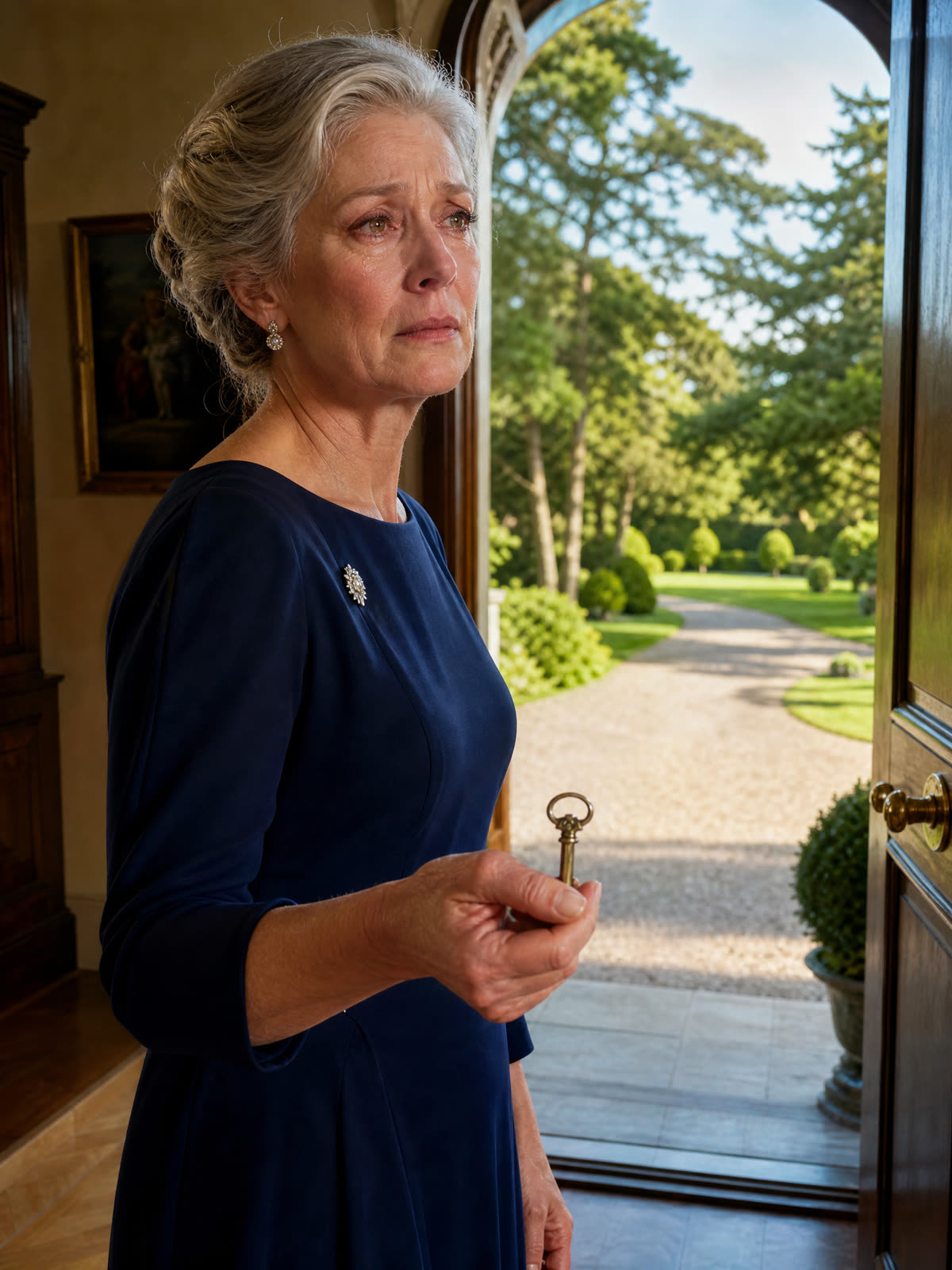
Later that summer, Daniel called. He had found work restoring antique furniture and was learning the skills Thomas had once tried to teach him. “I’m not calling for money,” he said. “I just wanted you to know I’m trying.” We talked about the pieces he was working on and about my garden. The conversation did not repair everything between us, but it was the first one we had shared in years that contained no request. I did not have to solve a problem, write a check, or decide whether another promise deserved another chance.
The next Easter, I invited twelve people to dinner. Beatrice arrived with flowers. Ellen brought her husband, and Rosa joined us as a guest with her grandchildren. No investors attended. There were no expensive rentals and no strangers discussing what my property might be worth. In the kitchen, I prepared the rosemary sauce again. A young friend named Grace tasted it and said, “This tastes like Sunday afternoons when somebody really loves you.” I smiled, remembering what Vanessa had said in that same room a year before.
Then the doorbell rang. Daniel stood outside carrying a small, polished wooden box with a rose carved into the lid. “Happy Easter, Mom.” I stepped aside to let him enter. “Happy Easter, Daniel.” Inside the box were a new key to Thomas’s workshop and a handwritten note. With my permission, Daniel had repaired the workbench and arranged his father’s tools. His letter did not ask me to forget what he had done. It acknowledged that he could not undo it and said he wanted to become someone who no longer needed to conceal his mistakes.
He also told me he had started repaying the money he owed. “It’ll take years,” he admitted. “But I want to make it right.” I thanked him. Then he paused. “May I hug you?” For a moment, I had no words. One year earlier, he had behaved as if everything I owned was already his to use. Now he was asking permission for something as simple as an embrace. I opened my arms, and we held each other quietly before going back to the kitchen.
Daniel helped serve the meal, washed the dishes afterward, and spent the afternoon talking with our guests. None of that erased what had happened. Trust would take time, and the financial consequences remained his to carry. But his choices that day were different. He was not presenting my home to investors, making promises in my name, or expecting me to absorb the cost of his decisions. He was helping with dinner and sharing the company of people I had chosen to welcome.
That evening, we sat on Thomas’s favorite garden bench. Daniel handed me an old photograph he had found in the workshop. In it, Thomas stood behind me as I cooked, his arms wrapped around my waist. On the back, my husband had written five words: Her kitchen. Her rules. Always. I laughed through my tears. For years, I had believed that loving Daniel meant rescuing him whenever something went wrong. The previous Easter had forced me to understand that love did not require me to surrender my peace.
I could love my son without paying his debts, giving up my property, or accepting disrespect. He could have a place in my life without taking control of it. When the guests had all left, I returned to the kitchen. The counters had been cleaned, the dishes were put away, and my blue apron hung beside the stove. I turned off the lights and went upstairs. My new house keys lay on the bedside table, where I could see them.
A year earlier, I had removed my apron because my own family had made me feel unwelcome in my home. Now I could invite Daniel back because he had begun to respect the boundaries I had set. For the first time in a long while, the house was peaceful again, and I intended to protect that peace. My son had started making different choices. Whether he would continue making them—and give me a reason to trust him again—remained to be seen.
Disclaimer: This story is a work of fiction inspired by real-life themes. Names, characters, places and events are fictionalized, and any resemblance to real persons is purely coincidental. Images are for illustration purposes only.
