

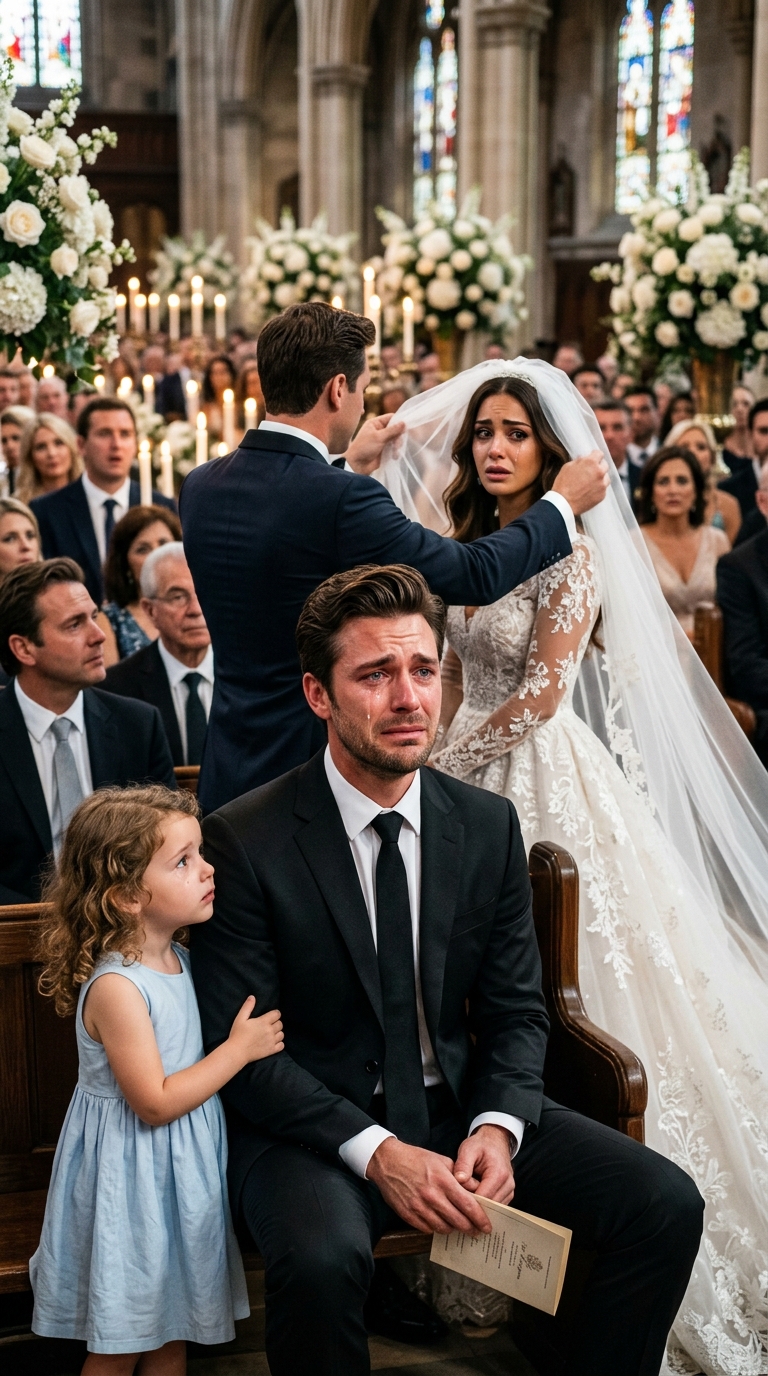
Five years after I buried my wife, I watched her walk down the aisle toward another man.
At first, I told myself grief was playing tricks on me.
That was what grief did. It twisted shadows into familiar shapes. It turned strangers’ laughter into voices you had lost. It made you hear footsteps in empty rooms and see ghosts in crowds.
But this was not a shadow.
This woman had Isabelle’s eyes.
She had Isabelle’s mouth.
And when Thomas lifted her veil, she had the same tiny scar near her left eyebrow, the one Isabelle had gotten in our old kitchen when she slipped, hit the cabinet, then laughed so hard she cried because I had panicked worse than she had.
My daughter Sarah tugged my sleeve.
“Daddy,” she whispered, her little voice trembling, “why are you crying?”
I couldn’t answer.
Because the bride had just turned toward me.
And the moment our eyes met, all the color drained from her face.
Her bouquet slipped lower in her hands.
Her lips parted.
Then, in a voice so faint I almost thought I had imagined it, she whispered, “Daniel?”

The church fell silent around me.
Not quiet.
Silent.
The kind of silence that feels alive.
Thomas looked from her to me, confusion pulling at his face. The priest stopped mid-sentence. Guests leaned forward. Someone in the back gasped.
I stood before I knew I was moving.
Sarah’s hand tightened around mine.
The bride took one small step backward.
“Isabelle?” I said.
The name cracked through the church like glass breaking.
Thomas’s smile disappeared.
“What did you call her?” he asked.
But I could not look at him. I could only stare at the woman in white.
Five years. Five years of mourning. Five years of learning how to raise our daughter alone. Five years of kissing Sarah’s forehead at night and telling her that her mother loved her more than anything in the world.
Five years of believing Isabelle was dead.
And now she stood at the altar, wearing another man’s ring.
The bride shook her head slowly, tears gathering in her eyes.
“No,” she whispered. “No… I don’t know you.”
But she did.
I saw it.
Recognition had flashed across her face before fear buried it.
“Daddy?” Sarah asked, looking up at me. “Is that Mommy?”
The question destroyed whatever strength I had left.
The bride pressed a trembling hand to her mouth.
Thomas turned sharply toward her. “Emily?”
Emily.
That was the name printed on the wedding invitation.
I remembered reading it and thinking nothing of it.
Now the name felt like a lie written over a grave.
Thomas took her arm gently, but she flinched.
That tiny movement changed the whole room.
My eyes moved to his hand.
To her face.
To the way fear moved through her body before she could hide it.
“Daniel,” Thomas said, his voice low and controlled, “you should sit down.”
I finally looked at him.
My childhood friend.
The boy who used to climb trees with me. The man who had stood beside me at my wedding. The soldier who had disappeared from my life after Isabelle’s accident.
“You knew?” I asked.
His jaw tightened. “You’re confused.”
“No,” I said, stepping into the aisle. “For the first time in five years, I think I’m not.”
Murmurs spread through the guests.
Sarah clutched my hand with both of hers. Her eyes never left the bride.
The bride looked at Sarah then.
Really looked.
Something broke inside her expression.
She stared at my daughter’s face, at her curls, at the small dimple in her chin—the same dimple Isabelle used to kiss every morning.
The bouquet slipped from her hands and hit the floor.
White roses scattered across the aisle.
“Sarah,” the bride breathed.
Thomas froze.
I heard it.
Everyone close enough heard it.
She had said my daughter’s name.
I moved faster now.
“Isabelle.”
The bride staggered as if the name hurt her.
“I don’t—” She pressed both hands to her temples. “I don’t know. I don’t know.”
Thomas stepped between us. “That’s enough.”
I looked at him, and for the first time, I saw not confusion on his face, but calculation.
Cold.
Fast.
Practiced.
“Move,” I said.
His voice dropped. “Daniel, you are grieving. You lost your wife. This is not her.”
“Then how does she know my daughter’s name?”
The church went completely still again.
Thomas said nothing.
The bride was crying now, but silently, as though she had learned not to make noise when afraid.
Sarah slipped from my grip and walked forward.
“Mommy?” she whispered.
I reached for her, but I couldn’t stop her.
She took three small steps down the aisle.
The bride’s face crumpled.
A sound escaped her—soft, wounded, almost animal-like. She dropped to her knees in the middle of the church, her wedding dress pooling around her like spilled moonlight.

Sarah stopped in front of her.
The bride lifted a shaking hand.
She did not touch Sarah.
Not at first.
She hovered, as if terrified that touching her would make everything real.
Then Sarah placed her tiny palm against the woman’s fingers.
And the bride sobbed.
“Baby,” she whispered.
My knees nearly gave out.
Thomas grabbed her shoulder. “Emily, stop.”
She jerked away from him.
That was when an older woman stood from the second row on the bride’s side. She wore a silver dress and an expression carved from stone.
“Thomas,” she said sharply, “end this now.”
I turned toward her.
Something about her voice made the hair on the back of my neck rise.
The bride looked at the woman and went pale again.
“Dr. Vale,” she whispered.
Thomas’s mother stepped forward quickly. “Guests, please remain calm. My daughter-in-law has had health issues—”
“Daughter-in-law?” I repeated. “The ceremony isn’t even finished.”
Her eyes snapped to mine.
For one second, she looked furious.
Then she smiled.
It was the kind of smile people use when they are hiding knives.
“Mr. Walker,” she said. “You have suffered a tragedy. No one blames you for being overwhelmed.”
I took out my phone with trembling hands.
Thomas saw it and moved toward me.
“What are you doing?” he asked.
“Calling the police.”
His face changed.
Only for a second.
But I saw it.
“Daniel,” he said quietly, “don’t.”
That single word confirmed everything.
I dialed anyway.
Before the call connected, the bride suddenly reached toward me.
“Hospital,” she gasped. “White room. Cold lights. Thomas said—”
Thomas spun toward her. “Emily.”
She flinched again.
But this time, she did not stop.
“He said Sarah was gone.”
My blood turned cold.
“What?”
The bride’s eyes locked onto mine, wild and terrified.
“He told me there was an accident. He told me my husband and baby died.” Her voice cracked. “He said I had no one.”
The church erupted.
Guests stood. Someone shouted. Sarah began crying.
I could barely hear anything over the roaring in my ears.
Thomas backed away from the altar.
Dr. Vale moved toward the side door.
“Stop her!” I shouted.
Two men near the aisle blocked her path.
The police arrived thirteen minutes later.
But the truth took much longer to understand.
At the station, Isabelle sat wrapped in a gray blanket, holding Sarah against her chest as if she might vanish if she loosened her arms. Sarah cried until she fell asleep, one hand tangled in Isabelle’s dress.
I sat across from my wife.
My wife.
Alive.
Shattered.
Remembering in pieces.
She told me what she could.
After the accident, she had woken in a private medical facility with no memory of the crash. Thomas was there. He told her I had died. He told her Sarah had died. He told her the trauma had damaged her memory and that her name was Emily Hart.
Dr. Vale confirmed it all.
Medication. Isolation. False documents. Controlled therapy.
Thomas had not rescued her.
He had stolen her.
He had loved Isabelle long before I married her. I never knew. Maybe she never did either. And after the accident, when she survived but lost parts of her memory, he saw his chance.
For five years, he kept her hidden behind a false life.
Five years.
I thought I had buried my wife.
She thought she had buried me and our daughter.
But the story still had one final secret waiting in the dark.
Two days after the wedding, a detective came to my house.
Isabelle sat beside me on the sofa, Sarah asleep upstairs after refusing to let her mother out of sight.
The detective placed a sealed evidence bag on the coffee table.
Inside was a folded document.
“We found this in Thomas Whitaker’s safe,” he said. “It was hidden behind military records and medical files.”
I looked at Isabelle.
She looked as confused as I felt.
The detective continued, “It’s a letter. Written by Isabelle three days before the accident.”
My stomach tightened.
Isabelle whispered, “I don’t remember writing that.”
The detective nodded. “That may be because the accident wasn’t random.”
He unfolded a copy and slid it toward us.
My hands shook as I read.
Daniel,
If anything happens to me, do not trust Thomas.
I found records. My father’s company was moving money through his military contracts. Thomas knows. His mother knows. I was going to give everything to the authorities.

If I disappear, protect Sarah.
And Daniel… I am pregnant.
The room tilted.
Isabelle covered her mouth.
I read the final line again.
I am pregnant.
No one spoke.
Not the detective.
Not me.
Not Isabelle.
The world narrowed to those three words.
Finally, Isabelle whispered, “That isn’t possible.”
But the detective’s face told me it was.
“There’s more,” he said quietly.
He placed a photograph on the table.
It showed a little boy around four years old. Dark curls. Serious eyes. A small dimple in his chin.
Sarah’s dimple.
Isabelle’s breath stopped.
The detective said, “Thomas and his mother told everyone the child was adopted. His name is Noah.”
My hands went numb.
Isabelle stared at the photograph as if her soul had left her body and returned all at once.
“No,” she whispered. “No, no, no…”
The detective’s voice softened. “We believe he is your son.”
I couldn’t move.
I had spent five years mourning a wife who was alive.
Isabelle had spent five years grieving a husband and daughter who were alive.
And somewhere, hidden inside Thomas’s stolen life, was the child neither of us knew had survived.
That evening, police found Noah in a countryside house registered under Dr. Vale’s name.
When they brought him in, he was clutching a toy soldier and refusing to speak.
Isabelle fell to her knees the moment she saw him.
“Noah,” she sobbed.
The little boy stared at her, frightened and uncertain.
Then Sarah stepped forward.
She looked at him with the strange, fearless wisdom children sometimes have.
“I’m Sarah,” she said softly. “I think you’re my brother.”
Noah blinked.
Then he looked at Isabelle.
Something in his small face shifted.
He dropped the toy soldier and ran into her arms.
I stood there watching my wife hold both our children, and for the first time in five years, grief loosened its grip on my heart.
But the final twist came at Thomas’s trial.
He confessed to almost everything.
The false identity. The private doctors. The stolen child. The lies.
But when the prosecutor asked why he had invited me to the wedding, Thomas smiled.
A broken, bitter smile.
“Because I didn’t,” he said.
The courtroom went silent.
The prosecutor frowned. “What do you mean?”
Thomas looked directly at me.
“I never sent Daniel an invitation.”
My pulse stopped.
The detective later traced it.
The invitation had been mailed from a small post office near the countryside house.
The handwriting on the envelope belonged to no adult.
It belonged to a child.
Noah.
He had found my name on old papers hidden in Thomas’s study. He did not understand who I was. He only knew his mother cried in her sleep and whispered one name again and again.
Daniel.
So he mailed the invitation.
A four-year-old boy, trapped in a stolen life, had unknowingly led me back to my wife.
And that was the truth no one saw coming.
I had not found Isabelle at Thomas’s wedding.
Our son had brought me there.
