

PART 1
“Quit fussing, Donna.”
My brother Vince said those words without even looking up from his dessert.
He was sitting at my kitchen table on the first Sunday in June, eating a slice of rhubarb pie. He spoke to the pie more than he spoke to me.
It was a typical Sunday dinner.
Vince had been eating at my house most Sundays since his wife, Pam, began working weekends at the nursing home.
I’d prepared a chuck roast with carrots, followed by his favorite rhubarb pie.
And I had deliberately waited until dessert to bring up the subject.
My brother was usually easier to reason with when he had a fork in his hand.
“Vince,” I had said, “could you move the hay wagon? I’d like to get the car inside before hail season.”
He cut another bite from his pie.
“Quit fussing, Donna. There’s plenty of room in that shed.”
“There is,” I said. “It’s all behind your wagon.”
“I’ll get to it.”
“You said that at Easter.”
He finally looked up.
He wasn’t angry.
I want to make that clear, because it matters.
His expression was almost affectionate, with a trace of weary amusement.
It was the look someone gives a sister who has asked three times whether the car doors are locked.
“It’s a wagon,” he said. “It isn’t hurting anything. You’ve got forty acres of yard to park in.”
Then he asked for more coffee.
There was plenty left, so I poured him another cup.
And the conversation ended.
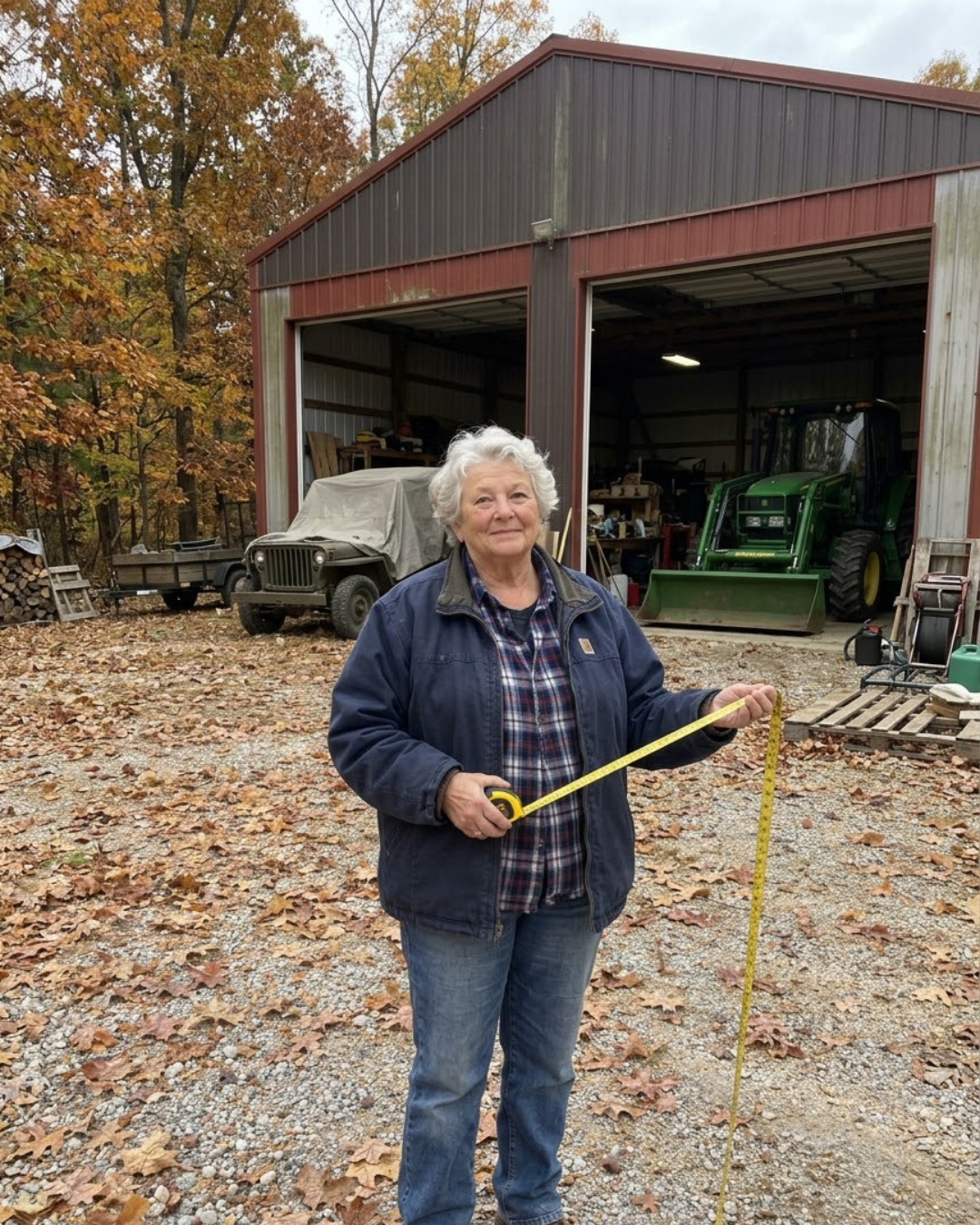
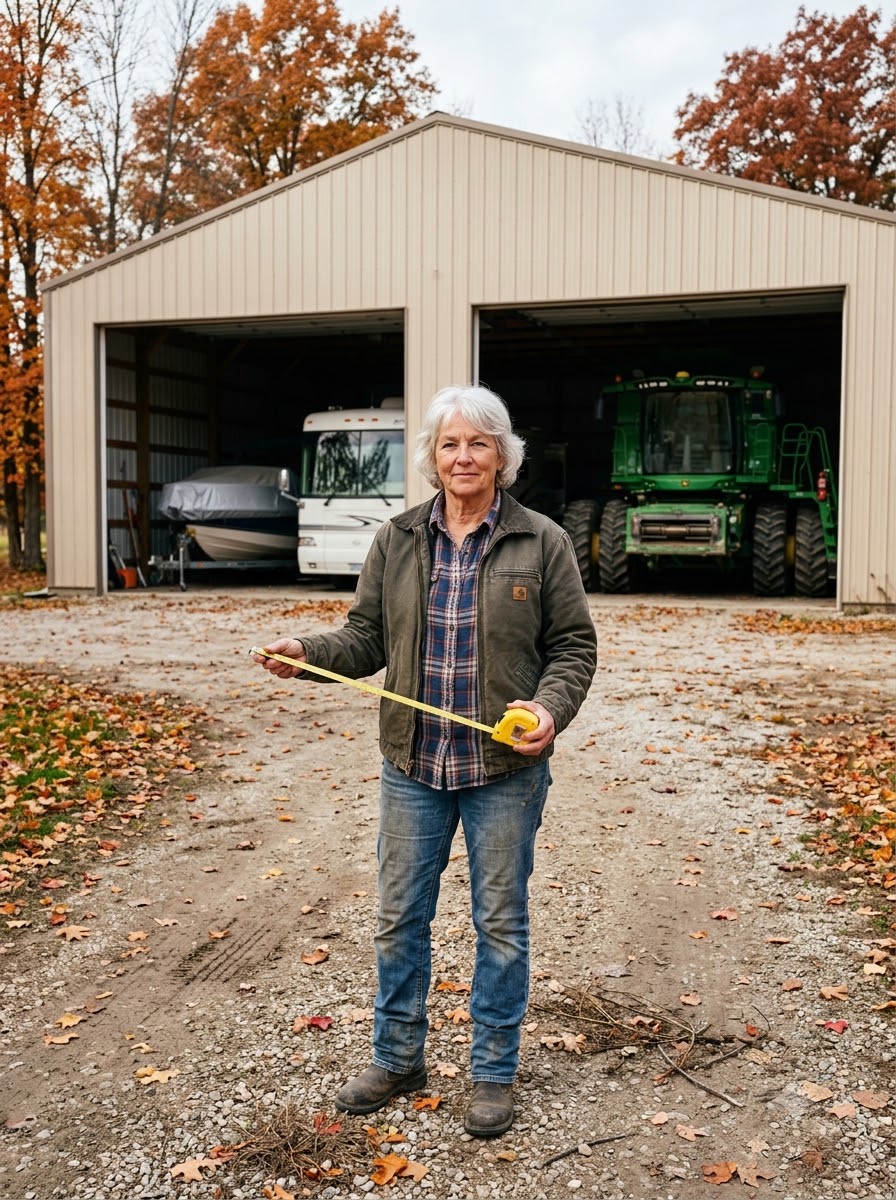
My husband Len had built that machine shed in the summer of 1998.
It measured sixty feet across and one hundred and twenty feet long, with sixteen-foot sidewalls.
There were two enormous sliding doors, one at each end.
Both were thirty feet wide and fifteen feet tall.
Len had designed the building so he could drive a combine through the north entrance and straight out the south without having to reverse.
He was particularly proud of that feature.
He hated backing a combine.
Our farm lies eleven miles northeast of Pierre, South Dakota, on the flat ground above the Missouri River breaks.
The land was part of the quarter-section Len’s father had homesteaded on his second attempt.
The machine shed stands north of the house.
Behind it is a shelterbelt of cedar and Chinese elm.
When the wind sweeps across from the Missouri, it catches the tracks of the sliding doors and makes them sing.
Vince helped Len build that shed.
That is important, and I want it understood from the beginning.
Back then, Vince worked for the state highway department.
He took two weeks of vacation and spent them operating a rented scissor lift while helping Len and a crane operator from Fort Pierre position the sixty-foot trusses.
He refused payment.
Len tried to give him a check anyway.
Vince folded it in half and dropped it into the church offering plate.
Len thought it was the funniest thing anyone had ever done to him.
So although the building belonged to Len, my brother had put his own sweat into it.
I understood that.
For nine years, I understood it.
Len died in March 2017.
His heart gave out while he was standing at our kitchen sink.
The water was still running when I found him.
He was fifty-eight.
I called the ambulance.
Then I called Vince.
The roads were covered with glare ice that morning, but my brother drove out from town in nineteen minutes.
He sat at my kitchen table until daylight.
He didn’t have much to say.
He made coffee incorrectly, and we drank it anyway.
I have never forgotten that morning.
Two months later, Vince arrived with a boat on a trailer.
“The city won’t let me leave it on the street,” he said. “Len always said there was room.”
And Len had always said exactly that.
“Put it wherever,” I told him.
The following spring, Vince brought a camper.
It was twenty-six feet long, a bumper-pull model.
He backed it along the west wall of the shed, leaving the rear end hanging over part of Len’s workbench.
“Just till I pour a pad at home,” he said.
He never poured that pad.
In 2019, Vince bought a hay wagon at a farm auction near Blunt.
It was a flat rack mounted on four-wheel running gear.
The church youth group wanted to offer a hayride during the fall festival, and Vince thought the wagon would be useful.
The young people enjoyed their hayride.
Once.
Afterward, Vince brought the wagon to my shed.
He pulled it through the large south entrance, discovered he couldn’t turn it around inside, and unhooked it crosswise about ten feet past the door.
“Just for now.”
That was what he said.
In 2021, another boat arrived.
This one was an old sixteen-foot aluminum fishing boat.
Vince had bought it from a widower in town for four hundred dollars.
He planned to restore it for his grandchildren.
He parked it beside the wagon.
And that effectively finished off the south entrance.
The wagon sat sideways.
The aluminum boat occupied the remaining space.
Beyond them lay sixty feet of good, clean concrete that no ordinary vehicle could reach.
My daughter Kim has pointed out the obvious more than once.
At least twice a year, in fact.
There was another door.
The north entrance.
And she was right.
But the north door opened toward the shelterbelt and hay ground.
There was no proper driveway leading to it.
To reach it in my car, I would have needed to leave our driveway, drive down the section line, pass through a wire gate, and cross a quarter mile of rough two-track on gumbo soil.
Anyone familiar with the Pierre area knows what gumbo becomes when it’s wet.
It turns into something that can swallow tires and hold them.
Besides, that door hadn’t been opened since the week of Len’s funeral.
Nine years of dirt had accumulated in the bottom track.
A volunteer elm had grown in front of it, with a trunk nearly as thick as my wrist.
Opening the door would have taken perhaps an hour.
That wasn’t the real problem.
The problem was the ground beyond it.
A large piece of farm equipment could cross frozen hay ground a couple of times each year.
But no car I could afford could make that trip twice a day through the wet months.
The south door was the only practical entrance for my vehicle.
And Vince’s wagon and boat blocked it.
That was the entire situation.
So my car stayed outside.
It hadn’t always been that way.
Len had built a lean-to along the east side of the shed.
It was twenty feet wide and sixty feet long, open toward the morning sun.
For years, our pickup and my car had been parked beneath it.
He had roofed it with salvaged tin from his father’s old barn.
We’d been short of money that year, and using the old material had seemed sensible.
But the sheets already had plenty of nail holes.
By the time Len died, the roof leaked in several places.
I continued parking underneath it until a windstorm in 2020 tore off two sheets.
After that, I left my car beside the house.
Every April and October, I paid the property taxes.
I paid the insurance on the shed and its contents.
I paid the electricity bill from the cooperative.
Even when I didn’t turn on a single light, the meter cost me roughly forty dollars a month.
I covered those expenses alone for nine years.
And I never presented Vince with a bill.
Every time I thought about asking him to contribute, I remembered him sitting at my kitchen table at four in the morning after Len died.
His coat had still been on.
He had stayed with me because he knew I shouldn’t be alone.
I believed you didn’t hand a man like that a bill.
Then came July ninth.
I was sitting on the porch shelling peas when the meadowlarks suddenly stopped singing.
I looked up.
The sky above the river bluffs had turned the color of an old bruise, with a greenish cast along the edges.
The kitchen radio was broadcasting a warning for Stanley County.
Golf-ball-sized hail.
Moving east at thirty miles per hour.
East meant our farm.
I stood and looked at my car.
It was a 2017 Chevrolet Equinox.
Paid for.
The first vehicle I had ever purchased entirely by myself.
Then I looked toward Len’s shed.
I could have walked out there and moved the wagon.
I want to be fair about that.
I wasn’t helpless.
Len’s tractor was inside, with a drawbar.
I’d been hitching wagons since I was nine years old.
With ten minutes of work, I could have pulled the hay rack into the yard and parked my car safely on the concrete.
But I’d asked Vince.
He had promised to move it.
And I knew what would happen if I dragged his wagon outside just before a hailstorm and its wooden deck was damaged.
That story would be repeated at the gas station coffee table for twenty years.
In our family, moving another person’s belongings without permission was the sort of thing that could end relationships.
So I left the wagon alone.
Instead, I carried two quilts and the porch rug outside.
I spread them across the hood and windshield of my Equinox.
Then I went down to the cellar.
The storm lasted eleven minutes.
I know because I timed it with Len’s watch, which I still wind.
When I came upstairs, the quilts had blown into the lilac bushes.
The yard was white with hailstones.
My car looked as though someone had attacked it with a ball-peen hammer.
The windshield survived.
The rear window didn’t.
Vince called that evening.
He had been fishing for walleye on Lake Oahe and had watched the storm pass south of him.
“You get any of that?” he said.
“Some.”
“Car all right?”
I looked through the window.
“It’ll run,” I said.
“Well, that’s what insurance is for,” he said, and he was being kind. He truly thought he was being kind.
The body shop in Pierre estimated the damage at four thousand one hundred dollars.
My insurance deductible was one thousand.
I paid it using money I’d been saving toward a new furnace.
Then I drove a tiny loaner car for sixteen days while mine was repaired.
I didn’t argue with Vince.
I didn’t move his wagon.
But something had changed.
That October, while working at the farm store on the truck bypass, I met two young men who gave me an idea.
I worked there four days a week, managing the front counter.
I knew where almost everything was kept, which accounted for much of the job.
The two men came in during the second week of October.
They were covered in dust, with sunflower chaff clinging to their caps.
They bought grease cartridges, a case of hydraulic fluid, and every box of mouse bait we had on the shelf.
“That’s a lot of mouse bait,” I said.
“We’ve got a lot of mice,” the older one said. “Or we’re about to.”
His name was Kurt Schmidt.
His younger brother was Joel.
They operated a custom harvesting business near Onida.
Their equipment included two combines and two trucks.
Every summer, they followed the wheat harvest from Oklahoma toward the Canadian border.
In autumn, they harvested sunflowers and corn closer to home.
Their father had run the business before them.
“We wintered the machines in a man’s shed up by Agar for six years,” Kurt said. “He sold out in August. New owner wants it for his own.”
I continued ringing up their purchases.
“So where do they go?”
“Right now? Under the sky.”
He sounded as though he were describing a death in the family.
“Two combines. I can’t leave them out. Mice get in the wiring and a harness will run you three thousand dollars, and that’s before the snow gets in the bearings.”
I looked at him.
“How tall a door do you need?” I said.
Both brothers stopped.
“Fourteen foot,” Kurt said slowly. “Thirteen and a half if I fold the tank extensions down. Twenty wide if I want to keep the paint on the duals.”
“I’ve got fifteen by thirty,” I said. “On both ends.”
Joel slowly put the mouse bait back onto the counter.
They came to the farm that Saturday.
It was one of those beautiful October days South Dakota gives us before winter arrives.
The air was still.
The temperature was around sixty degrees.
Cottonwoods along the creek had turned gold.
I led the brothers through the walk-in door at the south end of the machine shed.
Then I stood aside and let them inspect it.
They saw Vince’s wagon sitting crosswise.
They saw the old aluminum boat.
Along the west wall stood the camper and the better fishing boat beneath its blue cover.
Beyond them was Len’s workbench.
Then the brothers looked toward the north half of the building.
Sixty feet of largely empty concrete.
Len’s tractor stood in one corner.
Sunlight streamed through the skylight panels, illuminating long bars of dust.
“Whose is all this up front?” Kurt asked.
“My brother’s.”
“He farm?”
“He’s retired from the highway department. He lives in town.”
Kurt studied the wagon.
“Ma’am, we can’t get past that wagon.”
“You won’t need to,” I said. “Come look at the other door.”
Kurt spent the next hour freeing the north entrance.
He cut down the volunteer elm with a handsaw from his pickup.
He dug years of packed dirt from the bottom track using a spade and putty knife.
Then he lubricated the rollers with grease he’d purchased from me.
Finally, he and Joel pushed against the sliding door.
It groaned like something waking after a very long sleep.
Then it moved.
Both halves rolled aside.
All thirty feet opened.
Light flooded the north end of Len’s shed.
I hadn’t seen that door open since his funeral.
For a moment, I turned away and looked at the tractor.
I needed a little time before I could speak.
“How do you get a combine to it?” I asked, when I could.
“Across your hay ground, if you’ll let us, after it freezes. We go in once in November and come out once in April. We’ll stay off it when it’s soft and we’ll fix any rut we leave.”
“That’s fair.”
It was more than fair.
Those huge machines could cross frozen ground twice a year without much difficulty.
That was entirely different from driving an ordinary car across gumbo every day.
“What do you want for it?” Kurt said.
“Seven hundred a month,” I said. “For half. But let’s find out where half is.”
Len had kept a hundred-foot measuring tape hanging on a nail beside his workbench.
It was the old hand-cranked kind.
The case was rusty, but the blade still worked.
Joel hooked the end at the north door track and walked toward the south.
I held the reel.
I’d held that same end for Len hundreds of times.
“Sixty feet puts me right here,” Joel called.
He stopped about eighteen inches short of the wagon.
“Half the building, even.”
“Mark it.”
The brothers snapped a bright blue chalk line across the concrete.
It ran from the east wall to the west.
Exactly sixty feet from either end.
“His wagon tongue’s over,” Joel said. “Fourteen inches. And the nose of that camper is over by about a foot. You want us to nudge them back?”
“No,” I said. “Leave it. Don’t touch one thing of his. If it’s over the line, go around it.”
Kurt looked at me for a moment.
“Yes, ma’am,” he said.
The following week, we signed a lease at my kitchen table.
It was a simple one-page farm-building agreement provided by the county extension office.
I had typed our information into the form at the library.
The rental period ran from November first through the last day of April.
Seven hundred dollars a month for the north sixty feet.
The Schmidt brothers would maintain their own insurance on their machinery.
They showed me the certificate.
Joel wrote the first check at the table.
I slipped it beneath the sugar bowl because I could hardly believe it was real.
Four thousand two hundred dollars for one winter.
That would cover the property taxes.
The shed insurance.
My hail deductible.
And leave a little money toward replacing the furnace.
Since Len’s death, the shed had never earned a dollar.
It had only cost me money.
I didn’t call Vince.
People have asked why.
My answer has always been the same.
I’d asked my brother for ten feet of my own floor and been told to stop fussing.
I didn’t believe I owed him a phone call about renting the other half of a building that belonged to me.
His belongings remained exactly where he’d left them.
The chalk line made that clear.
On the first Thursday in November, after three hard frosts, the Schmidt brothers arrived with their combines.
I heard the engines before I saw the machines.
Two enormous green combines crossed the frozen hay ground from the section line.
Their headers had been removed.
Their lights glowed in the gray morning.
When the first machine passed beneath the north doorway, it cleared the top by only a hand’s width.
I hollered so loudly that Kenzie’s entire fifth-grade class probably could have heard me.
Before parking anything, the brothers swept the floor.
I want that remembered.
Two grown men with push brooms cleaned a sixty-by-sixty-foot section of concrete before breakfast.
Then they parked the combines nose to tail along the east side.
The headers came next, secured on their trailers.
Then a grain cart.
Joel hung a fire extinguisher on a post.
Kurt positioned mouse bait stations every twelve feet along the wall.
Drip pans went beneath both machines.
By noon, their half of the building looked like a display at the implement dealership in Pierre.
And on the other side of the bright blue line sat my brother’s belongings.
The wagon had a sparrow nest in its front rack.
Two deck boards had rotted through.
The good boat remained protected beneath its cover.
The aluminum boat was full of leaves, rusted fishing lures, and the remains of a cushion that mice had destroyed.
Its trailer rested on four completely flat tires.
The rubber was cracked like a dry creek bed.
At about one o’clock, Kurt came to the house holding his cap.
“Ma’am, I don’t want to speak out of turn.”
“Go ahead.”
“That fishing boat’s on four flat tires and it’s a mouse hotel. I’m baiting hard on our side, but they’ll just come across. I’m not asking you to do anything. I only wanted you to know I saw it, so you don’t think it was us.”
“I appreciate that.”
He turned his cap in his hands.
“And that camper’s leaking.”
I frowned.
“It’s inside a building, Kurt.”
“Yes, ma’am. I mean it’s leaking out. Come look.”
I followed him into the shed.
Vince had taken the camper west of the river for antelope hunting during the first week of October.
It had rained for two days.
I already knew the camper’s roof seam had been failing since the previous summer.
Pam had complained about a wet mattress.
What I hadn’t known was where all that water went.
It had traveled down inside the rear wall.
A month later, it was still dripping from the back corner.
One drop at a time.
Directly onto Len’s workbench.
A brown water stain the size of a dinner plate had formed on the thick wooden surface.
The planks had swollen.
One had split.
The top drawer beneath the damage was jammed shut.
I stood with my palm resting against the bench.
Len had built it from old bridge planks the county was discarding.
Every morning, he drank his coffee there.
His vise was mounted on one end.
Beside it sat an old radio that received only one station.
The drawers held tools his father had given him.
And tools I’d bought him for Christmas, one year at a time, during our thirty-one years together.
“Kurt said quietly, “I can get that drawer open if you want,” he offered. “I’d go slow.”
I shook my head.
“Not today,” I said. “Thank you. I can’t today.”
The next morning, before leaving for work, I went back to the shed.
I couldn’t stop thinking about the bench.
When I entered, I saw a blue tarp covering the rear corner of Vince’s camper.
It was tied neatly.
A five-gallon bucket hung beneath the lowest point to catch the remaining drips.
The camper hadn’t moved.
I checked.
Its nose still crossed the chalk line by exactly the same amount.
Then I noticed the workbench.
A clean shop towel had been spread across the dry end.
On it, someone had arranged every tool from the damaged drawer.
Each piece was grouped by size.
Exactly the way Len had always organized them.
His father’s box wrenches.
The socket set I’d given him in 1989.
His folding rule.
His chisels.
The little brass plumb bob.
Every tool had been wiped clean and lightly oiled.
I could smell the oil.
The drawer itself stood upright against the wall, drying with a fan blowing across it.
There was no note.
I stood there at quarter to seven in the morning, wearing my farm-store vest with my name stitched on it.
And I cried.
I cried over a set of sockets in a way I hadn’t cried since Len’s funeral.
It wasn’t only grief.
It was the realization that a young man who had known me for three weeks, and who had never met my husband, had looked at those tools and understood what they meant.
When I thanked Kurt that evening, his ears turned red.
“They’re good tools,” he said. “It didn’t seem right.”
He never mentioned it again.
Vince discovered the arrangement the way people learn almost everything in Hughes County.
Someone at the gas station asked how he liked sharing a shed with the Schmidt brothers.
The following Saturday, my brother came out to the farm.
And he wasn’t pleased.
PART 2
It was the second Saturday in November.
My granddaughter Kenzie was staying with me because Kim worked every other weekend at the hospital.
Kenzie was ten years old.
She had Len’s stubborn cowlick and an endless supply of questions.
She asked them steadily, with the determined curiosity of a child picking at a scab.
We were in the machine shed when Vince arrived.
Kurt was standing on a stepladder, replacing a light tube above one of the combines.
Joel stood below, steadying the ladder.
Kenzie sat on a bucket beside Len’s workbench.
She was sorting his sockets back into their case by size.
Kurt had taught her how to read the numbers.
I heard Vince’s pickup before I saw it.
He came up the lane faster than usual.
Instead of stopping at the house, he drove past the south entrance and continued around the shelterbelt.
His truck bumped across the hay ground.
Then he pulled up outside the open north door.
Vince climbed out.
He was sixty-six, a broad, square man with our father’s hands.
He wore his orange hunting cap.
West River deer season had opened that morning, and he’d intended to be hunting.
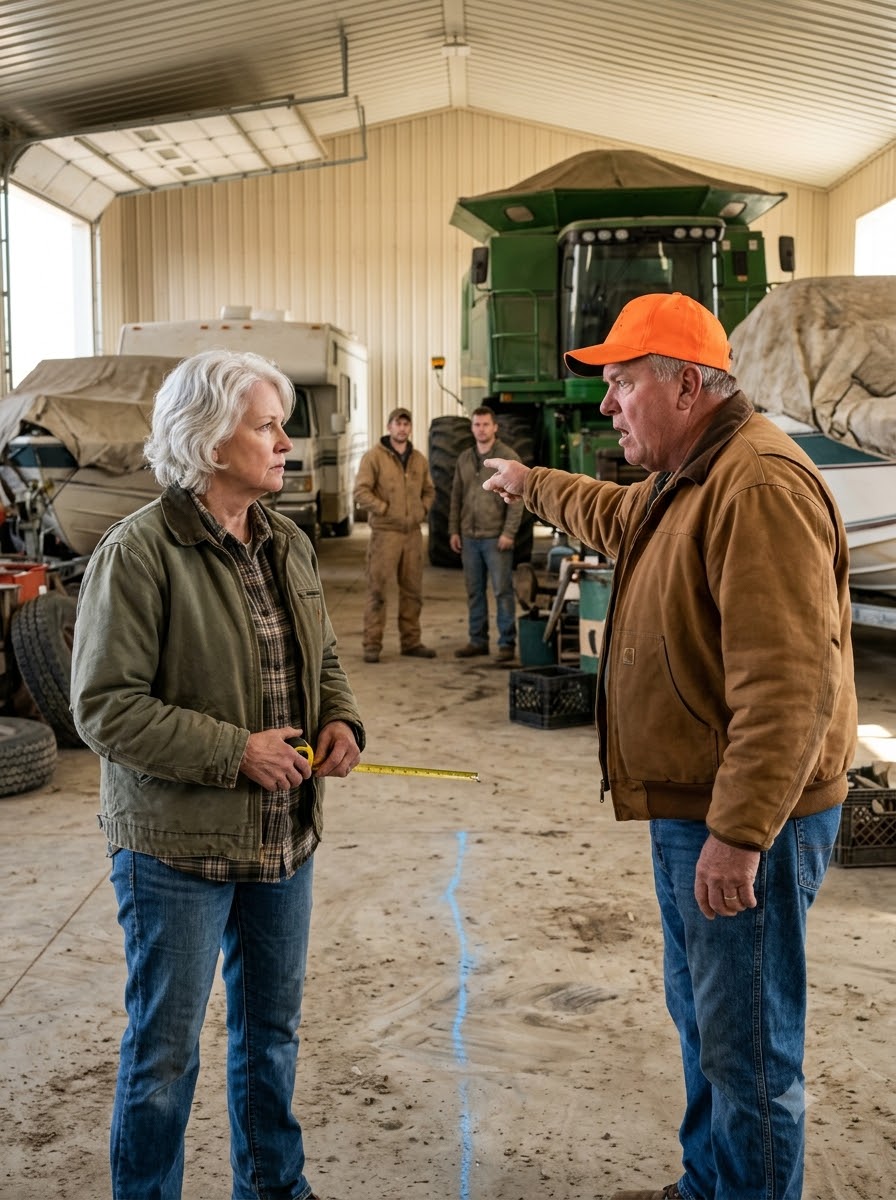
Instead, he stood at the entrance to Len’s shed.
He looked inside.
Two enormous green combines.
Clean concrete.
A blue chalk line.
And the tongue of his hay wagon extending across it.
He took his time looking at everything.
Then he turned toward me.
“Donna, who let these people into Len’s shed?”
He didn’t shout.
Vince rarely shouted.
His voice was flat and puzzled, like a man returning home to discover someone had rearranged his furniture.
Kurt climbed down from the ladder.
He wiped his hands on a rag.
“Morning, sir,” he said. “Kurt Schmidt. That’s my brother, Joel. We have a lease with the owner.”
Vince stared at him.
“The owner,” Vince said, “has been dead nine years.”
Nobody answered.
The wind moved through the open doorway.
I could hear it singing faintly in the metal tracks.
Then Kenzie looked up from her bucket.
She was holding a half-inch socket.
“Uncle Vince,” she said, “can I ask you something?”
He turned toward her.
His expression softened immediately.
“Sure, kiddo.”
Kenzie spoke carefully.
“Kurt and Joel pay Grandma seven hundred dollars a month for their half.” She said it carefully, like a spelling word. “How much do you pay for yours?”
Vince opened his mouth.
Then closed it.
I watched him search for an answer.
And I watched the moment he realized what the answer was.
It wasn’t easy to see.
“I don’t, honey,” he said. “I never have.”
Kenzie thought about that.
“Oh,” Kenzie said. She thought about it. “Is that why Grandma’s car has to sleep outside?”
I interrupted.
“Kenzie,” I said. “That’s enough, sweetheart.”
But Vince raised his hand.
“No,” Vince said. “Let her.”
He walked toward the chalk line.
He stood with one boot on each side.
He looked at the wagon.
Then at the aluminum boat sitting on its four flat tires.
His eyes moved to the camper, where a tarp covered the rear corner and a bucket hung beneath it.
“Who put the tarp on?” he asked.
Kurt answered.
“I did, sir,” Kurt said. “I hope that’s all right. I didn’t go inside it and I didn’t move it. It was running water on the bench.”
Vince frowned.
“What bench?”
Nobody needed to explain.
He was already walking toward Len’s workbench.
He stood in front of it for a long time.
He touched the split in the plank with his thumb.
He studied the drawer drying against the wall.
Then the tools arranged on the towel.
Then Kenzie, still sitting on the bucket and carefully putting sockets away.
Finally, he reached past her and picked up Len’s level.
It was a beautiful four-foot mahogany level with brass ends.
Len had kept it leaning behind the vise.
Unfortunately, that was also where water from the camper had traveled down the wall.
One edge of the mahogany had turned gray.
The glass in the center vial was fogged inside.
Vince held it in both hands.
“That’s his good one,” Vince said.
“It is.”
“I borrowed this to set the trusses. I borrowed it about six times after.” He turned it over. “He told me if I ever left it out in the weather he’d skin me.”
“I remember.”
“I would have skinned anybody who did this to it.”
I looked at him.
“Somebody did do it,” I said.
I didn’t raise my voice.
I didn’t say it cruelly.
But those words were among the hardest I’d ever spoken to my brother.
He lowered the level onto the towel.
Very carefully.
Then I remembered something else.
“There’s something else you should see,” I said. “Kurt found it when he pulled the drawer.”
I opened the cupboard beneath the workbench.
Len had never been able to keep track of notebooks.
He lost them constantly.
So he wrote his lists in carpenter’s pencil on the inside of the cupboard door.
Thirty years of reminders covered that wood.
Oil changes.
Seed varieties.
Measurements.
Parts that needed ordering.
And along the right side, a column listing everything he had lent to other people.
Len wrote those things down so he would know where to retrieve them.
About half the entries contained the same name.
Vince, post hole digger.
Vince, come-along.
Vince, my good level.
Vince, my good level again.
Near the bottom was a final note.
The pencil was darker.
The handwriting was Len’s careful square printing, the style he used when something mattered.
Vince set every truss in this building and never took a dime. Whatever he needs.
Kurt had shown it to me the day he removed the drawer.
I’d sat on the bucket and read it four times.
Now Vince read it.
Once.
Then he took off his orange cap.
He held it in both hands.
“He meant that,” I said. “I want you to know I know he meant it. He would have given you the whole shed and slept in the car.”
My brother swallowed.
“Donna.”
I continued.
“And I meant it too. Nine years I meant it. You came out here on ice the night he died and you sat with me, and I have never forgotten it one day. That’s why I never said anything. That’s the whole reason.”
“I know it.”
I looked toward the wagon.
“But he wrote down what you need, Vince. Nobody needs a boat on four flat tires. Nobody needs a wagon crossways in a door for seven years. I asked you for ten feet of floor so I could get my car out of the hail, and you told me to quit fussing, and then it hailed.”
He turned his cap around slowly.
For a while, he didn’t speak.
Then he looked at the building.
“I never once thought of it as yours,” he said finally. “That’s the truth, and I can hear how it sounds. In my head it was Len’s. And if it was Len’s then it was sort of all of ours, like it was when we were building it. I’d come out here and back something in and it felt like he was still around to say go ahead.”
He cleared his throat.
“I never thought about who was writing the check for the lights. I never thought about it. Thirty-one years I worked for the state, I know what a building costs to keep, and I did not think about it one time.”
I nodded.
“I know you didn’t.”
Vince stared at the floor.
Then he began calculating aloud.
“Four stalls at the storage place out by the airport.” He was doing it out loud now, the way he used to do bids. “Better than three hundred a month. Nine years.”
He stopped.
“I’m not going to say that number in front of the child.”
“I never wanted the number,” I said.
He looked at me.
“What do you want?”
It was a fair question.
And he asked it plainly.
“I want to park my car out of the weather,” I said. “That’s all I wanted in June.”
Vince looked toward the south door.
His wagon was still parked across the entrance.
Then he glanced through the walk-in door toward the lean-to.
From where we stood, the sky was visible through a dozen holes in its old roof.
“That tin’s off Dad Mercer’s barn,” he said.
“It is.”
“It was no good when he put it up. I told him so.”
“You did.”
Vince put his cap back on.
Then he turned toward Joel.
“Joel,” he said, “is that your pickup with the receiver hitch?”
“Yes, sir.”
“If I air up the tires on that wagon, would you help me swing it? My sister would like to use her door.”
The three men worked together.
They inflated the wagon’s tires, attached it to Joel’s truck, and carefully maneuvered it through the south entrance.
The whole job took twenty minutes.
Kenzie and I stood outside in the sunlight.
We watched the hay wagon roll out of Len’s shed for the first time since 2019.
When it cleared the doorway, Kenzie slipped her hand into mine.
“Was that a rude question, Grandma?”
I looked down at her.
“No,” I said. “It was a plain one. There’s a difference.”
Vince didn’t go deer hunting that day.
Instead, he spent time looking over the shed and thinking about what needed to be done.
The following Saturday, he arrived at seven in the morning.
He was driving a truck with a flatbed trailer.
Pam sat beside him.
She carried a pan of caramel rolls.
Neither offered an explanation for why they were there.
They simply got to work.
That first Saturday, Vince hauled away the belongings that no longer had any reason to occupy the building.
The old aluminum fishing boat went to a boy in Fort Pierre who wanted a restoration project.
Vince gave him the boat and trailer for free.
The hay wagon went to the church.
That was where it should have gone years earlier.
The trustees parked it behind the fellowship hall.
Vince pulled the camper outside.
He climbed onto a ladder and resealed the entire roof seam, working from front to back.
When he finished, he returned the camper to the shed.
This time, he parked it along the west wall, leaving a good four feet between its rear corner and Len’s workbench.
The better fishing boat went behind it.
Nose to tail.
By the time he finished, everything Vince owned inside the shed occupied a strip only twelve feet wide along one wall.
There was enough open floor to park three cars beside it.
For the first time in years, I could see clear concrete all the way through the south entrance.
But Vince wasn’t finished.
Over the next three Saturdays, he replaced the lean-to roof.
He wouldn’t let me see the bill from the lumberyard.
Pam later told me the steel, screws, and new purlins cost a little more than twenty-eight hundred dollars.
Vince paid for everything from money he’d saved for fishing.
I hadn’t asked him to.
He removed every sheet of old barn tin himself.
He stacked the discarded metal beside the fence.
Then he installed new two-by-fours at two-foot intervals.
He snapped chalk lines to keep everything straight.
And he began laying ribbed steel roofing.
The lumberyard called the color barn red.
Vince set each screw into the flat beside the rib, tightening the rubber washer just enough to seal without crushing it.
He followed the manufacturer’s instructions exactly.
Almost nobody did.
The Schmidt brothers arrived on the second Saturday.
They hadn’t been invited.
They simply showed up to help.
They were working on their own time.
Kurt operated the screw gun on the high side.
Joel passed sheets up from below.
And Vince, who had never liked another man working on one of his projects without constant supervision, let them do it.
Kenzie counted screws into a nail apron.
She sent them up in a coffee can tied to a rope.
I watched the four of them work.
Vince.
Kurt.
Joel.
And Kenzie, who seemed to believe she was in charge of the entire operation.
There was something comforting about the sight.
For nine years, that shed had been a place where I avoided difficult conversations.
Now people were working together to make it useful again.
At noon on the final Saturday, Vince climbed down from the ladder.
He washed his hands at the hydrant.
Then he went inside the shed alone.
I found him at Len’s workbench.
He had placed the damaged mahogany level in the vise, with a rag wrapped around it to protect the wood.
He had carefully sanded away the gray discoloration.
Now he was rubbing linseed oil into the surface with his thumb.
“I can’t do anything about the vial,” he said, without turning around. “It’ll read. It just won’t ever look right.”
I stood beside him.
“That’s all right.”
“It isn’t.”
He continued working the oil into the wood.
“But it’ll read.”
For a while, neither of us said anything.
Then Vince spoke.
“I should have been the one who dried those tools off,” Vince said. “Not some kid from Onida.”
I looked toward the clean drawer.
“He’s a good kid from Onida.”
“He is.”
Vince almost smiled.
“He told me my camper was a foot over the line, and called me sir while he did it.”
“I told him to leave it be.”
“I know you did. That’s what got me, Donna, when I had time to think. You had every right to drag all of it out in the yard, and you never laid a hand on it. You just let me look at it.”
I didn’t know what to say.
So I said nothing.
Vince finished oiling the level.
Then he returned it to the two nails where Len had always kept it.
Safely away from the damaged section of the wall.
That afternoon, the last piece of ridge trim went onto the lean-to roof.
Vince climbed down.
He walked to the house.
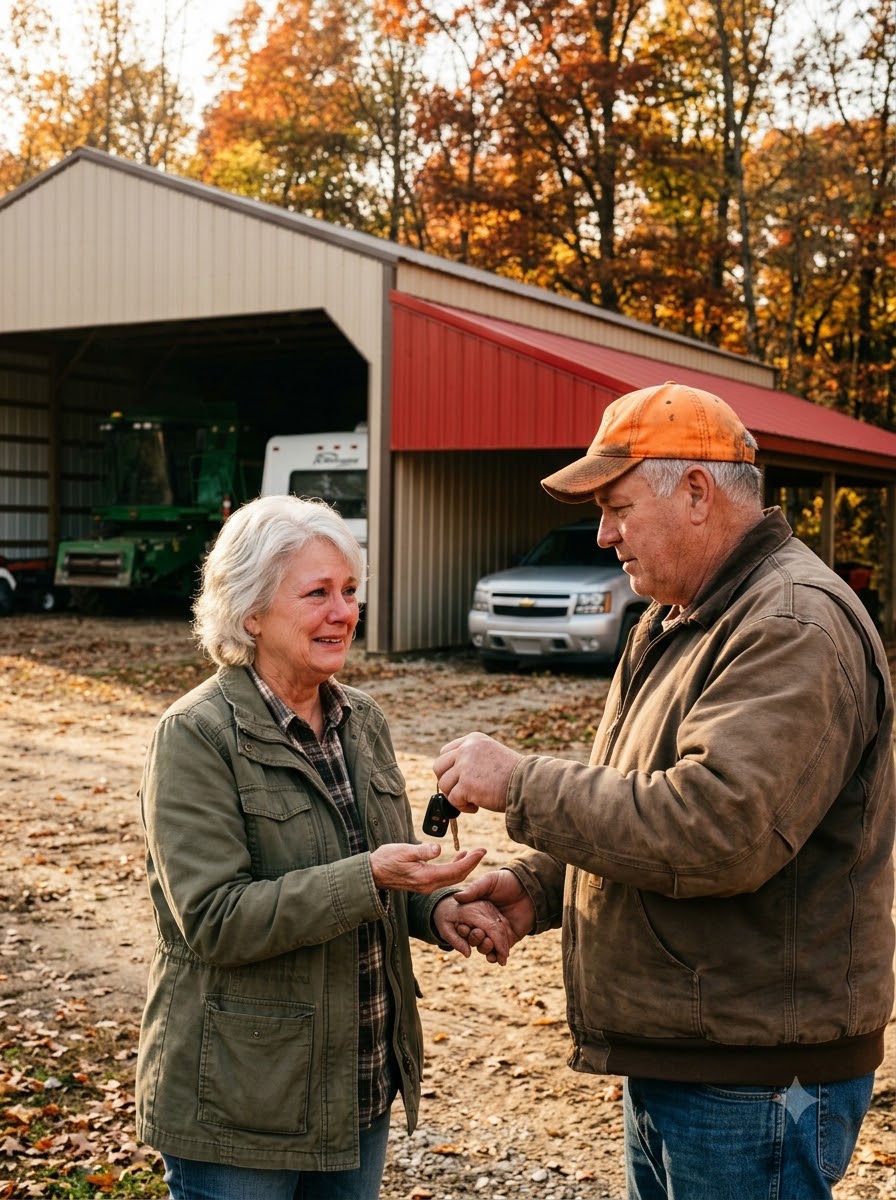
Without asking, he took my car keys from the hook beside the door.
Then he drove my Equinox across the yard.
He backed it beneath the new red steel.
Perfectly centered.
He switched off the engine.
For a moment, he remained in the driver’s seat with both hands resting on the wheel.
Then he climbed out.
He walked over and placed the keys in my hand.
“There,” he said. “Quit fussing.”
This time, the words meant something entirely different.
PART 3
Winter settled over the farm.
The Schmidt brothers’ combines remained parked in the north half of Len’s shed.
They had their own insurance, their own tools, and their own routines.
Every time I walked inside, I noticed how carefully they treated the building.
The concrete stayed clean.
The drip pans remained beneath the machines.
The bait stations were checked.
Nothing was piled carelessly against the walls.
They treated the rented space as though it mattered.
And perhaps that was what had surprised me most.
For nine years, I had accepted the idea that allowing someone to use the shed meant I shouldn’t expect anything in return.
Now two young men were paying seven hundred dollars a month and still treating the building with more care than anyone had in years.
They weren’t doing it to make a point.
They simply understood what it meant to use something that belonged to another person.
Vince continued coming out on Sundays.
That never changed.
He still sat at my kitchen table.
He still liked his rhubarb pie.
Pam still worked weekends at the nursing home.
And when there was coffee left in the pot, I poured him another cup.
We didn’t spend our Sundays discussing the argument.
There was no need.
He had heard what I was trying to say.
And I had heard what he’d been trying to explain.
I knew he had never intended to take advantage of me.
In his mind, the shed had always belonged to Len.
And Len had always welcomed him.
For Vince, parking a boat or camper inside had been a way of keeping part of that friendship alive.
I understood that.
But I also understood something I hadn’t allowed myself to say before.
Len was gone.
I was still here.
The taxes still arrived every April and October.
The electric cooperative still sent its bill.
The roof still needed repairs.
And the woman responsible for all of it deserved to park her car out of the weather.
Vince understood that now too.
At the beginning of each month, I started finding a fifty-dollar bill in a coffee can on Len’s workbench.
I never asked him to leave it.
He never mentioned it.
But there it was.
One bill.
Then another.
And another.
I didn’t spend them.
Instead, I put them into an envelope.
I had an idea for that money.
The workbench had been repaired enough to protect the tools, but the damaged plank remained split.
The surface would never be quite right until the top was replaced.
I thought that perhaps those fifty-dollar bills could eventually become a new plank top.
And I had a pretty good idea who would plane it.
In February, the new furnace was installed.
That had been the expense I was trying to save for when the July hailstorm damaged my car.
The insurance deductible had taken a thousand dollars from that fund.
But the shed rental brought in enough money to replace what I’d spent.
The rest helped me move forward with the furnace.
I remember standing beside the installer and listening to the new system start.
Warm air began moving through the house.
For the first time in a long while, I wasn’t mentally adding up every bill and wondering which repair would have to wait.
I still worked four days a week at the farm store.
I still kept track of my expenses.
But the shed was finally helping pay for its own upkeep.
It felt like something Len would have appreciated.
He had never been a man who liked waste.
He’d built that enormous machine shed because he believed a good building should be useful.
Not because he wanted it filled with things nobody used.
The winter passed.
Snow collected along the shelterbelt.
Wind rattled the sliding door tracks.
And my car stayed dry beneath the new barn-red lean-to roof.
Every morning, when I walked outside, I could see it parked where Len had intended our vehicles to be.
The new steel looked bright against the old building.
Vince had taken his time installing it.
Every line was straight.
Every screw properly seated.
It was the sort of job he’d always been proud to do.
The only difference was that this time, he had done it for me.
In late April, the Schmidt brothers returned to collect their machinery.
The weather had been dry enough for them to cross the hay ground without making a mess.
They opened the north door and brought their equipment out one piece at a time.
First the grain cart.
Then the headers.
Then the combines.
Those big green machines crossed the field toward the section line, just as they’d come in the previous November.
The brothers had promised to repair any ruts they left.
And they did.
Before leaving, they filled the tracks and smoothed the ground.
They kept their word.
Kurt told me they wanted to rent the same space again the following winter.
I agreed.
The price would remain seven hundred dollars a month.
The entrance would remain the north door.
And the arrangement would remain exactly as we’d written it.
There was no reason to change something that worked.
After they left, I stood inside the machine shed for a while.
The north half was empty again.
Sunlight came through the skylight panels.
The concrete was clean.
Along the west wall, Vince’s camper and good fishing boat sat neatly parked.
Neither blocked the entrance.
The old aluminum boat was gone.
The hay wagon was gone.
And the south doorway stood clear.
It was such a simple thing.
An open door.
Yet it had taken nine years, a hailstorm, a rental agreement, and a ten-year-old girl’s question to get there.
I walked to Len’s workbench.
His tools were back in their drawers.
The top drawer slid smoothly.
The mahogany level hung on its two nails.
The wood was darker now where Vince had rubbed in the linseed oil.
The center vial was still fogged.
He had been right about that.
It would never look exactly the way it had before.
But it still worked.
I thought that was a fair description of a great many things in life.
Some damage couldn’t be erased.
Some mistakes couldn’t be undone.
But that didn’t mean everything was ruined.
Sometimes something could still be useful.
Sometimes it could even be good again.
I looked at the cupboard door beneath the bench.
Len’s pencil lists were still there.
Oil changes.
Seed numbers.
Borrowed tools.
Vince’s name appeared again and again.
And at the bottom, the words I’d read so many times:
Vince set every truss in this building and never took a dime. Whatever he needs.
I still believed Len had meant them.
I knew exactly why he had written them.
Vince had been his friend as well as his brother-in-law.
He had helped build the shed when we couldn’t have managed the job without him.
He had given two weeks of vacation and refused a penny.
And when Len died, Vince had come through icy roads to sit with me until morning.
Those things mattered.
They would always matter.
But there was a difference between honoring what someone had given and allowing an old promise to become an excuse for never asking what anyone else needed.
Len had written, Whatever he needs.
He hadn’t written that Vince could leave unused equipment across the only accessible door forever.
He hadn’t written that I should pay every expense while my own car sat in hailstorms.
He hadn’t written that gratitude required silence.
Those were meanings I’d added myself.
And for nine years, I’d lived by them.
I was grateful that Vince had finally understood the difference.
I was grateful that I had spoken plainly.
And I was grateful that neither of us had allowed the conversation to destroy our relationship.
The following June, the weather gave me another chance to see what had changed.
It was June eighteenth.
Around four in the afternoon, the meadowlarks suddenly stopped singing.
I was in the house when I noticed the silence.
I looked out toward the river bluffs.
The sky was turning green.
The same sickly color I’d seen the previous July.
The kitchen radio announced a warning for Stanley County.
Quarter-sized hail.
Moving east.
Toward our farm.
I remembered the previous storm immediately.
The quilts.
The porch rug.
The cellar steps.
The sound of hail striking the house.
And the sight of my car afterward, its metal covered with dents and its rear window shattered.
I remembered paying the thousand-dollar deductible from my furnace savings.
I remembered Vince calling from Lake Oahe and asking whether the car would still run.
And I remembered how helpless I’d felt, not because I couldn’t move the wagon, but because I believed I wasn’t allowed to.
This time, I didn’t go searching for quilts.
I didn’t drag the porch rug outside.
I didn’t run across the yard trying to protect the windshield.
Instead, I poured myself a glass of tea.
Then I sat on the porch.
I watched the sky darken.
The wind moved through the cedar and Chinese elm shelterbelt.
The meadowlarks remained silent.
A few moments later, the hail began.
It struck the new steel roof of the lean-to with an astonishing racket.
The sound was almost deafening.
It was as though the entire county had gathered handfuls of gravel and begun throwing them at my brother’s roof.
The noise rolled across the yard.
It bounced off the machine shed.
It rattled against the porch.
I sat there listening.
I didn’t feel the panic I had felt the year before.
I knew exactly where my car was.
It was beneath the new roof.
The roof Vince had built.
The roof Kurt and Joel had helped him install.
The roof Kenzie had supplied with screws in a coffee can tied to a rope.
The hail lasted six minutes.
Then it stopped.
The silence afterward seemed enormous.
I set down my tea and walked across the yard.
White hailstones covered the ground.
I approached the lean-to and looked beneath it.
My Equinox was parked exactly where Vince had left it the day he finished the roof.
It was dry.
A little dusty.
But there wasn’t a single new mark on it.
I stood there for a moment, looking at the undamaged car.
Then I smiled.
I hadn’t needed to ask anyone to move anything.
I hadn’t needed to worry about damaging someone else’s belongings.
I hadn’t needed to choose between protecting my car and keeping peace with my brother.
The problem had been solved.
Not by a grand gesture.
Not by a check meant to settle nine years of expenses.
But by work.
By someone finally listening.
And by a roof that did what a roof was supposed to do.
Afterward, I went inside Len’s shed through the south entrance.
The door I could use again.
I walked past the clear floor and over to his workbench.
His level hung on its nails.
The drawer opened smoothly.
Everything was in its place.
Then I noticed something on the cupboard door.
Below Len’s last pencil note, someone had added another line.
The handwriting was familiar.
I’d known it since childhood.
I leaned closer and read it.
Donna, roof. Paid some. Still owe.
I stood there looking at those words.
I could picture Vince writing them.
Probably with one of Len’s carpenter’s pencils.
Probably standing in the same place where Len had once made his lists.
He hadn’t told me about it.
He hadn’t asked whether I wanted him to write on the door.
He’d simply added himself to the record.
For years, that cupboard door had held a list of everything Len had lent to other people.
Now it held something different.
A reminder that my brother had finally recognized what he’d been given.
And what he still wanted to give back.
I didn’t erase the line.
I didn’t correct it.
I didn’t add up the cost of nine years of storage.
I didn’t calculate the electricity, insurance, taxes, or repairs.
I’d never wanted that number.
I wanted my car protected.
I wanted Len’s shed treated with care.
And I wanted my brother to understand that I could be grateful for his kindness without surrendering the right to ask for some in return.
Now I had all three.
Vince still came for Sunday dinner.
He still ate my rhubarb pie.
Sometimes he helped himself to another cup of coffee.
And sometimes he went out to the shed afterward to check on the camper or look at Len’s tools.
He no longer treated the building as though nobody owned it.
But he still belonged there.
That mattered to me.
I hadn’t wanted to lose my brother.
I had only wanted him to see me.
I looked once more at the two notes written near the bottom of the cupboard door.
Len’s words.
And Vince’s.
Then I closed it.
I left the new line exactly where it was.
I think Len would say that is about right for both of us.
