


Part 4 — What He Really Did
Alejandro didn’t move.
He simply stared at the guitar case.
“No.”
Nathan blinked.
“No?”
“You don’t have to do that.”
Nathan smiled.
“Neither did you.”
Alejandro looked at Elena.
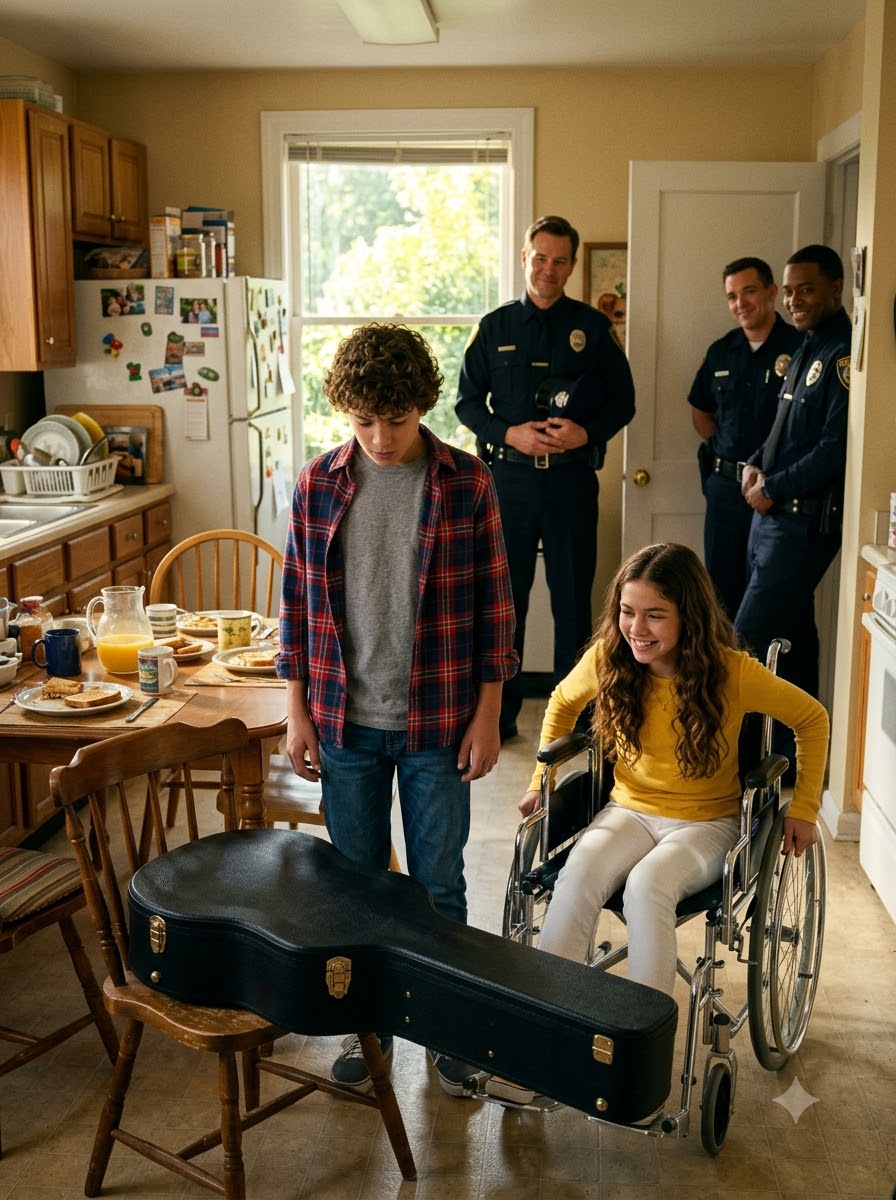
She rolled toward him smoothly in her new wheelchair.
For the first time since I’d known her, there was no squeaking wheel.
No struggle.
No awkward pause while she tried to force the chair forward.
She stopped beside him.
“And you better keep this guitar longer than twenty-four hours.”
Alejandro finally laughed.
“No promises, Elena.”
Everyone in the room laughed with him.
Officer Cooper opened the case.
Alejandro stepped closer.
His fingers hovered over the instrument before touching it.
He looked at me.
I could see the question in his eyes.
Was it okay to accept something after giving something away?
I nodded.
“Go ahead.”
He carefully lifted the guitar.
Nathan watched him.
“I want you to understand something, Alejandro.”
My son looked up.
“You didn’t just buy Elena a chair.”
Nathan glanced toward his daughter.
“You noticed something the adults around her hadn’t fully understood.”
Elena rolled her eyes.
“Dad.”
“It’s true.”
Nathan looked back at Alejandro.
“You saw she was struggling. You saw she was embarrassed. And instead of laughing or pretending you hadn’t noticed, you did something.”
Alejandro shifted uncomfortably.
He had never been good at accepting praise.
“I just wanted her to get around school.”
“I know.”
Nathan nodded toward the guitar.
“And we just wanted you to keep playing.”
I stood near the kitchen doorway watching my son hold that guitar while Elena smiled beside him.
Less than an hour earlier, I had opened my front door convinced the police had come because Alejandro had crossed some terrible line.
Instead, they had come because his kindness had traveled farther than either of us realized.
I thought about the empty guitar stand in his bedroom.
About how angry I’d almost become before letting him explain.
About a thirteen-year-old deciding that something he loved could become something another person needed.
Alejandro looked over at me.
“Mom?”
“Yes?”
“Are you crying?”
“No.”
Elena laughed.
“You definitely are.”
I wiped my cheek.
“Eat your pancakes.”
Alejandro grinned.
Then he sat down beside Elena, the guitar case resting safely against his chair.
The officers joined Nathan near the kitchen counter.
Jillian poured coffee.
And for a little while, nobody talked about hospitals, money, broken wheelchairs, or sacrifices.
They were simply two thirteen-year-old kids teasing each other over breakfast.
That was what stayed with me.
My son didn’t sell his guitar because he stopped loving music.
He sold it because, for one moment, someone else’s need mattered more to him than something he loved.
And the police hadn’t come to tell me what he’d done wrong.
They came to show me how many people had noticed what he’d done right.
