

PART 3
I didn’t respond to any of them.
Victoria had advised me not to discuss the matter publicly while the financial records were being reviewed.
I followed her advice.
Vanessa, however, had other ideas.
By midmorning, she had posted a statement online claiming that I had deliberately humiliated her family after the divorce.
She described the mansion as the place where Ryan and I had built our life together.
She claimed that Patricia had only brought a few belongings because she believed she had permission to stay.
She made no mention of the email describing the occupancy plan.
She didn’t mention the proposed loan.
And she certainly didn’t mention the signature that I had never written.
For several hours, the comments were divided.
Some people sympathized with her.
Others questioned why a family would arrive with two moving trucks without written permission.
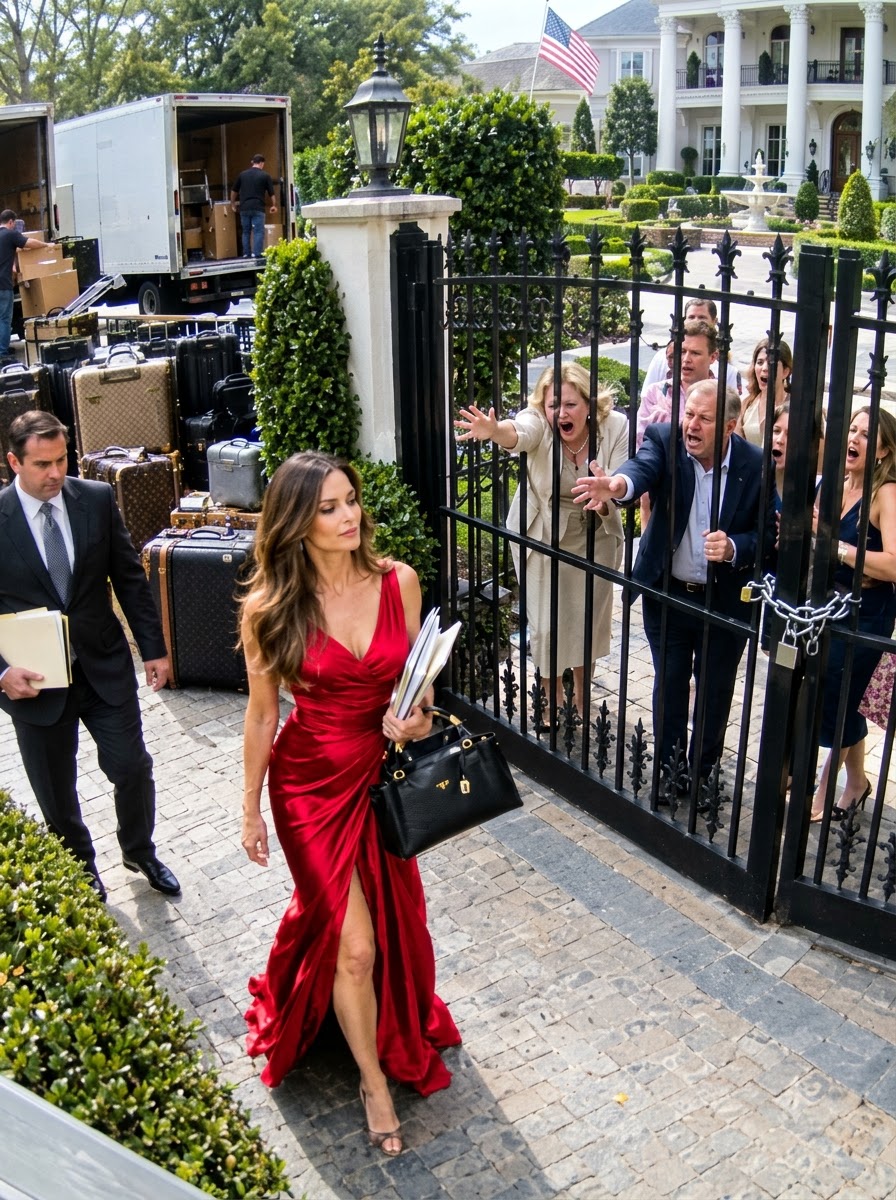
Then a neighbor uploaded a short video showing Patricia pointing at the gate and demanding entry.
Another clip showed the movers standing beside the trucks while the officer reviewed the ownership documents.
Finally, someone posted a screenshot of Vanessa’s own livestream comments, including the moment viewers began questioning the family’s story.
The narrative began to change.
I watched none of it directly.
Victoria sent me a brief message advising me to preserve anything relevant and avoid engaging with online speculation.
So I turned off my notifications and went to work.
For the first time in months, I spent an entire afternoon without wondering what Ryan would think of my decisions.
It was peaceful.
Then, at six thirty, my doorbell rang.
I checked the security camera.
Ryan stood outside the gate alone.
No Patricia.
No Vanessa.
No moving trucks.
He held a thick envelope in one hand.
I called Victoria before opening the pedestrian entrance.
She advised me to keep the conversation brief and avoid accepting any new financial or legal commitments without review.
I agreed.
Then I met him at the gate.
He looked exhausted.
His suit was wrinkled, his hair uncombed, and the confidence he usually wore like armor had almost disappeared.
“Madison,” he said.
“What do you want?”
He held out the envelope.
“These are the documents from the lender. I thought you should see them.”
I didn’t take it immediately.
“Have you spoken to your attorney?”
“Yes.”
“Then your attorney can send the documents to mine.”
He nodded, accepting the boundary.
“I know.”
For a moment, neither of us spoke.
Then he looked past me toward the mansion.
“I never thought you’d actually keep me out.”
I stared at him.
“You didn’t think I would enforce a boundary you chose to ignore.”
He lowered his eyes.
“Mom said you’d eventually let her stay. She thought once she was inside, you’d calm down and we could work things out.”
“And you agreed?”
He rubbed the back of his neck.
“I thought if she had a place to stay, it would make things easier for everyone.”
“By making decisions about my property without asking me?”
He didn’t answer.
“Ryan, why did you really need the loan?”
He looked away.
For several seconds, I thought he would refuse to tell me.
Then he sighed.
“My father’s company has been struggling. Some payments were overdue. We had obligations we couldn’t cover as quickly as we’d expected.”
“And you decided to use my house?”
“I thought the lender would consider the proposal.”
“Did you sign my name?”
He closed his eyes.
“I submitted the paperwork.”
“That wasn’t my question.”
He opened his eyes again.
“The signature was added to the application.”
“By whom?”
“I don’t know who physically entered it into the final document.”
“Did you have my permission?”
“No.”
The answer came quietly.
But at least it came.
I gripped the gate’s metal railing.
“Did you intend to tell me?”
He swallowed.
“I kept thinking there would be a way to fix everything before you found out.”
“That isn’t the same as asking permission.”
“I know.”
“No, Ryan. I don’t think you do.”
He looked genuinely wounded.
“I loved you.”
I felt the familiar ache in my chest, but it no longer controlled my decisions.
“Maybe you did. But love doesn’t make your choices harmless.”
He stared at the ground.
“I don’t know how to fix this.”
“Then start by telling the truth to the people you’ve misled. Let your attorney cooperate with the lender’s review. Stop using my name, my address, or my property in any financial discussions. And don’t come back here without a legitimate reason and proper authorization.”
He nodded slowly.
“I understand.”
I didn’t know whether he meant it.
For years, I had believed that if I explained my feelings clearly enough, Ryan would finally understand why his actions hurt me.
Now I knew that understanding wasn’t the same as agreement, and regret wasn’t the same as change.
I stepped back from the gate.
“Goodbye, Ryan.”
He stood there for a moment longer.
Then he walked toward his car.
I watched him leave.
And when the street became quiet again, I returned to the house.
The legal review took several weeks.
Victoria communicated with the lender, preserved the relevant correspondence, and arranged for the disputed signature to be examined as part of the appropriate process.
The lender confirmed that the proposed transaction had not been completed and that no funds had been released against my property.
That was a relief.
The lender also confirmed that the application was being reviewed because of the ownership dispute and the questioned authorization.
I provided the records I had, including the dates when I had been away from the house and the messages Ryan had sent me around the time the paperwork was submitted.
Victoria advised me not to speculate about who had created the signature or what everyone involved had known.
I followed her advice.
I didn’t need to embellish anything.
The facts were serious enough.
Meanwhile, the Montgomery family’s financial difficulties became harder to conceal.
Ryan’s father eventually acknowledged that the construction company had been struggling with delayed payments and several expensive commitments.
The business had not collapsed overnight, as some relatives suggested.
Its problems had accumulated over time.
But instead of confronting those problems directly, Ryan had tried to use my property as a shortcut.
Patricia was furious when she learned that I wouldn’t withdraw my objection.
She sent several messages accusing me of destroying the family.
I didn’t answer.
Victoria advised me to preserve the messages and keep any necessary communication in writing.
I did exactly that.
Vanessa eventually deleted her original livestream.
Unfortunately for her, several viewers had already saved clips.
The public conversation moved on, but the people who mattered to the Montgomerys remembered what had happened.
A family friend who had once praised Patricia’s supposed generosity stopped inviting her to certain gatherings.
One of Ryan’s business associates asked him to clarify the circumstances surrounding the proposed loan before discussing future projects.
Brandon, angry that Ryan had told him the move was approved, refused to get involved in any further family plans.
And Patricia, who had expected to enter my home surrounded by boxes and admirers, found herself explaining why the trucks had returned empty.
I took no pleasure in her embarrassment.
I had simply stopped protecting her from the consequences of her own decisions.
Several weeks after the confrontation, I received a letter from Ryan through his attorney.
It contained an apology.
He acknowledged that the proposed loan had involved my property without my authorization. He also admitted that he had allowed his family to believe they could occupy the mansion after the divorce.
The letter did not erase what had happened.
It did, however, establish a written acknowledgment that would become part of the record.
Victoria reviewed it and advised me that no response was necessary unless I wanted to communicate through counsel.
I chose not to reply.
For the first time, I understood that closure did not require one final conversation.
It didn’t require Ryan to understand every hurt he had caused.
It didn’t require Patricia to admit that she had been wrong.
And it certainly didn’t require me to forgive someone before I could move forward.
Closure was the decision to stop participating in a pattern that had made me doubt my own judgment.
The divorce was final.
The house was mine.
And the future no longer depended on the Montgomerys’ approval.
Autumn arrived in Westport with cool mornings and golden leaves scattered across the driveway.
I spent a Saturday tending to my mother’s roses.
Some of the bushes needed pruning, and a few had grown wild during the months when the divorce consumed nearly all my attention.
I worked slowly, trimming dead branches and clearing the soil around their roots.
The task reminded me of something my mother used to say.
“You don’t have to save everything that has stopped growing, Madison. Sometimes you have to make room for what comes next.”
For a long time, I had interpreted those words as advice about the garden.
Now I understood them differently.
I had spent years trying to preserve my marriage by making excuses for Ryan.
I had told myself that his family was demanding because they cared.
I had convinced myself that his secrecy came from stress.
I had mistaken his apologies for change and his confidence for reliability.
When the marriage finally ended, I grieved the future I had imagined.
But I also began to recognize the life I had neglected while trying to keep that future alive.
I reopened the rooms I had stopped using.
I invited friends over for dinner.
I spent evenings reading in my father’s study without worrying that someone would accuse me of being antisocial.
I even rearranged the guest wing, not because Patricia had planned to occupy it, but because I wanted the rooms to reflect my own preferences.
The mansion began to feel like mine again.
Not because I had defeated the Montgomerys.
Because I had stopped asking their permission to live in it.
One Sunday afternoon, Victoria visited to deliver the final set of documents related to the property dispute.
She placed the folder on my desk.
“The ownership records remain in your name,” she said. “The lender’s review has progressed, and your position regarding the disputed authorization has been documented. We’ll keep the file in case anything further arises.”
I thanked her.
Then I asked a question that had been bothering me.
“Do you think I should have handled the confrontation differently?”
Victoria considered it.
“You stayed calm, presented the ownership records, and let the authorities handle the immediate situation. You also avoided making public accusations beyond what the documents supported. From a practical standpoint, those were sensible choices.”
“But what about the family?”
She smiled faintly.
“Madison, you’re not responsible for making an unauthorized move feel comfortable for the people attempting it.”
I laughed.
It was the first time I had laughed about the entire ordeal without feeling a knot of anger beneath it.
After Victoria left, I walked to the front gate.
The same gate Patricia had struck with her palm.
The same gate Brandon had tried to open with codes he had no right to use.
The same gate Vanessa had filmed while telling her audience that I was the villain.
I placed my hand against the cool metal.
For years, I had thought of the gate as a barrier between the outside world and my private life.
Now it represented something more important.
A boundary was not an act of cruelty.
It was a statement about what I would and would not permit.
And I no longer felt guilty for having one.
Nearly three months after the divorce, Patricia appeared outside the estate again.
This time, she arrived alone.
There were no trucks.
No cameras.
No crowd of relatives waiting behind her.
I saw her through the security feed and felt my shoulders tense automatically.
For a moment, I considered letting the call go unanswered.
