

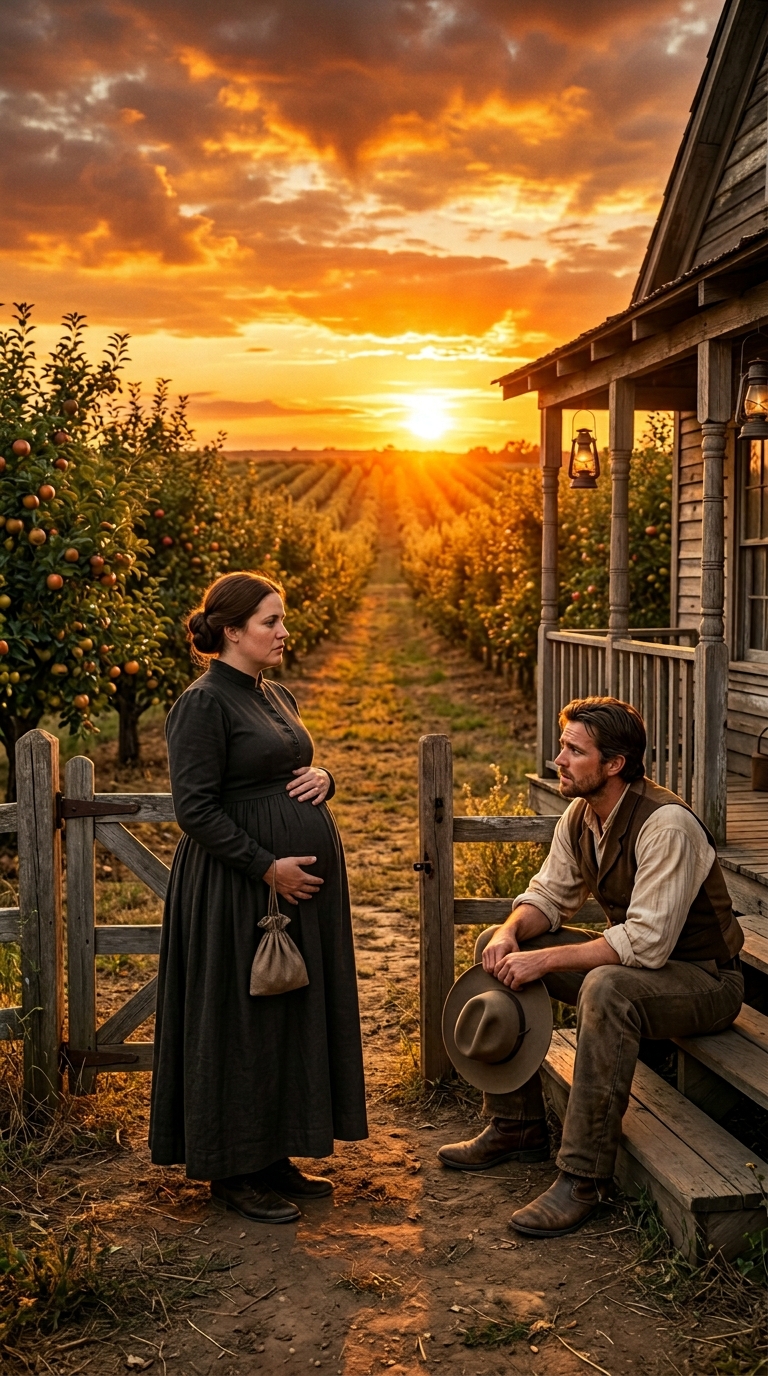
The first night Mariana Salvatierra arrived at the peach orchard, she didn’t ask for charity: she asked for work with one hand on her belly and the other clutching an old bag.
She had walked from the town, her shoes covered in mud and her face pale from someone who had swallowed too much shame for far too long. In the town square, three doors had been closed to her. At the first house, a woman told her that a pregnant woman without a husband brought trouble. At the second, they slipped her a coin under the gate, as if touching her might spread misfortune. At the third, they didn’t even open the door.
When she saw the wooden entrance to the Los Nogales estate, night was already falling. The air smelled of sweet and rotting fruit. Under the trees lay hundreds of burst peaches on the ground, abandoned, covered in flies and damp leaves. Mariana stopped, took a deep breath, and immediately understood what she was seeing. She had been a cook for eleven years in a roadside eatery in Querétaro. She knew when a harvest was being lost, and she also knew how much pain lay behind a cold kitchen.
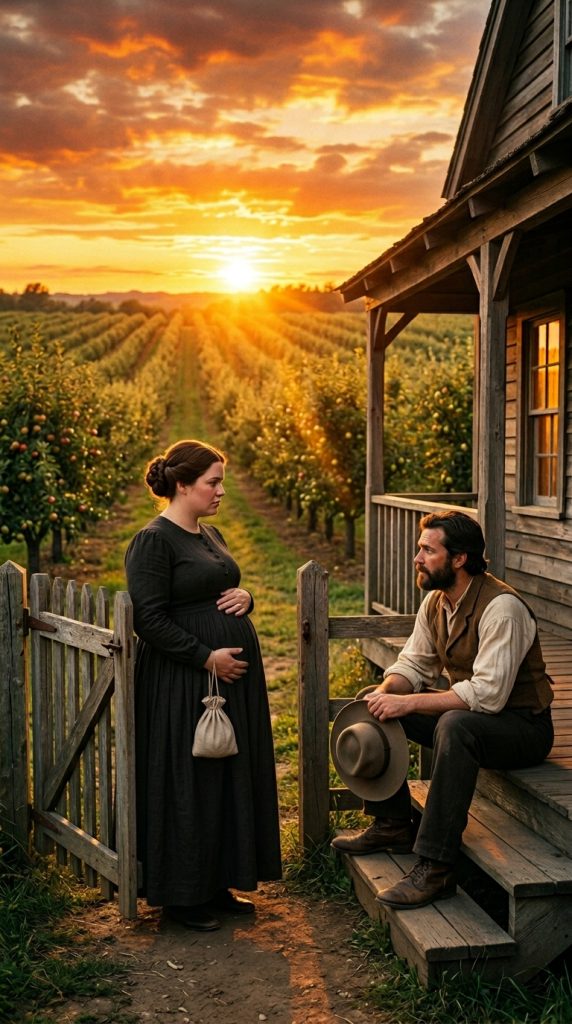
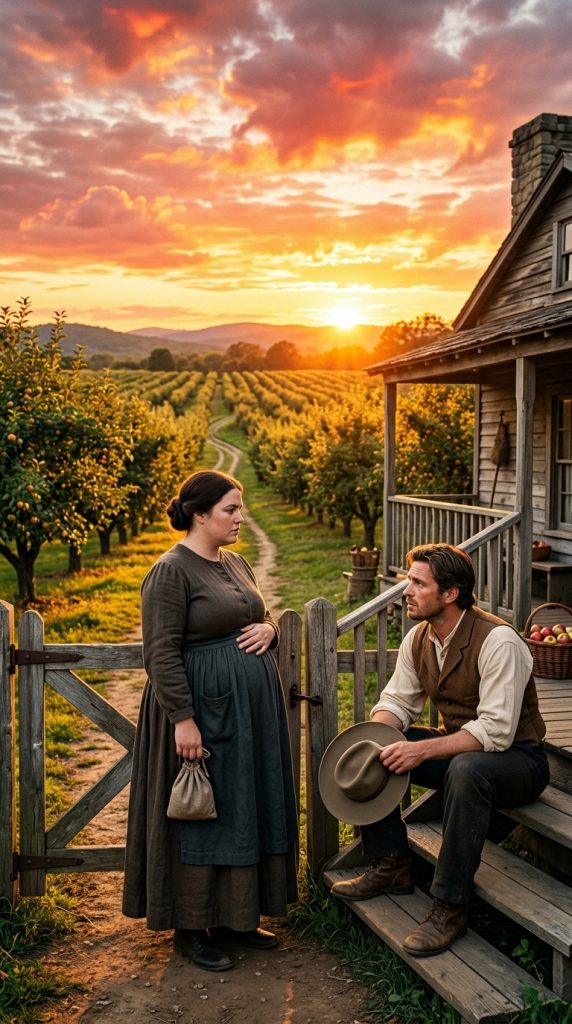
On the porch sat Esteban Robles, in an old chair, staring at the orchard as if it no longer belonged to him. He was thirty-eight years old, with an unkempt beard and the eyes of someone who had stopped expecting good news. His mother, Doña Amparo, had died eight months earlier, and with her had gone the order of the house, the recipes, the buyers, and even the sound of plates at the table.
Mariana looked at the trees.
“You’re losing your winter reserves,” she said.
Esteban looked up. He first saw the bag, then the stretched coat over her belly. He didn’t ask whose baby it was. He didn’t ask where she had come from. He simply looked at her with exhaustion.
“I can save what’s left,” Mariana added. “Make preserves, dried fruit, jam, peach cajeta. I can cook for the house too. Just let me stay until my baby is born.”
Esteban took a long time to answer.
“There’s no room here,” he murmured. “Try in the town.”
Mariana lowered her eyes to the road she had come from. She didn’t say that she had already tried. She simply nodded. She walked toward a small storage shed beside the trees, pushed the stuck door open, and went inside. There were empty boxes, dust, forgotten jars, and a cold smell of old wood. But it was dry. For her that night, it was enough.
Before dawn, Esteban found her working. She had a lamp lit on the floor and had separated the fruit into piles: the good ones, the rotten ones, and the bruised ones that could still be used for preserves. Her sleeves were rolled up, her hands red from the cold, and her belly under the coat like a fragile promise.
“Almost 40% can be saved,” she said without looking at him. “If we start today, we can still make it.”
Esteban looked at the boxes. Then he saw the folded coat in the corner, where she had slept on the wood. He didn’t say thank you. He didn’t say stay. He turned around and went back to the house.
Half an hour later, Mariana heard noise inside. Furniture being dragged, a door opening, drawers being emptied. When she carried the first box of usable peaches into the kitchen, she saw a small room next to the stove. There was a narrow bed, a clean blanket, and an empty nightstand.
No one was there to explain anything to her.
Mariana left her bag beside the bed, still closed, as if she didn’t want to make the mistake of believing too soon. Then she went into the kitchen, lit the wood stove, and started heating water. When the first smell of coffee filled the house, Esteban appeared in the hallway.
She placed a cup on the table without turning around. He sat down.
They didn’t speak. But for the first time in eight months, that kitchen had the sound of life.
The following days filled with work. Mariana boiled fruit, sterilized jars, baked bread, prepared atole, and saved seeds for the next season. Esteban pretended not to notice when she leaned on the table to catch her breath, when she sat on a small stool to keep stirring the pots, or when she carried less weight than she wanted to carry. But every morning he left the firewood closer to the door. Every night he fixed something without saying a word: a loose board on the porch, a broken hook in the kitchen, a crack where the cold came in.
The old orchard helper, Don Julián, was the first to change. At first he came in with his hat on, distrustful of the pregnant stranger who had appeared in his boss’s house. But one afternoon he tried a piece of fresh cheese that Mariana had made with milk from the most difficult cow in the corral — a cow that had stopped giving milk after losing her calf.
“She has good hands,” Don Julián said, and from then on he started wiping his boots before entering.
The cow changed too. No one could approach her without her kicking the stable wood. Mariana didn’t force her. She simply stayed quietly beside her, one gentle hand on her neck, waiting. Little by little, the animal stopped trembling. Then she stopped kicking. One morning, the milk appeared in the kitchen, warm and white, next to the jars of jam.
Esteban watched all of this in silence.
One night, as he passed Mariana’s room, he saw her sitting on the bed with the bag open. On her lap were tiny baby clothes: two blankets, some socks, a hand-sewn shirt. She folded each piece with a delicacy that tightened Esteban’s chest. When she finished, she put everything back in the bag and left it on the floor, near the door.
As if she were ready to leave at any moment.
The next morning, a small cradle made of pine wood appeared against the warmest wall of the kitchen. It wasn’t elegant, but it was carefully sanded and had soft flannel on the bottom. Mariana stood motionless when she saw it. Then she went to her room, brought the socks, and placed them inside.
She didn’t say thank you. But that night she stayed sitting at the table until Esteban finished eating.
The orchard began to come back to life. The buyers returned. One of them tried the peach preserve with cinnamon and doubled the winter order. Don Julián started coming three days a week. The storage shed once again smelled of sugar, fruit, and clean wood, no longer of abandonment.
But where there is hope, envy sometimes arrives too.
Aurelio Cárdenas appeared one Tuesday, riding in a gray pickup truck, with clean boots and the smile of a man used to buying what others don’t want to sell. He owned the neighboring land and had been waiting for years for Esteban to go broke so he could take Los Nogales. He entered the kitchen as if it were his own, looked at the jars, the cradle, Mariana’s belly, and then smiled.
“Doña Amparo took great care of this house’s good name,” he said in a friendly voice. “It would be a shame if the buyers started talking.”
Mariana continued kneading bread, but her hands stiffened.
“I don’t understand.”
“A woman alone, about to give birth, living in the house of a man alone. You know how people are. They’re not bad, they just prefer to do business with respectable houses.”
Aurelio drank his coffee, left the cup perfectly aligned, and left. But his poison remained in the kitchen.
That afternoon, Esteban noticed that Mariana walked close to the walls, as if she wanted to take up less space. She put away her spoons, her jar of salt, her stove cloth. The next day, he built a new shelf next to the stove — large, sturdy, enough for another full season of preserves.
When Mariana saw it, she understood. She put her things back in the kitchen.
Three weeks later, Aurelio returned with a paper. Esteban read it by the fence: an old debt of his mother’s, small at first, but inflated with unfair interest. Aurelio spoke of stability, rumors, nervous buyers.
“I can take that weight off your shoulders,” he said. “Sell before it’s too late.”
Esteban folded the paper.
“I’m not selling my mother’s house.”
That night, Mariana read the debt in silence.
“Are you going to lose the orchard?” she asked.
“No,” he replied.
But she saw the shadow in his eyes.
At midnight, Esteban heard from his room the sound he already recognized: the bag opening, clothes being folded, fear preparing to flee. He didn’t sleep. Before dawn he went to town. He sold two horses, withdrew his last savings, and confronted Aurelio at the notary’s office. To everyone’s surprise, the notary reviewed the debt and discovered that Aurelio had altered the dates. He couldn’t charge the interest. Esteban paid only what was fair and left with a signed receipt.
When he returned, he placed the paper next to Mariana’s plate.
“Paid in full.”
She read it once. Then she stood up slowly and walked to her room. Esteban heard the wardrobe open. Then, for the first time, he heard the bag being put inside, not left by the door.
That same night the storm began.
The pain woke Mariana shortly after midnight. At first she thought it was the cold, but the second pain pierced her back and stole her breath. She sat up in bed, one hand on her belly.
It was still six weeks away.
She went to the kitchen trying not to make noise. She lit the stove and put water on to heat because she didn’t know what else to do. When the contraction returned, she placed both hands on the table and lowered her head.
Esteban appeared in the doorway.
“It’s too early,” she whispered. “Too early.”
He grabbed his coat and went out to the road, but the snow and mud had made it impossible to reach the town. He ran back and went for Doña Rosario, the midwife who lived on the other side of the stream. The woman arrived with her skirt soaked, a lamp in her hand, and a serious face.
“Hot water, clean blankets, more firewood,” she ordered.
Esteban obeyed everything. Don Julián appeared before dawn, drawn by the light of the kitchen in the middle of the storm. He didn’t ask anything. He made coffee, carried water, held the door when the wind tried to tear it off.
Mariana didn’t scream. She only breathed, clutched the sheets, and said thank you every time Doña Rosario brought her water. The midwife looked at her with sadness. Women who have been cared for ask for help easily. Those who have been abandoned learn to suffer in silence.
The baby girl was born just as the sky began to lighten.
She was small, too small, but she cried. A sharp, thin, alive cry.
Esteban stood in the hallway, his hands trembling. Doña Rosario came out with a tired face.
“The baby needs milk. Mariana still doesn’t have enough.”
Esteban didn’t hesitate. He went to the stable, took the cow that Mariana had calmed for weeks, and brought her into the kitchen to protect her from the cold. Don Julián moved the table without a word. Doña Rosario heated the milk slowly, drop by drop, and the baby drank with minimal but fierce strength.
Mariana, exhausted, looked at her as if the entire world fit inside that little body wrapped in blankets.
“Her name will be Lucía,” she said. “Because she arrived while it was still dark.”
Spring returned little by little. Lucía grew small, but strong. She slept in the pine cradle next to the stove, and during the day she was tied to Mariana’s chest while the bread rose, the preserves boiled, and the flowers opened on the trees.
The buyers signed new contracts. The fame of the Los Nogales preserves reached the capital of Puebla. Aurelio tried to return one last time, but when he saw the orchard full of workers, the chimney lit, and Esteban standing at the entrance, he left without getting out of his truck.
That afternoon, Mariana went into her room and finally opened the bag. She took out Lucía’s clothes, her dresses, her mother’s photo, and an old Bible. She put each thing in its place. The bag was left empty. She folded it and stored it in the upper part of the wardrobe.
When she closed the door, Esteban was standing in the doorway. His eyes traveled around the room: the dresses hanging next to his jacket, the photo on the shelf, the cradle in the background, the bag far from the exit.
“I was just arranging my things,” Mariana said, embarrassed.
Esteban looked at her with a tenderness he no longer tried to hide.
“Should I make more space?”
Mariana heard Lucía moving in the kitchen. Outside, the peach trees were beginning to bloom. For the first time in a long time, she was not afraid of belonging to a place.
“Yes,” she answered, her eyes full of tears. “But this time not just until spring comes.”
Esteban smiled faintly.
And in that house where for months there had only been silence, the sound of a family returned.
