

Part 1: The Woman in the Pale Blue Gown
The hallway smelled like hand sanitizer, burnt coffee, and the cold air hospitals pump through their vents no matter how many people sit shivering beneath thin blankets. Somewhere down the corridor a monitor kept up its steady little beep, and every few seconds a cart wheel squeaked across the polished floor, as though the building itself were counting out the time.
I had come to visit my best friend after his surgery. That was all. A simple errand, a paper cup of coffee, a few jokes to make a sore man laugh. I never expected to see Rachel. Not like that.
She sat alone near the corner of the internal medicine hallway, swallowed by a pale blue hospital gown that hung loose on her shoulders. Her hands were folded in her lap as if she were trying to take up less space in the world. Her eyes were open, but they rested on nothing at all, blank and tired beneath the harsh white ceiling lights. For one second, I forgot how to breathe.
My name is Warren. I’m thirty-four, an ordinary office employee with a rented apartment, a dented sedan, and a life I kept telling myself was finally under control. Rachel and I had been married for five years. To everyone else, we looked steady. We had a quiet house, regular jobs, grocery runs on Sunday, and coffee in paper cups before work. Bills got paid late sometimes, but they always got paid.
Rachel was never loud about love. She showed it by warming leftovers before I got home, by leaving my clean shirts draped over the back of a chair, by asking whether I had eaten even when she was too tired to eat herself. We had ordinary dreams, the kind you never say out loud because they seem too small to need saying. A little house with a driveway. Kids. A backyard with cheap patio chairs and too many toys scattered through the grass.
Then came three years of waiting, two miscarriages, and a silence neither of us knew how to hold. The first loss broke something open in her. The second made her fold into herself. After that, Rachel grew quiet in a way that made the whole apartment feel careful, as if every room were holding its breath. She still smiled when someone asked if she was okay, but the smile never reached her eyes.
I changed too, and I hate admitting how easy it was to call avoidance responsibility. I stayed late at work. I answered emails I could have ignored. I told myself overtime mattered more than another painful conversation across the kitchen table. Grief does not always tear a house down in one night. Sometimes it loosens one screw at a time until the whole thing starts leaning and nobody wants to be the first to say so. By April, we were two exhausted people living around each other. There were no screaming fights, only small arguments over laundry, money, dinner, silence. They were the kind that end with one person in the bedroom and the other staring at the sink as if the dishes might explain what went wrong.
On Tuesday, April 9, at 10:42 p.m., after another pointless argument that left both of us standing in the kitchen with our voices low and our faces empty, I said the words I had been too afraid to say for months. “Rachel… maybe we should get divorced.” She looked at me for a long time. Then she asked softly, “You had already decided before you said that, hadn’t you?” I did not have the courage to lie. I nodded.
She did not scream. She did not throw anything. She did not beg me to stay. Somehow, that was worse. She lowered her eyes, walked to the bedroom, and began packing her clothes into the old gray suitcase we had once used for a weekend trip, back when we still believed we had forever to fix things. The divorce moved fast. Too fast. There were county clerk forms, scanned signatures, a final packet with both our names printed in black ink, and one quiet morning when we walked out of a family court hallway as if five years could be folded, stamped, and filed away. Afterward, I moved into a small rented apartment across town. I bought one plate, one mug, and a cheap folding chair I hated looking at. My days became a routine I could survive: work, microwaved dinners, a drink with coworkers now and then, movies playing while I stared right through them. There was no warm light in the kitchen when I came home, no familiar footsteps in the morning, no gentle voice asking, “Have you eaten?” Still, I kept telling myself I had done the right thing. That was the lie I used like a blanket. Two months passed that way.
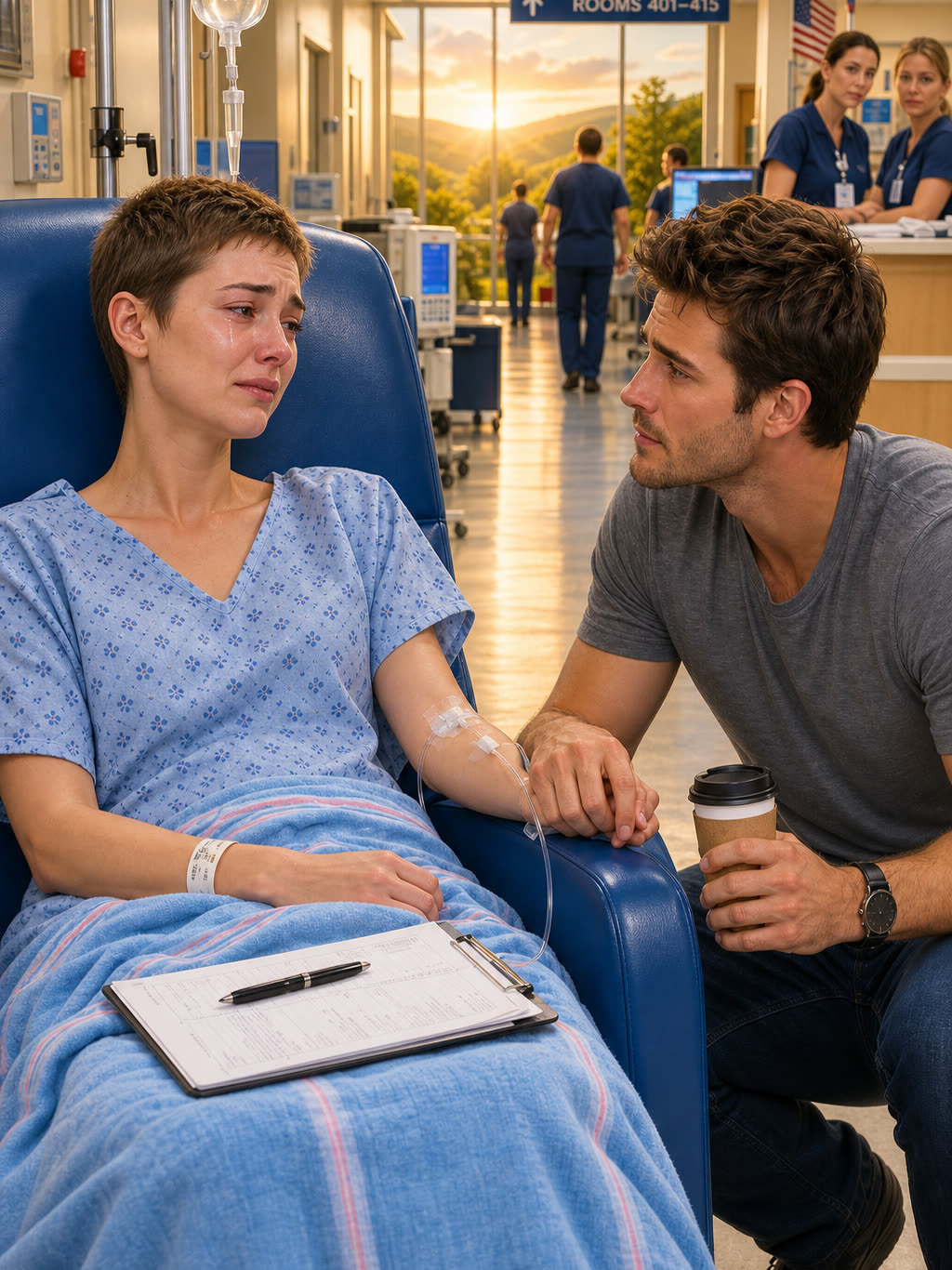
On Thursday, June 13, at 1:17 p.m., Spencer texted me from the hospital after his surgery. Nothing dramatic. Just: Still alive. Bring coffee if you’re coming. So I went. I stopped at the gift shop for a paper cup of bad coffee, signed in at the front desk, and followed the signs toward the recovery wing. A small American flag stood near the reception counter beside a stack of visitor badges, the kind of detail you notice only when you are trying not to think about why hospitals make everyone look smaller. Spencer’s room was farther back, past internal medicine, and that was where I saw her. At first she was just a shape at the edge of my vision, a woman in a pale blue gown sitting alone against the wall beside an IV stand. Her shoulders were hunched. Her hair was cut heartbreakingly short, nothing like the soft brown waves she used to twist into a messy bun while brushing her teeth. Then she turned her face slightly toward the light. Rachel. My ex-wife. The woman I had let walk out of our apartment only two months earlier. My hand tightened around the coffee cup until the lid bent, and heat pressed into my palm, but I barely felt it.
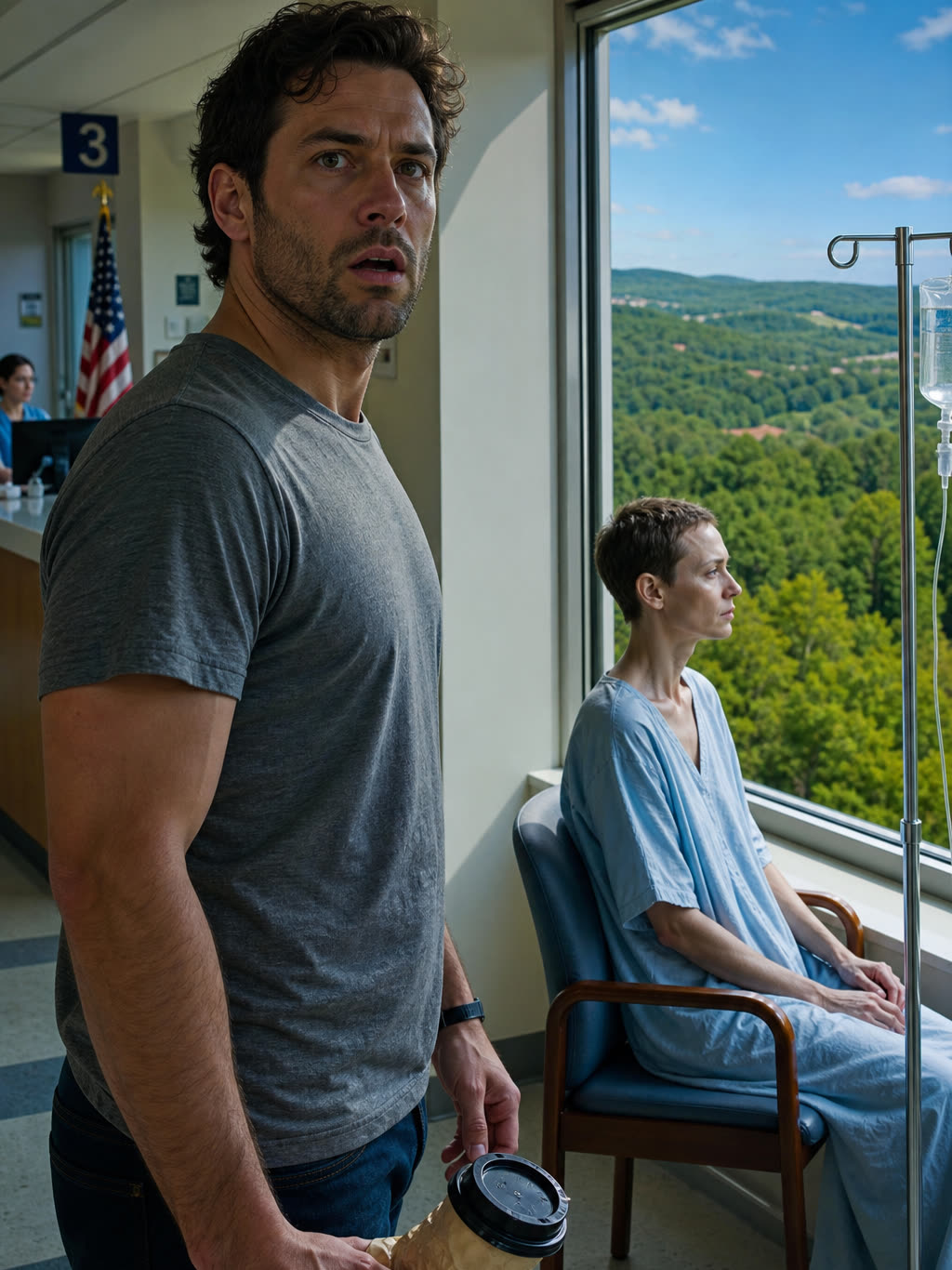
Her face was thin. Too thin. The color had drained out of her skin, and dark circles sat beneath her eyes like bruised shadows. A hospital wristband circled one wrist. Beside her chair, a clipboard lay half-tucked under a folded blanket, with the word “INTAKE” printed across the top page.
Questions hit me all at once. What happened to her? Why was she here? Why was she alone? Every one of them arrived at the same moment, and none of them had an answer I could reach from where I stood.
I walked toward her slowly, as if one wrong step might make the whole scene disappear. The linoleum seemed to stretch longer with every footstep. Behind me, the monitor went on beeping, the cart wheel squeaked, and the world kept its ordinary pace while mine had stopped. “Rachel?”
She looked up. For a moment, shock moved across her face. It was not relief. It was not anger. It was pure shock, as if I were the last person on earth she had expected to find standing in front of her. “Warren…?”
My chest tightened so hard I had to sit before my knees gave out. “What happened to you?” I asked. “Why are you here?” She looked away immediately, toward the vending machines humming near the nurses’ station, as if the glowing rows of snacks were suddenly the most fascinating thing in the building. “It’s nothing,” she whispered. “Just some tests.”
I reached for her hand before I could stop myself. It was ice cold. It felt small and light in my palm, like something that had been left out in winter. “Rachel,” I said, trying to keep my voice steady, “don’t lie to me.”
Her fingers gave one small tremble inside mine. “I can see you’re not okay.” For several seconds, she said nothing. A nurse passed with a rolling cart. Someone laughed softly behind a closed door. The hospital kept moving around us like this was ordinary, like my whole past was not sitting in front of me in a gown that looked too big for her body.
I thought about every night I had stayed late instead of coming home. Every time she had gone quiet and I had treated the quiet like peace. Every form we signed, every box she packed, every moment I had mistaken her silence for agreement. It all came back to me in that hallway, and it did not feel like memory. It felt like evidence.
Then Rachel looked down at our joined hands. Her lips parted, and in a voice so small I almost missed it, she spoke. “I didn’t want you to see me like this.” Somehow it hurt worse than any accusation would have. Her eyes stayed on our hands, not my face, as if looking at me directly would make the words too real. She tried to pull her hand back, but she barely had the strength. The IV tubing shifted against her wrist, and the hospital bracelet scratched softly against my thumb.
That was when I noticed the clipboard under the blanket had slipped farther out. The top page was a hospital intake form. Her name was there. The date was there. So was the time: 6:18 AM. Under emergency contact, the line had not been left blank. It still had my name. Warren Hayes. My phone number. My old apartment address crossed out in blue ink.
Before I could say a word, a woman in navy scrubs stepped out from the nurses’ station holding a sealed envelope and a small plastic bag with Rachel’s personal items inside. “Rachel?” she called gently. “The doctor wants to go over the next steps, but we need someone with you for the discharge conversation.” Rachel’s face collapsed. It wasn’t crying. It was worse. She closed her eyes like she had been holding one last wall up and the nurse had just touched it with a single finger. “Warren,” she whispered, “please don’t make this harder.” I stared at the envelope, then at the woman I had once promised to protect. For the first time since our divorce, I understood that the papers we signed had ended a marriage, not whatever this was. The nurse looked from Rachel to me and quietly asked, “Are you the emergency contact, sir?” I opened my mouth to answer.
Part 2: A Diagnosis Years in the Making
“Yes,” I said. “I’m her emergency contact.” The word came out before I had time to think about whether I still had the right to it. It sat in the air between the three of us, heavy and strange, like something I had borrowed from a version of myself I had abandoned months ago.
Rachel didn’t look at me. She stared at the floor tiles, her jaw tight, like she was bracing for me to take it back. I knew that look. It was the one she wore when she expected disappointment, and the worst part was that I had taught it to her myself, one late night at a time.
The nurse smiled gently. “Good. I’m Tamika. Dr. Okafor would like to talk with both of you. It won’t take long.” She said it so easily, so kindly, that for a second I almost believed it would be simple. Hospitals have a way of making terrible news sound like a scheduling matter.
“Warren, you don’t have to,” Rachel whispered. “I know,” I said. “I want to.” I meant it more than I had meant anything in months, and I think she heard that, because her shoulders dipped just slightly, the way a person lets out a breath she has held too long.
Tamika helped her out of the chair and walked beside her, one hand lightly at her elbow. I followed a step behind, carrying nothing but a bent paper cup of coffee that had gone lukewarm and no longer mattered. We passed rooms with half-open doors, glimpses of strangers in beds, flowers on windowsills, a television murmuring to no one. I kept my eyes on the back of Rachel’s head, on the short ends of her hair, and I kept wondering when she had decided to cut it all off and who had been there when she did.
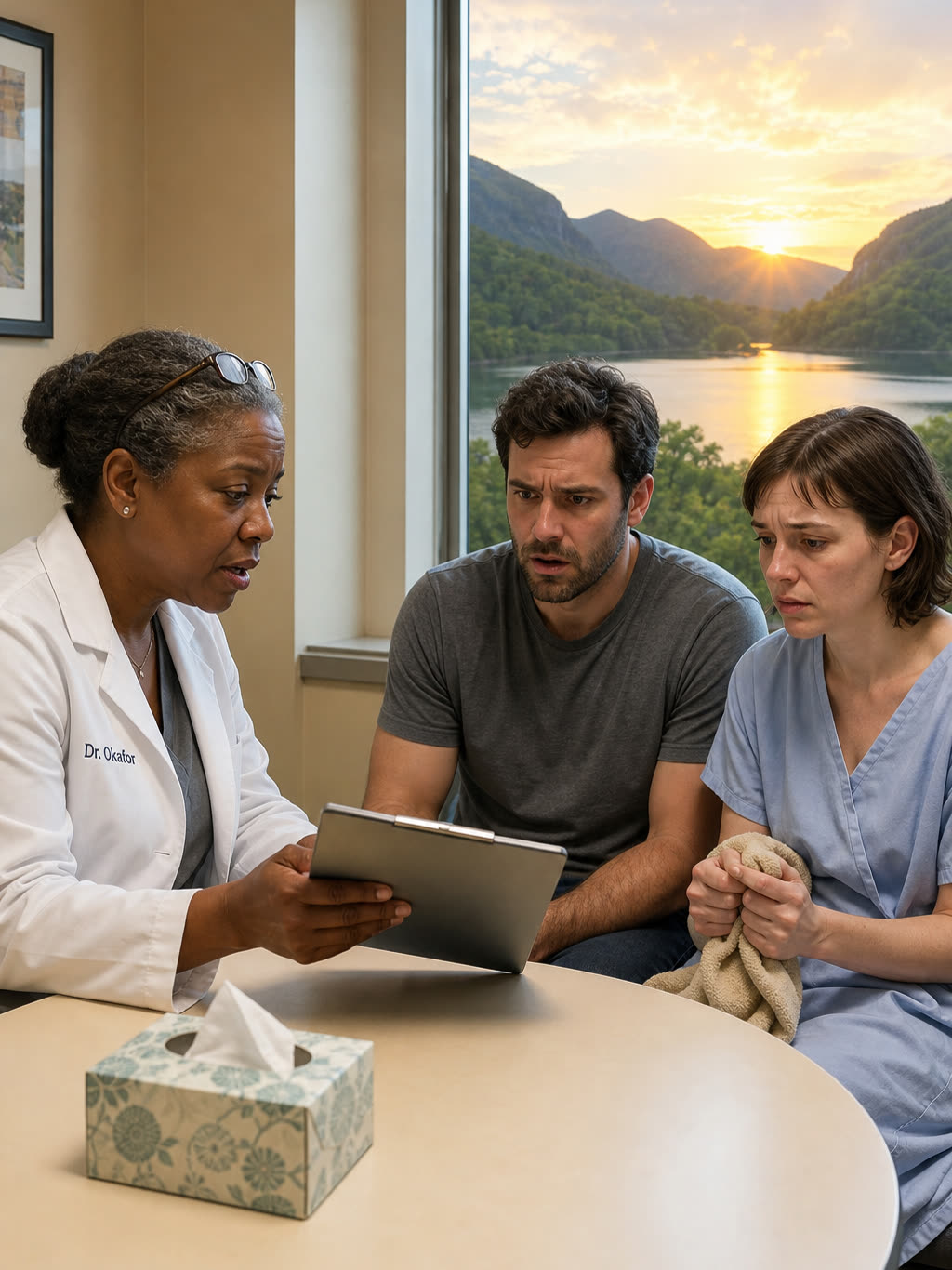
The consultation room was small and beige, with a box of tissues placed on the table in a way that told you exactly what kind of room it was. A framed print of a calm lake hung crookedly on one wall, the sort of picture meant to soothe people and never quite managing it. I sat in the chair next to Rachel’s. Our knees were a few inches apart, and neither of us moved to close the gap.
Dr. Okafor, a calm woman with reading glasses pushed up into her gray-streaked hair, waited until we were both seated. She folded her hands over a thin folder and let a moment of quiet settle, as if she understood that people need time to arrive in a room before they can hear what it holds. “Rachel, are you comfortable with Mr. Hayes hearing this?”
Rachel’s fingers twisted in the blanket across her lap. The seconds stretched. I watched her decide, watched her weigh pride against exhaustion, and I did not say a word, because for once I understood that this choice was hers and not mine. After a long moment, she nodded.
“Your scan this morning confirmed what we suspected last week,” Dr. Okafor said. “You have a large fibroid mass pressing on your uterus, along with advanced endometriosis. The bleeding that brought you in today has made you severely anemic. That’s why you’ve been so exhausted and lightheaded.” She spoke slowly and clearly, the way people do when they have said hard things many times and still refuse to say them carelessly.
“Fibroids,” I repeated. “Is that… cancer?” “No. It’s benign. But it’s serious, and it’s been growing for a long time.” A long time. Something cold slid down my spine, and the beige walls seemed to lean in a little closer. I looked at Rachel, but she kept her eyes on the folder, as though the pages might change if she refused to read them.
“How long?” I asked. Dr. Okafor looked at Rachel, then back at me. “Based on the size, likely several years. Conditions like this are a common cause of repeated pregnancy loss. I’m sorry to say it may be part of why you two struggled.”
The room went very quiet. I could hear the ventilation humming above us and, faintly, a phone ringing at the nurses’ station that no one seemed in a hurry to answer. “Years,” I said hoarsely. “She’s been in pain for years?”
“Warren,” Rachel said. “You told me you were just tired. After the second miscarriage, you said you were just tired.” “I thought I was,” she whispered. “I thought it was grief.”
Her answer cracked something open in me. I thought of every morning she had moved slowly around the kitchen and I had blamed sorrow. Every evening she had lain curled on the couch with a heating pad, and I had told myself she needed space. I had watched her disappear in small ways, and I had called it healing, because healing was easier to believe than the truth.
Dr. Okafor explained the plan: a surgery in two days, careful recovery, a good prognosis. Rachel would need an iron infusion first, and someone to drive her home and stay with her afterward. “She’ll need help for at least two weeks,” Dr. Okafor said. “Is there family nearby?”
“My sister lives in Phoenix,” Rachel said. “I haven’t told her yet.” “Why not?” I asked.
She finally looked at me. Her eyes were red, but steady, and there was something almost calm in them, the calm of a person who has already survived the worst of her own fear.
“Because I didn’t want anyone to worry. And because I didn’t want you to find out and come back out of guilt. I’d rather be alone than be someone’s obligation.” That sentence hit harder than anything else she could have said.
I should have gone home that night. Instead I sat in a vinyl chair beside her hospital bed until visiting hours ended. Afterward I called Spencer, who was groggy and sore and thrilled to hear I had found something more interesting than his hospital Jell-O. “Go,” he said, once I explained. “Be there. Don’t mess it up.” I did not plan to go back to the apartment. I just drove, and somehow I ended up in front of the old building on Maple Street, where the porch light still hadn’t been fixed. Rachel had kept the lease. I had the spare key on my ring because I had never taken it off. Inside, everything was spotless. The kitchen smelled like lemon cleaner. The couch had a new blanket. On the refrigerator was a neat list in Rachel’s handwriting: iron pills, 8 a.m. Call Dr. O’s office. Sister: tell her after the scan. She had been managing all of this by herself for weeks.
On the counter sat a stack of unopened mail, and on top of it, a flat white envelope with my name on it. Not a bill. Not a legal notice. It was a letter, dated three weeks earlier, written in the hand I had once known better than my own. My thumb slid under the flap, and the paper whispered open, and I began to read.
Part 3: Asking the Question I Should Have Asked
I stood in the kitchen with the letter in my hands and the refrigerator humming behind me. The handwriting slanted a little to the right, the way it always had when Rachel was tired. I unfolded the page carefully, as if it might break, and read the first line.
Warren, I started this a few times and never sent it. Mostly I wanted to say I’m not angry. I was for a while. But I understand now that we both stopped asking each other how we were, because the answer hurt too much.
I’ve been having bad days lately. Maybe it’s nothing. If it is something, I want you to know I’m okay. I don’t want you to carry any of it.
I hope you’re eating. I hope you’ve got someone telling you to. Rachel.
I sat down on the kitchen floor and read it twice. She had been sick, she had suspected it, and her first instinct had been to protect me. I could not remember a time in five years when I had done the same for her.
The surgery went well. I sat in the waiting room for four hours, reading the same page of a magazine without taking in a single word, until Dr. Okafor came out with her mask hanging loose around her neck and said, “She did great.”
I put my face in my hands. I didn’t care who saw. Something inside me, tight for two months and maybe much longer, finally let go.
When Rachel woke up, groggy and pale, I was in the chair beside her bed, holding a cup of ice chips. “Hey,” I said softly. “You stayed.” “I told you I would.”
“You said you’d drive me home. You didn’t say you’d stay.” “I’m saying it now.” She studied me for a long moment, the way she used to study a recipe before deciding whether it was worth the effort.
“Warren, I don’t want you here because you feel bad.” “I feel terrible,” I said. “I feel like the worst man alive. But that’s not why I’m here.” “Then why?” I took a breath. I had practiced answers all night, none of them good enough. “Because I mistook your quiet for peace. I thought if you weren’t crying, you were okay. I never asked. I’m asking now. How are you? Really?” Her eyes filled. “I’m scared,” she whispered. “I’ve been scared for so long. I didn’t think anyone was left to tell.” I took her hand, the cold one with the IV, and held it very gently. “Tell me.”
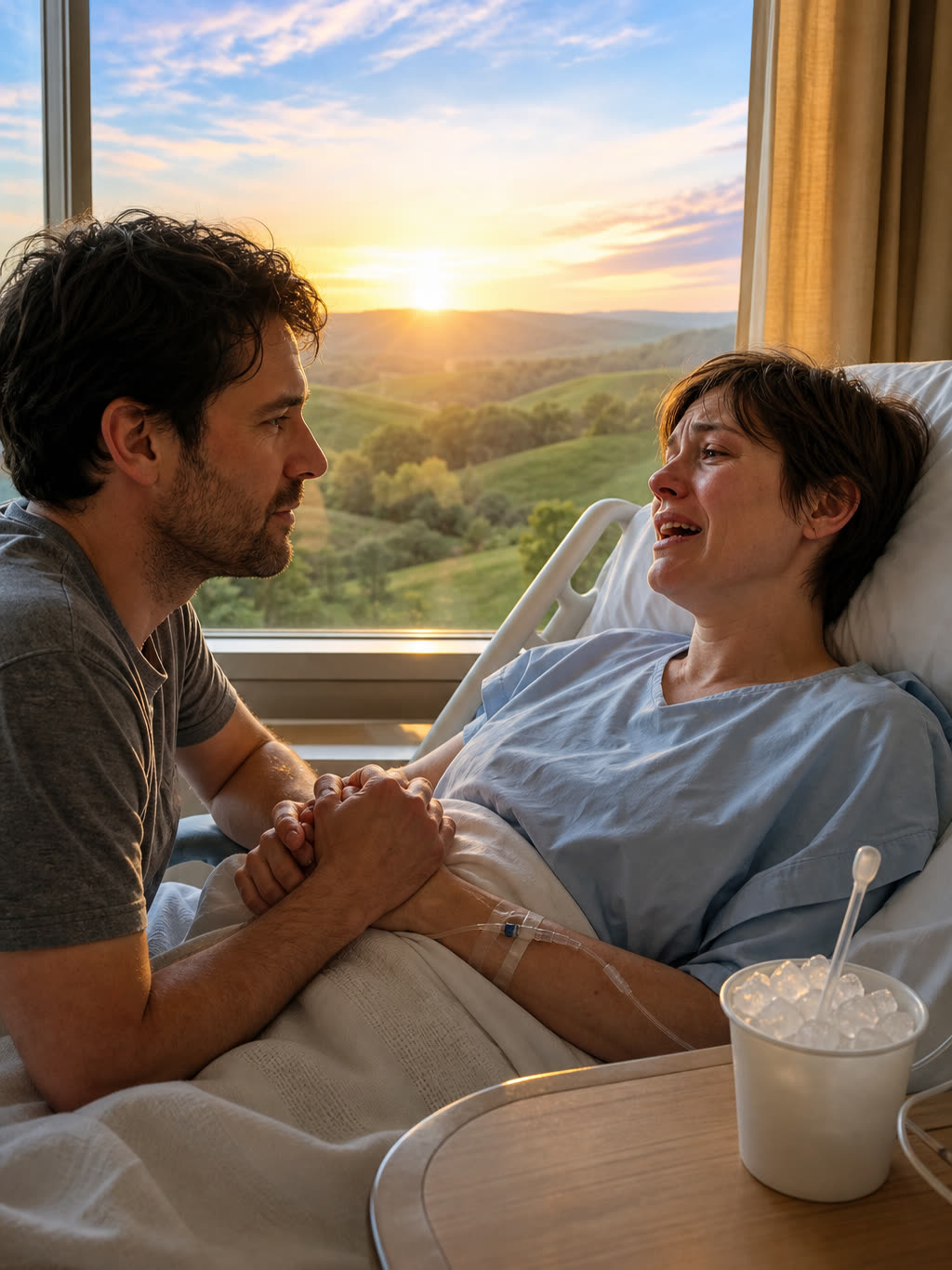
She did. For an hour, the words came out of her slowly at first, then in a rush, like water finding its way through a wall that had stood too long. She told me about the pain she had hidden and the doctors she had avoided. She told me about the nights she had cried in the shower so I wouldn’t hear. She told me about the day she cut her hair, standing at a mirror in the apartment, deciding she was done waiting for someone to notice she was disappearing.
I listened without interrupting. For once in my life, I didn’t try to fix anything. I didn’t reach for a solution or a schedule or a reason. I just stayed, and the afternoon light moved across her blanket, and the monitor beside us kept its patient rhythm.
Recovery took six weeks. I took leave from work. My boss, to my surprise, said, “Take as long as you need.” I think he had noticed what I’d been like for the last two months, too. I moved through those weeks learning small things: how to fill a pill organizer, how to read an instruction sheet twice, how to sit quietly in a room and let someone else’s healing be the center of it.
Her sister Dana flew in from Phoenix and eyed me suspiciously at the door. “You’re the ex-husband,” she said. “I am.” “I should be furious with you.” “You’d be right.” She looked at me for a long moment, then handed me her suitcase. “Fine. But you cook. She hasn’t eaten properly in weeks.”
I cooked badly. Rachel ate it anyway and then politely suggested I try seasoning. We didn’t talk about the divorce. We talked about everything else: her physical therapy, the books piled on her nightstand, the neighbor’s dog who barked at the mailman. Slowly, the apartment started to feel like a place two people lived in instead of a place two people avoided.
One evening in August, I found her on the porch, wrapped in a blanket, watching the sun go down over the street. The sky had turned orange and rose above the rooftops, and the light touched her face in a way I hadn’t seen in years. “I never thanked you,” she said. “For what?” “For showing up. For reading the letter.” “You don’t owe me thanks. I owe you years.” She smiled faintly. “We both owe each other something.”
I sat beside her on the step. The air smelled like cut grass and somebody’s barbecue. “I’m not asking to move back in,” I said. “I’m not asking for anything. But if you’d ever let me take you to dinner, I’d like to start over. Slowly. The right way.” She looked at me for a long time. “I want to know who you are when you’re not hiding at work,” she said. “And I want you to know who I am when I’m not being brave for everybody else.” “Deal.” “Dinner,” she said. “Not tonight. In two weeks. When I can eat something that isn’t toast.” “Two weeks,” I agreed.
We got remarried two years later, in a small ceremony at a courthouse in the same county where we had signed the divorce papers. It seemed fitting. Same hallway, same marble floors, same clerk with the same cheerful stamp. Dana cried the whole time. Spencer served as my witness, still complaining about his scar. Rachel wore a simple cream dress, her hair grown out to her shoulders, a little gray at the temples that she refused to dye.
After the ceremony, we walked out into the sunlight on the courthouse steps. “We folded and filed five years once,” she said, squeezing my hand. “I like this version better.” “Me too.” “Do you want to know something?” “Always.” She leaned close and whispered, “I’m still going to ask if you’ve eaten. For the rest of your life.” I laughed, and my eyes stung, and I kissed her right there on the steps with the flag snapping overhead and strangers clapping politely on their way to pay parking tickets.
For two years I had believed the end of a marriage was something you could sign and walk away from. I was wrong. Sometimes the end is only the part where you finally learn how to ask the question you should have asked all along. Rachel, how are you? And then stay long enough to hear the answer.
Disclaimer: This story is a work of fiction inspired by real-life themes. Names, characters, places and events are fictionalized, and any resemblance to real persons is purely coincidental. Images are for illustration purposes only.
