


Part One: The Aluminum Promise
At twenty-nine, I lived in a world drained of every shade of color, bleached pale by the crushing, relentless grief of losing my mother. Each morning was a negotiation with gravity just to leave my bed. To keep from sinking beneath the silence of my apartment, I tied myself to the one place where pain made sense to me: Mercy General Hospital. Volunteering on the palliative care ward became my odd kind of salvation. For almost a year I wandered those antiseptic-scented corridors, sitting beside patients whose families had long since drifted away, making sure that no one had to face the great darkness alone.
That was how Alexander found his way into my broken life.
He was seventy-two, a man who looked carved from fragile, translucent parchment, slowly dying of end-stage heart failure. The first time I walked into Room 412, the rhythmic, metallic hiss-click of his oxygen concentrator sounded like a countdown clock. Yet despite the deep hollows beneath his eyes and the tangle of IV lines tethering him to the bed, he gave me a smile so unexpectedly warm that it knocked the air out of me for a moment.
We began to talk. At first it was the polite, shallow chatter of strangers: the dreadful hospital food, the gray Chicago rain streaking down the windowpanes. But Alexander had an achingly sharp mind and a soul that felt ancient. He listened to my stories about my mother with a quiet, deep empathy that no therapist had ever managed to offer me. Within days, the heavy door closing behind me felt less like a trap and more like a sanctuary. Our afternoon conversations became the vital pulse of my otherwise stagnant days.
Then, on a Tuesday afternoon, the mood in the room changed. The late autumn sun laid long, bruised shadows across his sheets. Alexander coughed, a wet, rattling sound that shook his brittle frame. I reached for his water cup, and his hand shot out. His fingers, cool and bony, clamped around my wrist with startling, desperate strength.
“Marry me, Emily,” he rasped, his eyes fixed on mine with a fierce, burning clarity.
A cold dread coiled in my stomach. I froze, the plastic cup trembling in my fingers. “Alexander… you’re exhausted. The medication is confusing you. We barely know each other.”
He shook his head and pressed his thumb against my pulse. “I am entirely lucid, my dear. I don’t want the state handling my final hours. I refuse to let the bureaucracy dictate my end.” His voice cracked and sank into a raw, vulnerable whisper. “My last wish is to leave this world as a husband, not as a nameless file shoved into a basement cabinet.”
I stared at him while my heart hammered a frantic rhythm against my ribs. It was an impossible, absurd request. And yet, beneath the madness of his words, I recognized a terror I knew intimately: the paralyzing fear of being utterly forgotten. What if he didn’t have to be?
The absurdity of it gnawed at me for forty-eight hours, but the memory of my own mother’s lonely final moments proved stronger than my logic. Two days later I stood beside Alexander’s bed wearing an oversized, bright yellow sweater, a desperate attempt to bring a little sunlight into a room ruled by the shadow of death. The hospital chaplain, a weary man with kind eyes, performed the ceremony. He kept glancing between us, plainly bewildered, but he read the vows with solemn dignity. The air smelled of rubbing alcohol and the faint, sweet scent of a single white chrysanthemum a nurse had left on the bedside table. When the time came for the rings, a heavy silence fell. We had nothing. Alexander, breathing shallowly, reached for his lunch tray and, with trembling, agonizingly slow movements, snapped the aluminum pull-tab off an empty soda can. His hands shook as he took my left hand and slid that jagged little scrap of metal onto my ring finger. “My family now,” he murmured, his eyes shining with unshed tears. The aluminum was cold against my skin and light as a feather, yet it felt heavier than any diamond.
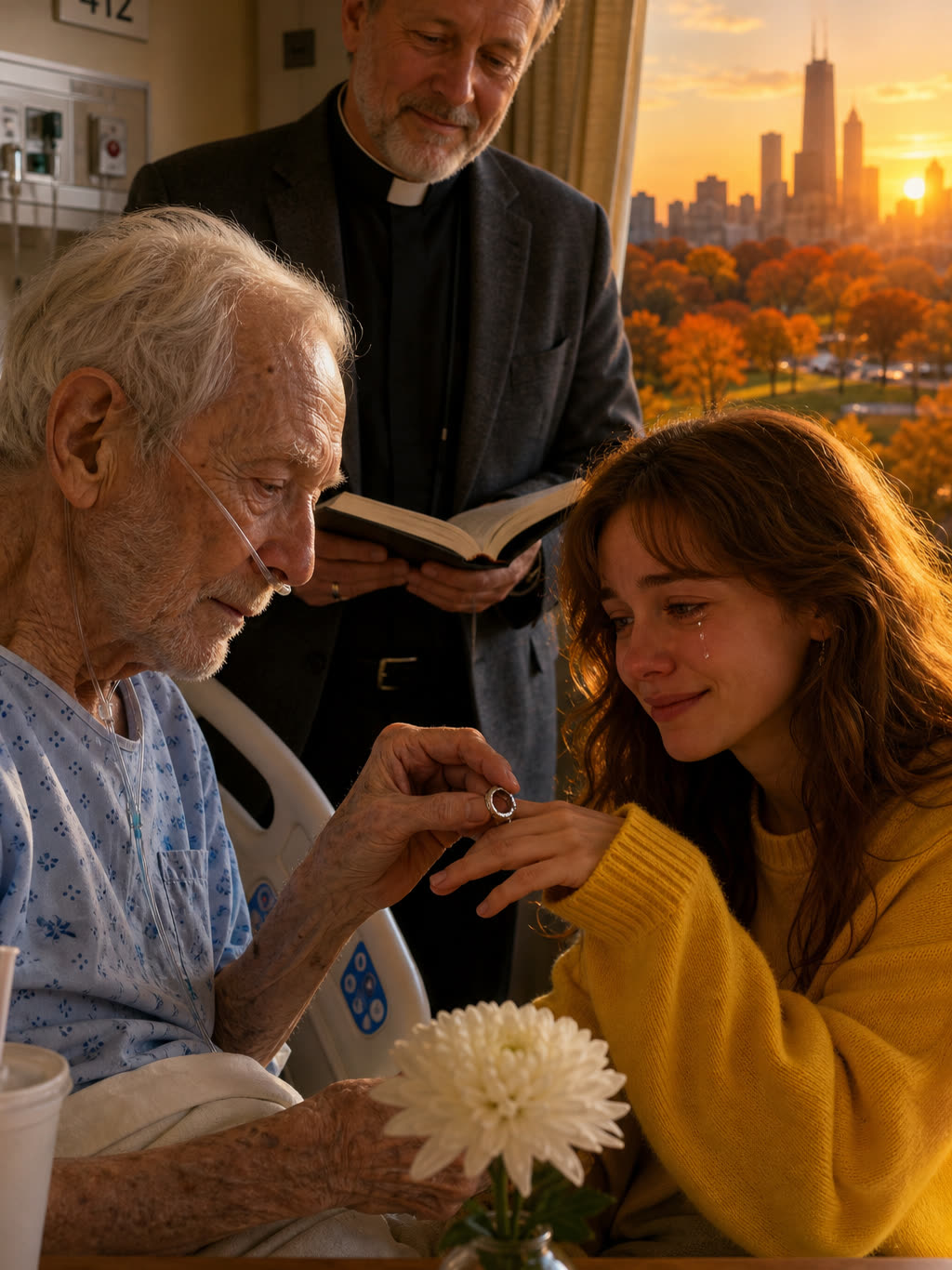
For the next seven days I practically lived in Room 412. I slept in the rigid vinyl chair and woke at every change in his breathing. I wiped the cold sweat from his brow and held his hand through the terrifying, suffocating moments when his failing heart struggled to keep pumping. In the quiet hours he told me small things: the way he liked his tea, the songs he had hummed while he worked, the smell of rain on wool. I told him I had never felt less alone in my life, and he squeezed my fingers as if I had given him a gift.
Then, on the seventh evening, as the city lights flickered on beyond the window, his chest hitched one final time. The monitor shrieked its flat, endless tone. He was gone.
The nurses moved with practiced, invisible efficiency, and soon I was left alone in the echoing silence of the empty room. The void he left behind was staggeringly vast for someone I had known less than a fortnight. I sat twisting the soda-can ring around my finger, tears blurring everything, wondering whether grief was something that simply multiplied no matter how many times you swore you would never feel it again.
The door creaked open. An elderly gentleman in a slightly frayed tweed suit stepped inside, carrying a bulky, faded green canvas backpack. His silver hair was combed with care, and behind small round glasses his eyes were tired but sharp.
“Emily?” he asked, his voice low and gravelly. “I am Arthur Pendelton. I was your husband’s legal counsel.”
He crossed the room and set the heavy backpack squarely on my lap. The sheer weight of it made me gasp. Arthur stepped back and studied my tear-streaked face for a long, calculating moment, as though measuring whether I could bear what came next.
“Alexander wasn’t the destitute man you thought he was, Emily,” Arthur whispered, and the words hung in the sterile air like a curse. “And there are forces already moving against you. He wanted you to know the truth before the wolves arrive.”
My hands shook so badly that I could barely work the zipper. The metal teeth parted with a harsh rasp, exposing the secrets of a man I had promised to love in his dying breaths. Arthur stood perfectly still by the window, a silent sentinel watching my world unravel.
Inside lay three objects: a thick, leather-bound ledger that smelled of old paper and dust, a sealed legal envelope stamped with red wax, and, folded carefully beneath them, a square of vibrant crimson silk. I reached for the fabric first. As I drew it onto my lap, it unfolded into a child’s dress, a vintage masterpiece small enough for a five-year-old, with meticulous, microscopic hand-stitching along the bodice. But the hem was badly frayed, and a faint, unmistakable scent of ancient smoke clung to the silk.
“What is this?” I breathed, tracing a soot-stained embroidered flower.
“Forty-five years ago,” Arthur began, his voice dropping to a somber cadence, “Alexander was not a lonely old man. He was a master tailor. He owned a thriving bespoke shop right here in the city, living a quiet, beautiful life with his wife and their five-year-old twins—a boy named Caleb, and a girl named Lily.”
My breath caught. Twins. A family. In all our long afternoons, he had never spoken a word of them. I thought of every time he had gone silent and stared out the window at the rain, and suddenly the silences had a shape.
“That red dress,” Arthur continued, nodding toward my lap, “was Lily’s absolute favorite. Alexander made it for her birthday. But that winter… a faulty boiler in their brownstone sparked a blaze in the dead of night. Alexander fought through the flames, dragging his wife and Caleb out into the snow. But by the time he went back in for Lily…” Arthur swallowed hard and looked away. “The floor collapsed. The only thing he salvaged from the wreckage of her room was that dress.”
A sob tore from my throat. I clutched the silk to my chest and felt, like a phantom weight, a grieving father’s agony pressing on my ribs. I thought of the way he had said my family now, and understood that he had once said it to someone else.
“The tragedy shattered them,” Arthur said gently. “His wife took Caleb and vanished, unable to look at the man who couldn’t save their daughter. Alexander spent the next four decades as a ghost, hiding in his work, pouring every cent from his tailoring and quiet investments into a blind trust.”
“Why me, Arthur?” I asked, wiping my eyes. “Why marry a grief-stricken stranger?”
Arthur reached over and tapped the sealed envelope. “Because his estranged son, Caleb, is no longer a little boy. He is a ruthless, predatory real estate developer, and he had finally tracked his father down. Not for a reunion, Emily. Caleb discovered that Alexander still owned the downtown block where his original tailor shop stands—a parcel of land now worth over fourteen million dollars. Under state law, if Alexander died intestate and unmarried, the property would automatically revert to Caleb.”
The room seemed to tilt. “And because we were married…?”
“Under the explicit terms of the deed in that bag,” Arthur said, the ghost of a smile touching his lips, “the entire estate belongs exclusively to you. Alexander watched you for months in this hospital. He knew you were the only soul who would protect his legacy, rather than bulldoze it for profit.”
Arthur nodded toward the leather ledger. “Read the last page.”
I opened the book to a dog-eared page. Alexander’s elegant, cursive script leapt out at me: My dearest Emily, Forgive an old man’s deception. I needed to know your heart was pure, untainted by the poison of wealth. The aluminum ring was a placeholder for my eternal gratitude. The red dress is my heart. The estate is yours. But be warned: my son Caleb is a force of nature, and he will come for what he believes is his birthright. Protect Lily’s memory. Protect the shop.
Before the meaning of those lines had even settled in my mind, the heavy wooden door of the hospital room was violently shoved open and slammed against the wall with a deafening crack.
Part Two: The Heir Apparent
He swept into the room like a localized hurricane. The man was tall, wrapped in a bespoke charcoal suit that screamed old money and new aggression. Behind him scurried a younger associate clutching a sleek leather briefcase. His features were sharp and aristocratic, but it was his eyes that drove a spike of ice into my veins. They were Alexander’s eyes, stripped of every trace of warmth and replaced with absolute, chilling calculation.
It was Caleb.
He didn’t even glance at me. His gaze locked onto Arthur. “Pendelton,” Caleb snapped, his voice a polished whip. “The nurses’ station just confirmed it. Where are the estate authorization forms? My legal team needs to file the probate claim before the municipal courts close.”
Arthur didn’t flinch. He simply straightened his tie. “You’re too late, Caleb. Your father’s estate is not entering probate.”
Caleb’s jaw tightened. “Excuse me? He had no spouse, and I am his sole surviving blood heir. The Oak Tailor commercial lot reverts to me.”
“Your father was married,” Arthur replied, his voice maddeningly calm. He gestured to where I sat frozen in the vinyl chair. “Meet Emily. Alexander’s lawful wife.”
Caleb finally turned his head. His eyes dragged over my cheap yellow sweater and my scuffed boots, then landed on the green backpack. Then his gaze snagged on the red silk dress in my lap. For a fraction of a second the corporate predator vanished. His face went ashen, the muscles in his jaw twitching as if an invisible fist had struck him. The memory of his dead twin sister was a live wire he clearly hadn’t expected to touch. But the vulnerability evaporated at once, replaced by a sneer of nuclear-grade contempt.
“A hospital volunteer?” Caleb barked a harsh, bitter laugh. “Are you out of your mind, Pendelton? My father was a senile geriatric dying of heart failure. This little opportunist took advantage of an incapacitated patient to orchestrate a deathbed marriage scam!”
“I cared for him when he had absolutely no one!” I shouted, anger burning suddenly through my shock. I stood up, clutching the red dress against my chest like a shield. “He was entirely lucid. He knew exactly what he was doing.”
Caleb closed the distance between us in two strides, invading my space. He smelled of expensive cedar cologne and sheer hostility. “We will have this circus annulled by Monday morning. You think you can walk out of here with fourteen million dollars of my family’s assets because you fluffed an old man’s pillows for a week? You are a nobody, Emily. A pathetic fraud.”

“I am his wife,” I said, forcing my chin up and refusing to break eye contact despite the tremor in my knees. “And according to the trust, I am the sole owner of the Oak Tailor property.”
Caleb leaned in, his voice dropping to a lethal whisper. “Listen to me, little girl. My firm is developing a fifty-story luxury high-rise on that block. That property is the anchor of a three-hundred-million-dollar project. I have spent three years lining up international investors. If you try to play games with me, my lawyers will bury you in so much litigation you won’t be able to afford the bus ride to court. Hand over the deed, or I will systematically destroy your life.”
Arthur stepped smoothly between us, drawing a crisp, watermarked document from his breast pocket. “Actually, Caleb, your father anticipated your tantrums. He filed an irrevocable transfer deed forty-eight hours ago, backed by a video deposition and sworn affidavits from two independent, board-certified psychiatrists confirming his absolute mental competency. The property doesn’t belong to the family. It belongs to Emily.”
Caleb stared at the seals on the page. The color drained from his face, replaced by a mottled, furious red, and his corporate armor cracked wide open.
“This isn’t over,” Caleb spat, his eyes locked on mine with pure venom. “You think you can keep that building? You’re just a lonely, naive girl clinging to a dead child’s rag. You’ll break.”
He turned on his heel and stormed out, his associate scrambling in his wake. The silence he left behind rang in my ears. My knees finally gave way and I sank back into the vinyl chair, the red silk crushed in my fists, my pulse pounding so hard I could hear it over the hum of the hallway lights.
Arthur looked at me, his expression grim. “He meant every word, Emily. He has unlimited resources, and he will not stop.”
I looked down at the cheap aluminum pull-tab digging into my finger, and then at the bright, defiant red of Lily’s dress. My mother had taught me how to survive grief; Alexander had taught me how to fight it.
“Neither will I,” I whispered.
The next three weeks were a masterclass in psychological warfare. True to his word, Caleb unleashed a legal hellstorm. His lawyers filed injunctions, contested the marriage’s validity, and sent private investigators to dig through my trash. When the legal bullying stalled against Arthur’s ironclad defenses, Caleb tried bribery. Anonymous men in sharp suits cornered me at the grocery store and slid briefcases across cafe tables, each holding an off-the-books cash offer: five million, ten million, up to a staggering twenty million dollars to simply sign a piece of paper and walk away. I refused every single one. The property was mine.
On a crisp, windy Tuesday morning, I stood on the sidewalk in the city’s historic district. Wedged between two towering monuments of modern glass and steel stood a small, two-story brick building. The windows were opaque with decades of grime, but the faded gold-leaf lettering above the door still proudly proclaimed: The Oak Tailor — J. Vance, Est. 1974. I unlocked the heavy door and stepped inside, Arthur right behind me.
The air was thick and still, smelling intensely of old cedarwood, polished brass, and the lingering, rich scent of raw wool. Along the back wall sat a row of pristine, industrial sewing machines from the 1970s, oiled and maintained as if waiting for the tailor to return from lunch. Bolts of magnificent silks, tweeds, and linens lined the mahogany shelves. It wasn’t a derelict building; it was a mausoleum of love and meticulous craft.
I used a small fraction of the liquid trust to hire a preservation crew. We spent the whole day cleaning, polishing, and restoring the space, and by late afternoon the shop gleamed under the warm glow of its vintage pendant lights. Through the newly cleaned front windows, the last of the sun lit the maples along the street in shades of copper and flame, as if the whole block had been waiting to be seen again.
Just as the sun began to dip below the skyline, a sleek black town car pulled up to the curb. Caleb stepped out. He looked exhausted, the sharp lines of his face drawn tight with stress. He pushed the shop door open, and the bell chimed a cheerful, mocking welcome.
“You turned down twenty million dollars in cash,” Caleb said, his voice echoing in the cavernous room. He looked around the immaculately restored shop, shaking his head in disbelief. “You’re keeping this decaying pile of bricks purely out of spite.”
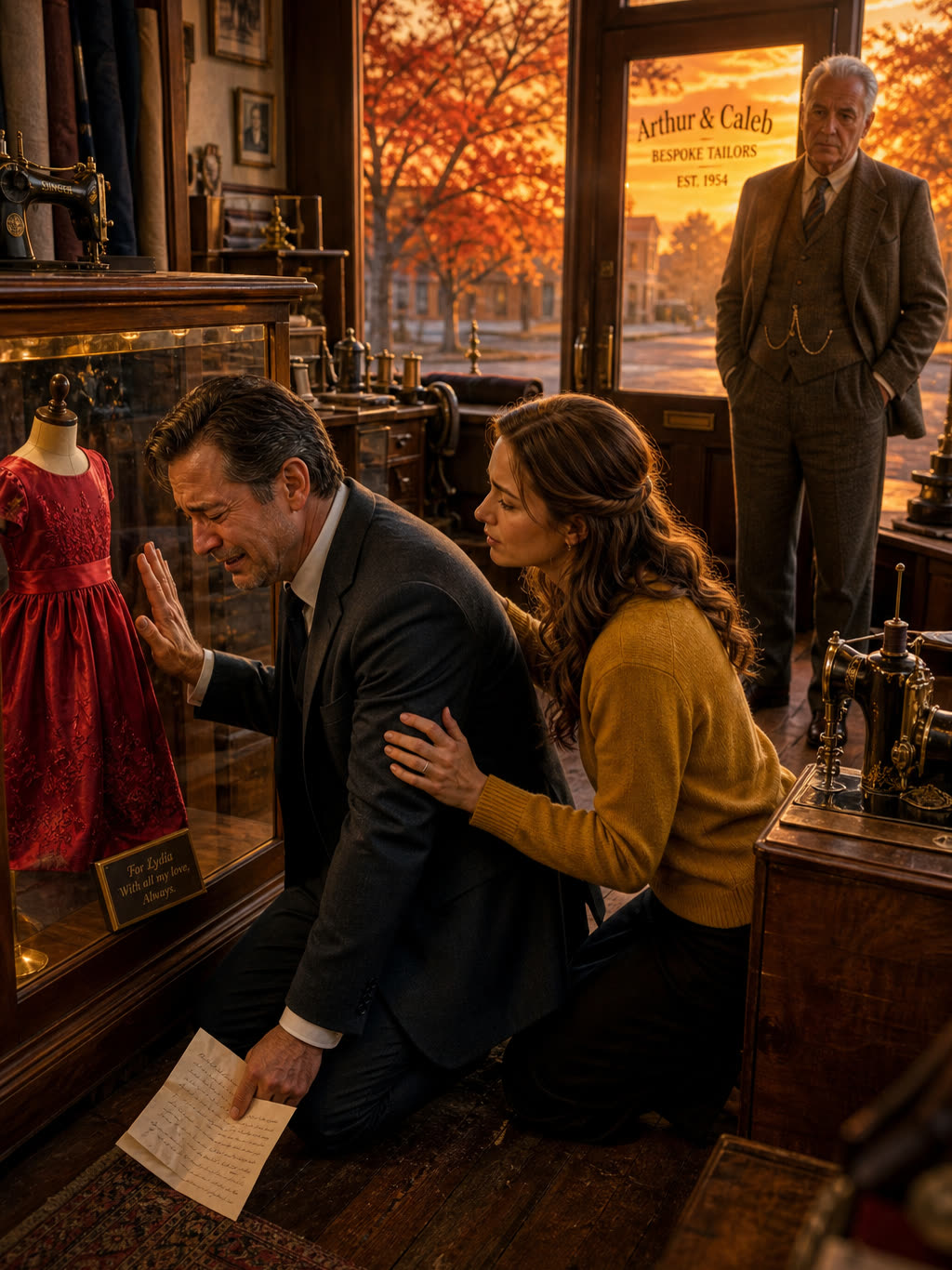
I stood behind the massive central cutting table. Resting in the center, protected inside a museum-quality glass display case I had ordered for this very day, was Lily’s red silk dress.
“I didn’t keep it out of spite, Caleb,” I said, my voice steady, anchored by the truth I now carried. “I kept it because your father spent forty years inside these walls, pouring his broken heart into his craft while mourning the daughter he couldn’t pull from the fire.”
Caleb stopped dead. He stood before the glass case, staring down at the crimson fabric. The reflection of his face in the glass was twisted in agony. The ruthless developer vanished, leaving only a wounded, furious boy.
“He abandoned us,” Caleb’s voice cracked, a raw, ugly sound. “After the fire… he wouldn’t even look at me. He acted like I was the one who died.”
“He didn’t abandon you because he didn’t love you,” I said softly, sliding my hand into my pocket. My fingers closed around the sealed envelope with its crimson wax seal, the ultimate truth Alexander had hidden away and saved for the perfect moment. I laid it on the glass in front of him. Across the front, in that elegant, cursive script, was a single word: Caleb.
He stared at it as if it might burn him. Slowly, his hand reached out, and the wax cracked under his thumb. His eyes moved over the first line, and every drop of color left his face. The paper trembled. When he finally spoke, it was in a whisper so small I almost missed it. “How… how did he know about the candle?” He looked up at me, his eyes wild. “I never told anyone. Not once in forty-five years.”
Part Three: The Crimson Thread
Caleb’s knuckles had gone white around the letter. “I never told anyone,” he said again, as though saying it twice might change what the page said. Arthur had slipped quietly to the doorway, hat in hand, giving us the awkward mercy of his silence. Outside, the sky had deepened to a rich violet, and the shop lights made a small gold island in the dusk.
“The night of the fire,” Caleb said at last, each word scraped out of him, “Lily was afraid of the dark. She always made me promise to check on her. I took a candle stub from the dinner table and crept into her room, and I left it burning by her bed so she wouldn’t be scared. I was five. In the snow, with the whole house roaring behind us, my mother kept screaming, What did you do, what did you do. I decided then that I had killed my sister.”
I pressed my hand over my mouth. All those years he had been building towers, I realized, he had been trying to put something between himself and that small, burning room.
“Read it,” I said, as gently as I could. “Please. Read what he wrote.”
He cleared his throat and began, his voice breaking over the opening words. My son, I saw you at your sister’s door that evening, and I saw you blow the candle out before you left. I have carried that picture in my mind for forty-five years, the little boy tucking the blanket under her chin. You did not start the fire, Caleb. The boiler did. The fire marshal’s report is enclosed so that you may read it with your own eyes, though I should have put it in your hands the day you were old enough to understand it.
He paused, dragging the back of his wrist across his face. The rest came out in pieces. I could not look at you, he read, because you had your sister’s laugh and her stubborn chin, and every time you turned toward me I saw her. I was a coward. I mistook my grief for your guilt, and I let you believe it was yours to carry. There is no forgiveness big enough for that, but I will ask for it anyway, in every letter I wrote.
Letters. Arthur stepped forward with his gaze lowered and slid a thick bundle from the bottom of the ledger, where I had never thought to look. Forty-odd envelopes, tied with faded red ribbon, each addressed in Alexander’s hand, each stamped in angry ink: RETURN TO SENDER. “One for every birthday,” Arthur said quietly. “Your mother sent them back unopened, and he mailed the next one anyway. When he finally learned where you lived, three years ago, he stood outside your building for an hour. He couldn’t make himself go in.”
“Why wouldn’t he come?” Caleb’s voice cracked. “Why didn’t he just come?”
“Because he thought you hated him,” I said. “And because he was dying and ashamed. So he did the only thing he knew how to do. He sewed it into a plan. He told me the property would stay safe in my hands until the day you were ready to read his words. I wasn’t only a wife, Caleb. I was meant to be a bridge.”
The last of his composure gave out. Caleb sank to his knees in front of the glass case, a man in a three-thousand-dollar suit kneeling on a worn wooden floor, one palm pressed flat against the glass above the crimson silk. His shoulders shook, and a sound came out of him that was not quite a sob, the sound of a door that had been bolted for forty-five years finally splintering. I knelt beside him and rested a hand between his shoulder blades. He did not push it away.
Behind us, the briefcase snapped. His associate, who had hovered stiffly near the door, held out a buzzing phone. “Mr. Vance, the investors are in the conference room. They want to sign tonight.” Caleb didn’t even turn his head. “Tell them the meeting is postponed,” he said hoarsely. “Tell them it’s postponed indefinitely.” The young man opened his mouth, thought better of it, and retreated into the evening.
Eventually Caleb rose and wandered the shop like a man walking through a dream. His fingers brushed the old sewing machines, the brass shears, the neat rows of chalk. In a shallow drawer beneath the cutting table he found a folded tissue-paper pattern, yellowed and brittle, labeled in careful pencil: Caleb, age 5, Christmas suit. Beside it lay another: Lily, age 5, birthday dress. He held the little boy’s pattern against his chest and laughed through his tears, a wet, astonished laugh. “He made me a suit,” he whispered. “I never even saw it.”
“Caleb,” I said carefully, “what will you do about the tower?”
He looked at the window, where the glass giants rose on either side of the shop, hard and bright against the afterglow. “I don’t know yet,” he admitted. “But I know it won’t be what I came here to do.”
The next morning he walked into his own boardroom with the fire marshal’s report in his jacket and Alexander’s letter in his pocket. I wasn’t there, but Arthur, who sat in the corner like a quiet tweed gargoyle, told me later that Caleb stood at the head of the table for a full minute without speaking. Then he told his investors he was redrawing the plans. The tower would rise behind the Oak Tailor, and the old shop would stand at its heart, a courtyard of brick and brass and maple trees in front of the glass. Two investors walked out. A third called him sentimental. Caleb smiled, for the first time in memory, and said that was the kindest thing anyone had said to him all year.
By spring the scaffolding had gone up around the neighboring lot, and the shop door stood open to the street. With Caleb’s help, and with the last of Alexander’s trust, I opened a small school in the back rooms where grieving people could come and learn to sew, to cut and to stitch, to make something with their hands when words failed. We called it Lily’s Thread. The first class was nine people strong. A widower made a pillowcase. A teenage girl who had lost her brother made a scarf, red, and cried when she finished it. Caleb, in rolled shirtsleeves, taught her how to knot the last stitch.
On a bright Sunday afternoon in April, the three of us, Caleb, Arthur, and I, drove out to the cemetery on the hill above the lake. Cherry blossoms dropped pink petals over the grass, and the water below glittered like a field of coins. Alexander’s stone was simple. Caleb had asked that it read Husband and Father, and beneath it, Lily’s name had been added. He set a small folded square of tissue-paper pattern at the base of the stone, and I slipped my hand into his, and the three of us stood there in the quiet wind. I slid the aluminum ring from my finger, turned it over once, and slid it back on. Some promises were not meant to be set down.
We returned to the shop at dusk to find the lights off and the bell above the door silent. But on the step, in the amber light of the street lamp, stood a slender woman in her seventies, her silver hair pinned back, her hands wrapped around a worn, faded red ribbon. She looked at Caleb, and her face crumpled as if she had been holding it together for four decades.
“Caleb,” she said, her voice thin and shaking. “I’m your mother. I’ve come because I owe you the truth about those letters.” She drew a breath and held out a single small, scorched object wrapped in cloth. “And because there is something I found in the ashes the morning after the fire, something your father never knew about, something I have kept hidden for forty-five years.”
I reached into my pocket, took out a small, weathered Polaroid photograph, and pushed it gently across the smooth oak countertop toward him. I had discovered it hidden beneath the inner lining of the green backpack.
The photograph showed Alexander as a handsome young man, standing proudly outside the very shop where we now stood. Sitting high upon his shoulders was a little boy with thick, tousled dark hair, laughing uncontrollably toward the camera. On the reverse side, Alexander had written a few words in his distinctive, graceful handwriting: My boy Caleb. My greatest hope.
Caleb lifted the photograph from the counter. His hands, ordinarily controlled and unwavering, began shaking uncontrollably. He studied his father’s smiling face, returning again and again to the handwritten message on the back.
“He couldn’t look at you because you looked exactly like her, Caleb,” I murmured into the stillness separating us. “You were twins. Every time he looked into your face, he saw the child he let burn. The guilt destroyed his mind. He pushed you away to spare you from a man who was rotting from the inside out.”
Caleb shut his eyes, drawing a broken, trembling breath that shook his entire chest.
“He left this property to me,” I went on, “not to steal it from you, but to protect it from being erased. He knew you wanted to tear down the only physical place where his memories of your family still existed. He couldn’t let you bulldoze the only monument to Lily he had left.”
For what seemed like an endless stretch of time, Caleb remained completely motionless and silent. The deep, consuming resentment that had shaped so much of his existence appeared to drain from his body, leaving him emotionally emptied, yet painfully and unmistakably aware at last. He carefully returned the photograph to the counter beside the glass display case, then placed his fingertips lightly against the glass above the little red dress. His throat tightened as he swallowed.
“My architectural team will re-route the tower’s foundation,” Caleb finally said, all traces of his former superiority gone from his voice. He spoke so quietly that his words were scarcely louder than a breath. “We will build around this lot. The historical footprint will remain completely untouched.”
He turned away and headed for the entrance. At the doorway, he stopped briefly without turning around. “Keep the shop, Emily.”
The door closed behind him with a quiet click.
Six months passed before the building welcomed visitors through its doors again, no longer operating as a business, but reborn as the Lily Vance Memorial Textile Center and Community Workshop.
With its expenses covered entirely by Alexander’s trust, the center offered complimentary fashion design instruction, sewing lessons, and professional clothing alterations to students from low-income households, young people in foster care, and job applicants who lacked the money to purchase a proper suit for their interviews.
On the day of our official opening, the old shop was filled with energy and excitement. The steady, familiar rattling of antique sewing machines blended with the cheerful voices and laughter of twelve teenagers. Dressed in a modest blue dress, I stood beside the front window, watching an elderly volunteer tailor carefully shorten the hem of a donated prom gown for a delighted high school senior.
I raised my hand to the small silver pull-tab from a soda can, which a jeweler had permanently attached to the fine gold necklace resting against my throat.
I had agreed to marry a man I barely knew while he lay in a hospital bed because I refused to let him leave this world as nothing more than an unidentified name in a medical record. Yet in return, he had entrusted me with something far greater than I could ever have imagined: a lasting inheritance that helped mend the terrible emptiness left by my own sorrow, preserved a precious family’s history, and created a welcoming refuge for dozens of overlooked people who had longed for somewhere to belong.
My gaze drifted toward the glass display case, where Lily’s red dress glowed gently beneath the soft golden light of the hanging lamps. Surrounded by the happy bustle of the workshop, I whispered:
“We protected it, Alexander. Your masterpiece lives on.”
Disclaimer: This story is a work of fiction inspired by real-life themes. Names, characters, places and events are fictionalized, and any resemblance to real persons is purely coincidental. Images are for illustration purposes only.
