

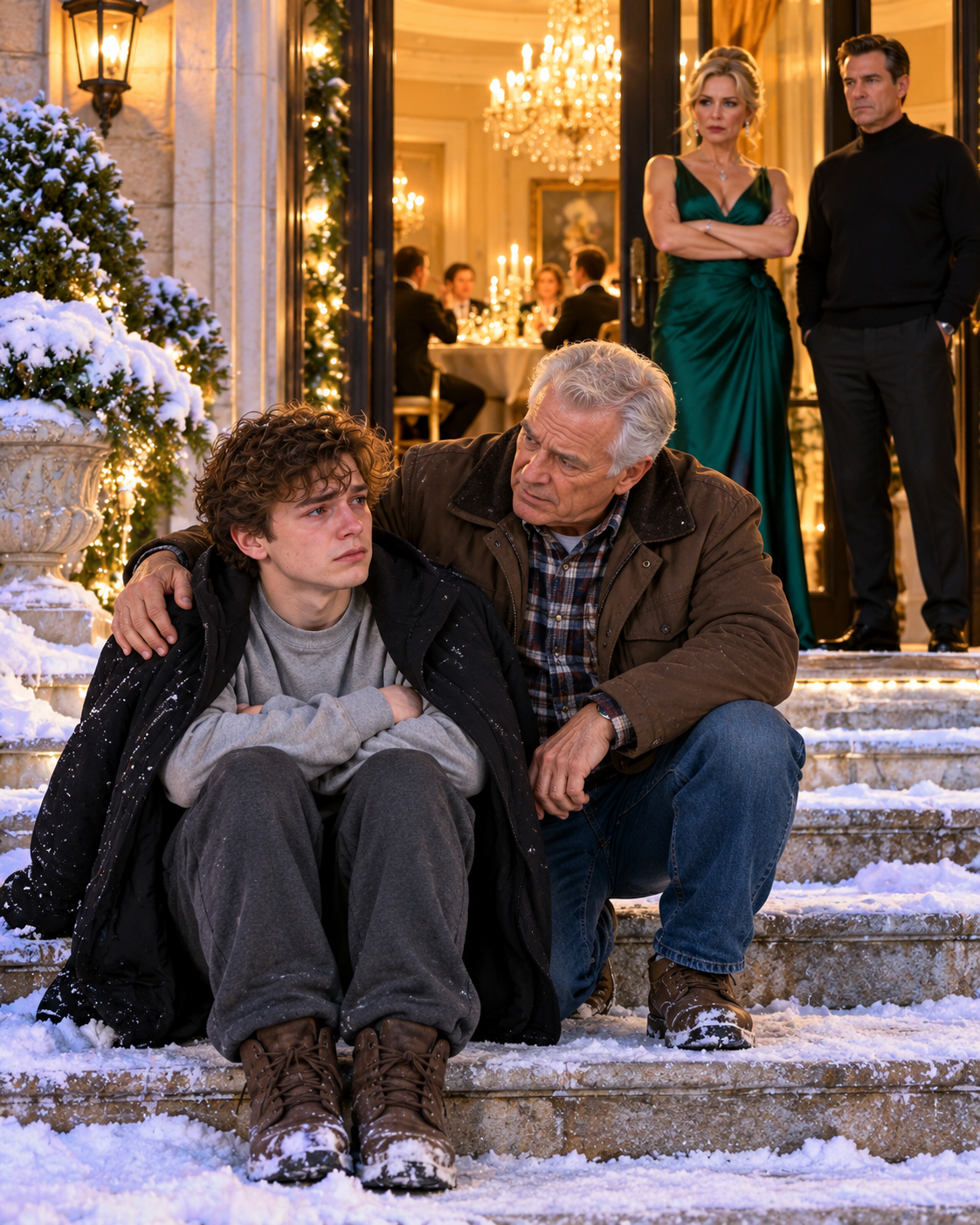
PART 2
It was as though a private alliance had suddenly turned into a public negotiation.
“Rebecca,” he said quietly, “stop.”
“No, Michael. You don’t get to become innocent because your father showed up.”
She then turned toward the deputy.
“If you’re investigating finances, you should investigate Michael’s business accounts too.”
Michael’s face turned pale.
For the first time that evening, Rebecca seemed more concerned with protecting herself than protecting her husband.
And I began to realize that whatever had been happening inside that house extended far beyond poor parenting.
THE CAMERA ABOVE MY WINDSHIELD
Rebecca recovered her composure with surprising speed.
She crossed her arms and faced Deputy Pierce.
“This is still mostly a frightened teenager making accusations during an emotional family dispute. You have no idea what was said before Henry arrived.”
She was almost right.
Almost.
During my years investigating commercial fires and safety violations, I had learned the same lesson time and again: memories shift under stress, but recordings don’t.
Two years earlier, after another driver challenged my account of a minor parking-lot collision, I had installed a dashcam in my truck. It recorded video and audio and automatically kept recording whenever its motion sensor detected activity around the vehicle.
When I pulled into Michael’s driveway that evening, the camera had already started recording.
I took my phone out.
“Actually,” I said, “we may know more than you think.”
Rebecca turned to look at me.
I opened the camera app and scrolled back through the footage.
There was my truck pulling into the driveway.
There was Owen standing beside the gate.
And a few minutes earlier, the motion sensor had captured activity near the front porch.
The footage wasn’t flawless, but the audio was clear enough.
Rebecca stood inside the open doorway while Owen remained several feet away.
Her voice came through the microphone.
“You’re staying outside until you can come back in and behave respectfully.”
Owen replied.
“Please, Rebecca. I don’t have shoes.”
“Then maybe next time you’ll think before ruining something that belongs to me.”
The door shut.
Nobody spoke for several seconds after the recording stopped.
Rebecca stared at my phone.
“You recorded our house?”
“My camera recorded what happened in front of my truck.”
Deputy Pierce instructed me to preserve the original recording and submit a copy through the appropriate evidence channel.
Rebecca began walking toward the house.
Another deputy moved in front of her.
“Ma’am, please stay here while we sort this out.”
For the first time, her confidence started to crumble.
Michael sank onto the edge of the porch.
Then he began to cry.
Not loudly.
Not theatrically.
He simply bent forward, resting his elbows on his knees, as though years of excuses had suddenly become too heavy to bear.
“Dad,” he said, “I messed everything up.”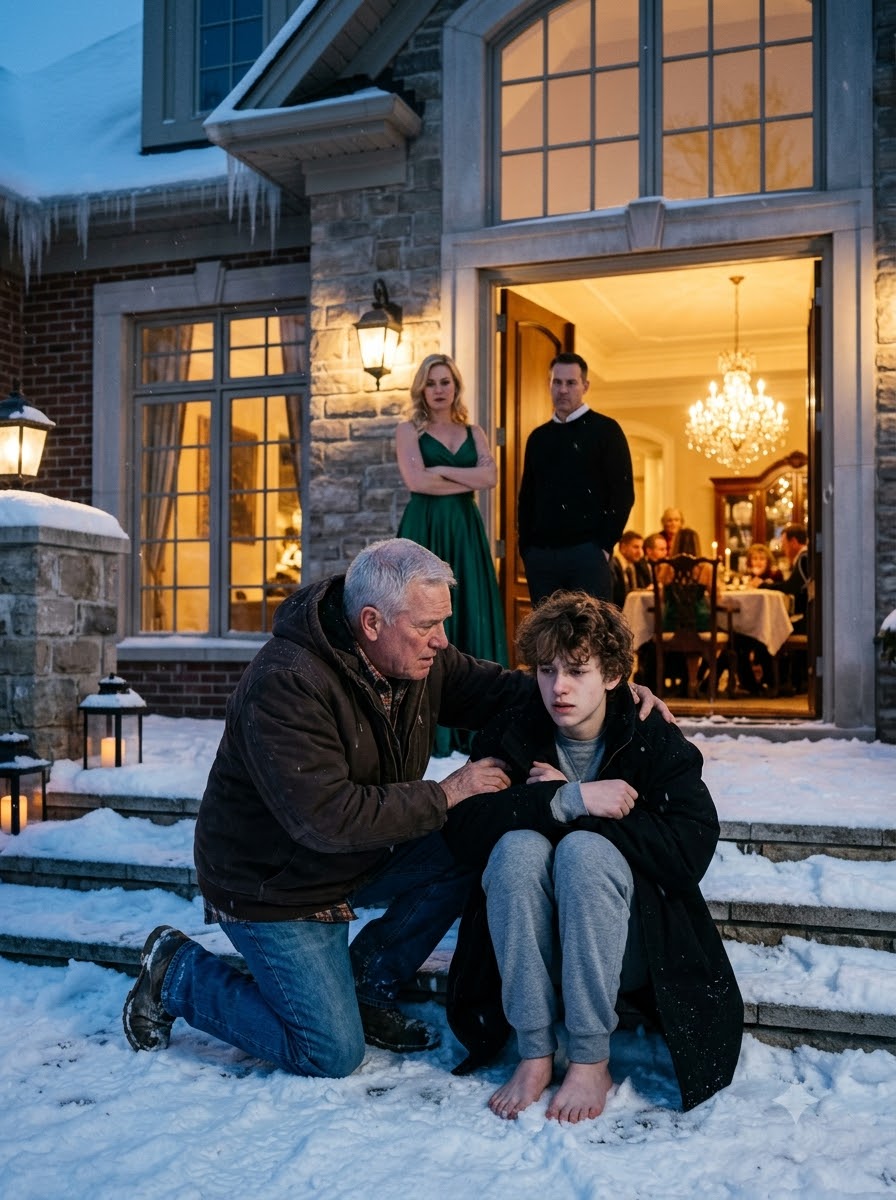
I said nothing.
He pulled his phone from his pocket and handed it to Deputy Pierce.
“There are messages,” he said. “Between Rebecca and me. Messages about Owen’s trust, the lawyer appointments, everything. There are bank records too.”
Rebecca turned toward him.
“Michael, don’t.” He shook his head.
“I’m done.”
I wish I could say I felt relieved. I didn’t.
Michael was my son.
I had taught him to ride a bicycle, stayed beside him through childhood fevers, driven through the night to help him move into his first apartment, stood by him at his first wedding, and cradled Owen in my arms the morning he was born.
Yet when his own child needed him, Michael had chosen fear and convenience.
That truth wounded me in a way anger never could.
So I left him sitting there and climbed into the ambulance beside my grandson.
THE QUESTION OWEN WAS AFRAID TO ASK
On the way to the hospital, Owen said very little.
The medic repeatedly checked his temperature and asked him simple questions while I sat beside him, holding one of his hands between mine.
Eventually, he turned to me.
“Grandpa?”
“I’m here.”
“Do I have to go back?”
I knew exactly what he meant.
Not back to the hospital.
Back to that house.
I squeezed his hand tighter.
“No.”
His eyes filled with tears.
“You don’t know that yet.”
“Then I’ll make sure every person who needs to know what happened hears the truth. You’re not handling this alone anymore.”
He looked at me for several seconds.
Then he rested his head against my shoulder.
For the first time since I had discovered him outside, his body seemed to loosen with relief.
The weeks that followed were difficult and complicated, as real life often is after a moment that might seem simple from the outside.
There were interviews, financial reviews, court hearings, medical evaluations, meetings with attorneys, and lengthy discussions in quiet offices where Owen had to recount things he desperately wanted to forget.
Investigators uncovered financial transactions involving his trust that needed further explanation. Messages on Michael’s phone revealed that Rebecca had repeatedly discussed creating a record that portrayed Owen as incapable of managing his future inheritance. Medical tests also raised troubling questions about why he had experienced unexplained episodes of extreme drowsiness.
The earlier hospital visit was reopened for review.
Eventually, Michael admitted that he had known more than he had initially acknowledged.
He said fear had kept him silent.
Financial pressure had kept him cooperating.
Rebecca had threatened to expose irregularities involving his business if he refused to carry out her plans.
Perhaps all of that was true.
But explanations are not the same as excuses.
I told him that once.
It was the only conversation we had for a long time.
“I was afraid of losing everything,” Michael said.
I looked at him across the small visitation table.
“You were so busy protecting everything else that you forgot who you were supposed to protect first.”
He lowered his head.
There was nothing left to say.
A DIFFERENT KIND OF INHERITANCE
By the following summer, Owen was living with me permanently.
The legal proceedings involving Michael and Rebecca continued for months, and both eventually faced serious consequences related to their treatment of Owen and the financial decisions surrounding his trust. The disputed funds were restored under independent supervision, and new safeguards were established to prevent any family member from accessing the money without proper oversight.
But money turned out to be the least important thing Owen regained.
When he first moved into my house, he apologized constantly.
If he left a glass beside the sink, he said he was sorry.
If he forgot to switch off a light, he apologized.
If he dropped something, his entire body would tense before he even looked at me.
One Saturday morning, about three months after he arrived, he accidentally spilled a bowl of pancake batter across my kitchen floor.
The bowl bounced once before rolling beneath the table.
Owen froze.
I glanced at the batter spreading across the tiles.
Then I looked at him.
“Well,” I said, “I guess the floor wanted breakfast.”
He stared at me.
I handed him a towel.
“Grab the mop, kiddo.”
For a moment, he didn’t move.
Then he laughed.
It was a quiet, uncertain laugh, but I hadn’t heard that sound from him in a very long time.
We cleaned the kitchen together.
Nothing else happened.
Nobody yelled.
Nobody threatened him.
Nobody sent him outside.
It was simply spilled pancake batter.
That morning taught me something I wish I had understood much sooner: people don’t always recognize safety when they finally experience it. Sometimes, they must learn what it feels like gradually, through hundreds of ordinary moments when a simple mistake doesn’t lead to something terrible.
Owen is seventeen now.
He has friends over on weekends, plays guitar badly but enthusiastically, and has started discussing plans to study environmental engineering after high school. His grades have improved, but what matters far more to me is that he now leaves his bedroom door open.
There was a time when he always kept it closed.
These days, when I sit on the porch with my coffee, I sometimes watch him and his friends gathered around the old wooden table near the garden, arguing about music, college, or whose turn it is to drive into town for pizza.
On those afternoons, the house feels wonderfully noisy.
Shoes accumulate beside the door.
Someone inevitably leaves an empty glass on the counter.
The refrigerator opens twenty times an hour.
I wouldn’t change a thing.
One evening toward the end of summer, Owen sat beside me on the porch as the sun sank behind the foothills.
After a while, he spoke.
“Grandpa, can I ask you something?”
“Always.”
He gazed across the yard.
“Why did you believe me?”
His question caught me off guard.
“What do you mean?”
“That first night. Everybody else had explanations for everything. Rebecca always made things sound reasonable. Dad always said there were two sides. But you believed me.”
I considered his question for a long moment.
Then I gave him an honest answer.
“I didn’t know every detail yet. But I knew what I saw.”
He waited for me to continue.
“I saw my grandson standing barefoot outside in freezing weather while the adults responsible for him were sitting comfortably inside. I didn’t need the rest of the story before deciding you deserved to be safe.”
Owen slowly nodded.
A few minutes later, his friends arrived, and he hurried down the steps to greet them.
I remained in my chair, watching them disappear around the side of the house, laughing about something I couldn’t hear.
For most of my career, I believed evidence mattered because it helped us understand what had already happened.
I’m no longer sure I believe that.
Sometimes, evidence gives someone permission to speak the truth.
Sometimes, the truth opens a door.
And sometimes, if you’re fortunate enough to arrive at the right moment, that door leads a frightened kid away from a freezing driveway and toward a home where he finally learns that spilling something on the floor is simply spilling something on the floor.
Nothing more.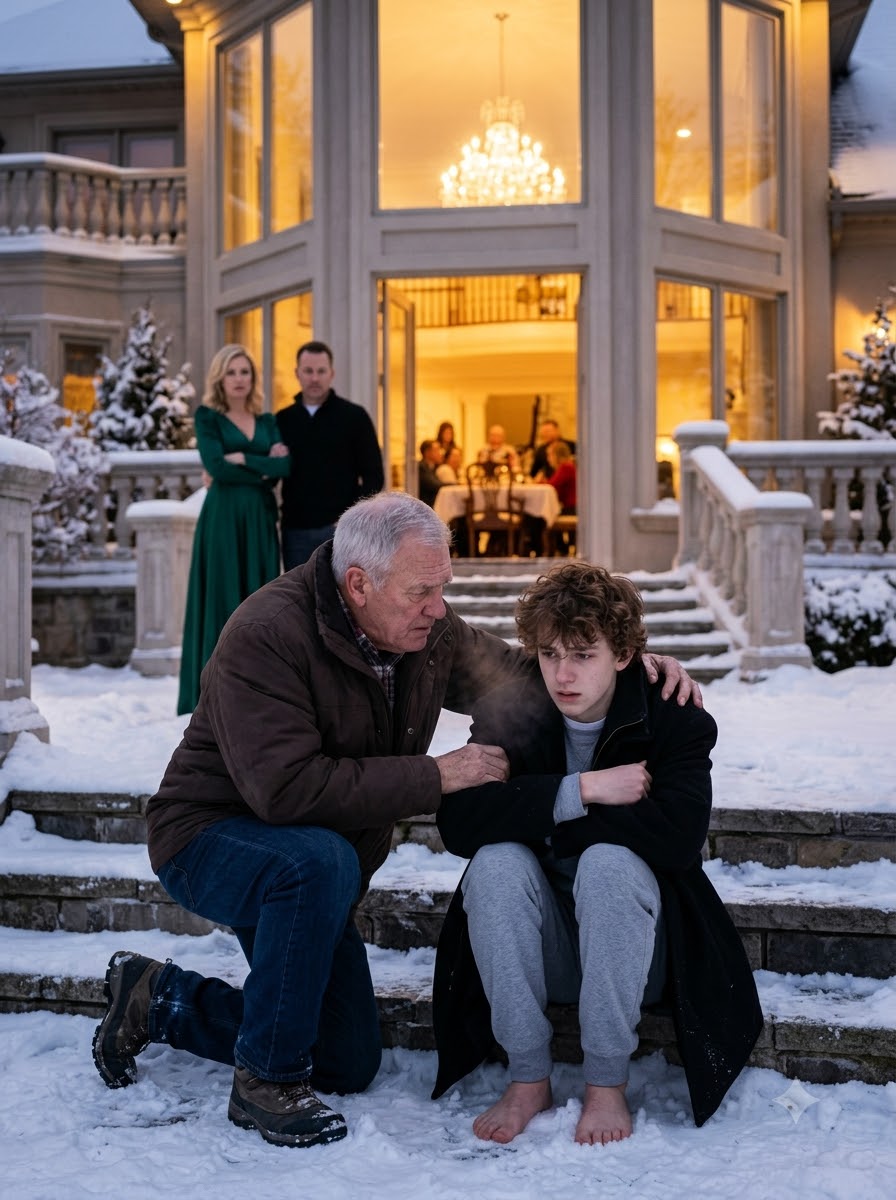
That winter night, I thought I was rescuing my grandson from the cold.
It took me much longer to realize that the real work began afterward, during the quiet months when we taught each other what family was supposed to feel like.
Not perfect.
Not spotless.
Not impressive from the street.
Just warm enough that nobody has to wonder whether they’re allowed to come inside.
