

PART 1: THE BADGE THEY REFUSED TO RECOGNIZE
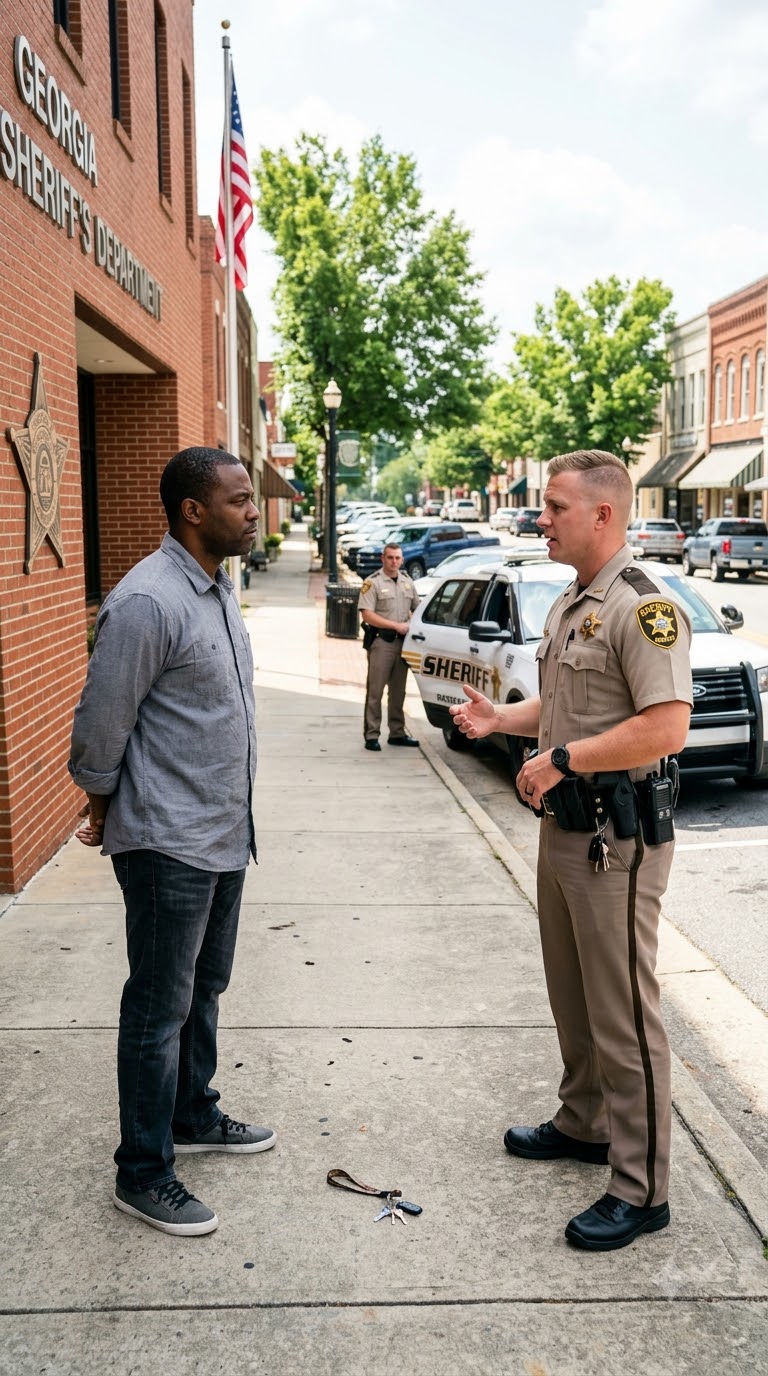
Sergeant Kenneth Iverson barely glanced at the badge.
Instead, he struck Arnold Parsons’ hand with the back of his wrist, knocking the credentials onto the sidewalk in Dellwood, Georgia.
The silver badge hit the concrete.
It bounced once.
The federal identification card slipped out beside it.
Shoppers continued walking past the hardware store. Across the street, an elderly man sat on a bench with a newspaper spread across his knees.
And beneath the bright Saturday sun, Iverson locked handcuffs around Arnold’s wrists.
Arnold did not protest.
His jaw tightened slightly.
His gaze remained steady.
Twenty-four years in the Federal Bureau of Investigation had taught him how to control his reactions.
He had faced armed suspects, dishonest officials, dangerous informants, and politicians who concealed crimes behind perfectly prepared paperwork.
He knew how to remain composed when circumstances became threatening.
But this was different.
Standing on a public sidewalk, handcuffed while his federal badge lay discarded near his shoes, Arnold experienced something he had not expected.
It was not panic.
It was not fear.
It was recognition.
He had understood that an undercover investigation could eventually bring him into direct conflict with the people he was investigating.
He simply had not expected the confrontation to happen so openly.
Iverson leaned toward him.
Arnold could smell coffee on the sergeant’s breath.
“That ID could be anything,” the sergeant said. “You people will print anything these days.”
Arnold looked directly into his eyes.
His voice remained quiet.
“I’m advising you one time. What you are about to do will end your career.”
Iverson smiled.
Then he shoved Arnold toward the patrol vehicle.
The sergeant believed he had arrested an ordinary Black man who could be intimidated into silence.
He did not understand that Arnold had spent twenty-four years working federal investigations.
And he had no idea that one missed telephone call would soon bring the full weight of that experience down on Dellwood County.
Twenty minutes earlier, Arnold’s coffee had already gone cold.
It sat untouched on the table inside Ray’s Diner.
Arnold occupied a corner booth with his back against the wall, a folded newspaper beside his cup.
From that position, he could watch the street through the broad front window without drawing much attention.
It was an old habit.
He had spent nearly a quarter century noticing details that other people overlooked.
Outside, Dellwood County moved through an ordinary Saturday afternoon.
A couple walked their dog past the barbershop.
A teenager rode around a pothole on his bicycle.
Heat rose from the pale sidewalk.
Cars moved slowly through the intersection.
But Arnold was not interested in the pedestrians.
He was studying the building across the street.
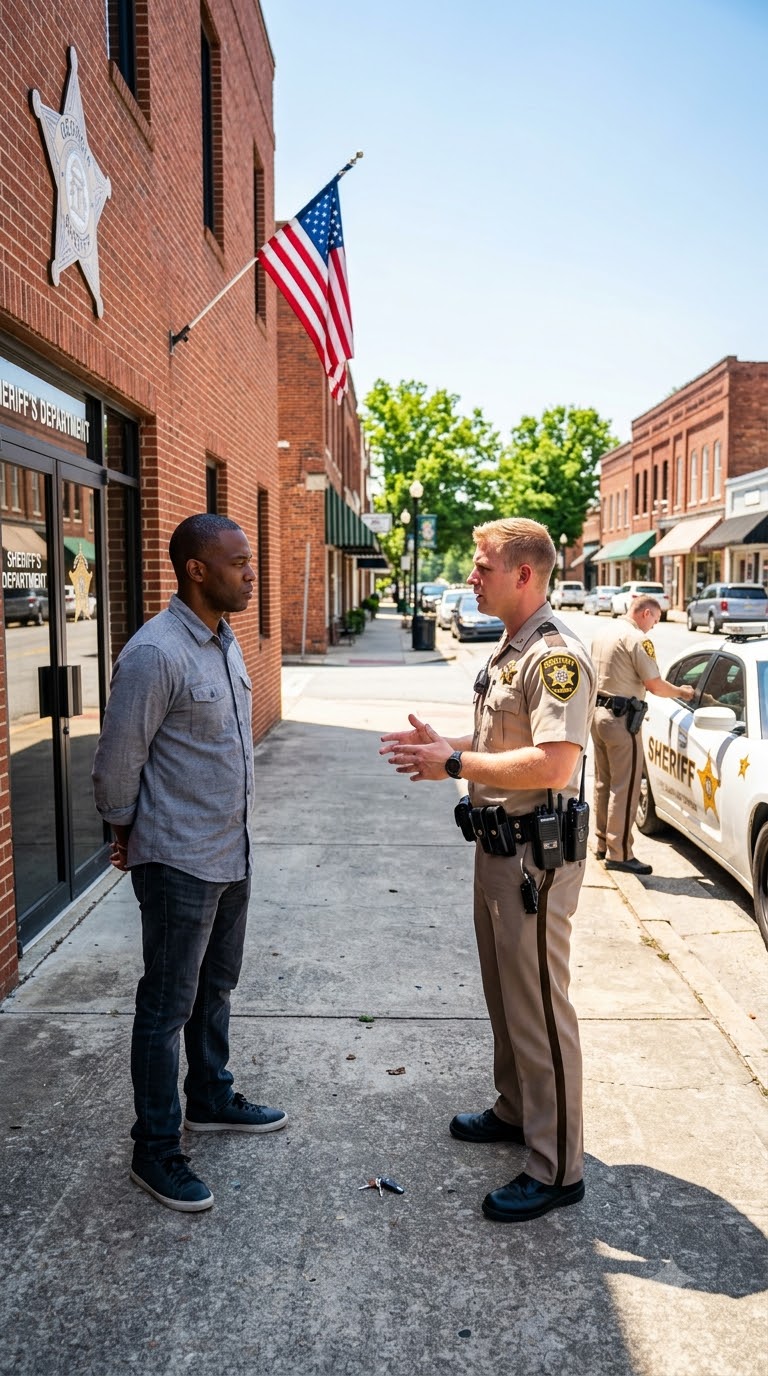
The Dellwood County Sheriff’s Department stood on the opposite corner.
Its brick exterior was plain.
An American flag hung above the entrance.
Two patrol vehicles were parked outside.
On the second floor, several window blinds were angled downward.
They allowed someone inside to watch the street without making it obvious.
Arnold had noticed those blinds during his first day in town.
Now, six days later, he understood their significance.
He wore faded jeans, a gray button-down shirt, and running shoes.
His badge was concealed.
His weapon was not visible.
Nothing about him suggested federal authority.
To anyone passing the diner, he was simply a middle-aged Black man drinking coffee and reading a newspaper.
That was exactly how he wanted to appear.
For six days, Arnold had presented himself as a contractor from Atlanta.
He claimed to be preparing a bid for a county road resurfacing project.
He asked routine questions about gravel, drainage, construction schedules, and county purchasing procedures.
He shook hands.
Smiled politely.
Allowed people to underestimate him.
And while they discussed roadwork, he quietly studied how money moved through the county.
Operation Dellwood Ledger had begun eighteen months earlier.
At the FBI’s Atlanta field office, investigators noticed inconsistencies in financial records connected to the Dellwood County Sheriff’s Department.
At first, the discrepancies seemed unrelated.
A seized vehicle was recorded as transferred but never appeared in the proper county account.
Cash confiscated during a traffic stop disappeared between the evidence log and the financial ledger.
Property forfeiture records showed assets being processed correctly on paper, yet the expected revenue never reached the county.
The individual reports appeared routine.
But the pattern was impossible to ignore.
Many seizures involved Black residents.
Some had never been charged with a crime.
Others had faced accusations that were later dismissed.
Yet their money, vehicles, or other property remained in government custody.
Over six years, the department had seized more than two million dollars in cash and property from Black residents.
Much of it could no longer be accounted for.
Someone had built a system that made theft look like ordinary law enforcement procedure.
Arnold Parsons had been assigned to discover how it worked.
He had already spent months tracing transactions, interviewing witnesses, and reviewing official documents.
The investigation eventually brought him to Dellwood itself.
Now he was close enough to observe the people controlling the operation.
He glanced at his watch.
Thirty-eight minutes remained before his scheduled check-in with Special Agent Patrice Oslo.
Pat had worked with Arnold long enough to know his habits.
He never missed a check-in.
Not when an informant arrived late.
Not when a meeting ran over.
Not even during an assignment in Savannah when he had been violently ill.
A missed call from Arnold was not something Pat would dismiss.
He reached toward the coffee.
Then remembered it was cold.
He set the cup down again.
That was when he noticed two deputies approaching.
Sergeant Kenneth Iverson came around the corner first.
He was broad-shouldered, with a heavy jaw and the confident walk of a man accustomed to giving orders.
Deputy Lance Wilkin followed half a step behind.
Wilkin was younger.
He appeared uneasy.
His posture suggested someone who had learned to obey a senior officer before developing the confidence to question one.
The two men separated near the diner entrance.
One moved toward the left side.
The other remained to the right.
Their movements appeared casual.
But Arnold recognized the positioning immediately.
They were waiting for him.
He stood.
Placed three dollars beside his untouched coffee.
Picked up his belongings.
Then walked through the diner door into the Georgia heat.
Before either deputy could speak, Arnold identified himself.
“My name is Arnold Parsons,” he said. “I am a special agent with the Federal Bureau of Investigation, twenty-four-year veteran out of the Atlanta field office. My partner is Agent Patrice Oslo. I am conducting a federal investigation in this county.”
He produced his badge and federal identification.
“I would like to speak with your senior officer on duty right now.”
Wilkin examined the credentials.
Iverson barely looked.
Arnold noticed.
A deputy unexpectedly confronted with an authentic federal badge would normally examine it carefully.
He would ask questions.
He would verify the information.
Iverson showed no surprise.
No uncertainty.
No interest in confirming the identification.
His eyes moved from the badge to Arnold’s face.
“That ID could be anything,” Iverson said. “You’re going to need to come with us.”
A moment later, the badge struck the sidewalk.
The handcuffs closed.
And Arnold Parsons was escorted across Main Street in full view of the town.
People watched.
Nobody intervened.
Inside the sheriff’s department, cold air replaced the afternoon heat.
The building smelled of burnt coffee and cleaning chemicals.
Iverson led Arnold toward the processing desk.
“Suspicious individual,” he told the desk sergeant. “Possible fake federal credentials. Hold him for verification.”
Arnold spoke clearly.
“I am a federal agent,” Arnold said clearly. “Special Agent Arnold Parsons, FBI, Atlanta field office. My partner is Agent Patrice Oslo. One phone call will confirm everything.”
The desk sergeant began to respond.
Iverson interrupted.
“Give us a minute.”
The desk sergeant fell silent.
Then a side door opened.
Deputy Chief Francis Palmer entered.
He was fifty-eight, with silver hair, a thick waist, and a small American flag pin on his lapel.
His expression was pleasant.
His smile seemed practiced.
“Well, now,” Palmer said. “What’s going on here? Some kind of mix-up?”
Arnold studied him.
After twenty-four years in federal investigations, he recognized a performance when he saw one.
Iverson answered.
“This individual was casing the building,” Iverson said. “Claims to be FBI.”
Palmer arranged his face into an expression of concern.
“Sir, I’m sure we can get this sorted out real quick. If you’ll just cooperate with my deputies, we’ll have you on your way in no time.”
Arnold remained composed.
“I have already cooperated,” Arnold said. “I identified myself, produced my credentials, and requested a senior officer. I would like to make a phone call.”
Palmer lifted one hand reassuringly.
“Of course,” Palmer said, lifting a hand. “Let’s just get you situated first.”
Arnold mentally repeated the word.
Situated.
It was an odd choice.
And he suspected it had been chosen deliberately.
Palmer picked up the desk telephone.
He dialed without consulting a directory or asking anyone for a number.
The call rang once.
He hung up.
Then he shook his head as though disappointed.
“No answer over at the Atlanta office,” Palmer said. “Must be the weekend skeleton crew.”
Arnold did not respond.
He knew how federal offices operated.
He also knew Palmer had not genuinely attempted to verify his identity.
The call had been staged.
Palmer turned toward Iverson.
“Go ahead and put him in holding until we can verify.”
Arnold made another request.
“I want to speak to the sheriff,” Arnold said.
Palmer smiled.
“Sheriff’s not in today.”
Then he added:
“Don’t worry. We’ll get this cleared up.”
Arnold was taken toward the holding cells.
The cell was bare.
A concrete floor.
A metal bench.
A drain in the center.
Arnold sat down.
He rested his forearms on his knees.
Then he closed his eyes.
He breathed in slowly.
And exhaled.
There was no advantage in shouting.
No advantage in threatening the deputies.
No advantage in wasting energy on people who had already decided not to listen.
Instead, he considered what he knew.
Iverson had ignored his credentials.
Palmer had appeared at exactly the right moment.
The deputy chief had pretended to make a verification call.
The arrest had happened directly outside the building Arnold was investigating.
These details did not fit an accidental misunderstanding.
They suggested coordination.
Arnold thought about his scheduled check-in.
Patrice Oslo knew where he was working.
She knew he was monitoring the sheriff’s department.
She knew he never missed a call.
When the check-in failed, she would begin looking.
Arnold settled against the bench.
Then he started counting the minutes.
In Atlanta, Patrice Oslo watched the time pass on her computer.
Arnold’s scheduled call did not arrive.
Three minutes passed.
Then five.
Pat called his cellphone.
Voicemail.
She called again.
Voicemail.
She did not tell herself he was probably busy.
She knew him too well.
Arnold might delay a meal.
He might work through an entire night.
He might forget to replace the coffee sitting beside him.
But he did not forget a scheduled operational check-in.
Pat accessed the authorized tracking system and checked the last available location information.
The final signal was not near the road project.
It was not at Arnold’s motel.
It came from a building at Main Street and Caldwell Avenue.
The Dellwood County Sheriff’s Department.
Pat reached for the telephone.
Her first call went to Arnold’s wife.
Rosalie Parsons answered on the second ring.
She was sixty years old, a retired schoolteacher, and had spent enough years married to an FBI agent to recognize the significance of an unexpected call from his partner.
“Pat,” she said.
Her voice was controlled.
But Pat could hear the tension beneath it.
“Rosalie, I need to ask you something quickly,” Pat said. “Did Arnold mention watching the sheriff’s department directly this week?”
Rosalie paused.
“He said that was where the money was coming from,” Rosalie said. “He said that was where he needed to be watching.”
Pat absorbed the information.
“Thank you.”
Rosalie spoke again.
“Pat.”
Her voice became quieter.
“Find him.”
Pat answered immediately.
“Yes, ma’am,” Pat said. “That is exactly what I’m doing.”
Her next call went to Assistant U.S. Attorney Vanessa Butler.
“Arnold missed his check-in twenty-two minutes ago,” Pat said. “His phone went dark inside the building he’s investigating. I need a federal court order. And I need bodies.”
Vanessa remained silent for three seconds.
Then she answered.
“Give me fifteen minutes.”
She needed only twelve.
Fifty-four minutes after Arnold’s missed check-in, a convoy of federal vehicles pulled up outside the Dellwood County Sheriff’s Department.
Pat stepped out carrying a folder.
Three FBI agents followed.
A U.S. marshal entered the building and positioned himself near the doorway.
Vanessa Butler walked beside Pat with a court order in hand.
The desk sergeant looked up.
He saw the badges.
Counted the agents.
And said nothing.
Francis Palmer appeared from the side hallway.
He wore the same pleasant expression he had used with Arnold.
But the smile lasted only a few seconds.
Pat approached him.
“Deputy Chief Palmer,” Pat said. “I am Special Agent Patrice Oslo, FBI Atlanta Field Office. This is Assistant U.S. Attorney Vanessa Butler.”
She placed the folder on the desk.
Turned it toward him.
“That is a federal court order for the immediate release of Special Agent Arnold Jerome Parsons. I need him in front of me in the next five minutes.”
Palmer examined the document.
Then looked at Pat.
“I can explain what happened here. There was a miscommunication. My deputies encountered an individual they couldn’t verify and followed protocol.”
Pat did not respond to the explanation.
“Where is he?”
Palmer hesitated.
“Holding,” Palmer said. “Cell three.”
Pat’s expression remained unchanged.
“Take me there.”
Three minutes later, Arnold Parsons walked out of the holding cell.
He straightened his shirt.
Rolled his shoulders once.
Pat handed him his badge and identification.
He slipped them into his pocket.
No dramatic embrace.
No angry speech.
Just two experienced federal agents exchanging a brief look.
They understood each other.
As they returned to the main room, Palmer approached again.
“Agent Parsons, I want to personally apologize for any confusion today. My deputies were following procedure, and—”
Arnold stopped.
He looked at Palmer for five full seconds.
His expression revealed nothing.
Then he turned away.
He walked through the front entrance and stepped back into the afternoon sunlight.
He had spent fifty-eight minutes inside the holding cell.
Pat joined him outside.
“How bad was it in there?” she asked.
“Managed,” Arnold said.
They continued toward the federal vehicles.
After several steps, Arnold spoke again.
“That phone call Palmer made,” he said. “The one where he got no answer at the Atlanta office.”
Pat looked toward him.
“What about it?”
“He dialed it from memory. One ring, then hung up.”
Arnold paused.
“Find out whose number that was.”
Pat met his eyes.
“I already started.”
The first decisive piece of evidence was waiting for them.
And it would reveal that Arnold’s arrest had never been an innocent mistake.
Pat spread the available telephone records across the hood of a federal vehicle.
The records showed that a call had been placed to Iverson’s personal cellphone at 1:47 p.m.
Six minutes before Iverson and Wilkin positioned themselves outside Ray’s Diner.
The call had not come through dispatch.
It had not originated from a citizen complaint.
It came from a landline assigned to Deputy Chief Palmer’s private office.
Arnold read the entry.
Then read it again.
The timing was too precise.
Palmer had apparently seen Arnold from the sheriff’s department.
He had called Iverson directly.
And minutes later, the deputies had been waiting outside the diner.
The arrest was not a random stop.
It was a deliberate attempt to interfere with a federal investigation.
Arnold looked at Pat.
“That’s obstruction,” Arnold said.
Pat nodded.
“Federal felony,” Pat answered.
Inside the building, Vanessa was already demanding to speak with Sheriff Louise Underwood.
When Underwood arrived eleven minutes later, Vanessa presented the evidence.
The call record.
The timing.
Palmer’s extension.
Iverson’s personal number.
The arrest.
The refusal to verify Arnold’s credentials.
Underwood listened without interrupting.
By the time Vanessa finished, his face had changed.
He understood the implications.
“Get them in here,” he said. “Both of them.”
Seven minutes later, Palmer and Iverson entered the conference room.
Underwood left them standing.
He explained what federal investigators had uncovered.
Palmer attempted to respond.
“Louise, I can explain.”
Underwood cut him off.
“Badges,” Underwood said. “Both of you. Weapons on the desk.”
Iverson’s hands began shaking.
He struggled to remove his badge.
Palmer moved more slowly.
He seemed determined to preserve his dignity even as his position collapsed around him.
He placed his badge on the desk.
Then looked through the conference-room window.
Outside, Arnold Parsons stood beside the federal vehicles.
His hands rested in his pockets.
He was watching the building.
Palmer looked away first.
Three hours and seven minutes after Arnold had been handcuffed on the sidewalk, Kenneth Iverson and Francis Palmer left the sheriff’s department without their badges, weapons, or jobs.
Their authority had been taken from them.
But the investigation was only beginning to reveal how much damage they had caused.
