

PART 3
Preston’s attempt to reclaim control of my business failed almost as quickly as his marriage.
Within two weeks, his professional reputation had collapsed.
His hedge fund’s board removed him from the partnership, froze his carried interest, and revoked his access to the office.
The investigation into the pediatric medical trust had made him an unacceptable liability.
With his accounts frozen and criminal charges approaching, he rented an aging studio apartment in Brooklyn and survived on what remained of his debit reserves.
His desperation brought him to my company’s headquarters.
Wearing a wrinkled suit, he entered the lobby and demanded to see Margaret, my CFO.
He insisted that his status as my husband entitled him to withdraw one hundred thousand dollars from the corporate accounts.
Margaret had worked beside my father for years.
She understood precisely how much the company meant to me.
She came downstairs, handed Preston a printed copy of his own proposed five-thousand-dollar divorce settlement, and instructed security to remove him.
Two dozen employees witnessed him being escorted outside.
Brittany tried a different approach.
With her apartment at risk and her financial support gone, she organized what she called a charity fundraiser for Hudson’s continuing medical expenses.
She reserved a banquet hall in Queens and advertised an elaborate evening to former friends, relatives, and my business associates.
Tickets cost five hundred dollars each.
She claimed the proceeds would pay for Hudson’s recovery.
But I had already established a restricted medical trust covering his care.
Winston discovered her plans.
On the morning of the event, while Brittany supervised decorations and a large acrylic sign for The Hudson Sterling Miracle Fund, Winston arrived with a representative from the New York State Attorney General’s Charities Bureau.
They presented a cease-and-desist order documenting the fraudulent fundraising operation.
The venue cancelled the event, dismissed the catering company, and retained Brittany’s nonrefundable deposit.
She was left screaming in the parking lot as the rental trucks departed.
News of the failed fundraiser spread quickly.
Her remaining social connections disappeared, and accusations of fraud overwhelmed her social media accounts until she deleted them.
Neither Preston nor Brittany could accept that the financial arrangements they had relied upon were finished.
But my boundaries were no longer negotiable.
Then Winston discovered something neither of us had anticipated.
During the forensic examination of Beatrice’s accounts, his team located a concealed safety deposit box.
Inside was a letter from my father.
Winston called me that night.
“Victoria,” Winston said, breathing heavily. “During the forensic audit of your mother’s accounts… we found something. A hidden safety deposit box. It contains a letter from your father. And Victoria… it changes everything.”
While the investigation continued, I concentrated on healing.
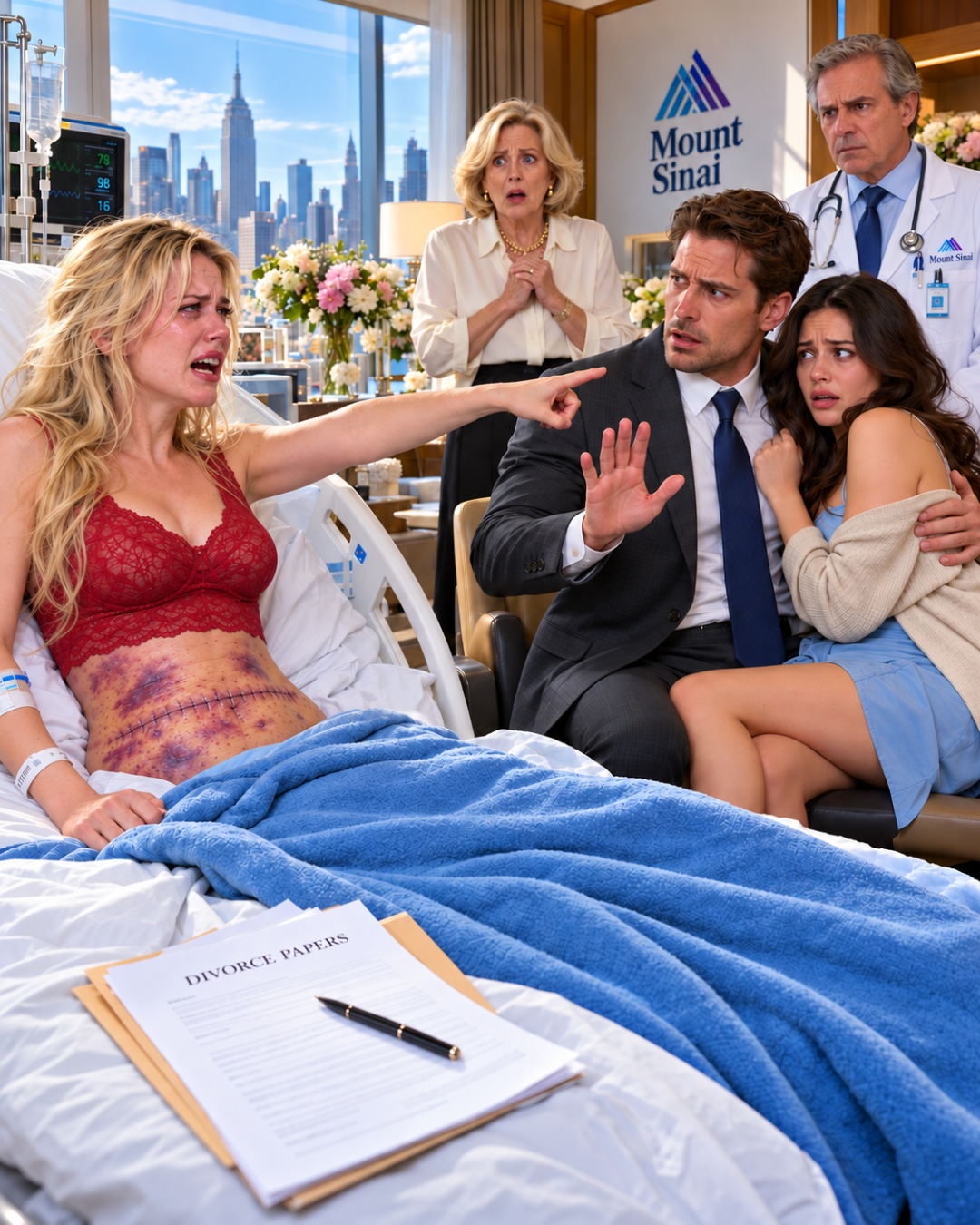
Ten days after surgery, I left Mount Sinai in a private medical vehicle and returned to my estate overlooking the Hudson River.
I had designed the house years earlier.
Its large windows welcomed natural light, while cedar trees and clean mountain air surrounded the property.
There, away from my family’s demands, I finally had time to recover.
Over the following six weeks, my remaining liver tissue regenerated until it restored full functional volume.
The surgical incision gradually changed from an angry red wound into a silver scar.
I knew it would always remind me of what had happened.
But it would also remind me that I had survived.
Hudson remained important to me.
He was innocent of everything his mother had done.
Through a court-appointed trust managed by Winston, I ensured his medications, post-transplant appointments, and private tutoring were fully funded.
The doctors and pharmacy received payments directly.
Brittany had no access to the money.
When I visited Hudson, his jaundice had disappeared and his eyes were bright again.
He hugged me and thanked me for donating my liver.
Then we spent two hours building a detailed Lego model of the Brooklyn Bridge.
For the first time in years, I experienced a family moment without manipulation or demands.
Three months after the operation, Winston visited my estate on a quiet autumn afternoon.
Golden leaves drifted toward the river as we sat on the stone patio drinking tea.
He placed a dark leather binder on the table.
Beside it lay my finalized divorce decree, bearing the seal of the New York State Supreme Court.
Preston had accepted every waiver.
With an active wire-fraud indictment and almost no resources remaining, he could no longer sustain a legal fight.
“You are officially, entirely free, Victoria,” Winston said, his eyes crinkling with quiet satisfaction. “Every asset, patent, and property has been restored to your exclusive ownership. Preston is living in a studio apartment above a bowling alley, and Brittany has moved into a basement rental in New Jersey.”
I examined the decree.
There was no overwhelming desire to celebrate.
Only peace.
“Thank you, Winston,” I murmured, reaching for my mug.
But Winston was not finished.
He pushed an old parchment envelope across the table.
The wax seal carried my father’s initials.
“There is one final matter, Victoria,” Winston said softly, his voice dropping an octave. “The forensic audit we ran on your mother’s accounts during the litigation uncovered an escrow directive that Beatrice kept hidden for over twelve years. It was drafted by your father forty-eight hours before he died.”
My hands trembled as I opened it.
Inside was a handwritten letter.
“My dearest Victoria,
If you are reading this, it means you have finally stopped carrying the weight of people who refuse to stand on their own feet. I watched your mother and sister spend your childhood draining your joy, treating your brilliant, generous mind as their personal safety net. I knew that if I left my true legacy openly, they would consume it—and you along with it.
The maritime logistics firm and the deep-water port patents I built were never meant for them. They were placed in an irrevocable offshore blind trust, conditioned upon a single legal trigger: that you severed all personal and financial entanglements with Beatrice and Brittany, or reached your thirty-second birthday without surrendering your independence.
You are the only true builder in this family. Go build a world that is worthy of you.”
I read the letter again.
My father had understood my family’s behavior long before I was willing to acknowledge it.
He had anticipated how they would exploit me.
And he had protected his greatest financial legacy behind a condition designed to preserve my independence.
Winston explained that the offshore trust contained the maritime business and its accumulated patent revenues.
Its current valuation was eighty-four million dollars.
For several moments, I could not speak.
My father had left me far more than money.
He had left me a way out.
With that inheritance, I made one final financial decision.
I used a portion of the trust to acquire the remaining debts owed by Beatrice and Brittany’s creditors.
I did not need their possessions or their money.
I wanted the liquidation of their false financial empire to proceed without another rescue funded by me.
Their remaining assets were sold to satisfy outstanding obligations.
The consequences they had avoided for years finally belonged to them.
One year after my surgery, I attended the annual American Institute of Architects gala at Lincoln Center.
The hall glittered beneath thousands of crystal lights.
That evening, I became the youngest woman to receive the Pritzker Architecture Prize for my sustainable Manhattan high-rise designs and their innovative systems for absorbing seismic forces.
I wore an emerald-green silk gown with an open back.
The cut revealed a small portion of the silver scar near my right waist.
I had no intention of hiding it.
That scar represented the day I stopped allowing my family to treat my body, my work, and my money as things they owned.
Following the ceremony, a reporter from Architectural Digest approached the microphone.
“Ms. Vance, your designs are famous for their resilience under extreme pressure. You survived a life-threatening, six-figure organ donation and a highly publicized, catastrophic personal divorce in the exact same year, only to emerge as the defining architect of your generation. How did you maintain your structural vision through that level of personal betrayal?”
Camera flashes illuminated the room.
I thought about Preston, stripped of his professional title and expensive lifestyle.
I thought about Brittany and Beatrice, whose Chapter 7 bankruptcy filings had appeared in public notices that morning.
Their assets were being liquidated.
Their years of financial dependence had finally ended.
I felt no hatred.
They were simply people I could no longer afford to carry.
I looked toward the audience and answered.
“I used to believe that family loyalty required you to bleed until you were empty,” I answered, my voice steady, dry, and resonant throughout the hall. “I gave away sixty percent of an internal organ thinking it would finally earn me the love of people who only saw me as an open vein and an open wallet. But biology is not destiny, and sacrifice without self-respect is not nobility—it is just poor engineering. Anything collapses if you keep piling weight onto it without checking the load limits. When you finally cut away the rot in your foundation, you don’t lose your balance. You simply make room to grow back stronger, whole, and entirely untouchable.”
Later that evening, after the celebration ended, I stepped onto the granite terrace overlooking Manhattan.
The city stretched before me, filled with towers, bridges, and structures that reminded me of everything I had worked to build.
My phone chimed.
A notification from Winston’s office confirmed that Beatrice and Brittany’s Chapter 7 bankruptcy filings had been approved.
Liquidation of their remaining personal assets had begun.
The case was closed.
I did not open the attachment.
I had already spent too many years studying the details of their lives.
Instead, I dismissed the notification and breathed in the cool evening air.
For thirty-one years, I had believed my purpose was to hold everyone else upright.
Now I understood that even the strongest foundation needs limits.
My body was healing.
My company was secure.
My father’s legacy was protected.
And for the first time, my future belonged entirely to me.
