

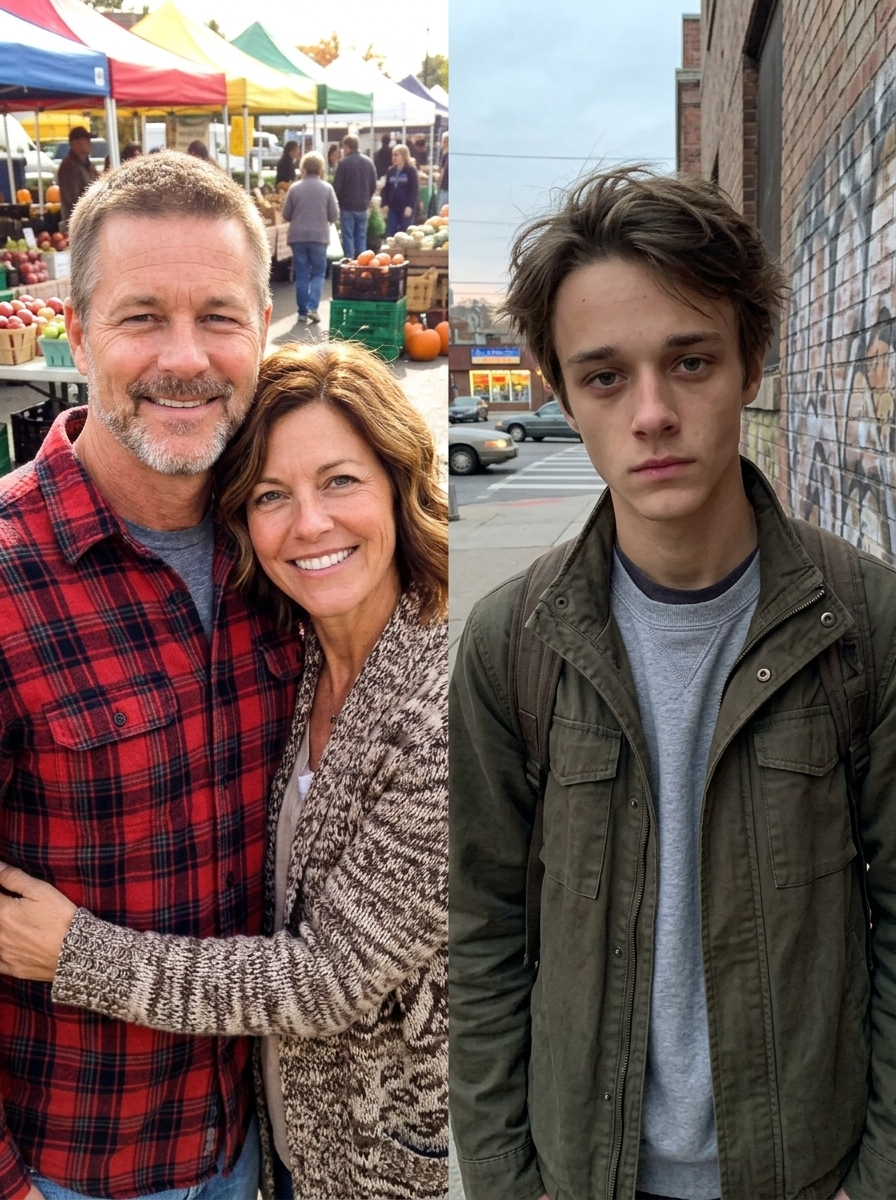
PART 1: THE BOY AT THE GAS STATION
I never expected that a brief warning from a homeless teenager would reveal the reality behind my twenty-two-year marriage.
He gave my phone back, looked anxiously around the gas station, and whispered, “Your husband has been paying me to follow you.”
At first, I laughed.
Then he revealed how long it had been going on.
My name is Rachel. Until that Tuesday evening, I thought my life was secure.
Our two children were off at college. My husband, David, was a respected doctor. Friends called our marriage unbreakable.
I also owned a lake cabin my father had left me. A developer had recently made a huge offer for it, but I turned it down. The cabin held memories far more important than any payment.
Still, a few recent things had troubled me.
David had put a new lock on his home office while I was at work. I had also discovered a business card in his coat from an attorney who specialized in guardianship and estate law.
David said it was about an elderly patient.
I trusted him.
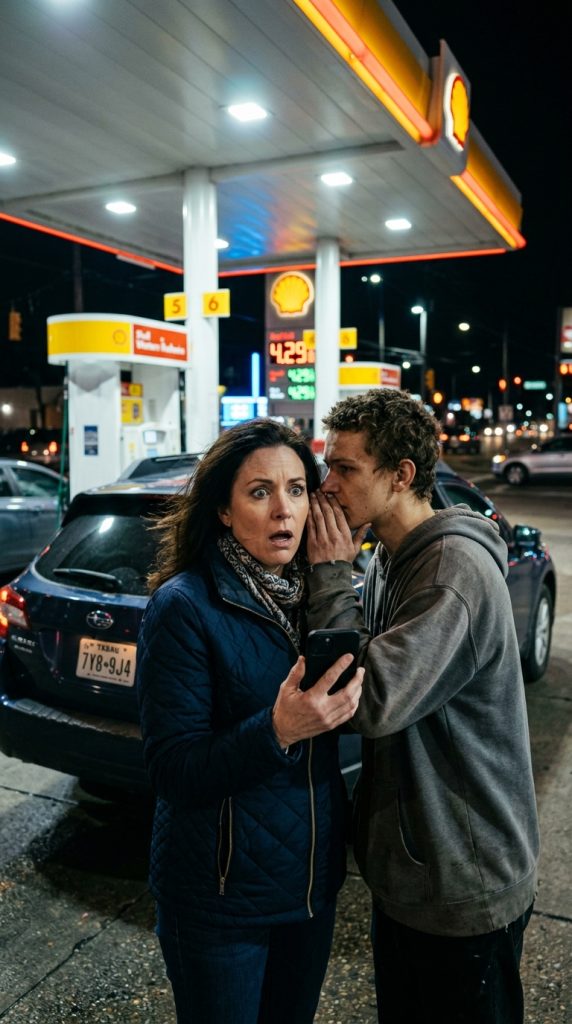
That evening, I pulled into my regular gas station. As the tank filled, I spotted a thin teenage boy sitting by the ice machine with a worn backpack between his knees.
He came over cautiously.
“Ma’am, could I borrow your phone? I need to call my aunt.”
I thought of my own son and gave it to him.
When the boy handed the phone back, he thanked me and said his aunt was on the way.
Then he glanced toward the parking lot entrance and moved closer.
“Please don’t get into your car yet.”
His voice was so serious that I froze.
“My husband is paying you to watch me?” I repeated after he told me.
The boy nodded.
His name was Marcus.
He explained that David had approached him at a church meal program nearly two months earlier. David claimed his wife had memory issues and sometimes wandered around town without knowing where she was.
He offered Marcus three hundred dollars a week to report where I went, who I spoke to, and whether I drove toward the lake.
At first, the requests seemed like worry.
Then they shifted.
David started asking whether I met other men, bought alcohol, or looked confused.
“Have you ever seen me confused?” I asked.
“No,” Marcus replied. “I kept telling him you seemed normal. He got angry and told me to look harder.”
Marcus said David reminded him of his own father, who had always described his mother as unstable until others started believing it.
“She wasn’t broken,” Marcus said. “He just needed everyone to think she was.”
He gave me the payment details and the number David used.
I asked Marcus to keep sending normal reports so David would not suspect we had talked. Then I set up a meeting for him with my attorney.
I drove home without challenging my husband.
During dinner, David casually asked if I had thought again about selling the cabin.
“I’m not selling it,” I said.
He watched me for a moment.
“You seem unusually quiet.”
“I’m tired.”
The next morning, after David left for the hospital, I checked our bank statements.
Every Friday, he had withdrawn three or four hundred dollars in cash.
The payments were small enough to escape notice but steady enough to be regular pay.
Then I opened his office with a spare key I found in the kitchen drawer.
Inside his desk, I found a notebook full of reports about me.
Some entries described places I had really been.
Others were total fabrications.
One said I had bought two bottles of wine and looked unsteady outside the store.
I had gone straight home that day.
Marcus had refused to supply the evidence David wanted, so David had started making it up himself.
The folder also held photos of me at stores, pharmacies, and traffic lights.
Then I discovered a draft petition seeking legal guardianship over me due to “diminished mental capacity.”
Behind it was an appraisal of my lake cabin and a revised offer from the developer.
An email from the attorney explained that once David became my guardian, he could seek court approval to sell property held only in my name.
That was the true plan.
David was trying to create proof that I could no longer handle my own affairs so he could take control and sell my inheritance.
I photographed every document and left the office exactly as I had found it.
Then I called my friend Karen.
“I need you to be my attorney today, not my friend.”
After hearing everything, she gave me one instruction.
“Do not confront him. He has spent months preparing this. We are going to be smarter for one more week.”
PART 2: THE PERFECT PUBLIC SCENE
I met Marcus at a roadside diner two days later.
David had contacted him again and offered extra money for photos showing me confused or drinking in public.
“When?” I asked.
“Saturday. He said he would send the address.”
That evening, David poured himself a drink and said he had made a dinner reservation for us on Saturday.
It was a restaurant near the lake cabin.
Everything fell into place.
He planned to put me in public, push me to drink, and have Marcus take pictures. The restaurant was close enough to the cabin to support a story that I had driven there while confused.
I smiled.
“That sounds perfect.”
After David went upstairs, I sent Karen one word:
Saturday.
By the time the evening arrived, we had prepared everything carefully.
Marcus had given Karen a sworn statement. His payment records showed transfers linked to David. The guardianship petition had already been filed with the court, meaning Karen could legally obtain copies without using anything I found in his office.
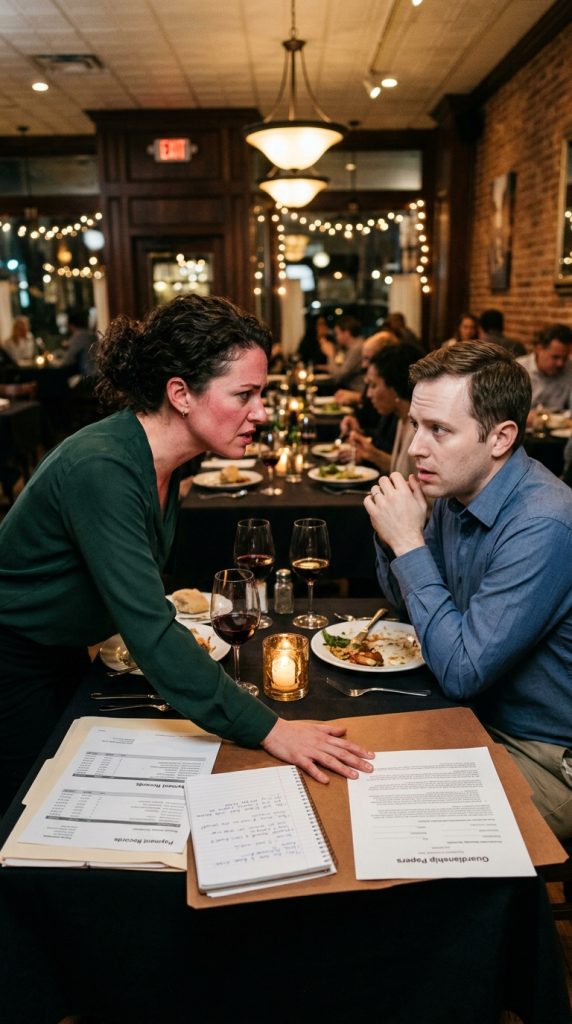
At the restaurant, David acted like the devoted husband he wanted everyone to see.
He pulled out my chair and ordered wine for me without asking.
I never touched it.
“You’ve seemed tired lately,” he said. “I’m worried about you.”
“I’ve been worried too.”
Then I slid a folder across the table.
David opened it.
The color disappeared from his face.
Inside were copies of his fabricated notes, Marcus’s payment records, the guardianship documents, and the correspondence concerning the cabin.
“I know about Marcus,” I said quietly. “I know you’re trying to have me declared incapable so you can control and sell my property.”
David quickly regained his composure.
“Rachel, you’re misunderstanding what you found.”
“Am I forgetting things again?”
His voice hardened.
“You entered my office. Anything you took is inadmissible.”
“I didn’t need anything from your desk. Marcus gave a formal statement. The payment records came from his account, and the guardianship papers were filed with the court.”
For the first time, David had no prepared answer.
“Karen has secured the evidence,” I continued. “Our children will hear the truth from me tonight—not from you.”
Then I placed divorce papers on top of the folder.
“You don’t have to sign them here,” I said. “But this marriage is over.”
David stared at me.
I left enough cash to cover my half of the dinner, stood, and walked away.
He had planned to turn that restaurant into proof that I was unstable.
Instead, it became the place where his entire scheme collapsed.
But David was not ready to give up.
Before I reached my car, he called our children and claimed I had suffered a serious emotional episode. He said I had become paranoid, accused him of stealing, and abandoned him in the middle of dinner.
Fortunately, I had already sent Emma and Ben a message asking them not to react until they saw my evidence.
Karen also filed an emergency response opposing the guardianship petition and requested an independent medical evaluation.
The next morning, I completed a full neurological and psychological assessment.
The results showed no cognitive decline.
Meanwhile, Marcus agreed to explain everything to investigators.
David had not hired him because he believed I was ill.
He had repeatedly instructed Marcus to create reports supporting that conclusion, even when Marcus insisted I behaved normally.
The financial motive was equally clear.
The developer’s new offer for the cabin was substantially higher than the amount David had mentioned to me. The emails suggested he expected to receive a private consulting payment after arranging the sale.
He was not only trying to steal control of my property.
He intended to profit personally while convincing our children and friends that he was protecting me.

PART 3: THE LIFE HE COULD NO LONGER CONTROL
Once the guardianship case reached court, David’s polished image began to crack.
His attorney argued that he had acted out of concern. They presented the false notebook entries, photographs, and statements about my supposed confusion.
Then Karen called Marcus.
He explained how David had recruited him, paid him, and pressured him to provide dishonest observations.
“I told him she seemed fine,” Marcus testified. “He told me to find something wrong.”
The payment records supported every word.
My independent medical evaluation confirmed that I was fully capable of managing my health, finances, and property.
Karen then showed the court David’s communications with the developer and guardianship attorney.
The judge dismissed the petition and referred the matter for investigation.
David later claimed he had only wanted to protect our future.
But protecting our future would not have required inventing an illness, following me, or secretly negotiating the sale of property he did not own.
Our children were devastated.
Emma initially struggled to believe that her father could have planned something so calculated.
Ben remained silent for several days before asking David one question:
“If Mom was really sick, why did you need someone to lie about her?”
David had no answer.
The divorce was finalized months later.
The cabin remained mine.
David received no control over it and no share of the private inheritance my father had left me.
His medical employer also opened an internal inquiry after learning that he had used his professional status to support false claims about my mental health.
Marcus entered a housing and employment program with help from Karen’s office. I made sure he received a phone and reliable transportation, but I never treated him as though he owed me anything.
He had already given me more than money could repay.
He had told me the truth when everyone else involved expected him to stay silent.
One afternoon, I returned to the lake cabin alone.
For months, David had treated it like an asset waiting to be converted into cash.
But as I stood on the dock and watched the light move across the water, I remembered why my father had left it to me.
It was never merely property.
It was proof that I had a life separate from my marriage.
A life David had tried to place under his control.
I replaced the locks, repaired the porch, and turned his planned office into a reading room.
Above the desk, I framed a small handwritten note Marcus had given me after the hearing.
It read:
You weren’t confused. He just needed you to believe you were.
My marriage ended because of five whispered seconds at a gas station.
But the truth was that David had been dismantling it long before Marcus spoke.
The whisper did not destroy my life.
It gave it back to me.
